Evidence You Can See: The Wisdom Books and the Prophets
Real places you can visit and real objects you can see in museums, connected to Job, Psalms, Proverbs and the other wisdom books, and to the prophets from Isaiah to Malachi, including Daniel, with the traditional tombs of the prophets. Each one is marked honestly, so you can tell solid evidence from tradition and from claims that are still argued over.
ConfirmedThe place or object is real and is clearly the one the Bible names. For a written object, such as an inscription or a scroll, it means the object is genuine and its words are read with confidence, not that every event it mentions is proven.9
Traditional siteA real place that long tradition links to the Bible, but the exact spot cannot be proven.6
DisputedInformed people disagree, or the claim rests on weak evidence.3
BackgroundShows the world the Bible describes, but does not name a Bible person or event.2
Job, Psalms and the Wisdom Books
1
The Great Psalms Scroll from Qumran Cave 11 (11Q5)
Psalm 145:13 · 1 Samuel 16:11
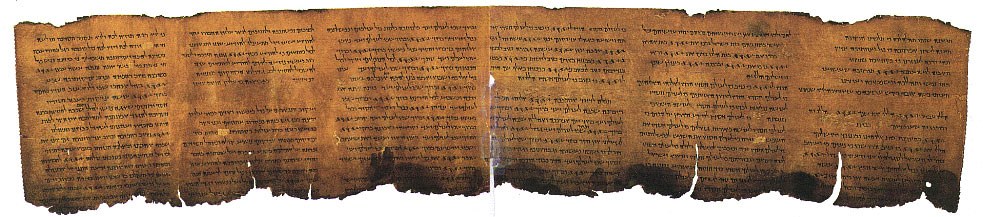
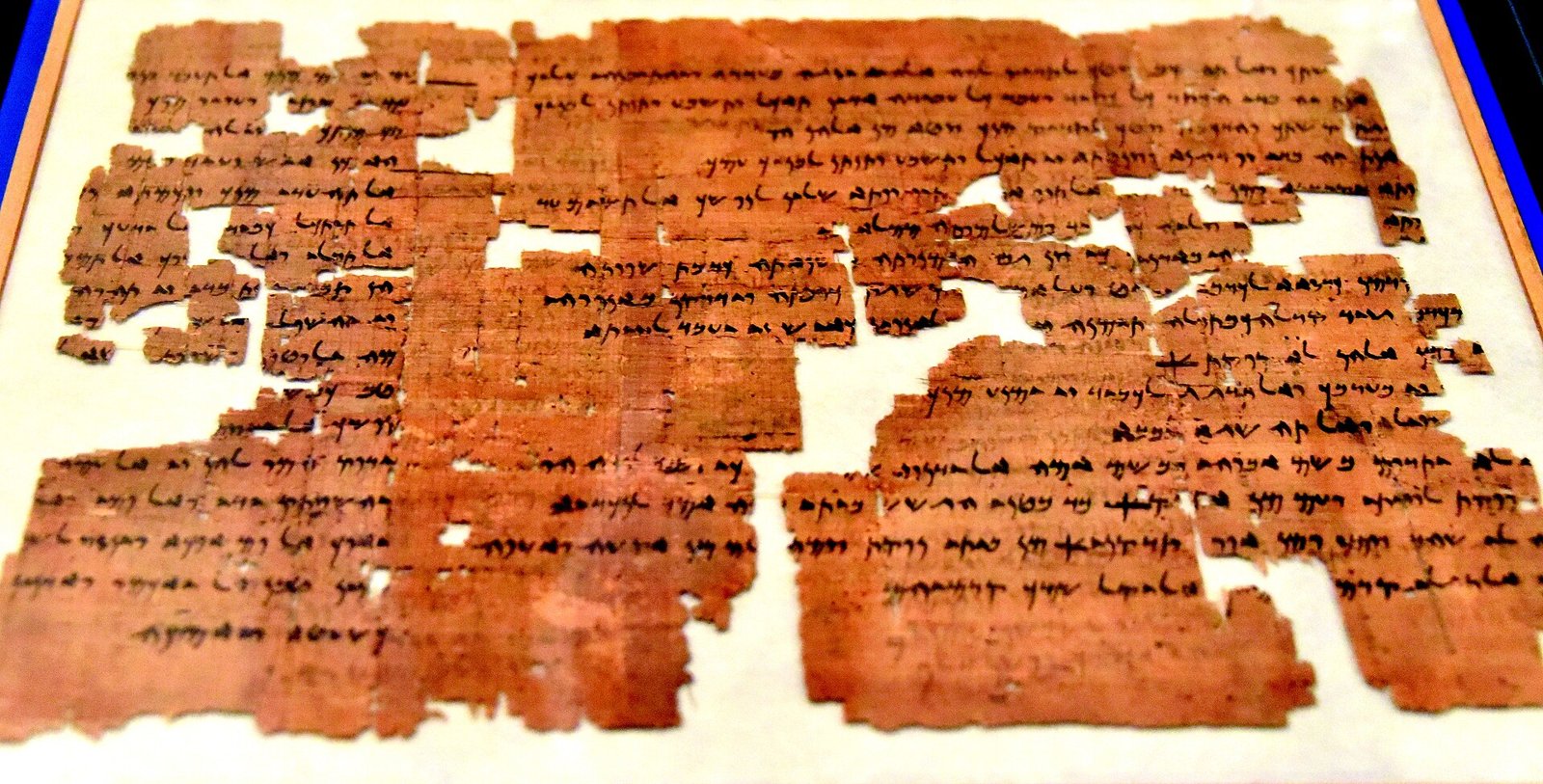
ConfirmedPart of the Great Psalms Scroll from Qumran Cave 11. Israel Antiquities Authority photograph (1993), via the Library of Congress and Wikimedia Commons, Public domain.
Thy kingdom is an everlasting kingdom, and thy dominion endureth throughout all generations.
Psalm 145:13, KJV
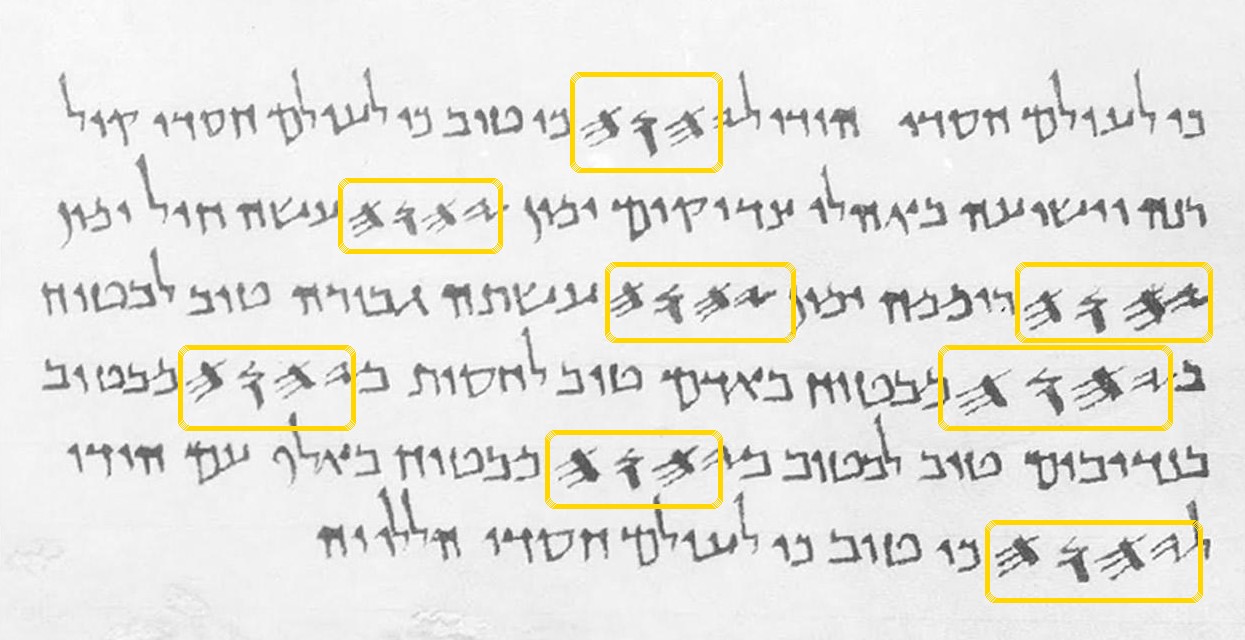
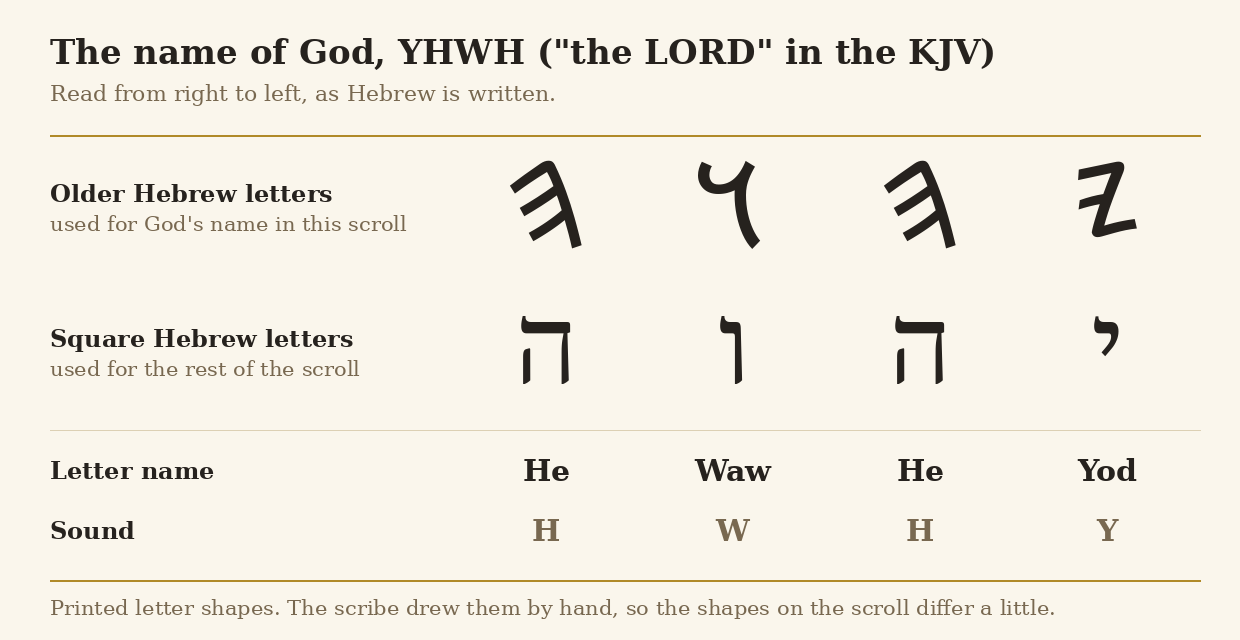
The Great Psalms Scroll is the largest and best-kept copy of the Psalms found among the Dead Sea Scrolls. It was found in 1956 in Cave 11 near Qumran and unrolled in 1961. It holds parts of about 41 psalms from the Bible, mostly from Psalms 101 to 150, often in a different order from our Bibles, along with several pieces that are not in the Bible: Psalm 151, other prayers, and a short note saying David wrote 3,600 psalms and 450 songs. The scribe wrote the name of God, the four letters YHWH (shown as "the LORD" in the KJV), in the older Hebrew letters that were used before the exile to Babylon, while the rest of the scroll is in the square Hebrew letters still used today. The close-up below shows the name on the scroll itself, and the chart shows the four letters in both alphabets.
Close-up of the Great Psalms Scroll, Psalm 118. The yellow boxes, added for this page, mark the 8 places where God's name YHWH is written in the older Hebrew letters; everything else is in square letters. Image by KetefHinnomFan, via Wikimedia Commons, CC0.The four letters of God's name, YHWH, in the older Hebrew letters used in this scroll and in the square letters used for the rest of it, with each letter's name and sound. Chart made for this page, free to reuse.
Hear it said
YahwehVealhurl, Lingua Libre, via Wikimedia Commons, CC BY-SA 4.0
JehovahVealhurl, Lingua Libre, via Wikimedia Commons, CC BY-SA 4.0
Two common ways of saying the name in English today, read by one English speaker. Yahweh is how most scholars think the name was first said; Jehovah is the form the KJV uses. Jewish readers say Adonai ("my Lord") instead. No one knows the original sound for certain.
Where it is today
Jerusalem, in the Dead Sea Scrolls collection of the Israel Antiquities Authority (catalogue number 11Q5, also called 11QPsalms-a). It is not always on display. Six of its columns were shown at the Library of Congress in Washington in 1993.
Date
Copied about AD 30 to 50, judging by the handwriting, so in the first half of the 1st century AD.
Why this label: The scroll is a real, well-studied ancient manuscript, and most of it is clearly the Bible's psalms. What is debated is not the scroll itself but what kind of book it was meant to be.
Good to know
Why the older letters: The ancient Israelites treated God's name with great respect (Exodus 20:7). Some Qumran scribes set the name apart on the page by writing it in the older letters, or by putting four dots in its place. Emanuel Tov, who led the international team that published most of the scrolls, found these habits mainly in scrolls that follow the particular writing style of the Qumran scribes, and not in the other scrolls found in the Judean Desert. The scroll does not say why the scribe did it. Scholars see it as a mark of respect: a way to avoid writing the holy name in the ordinary way. A Greek copy of the Minor Prophets found at Nahal Hever does the same: its text is in Greek, but God's name is written in the older Hebrew letters.
How it is said: Hebrew was first written with consonants only, so the Bible text did not show the vowels of the name. Out of deep respect, Jewish readers came to say Adonai, meaning "my Lord", in its place, which is why the KJV prints "the LORD" in capital letters. Later copyists wrote the vowels of Adonai under the four letters as a reminder, and joining those vowels to the letters gave the form "Jehovah". Christian writers used it from the Middle Ages, and it came into wide use in the 1500s. The KJV uses Jehovah on its own in four verses (Exodus 6:3, Psalm 83:18, Isaiah 12:2 and Isaiah 26:4), and as part of three names given to a place or an altar: Jehovah-jireh (Genesis 22:14), Jehovah-nissi (Exodus 17:15) and Jehovah-shalom (Judges 6:24). Most scholars think the name was first said something like "Yahweh", from the short form "JAH" (Psalm 68:4), names ending in -iah, and the form "Iabe" written down by early church writers. Epiphanius gives it as a name of God, and Theodoret says it was how the Samaritans said the name. The original sound is not known for certain.
Bible or prayer book: James Sanders, who first published it, saw it as a true book of Psalms from a time when the last part of the book was not yet fixed in its final order. Others, such as Patrick Skehan and Moshe Goshen-Gottstein, saw it as a collection for worship, drawn from a book of 150 psalms that was already settled. Peter Flint linked its layout to the 52 weeks of the solar calendar used at Qumran. The scroll does not settle the question by itself.
An added line: Each verse of Psalm 145 begins with the next letter of the Hebrew alphabet, but the Hebrew text behind the KJV has no verse for the letter nun, between verses 13 and 14. The scroll has such a line, saying God is faithful in his words, and so does the old Greek translation. Some modern Bibles add it. Others think it was added later to fill the gap, and the scroll also adds a refrain after every verse of this psalm, so it is not a simple copy.
The extra psalm: Psalm 151, in which David speaks of being the youngest son and a shepherd (compare 1 Samuel 16:11), was known before only in Greek and other old translations. The scroll gave a longer Hebrew form. It is not in the KJV and is not counted as Scripture by Protestants or by most Jews.
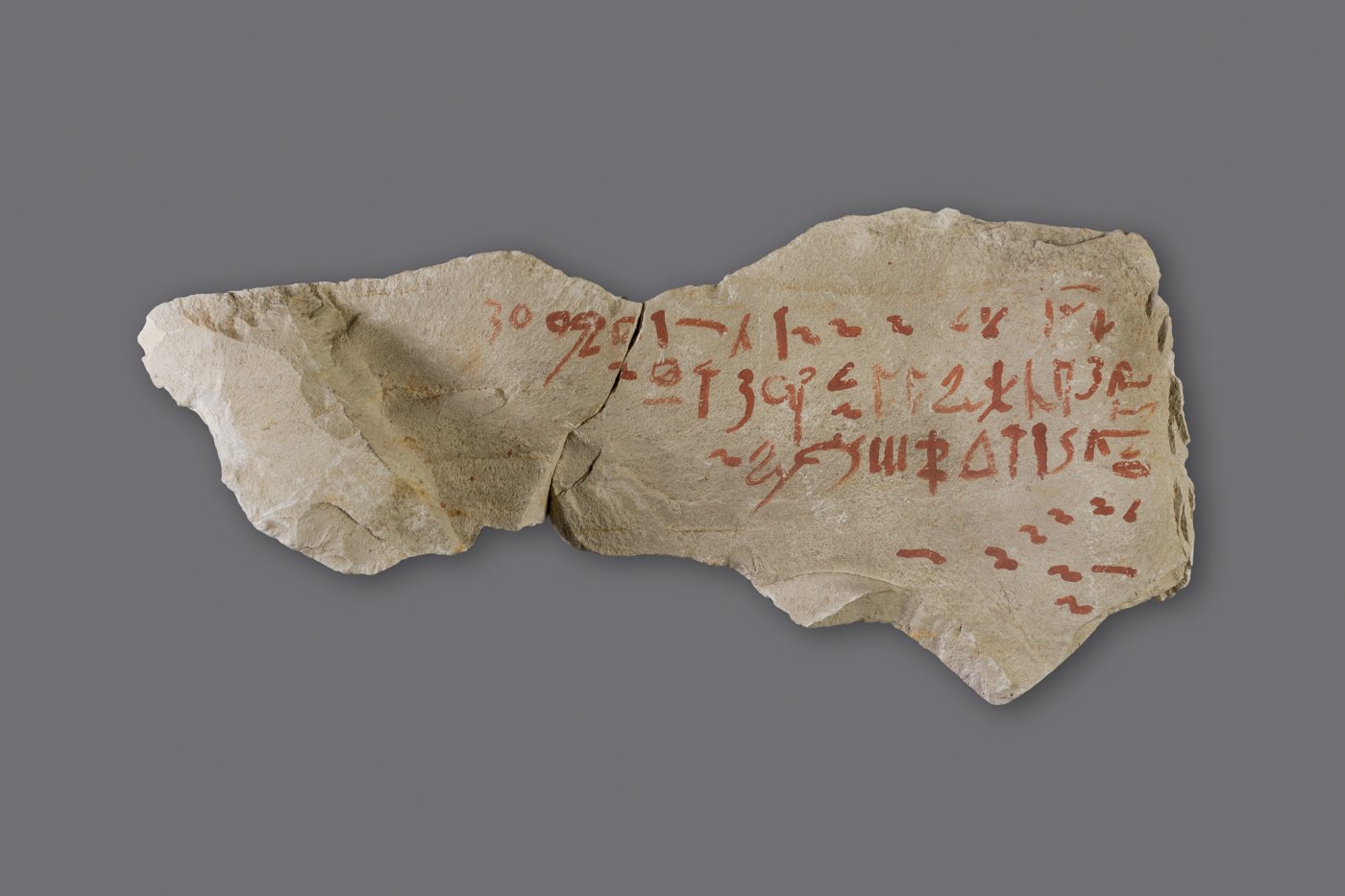
BackgroundA flake of limestone (ostracon) with the opening lines of the Instruction of Amenemope in red ink, written in hieratic, a quick handwritten form of Egyptian writing, about 525 to 404 BC. The Metropolitan Museum of Art, Rogers Fund, 1926 (26.3.165), Public Domain (The Met Open Access).
Bow down thine ear, and hear the words of the wise, and apply thine heart unto my knowledge.
Proverbs 22:17, KJV
The Instruction of Amenemope is an Egyptian book of advice in 30 numbered chapters, written as the teaching of a scribe named Amenemope to his son. Its best copy is a papyrus scroll about 3.7 metres long, bought at Thebes in 1888 and fully published in 1923. Scholars soon saw that many of its sayings are very close to Proverbs 22:17 to 24:22, the part of Proverbs that calls itself "the words of the wise". For example, both say to listen and keep the words in your heart, both warn against robbing the poor and moving a boundary stone, and both say riches make themselves wings and fly away (Proverbs says like an eagle, Amenemope says like geese).
Where it is today
British Museum, London (EA 10474; registration number 1888,0515.3). Check before a visit whether it is on display. Smaller copies exist elsewhere, including a flake of limestone with the opening lines at The Metropolitan Museum of Art, New York (26.3.165).
Date
Written most likely in the time of Egypt's Ramesses kings (the Ramesside period), about 1300 to 1075 BC. The oldest known copy, on a flake of stone or pottery in Cairo, dates to about 1000 to 900 BC. The British Museum papyrus was copied much later, about 600 to 500 BC.
Why this label: Amenemope is a real Egyptian text that shows the kind of wisdom writing known in the world of Solomon. It names no Bible person, and how exactly it is related to Proverbs is still argued.
Good to know
Mainstream view: Since Adolf Erman in 1924, most scholars think the writer of Proverbs 22:17 to 23:11 knew Amenemope and reworked some of its sayings. A main reason is the dating, since Amenemope was most likely written before 1075 BC, and a copy survives from about 1000 to 900 BC.
Common source view: A few scholars think both books drew on an older collection of sayings that is now lost.
Hebrew first view: A small minority argued that Amenemope borrowed from Hebrew wisdom. This was easier to hold when scholars dated Amenemope much later, to around 500 BC, before the older copies were dated.
Cautious view: John Ruffle and, later, Norman Whybray argued that the likeness has been overstated, since many of the shared ideas are found in wise sayings around the world and the order of topics differs. Others, such as John Emerton and Nili Shupak, answered Whybray and still hold the majority view.
Thirty sayings: In Proverbs 22:20 the Hebrew word is unclear. The KJV reads "Have not I written to thee excellent things in counsels and knowledge," and the NASB also has "excellent things". Many modern Bibles read "thirty sayings" instead, partly because Amenemope has 30 chapters, so that reading leans in part on the Egyptian text.
Words of the wise: Proverbs itself calls this section "the words of the wise" (22:17) and adds "These things also belong to the wise" (24:23), and it gives the purpose: "That thy trust may be in the LORD" (22:19).
The Words of Ahiqar: an Aramaic wisdom papyrus from Elephantine
Proverbs 23:13-14
BackgroundPart of the Aramaic papyrus of the Words of Ahiqar from Elephantine, in the Neues Museum, Berlin. Osama Shukir Muhammed Amin, via Wikimedia Commons, CC BY-SA 4.0.
Withhold not correction from the child: for if thou beatest him with the rod, he shall not die.
Proverbs 23:13, KJV
The Story and Words of Ahiqar tell of a wise adviser to the Assyrian kings Sennacherib and Esarhaddon who is betrayed by his adopted nephew, followed by a long set of wise sayings. The oldest copy is an Aramaic papyrus found in 1907 at Elephantine, an island in the Nile where a Jewish military community lived (its letters are covered on the Ezra, Nehemiah and Esther page). Some of the sayings are close to Proverbs. For example, Ahiqar says, "If I strike you, my son, you will not die," much like Proverbs 23:13.
Where it is today
Egyptian Museum and Papyrus Collection, Berlin, shown in the Neues Museum (P. 13446). One column was returned to Egypt and is in the Egyptian Museum, Cairo.
Date
The Elephantine copy is from the 400s BC (5th century BC). The text was probably first written in Aramaic in Mesopotamia in the late 600s or early 500s BC.
Why this label: The papyrus is real and shows the kind of wise sayings that were read in the Bible's world, even by a Jewish community. It names no Bible person or event, and the likeness to Proverbs is in ideas, not proof that one copied the other.
Good to know
Real person: A cuneiform tablet (wedge-shaped writing pressed into clay) from Uruk in Iraq, copied in the 100s BC, names a sage called Ahuqar under King Esarhaddon, but whether the story is based on a real man is uncertain.
The Apocrypha: The book of Tobit makes Ahiqar the nephew of Tobit at Nineveh. Tobit is in the Apocrypha and is not part of the Protestant Old Testament.
Why it matters: Like Amenemope, it shows that Proverbs belongs to a wider world of wise sayings, while Proverbs bases its wisdom on the fear of the LORD (Proverbs 1:7).
The Aramaic translation of Job from Qumran Cave 11 (11Q10)
Job 1:1 · Lamentations 4:21 · Acts 22:3
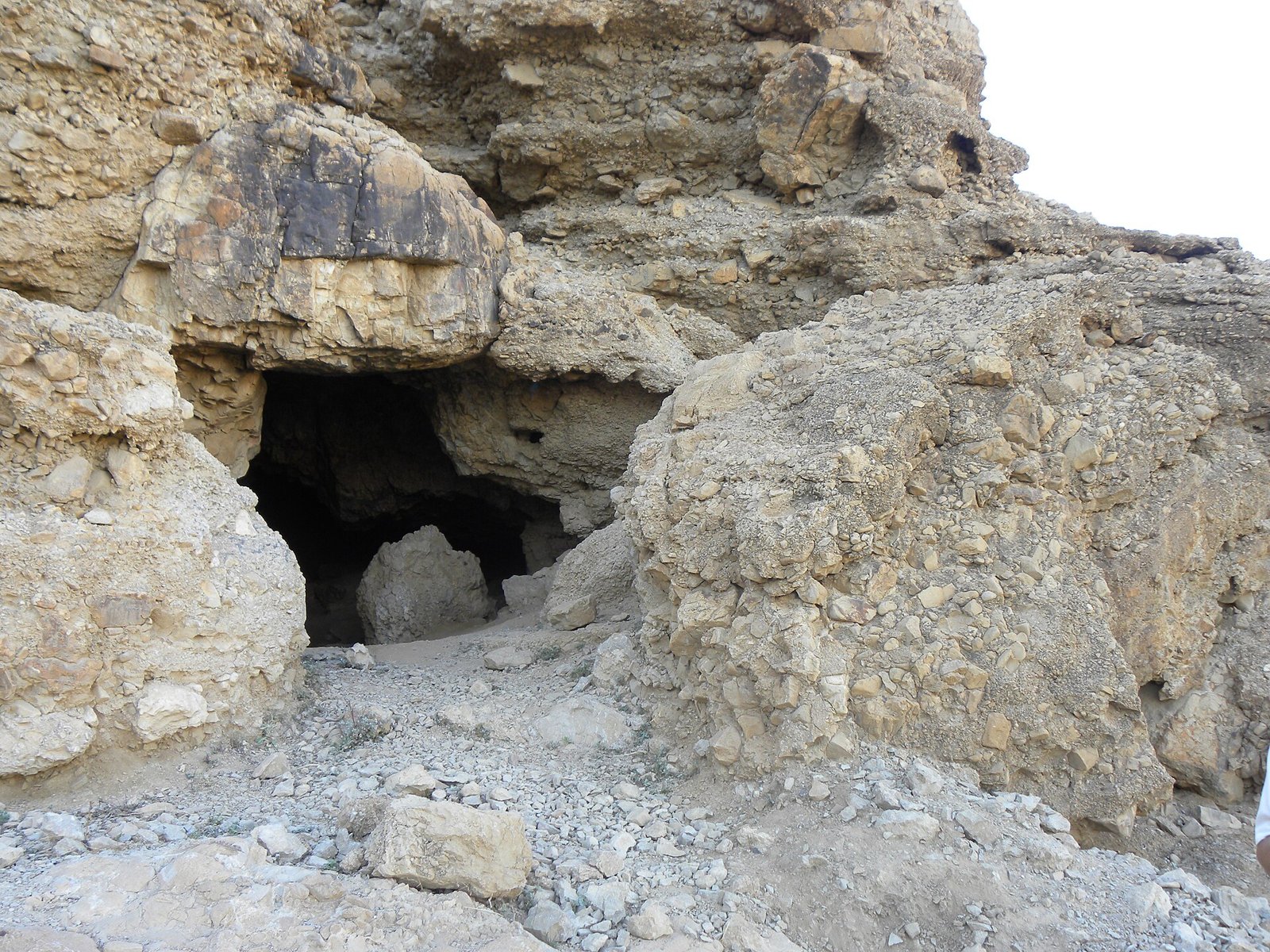
ConfirmedThe entrance to Qumran Cave 11, where the Aramaic copy of Job was found. Ian Scott, via Wikimedia Commons, CC BY-SA 2.0.
There was a man in the land of Uz, whose name was Job; and that man was perfect and upright, and one that feared God, and eschewed evil.
Job 1:1, KJV
Among the scrolls from Cave 11 near Qumran is a translation of the book of Job into Aramaic, the everyday language of many Jews at the time. Scholars call it 11QtgJob, from the word targum, which means translation. Parts of 32 columns survive, with text from Job 17:14 to Job 42:12, about 15 percent of the book. It mostly follows closely the Hebrew text that the KJV was translated from, while making hard passages clearer and softening some lines about God that could be misunderstood. Along with a small, older Aramaic piece of Leviticus and two small pieces of another Aramaic Job from Cave 4, it is among the oldest written Aramaic translations of Bible books known.
Where it is today
Jerusalem, in the Dead Sea Scrolls collection (catalogue number 11Q10).
Date
The copy was made about the middle of the 1st century AD. From its language, some scholars think the translation itself was made earlier, perhaps between 250 and 150 BC.
Why this label: It is a real ancient scroll and clearly a translation of the book of Job, so it shows that Job was read and translated before AD 70. It tells us nothing new about when Job lived or who wrote the book.
Good to know
Gamaliel story: Later Jewish writings (the Tosefta and the Talmud, Shabbat 115a) say that Gamaliel, the teacher of Paul (Acts 22:3), was shown a translation of Job on the Temple Mount and ordered it buried. This suggests written Aramaic translations of Job existed in his day, but there is no way to know if it was this same translation.
Is it a targum: David Shepherd argued that it does not fit well with the later Aramaic translations used by the rabbis. The later rabbinic Targum of Job is also a different work.
The land of Uz: Job 1:1 places Job in Uz. Lamentations 4:21 links Uz with Edom, while Genesis 10:23 names Uz as a son of Aram, so where Uz lay is still debated. No site or object has been tied to Job himself.
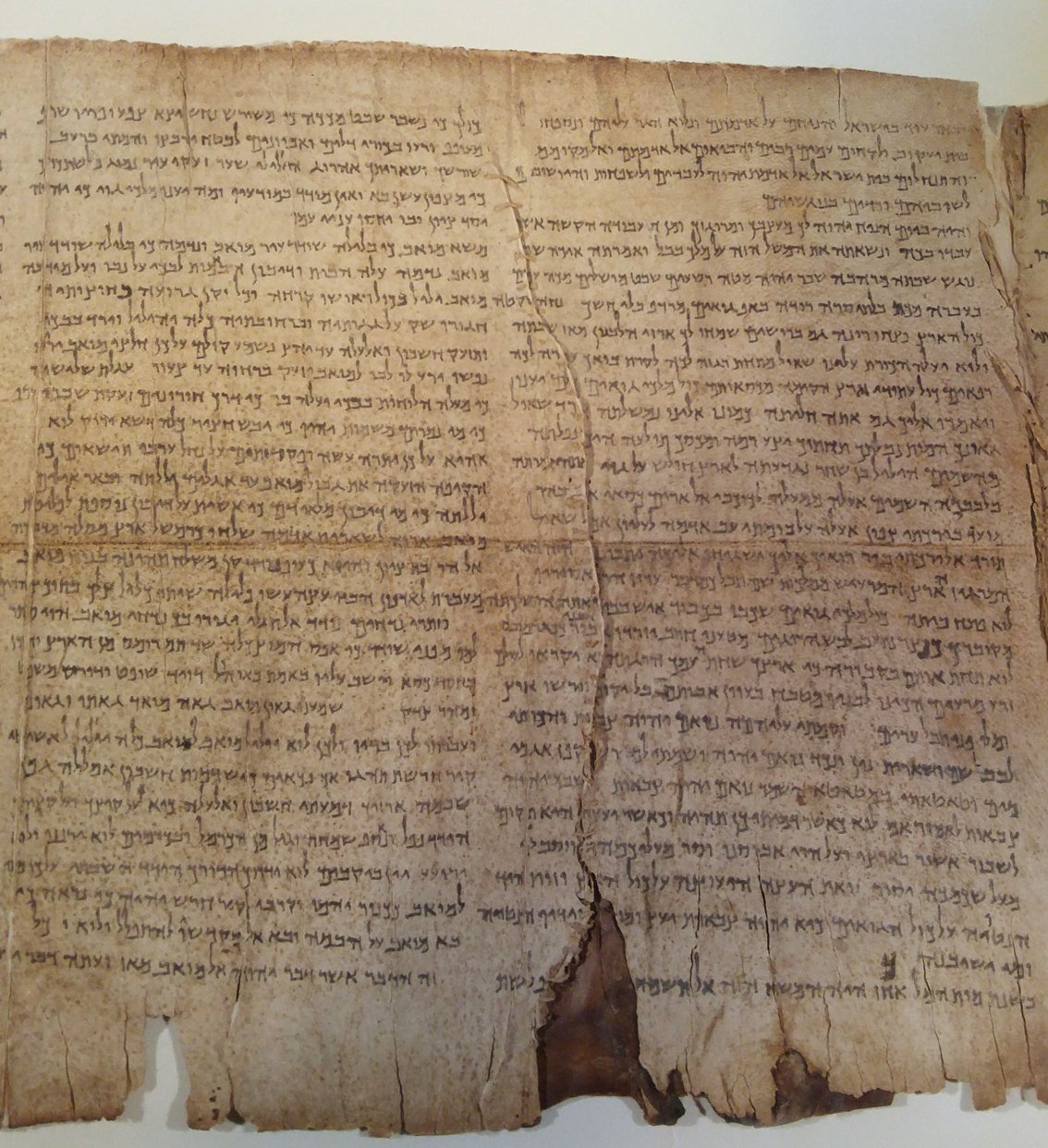
ConfirmedA full-size copy (facsimile) of the Great Isaiah Scroll: columns 12 and 13, with Isaiah 14 to 16, showing wear and damage. Wikimedia Commons user Jb344tul, CC0.
The grass withereth, the flower fadeth: but the word of our God shall stand for ever.
Isaiah 40:8, KJV
The Great Isaiah Scroll is a leather scroll about 7.34 metres long that holds the whole Book of Isaiah in Hebrew, in 54 columns. Bedouin shepherds found it in Cave 1 at Qumran, near the Dead Sea, in 1947. It is the best-kept of the Bible scrolls from Qumran and the only one that is almost complete. It is about 1,000 years older than the oldest Hebrew copies of Isaiah known before 1947. Its text agrees in general with the later Masoretic text, the Hebrew text behind the King James Version, though it has many small differences.
Where it is today
The Shrine of the Book, Israel Museum, Jerusalem (accession number HU 95.57/27). The original is normally kept in storage to protect it, and a facsimile (an exact copy) is shown in the central hall. The original is put on display only rarely.
Date
Copied about 125 BC, judging by the handwriting. Radiocarbon tests gave a wider range of about 356 to 103 BC.
Why this label: The scroll is real, well studied, and plainly a copy of the Book of Isaiah. What it confirms is the age and wording of the text, not who wrote each part of the book.
Good to know
What the scroll shows: The Israel Museum counts more than 2,600 differences from the Masoretic text. Most are spelling, single words, singular versus plural, or word order. A few are larger. For example, the second half of Isaiah 2:9 and all of 2:10 are missing, and in Isaiah 53:11 the scroll agrees with the old Greek translation called the Septuagint, a reading some modern translations follow. The scroll also has copying mistakes and later corrections.
Mainstream view: Most scholars today hold that chapters 1 to 39 come mainly from Isaiah in about 700 BC, and that chapters 40 to 66 were written about 150 years later, near the end of the exile in Babylon. Many split off chapters 56 to 66 as later still.
Traditional view: Many Christians and Jews hold that Isaiah son of Amoz wrote the whole book. They point out that the Septuagint treats the whole book as Isaiah's, and that the New Testament quotes both halves as words of Isaiah (John 12:38-41 quotes Isaiah 53:1 and 6:10 together).
What it settles: The scroll has all 66 chapters as one book. Its one large break falls after chapter 33, halfway through, not at chapter 40. This shows the book was read as one work by about 125 BC. It does not settle who wrote the chapters, because both views agree the book was complete long before then.
Sargon, king of Assyria, and the capture of Ashdod
Isaiah 20:1-6 · 2 Kings 18:17
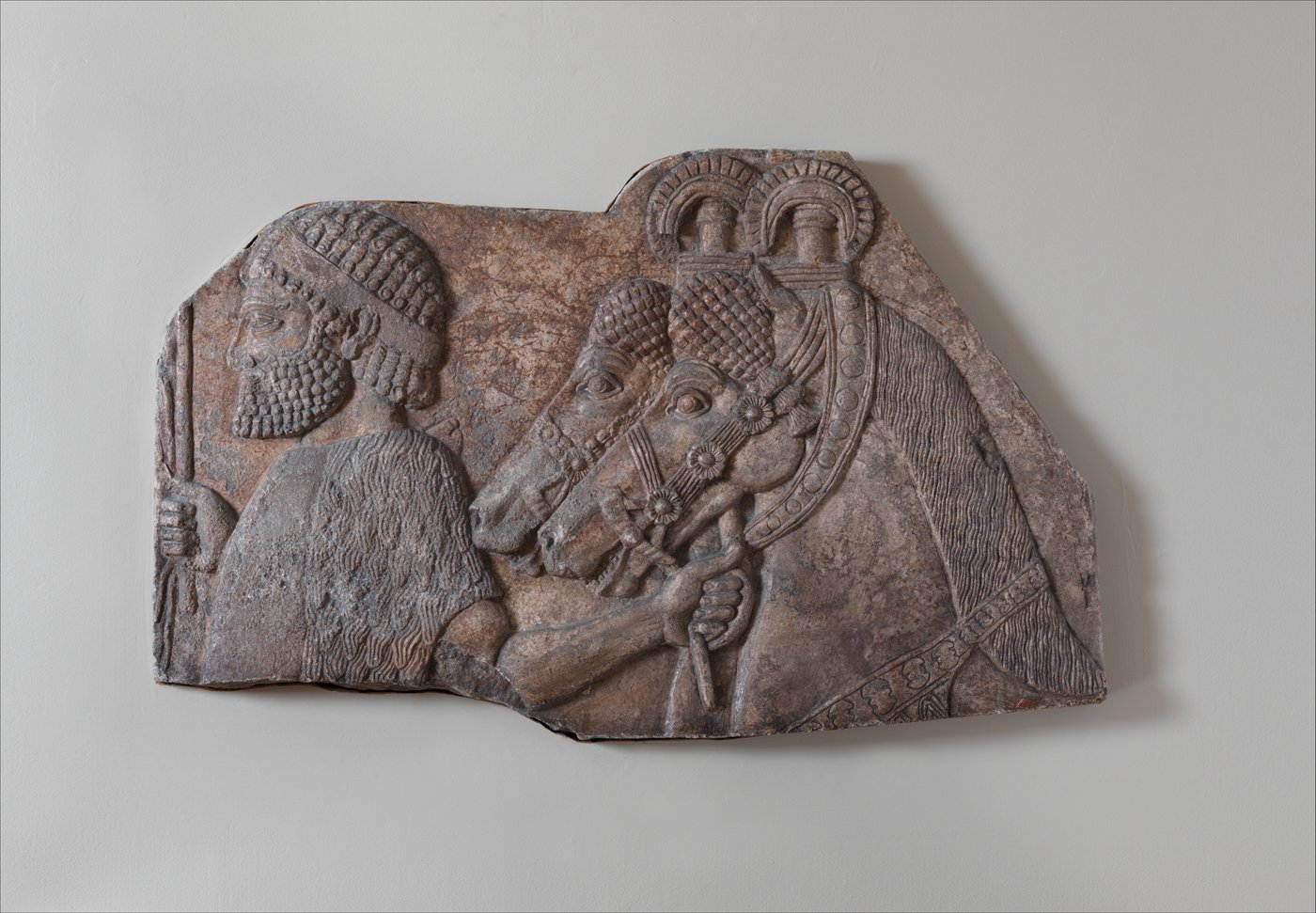
ConfirmedRelief from Sargon's palace at Khorsabad: a foreign groom leading horses as tribute, carved about 721 to 705 BC. The Metropolitan Museum of Art, New York, Gift of John D. Rockefeller Jr., 1933 (33.16.1), Public Domain (The Met Open Access, CC0).
In the year that Tartan came unto Ashdod, (when Sargon the king of Assyria sent him,) and fought against Ashdod, and took it;
Isaiah 20:1, KJV
Isaiah 20 dates one of Isaiah's messages to the year an Assyrian army sent by Sargon took the Philistine city of Ashdod. For a long time this verse was the only known ancient writing that named Sargon, and many Bible commentators thought Sargon was another name for a better-known king. In 1843 Paul-Emile Botta found Sargon's palace city, Dur-Sharrukin, at Khorsabad in northern Iraq, with carved stone wall panels (reliefs) and inscriptions. Sargon's own inscriptions tell how Ashdod rebelled under a man named Yamani and how he crushed it. In 1963, digs at Tel Ashdod found 3 pieces of a basalt victory stele (an inscribed stone monument) of Sargon in the city itself.
Where it is today
Reliefs from Sargon's palace are in the Louvre (Paris), the British Museum (London), the Oriental Institute in Chicago and the Iraq Museum (Baghdad). The Ashdod stele fragments went to the Israel Museum, Jerusalem, but they have not always been on display, so check before a visit.
Date
Sargon the Second reigned about 722 to 705 BC. The capture of Ashdod was in 711 BC (some date it 712 BC). The Ashdod stele was set up between then and 705 BC.
Why this label: Sargon's palace, his inscriptions and the stele found at Ashdod itself show that the king and the campaign in Isaiah 20:1 are real. Assyrian records and the Bible agree that Ashdod was taken in his reign.
Good to know
Title not name: "Tartan" is not a personal name. It is the Assyrian title turtanu, the army's top commander, also used in 2 Kings 18:17.
Who took Ashdod: Sargon's inscriptions say he marched to Ashdod himself, while Isaiah says the Tartan came. Scholars explain this in two ways: Assyrian kings often took credit for their army's victories, or the commander led the attack while the king was nearby.
The stele: The surviving pieces read like Sargon's other victory monuments. The part that described the capture of Ashdod is mostly lost, so the full story comes from his palace inscriptions.
Common myth: It is often said that sceptics once claimed Sargon never existed. The author of a 2024 Bible Archaeology Report article on Sargon searched for such a sceptic and could not find one. What is true is that before 1843 commentators were unsure who Sargon was. Assyria's capture of Samaria under Sargon is covered on the Assyria page.
The seal impressions of "Berekhyahu son of Neriyahu the scribe" (Baruch)
Jeremiah 36:4 · Jeremiah 36:32 · Jeremiah 45:1
Disputed
Then Jeremiah called Baruch the son of Neriah: and Baruch wrote from the mouth of Jeremiah all the words of the LORD, which he had spoken unto him, upon a roll of a book.
Jeremiah 36:4, KJV
Baruch son of Neriah was the scribe who wrote down Jeremiah's messages (Jeremiah 36). Two small clay sealings (bullae) carry the stamp of one seal reading "belonging to Berekhyahu son of Neriyahu the scribe". Berekhyahu and Neriyahu are longer forms of the names Baruch and Neriah. The first appeared on the Jerusalem antiquities market in 1975 with a group of about 49 sealings and was published by Nahman Avigad in 1978. The second appeared in the 1970s, was bought by the collector Shlomo Moussaieff in 1991 and has a fingerprint pressed into it.
Where it is today
Bulla 1: Israel Museum, Jerusalem, donated by Reuben Hecht in 1976 (a copy is shown at the Hecht Museum, Haifa). Bulla 2: the Moussaieff collection.
Date
If genuine, about 600 BC, the time of Jeremiah.
Why this label: Neither bulla has a findspot: both were bought from dealers, so no one knows where or how they were found. In 2014 laboratory tests led two scholars to conclude they were made in modern times, and others have replied that this is not proven.
Good to know
No findspot: Both pieces came from the antiquities market. A story that the first came from a burnt room dug by Yigal Shiloh in the City of David is only a rumour.
Doubting view: In 2014 Yuval Goren and Eran Arie, a curator at the Israel Museum, compared the two bullae with more than 180 others, most from Jerusalem. They reported that the clay, the rough single string that tied each one and other details point to modern making. The writing expert Christopher Rollston has also questioned some letter shapes.
Defending view: In 2016 Pieter van der Veen, Robert Deutsch and Gabriel Barkay answered that these arguments do not hold up. They added that this does not prove the bullae are genuine. Excavated seal impressions of other officials named in Jeremiah are covered on the Assyria and Babylon page.
Take great stones in thine hand, and hide them in the clay in the brickkiln, which is at the entry of Pharaoh's house in Tahpanhes, in the sight of the men of Judah;
Jeremiah 43:9, KJV
After Jerusalem fell, a group of Judeans fled to Egypt and took Jeremiah with them to Tahpanhes. There he buried large stones in the brickwork at the entry of "Pharaoh's house" as a sign that Nebuchadnezzar would set his throne there. Tahpanhes is the town the Greeks called Daphnae, today Tell Defenneh (also spelled Tell Dafana) in the eastern Nile Delta. Flinders Petrie dug there in 1886. Local people called the main ruin "Qasr Bint el-Yahudi" ("palace of the Jew's daughter"), and in front of its entrance Petrie found a large brick platform that he linked to Jeremiah 43:9.
Where it is today
Tell Defenneh, on the eastern edge of the Nile Delta in Egypt, about 13 km west of the Suez Canal, roughly level with the town of El Qantara. Wind has worn the site down and little of what Petrie saw is visible. Most of his finds are in the British Museum, London.
Date
The town and its main brick building date to the Saite period (the 26th Dynasty, from about 664 BC). The Judean refugees came after 586 BC, in the reign of Pharaoh Apries (Hophra).
Why this label: Scholars broadly accept Tell Defenneh as Tahpanhes, from the names Daphnae and Defenneh and the town's place on Egypt's eastern border. A 2014 British Museum study says final proof is still lacking, though it calls the match more than plausible.
Good to know
Petrie view: Petrie took the main building to be a fort and palace for a camp of Greek soldiers, and the brick platform in front of it to be the brickwork of Jeremiah 43:9. He dug over the whole area hoping to find Jeremiah's stones.
Later study: A British Museum re-study (Leclere and Spencer, 2014), with new Egyptian digs, found that the remains are mainly Egyptian, with a large temple inside a walled town. The main building was a raised mud-brick platform building of the Saite period, of a type often found in temple areas. It may not have been a fort, and the town was not mainly a camp for Greek soldiers.
The name: The local name "palace of the Jew's daughter" was used for other ruins too, so it is not evidence by itself.
What remains: The place fits Jeremiah's Tahpanhes, a royal Egyptian town in his day. Petrie's link of one brick platform to the exact spot in Jeremiah 43:9 is a guess that cannot be checked. The KJV word "brickkiln" is often translated "brick terrace" or "pavement" in newer versions.
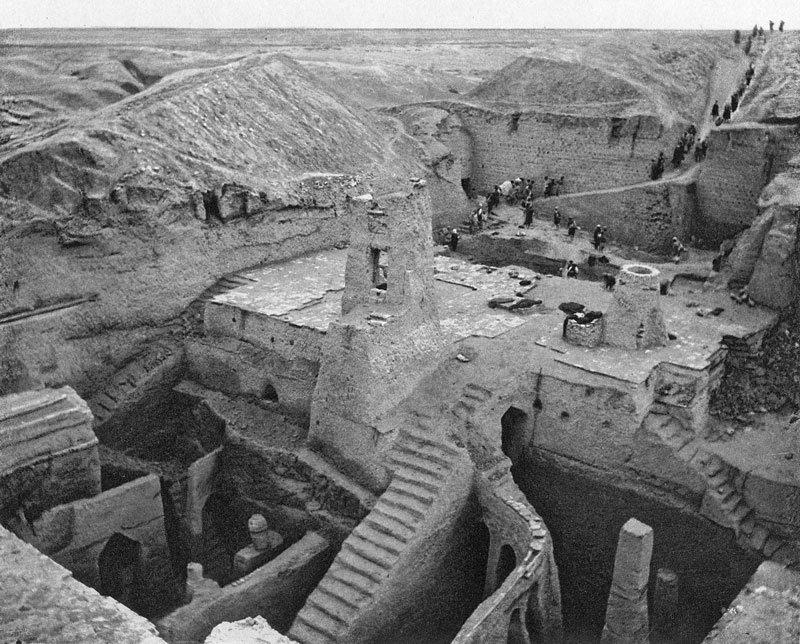
ConfirmedThe American dig in the temple area at Nippur in 1893. The Kabaru canal, most likely Ezekiel's river Chebar, is thought to have run past this city. John Henry Haynes, 1893, via Wikimedia Commons, Public domain.
Then I came to them of the captivity at Tel-abib, that dwelt by the river of Chebar, and I sat where they sat, and remained there astonished among them seven days.
Ezekiel 3:15, KJV
Ezekiel lived among the Judean captives "by the river of Chebar" in "the land of the Chaldeans" (Babylonia), where he saw his first visions. Business tablets from the city of Nippur in southern Iraq name a large canal called the Kabaru (naru kabari, "the great canal") near that city. The University of Pennsylvania's expedition found these tablets, the archive of the Murashu family, in 1893. Most scholars now agree that Ezekiel's "river" Chebar is this canal, since the Hebrew word for river was also used for canals. The tablets also name people with Judean names, such as names starting with Yahu-, which shows that Judeans were still living in the Nippur area.
Where it is today
Nippur is a large ruin in southern Iraq. The Kabaru is often linked to the dry, silted-up canal bed called Shatt en-Nil, which ran past Nippur.
Date
Ezekiel's first vision was about 593 BC. The Murashu tablets date from the reigns of the Persian kings Artaxerxes the First and Darius the Second, about 455 to 403 BC, roughly 150 years later.
Why this label: The canal name matches, and it ran through the right region of Babylonia, so scholars broadly agree on the canal. No ancient text names Ezekiel, and the town of Tel-abib has not been found.
Good to know
Older view: Many older books placed the Chebar at the Khabur River in Syria, the "Habor" of 2 Kings 17:6. Most scholars now reject this, because Ezekiel places the Chebar in Babylonia.
Honest limits: The Murashu tablets come from long after Ezekiel. They show the canal existed and that Judeans lived near Nippur, but they say nothing about Ezekiel himself. The exact course of the Kabaru is not certain, and linking it to the Shatt en-Nil is likely but not proven.
The town: The name Tel-abib probably comes from the Babylonian til abubi, "mound of the flood". Its site is unknown. Other Babylonian tablets that name Judean exiles, from the town called Al-Yahudu, are covered on the Ezra, Nehemiah and Esther page.
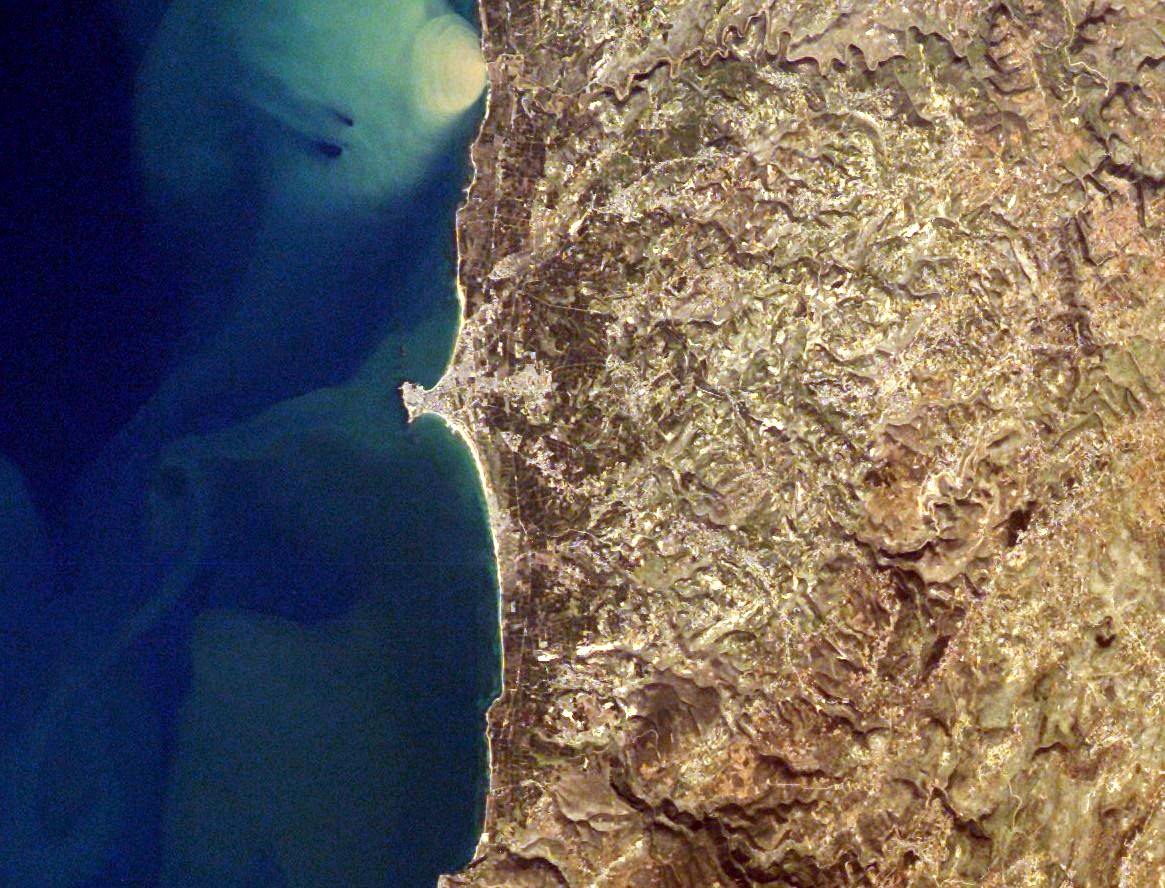
DisputedTyre seen from the International Space Station in 2003: the old island is now joined to the mainland. NASA Johnson Space Center, Earth Science and Remote Sensing Unit, via Wikimedia Commons, Public domain.
And they shall make a spoil of thy riches, and make a prey of thy merchandise: and they shall break down thy walls, and destroy thy pleasant houses: and they shall lay thy stones and thy timber and thy dust in the midst of the water.
Ezekiel 26:12, KJV
Ezekiel 26 to 28 foretells judgment on Tyre, the great Phoenician trading city. It says "many nations" will come against it, names Nebuchadnezzar of Babylon, and says its stones, timber and dust will be laid in the water. Tyre then had 2 parts: a walled island city about 1 km offshore and a town on the mainland, later called Old Tyre. In 332 BC Alexander the Great besieged the island for about 7 months. The Greek historian Diodorus says he tore down Old Tyre and had its stones carried out to build a causeway (a raised road across the water) to the island. Sand built up along the causeway over the following centuries, so the island is now joined to the land and Tyre stands on a peninsula.
Where it is today
Tyre (Sur), on the coast of southern Lebanon, about 80 km south of Beirut. The modern city covers much of the old island and the causeway. The ancient remains are a UNESCO World Heritage Site (since 1984). Access can be limited, so check before planning a visit.
Date
Ezekiel's prophecy is dated about 586 BC. Nebuchadnezzar's siege is usually dated about 586 to 573 BC. Alexander's siege lasted from January to July 332 BC.
Why this label: Tyre, Nebuchadnezzar's siege, Alexander's siege and the causeway are firm history. Whether these events fulfil Ezekiel 26 in every detail is a matter of interpretation on which careful readers disagree.
Good to know
Fulfilment view: Many Christian writers see Ezekiel 26:12 fulfilled when Alexander's men threw the ruins of mainland Tyre into the sea to build the causeway. They read "many nations" in verse 3 as attacks coming one after another, Babylon first, Alexander later, then others.
Doubting view: Verses 7 to 11 name Nebuchadnezzar, and Ezekiel 29:17-20 itself says his army got "no wages" from Tyre. Most historians think the island city was never taken by storm and in the end came to terms with Babylon. Critics say Ezekiel expected Babylon to destroy the city. They also note that Tyre was rebuilt, was a busy port again in Roman times when Paul stopped there (Acts 21:3-7), and is a city today, which seems to clash with verse 14, "thou shalt be built no more".
Common replies: Some answer that verse 14 refers to the old mainland city, or to Tyre never again being the great independent trading power it had been. Others read the wording as poetic. The 13-year length of Nebuchadnezzar's siege comes from the Jewish historian Josephus, who says he took it from Phoenician records.
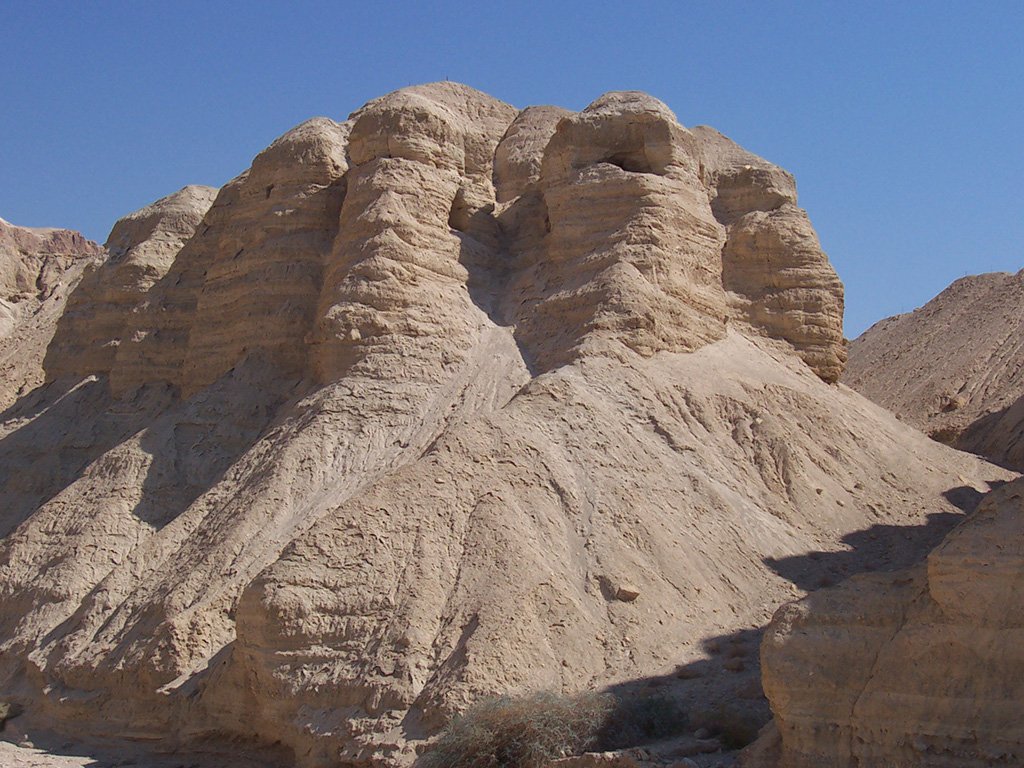
ConfirmedQumran Caves 4 and 10. Cave 4 held 5 of the 8 copies of Daniel found at Qumran. IHutchesson, via Wikimedia Commons, CC BY-SA 3.0.
Then spake the Chaldeans to the king in Syriack, O king, live for ever: tell thy servants the dream, and we will shew the interpretation.
Daniel 2:4, KJV
Pieces of 8 copies of the Book of Daniel were found in the Qumran caves near the Dead Sea: 2 in Cave 1, 5 in Cave 4 and 1 in Cave 6. Together they hold parts of 11 of Daniel's 12 chapters, and another scroll (4Q174) quotes chapter 12 as written "in the book of Daniel the prophet". Their text is very close to the Hebrew and Aramaic text the King James translators used. The copies that cover the right places switch from Hebrew to Aramaic at Daniel 2:4 (where the KJV says "in Syriack") and back to Hebrew at Daniel 8:1, just as our Bibles do.
Where it is today
Jerusalem. The Cave 4 copies (4Q112 to 4Q116; 4QDan-c is 4Q114) are kept by the Israel Antiquities Authority, which shows photos of them online in the Leon Levy Dead Sea Scrolls Digital Library.
Date
Copied from the 100s BC to about AD 50. The oldest, 4QDan-c, was dated by handwriting to the late 100s BC. A 2025 radiocarbon test placed it between 230 and 160 BC (the test also allowed an older range, which the researchers set aside).
Why this label: These are real ancient copies of Daniel, found at Qumran and fully published. What they show about when the book was first written is debated, as set out below.
Good to know
What they show: The scrolls show that Daniel, with its Hebrew and Aramaic parts in the same places as today, was being copied and read at Qumran in the 100s BC, and that its text has changed very little since. They cannot by themselves tell us when the book was first written.
Mainstream view: Most scholars date the finished book to about 167 to 164 BC, in the time of the Greek king Antiochus the Fourth. They point out that chapter 11 follows the wars of that time in close detail, but its last verses about the king's end do not match his death in Persia. They also note that Daniel is not placed among the Prophets in the Hebrew Bible, and that Sirach, written about 180 BC, draws on almost every other Bible book but not Daniel. Many traditional readers take those last verses of chapter 11 as speaking of a later ruler.
Early date view: Traditional scholars date the book to about 530 BC, the time it describes. They argue that 8 copies at one site, a copy made within a few decades of 164 BC, and a Qumran writer calling it the book of Daniel the prophet all fit an older and already respected book better. Jesus also speaks of Daniel the prophet in Matthew 24:15.
New radiocarbon test: In a 2025 study, Mladen Popovic and others tested a piece of 4QDan-c, which holds parts of chapters 10 and 11. Radiocarbon dating measures the age of the material by its carbon. It gives a span of years, not one year, and it dates the animal skin the scroll was made from, not the writing on it. The test allowed two spans: 230 to 160 BC, or an older 355 to 285 BC. On the carbon alone, the two spans were about equally likely. The researchers set the older span aside because the handwriting does not fit so early a date. They also wrote that the copy has scribal mistakes, so its scribe was unlikely to be the author.
Early date reading: Bryant Wood of the Associates for Biblical Research wrote in 2025 that the result makes it highly unlikely that Daniel was written after Antiochus died in 164 BC. Because the scribe was probably not the author, he argues that the book itself must be older than this copy.
Study authors reading: The researchers work from the mainstream date. They note that their span reaches into the 160s BC, when most scholars think the last part of Daniel was written. They suggest that the rough copy was made very soon after, perhaps among people close to the author, and say that future research may test this. Both readings rest on the same test. The mainstream view already places the book before Antiochus died, so a copy made before 164 BC does not settle the question by itself. A copy made in the 160s BC fits the span, but only at its latest end.
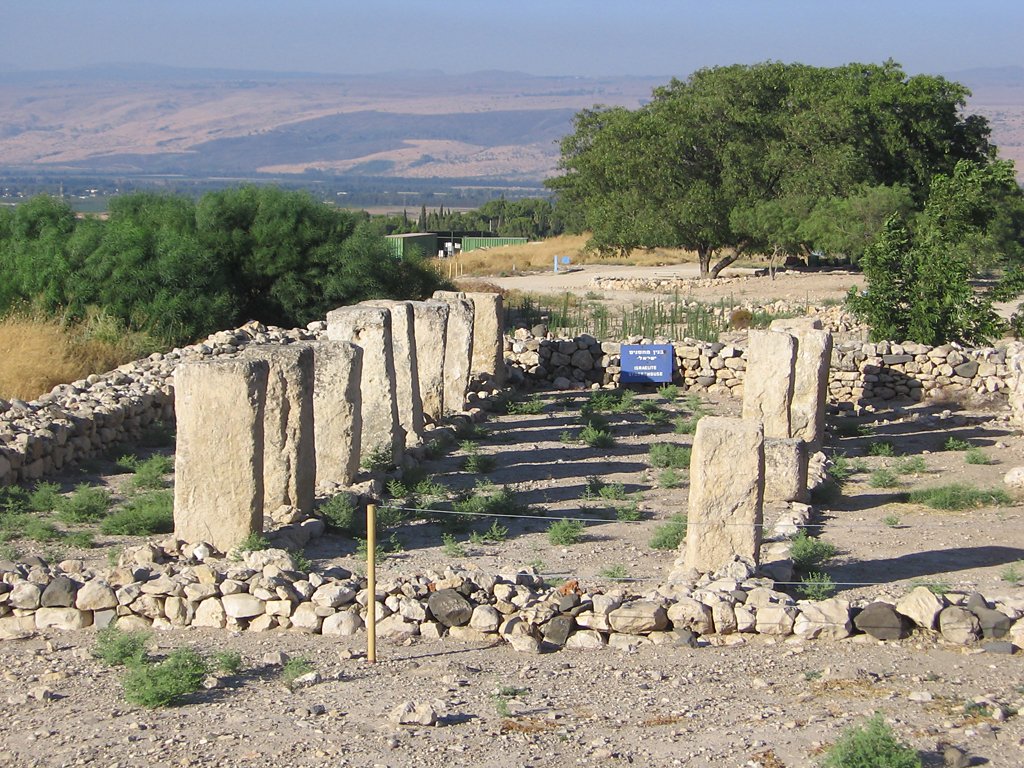
DisputedThe restored Israelite pillared building at Hazor, one of the sites where digs reported earthquake damage from the 700s BC. The photo does not show that damage. The Neolithic ram, via Wikimedia Commons, CC BY-SA 2.0.
The words of Amos, who was among the herdmen of Tekoa, which he saw concerning Israel in the days of Uzziah king of Judah, and in the days of Jeroboam the son of Joash king of Israel, two years before the earthquake.
Amos 1:1, KJV
Amos dates his message to "two years before the earthquake", in the reigns of Uzziah of Judah and Jeroboam the Second of Israel. Zechariah, writing long after, still speaks of people fleeing "from before the earthquake in the days of Uzziah". At several sites, digs have found walls that tilted or fell and smashed pots, with no sign of fire, in layers dated to the 700s BC. In the 1950s Yigael Yadin linked such damage in Stratum 6 (one of the layers of the ruin) at Hazor to Amos's earthquake, and similar damage has since been reported at Gezer, Tell es-Safi (Gath), Tel Agol and the City of David in Jerusalem.
Where it is today
At excavated sites in Israel, including Tel Hazor in Upper Galilee, Gezer, Tell es-Safi (Gath) and the City of David in Jerusalem. Hazor and the City of David are open to visitors.
Date
Mid 700s BC. Using the most widely used dates for the kings, the quake struck between about 766 and 751 BC; about 760 BC is the usual round figure.
Why this label: Earthquake damage from the 700s BC is well reported at several sites, but the pottery dates are not exact enough to show which quake caused it. Experts disagree on whether one great quake or more than one caused the damage, and on how many sites truly belong to it.
Good to know
The case for: Several digs found the same kind of damage in layers from the first half of the 700s BC, without burning, which fits an earthquake better than an enemy attack. At Hazor the damaged layer lies under the city the Assyrians burned in 732 BC. In 2000 the researchers Austin, Franz and Frost argued that one huge quake of about magnitude 8 (a very large quake), centred in southern Lebanon, did all this damage around 750 BC.
The doubts: The earthquake expert Nicholas Ambraseys argued that many sites were tied to the quake only because the Bible mentions one, and that a single quake wrecking towns over an area about 100 km in radius would be larger than is possible. Later digs at Hazor did not confirm all of Yadin's earthquake evidence, and at Lachish the excavator lists an earthquake only as a possibility. Attempts to fix the exact year lean on the Jewish historian Josephus, who wrote about 850 years later.
Two quakes: Layers of mud in the Dead Sea record two quakes in the mid 700s BC, a few decades apart, so the damage at different sites may come from more than one event.
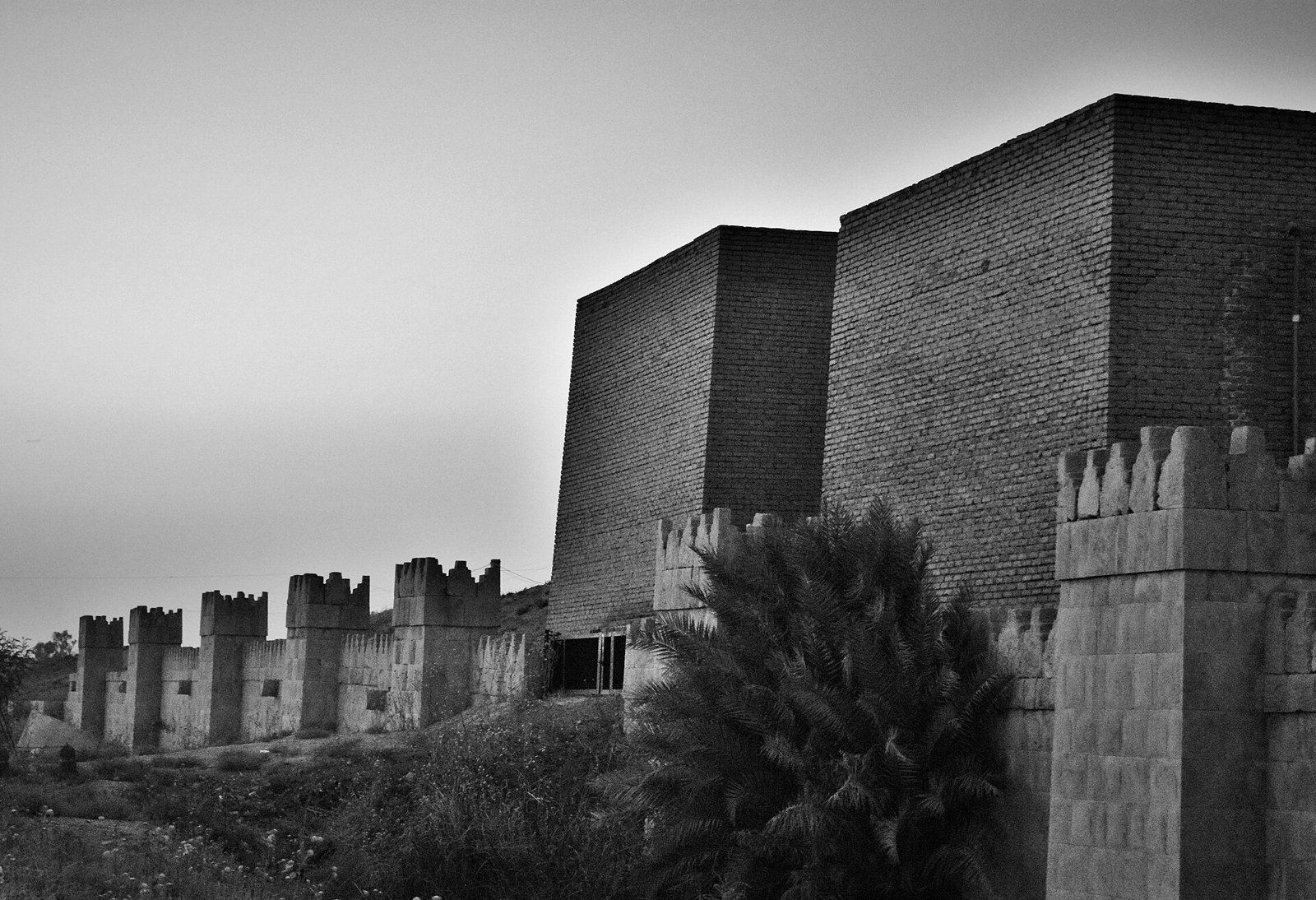
ConfirmedThe rebuilt Mashki Gate of Nineveh, at Mosul. This rebuilt gate was badly damaged in 2016. Omar Siddeeq Yousif, via Wikimedia Commons, CC BY-SA 4.0.
Behold, thy people in the midst of thee are women: the gates of thy land shall be set wide open unto thine enemies: the fire shall devour thy bars.
Nahum 3:13, KJV
Nineveh, the Assyrian capital that Jonah visited and Nahum spoke against, was surrounded by a wall about 12 km long, built by King Sennacherib around 700 BC. It had a stone base about 6 m high topped by a mud-brick wall about 10 m high and 15 m thick, with about 15 gates. Three gates were dug out and partly rebuilt in the 1900s: the Mashki Gate (the "gate of the watering places"), the Nergal Gate with its winged bull statues, and the Adad Gate. At the Adad and Halzi gates the last defenders had narrowed the passages with hasty mud-brick work, and human remains from the final battle were found in the Halzi Gate.
Where it is today
East bank of the Tigris River in Mosul, Iraq. An archaeological park opened at the site in 2023, entered by the Adad Gate. Check access before planning a visit.
Date
Walls and gates built about 700 BC. The gates seen in photos were partly rebuilt between the mid 1900s and the 1970s.
Why this label: The site of Nineveh was known all through the Middle Ages, and its excavated palaces and walls belong to the Assyrian kings who ruled from it. The gates are Sennacherib's work, though what visitors saw before 2016 was partly a modern rebuild.
Good to know
Nahum and the gates: Nahum 3:13 to 14 speaks of gates thrown open and tells the city to tread mortar and strengthen its brickworks for a siege. The rushed mud-brick work found in the Adad and Halzi gates shows defenders doing this kind of work in the city's last days, but it does not settle when Nahum spoke. The fall of Nineveh in 612 BC is covered on the Assyria page.
Three days journey: The walled city was about 12 km around, so Jonah 3:3 is often read as speaking of the wider Nineveh district, or of the time needed to go through the city preaching.
Damage and repair: The Mashki and Adad gates and part of the wall were bulldozed in 2016, and the winged bull statues of the Nergal Gate were badly damaged in 2015. Since 2019 an Iraqi and Italian team has cleared and repaired the Adad Gate. At the Mashki Gate an Iraqi and American team found 7 carved stone panels from Sennacherib's time in 2022.
Edom: Bozrah and the mountain top of Umm el-Biyara
Obadiah 1:3-4 · Jeremiah 49:16 · Amos 1:12
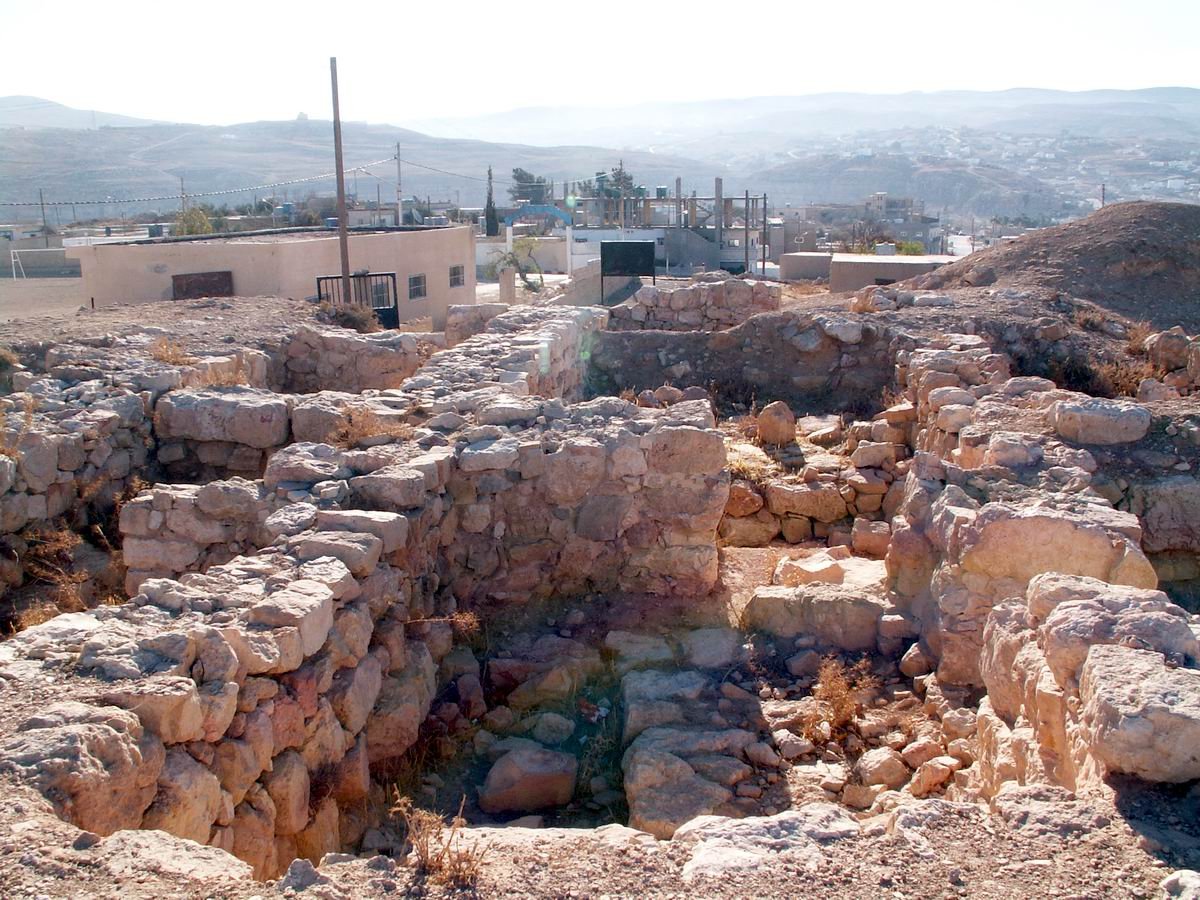
ConfirmedRuins at Buseirah in southern Jordan, the site most scholars identify as Bozrah, the capital of Edom. Wikimedia Commons user Uri, CC BY-SA 3.0.
The pride of thine heart hath deceived thee, thou that dwellest in the clefts of the rock, whose habitation is high; that saith in his heart, Who shall bring me down to the ground?
Obadiah 1:3, KJV
Obadiah and Jeremiah describe Edom, the nation descended from Esau, as living "in the clefts of the rock" and nesting high like an eagle. Edom's capital, Bozrah (Amos 1:12; Isaiah 63:1), is the ruin at Buseirah in southern Jordan, where Crystal Bennett's digs from the 1970s uncovered an Edomite town of the 600s BC and later. On the summit of Umm el-Biyara, the highest mountain in Petra, she found an unwalled Edomite village of the 600s and 500s BC, with a clay seal impression reading "Qos-Gabr, king of Edom". The same king, Qaus-gabri, is named in two Assyrian royal inscriptions of the 600s BC.
Where it is today
Buseirah is a town with an ancient ruin in Tafilah Governorate, southern Jordan, between Tafila and Shobak. Umm el-Biyara rises above the centre of Petra, Jordan; the summit is a steep climb.
Date
Edomite towns mainly of the 600s and early 500s BC; Qos-Gabr ruled in the 670s and 660s BC.
Why this label: Edom is named in Assyrian records and on its own king's seal impression. Bozrah's name survives in Buseirah, and scholars broadly accept the match, though it rests on the name and the remains rather than on an inscription naming the town.
Good to know
Petra is later: The famous rock-cut buildings of Petra, such as the Treasury and the Monastery, were carved by the Nabataeans in the 1st century BC and the 1st century AD, centuries after Obadiah. They are not Edomite and are not what Obadiah describes.
The rock: The Hebrew word for rock in Obadiah 3 is sela, which was also the name of an Edomite stronghold (2 Kings 14:7). Two high rock sites are proposed for it: es-Sela near Bozrah, and Umm el-Biyara at Petra.
The end of Edom: Assyrian records name kings of Edom in the 700s and 600s BC, and Jeremiah 27:3 still speaks of a king of Edom about 594 BC. The Babylonian king Nabonidus campaigned through Edom around 553 BC, and a worn carving of a Babylonian king, most likely him, is cut into the cliff at es-Sela. After that the kingdom disappears, and many Edomites settled to the west in southern Judah, later called Idumea.
Dating Obadiah: Obadiah 11 to 14 blames Edom for joining in when Jerusalem fell, which many readers link with the Babylonian capture of 586 BC; some date the book earlier.
Early Edom: Bennett concluded that Edom was not settled before the 700s BC. Many archaeologists now think this was too late, because copper-mining sites in the land of Edom have radiocarbon dates in the 900s BC and earlier. Others think those mining camps were run by local tribes rather than by a kingdom of Edom.
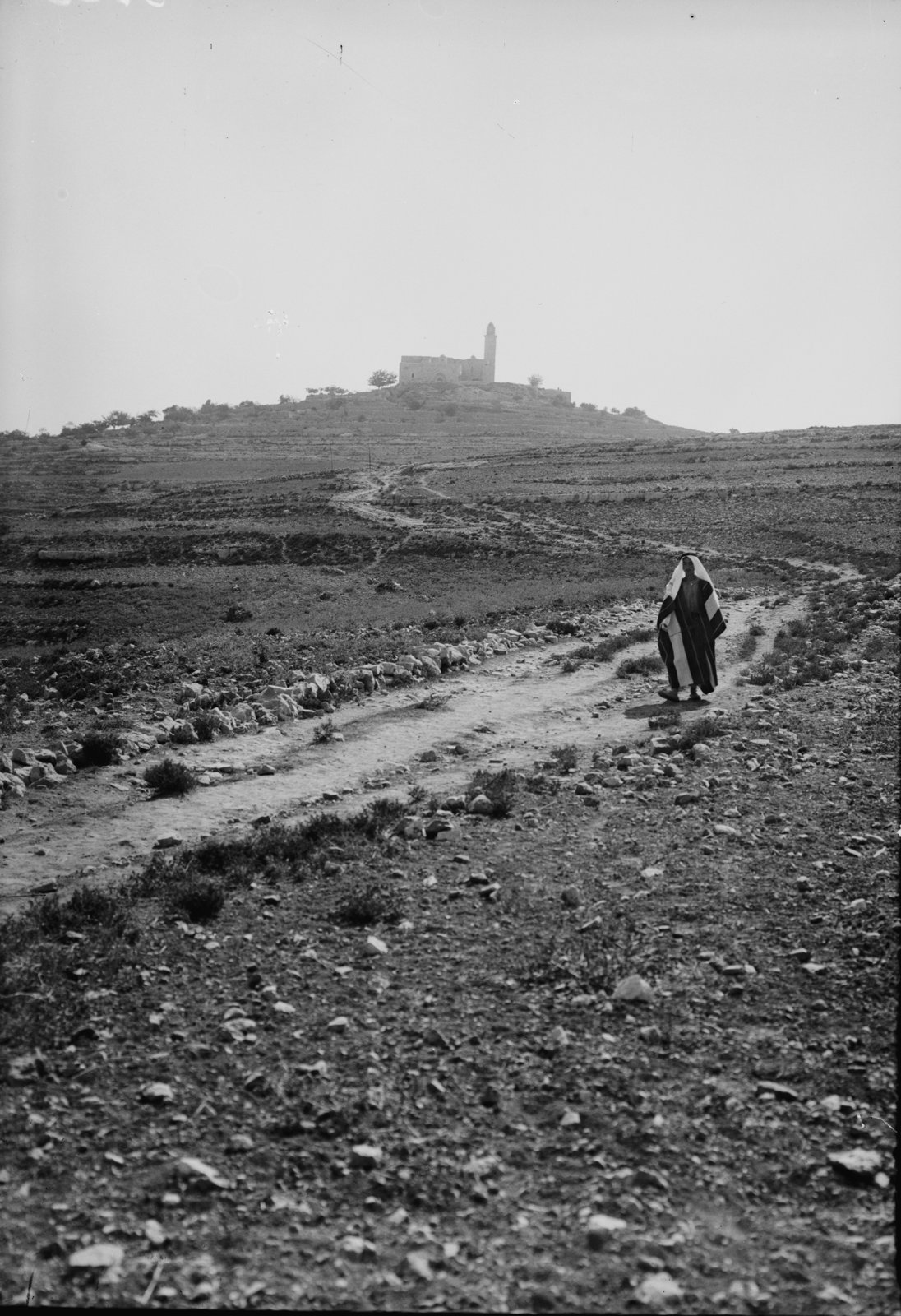
Traditional siteThe hill of Nabi Samwil seen from a track below, with the mosque in the old Crusader church on top, about 1920 to 1933. Library of Congress, Prints and Photographs Division, G. Eric and Edith Matson Photograph Collection, No known restrictions on publication.
And Samuel died; and all the Israelites were gathered together, and lamented him, and buried him in his house at Ramah. And David arose, and went down to the wilderness of Paran.
1 Samuel 25:1, KJV
Nabi Samwil is a high hilltop, 908 metres above sea level, about 7 kilometres north-west of Jerusalem. A building on the summit has a crypt that tradition calls the tomb of the prophet Samuel. The Bible says Samuel was buried "in his house at Ramah", his home town, but it does not say which modern hill Ramah is. Nabi Samwil is the place that later Christian, Jewish and Muslim tradition chose.
Where it is today
Nabi Samwil hilltop, about 7 km north-west of Jerusalem. The crypt below is used as a synagogue and the hall above as a mosque. Access can change, so check before planning a visit.
Date
Samuel lived a little before 1000 BC. A monastery named for him stood here by the 500s AD. Tomb shown here from at least the 1100s AD. Crusader church and fortress: 1100s AD. Mosque in the old church: from 1730, repaired after damage in 1917.
Why this label: No inscription or find ties Samuel to this hill, and the Bible places his grave at Ramah, which scholars usually look for at other villages. A monastery named for Samuel stood here in Byzantine times, but clear records of his tomb on this hill begin with the Crusaders in the 1100s.
Good to know
The tradition: A monastery of Samuel stood here by the 500s AD, and the writer Procopius says Emperor Justinian gave it a wall and a cistern. The excavator, Yitzhak Magen, thinks its builders saw it as a memorial to Samuel, not as his grave. Jerome wrote around AD 406 that Emperor Arcadius had moved what were believed to be Samuel's bones from Judea to Thrace. He does not say from where in Judea. The Crusaders called the hill Mount of Joy, because from here they first saw Jerusalem in 1099. The Jewish traveller Benjamin of Tudela wrote in 1173 that they had found bones said to be Samuel's at Ramla, on the coastal plain, and buried them again here under a large church. Medieval Jewish writers called the hill Ramah, and Jews came here on pilgrimage for about 500 years. In 1730 a mosque was set up in the church.
Ramah or Mizpah: Magen and a few others have argued that the hill is biblical Mizpah, where Samuel gathered Israel (1 Samuel 7:5). One reason Magen gives is that 1 Maccabees 3:46 places Mizpah opposite Jerusalem, and Nabi Samwil looks across at the city. Most other scholars place Mizpah at Tell en-Nasbeh, about 7 km to the north-east, on the main road north from Jerusalem.
The digs: Magen dug here from 1992 to 2003. He found pottery and seal impressions from the 700s to 500s BC, Persian-period finds, a well-built village of the 100s BC, and the remains of the Byzantine monastery and the large Crusader fortress. He found nothing from the time of Samuel himself, and the older finds from the 700s to 500s BC came from loose earth used to level the ground, not from buildings.
Tomb of the Prophets on the Mount of Olives (Haggai, Zechariah and Malachi)
Haggai 1:1 · Zechariah 1:1 · Malachi 1:1
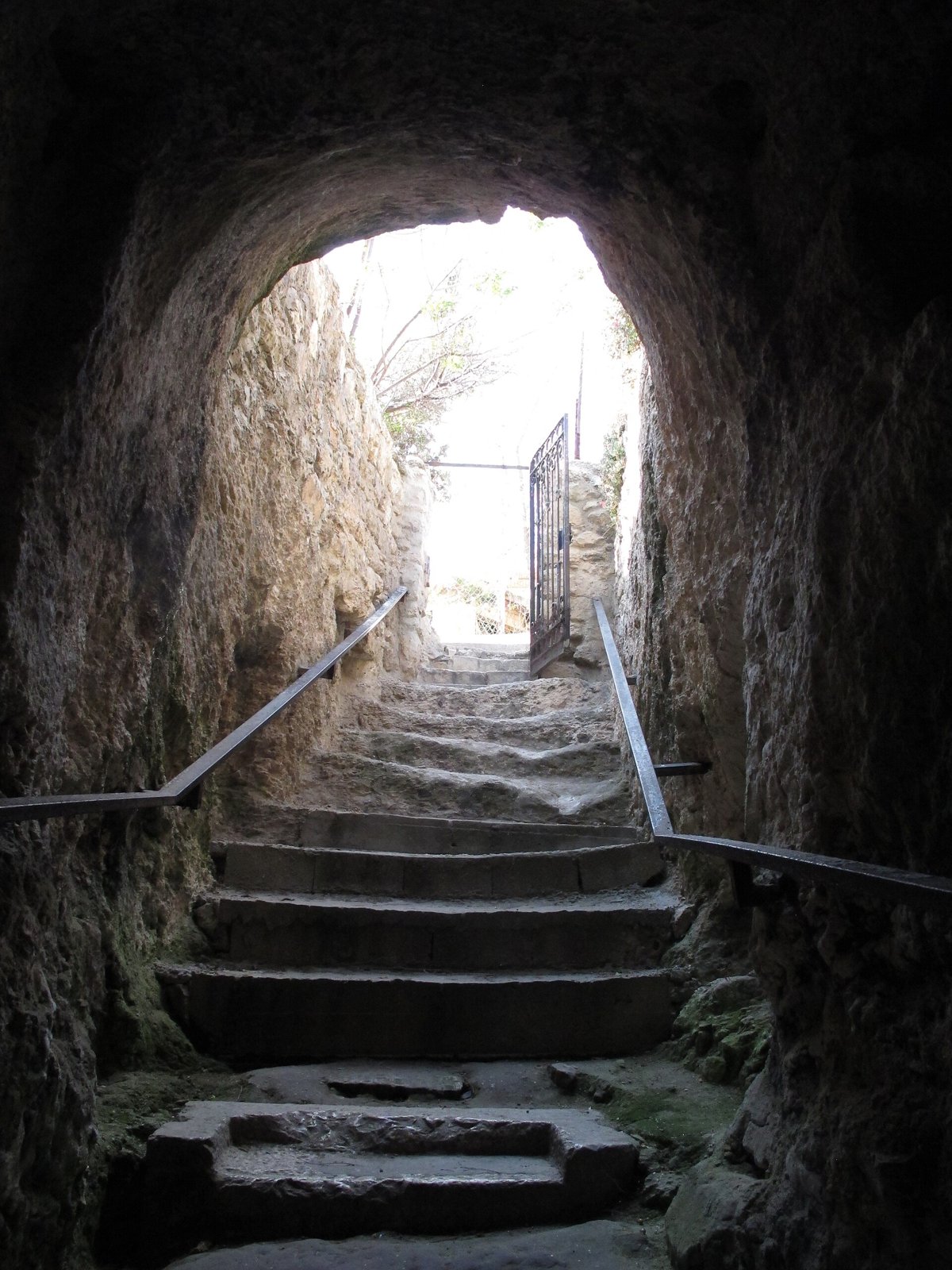
Traditional siteThe rock-cut stairway into the Tomb of the Prophets on the Mount of Olives, seen from inside. Ilari Aalto, via Wikimedia Commons, CC BY-SA 4.0.
In the eighth month, in the second year of Darius, came the word of the LORD unto Zechariah, the son of Berechiah, the son of Iddo the prophet, saying,
Zechariah 1:1, KJV
This is a rock-cut burial cave high on the western slope of the Mount of Olives in Jerusalem. A tradition from the Middle Ages says the last three prophets of the Old Testament, Haggai, Zechariah and Malachi, were buried here. The Bible does not say where any of the three was buried. The cave itself was cut several hundred years after they lived.
Where it is today
Upper western slope of the Mount of Olives, Jerusalem. Opening hours are limited and can change, so check before planning a visit.
Date
The prophets: about 520 BC (Haggai and Zechariah) to the 400s BC (Malachi). The cave: cut about the 1st century BC, used into the 1st century AD, and used again for Christian burials in the 300s and 400s AD. The tradition naming the prophets: Middle Ages.
Why this label: The cave is a real ancient Jewish tomb, but it is of a type that came into use in Jerusalem centuries after these prophets, so it cannot be their first grave. The link to the three prophets rests on a medieval tradition only.
Good to know
The cave: Steps lead down to a round central chamber about 7 metres across. Passages run off it in two curved rings, lined with dozens of long, narrow burial niches cut into the rock (38 by one count, 36 by another). Niches of this kind came into use in Jewish tombs around the 1st century BC.
The inscriptions: Greek inscriptions inside show that Christians, some from abroad, were buried here in the 300s and 400s AD. One of them reads, "Put thy faith in God, Dometila: No human creature is immortal!" These burials came long after the cave was first cut.
The tradition: The names of the three prophets come from a Jewish tradition of the Middle Ages, which Christians later took up. One source says Muslim tradition has also named the three prophets here since the 1600s. The sources checked do not name the first writer to record the tradition.
Not the same Zechariah: The prophet Zechariah, son of Berechiah, is a different man from the priest Zechariah son of Jehoiada, whose name is given to a monument in the Kidron Valley below.
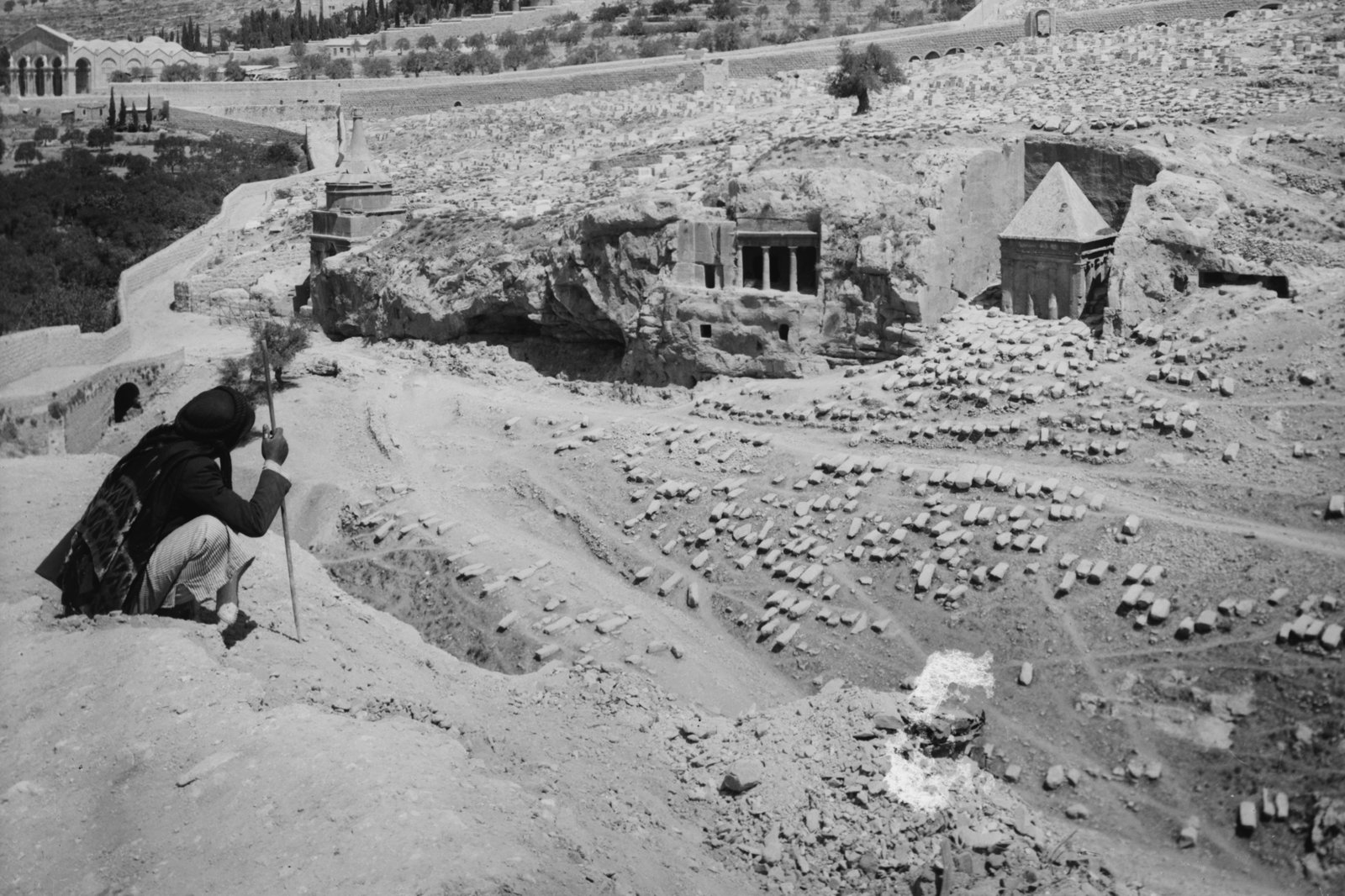
Traditional siteThe Kidron Valley in the early 1900s: from left, Absalom's Pillar, the Hezir tomb with its two columns, and the Tomb of Zechariah with its pyramid roof. Library of Congress, Prints and Photographs Division, G. Eric and Edith Matson Photograph Collection, No known restrictions on publication.
Now Absalom in his lifetime had taken and reared up for himself a pillar, which is in the king's dale: for he said, I have no son to keep my name in remembrance: and he called the pillar after his own name: and it is called unto this day, Absalom's place.
2 Samuel 18:18, KJV
Three large rock-cut tomb monuments stand close together in the Kidron Valley, below the Mount of Olives and facing the Temple Mount. Tradition calls one Absalom's Pillar, after the pillar Absalom set up in "the king's dale" (2 Samuel 18:18), and another the Tomb of Zechariah, after the priest Zechariah son of Jehoiada, who was stoned in the temple court (2 Chronicles 24:20-22). In fact all three were made for wealthy Jewish families between the 2nd century BC and the 1st century AD, many centuries after Absalom and Zechariah. The third, the Hezir family tomb, has a Hebrew inscription naming priests of the family of Hezir, a name found in 1 Chronicles 24:15.
Where it is today
Kidron Valley, east of the Old City of Jerusalem, below the Mount of Olives. The monuments can be seen from the valley path.
Date
Hezir family tomb: about the 2nd century BC. Tomb of Zechariah: about the 1st century BC or 1st century AD. Absalom's Pillar: about the 1st century AD (some scholars say 1st century BC). Greek inscriptions on Absalom's Pillar: Byzantine period, 300s AD or later. Absalom lived about 1000 BC; Zechariah son of Jehoiada about 800 BC.
Why this label: The monuments are real and well dated, but they were built many centuries after Absalom and Zechariah son of Jehoiada, so the traditional names cannot be right. Only the Hezir tomb has an ancient inscription naming the family buried there.
Good to know
Absalom pillar: About 20 metres tall, with a lower block cut from the rock and a built, cone-shaped top. It has a small burial chamber inside. It was a memorial for that burial, and perhaps also for the large burial cave behind it, called the Cave of Jehoshaphat. Its style, with Greek columns and an Egyptian-style ledge (cornice) along the top, belongs to the Roman period. The Bible says Absalom was buried in a pit in the wood under a great heap of stones (2 Samuel 18:17), not here.
Age of the names: The Jewish historian Josephus, writing about AD 93, says Absalom set up a marble pillar in the king's dale, 2 furlongs (about 370 metres) from Jerusalem. He says no more about it, so it is not certain he meant this monument, which is cut from the rock of the cliff. A Christian pilgrim from Bordeaux in AD 333 instead called Absalom's Pillar and the Tomb of Zechariah, the two monuments cut from single blocks of rock, the tombs of the prophet Isaiah and of King Hezekiah.
Tomb of Zechariah: A solid block cut out of the cliff, with columns and a pyramid roof. It may be the grave marker of the Hezir tomb beside it. The link with Zechariah son of Jehoiada is first recorded in 1215, by Menahem of Hebron.
The Hezir tomb: A Hebrew inscription over its porch says it is the tomb and memorial of several named men, priests of the sons of Hezir. Hezir is the 17th priestly division in 1 Chronicles 24:15, and a man named Hezir signed the covenant in Nehemiah 10:20, but no one knows whether this family is linked to either. Western visitors once called it the Tomb of Saint James.
Byzantine inscriptions: Faint Greek words over the entrance of Absalom's Pillar, not the Tomb of Zechariah, were first noticed by Joe Zias in 2000 and published by Emile Puech and Zias in 2003. As Puech read them, one says "the tomb of Zechariah, martyr, very pious priest, father of John", meaning the father of John the Baptist (Luke 1). Another names Simeon, a most righteous man "who awaited the consolation of the people" (compare Luke 2:25). Puech dated them to the mid 300s AD.
Doubting view: The Hebrew University's collection of medieval Holy Land inscriptions calls the reading extremely doubtful. It says the way the words are shortened and the faulty spelling point to a much later date, and that the first, if it can be read at all, is more likely the grave inscription of a late Byzantine priest. It also asks whether the reading was shaped by the known story of Simeon in Luke. Even on Puech's reading, they show only what some Byzantine Christians believed about the monument, not who was buried in it.
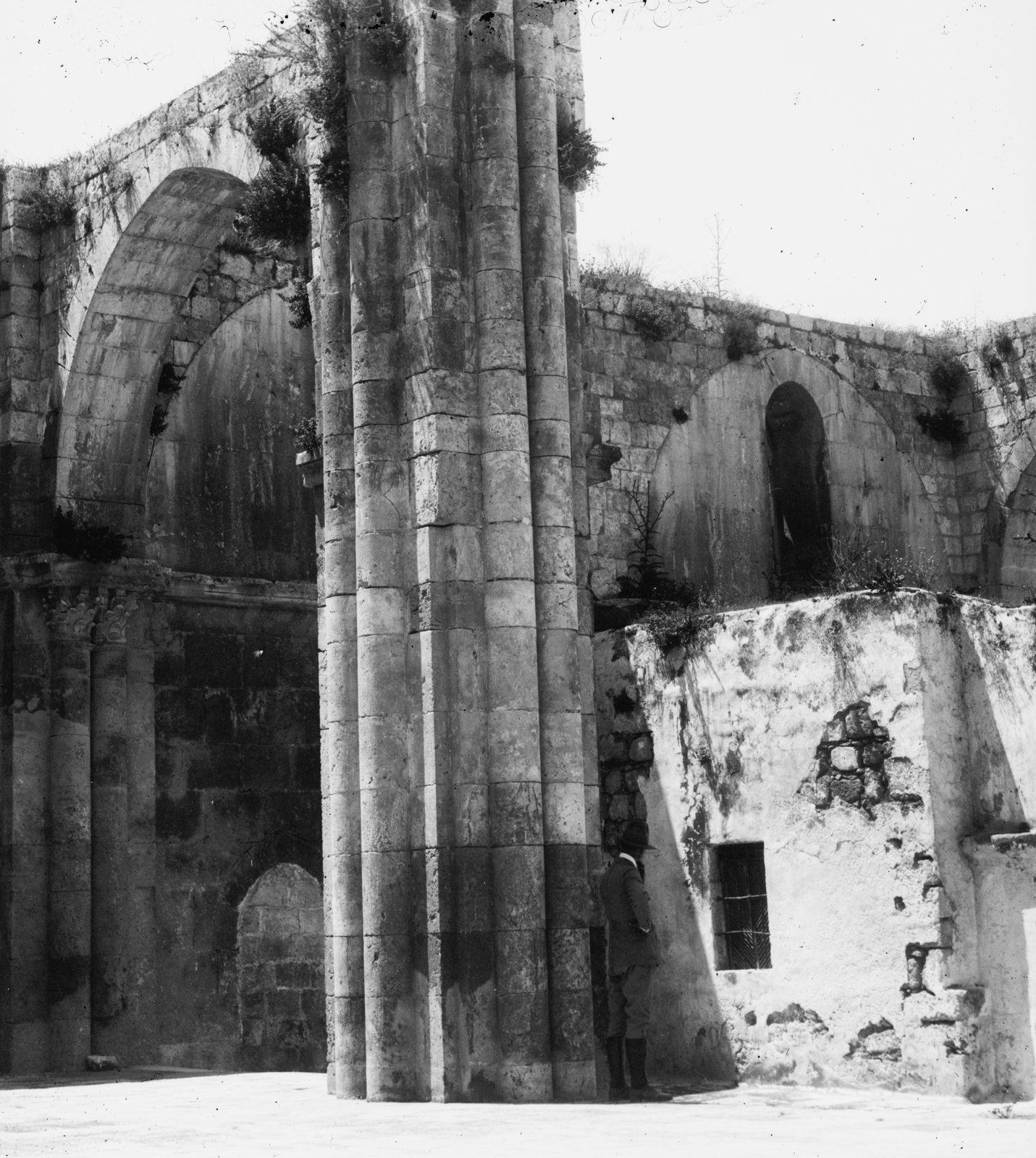
Traditional siteRuins of the Crusader cathedral of Saint John at Sebastia (Samaria), photographed between 1898 and 1946: a clustered stone pillar and pointed arches still standing. Library of Congress, Prints and Photographs Division, G. Eric and Edith Matson Photograph Collection, No known restrictions on publication.
And it came to pass, as they were burying a man, that, behold, they spied a band of men; and they cast the man into the sepulchre of Elisha: and when the man was let down, and touched the bones of Elisha, he revived, and stood up on his feet.
2 Kings 13:21, KJV
In the village of Sebastia, on the site of the ancient city of Samaria, a small domed building leads down 21 steps to a rock-cut burial chamber. Since at least the 300s AD Christians have honoured it as the grave of John the Baptist, together with the prophets Elisha and Obadiah. The Bible tells of Elisha's grave and of a dead man who came back to life when he touched Elisha's bones, but it does not say where the grave was. It does show that Elisha lived at times in Samaria (2 Kings 2:25; 5:3; 6:32).
Where it is today
Sebastia village, north-west of Nablus. The crypt is in the ruins of the Crusader cathedral, part of which is now a mosque. Access can change, so check before planning a visit.
Date
Elisha lived in the 800s BC. Tradition recorded from the 300s AD. Byzantine church over the crypt; Crusader cathedral of about AD 1160; made a mosque after 1187; present mosque rebuilt in 1892.
Why this label: The tradition is old, going back at least to the 300s AD, and it fits Elisha's ties to Samaria, but nothing found on the site shows who was buried in the chamber.
Good to know
Earliest record: Jerome, writing in AD 404, says his friend Paula visited Sebaste, the Roman name for Samaria, in 385. He writes that the prophets Elisha and Obadiah and John the Baptist lie there.
The buildings: A church was built over the tomb in the Byzantine period. The Crusaders rebuilt it around 1160 as a large cathedral, one of the biggest churches in the Holy Land. After 1187 it became a mosque named for the prophet Yahya, the Arabic name for John the Baptist, and part of the ruin was rebuilt as a mosque in 1892. The chamber below has six burial niches in its wall, and tradition puts John between Elisha and Obadiah.
Which Obadiah: The Bible says nothing about the life or death of the prophet Obadiah. Jewish tradition in the Talmud identified him with Obadiah, the steward of King Ahab of Samaria who hid 100 prophets in caves (1 Kings 18:3-4).
John the Baptist: The Gospels say his disciples buried his body (Matthew 14:12) but do not say where.
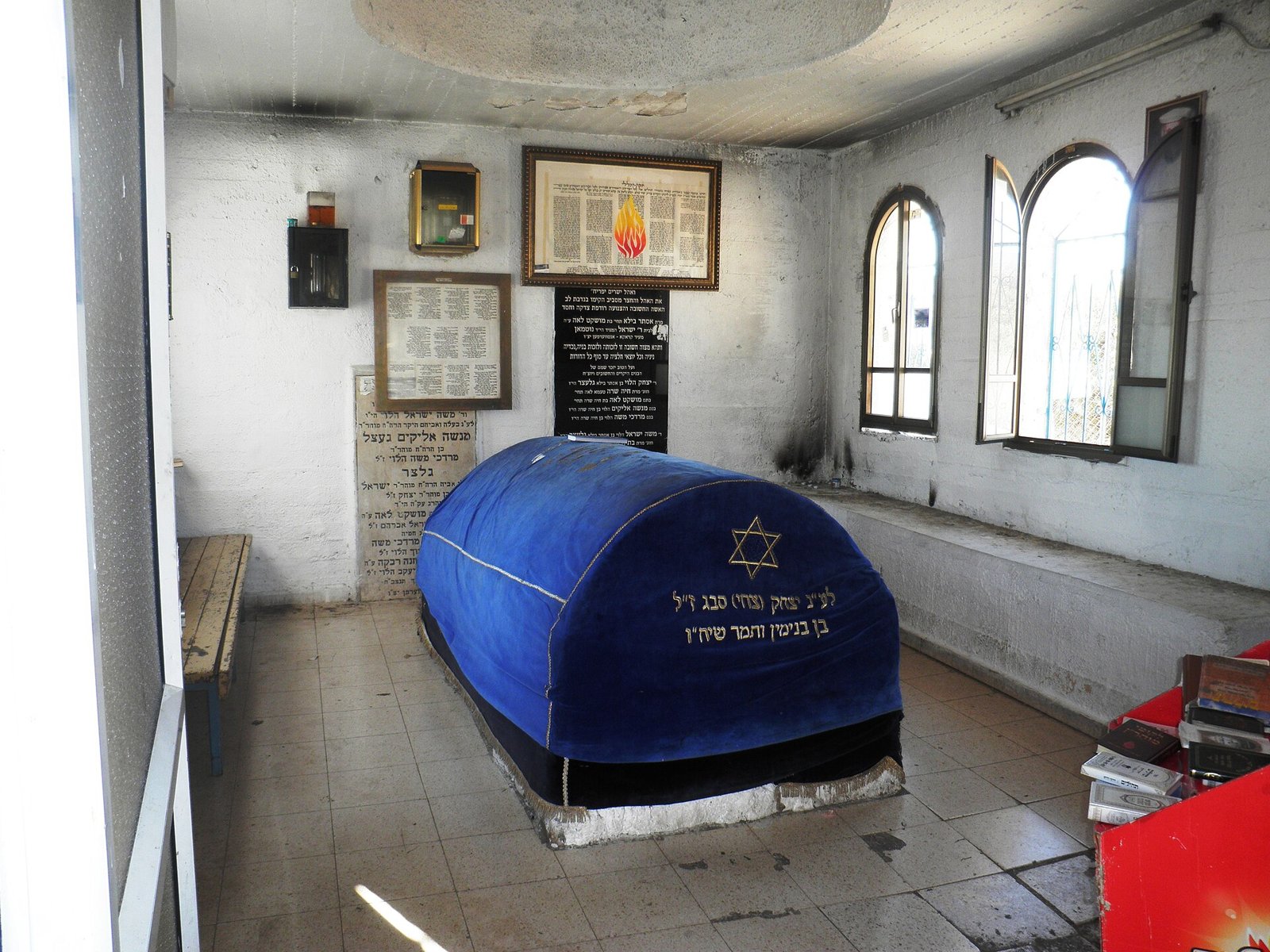
Traditional siteInside the traditional tomb of Habakkuk near Kadarim, Galilee, with its cloth-covered grave marker. Ariel Palmon, via Wikimedia Commons, CC BY 3.0.
The burden which Habakkuk the prophet did see.
Habakkuk 1:1, KJV
The Bible tells us nothing about Habakkuk's family, home town, death or burial. Two places now show his tomb. One is a small stone building on a hillside near Kadarim and Hukok, about 10 kilometres south-west of Safed in Galilee, Israel. The other is a brick tomb tower just south of the town of Tuyserkan in western Iran.
Where it is today
Near Kadarim and Hukok, Upper Galilee, Israel; and about 1 km south of Tuyserkan, Hamadan province, Iran. Access can change, so check before planning a visit.
Date
Habakkuk lived about 600 BC. Galilee site: tradition recorded from the 1200s AD; the present small building is from the 1900s. Iran site: tower usually dated to the Seljuk period, when a Turkish dynasty ruled Iran (sources range from the 1000s to the 1200s AD); first described by a visitor in about 1824.
Why this label: Both sites rest on tradition alone, first recorded some 1800 years after Habakkuk lived, and the Bible gives no burial place to test them against.
Good to know
Galilee site: Jewish pilgrims have visited it since at least the 1200s. In the early 1300s the writer Estori Farhi linked the Arab village of Yaquq, next to the tomb, with Hukkok, a border town of Naphtali (Joshua 19:34), and said he saw a synagogue there. The names Hukkok and Yaquq sound like Habakkuk, which may be how the tradition began. Some think the grave once belonged to a local Muslim holy man.
Iran site: An eight-sided brick tower about 7 metres high with a cone roof, honoured by both Jews and Muslims. Local stories say Habakkuk was taken to Babylon in the exile. The Encyclopaedia Iranica says these stories have no historical basis, and a Jewish traveller who visited around 1824 heard them and did not believe them.
A third claim: The church historian Sozomen, in the 400s AD, wrote that Habakkuk's remains were found at a place called Cela near Eleutheropolis (Beit Guvrin) in Judah, after the local bishop had a dream.
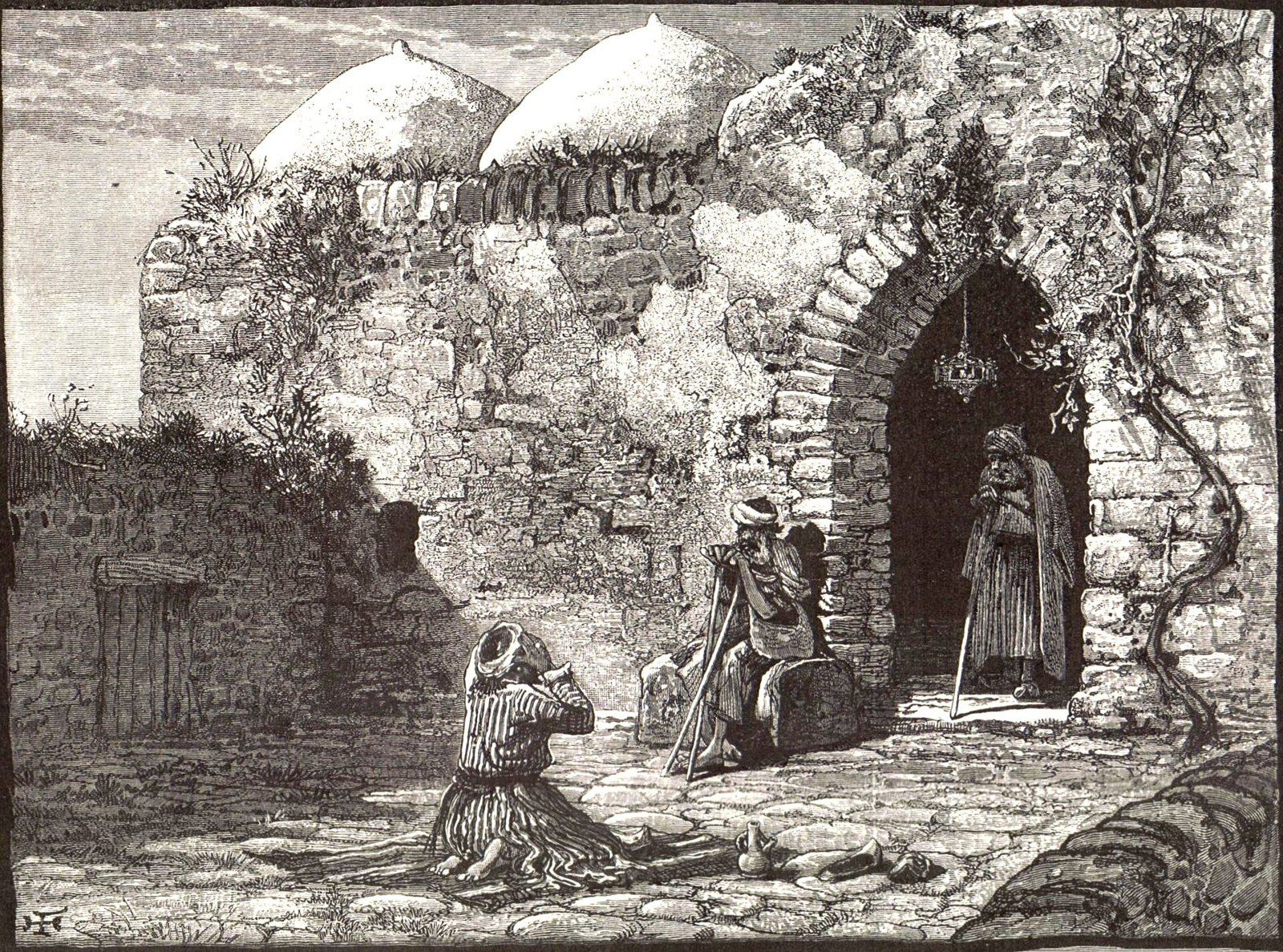
Traditional siteAn engraving from the 1800s of the domed tomb of Jonah at El-Meshhed (Mashhad), near ancient Gath-hepher. Harry Fenn (artist), engraving of the 1800s, via the Bibliotheque nationale de France and Wikimedia Commons, Public domain.
He restored the coast of Israel from the entering of Hamath unto the sea of the plain, according to the word of the LORD God of Israel, which he spake by the hand of his servant Jonah, the son of Amittai, the prophet, which was of Gath-hepher.
2 Kings 14:25, KJV
The Bible says the prophet Jonah came from Gath-hepher, a town on the border of Zebulun in Lower Galilee (the KJV spells it Gittah-hepher in Joshua 19:13). Gath-hepher is placed at a mound called Tel Gat Hefer (Khirbet ez-Zurra) beside the Arab village of Mashhad, near Nazareth and Sepphoris (Zippori). In the village a small shrine called Nabi Yunis is shown as Jonah's tomb. The Bible tells where Jonah came from, not where he was buried.
Where it is today
Mashhad village, Lower Galilee, Israel, about 4 km south-east of Sepphoris (Zippori), near Kafr Kanna and Nazareth.
Date
Jonah lived in the 700s BC, in the reign of Jeroboam the Second. Tomb tradition recorded from the late 300s AD (Jerome) and again in the 1100s. The sources checked do not give a building date for the present shrine.
Why this label: The village sits by the probable site of Jonah's home town, and the tomb tradition is old, but no inscription or find shows that Jonah was buried there.
Good to know
Early records: Jerome, in his commentary on Jonah written in the late 300s AD, says Jonah's tomb was shown at "Geth", a small village about 2 miles from Sepphoris on the road to Tiberias. In the 1100s Benjamin of Tudela placed the tomb on a hill near Sepphoris. A British survey published in 1881 described the village around the traditional tomb, a low building with two white domes.
Rival sites: Jonah's tomb is also shown at Nebi Yunus in Mosul, at the site of Nineveh (covered on the Ezra, Nehemiah and Esther page), and at Halhul near Hebron, among other places.
The digs: Pottery from the Iron Age (about 1200 to 586 BC, the time of the Israelite kings) has been found on the surface of the mound, and later digs found remains from the Early Bronze Age (before 2000 BC) and from the Persian, Roman and Byzantine periods. None of this names Jonah.
 LearnAboutHim