Evidence You Can See: Leviticus, Numbers and Deuteronomy
Real places you can visit and real objects you can see in museums, connected to the books of Leviticus, Numbers and Deuteronomy: the laws given at Sinai, the forty years in the wilderness and Moses' last words before Israel entered Canaan. Each one is marked honestly, so you can tell solid evidence from tradition and from claims that are still argued over.
ConfirmedThe place or object is real and is clearly the one the Bible names. For a written object, such as an inscription or a scroll, it means the object is genuine and its words are read with confidence, not that every event it mentions is proven.6
Traditional siteA real place that long tradition links to the Bible, but the exact spot cannot be proven.2
DisputedInformed people disagree, or the claim rests on weak evidence.5
BackgroundShows the world the Bible describes, but does not name a Bible person or event.4
Leviticus: Worship, Holiness and Daily Life
1
Horned altars from Beersheba and other Israelite sites
Exodus 27:2 · Leviticus 4:7 · 1 Kings 1:50
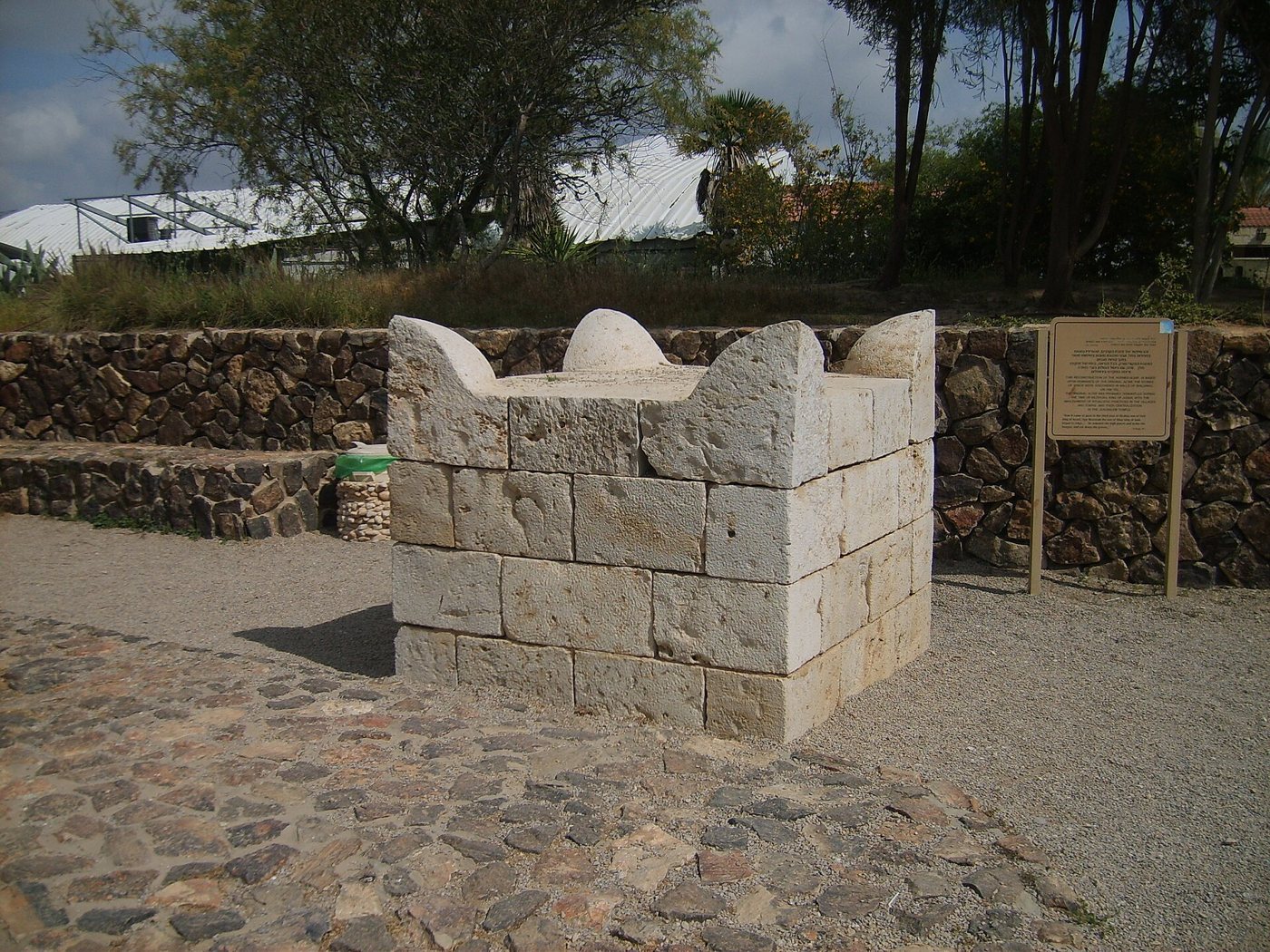
BackgroundCopy of the Beersheba horned altar at Tel Be'er Sheva National Park. gugganij, via Wikimedia Commons, CC BY-SA 3.0.
And the priest shall put some of the blood upon the horns of the altar of sweet incense before the LORD, which is in the tabernacle of the congregation; and shall pour all the blood of the bullock at the bottom of the altar of the burnt offering, which is at the door of the tabernacle of the congregation.
Leviticus 4:7, KJV
The law told Israel to make a horn at each of the 4 top corners of the altar, and in the sin offering the priest put blood on these horns. The horns were raised, curved points on the corners, made as one piece with the altar; a person in danger could also grab them to ask for mercy (1 Kings 1:50). At Tel Beersheba (a 'tel' is a mound built up from the ruins of an ancient town), archaeologists found the cut stones of a large horned altar reused as building stones in the wall of a later storehouse, and the Israel Museum has put them back together. Horn stones from large altars have also been found at Megiddo and Tel Dan, and small stone altars with horns, probably for burning incense, at Megiddo, Lachish and Ekron.
Where it is today
The rebuilt Beersheba altar is in the Israel Museum, Jerusalem. A copy stands at Tel Be'er Sheva National Park, just east of the modern city of Beersheba, Israel. (The town of Beersheba itself is covered on the Genesis page.)
Date
About the 8th century BC (some date the stones as early as the 10th century BC). This is the time of the kings, several centuries after Moses.
Why this label: These are real altars and show that horned altars like the ones the Bible describes were used in Israel and Judah. They come from the time of the kings, not from Moses' time, and none of them is the tabernacle or temple altar.
Good to know: The Beersheba altar was built of cut, smoothed stones, which goes against the command in Exodus 20:25 not to use cut stone for an altar; the Israel Museum points this out. The excavator, Yohanan Aharoni, thought it was taken apart during King Hezekiah's reform (2 Kings 18:22), but the date of the wall it was found in is debated, so this cannot be proven. No one knows for sure what the horns meant; one common idea is that they stood for strength.
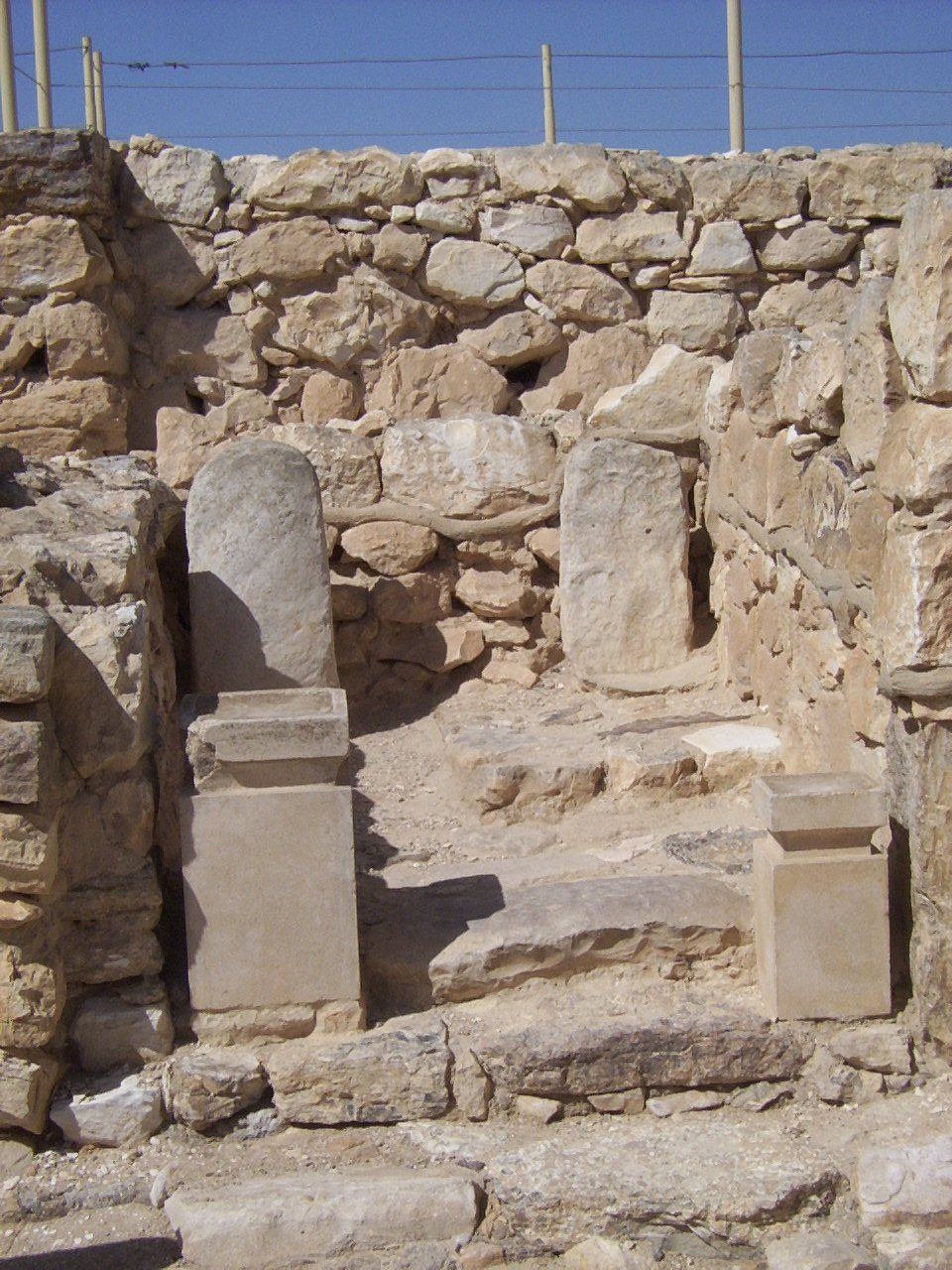
BackgroundThe inner room (holy of holies) of the Arad shrine, with standing stones and 2 small altars. Acer11, via Wikimedia Commons, CC BY-SA 3.0.
He removed the high places, and brake the images, and cut down the groves, and brake in pieces the brasen serpent that Moses had made: for unto those days the children of Israel did burn incense to it: and he called it Nehushtan.
2 Kings 18:4, KJV
Inside the fortress of Judah at Tel Arad (the mound of ruins of ancient Arad), in the Negev desert, archaeologists found a small shrine from the time of the kings. It had a courtyard with a large altar for animal offerings built of uncut stones (compare Exodus 20:25), a main hall, and a small inner room. In the inner room stood a smooth standing stone (a second, smaller one was also found), and on the step at its entrance stood 2 small stone altars for burning incense, without horns. The Israel Museum calls it the only temple of Judah ever found, though in 2012 another temple from the time of the kings was announced at Tel Motza near Jerusalem.
Where it is today
The inner room, with its 2 altars and standing stone, is rebuilt with the original stones in the Israel Museum, Jerusalem. The fortress and the shrine's remains can be visited at Tel Arad National Park, west of the modern town of Arad, Israel.
Date
In use about 760 to 715 BC, according to a 2020 study by an Israel Museum researcher; other scholars have proposed different dates.
Why this label: This is a real Israelite place of worship from the time of the kings, and it shows the kind of local shrine the Bible's reformers removed. The Bible does not mention this shrine, and nothing found there says why it went out of use.
Good to know: This shrine is not an example of worship the Bible approves: it was a local shrine away from Jerusalem, of the kind Hezekiah and Josiah removed (2 Kings 18:4; 23:8), and the word translated 'images' in 2 Kings 18:4 is the Hebrew word for standing stones like the one found here. The Israel Museum says the shrine was buried on purpose in Hezekiah's time, but others say it is not certain whether this was because of his reform or for another reason. Tests published in 2020 found frankincense on the larger altar and traces of cannabis on the smaller one.
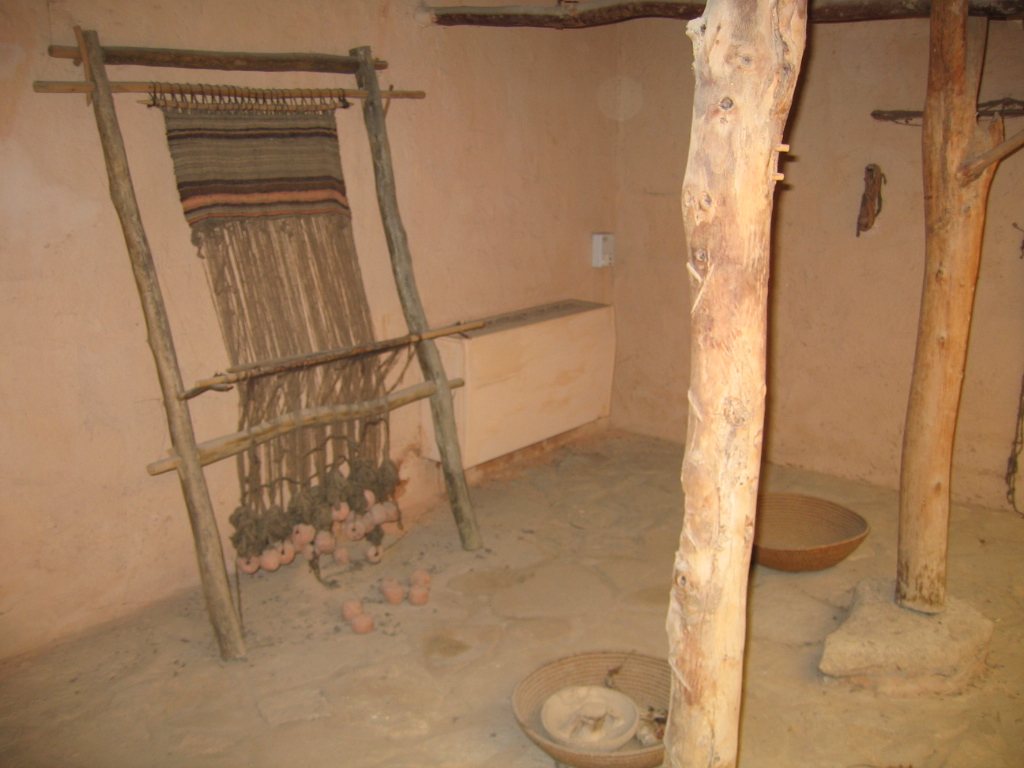
BackgroundMuseum reconstruction of an Israelite house of the time of the kings, Eretz Israel Museum, Tel Aviv. Talmoryair, via Wikimedia Commons, Public domain.
And the swine, though he divide the hoof, and be clovenfooted, yet he cheweth not the cud; he is unclean to you.
Leviticus 11:7, KJV
Animal bones from digs show what people ate. In the small hill villages of about 1200 to 1000 BC that most scholars link with early Israel, pig bones are almost entirely missing. In Philistine cities of the same time, pigs make up a large share of the farm animal bones: about 11 percent at Ashdod and up to about 20 percent at Ekron. Later, pig bones stay very rare at sites in Judah, while some lowland towns of the northern kingdom of Israel have more of them (about 3 to 9 percent).
Where it is today
There is no single object to see. The finding comes from animal bones dug up at many sites in Israel, such as hill villages in Samaria and Judah and the Philistine cities of Ashdod and Ekron (Tel Miqne), studied by scientists who specialize in ancient animal bones.
Date
About 1200 to 600 BC (the Iron Age).
Why this label: The pattern is real and fits the food law in Leviticus 11:7, but bones cannot tell us why people avoided pork. They do not show when the law was given or that the villagers were keeping it.
Good to know: Scholars give 3 main explanations, which can overlap: a religious food law or custom; a way to mark the group as different from the Philistines; and practical reasons such as climate, land and a herding life with sheep and goats. Newer studies found very few pig bones at some Canaanite towns and small Philistine villages too, and an occasional pig even in Jerusalem, so 'no pig bones' alone cannot prove a site was Israelite. Some scholars, including the authors of the 2013 study, think the ban on pork became a fixed rule only in the time of the later kings of Judah, and that the written law came then or later; others see the old village pattern as fitting a much older custom.
Molech, the Valley of Hinnom and the Phoenician tophets
Leviticus 18:21 · 2 Kings 23:10 · Jeremiah 7:31
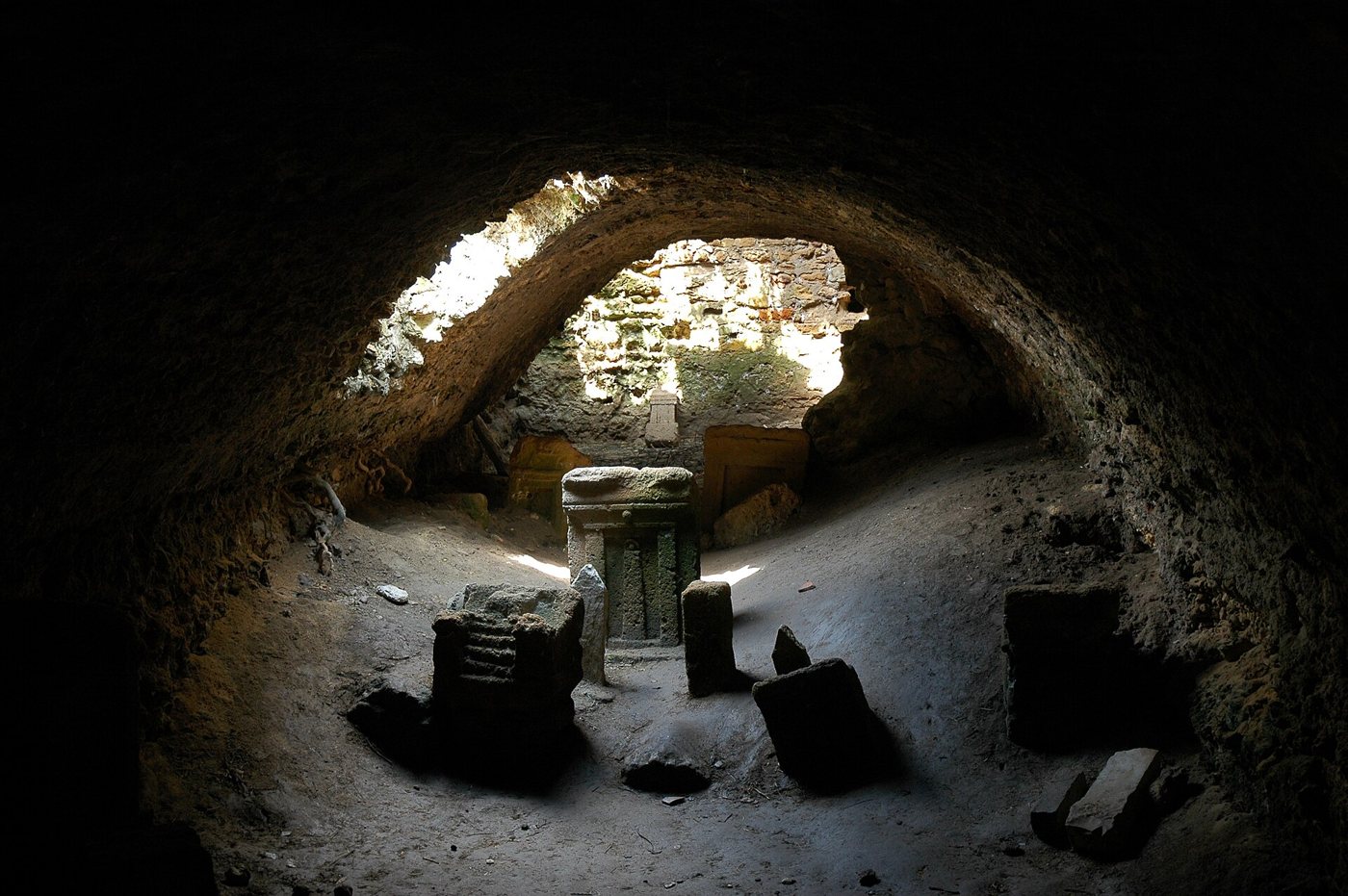
DisputedStone markers in the Carthage tophet, under a vault built later in Roman times. Patrick Giraud, via Wikimedia Commons, CC BY-SA 2.5.
And thou shalt not let any of thy seed pass through the fire to Molech, neither shalt thou profane the name of thy God: I am the LORD.
Leviticus 18:21, KJV
Leviticus forbids giving children to Molech, and Kings and Jeremiah say this was done at a place called Topheth in the Valley of Hinnom, just outside Jerusalem. No such site has been found in Jerusalem. But at Carthage in North Africa, a city founded by the Phoenicians (a trading people from the coast of today's Lebanon), and at other Phoenician sites in Sicily, Sardinia and Malta, archaeologists have found open-air grounds full of clay urns holding the burned bones of babies and young lambs, many marked with stone monuments. Archaeologists call these places 'tophets', borrowing the Bible's word.
Where it is today
The Carthage tophet is in the Salammbo area of Carthage, near Tunis, Tunisia, and can be visited as part of the Carthage archaeological site; stone monuments from it are also kept in several museums. The Valley of Hinnom runs along the west and south sides of the Old City of Jerusalem.
Date
Carthage tophet: in use from about the 9th or 8th century BC until after the Roman conquest in 146 BC. The Bible's references: the time of the later kings of Judah, about the 8th and 7th centuries BC.
Why this label: The Bible's Topheth has not been found, and scholars still disagree on whether the Phoenician tophets were places of child sacrifice or cemeteries for babies who died young, though many now think that at least some of the burials were sacrifices. Either way, the tophets are Phoenician, not Israelite.
Good to know: A 2010 study of 540 children from the Carthage tophet argued that many died before or soon after birth, and that their ages fit natural deaths better than regular sacrifice. Later studies by other teams found that most of the babies were under 3 months old, an age pattern they said does not fit natural deaths. They also pointed to inscriptions on the stones that record a parent's vow and say the god 'heard his voice', and to Greek and Roman writers, and concluded that many were sacrifices. Scholars also debate whether 'Molech' was the name of a god or a word for a kind of offering, since Phoenician inscriptions use the word 'mlk' for an offering.
BackgroundRuins of Royal Palace G at Ebla, where the archive of clay tablets was found. Marina Milella (Associazione DecArch), via Wikimedia Commons, CC BY-SA 4.0.
And the goat shall bear upon him all their iniquities unto a land not inhabited: and he shall let go the goat in the wilderness.
Leviticus 16:22, KJV
On the Day of Atonement the high priest laid his hands on a live goat, confessed Israel's sins over it, and sent it away into the wilderness. Two clay tablets from the royal archive of Ebla in Syria, written in the 24th century BC, describe a cleansing ritual for the king's wedding in which a female goat with a silver bracelet hung from its neck was driven out into the wild land of Alini. Hittite texts from what is now Turkey describe driving rams (male sheep) toward enemy land during a plague, to carry the sickness away or to calm the enemy god thought to have sent it. In one of these texts the ram's head is decorated with a wreath woven from wool of 5 colours.
Where it is today
The Ebla tablets were found in 1974 to 1975 in the ruins of Royal Palace G at Tell Mardikh in northern Syria. They were kept in museums in Aleppo, Damascus and Idlib, most of them at the Idlib Regional Museum, and their present condition is not known. Access is limited, so check before planning a visit.
Date
Ebla tablets: 24th century BC, long before Moses. Hittite kingdom: about 1650 to 1190 BC.
Why this label: The tablets are real and show that sending an animal away to carry off evil was an old custom in the Bible's world. They do not mention Israel or the Day of Atonement.
Good to know: Similar does not mean the same. In the Ebla and Hittite rites the animal carried away evil or sickness, with no confession of sin, while in Leviticus 16 the priest confesses the people's sins over the goat at God's command. Some scholars think the custom can be traced from Ebla to Israel; others see only a surface likeness.
The Ketef Hinnom silver scrolls (the priestly blessing)
Numbers 6:24-26 · Deuteronomy 7:9
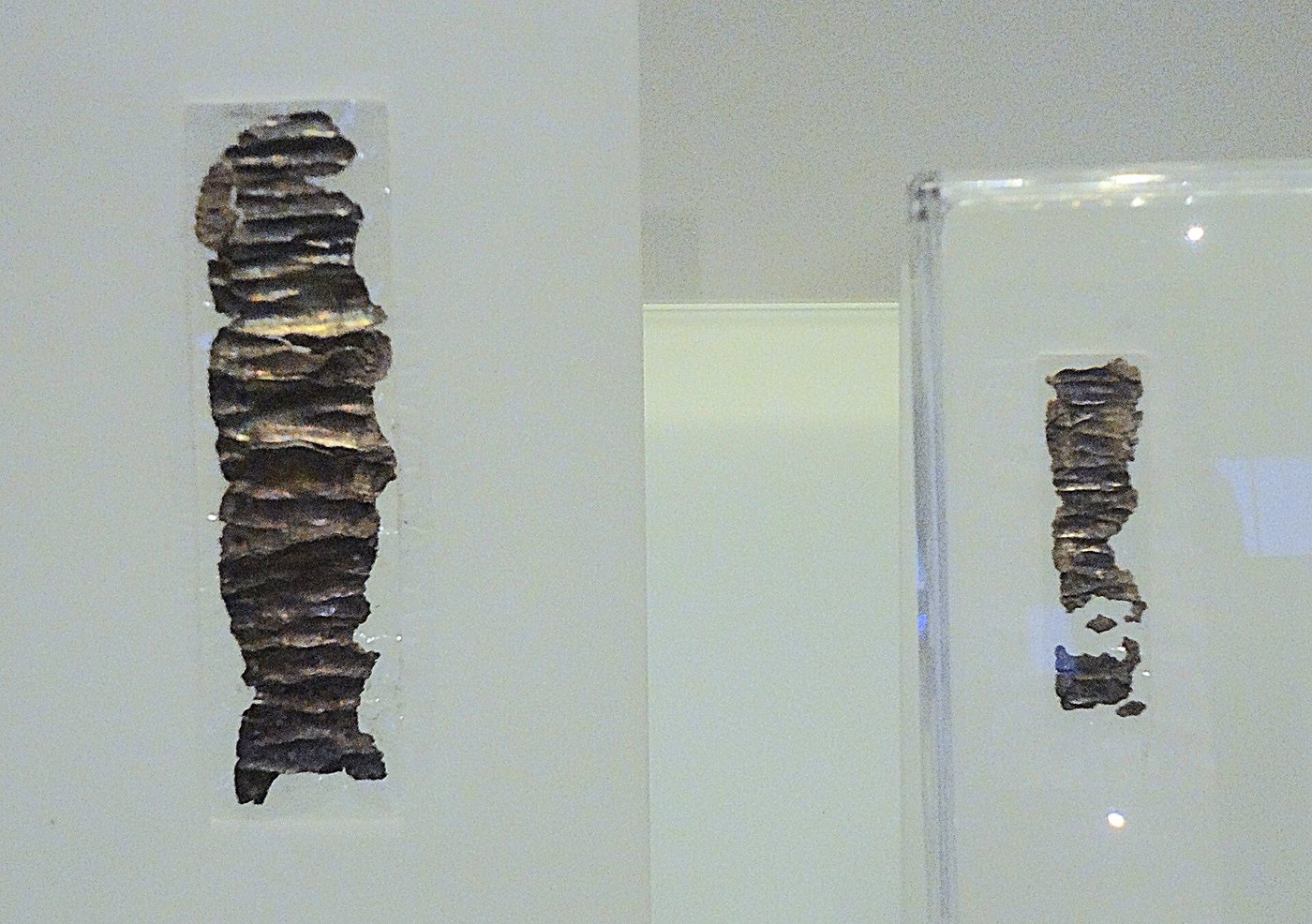
ConfirmedThe two silver scrolls on display. Unknown photographer, via Wikimedia Commons, Public domain.
The LORD bless thee, and keep thee: The LORD make his face shine upon thee, and be gracious unto thee: The LORD lift up his countenance upon thee, and give thee peace.
Numbers 6:24-26, KJV
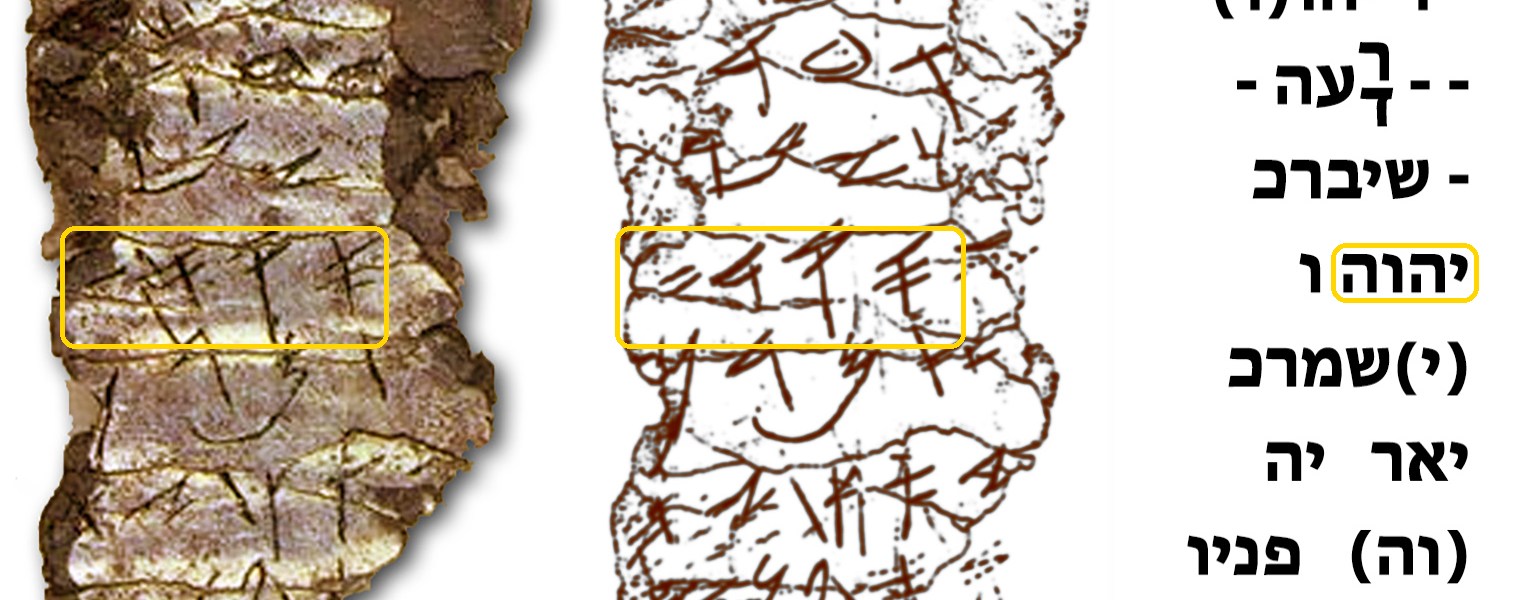
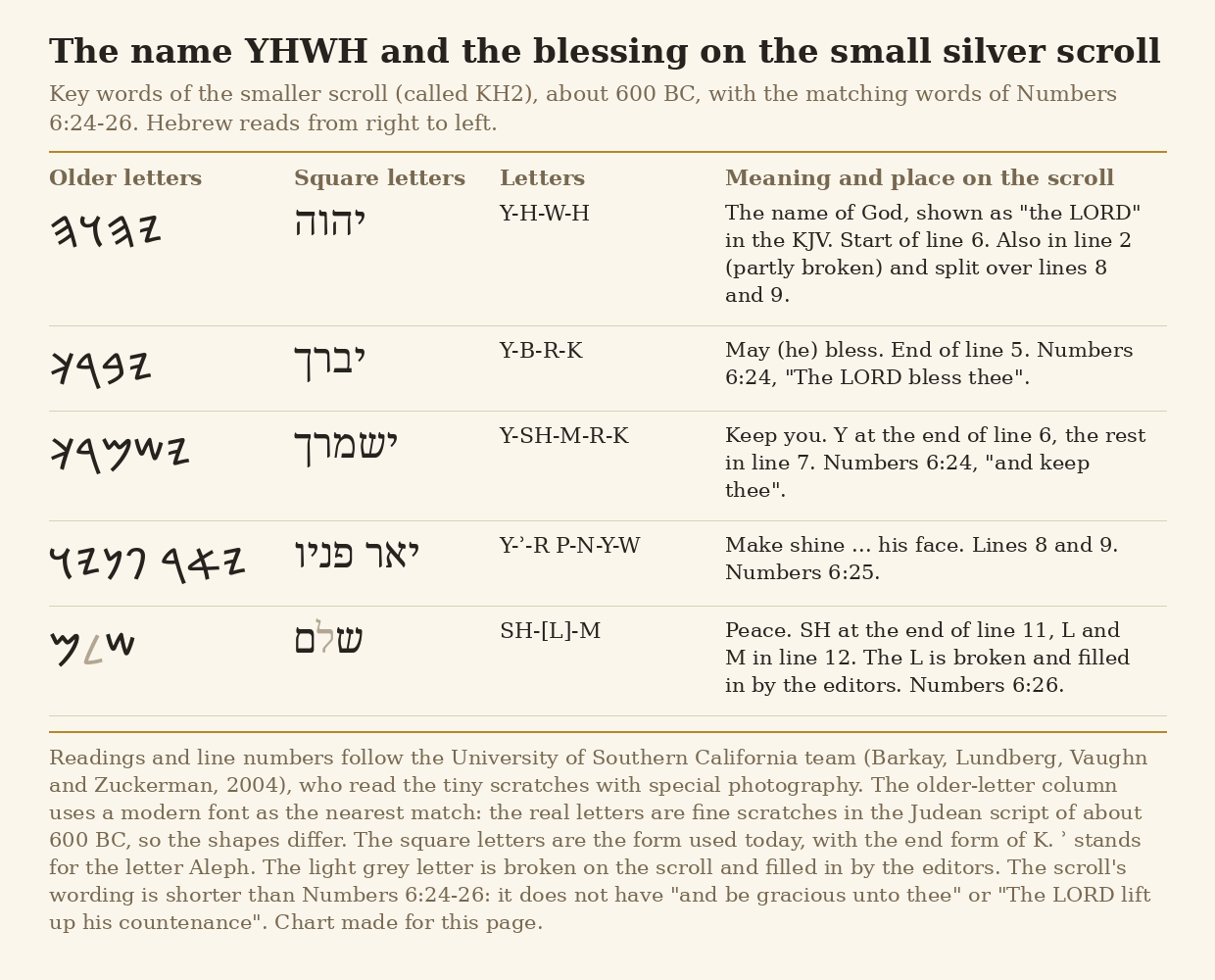
Two tiny sheets of silver, rolled up and worn as charms, were found in 1979 in a burial cave at Ketef Hinnom, just southwest of the Old City of Jerusalem. When they were unrolled, they were found to carry a form of the priestly blessing from Numbers 6:24-26, with the name of the LORD (YHWH) written several times. The larger scroll also has words close to Deuteronomy 7:9 about God keeping His covenant with those who love Him and keep His commandments. If the usual date is right, they are the oldest known objects that carry a passage also found in the Bible, several hundred years older than the Dead Sea Scrolls. A few of the same blessing words are older still (see below). The picture and chart below show where the name YHWH and the blessing words are on the smaller scroll.
The smaller silver scroll (called KH2), from a picture that sets three views side by side: left, a photo of the unrolled scroll; middle, a line drawing of its scratched letters; right, the letters in modern Hebrew type. The yellow boxes, added for this page, mark line 6 on the photo and on the drawing. Scholars read this line as starting with the name of God, YHWH (shown as "the LORD" in the KJV). On the right, the box marks the name itself in modern type. The scratches are too faint and tangled for us to box the 4 letters of the name one by one, so the whole line is boxed on the photo and the drawing. The modern type on the right follows an older reading in a few places: it ends line 6 with the letter W, where the 2004 reading has Y, the first letter of "keep you". Tamar Hayardeni (Hebrew Wikipedia), via Wikimedia Commons, Free to use with credit to the author.The name YHWH and the words of the blessing on the smaller silver scroll, in the older Hebrew letters and in today's square letters, with where each word sits on the scroll and the matching words of Numbers 6:24-26. The letter shown in light grey is broken on the scroll and filled in by the editors. Chart made for this page, free to reuse.
Where it is today
The Israel Museum, Jerusalem (the objects belong to the Israel Antiquities Authority). No public catalogue number was found. Unrolled, the larger scroll is about 27 by 97 mm and the smaller about 11 by 39 mm.
Date
About 650 to 587 BC, most likely about 600 BC, shortly before the Babylonians destroyed Jerusalem.
Why this label: The scrolls are genuine, and their words are clearly the priestly blessing of Numbers 6:24-26 in a slightly shorter form. What this confirms is that the blessing was in use around 600 BC; it does not by itself show when the book of Numbers was written.
Good to know: The wording is not the same as Numbers 6: the smaller scroll has 'bless you and keep you', 'make his face shine upon you' and 'give you peace', but not 'be gracious unto thee' or 'lift up his countenance upon thee' (the larger scroll breaks off after 'make shine'). In 1995 two German scholars, Johannes Renz and Wolfgang Röllig, said the script was too worn to date with certainty and might come from as late as the 200s or 100s BC; a 2004 study using new imaging confirmed the date before 587 BC, and most scholars accept it. Some of the same words are about 200 years older: an inscription on a large storage jar from Kuntillet Ajrud in northern Sinai, from about 800 BC, says 'may he bless you and keep you', using the same Hebrew words as the start of Numbers 6:24. That is a short, common blessing of the time, written there as part of a greeting, not a copy of the whole priestly blessing. It shows that at least part of the blessing was in use long before the silver scrolls were made. Scholars still disagree on what the scrolls prove: some say the book of Numbers already existed, while others say they show only that the blessing was a well-known prayer used both on charms and in Numbers.
The Deir Alla inscription naming Balaam son of Beor
Numbers 22:5 · Numbers 24:4 · Numbers 31:8
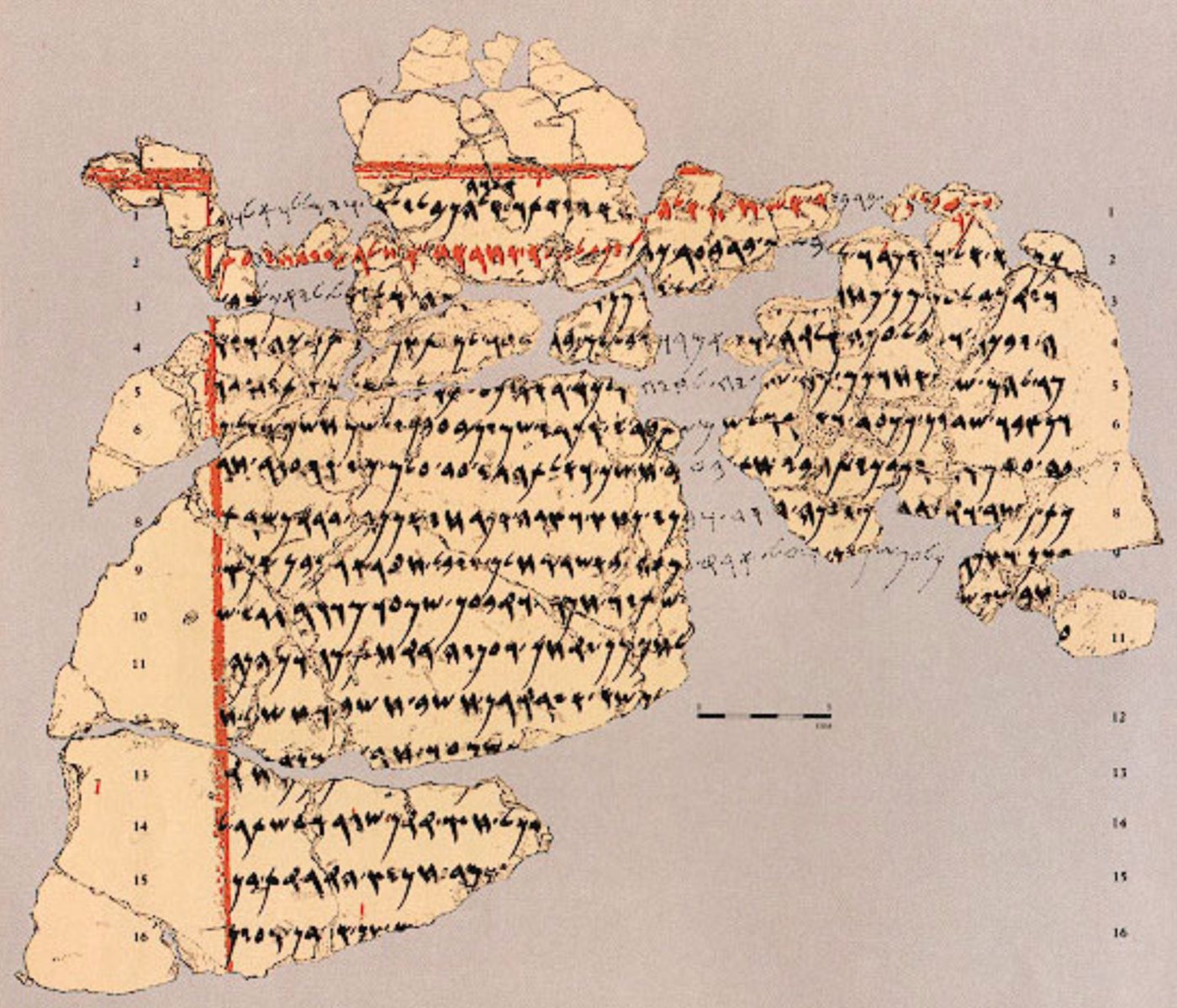
ConfirmedA modern drawing of the Deir Alla text (a drawing, not a photograph). Drawing by Disdero, via Wikimedia Commons, CC BY-SA 4.0.
He sent messengers therefore unto Balaam the son of Beor to Pethor, which is by the river of the land of the children of his people, to call him, saying, Behold, there is a people come out from Egypt: behold, they cover the face of the earth, and they abide over against me:
Numbers 22:5, KJV
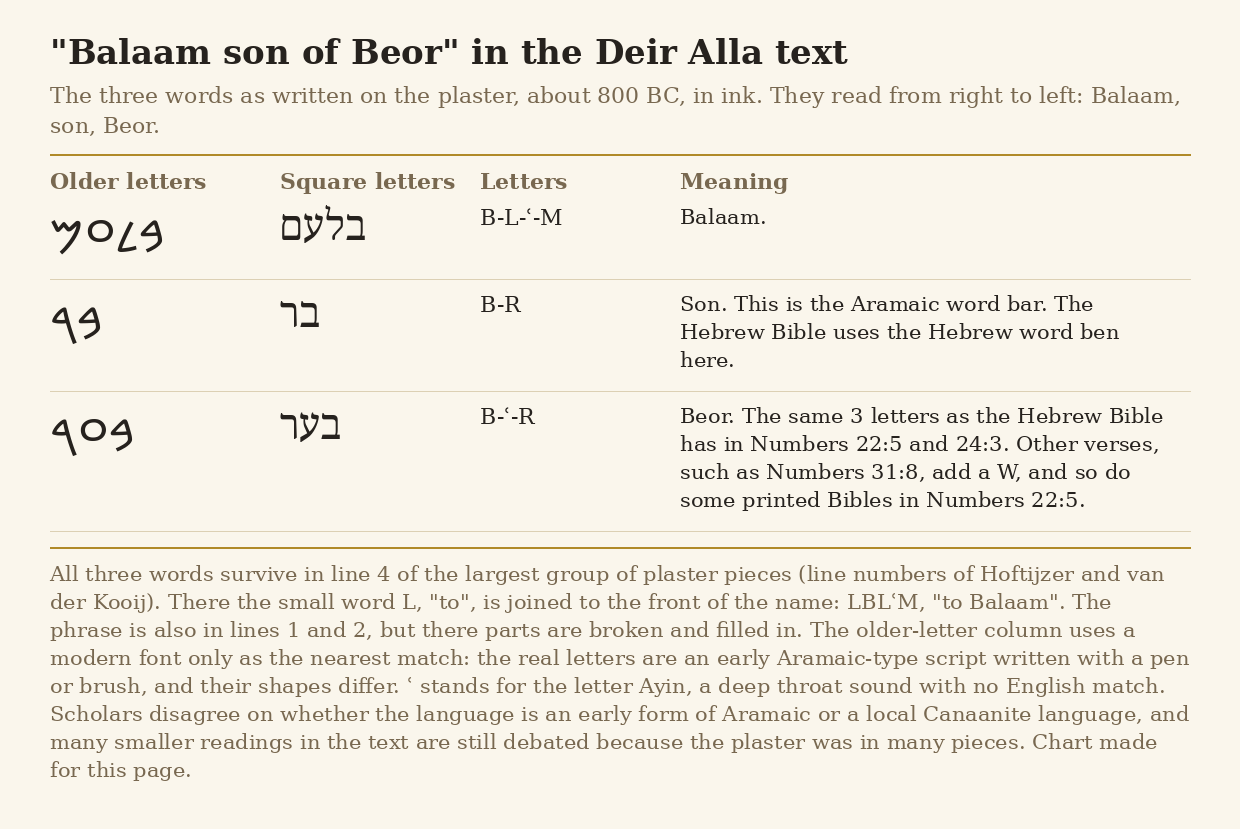
In 1967 a Dutch team digging at Tell Deir Alla (a mound of ruins) in the Jordan Valley found pieces of a text written in black and red ink on white wall plaster. As pieced together, it begins: 'The book of Balaam son of Beor, a seer of the gods.' The gods come to Balaam at night; in the morning he fasts and weeps, then tells his people that a council of gods (the Shaddayin) plans to bring darkness and disaster. Numbers 22 to 24 also names 'Balaam the son of Beor', a man who received messages from God at night and who 'saw the vision of the Almighty' (the Hebrew word there is Shaddai). The chart below shows how "Balaam son of Beor" is spelled on the plaster.
"Balaam son of Beor" as written on the Deir Alla plaster, with the letters in a modern font of older letters and in today's square Hebrew letters. The chart also notes how the spelling compares with the Hebrew Bible and what scholars still debate about the text. Chart made for this page, free to reuse.
Where it is today
Amman, Jordan. Older sources list the Jordan Archaeological Museum on the Amman Citadel; a photograph published in 2019 shows it on display at the Jordan Museum in Amman. Check which museum before visiting.
Date
About 800 BC (scholars' estimates run from about 880 to 700 BC). The building was brought down by an earthquake, probably around 800 BC.
Why this label: Confirmed here means only this: the inscription is genuine, and it names 'Balaam son of Beor', a seer, with the same name, father and role as the Balaam of Numbers 22 to 24. The name can be read clearly, though much of the rest of the broken text is pieced together and debated. It shows that stories about this seer were known east of the Jordan around 800 BC. It does not confirm any event in Numbers 22 to 24, and on its own it does not prove that Balaam was a real person, because it was written several hundred years after Moses' time.
Good to know: The Deir Alla text tells a different story from Numbers. There is no Balak, no Israel, no donkey and no blessing of Israel; Balaam speaks for other gods (El, Shagar-and-Ishtar and the Shaddayin) and warns his own people. It was written several hundred years after the dates usually given for Moses, so it is evidence that people remembered a seer named Balaam, not evidence of what he did in Moses' time. The plaster was found in many broken pieces, so parts of the reading are reconstructed and still debated.
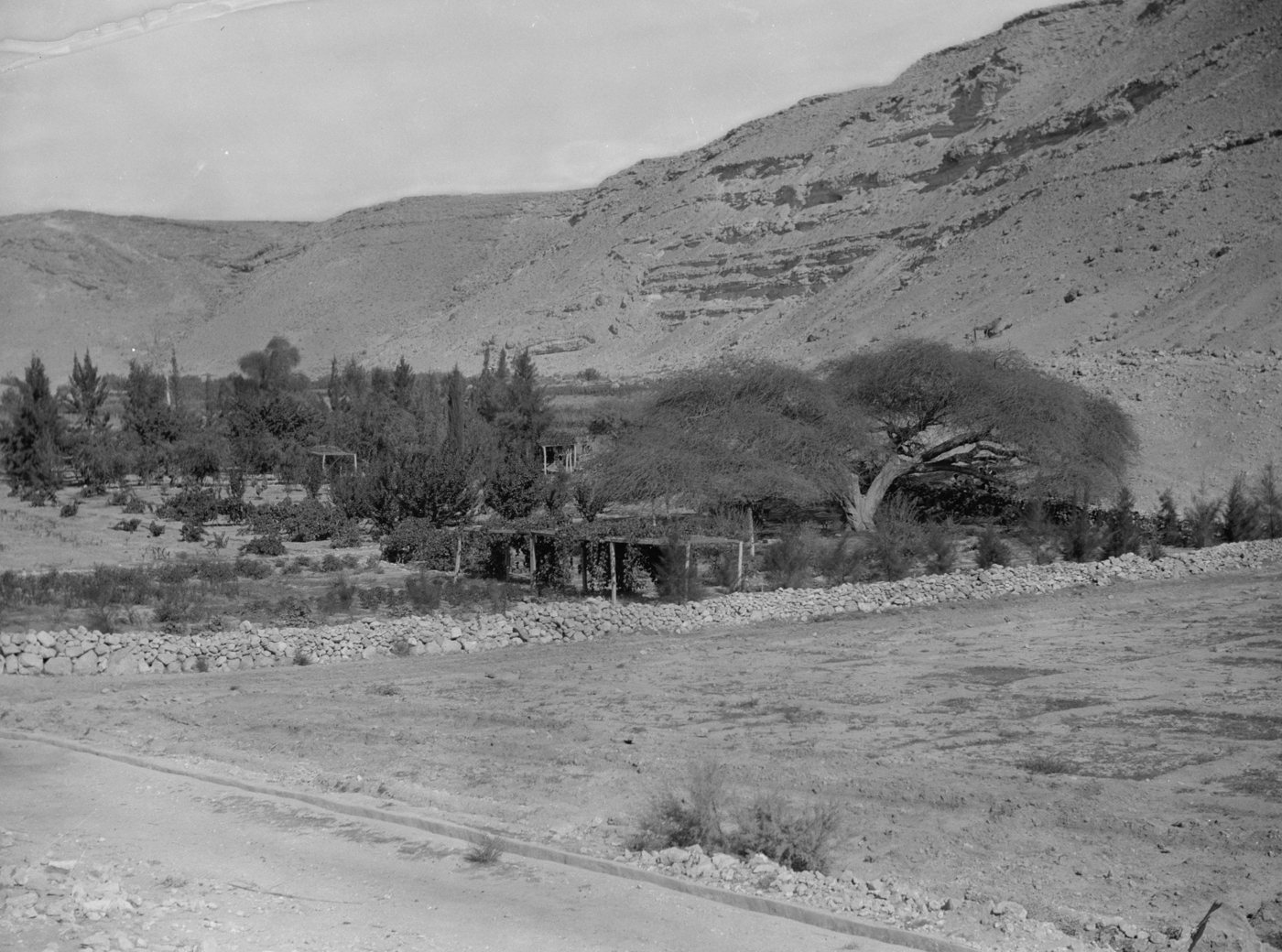
DisputedThe valley by the spring of Ain el-Qudeirat, with trees and stone terrace walls, photographed between about 1920 and 1933 and captioned 'Possibly Kadesh Barnea'. American Colony (Jerusalem) Photo Department; G. Eric and Edith Matson Photograph Collection, Library of Congress Prints and Photographs Division, LC-DIG-matpc-15542, No known restrictions on publication (Library of Congress statement).
Then came the children of Israel, even the whole congregation, into the desert of Zin in the first month: and the people abode in Kadesh; and Miriam died there, and was buried there.
Numbers 20:1, KJV
Kadesh, also called Kadeshbarnea (Numbers 32:8), was Israel's main camp in the wilderness. The twelve spies reported back there (Numbers 13:26), Miriam died there (Numbers 20:1), and Moses sent messengers from there to the king of Edom (Numbers 20:14). Most scholars place it at Ain el-Qudeirat in northeastern Sinai, the richest spring and oasis in the area. Beside the stream, about 6 kilometres southeast of the village of Quseima, stands Tell el-Qudeirat, a mound with the ruins of Iron Age forts, dug by Rudolph Cohen from 1976 to 1982.
Where it is today
North Sinai, Egypt, close to the border with Israel. Access is limited, so check before planning a visit.
Date
Remains at Tell el-Qudeirat begin about the 10th century BC (some date the lowest level to the 12th century BC). Forts stood there from about the 10th century BC to about 600 BC, with later use to about the 4th century BC. Nothing has been found from the time usually given for Moses.
Why this label: Most scholars today identify Kadesh Barnea with Ain el-Qudeirat, but no inscription names the site, and no remains from the time of Moses have been found there. Other springs and places have also been proposed.
Good to know: The forts were built in the 10th century BC or later, so they belong to the time of the kings, not Moses. Some reply that a desert camp of tents would leave little behind. The oldest finds, some pieces of local pottery and 4 small Egyptian-style seals and seal marks, may go back to about 1200 to 1000 BC; even these are a little later than the later date for Moses. Before 1905 many favoured the smaller spring of Ain Qedeis nearby, whose name sounds like Kadesh; the historian Josephus linked Kadesh, where Miriam was buried, with Petra in Jordan, and some scholars think the Bible speaks of two places called Kadesh.
ConfirmedA stretch of Highway 35, the modern road that follows the King's Highway. Malkawi99, via Wikimedia Commons, CC BY-SA 4.0.
Let us pass, I pray thee, through thy country: we will not pass through the fields, or through the vineyards, neither will we drink of the water of the wells: we will go by the king's high way, we will not turn to the right hand nor to the left, until we have passed thy borders.
Numbers 20:17, KJV
From Kadesh, Moses asked the king of Edom to let Israel travel along 'the king's high way', promising not to turn aside or drink from the wells, but Edom refused and came out against them (Numbers 20:14-21). Israel later asked Sihon, king of the Amorites, for the same road and was refused again (Numbers 21:21-23). The King's Highway is the ancient north-south route along the high plateau east of the Dead Sea and the Jordan Valley, linking Edom, Moab and Ammon. Today Jordan's Highway 35 follows much of the same line, past Madaba and Kerak and on to Wadi Musa, the town beside Petra, and dips through deep valleys such as Wadi Mujib (the Arnon).
Where it is today
Jordan, running north from the Petra area through Kerak and Madaba towards Amman. It is a popular scenic drive.
Date
The route along the plateau is very old. In the 9th century BC King Mesha of Moab wrote that he made 'the highway at the Arnon', which is probably part of this road. The Romans under Emperor Trajan (reigned AD 98 to 117) built a paved road along much of it, the Via Nova Traiana ('Trajan's New Road'), finished under the next emperor, Hadrian. Still in use today.
Why this label: The road is real and very old, and scholars broadly agree that the Bible's 'king's high way' is this main route along the plateau east of the Jordan. No inscription from Moses' time names it, and Edom's refusal is known only from the Bible.
Good to know: The Moabite king Mesha (9th century BC) wrote on the Mesha Stele (a stone slab carved with writing) that he made 'the highway at the Arnon', which is probably part of this road. Scholars debate how settled Edom was at the time of Moses: most Edomite towns dug so far date from the 8th to 6th centuries BC, but copper-mining camps go back to the 11th century BC, and an Egyptian letter from about 1200 BC mentions 'Shasu tribes of Edom'.
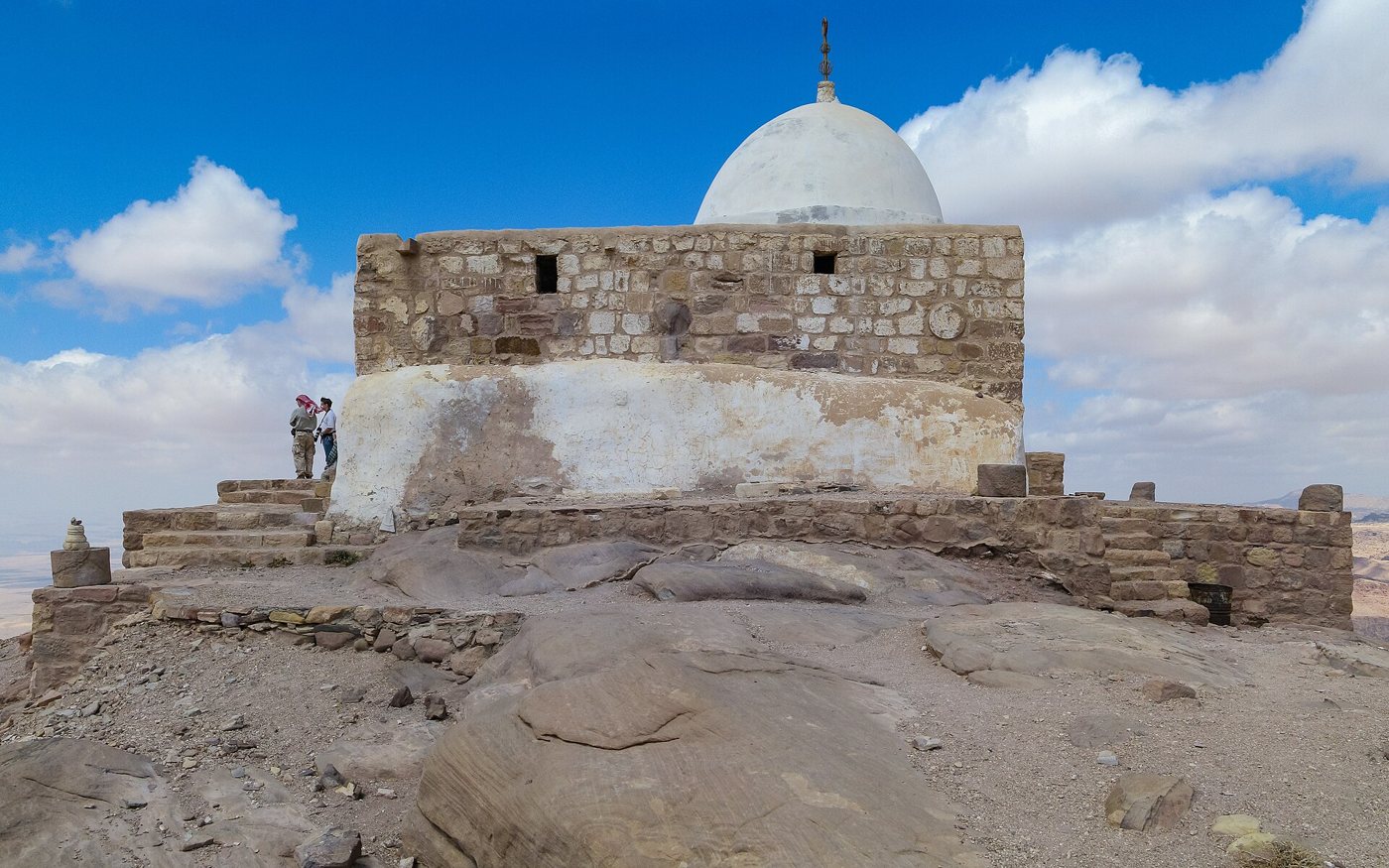
Traditional siteThe white-domed shrine of Aaron on the summit of Jebel Harun. Joneikifi, via Wikimedia Commons, CC BY-SA 3.0.
And Moses stripped Aaron of his garments, and put them upon Eleazar his son; and Aaron died there in the top of the mount: and Moses and Eleazar came down from the mount.
Numbers 20:28, KJV
Numbers says Aaron died on top of Mount Hor, 'in the edge of the land of Edom', after Moses put Aaron's priestly garments on his son Eleazar (Numbers 20:22-29; 33:37-39). The Jewish historian Josephus (1st century AD) placed Mount Hor beside Petra, and since then it has been identified with Jebel Harun ('Aaron's mountain'), a twin-peaked mountain about 1,350 metres high near Petra in southern Jordan. On the summit is a small white-domed shrine, rebuilt about AD 1320 under al-Nasir Muhammad, the Muslim ruler (sultan) of Egypt and Syria at the time, over the remains of an earlier church. Below the summit are the ruins of a monastery of Aaron from Byzantine times (when the eastern Roman Empire was Christian), dug by a Finnish team from 1997 to 2007; a papyrus from Petra dated AD 573 mentions 'the house of our Lord the Saint High-Priest Aaron'.
Where it is today
Jebel Harun, about 5 kilometres (3 miles) from central Petra, Ma'an Governorate, Jordan. Reaching the summit is a long hike, and access to the shrine can be limited, so check before planning a visit.
Date
Tradition from at least the 1st century AD; church and monastery from about the 5th century AD; the present shrine from about AD 1320.
Why this label: Jews, Christians and Muslims have linked this mountain to Aaron for many centuries (Josephus placed Aaron's death by Petra in the 1st century AD), but the Bible gives no exact location, and nothing found on the mountain dates from Aaron's time or names it as Mount Hor.
Good to know: Deuteronomy 10:6 says Aaron died and was buried at Mosera. Some place Mosera at the foot of Jebel Harun, but others point out that Numbers 33:31-37 lists 6 other camps between Moseroth and Mount Hor, and for similar reasons some doubt that Mount Hor is Jebel Harun at all. Some 19th- and early 20th-century scholars preferred Jebel Madara (also spelled Madurah), a peak near Kadesh, close to today's border between Israel and Egypt.
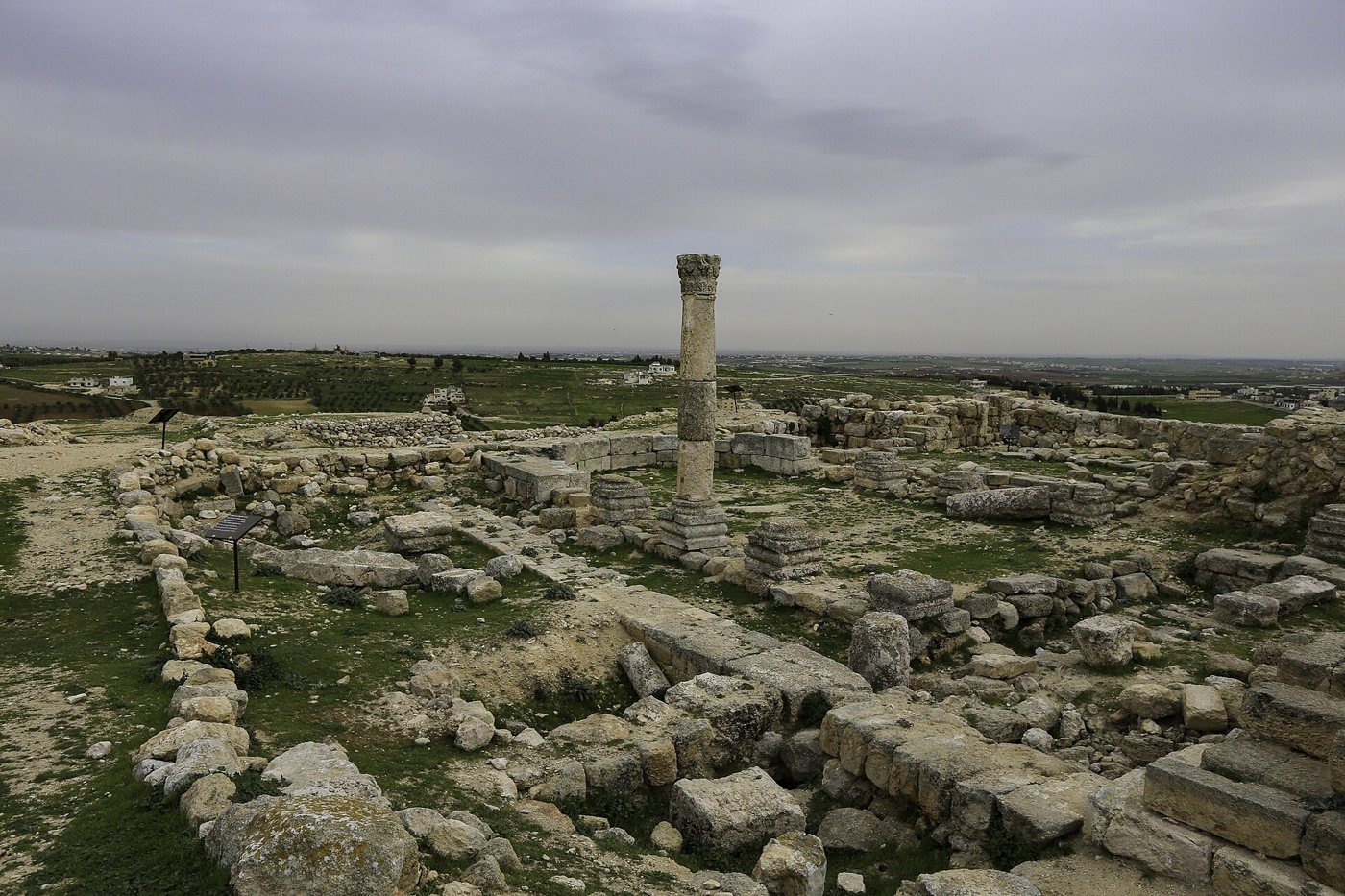
DisputedA standing column among the ruins at Tell Hesban. Bashar Tabbah, via Wikimedia Commons, CC BY-SA 4.0.
For Heshbon was the city of Sihon the king of the Amorites, who had fought against the former king of Moab, and taken all his land out of his hand, even unto Arnon.
Numbers 21:26, KJV
Numbers says Heshbon was the city of Sihon, king of the Amorites, who had taken Moab's land as far as the Arnon, and that Israel defeated Sihon and lived in his cities (Numbers 21:21-31). Heshbon later became a town of Reuben and Gad, and Isaiah and Jeremiah speak of it as a town of Moab. The name survives at Tell Hesban (also spelled Tall Hisban), a mound about 20 kilometres southwest of Amman and 9 kilometres north of Madaba in Jordan. Andrews University dug there from 1968 to 1976 (the Heshbon Expedition), hoping to find Sihon's city, and work has continued since 1996.
Where it is today
Tell Hesban (Tall Hisban), by the town of Hisban, Madaba Governorate, Jordan. The excavators have been preparing the site for visitors; check opening details before going.
Date
A few scattered pottery pieces from about 1200 to 1000 BC; a town from the later Iron Age (after about 1000 BC) through Roman and Byzantine times and the Islamic Middle Ages, and later.
Why this label: Tell Hesban keeps the ancient name, but the excavators found no town there from the Late Bronze Age, the time usually given for Moses. Whether this mound is Sihon's Heshbon is therefore debated.
Good to know: The excavators' own summary lists no buildings and no pottery from Late Bronze Age Heshbon (about 1550 to 1200 BC). William Dever sums up the finds as only a few scattered pieces of pottery from about 1200 to 1000 BC, with the town itself starting later. One reply is that Sihon's Heshbon stood at another mound nearby and the name later passed to Tell Hesban; Tall Jalul and Tall el-Umeiri, both within about 10 kilometres, have been suggested. Another is that later building on this busy hill destroyed or moved the earliest remains: the present directors, Øystein LaBianca and Bethany Walker, say some remains from the Late Bronze Age and the early Iron Age were found, but mostly mixed into soil and rubble moved by later builders. Some scholars, such as William Dever, take the gap as a sign that the story of Sihon's Heshbon is not history.
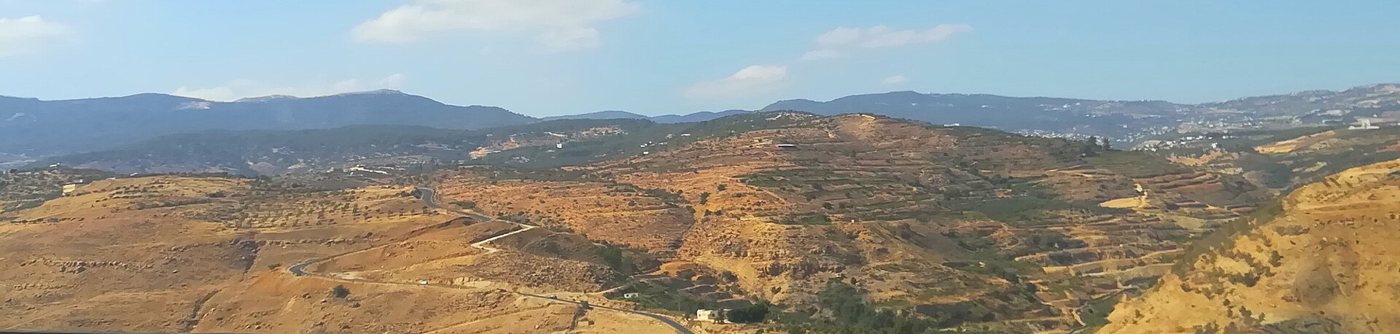
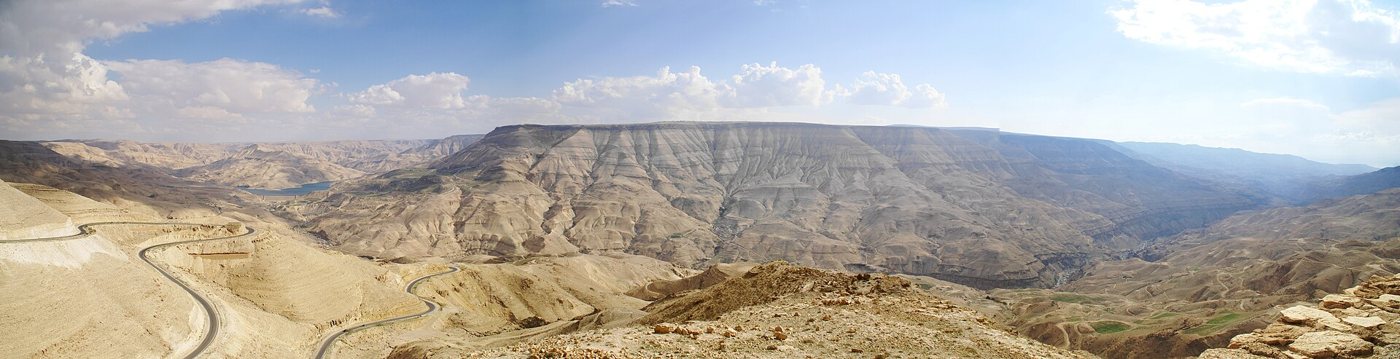
ConfirmedWide view of Wadi Mujib (the Arnon) from a lookout on the north side, with the lake behind the Mujib Dam at the far left. F. Higer, via Wikimedia Commons, CC BY-SA 3.0.
From thence they removed, and pitched on the other side of Arnon, which is in the wilderness that cometh out of the coasts of the Amorites: for Arnon is the border of Moab, between Moab and the Amorites.
Numbers 21:13, KJV
Numbers says that 'Arnon is the border of Moab, between Moab and the Amorites', and God told Israel to 'pass over the river Arnon' to face Sihon (Deuteronomy 2:24). The Arnon is today's Wadi Mujib in Jordan, a deep canyon that drains west into the Dead Sea. Travellers on the King's Highway still drop into the gorge and climb out the other side, and the Mujib Dam, finished in 2004, now stands where the road crosses.
Where it is today
Wadi Mujib, Jordan, between Madaba and Kerak. The lower canyon near the Dead Sea is the Mujib Biosphere Reserve, popular for hiking.
Date
A natural valley. It is named as Moab's northern border in the Bible, and the Moabite king Mesha names the Arnon in the 9th century BC.
Why this label: Scholars broadly agree that the Arnon is Wadi Mujib, the great canyon that the Bible names as Moab's northern border, and the Moabite king Mesha also names the Arnon. There is no inscription at the gorge itself.
Good to know: In the 9th century BC King Mesha of Moab wrote on the Mesha Stele (a stone slab carved with writing) that he made 'the highway at the Arnon', which is probably the King's Highway crossing of this gorge. The Bible describes the Arnon as a border at a set time: Numbers 21:26 says Sihon had taken Moab's land up to it. At other times Moab held towns north of the Arnon too, such as Dibon and Madaba, as the Mesha Stele shows.
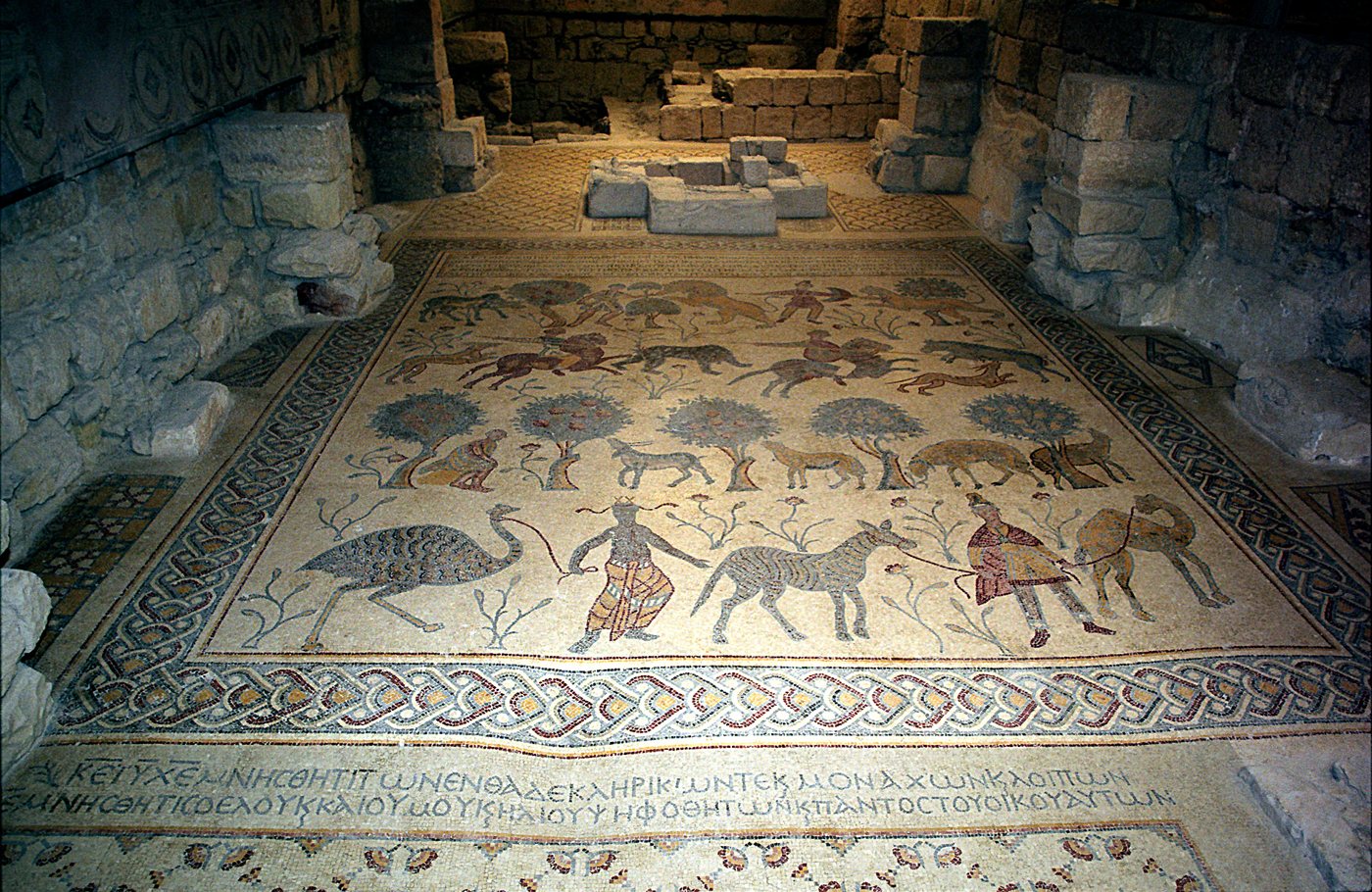
Traditional siteMosaic floor of the old baptism room in the Memorial Church of Moses on Mount Nebo. Jerzy Strzelecki, via Wikimedia Commons, CC BY-SA 3.0.
And Moses went up from the plains of Moab unto the mountain of Nebo, to the top of Pisgah, that is over against Jericho. And the LORD shewed him all the land of Gilead, unto Dan,
Deuteronomy 34:1, KJV
Mount Nebo is a ridge in Jordan, east of the Dead Sea and across the Jordan Valley from Jericho. Deuteronomy says God told Moses to climb Nebo, look at the land of Canaan, and die there. On the Siyagha peak stands the Memorial Church of Moses, built over the ruins of a church from the late 300s AD that was later enlarged. Its floors hold mosaics from Byzantine times (when the eastern Roman Empire was Christian), the best known being a scene of hunters, herders and animals in the old baptism room, dated by its Greek inscriptions to AD 531.
Where it is today
Siyagha peak of Mount Nebo, near Madaba, Jordan. The site is cared for by the Franciscan friars of the Custody of the Holy Land and is open to visitors. The rebuilt church reopened in 2016.
Date
Church first built in the second half of the 300s AD, enlarged in the late 400s and rebuilt in AD 597. Baptism room mosaic dated AD 531. Excavated from 1933 onward.
Why this label: The ridge fits the Bible's description (in Moab, across from Jericho), and Christians have honoured this peak since at least the 380s AD. But no inscription or find pins down the exact place where Moses stood.
Good to know: Deuteronomy 34:6 says no one knows where Moses was buried, so the church is a memorial, not a proven grave. When the pilgrim Egeria visited in about AD 381 to 384 (some older books say 394), the monks showed her a raised spot in the small church and said angels had laid Moses there; they took Deuteronomy 34:6 to mean that no one saw how he was buried. From the summit on a clear day you can see the Jordan Valley, the north end of the Dead Sea and Jericho, and sometimes the hills around Jerusalem.
DisputedFront view of the Iron Age stone structure on Mount Ebal. Bukvoed, via Wikimedia Commons, CC BY 4.0.
And there shalt thou build an altar unto the LORD thy God, an altar of stones: thou shalt not lift up any iron tool upon them.
Deuteronomy 27:5, KJV
Deuteronomy tells Israel to build an altar of uncut stones on Mount Ebal, near Shechem, and Joshua 8 says Joshua did so. In 1980 the archaeologist Adam Zertal found a large stone structure on the northeast slope of Ebal and dug it from 1982 to 1989. It was filled with layers of stones, ash and burnt animal bones (young bulls, goats and fallow deer), with a sloping stone ramp and paved courtyards beside it. Zertal argued it was the altar of Joshua 8. In 2019 a team led by Scott Stripling sifted the soil Zertal had thrown out and found a folded piece of lead about 2 cm across, which they say carries a curse in early Hebrew using the name of God.
Where it is today
Northeast slope of Mount Ebal, north of Nablus, in the West Bank. Part of a wall was damaged in 2021. Access is limited, so check before planning a visit. The lead object was studied by Stripling's team; its present storage place is not stated in the sources read.
Date
Structure: about 1250 to 1150 BC. Almost all the pottery is from about 1200 to 1150 BC, with a little from just before 1200 BC. The excavator, Adam Zertal, dated its 2 building stages to about 1250 and 1225 BC. Two Egyptian scarabs (small seals shaped like beetles) were also found: Baruch Brandl dated them to the 1200s BC, while Daphna Ben-Tor and Pieter Gert van der Veen date at least one of them earlier, to the time of Thutmose the Third or soon after (the 1400s BC). Lead object: dated by its finders to about 1200 BC or a little earlier; critics say its date cannot be fixed.
Why this label: Many archaeologists accept that the site was an early Israelite place of worship of some kind, but there is no agreement that it is Joshua's altar. Most experts who have published on the lead object say they cannot see any writing on it.
Good to know: Other views of the structure: Aharon Kempinski said it was a watchtower in a small village, and Israel Finkelstein and Nadav Na'aman accept that it was a place of worship but doubt it is an altar from Joshua's time. On the lead object: the finders published their reading in the journal Heritage Science in May 2023. Three papers in the Israel Exploration Journal in late 2023 replied: Aren Maeir and Christopher Rollston saw no letters at all, Amihai Mazar argued it is a fishing net weight, and Naama Yahalom-Mack found the lead came from Lavrion in Greece, a mine used over a very long time, so it does not fix the date. A 2024 paper by Mark Haughwout in Heritage Science also rejected the reading. Stripling and Pieter Gert van der Veen replied, and van der Veen has stepped back from his co-author Gershon Galil's full reading while still saying he sees some letters. As of 2026 the object is still strongly disputed.
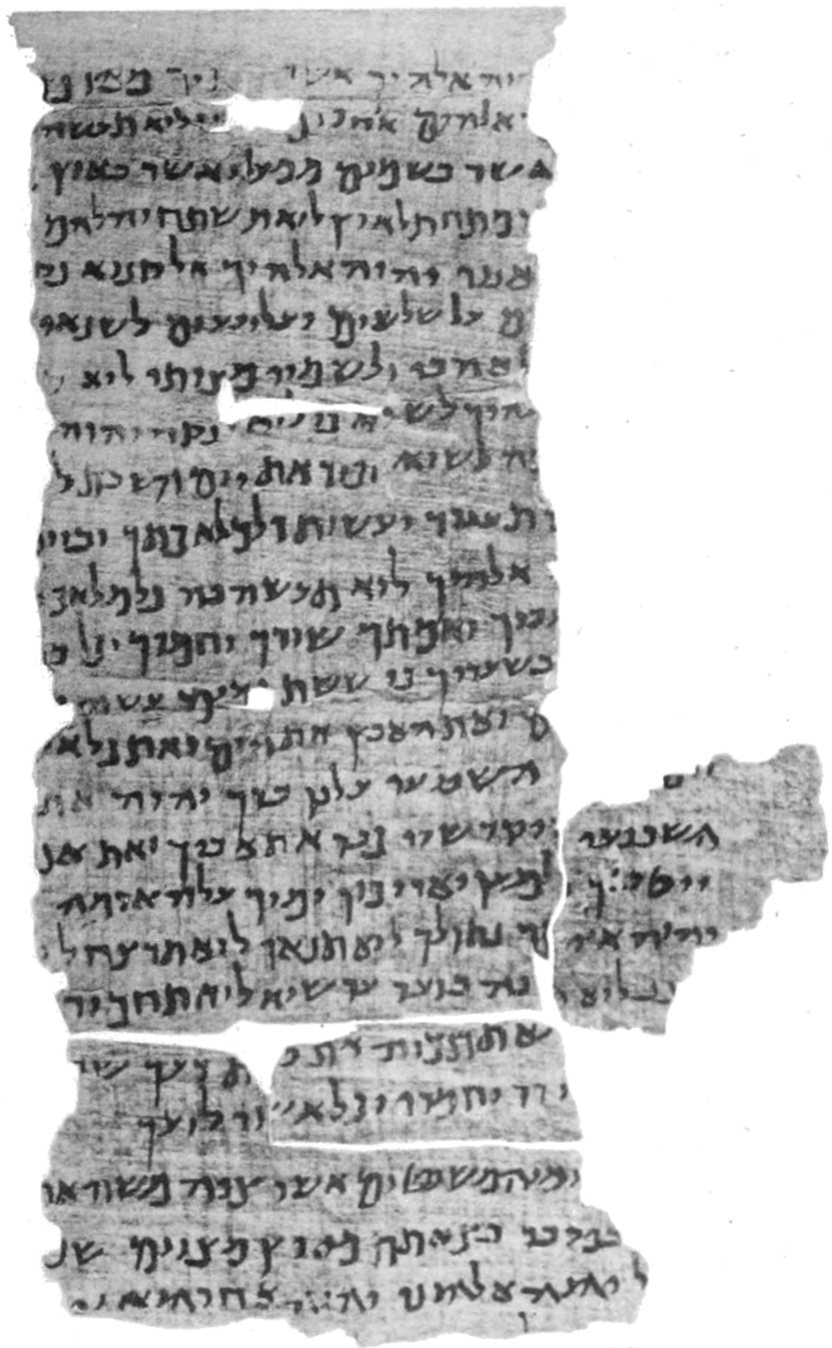
ConfirmedThe Nash Papyrus, as photographed for its first publication in 1903. Photograph first published in the Proceedings of the Society of Biblical Archaeology, 1903, via Wikimedia Commons, Public domain.
Hear, O Israel: The LORD our God is one LORD:
Deuteronomy 6:4, KJV
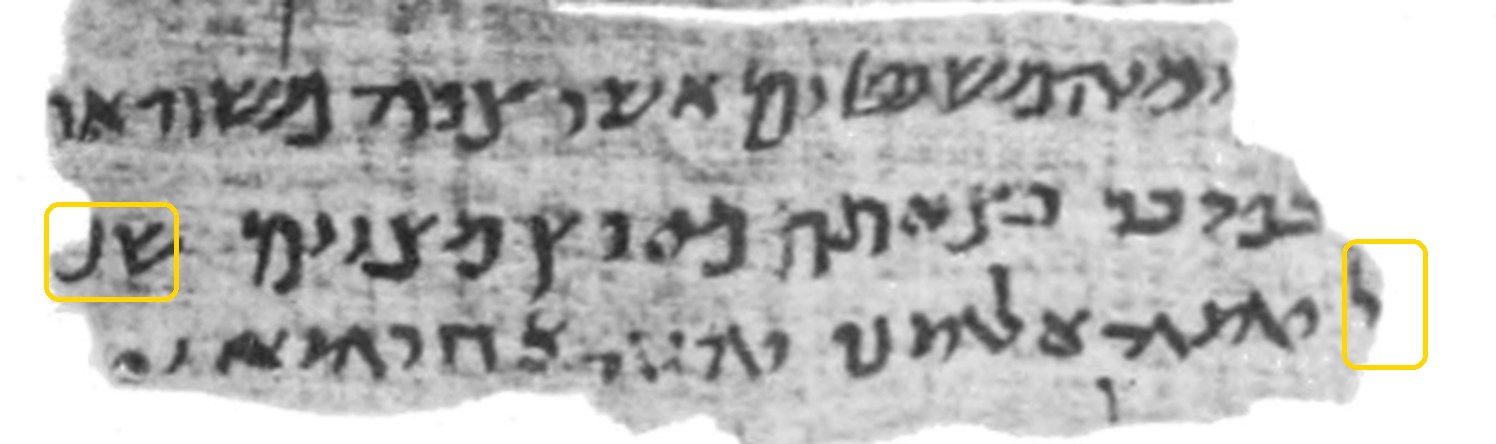
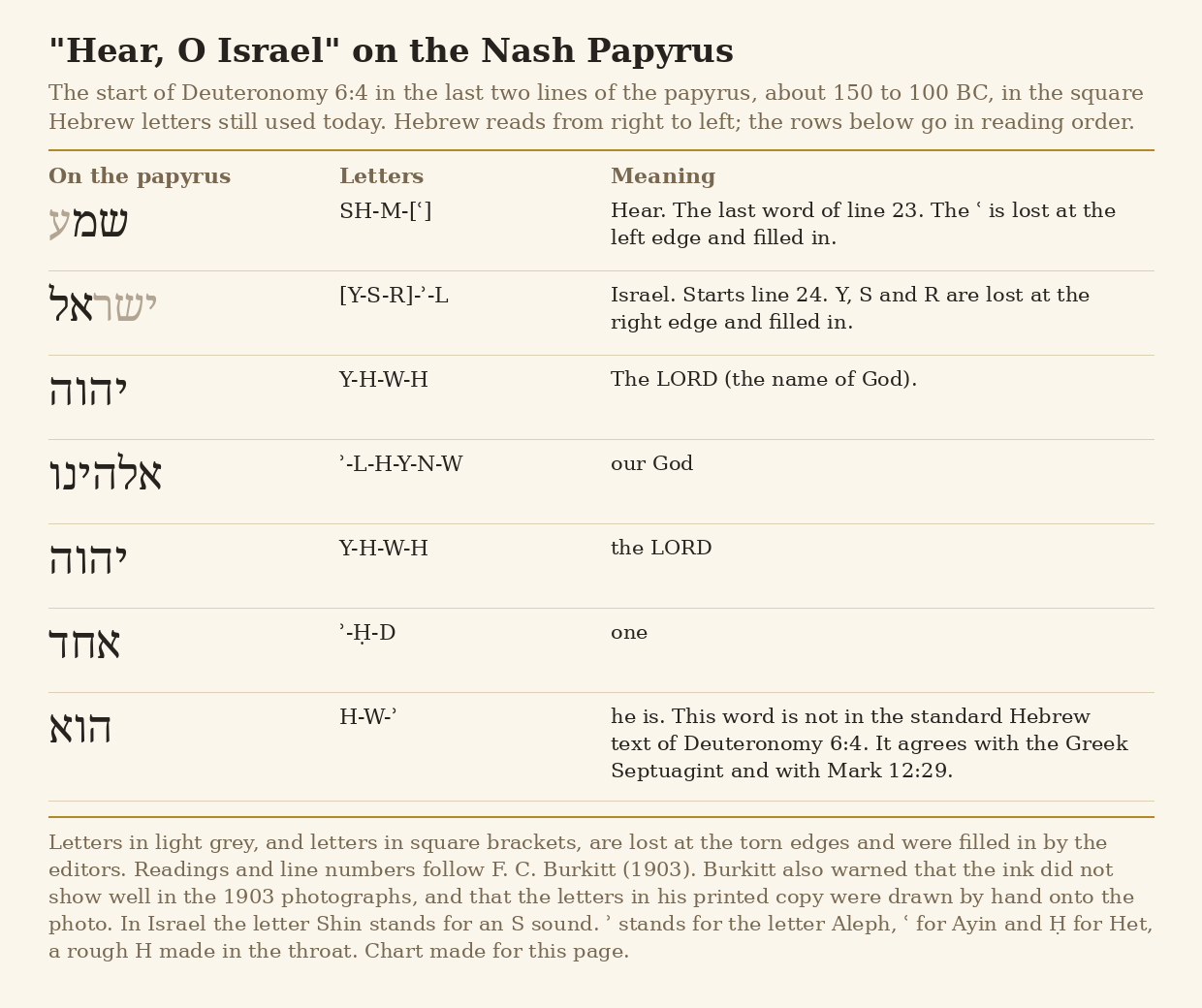
The Nash Papyrus is a small sheet of papyrus, about 14 by 6 centimetres, made up of 4 pieces that fit together. Its 24 lines of Hebrew give the Ten Commandments followed by the start of the Shema ("Hear, O Israel", Deuteronomy 6:4-5). Its wording of the commandments mixes Exodus 20 and Deuteronomy 5, and in places it agrees with the Septuagint (the early Greek translation) rather than the later standard Hebrew text. Scholars think it was a sheet for daily prayer, possibly from a set of tefillin (small prayer boxes), not a page from a Bible scroll. The photo and chart below show "Hear, O Israel" in the last two lines of the papyrus.
The last 3 lines of the Nash Papyrus, from the photograph published in 1903. The ink did not show well in photographs at the time, and one 1903 editor, F. C. Burkitt, said the letters in his plate were drawn in by hand on the photo; this plate may have been made the same way. The yellow boxes, added for this page, mark what survives of "Hear, O Israel" (Deuteronomy 6:4). Hebrew reads from right to left, so "Hear" is the last word of line 23 and "Israel" starts line 24. Left box: the letters SH and M of "Hear"; its last letter is lost at the edge. Right box: the end of "Israel" at the torn right edge; its first letters are lost. The rest of line 24, "the LORD our God, the LORD is one", is well kept and is not boxed. Photograph first published in the Proceedings of the Society of Biblical Archaeology, 1903, via Wikimedia Commons, Public domain."Hear, O Israel: the LORD our God, the LORD is one" as written on the Nash Papyrus, word by word in square Hebrew letters. Letters in light grey are lost at the torn edges and were filled in by the editors. Chart made for this page, free to reuse.
Where it is today
Cambridge University Library, England, shelf mark MS Or.233. W. L. Nash bought it from a dealer in Egypt and gave it to the library in 1903.
Date
About 150 to 100 BC (the library's catalogue gives the 2nd century BC). It was first dated to the 1st or 2nd century AD and later moved earlier.
Why this label: This is a genuine ancient Hebrew copy of the Ten Commandments and the Shema, passages found in Deuteronomy (and, for the commandments, also in Exodus). It shows these texts were being written out and prayed by Jews over 2,000 years ago; it does not by itself say who wrote Deuteronomy or when.
Good to know: When it came to light in 1903 it was the oldest known Hebrew manuscript with any Bible text. That changed after 1947, when the Dead Sea Scrolls were found, some of them older. Its text does not match any one Bible passage word for word, likely because it was a prayer sheet that combined Exodus and Deuteronomy.
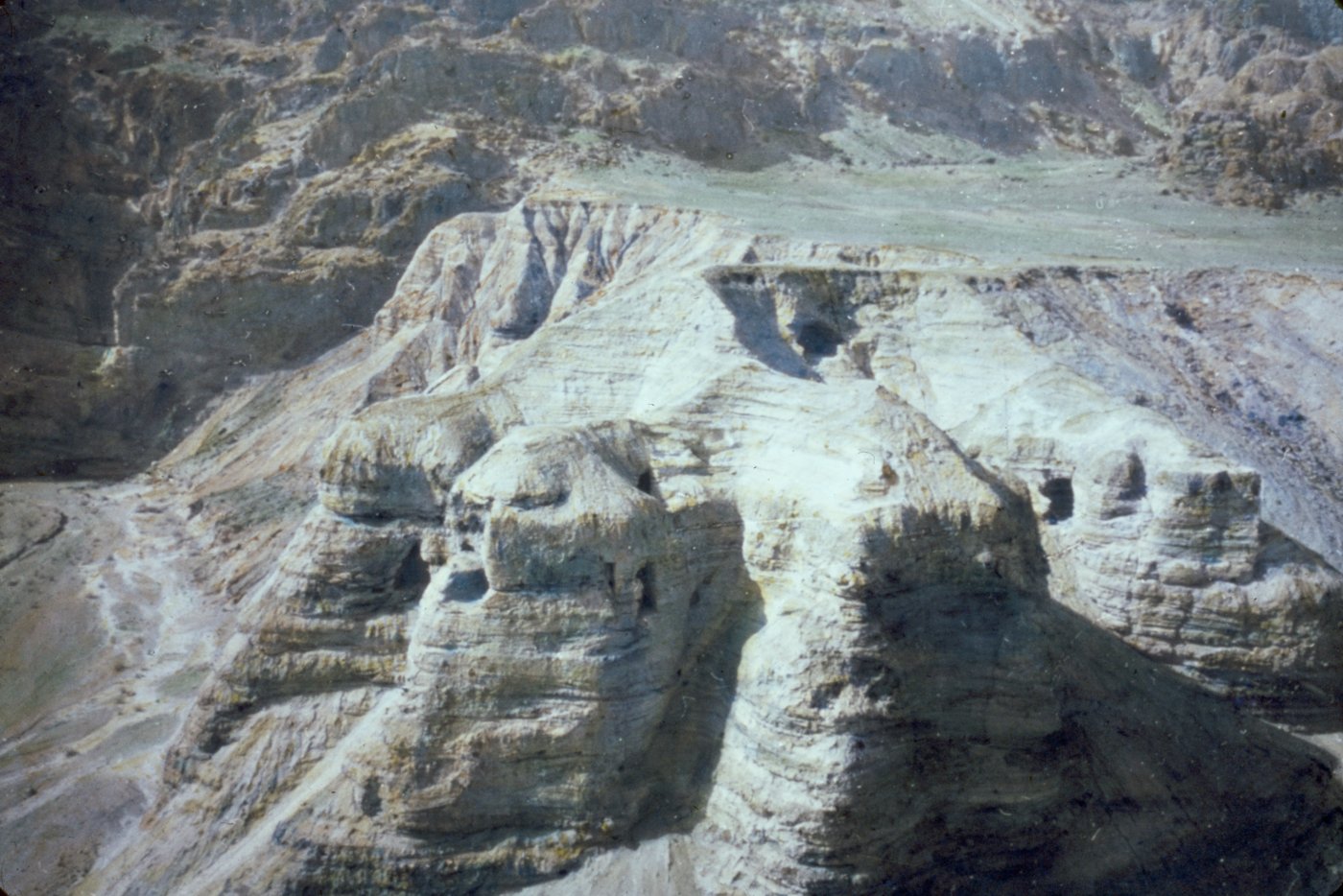
ConfirmedThe caves of Qumran above the Dead Sea. The openings in the rock spur in front are Cave 4, where most of the scrolls were found, including many copies of Deuteronomy. Colour slide taken between 1947 and 1961. G. Eric and Edith Matson Photograph Collection, Library of Congress Prints and Photographs Division, LC-DIG-matpc-22896, No known restrictions on publication (Library of Congress statement).
And thou shalt bind them for a sign upon thine hand, and they shall be as frontlets between thine eyes.
Deuteronomy 6:8, KJV
Among the Dead Sea Scrolls found at Qumran between 1947 and 1956, Deuteronomy is one of the books copied most often: about 30 copies (counts range up to 33, depending on how fragments are grouped), second only to the Psalms. One of the best preserved is 4Q41, the "All Souls Deuteronomy", which holds Deuteronomy 5:1 to 6:1, including the Ten Commandments, and Deuteronomy 8:5-10. The caves also held tefillin: tiny leather boxes and folded parchment slips with passages from Exodus and Deuteronomy, for example Deuteronomy 5:1 to 6:3 and 10:12 to 11:12 in one set. They show the command to "bind them for a sign upon thine hand" being carried out in the time before and during Jesus' life.
Where it is today
Jerusalem: the scrolls and tefillin are held by the Israel Antiquities Authority (IAA), and some are shown at the Israel Museum. In 2014 a researcher announced that he had found 9 tiny tefillin slips, never unrolled, among Qumran items stored since the 1950s.
Date
Qumran scrolls as a whole: 3rd century BC to 1st century AD. 4Q41: about 30 to 1 BC. Qumran tefillin: 2nd and 1st centuries BC and 1st century AD.
Why this label: These are real ancient copies of Deuteronomy and real tefillin holding its words, dated by handwriting style and the context of the caves. They confirm the book was widely copied and used in prayer by the 1st century BC; they do not settle who first wrote it or when.
Good to know: The Qumran copies are very close to the later standard Hebrew text in most places but show small differences in wording, as 4Q41 does when it adds the Exodus reason for the Sabbath. Some scholars think 4Q41 was a set of chosen passages for study or prayer, not a full copy of the book.
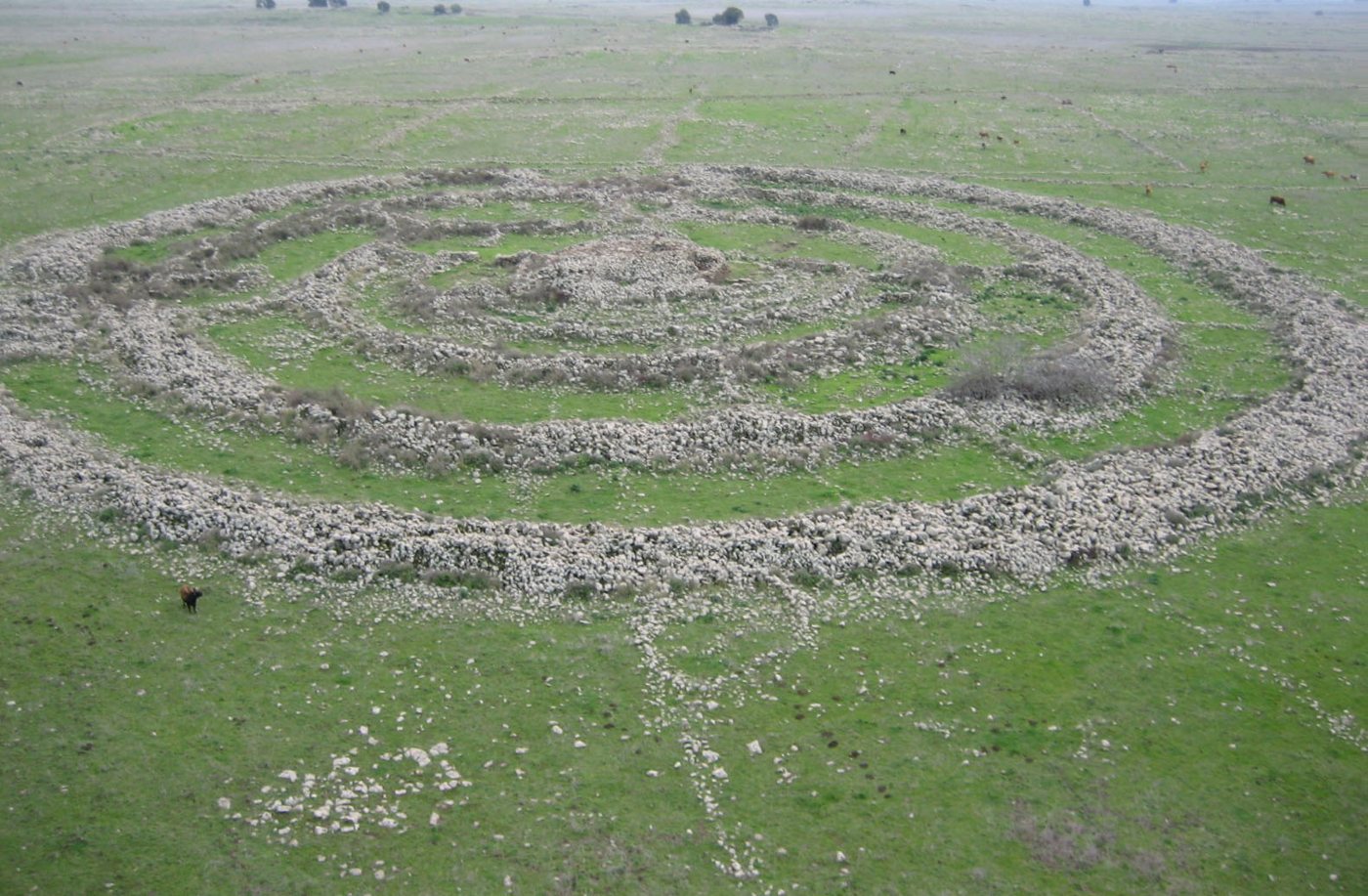
DisputedAerial view of Rujm el-Hiri, the stone circle in the Golan Heights, looking south (2007). Wikimedia Commons user Asaf.ts, CC BY-SA 3.0.
For only Og king of Bashan remained of the remnant of giants; behold his bedstead was a bedstead of iron; is it not in Rabbath of the children of Ammon? nine cubits was the length thereof, and four cubits the breadth of it, after the cubit of a man.
Deuteronomy 3:11, KJV
Deuteronomy says Og, king of Bashan, was the last of the Rephaim (giants) and that his iron bedstead, about 4 metres by 1.8 metres, could still be seen in Rabbath of the Ammonites, today's Amman in Jordan. The Golan and northern Jordan hold thousands of dolmens: ancient tombs made of large flat stones set on upright stones. Some writers suggest Og's "bed" was really a stone burial slab or a dolmen; in 1918 Gustaf Dalman reported a dolmen near Amman of about the right size. Rujm el-Hiri, a huge set of stone rings with a central burial mound in the Golan, sits in a dolmen field and is sometimes linked to the Rephaim.
Where it is today
No bed or coffin of Og has been found. Dolmens: Golan Heights, Galilee and northern Jordan (more than 5,600 structures built of huge stones, most of them dolmens, were recorded in the Golan survey alone). Rujm el-Hiri: Golan Heights, about 16 km east of the Sea of Galilee; a marked hiking trail passes it.
Date
Dolmens: dated with difficulty; in the Golan and Galilee the earliest finds are from about 2500 to 2000 BC, and east of the Jordan dolmens were used from about 3500 BC. Rujm el-Hiri: built about 3000 to 2700 BC; the central tomb may be later.
Why this label: Rabbath (Amman) is a known city, but no object can be tied to Og. Linking his bed to dolmens or to Rujm el-Hiri is an idea some writers suggest, not something proven by any find or inscription.
Good to know: The Hebrew word in Deuteronomy 3:11 means iron; the idea that it means dark basalt is a guess, and others take "bedstead" to mean a coffin. The dolmens are hundreds of years older than any likely date for Moses (the earliest finds in the Golan dolmens are from about 2500 to 2000 BC, and some east of the Jordan were used much earlier), and Rujm el-Hiri is well over 1,000 years older. So at most they could be old monuments that people of his day already saw. The name "Gilgal Refaim" (wheel of the Rephaim) for Rujm el-Hiri is a modern Hebrew name, not an ancient one. A 2024 study found that the circle does not line up with sunrise on the longest or shortest day or the equinoxes, which counts strongly against the popular idea that it was an ancient calendar.
 LearnAboutHim