Evidence You Can See: The Letters, Revelation and the First Martyrs
Real places you can visit and real objects you can see in museums, connected to the New Testament letters and the book of Revelation, and to the first Christians who died for their faith: the churches of Asia named in Revelation, the tombs of the apostles, and the arenas and records of the early martyrs. Each one is marked honestly, so you can tell solid evidence from tradition and from claims that are still argued over.
ConfirmedThe place or object is real and is clearly the one the Bible names. For a written object, such as an inscription or a scroll, it means the object is genuine and its words are read with confidence, not that every event it mentions is proven.10
Traditional siteA real place that long tradition links to the Bible, but the exact spot cannot be proven.8
DisputedInformed people disagree, or the claim rests on weak evidence.2
BackgroundShows the world the Bible describes, but does not name a Bible person or event.6
The Seven Churches of Revelation
1
Smyrna (Izmir): the agora and the city in John's time
Revelation 2:8-11 · Revelation 1:11
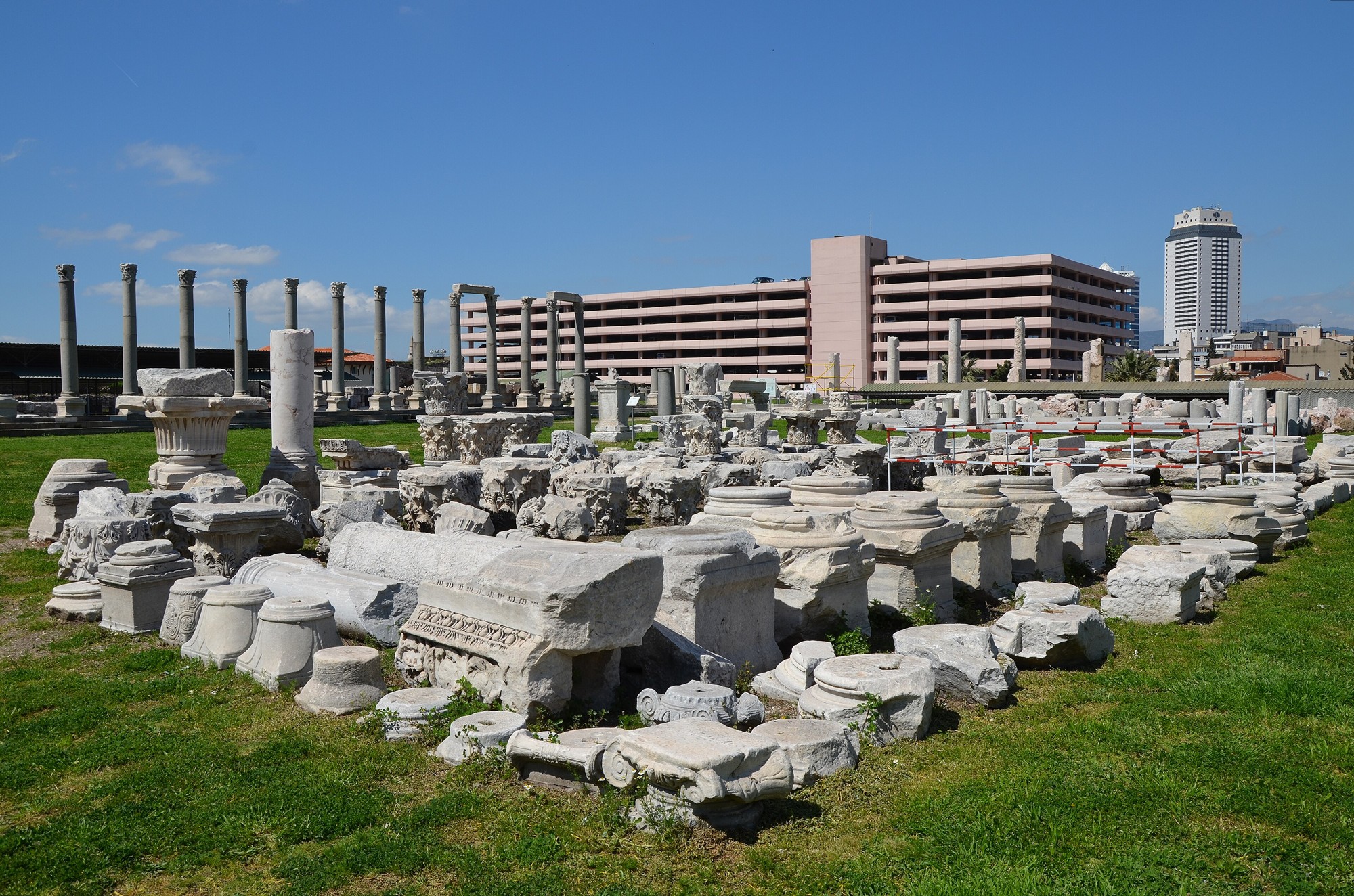
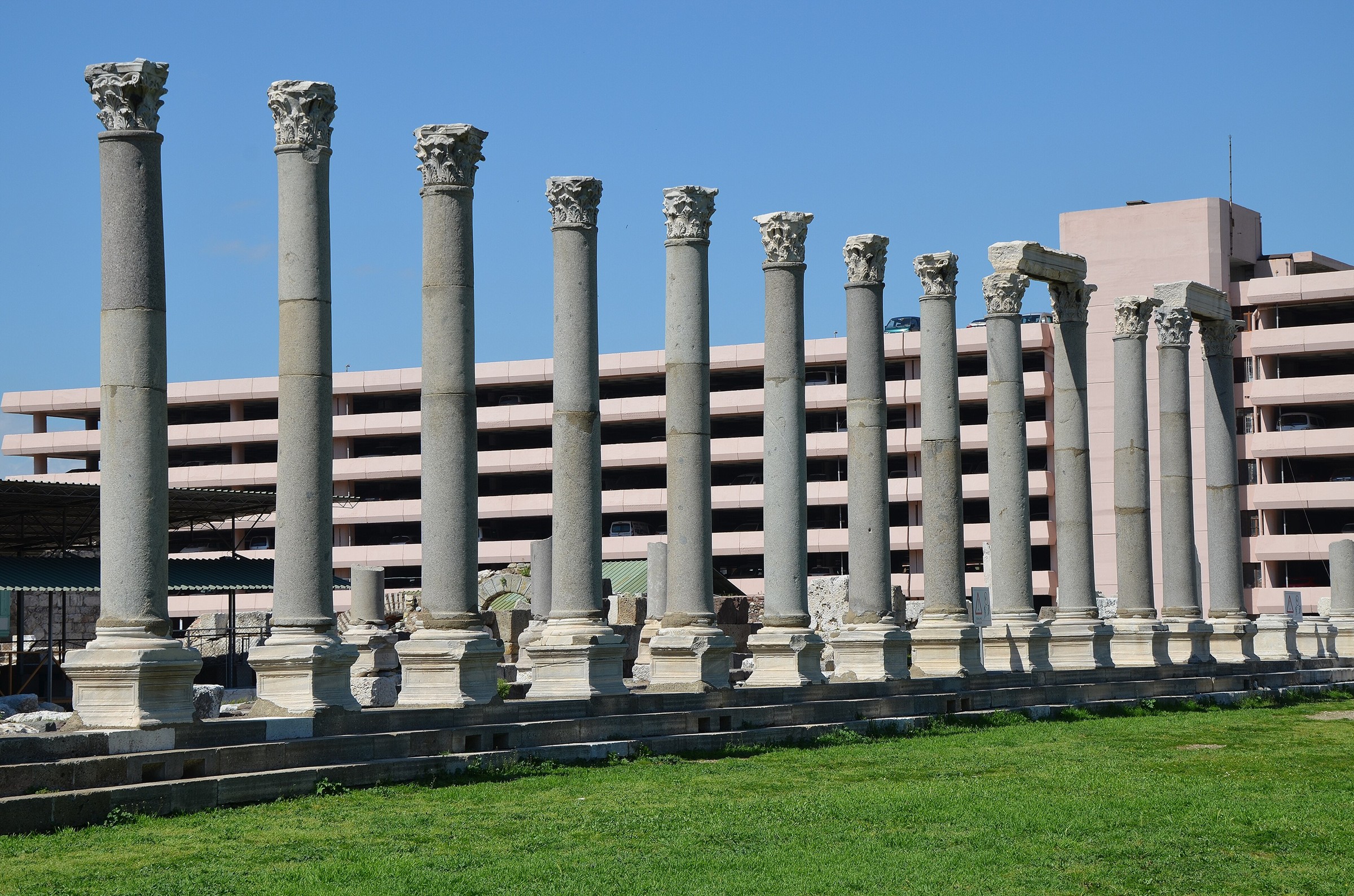
ConfirmedColumns and fallen carved stones of the Roman agora (market square) of Smyrna, with modern Izmir behind. Carole Raddato from FRANKFURT, Germany, via Wikimedia Commons, CC BY-SA 2.0.
Fear none of those things which thou shalt suffer: behold, the devil shall cast some of you into prison, that ye may be tried; and ye shall have tribulation ten days: be thou faithful unto death, and I will give thee a crown of life.
Revelation 2:10, KJV
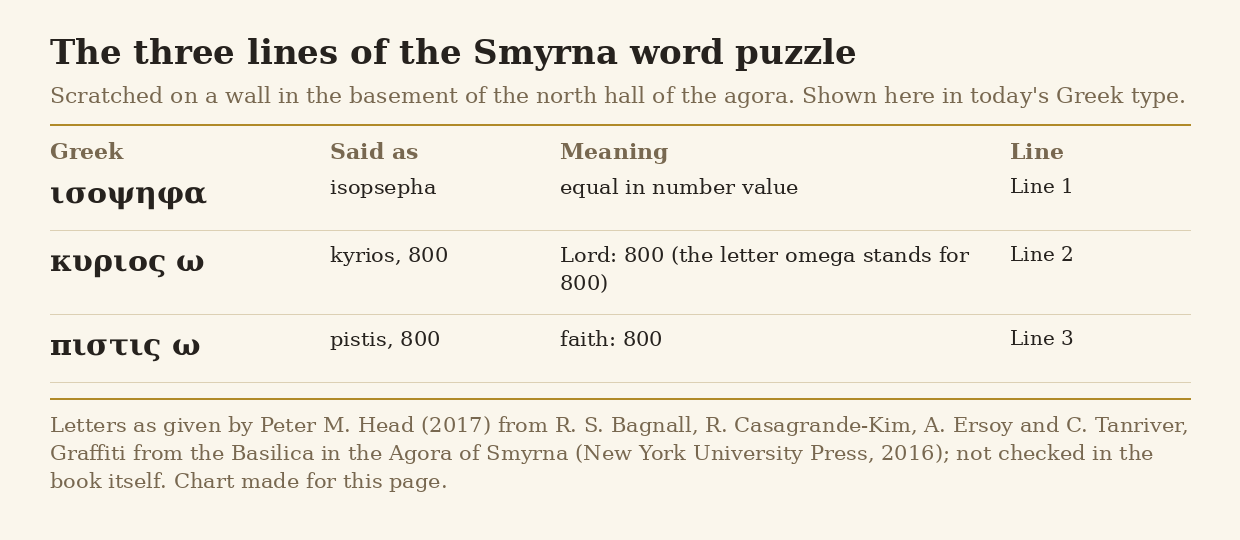
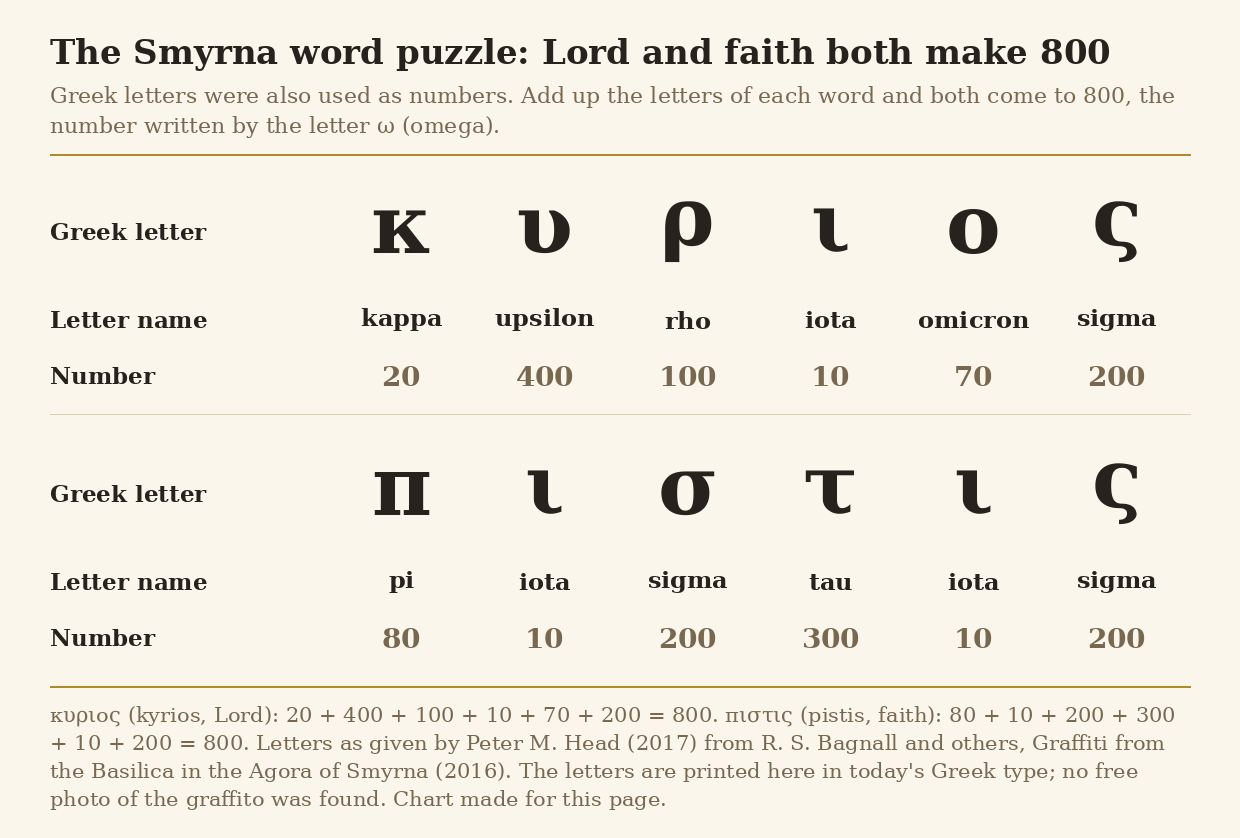
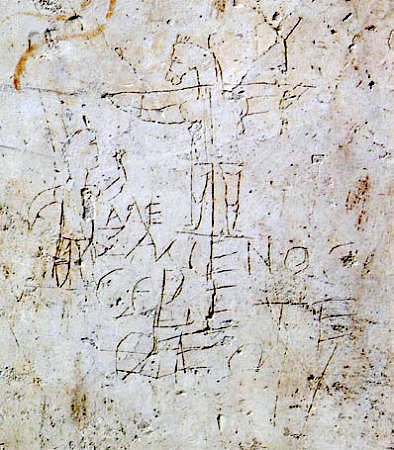
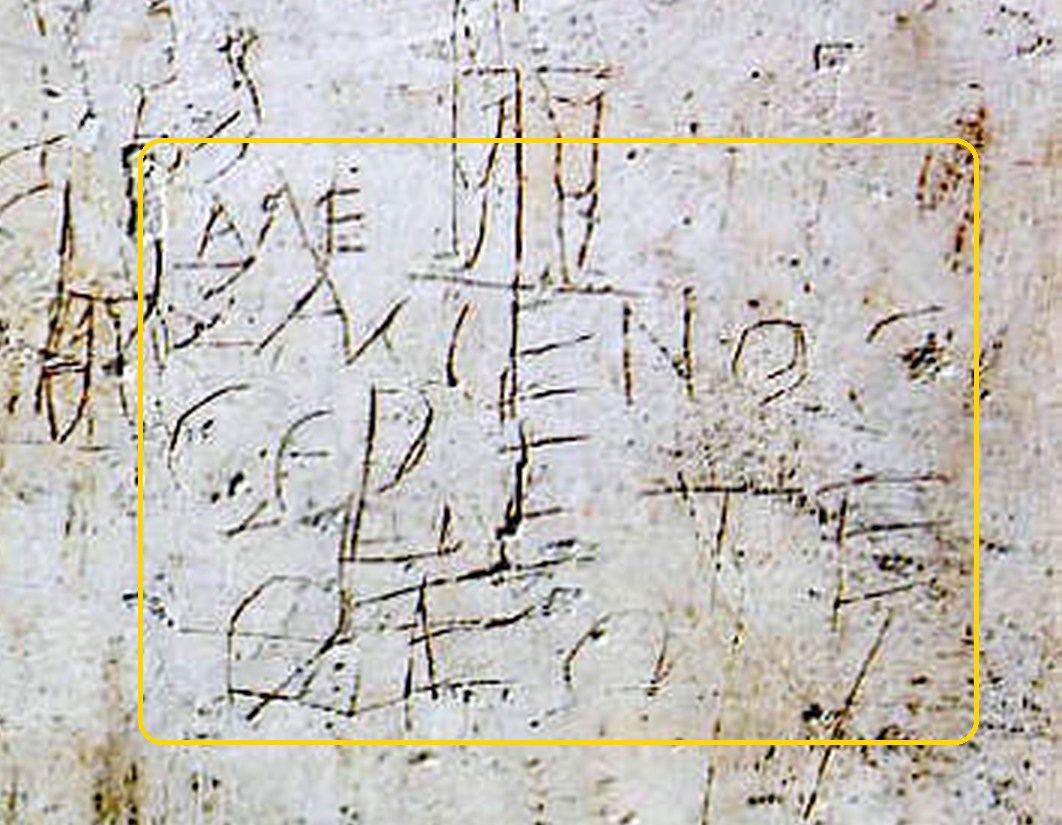
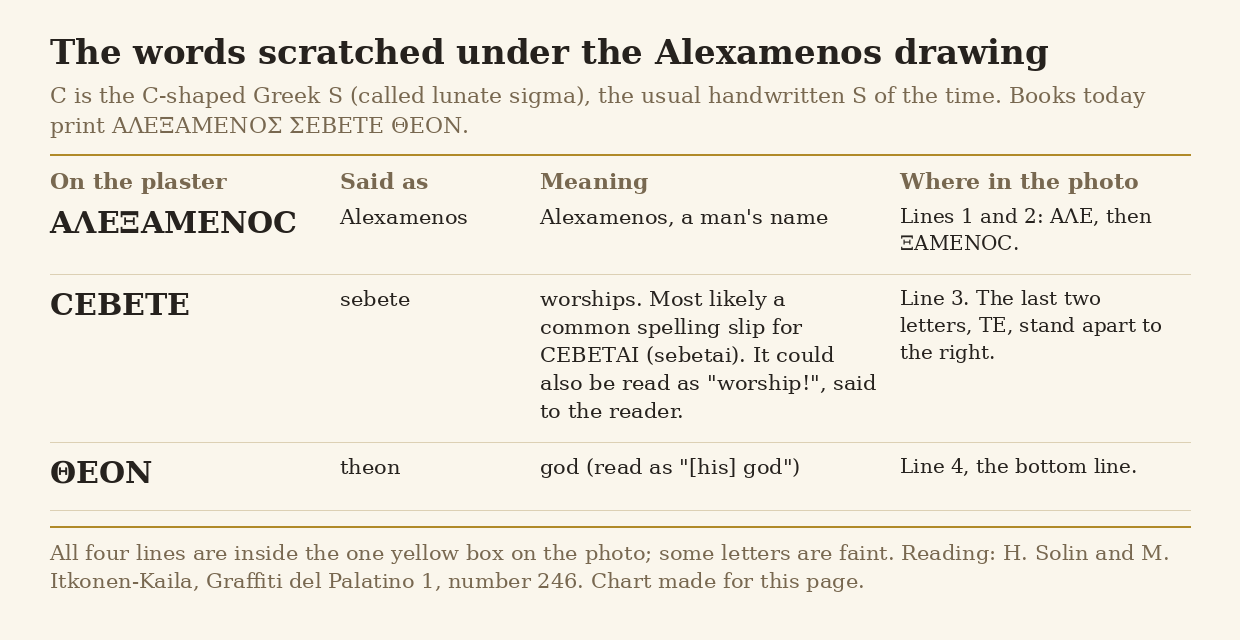
Smyrna was a large, rich harbour city on the west coast of what is now Turkey. The modern city of Izmir is built over it. Revelation 2:8 to 11 is the letter to the church there, which is told it will suffer and must be faithful unto death. Visitors can walk through the remains of the city's main public square (the agora), with rows of columns, a long hall with a vaulted basement, and an arched gate with a carved portrait of the empress Faustina. The charts below show a Christian word puzzle scratched in the basement of the agora, and how its two words, Lord and faith, both add up to 800.
The three lines of the Christian word puzzle scratched in the agora basement, with how they sound and what they mean. Chart made for this page, free to reuse.How the puzzle works: each Greek letter also stands for a number, and the letters of "Lord" and of "faith" both add up to 800. Chart made for this page, free to reuse.
Where it is today
Agora of Smyrna open-air site, central Izmir, Turkey. Finds are kept in the Izmir museums.
Date
The city was moved to the slopes of Mount Pagos in the 300s BC, and the agora was first built in the Hellenistic period (the centuries after Alexander the Great). Most of what stands today is from the rebuilding after the earthquake of AD 178, paid for with help from the emperor Marcus Aurelius. Revelation is usually dated about AD 95.
Why this label: Smyrna's name has stayed in use without a break (Izmir comes from Smyrna), and scholars agree it is the city of Revelation 2:8. No inscription links the agora to the church, and most of the ruins are from about 80 years after Revelation was written.
Good to know
In the first century: Smyrna was proud of its loyalty to Rome. The Roman historian Tacitus says Smyrna built the first temple to the goddess Roma (the city of Rome worshipped as a goddess) in 195 BC, and that in AD 26 the Roman Senate chose Smyrna over ten other cities to build a temple for the emperor Tiberius, his mother Livia and the Senate. This helps explain the pressure on Christians who would not honour the emperor as a god. Revelation 2:9 also speaks of conflict with some in the local Jewish community.
Christian graffiti: Writing scratched and painted on the walls of the hall's basement includes a Christian word puzzle. Greek letters were also used as numbers, and the puzzle points out that the Greek words for Lord and faith both add up to 800. It was first dated before AD 125, which would have made it very early, but the full report on the writings, published in 2016, dates it to the late 100s or early 200s, after the earthquake.
Polycarp: The bishop Polycarp was put to death in Smyrna in the mid-100s; he has his own entry.
Pergamum (Bergama): "where Satan's seat is" and the martyr Antipas
Revelation 2:12-17 · Revelation 1:11
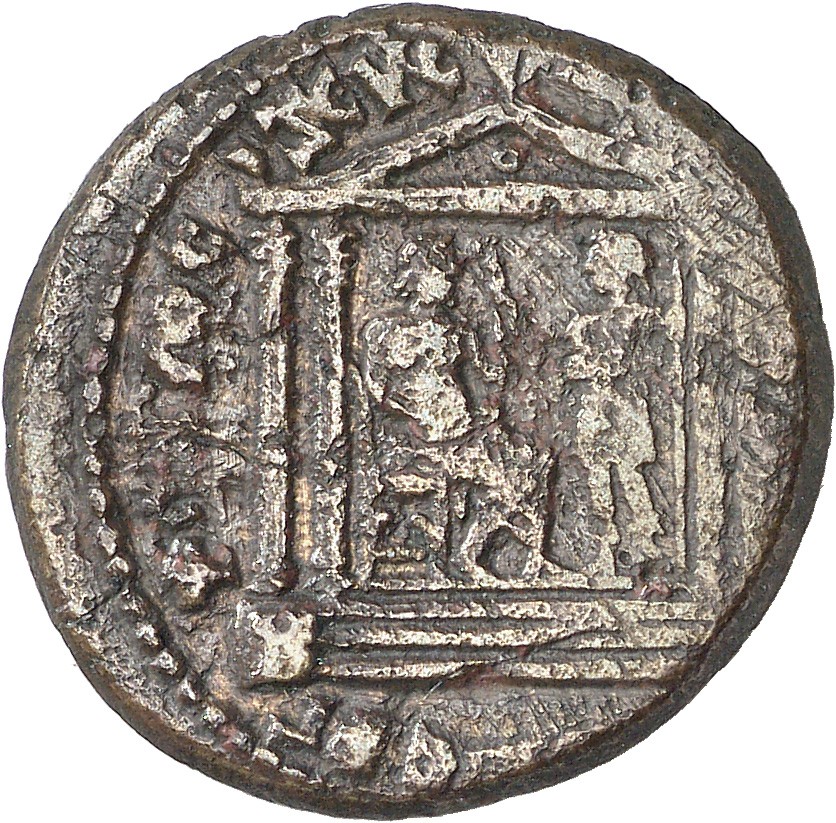
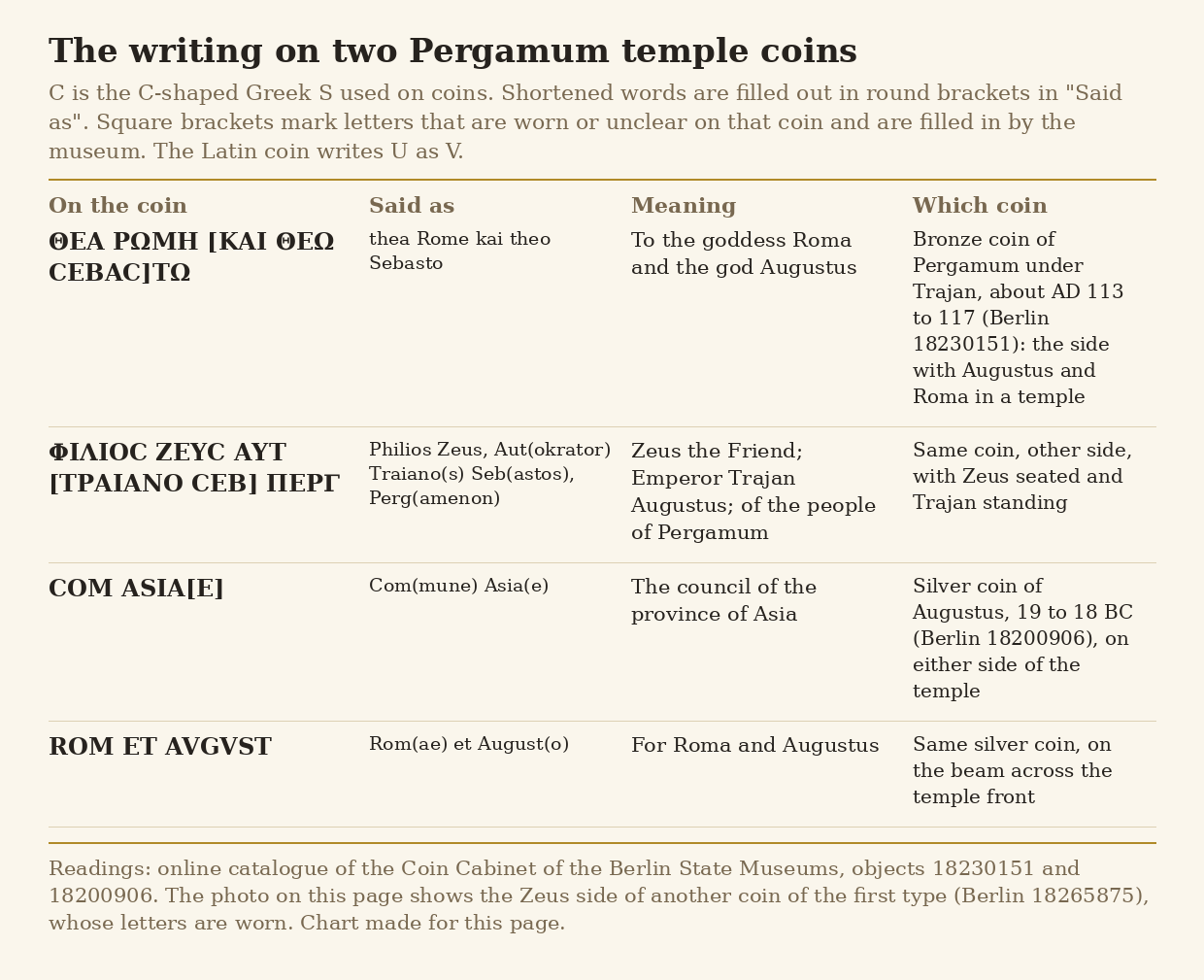
ConfirmedA worn bronze coin of Pergamum from the time of Trajan: Zeus sits on a throne inside a temple, with the emperor standing beside him. This is another coin of the same kind (Berlin Coin Cabinet 18265875), not the coin whose writing is given in the chart; most of its letters are worn away. Lutz-Jürgen Lübke (Lübke und Wiedemann), via Wikimedia Commons, Public domain.
I know thy works, and where thou dwellest, even where Satan's seat is: and thou holdest fast my name, and hast not denied my faith, even in those days wherein Antipas was my faithful martyr, who was slain among you, where Satan dwelleth.
Revelation 2:13, KJV
Pergamum was a royal city and later one of the leading Roman cities of the province of Asia, at modern Bergama in western Turkey. Its upper city stands on a steep hill (the acropolis) crowded with temples, a theatre and palaces. Revelation 2:13 says the church there lived "where Satan's seat is" and that a faithful believer named Antipas was killed there. The Great Altar from the hill, often called the Altar of Zeus, was taken to Germany and rebuilt inside the Pergamon Museum in Berlin.
The Greek and Latin writing on two coins that show Pergamum's temples for the worship of the emperor, with how it sounds and what it means. These are not the coin in the photo above, whose letters are worn. Chart made for this page, free to reuse.
Where it is today
Acropolis and lower city: Bergama, Izmir Province, Turkey. Great Altar: Pergamon Museum, Berlin, Germany; the museum has been closed for long repairs and is due to reopen on 4 June 2027, so check before planning a visit. Coins in the chart: Coin Cabinet (Münzkabinett) of the Berlin State Museums, objects 18230151 and 18200906. The coin in the photo is another coin in the same collection, object 18265875.
Date
Great Altar: built under King Eumenes the Second, in the first half of the 100s BC. Temple for the worship of Augustus and Roma: approved in 29 BC. Temple of Trajan on the acropolis: begun about AD 114 and dedicated under Hadrian, about AD 129. Coin: about AD 113 to 117.
Why this label: Bergama is ancient Pergamum: the name has stayed in use, and the city's own coins name it. What Revelation meant by "Satan's seat" is not confirmed, and scholars disagree about it.
Good to know
Great Altar view: Some scholars, such as Adela Yarbro Collins, think the seat (the Greek word means throne) was the Great Altar.
Emperor worship view: Many scholars think it means the worship of the emperor. Pergamum had the first temple in the province for the worship of Augustus and the goddess Roma, from 29 BC, and its coins show that temple again and again. Under Trajan it was given a second such temple.
Other views: Some point to the large healing centre of the god Asclepius below the city, or to the city as a whole as a centre of pagan worship. A few scholars, who date Revelation after AD 129, point to the huge seated statue of Zeus in the temple begun under Trajan. Most scholars date Revelation before that temple was finished. The verse does not say which building, and it may not mean a building at all.
Antipas: Nothing is known of Antipas outside this verse until centuries later. Andrew of Caesarea, in a commentary on Revelation written about AD 600, is usually named as the earliest writer who tells of his death. The well-known story that he was a bishop roasted inside a bronze bull under Nero or Domitian comes from later Greek lists of saints' lives, and it cannot be checked. The word translated martyr also means witness.
Thyatira (Akhisar), Lydia's home town, and the dyers' guild
Acts 16:14 · Revelation 2:18-29 · Revelation 1:11
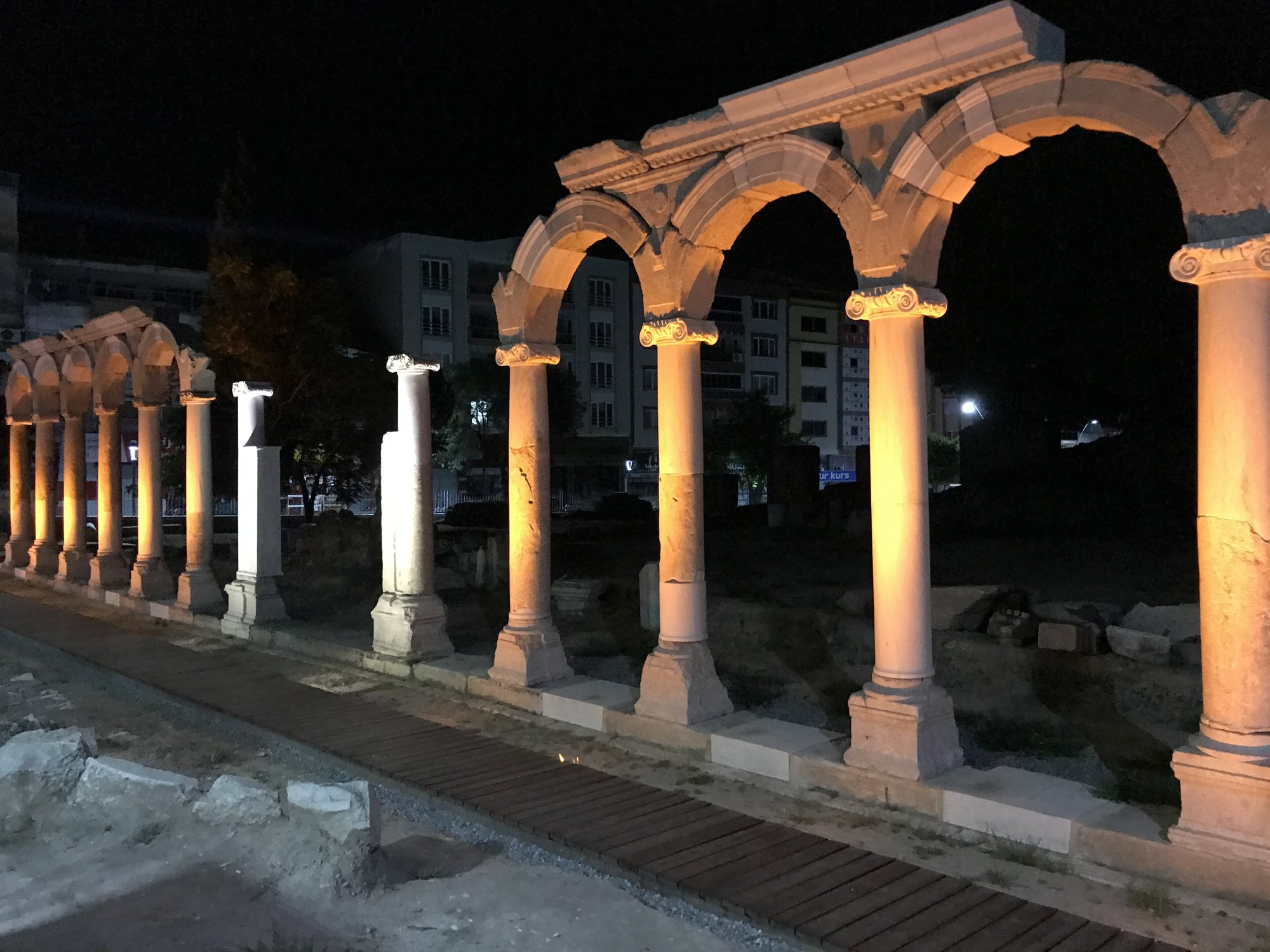
ConfirmedRestored columns and arches along the colonnaded street at Thyatira, Akhisar, lit up at night. Pragdon, via Wikimedia Commons, CC0.
And unto the angel of the church in Thyatira write; These things saith the Son of God, who hath his eyes like unto a flame of fire, and his feet are like fine brass;
Revelation 2:18, KJV
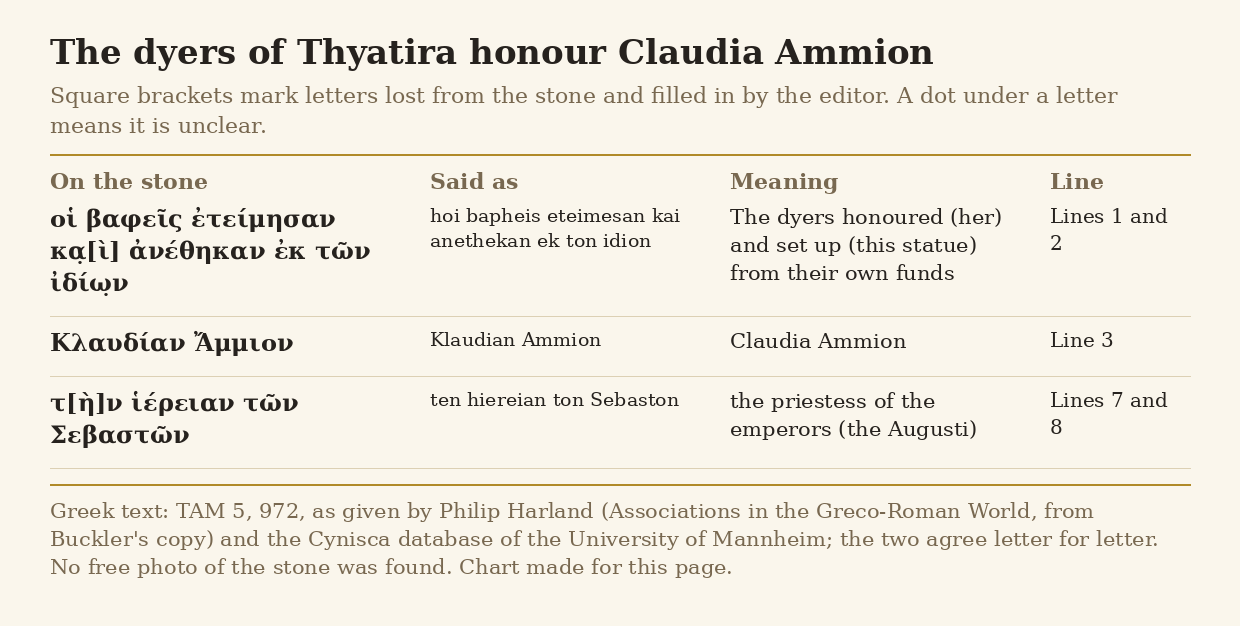
Thyatira was a trading and craft town in western Turkey, and the modern town of Akhisar is built right over it. Acts 16:14 says Lydia, "a seller of purple" whom Paul met at Philippi, came from Thyatira, and Revelation 2:18 to 29 is the letter to the church there. Stone inscriptions from the town show that its dyers formed a guild (a trade association) that set up statues to honour leading citizens. One of these was put up about AD 50, close to the time Paul met Lydia.
The key Greek words of the dyers' inscription for Claudia Ammion, with how they sound and what they mean. Square brackets mark letters lost from the stone; a dot under a letter means it is unclear. Chart made for this page, free to reuse.
Where it is today
Tepe Mezarligi open-air site in central Akhisar, Manisa Province, Turkey; finds are in the Akhisar and Manisa museums. The dyers' inscription for Claudia Ammion is published in Tituli Asiae Minoris, volume 5, part 2, number 972; its present location was not given in the sources read.
Date
Greek settlers under King Seleucus the First are said to have renamed the town Thyatira about 290 BC, though the name itself is probably older; dyers' inscriptions from about AD 50 to the 200s; the visible colonnaded street is from the 100s AD, and a large hall with a rounded end (apse) was in use from about the 100s to the 500s AD.
Why this label: Scholars accept Akhisar as Thyatira, and many inscriptions of the city's dyers and other trades were found there. Lydia herself is known only from Acts; no inscription names her.
Good to know
The dyers: The guild's statue base for Claudia Ammion calls her priestess of the emperors (the Augusti), so even the dyers' guild honoured people who led emperor worship.
Other guilds: According to William Ramsay (1904), more trade guilds are known from Thyatira than from any other city of the province, including wool workers, linen workers, makers of outer clothes, dyers, leather workers, tanners, potters, bakers, slave dealers and bronze smiths.
What remains: The ruins on show are small and mostly later than the New Testament. Digs began in 1962, and a university team has worked there since 2011.
Sardis: the temple of Artemis, the synagogue and the gymnasium
Revelation 3:1-6 · Revelation 1:11
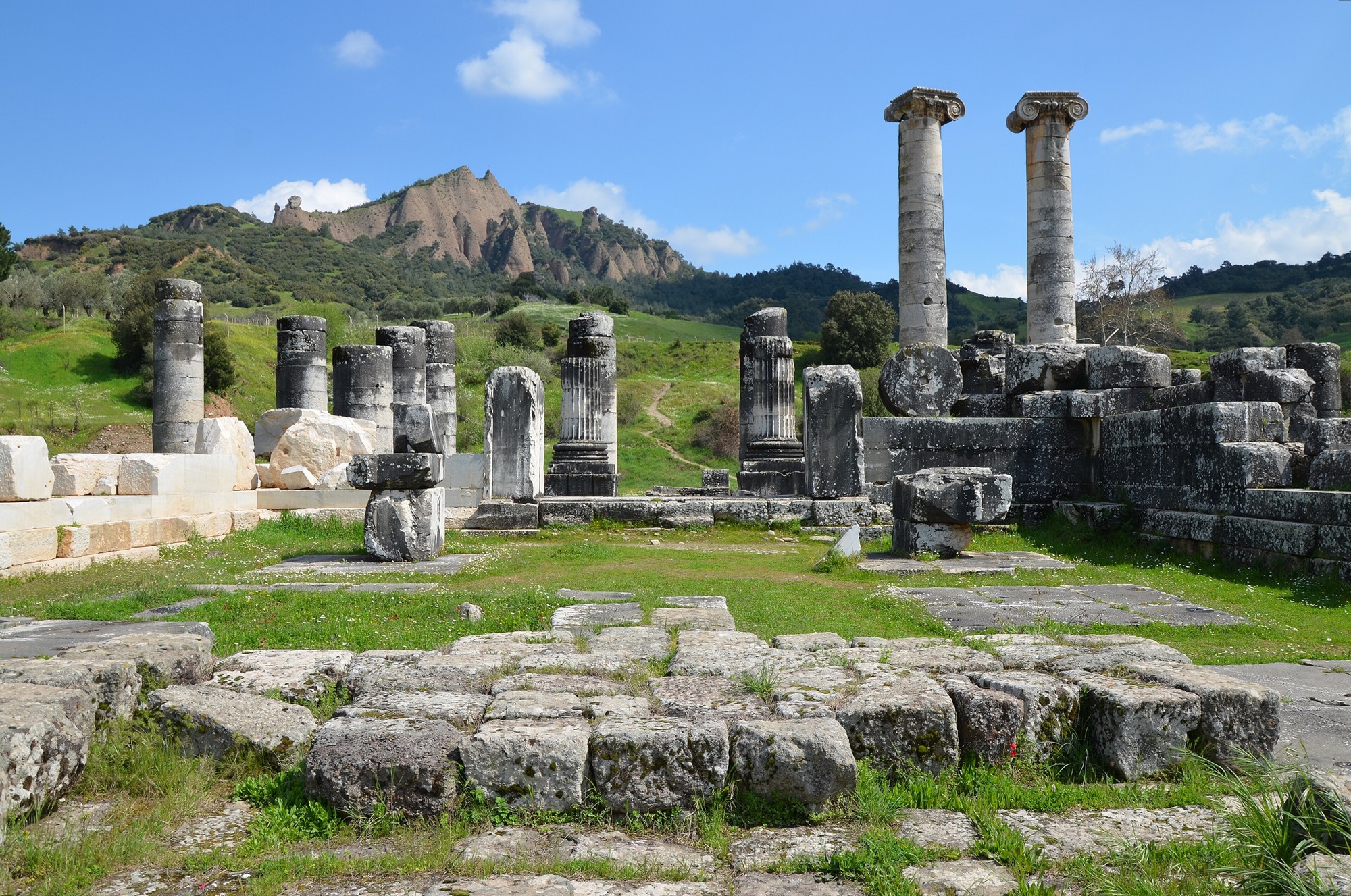
ConfirmedThe temple of Artemis at Sardis, with its two standing columns and the steep hill of the acropolis behind. Carole Raddato from FRANKFURT, Germany, via Wikimedia Commons, CC BY-SA 2.0.
Remember therefore how thou hast received and heard, and hold fast, and repent. If therefore thou shalt not watch, I will come on thee as a thief, and thou shalt not know what hour I will come upon thee.
Revelation 3:3, KJV
Sardis was the old royal capital of Lydia, in western Turkey near the village of Sart. A high, steep hill (the acropolis) rises behind the city. Revelation 3:1 to 6 tells the church there that it has a name for being alive but is dead, and warns it to watch. The ruins include one of the largest temples of Artemis ever built, a huge Roman bath and gymnasium (a sports and training centre), and a very large synagogue built into one corner of it.
Where it is today
Sardis (Sart), near Salihli, Manisa Province, Turkey; open to visitors. Dug by Princeton University from 1910 to 1914 and in 1922, and by the Archaeological Exploration of Sardis (Harvard and Cornell) every year since 1958.
Date
Temple of Artemis: begun in the 200s BC and changed in Roman times. City badly damaged by an earthquake in AD 17 and rebuilt with help from Tiberius. Bath and gymnasium: finished in the late 100s or early 200s AD. Synagogue: in use from the 300s; most of its surviving decoration is from the 300s and 400s AD.
Why this label: Sardis has a continuous written record, the site has been dug for over a century, and scholars agree it is the Sardis of Revelation. The temple is older than Revelation, and the gymnasium and synagogue as they stand are later.
Good to know
The thief warning: Some writers, starting with William Ramsay in 1904, suggest that "I will come on thee as a thief" would have reminded readers of their city's past. The hilltop was thought impossible to climb, yet the city was taken by surprise twice. Ramsay, using the Greek historian Herodotus, says the army of Cyrus of Persia took the city about 547 BC by climbing a side of the hill that no one guarded. He adds that over 300 years later men of Antiochus the Third did the same thing, because the guards again watched only the one known way up. This is only a suggestion. Jesus used the same picture in Matthew 24:43, Paul used it in 1 Thessalonians 5:2, and Revelation 16:15 uses it again for the whole world, so the words make sense without any local link.
The synagogue: It shows that the Jews of Sardis were many, well off and part of city life in later Roman times. Its main hall is over 50 metres long and could hold nearly a thousand people. It is later than Revelation, and the letter to Sardis does not mention Jews.
The temple: In Roman times part of the temple of Artemis was used to worship the emperors, and in the 400s AD a small church was built at its east end.
Philadelphia (Alaşehir): the pillars of the church of St John
Revelation 3:7-13 · Revelation 1:11
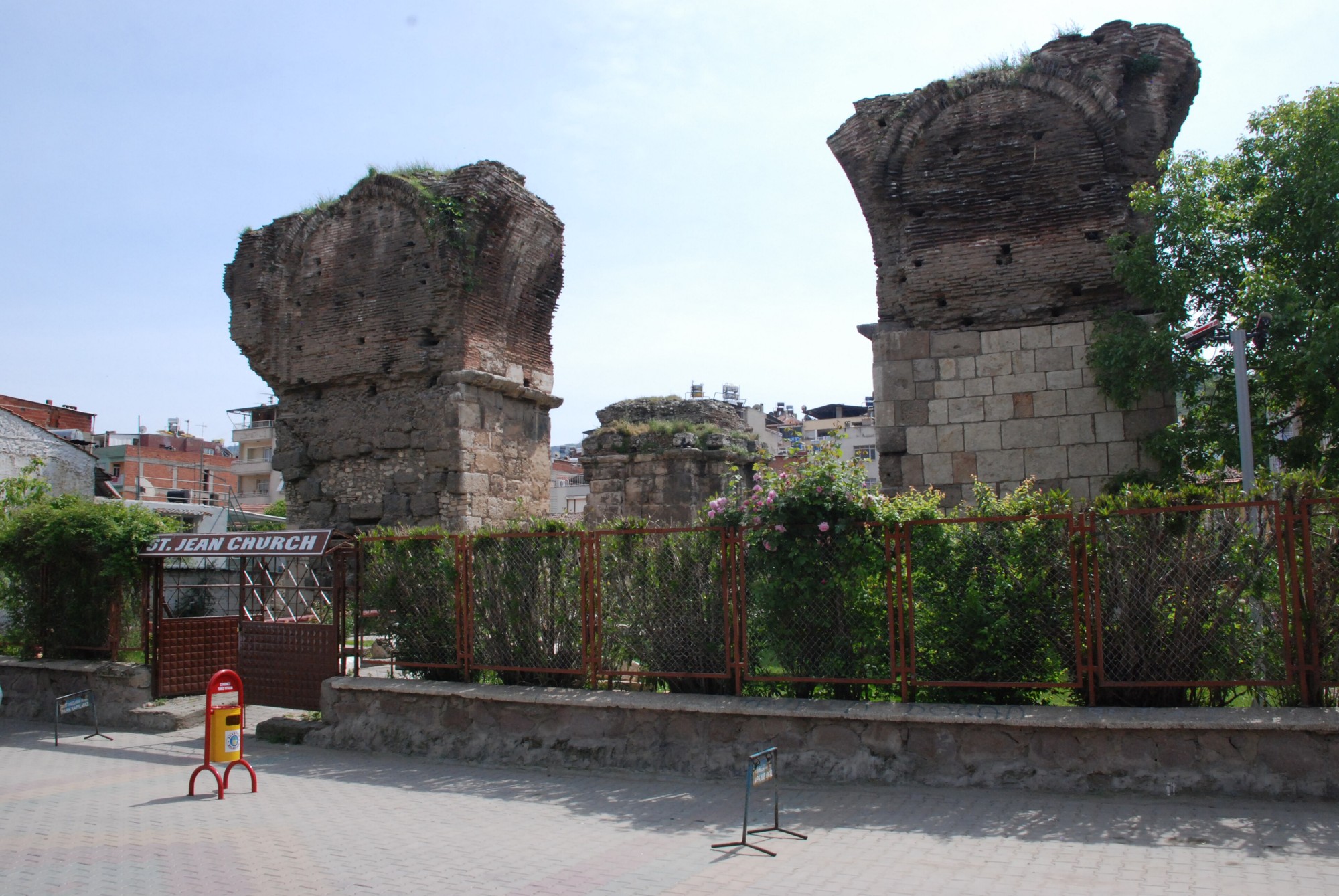
ConfirmedThe brick and stone pillars of the church of St John at Alaşehir (Philadelphia), behind a modern fence. Photo by simonjenkins' photos, uploaded by Wolfymoza, via Wikimedia Commons, CC BY-SA 2.0.
Him that overcometh will I make a pillar in the temple of my God, and he shall go no more out: and I will write upon him the name of my God, and the name of the city of my God, which is new Jerusalem, which cometh down out of heaven from my God: and I will write upon him my new name.
Revelation 3:12, KJV
Philadelphia was a town in a rich valley of western Turkey, and the modern town of Alaşehir stands over it. Revelation 3:7 to 13 is the letter to the church there, which is praised and is not blamed for anything. The best-known ruin is three huge pillars of stone and brick from a large church named after St John, built in the 500s AD. Little is left of the Roman town apart from a small theatre.
Where it is today
Church of St John ruins, Beşeylül district, central Alaşehir, Manisa Province, Turkey. Old carved stones and sarcophagi are displayed around the pillars.
Date
Town founded in the 100s BC by a king of Pergamum and named after Attalus the Second, called Philadelphus, which means one who loves his brother. Badly damaged by the earthquake of AD 17. Church of St John: built in the 500s AD (some sources say about AD 600).
Why this label: Several ancient towns were called Philadelphia, but scholars generally agree the one in Revelation is Alaşehir, which kept the name until 1390. The church pillars are more than 400 years later than Revelation and are not the meeting place of John's first readers.
Good to know
Earthquakes: The Greek geographer Strabo, writing in the time of Augustus and Tiberius, said Philadelphia was always shaking, the walls of houses kept cracking, and so most people lived out in the country. Some suggest this lies behind the promise of being made a pillar that "shall go no more out" (Revelation 3:12). This is a reasonable suggestion, but the text does not say it.
Later Christians: Bishop Ignatius of Antioch wrote a letter to the Christians of Philadelphia in the early 100s. The town stayed a Christian centre for centuries and was the last Byzantine Greek city in the region to fall, in 1390.
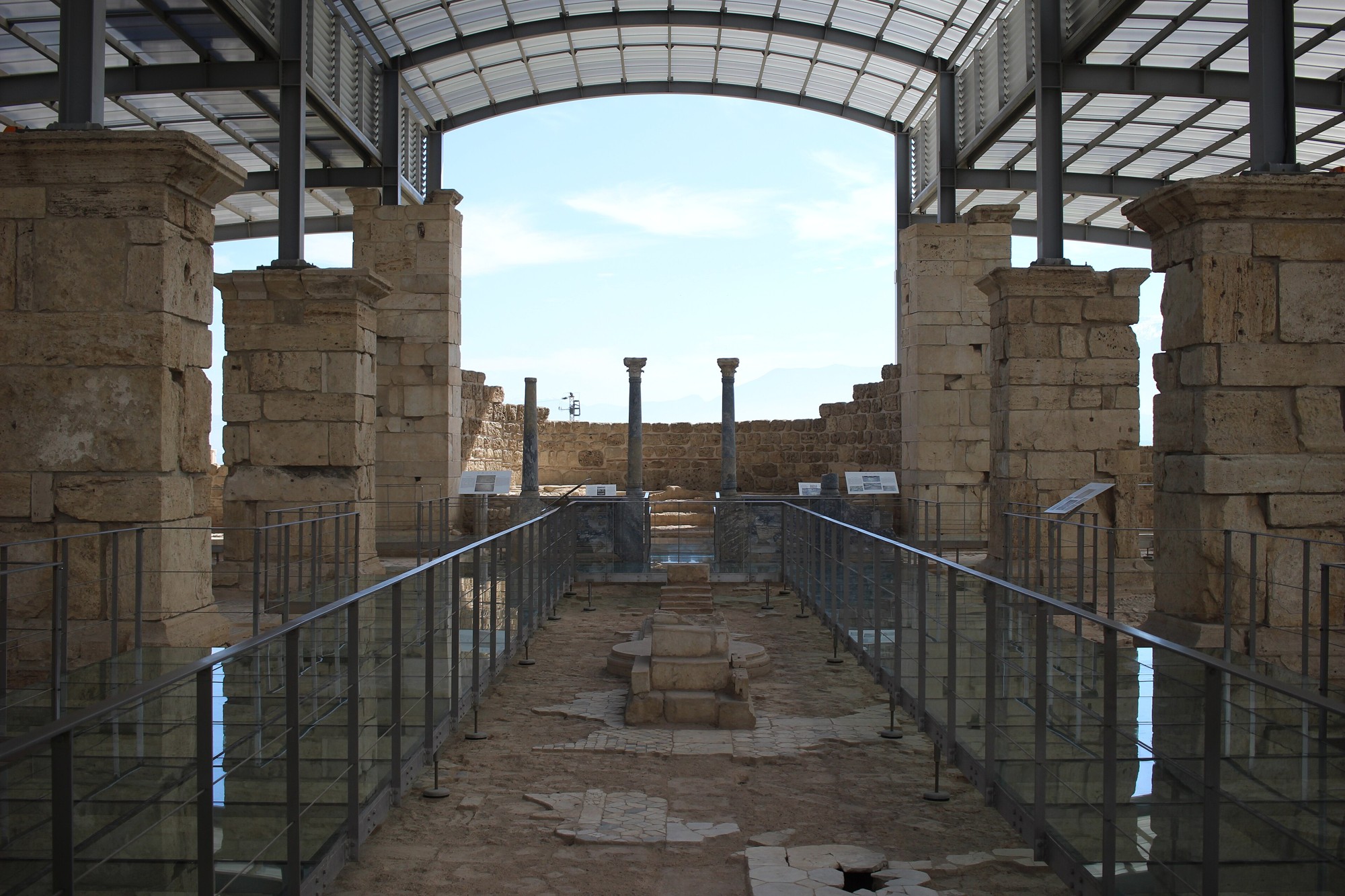
ConfirmedInside the restored church of the early 300s AD at Laodicea, under its modern protective roof. Blcksprt, via Wikimedia Commons, CC BY-SA 4.0.
So then because thou art lukewarm, and neither cold nor hot, I will spue thee out of my mouth.
Revelation 3:16, KJV
Laodicea was a rich trading city in the Lycus valley of western Turkey, near modern Denizli. Paul's letter to the Colossians mentions the believers there, and Revelation 3:14 to 22 is the harshest of the seven letters: the church is "lukewarm" and thinks it is rich. Since the early 2000s Pamukkale University has dug and restored much of the city, including theatres, a stadium, colonnaded streets and a large church. Water came in by aqueduct, and where it crossed a valley it ran through a double line of carved stone pipes, many now coated inside with a thick mineral crust.
Where it is today
Laodicea (Laodikeia) archaeological site near Eskihisar, Denizli Province, Turkey; open to visitors. Hierapolis (Pamukkale) is about 10 km to the north and Colossae about 15 km to the east.
Date
Founded between 261 and 253 BC by Antiochus the Second. Destroyed by an earthquake in AD 60 and rebuilt. The church was built in the time of Constantine (AD 306 to 337) and ruined by an earthquake in the early 600s.
Why this label: Scholars agree this is Laodicea on the Lycus; the site matches ancient descriptions, and over 20 years of digging have found many remains of the city. The church building is from about 230 years after Revelation and is not the church that received the letter.
Good to know
Water view: In 1957 two British scholars, Rudwick and Green, suggested that Laodicea's water was the point: Hierapolis had healing hot water and Colossae had cold, fresh water, but Laodicea's piped water arrived lukewarm. This became the usual explanation.
Doubting view: Craig Koester (2003) pointed out that the other cities of the area had similar water systems. Mark Wilson (2025) reports that the recent digs show Laodicea's drinking water came from good springs, not hot springs, that Hierapolis and Colossae used the same kinds of pipes and aqueducts, and that the mineral crust in the pipes does not prove the water was bad.
Other views: Koester suggests the picture comes from meals, where hosts served hot or cold drinks and a guest might spit out a lukewarm one. Wilson suggests the cold, warm and hot rooms of a Roman bath house. Others read it simply as a picture of half-hearted, undecided faith. The verse itself speaks of the church's works (Revelation 3:15) and does not mention water.
Rich city: Tacitus says that when the earthquake of AD 60 ruined Laodicea, the city rebuilt itself without help from Rome. This fits the proud words "I am rich" in Revelation 3:17, but the text does not mention the earthquake.
Patmos: the Cave of the Apocalypse and the monastery of St John
Revelation 1:9 · Revelation 1:11
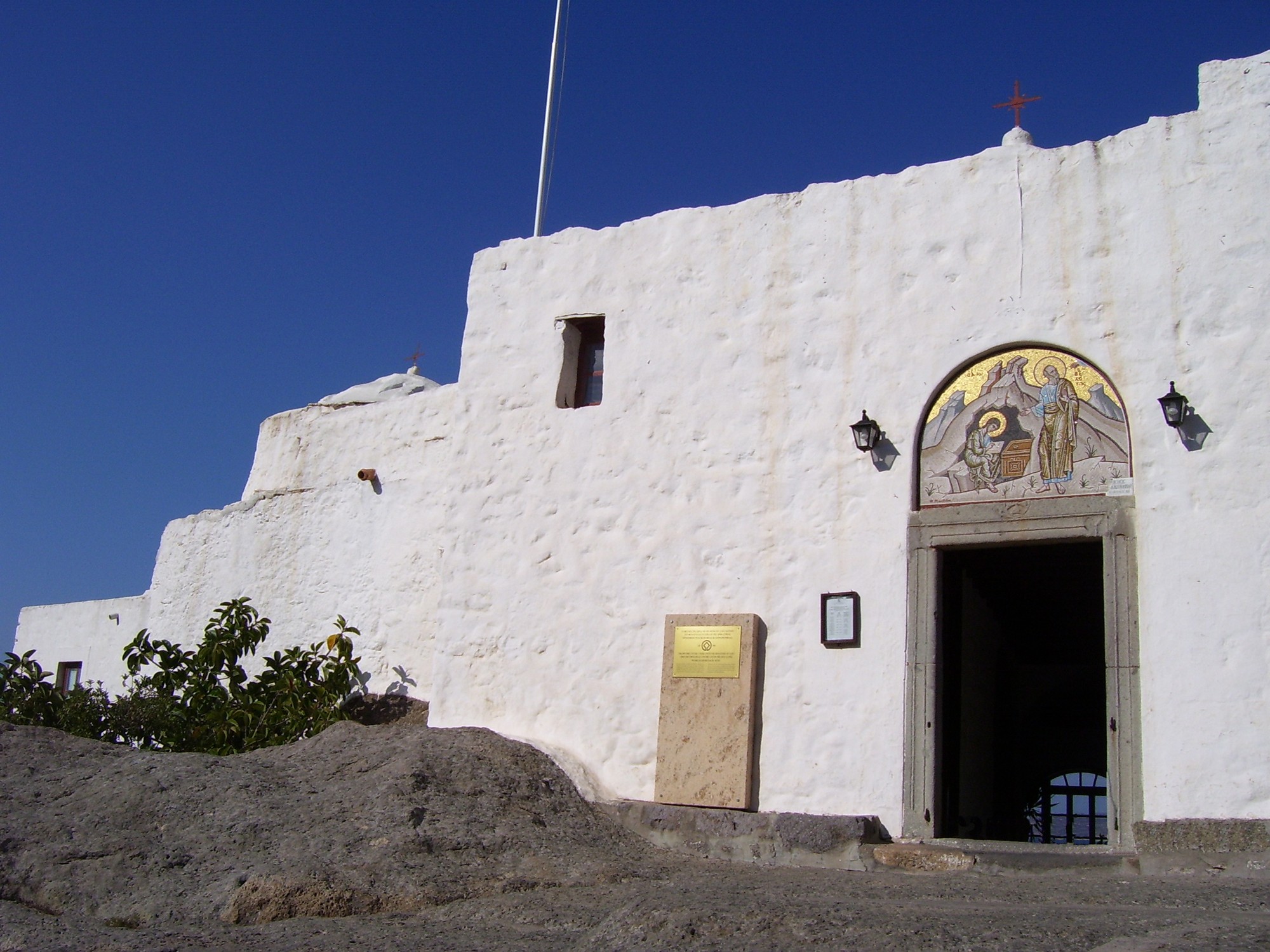
Traditional siteThe whitewashed entrance building over the Cave of the Apocalypse on Patmos, with a mosaic of John and his helper Prochorus above the door. Vladimir Boskovic at English Wikipedia, via Wikimedia Commons, Public domain.
I John, who also am your brother, and companion in tribulation, and in the kingdom and patience of Jesus Christ, was in the isle that is called Patmos, for the word of God, and for the testimony of Jesus Christ.
Revelation 1:9, KJV
Patmos is a small, rocky Greek island in the Aegean Sea. In Revelation 1:9 John says he was "in the isle that is called Patmos" when he saw his visions, and that he was told there to write to the seven churches (Revelation 1:11). Halfway up the hill between the harbour (Skala) and the hilltop town (Chora) is a small cave, now a church, shown as the place where John received the visions. Above it stands the fortified monastery of St John the Theologian, founded in 1088.
Where it is today
Patmos, Dodecanese islands, Greece. The cave and the monastery are open to visitors and are part of a UNESCO World Heritage Site named in 1999.
Date
John on Patmos: late 1st century AD (tradition says about AD 95). Monastery: the island was given to the monk Christodoulos in 1088, and building began in 1091, over the remains of an earlier church. The cave has been pointed out as the place of the visions since about the mid-1100s.
Why this label: The island is surely the Patmos of Revelation 1:9, since it has kept its name. The cave as the exact spot is a tradition first recorded about 1,000 years after John, and no archaeology links it to him.
Good to know
Early writers: Revelation says only that John was on Patmos "for the word of God"; it does not use the word exile. Irenaeus (about AD 180) says the vision was seen near the end of the reign of Domitian (AD 81 to 96). Clement of Alexandria (about AD 200) says that "on the tyrant's death" John came back to Ephesus from Patmos (William Wilson's translation in the Ante-Nicene Fathers), and Eusebius (about AD 325) says John was sent to live on Patmos. Some scholars date Revelation earlier, in the late 60s (see the note at the top of this section).
The cave tradition: No early writer mentions a cave. A legendary book, the Acts of John said to be by his helper Prochorus (written about the 400s), has John dictating his Gospel outside the town on Patmos. Christodoulos chose the island in 1088 because John had lived there. According to the Franciscan writer Noel Muscat, who follows the study of Nancy Patterson Ševčenko, this cave was first pointed out as the place of the visions around the mid-1100s, after the monastery was founded.
What it shows: The cave has been a place of prayer for more than 800 years. It does not show that John stayed in this cave.
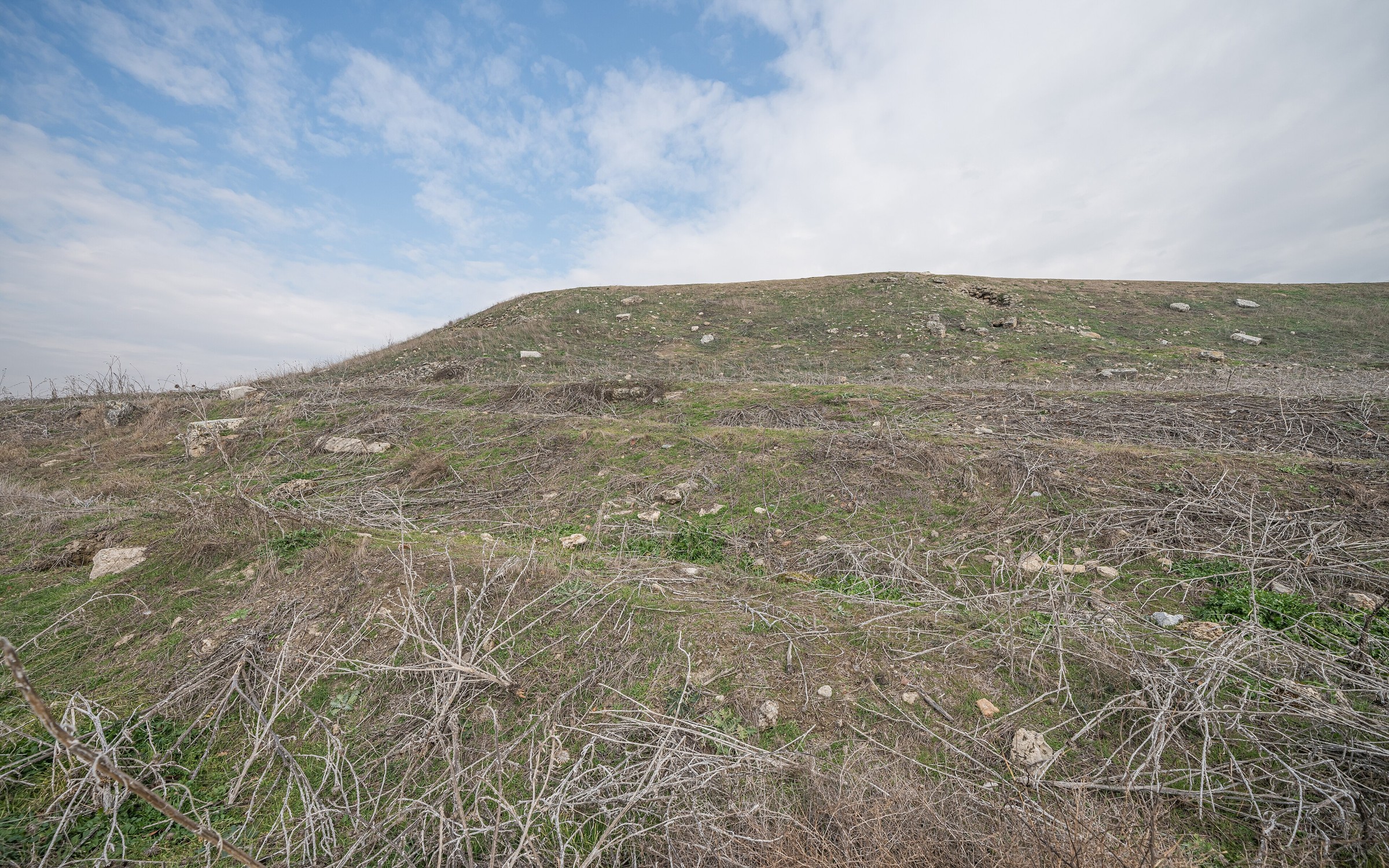
ConfirmedThe mound of Colossae: a long grassy hill with scattered stones and dry brush, photographed in February 2020. A.Savin, via Wikimedia Commons, Free Art Licence.
To the saints and faithful brethren in Christ which are at Colosse: Grace be unto you, and peace, from God our Father and the Lord Jesus Christ.
Colossians 1:2, KJV
Colossae was a city in the valley of the Lycus River in what is now southwest Turkey. The letter to the Colossians is addressed to the Christians there (Colossians 1:2), and Colossians 4:13 to 16 also names the nearby cities of Laodicea and Hierapolis. Today the site is a large grassy mound (a hill built up from the buried remains of the town) with scattered stones, about 3 km north of the town of Honaz. Laodicea and Hierapolis have been dug for many years, but Colossae was not dug at all until very recently, so much less is known about the city that received the letter.
Where it is today
Near Honaz, Denizli province, Turkey, about 15 km east of Laodicea. The digs are run by Pamukkale University in Denizli.
Date
People lived on the mound from about 4000 BC. The Greek writers Herodotus and Xenophon describe Colossae as a large city in the 400s BC. By Paul's day it was smaller than Laodicea and Hierapolis. In the 600s and 700s AD its people moved a few kilometres south to Chonae, the town now called Honaz.
Why this label: Scholars broadly agree that the mound north of Honaz is ancient Colossae, from ancient descriptions, its place on the road near Laodicea and Hierapolis, and the move of its people to nearby Chonae (Honaz). The sources read here report no inscription from the mound itself naming the city, and nothing from the church Paul wrote to has been found yet.
Good to know
The digs: A Pamukkale University team led by Barış Yener surveyed the whole site from 2021 to 2023, mapping it and collecting pottery from the surface, and began digging in 2025. In 2025 the team dug about 60 graves cut into the rock, about 2,200 years old. They held oil lamps, glass and clay bottles, coins, sandals and many charms and amulets that people believed would protect them. Earlier visitors saw traces of a theatre and rock-cut tombs.
The earthquake: The Roman historian Tacitus (Annals 14.27, written about AD 116) says that in AD 60 Laodicea was thrown down by an earthquake and rebuilt from its own money without help from Rome. Tacitus does not name Colossae. The Chronicle of Eusebius, written in the early 300s, says the earthquake also struck Hierapolis and Colossae, and places it in Nero's 10th year (about AD 63 or 64). So scholars are not sure whether there was one earthquake or two, or how badly Colossae was hit.
A common mistake: Some books say Colossae rebuilt itself without help from Rome. Tacitus says that about Laodicea, not Colossae.
What is not known: How much damage Colossae suffered, how quickly it recovered, and whether the earthquake came before or after the letter was written. The university team says the city seems never to have fully regained its earlier importance, though it may have begun to recover under the emperor Hadrian (AD 117 to 138).
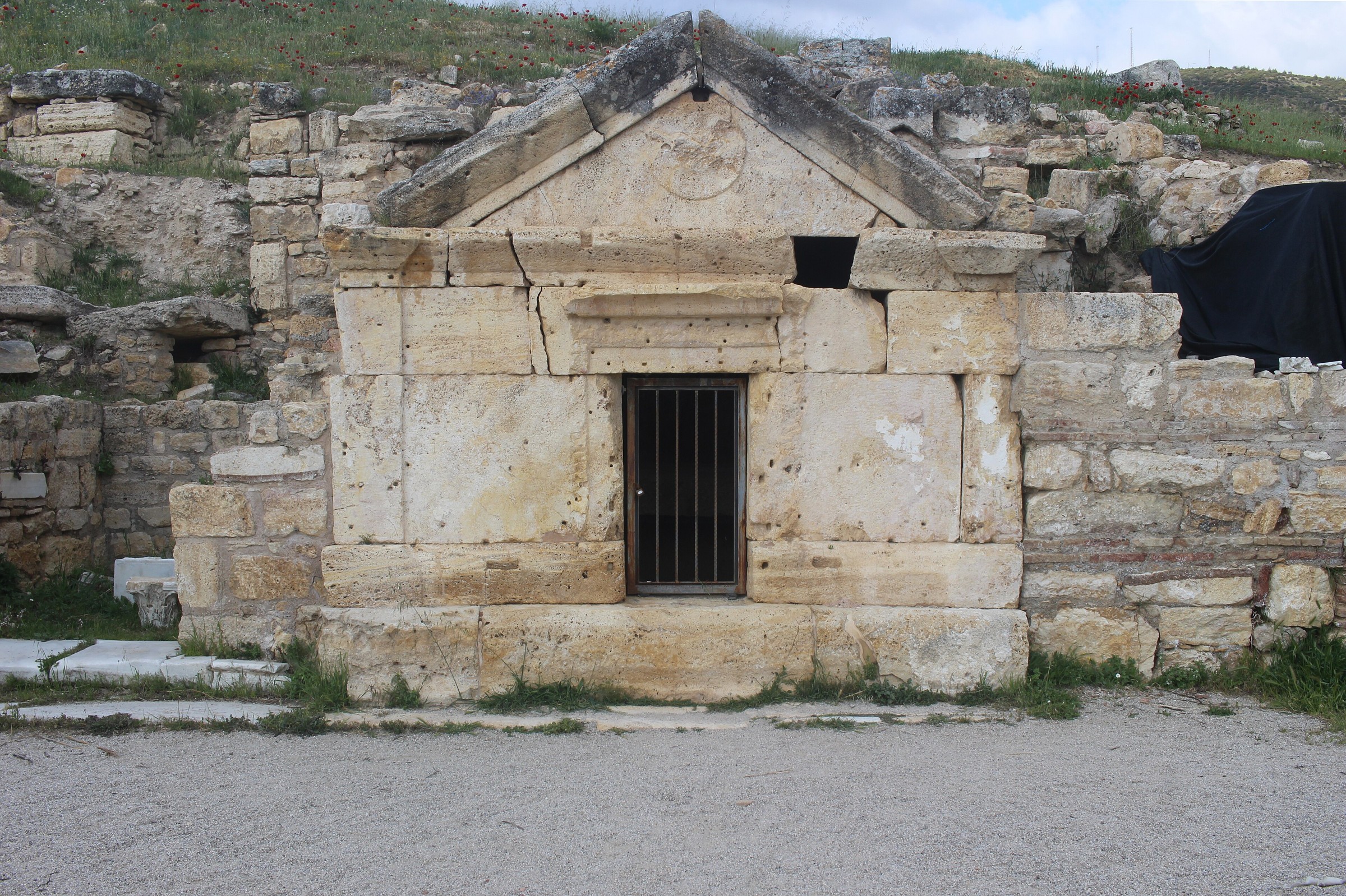
Traditional siteFront of the Roman tomb at Hierapolis that the excavators identify as Philip's: a small stone tomb shaped like a house, with a triangular gable and a barred doorway. Blcksprt, via Wikimedia Commons, CC BY-SA 4.0.
For I bear him record, that he hath a great zeal for you, and them that are in Laodicea, and them in Hierapolis.
Colossians 4:13, KJV
Hierapolis, beside the white rock terraces of modern Pamukkale in Turkey, was the third city of the Lycus valley, and Colossians 4:13 names the Christians there. Christian writers from the late 100s AD say that a man named Philip and his daughters were buried at Hierapolis. In 2011 the Italian archaeologist Francesco D'Andria announced that his team had found a Roman tomb from the first century AD at the centre of a newly dug church, less than 40 metres from the eight-sided church long known as the martyrium of St Philip (a church built to honour a martyr). He believes this tomb once held Philip's body. The church had been built around the tomb in the 300s or 400s AD, and the marble steps leading over the tomb were worn down by the feet of many pilgrims.
Where it is today
Hierapolis archaeological site (a UNESCO World Heritage Site), Pamukkale, Denizli province, Turkey. The tomb and its church are on the hill northeast of the ancient city, beside the martyrium of St Philip. The Italian Archaeological Mission at Hierapolis has worked there since 1957.
Date
Tomb: first century AD, by its Roman style. Church built around it: 300s or 400s AD. Martyrium: early 400s AD. The first written claim that Philip was buried at Hierapolis comes from Polycrates of Ephesus, about AD 190.
Why this label: The belief that a Philip was buried at Hierapolis was written down by about AD 190, and the dig shows that Christians of the 400s honoured this tomb as his. But no inscription on the tomb names Philip, no bones were found in it, and the early writers disagree about which Philip he was.
Good to know
Early writers: Papias, bishop of Hierapolis, wrote about AD 110, and Eusebius says he heard stories from "the daughters of Philip". Polycrates, bishop of Ephesus, wrote about AD 190 that "Philip, one of the twelve apostles" sleeps in Hierapolis "and his two aged virgin daughters", while a third daughter was buried at Ephesus. Around AD 200 Proclus, a teacher of the Montanists (a movement that stressed new prophecy), wrote of "four prophetesses, the daughters of Philip, at Hierapolis", and said their tomb and their father's were there. These are quoted in Eusebius, Church History 3.31, in the A. C. McGiffert translation.
Which Philip: Acts 21:8 to 9 says Philip the evangelist, "one of the seven", had "four daughters, virgins, which did prophesy". Four daughters who prophesied fit the evangelist, not the apostle. So many think the Philip of Hierapolis was the evangelist, and that the two men became mixed up very early. Others, such as the scholar J. B. Lightfoot and D'Andria, accept Polycrates, who lived nearby and wrote about a century later, and hold that he was the apostle. Eusebius set both reports side by side in Church History 3.31, and in 3.39 he calls the Philip of Hierapolis the apostle.
The tomb evidence: D'Andria points to the church built around an older Roman tomb, the worn steps, and a bronze bread stamp from the late 500s or 600s, now in the Virginia Museum of Fine Arts, that shows Saint Philip between two church buildings. These show what Christians believed by the 400s. They do not show whose body was first laid in the tomb. D'Andria thinks the remains were moved to Constantinople, and perhaps later to Rome.
Nero's persecution of the Christians in Rome (Tacitus, Annals 15.44)
1 Peter 4:16 · 1 Peter 4:12 · Romans 16:3-5
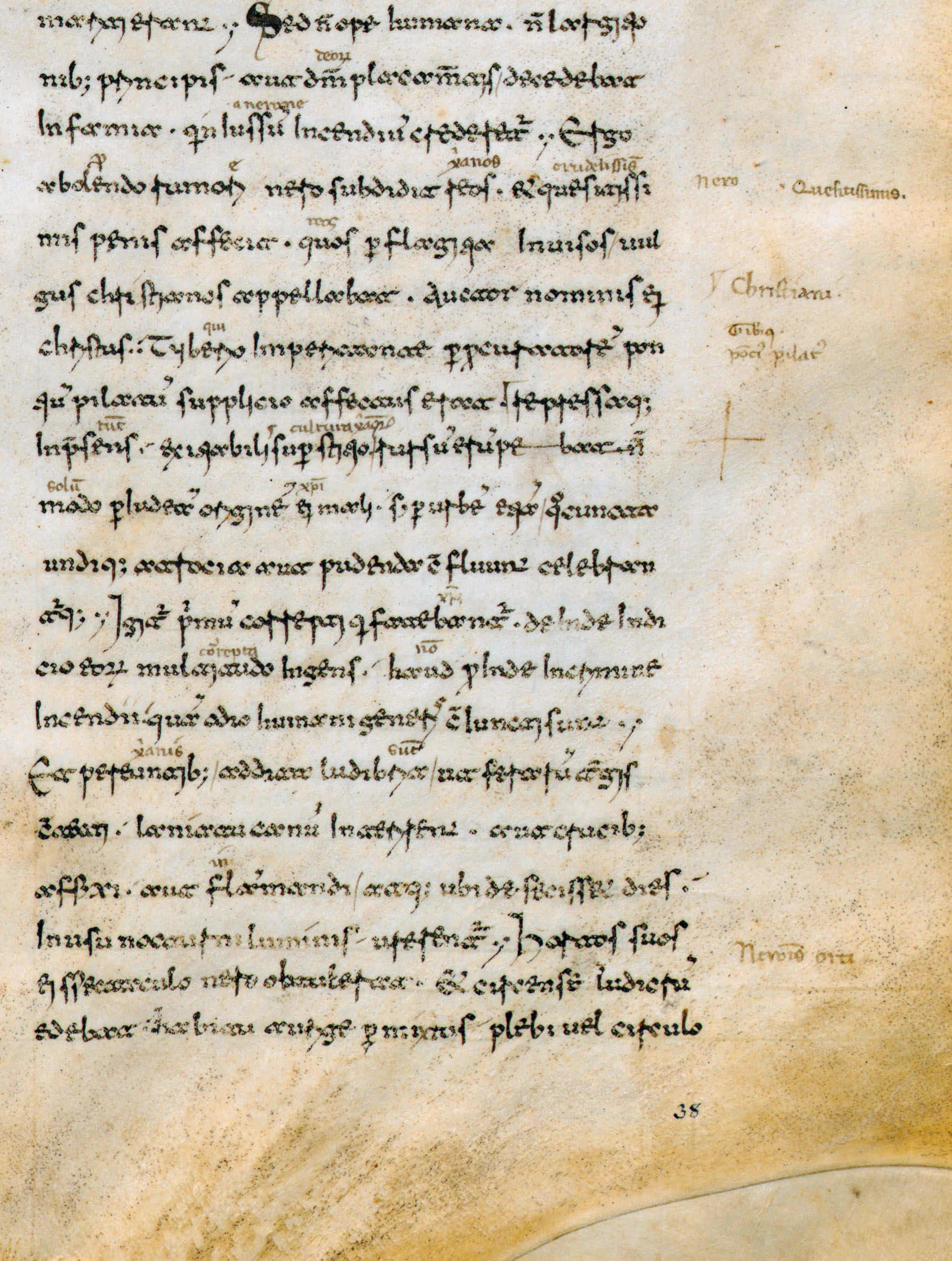
ConfirmedPage 38 of the Florence manuscript of Tacitus (written in the 1000s), with the passage about Nero and the Christians. Unknown author, via Wikimedia Commons, Public domain.
Yet if any man suffer as a Christian, let him not be ashamed; but let him glorify God on this behalf.
1 Peter 4:16, KJV
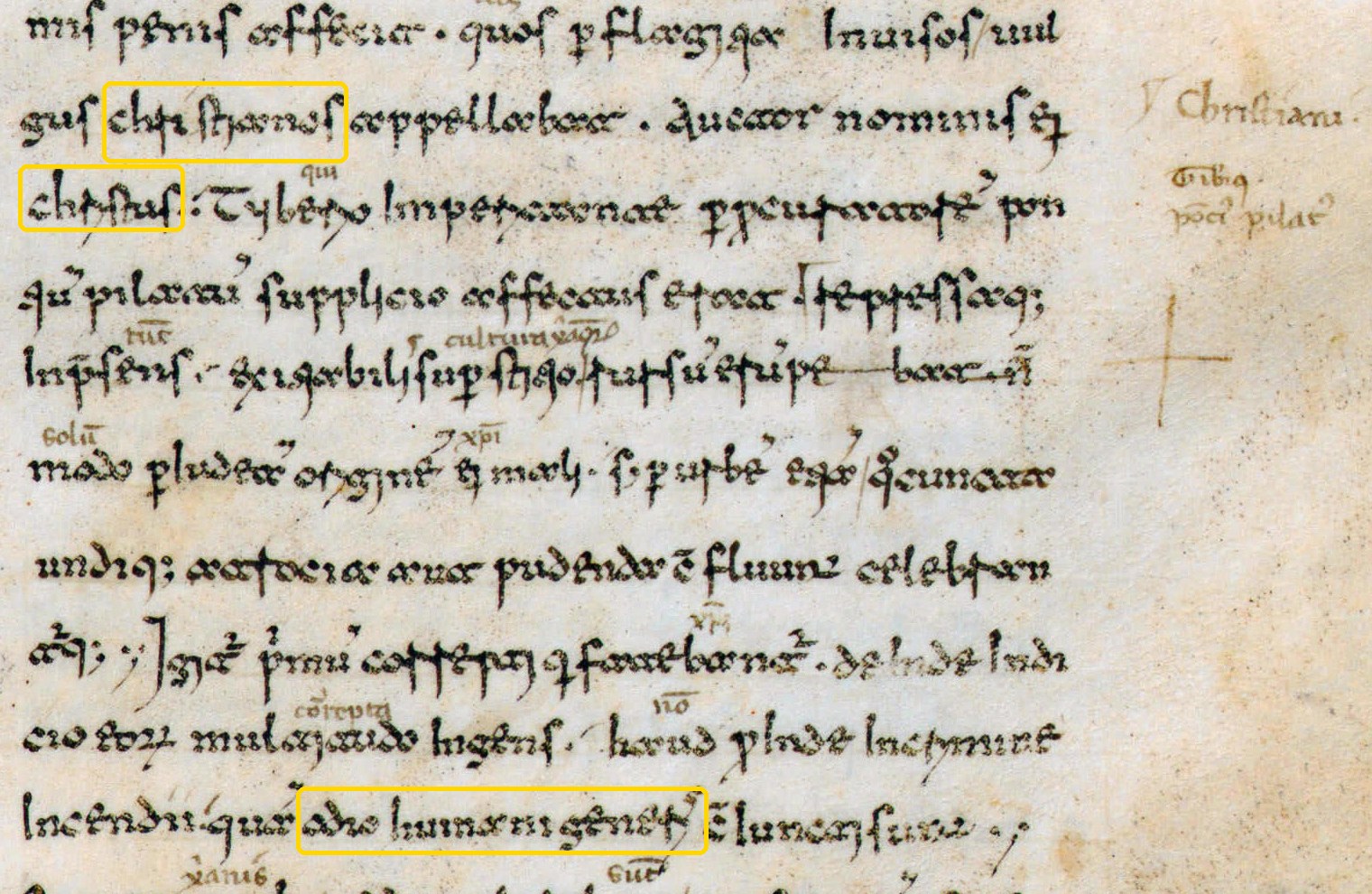
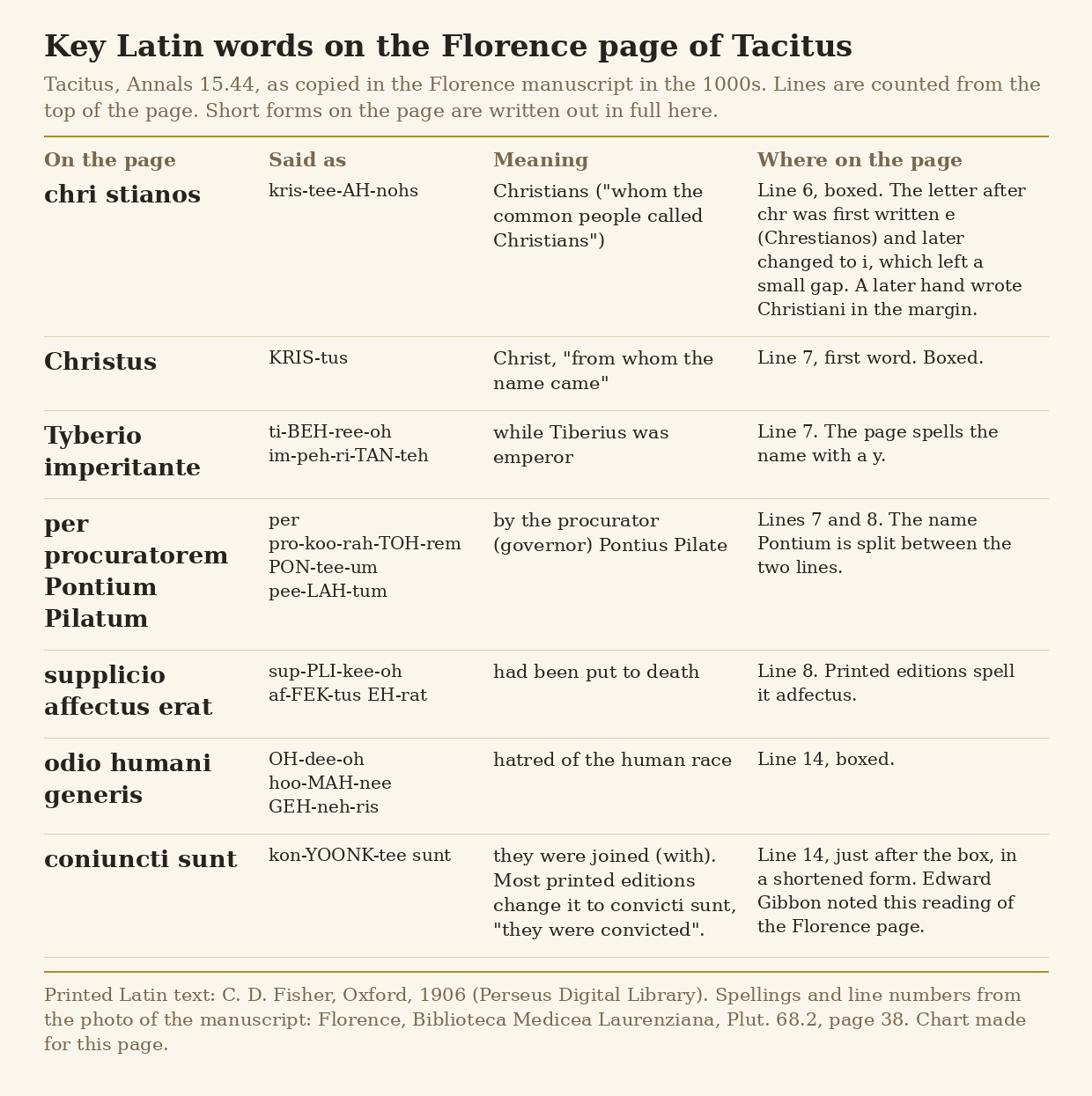
The Roman historian Tacitus, writing about AD 116, says that after the great fire of Rome in July AD 64, people blamed the emperor Nero. To stop the rumour, Nero put the blame on a group "hated for their abominations, called Christians by the populace". Tacitus explains that the name came from "Christus", who "suffered the extreme penalty" under the emperor Tiberius at the hands of Pontius Pilate. First those who admitted being Christians were arrested, then on their information "an immense multitude" was convicted, less for the fire than "of hatred against mankind". Some were covered with animal skins and torn by dogs, some nailed to crosses, and some burned to light the night in Nero's gardens. (Quotations from the A. J. Church and W. J. Brodribb translation, 1876.) The photos below show the words for Christians, Christ and "hatred of the human race" on the manuscript page itself.
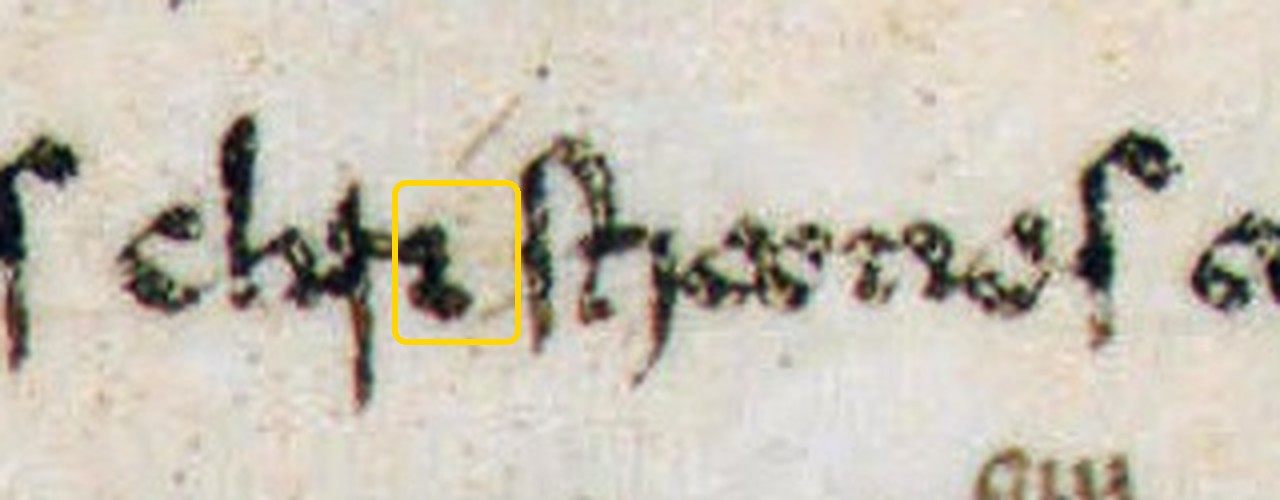
Photo of part of page 38 of the Florence manuscript of Tacitus's Annals (Biblioteca Medicea Laurenziana, Plut. 68.2), copied by hand in the 1000s, more than 900 years after Tacitus wrote. The top line shown is line 5 of the page. The three yellow boxes were added for this page. Upper box, line 6: chri stianos, "Christians". Middle box, line 7: Christus, "Christ", the first word of the line. Lower box, line 14: odio humani generis, "hatred of the human race". The note Christiani in the right margin beside line 6 was added later by another hand and is not boxed. Biblioteca Medicea Laurenziana, Florence, via Wikimedia Commons, Public domain.Close-up of the word chri stianos on line 6, enlarged four times. The yellow box, added for this page, marks the letter after chr and the small gap just after it. Scholars report that this letter was first written as e, making Chrestianos, and later changed to i. Georg Andresen pointed this out in 1902, and study of the page under ultraviolet light later confirmed it. No one can say who made the change. In an ordinary photo the change itself is hard to see; the gap is the clearest sign of it. Biblioteca Medicea Laurenziana, Florence, via Wikimedia Commons, Public domain.The key Latin words on the page, with how they sound, what they mean and where they are. Short forms on the page are written out in full. It also notes three places where the manuscript differs from printed editions: the changed letter in chri stianos, affectus where printed editions have adfectus, and coniuncti where printed editions have convicti. Chart made for this page, free to reuse.
Where it is today
The oldest surviving copy of this passage is a manuscript written in the 1000s at the abbey of Monte Cassino in Italy. It is now in the Laurentian Library (Biblioteca Medicea Laurenziana), Florence, shelf mark Plut. 68.2, page 38 front.
Date
Events: AD 64. Tacitus wrote the Annals about AD 116. The Florence manuscript: 1000s AD.
Why this label: Nearly all scholars accept that Tacitus wrote this passage. It is a Roman, non-Christian witness that Christ was executed under Pilate and that there were many Christians in Rome by AD 64, as Romans 16 also shows. The Bible itself does not describe Nero's persecution, and a small number of scholars doubt that Nero really punished Christians for the fire.
Good to know
Chrestians or Christians: In the Florence manuscript the word for Christians was first written with an e (Chrestianos) and later changed to an i (Christianos). Georg Andresen pointed this out in 1902, and later study under ultraviolet light confirmed it. No one can say who made the change. Some scholars think Tacitus wrote Chrestianos on purpose, as the common people said it, and then wrote Christus to show he knew better. Others think it was a copying slip. Either way the meaning of the passage stays the same.
Why scholars trust it: Tacitus was a senator and a member of the board of priests that watched over foreign religions in Rome. The passage is openly hostile to Christians, so a Christian copyist is very unlikely to have made it up. Tacitus calls Pilate "procurator" (a governor's title), while the Pilate stone calls him "prefect"; most scholars think Tacitus used the title common in his own day. The historian Suetonius (Nero 16.2) also says Christians were punished under Nero, without linking it to the fire.
Doubting view: Brent Shaw (Journal of Roman Studies, 2015) accepted that the passage is probably by Tacitus, but argued that tying a mass killing of Christians to the fire reflects ideas of Tacitus's own time, 50 years later. Christopher Jones (New Testament Studies, 2017) replied that the account is historical.
The Bible link: Romans 16, written about AD 55 to 57, greets many named believers and house churches in Rome only a few years before the fire, though some scholars think chapter 16 was first sent to Ephesus. 1 Peter 4:16 speaks of suffering "as a Christian", that is, for the name itself, which fits the kind of charge Tacitus and Pliny describe. But 1 Peter does not name Nero or Rome's fire, and scholars disagree on when it was written. Most scholars read the "fiery trial" of 1 Peter 4:12 as a way of speaking about testing, the way metal is tested in a furnace, and not as a report of Christians burned as torches.
Pliny's letter to Trajan about the Christians of Bithynia
1 Peter 1:1 · Acts 16:7 · 1 Peter 4:16
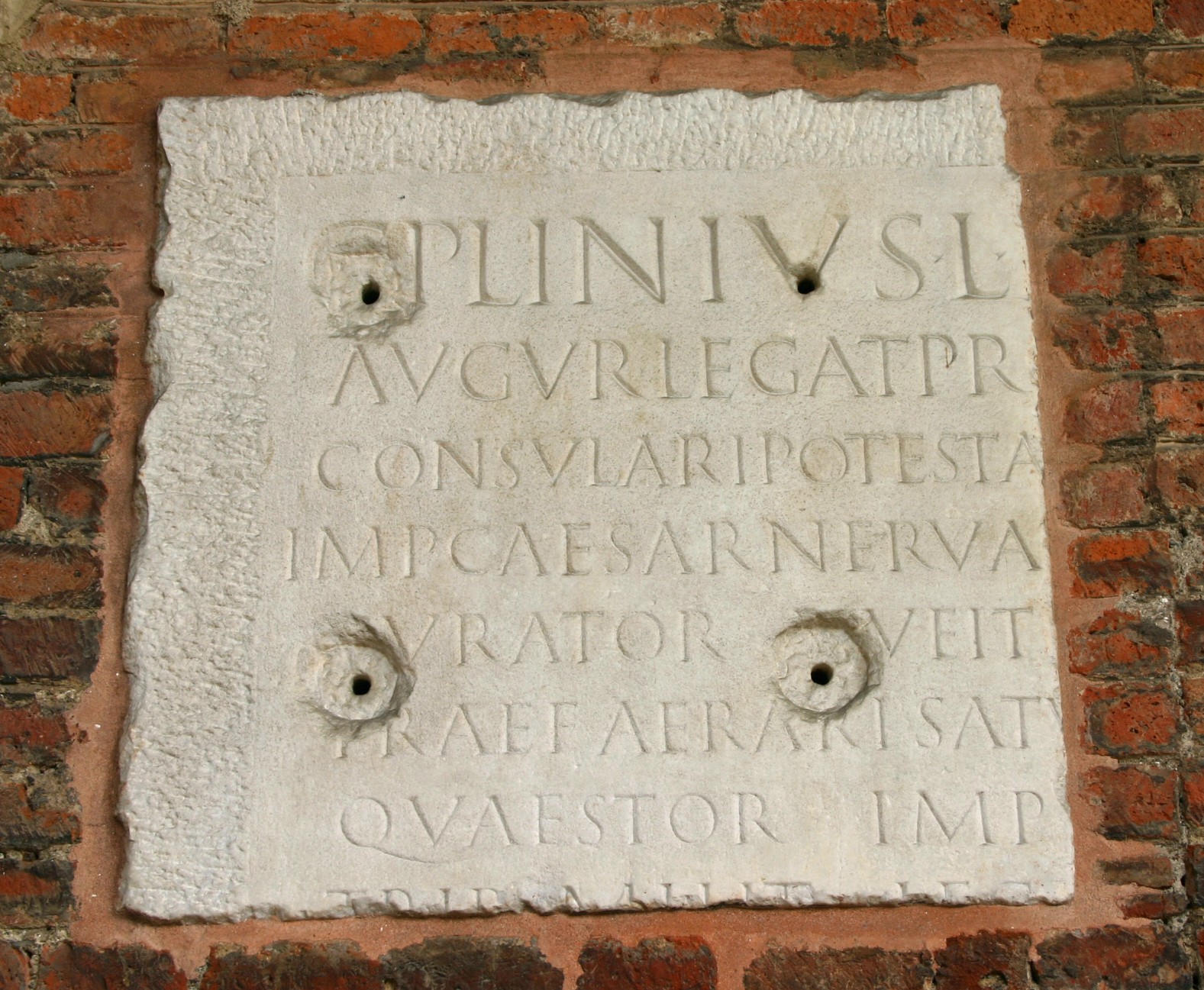
ConfirmedThe surviving piece of Pliny's own building inscription, set into a brick wall at Sant'Ambrogio in Milan. It begins C PLINIVS, Gaius Plinius. Giovanni Dall'Orto, via Wikimedia Commons, CC BY-SA 2.5 it.
Peter, an apostle of Jesus Christ, to the strangers scattered throughout Pontus, Galatia, Cappadocia, Asia, and Bithynia,
1 Peter 1:1, KJV
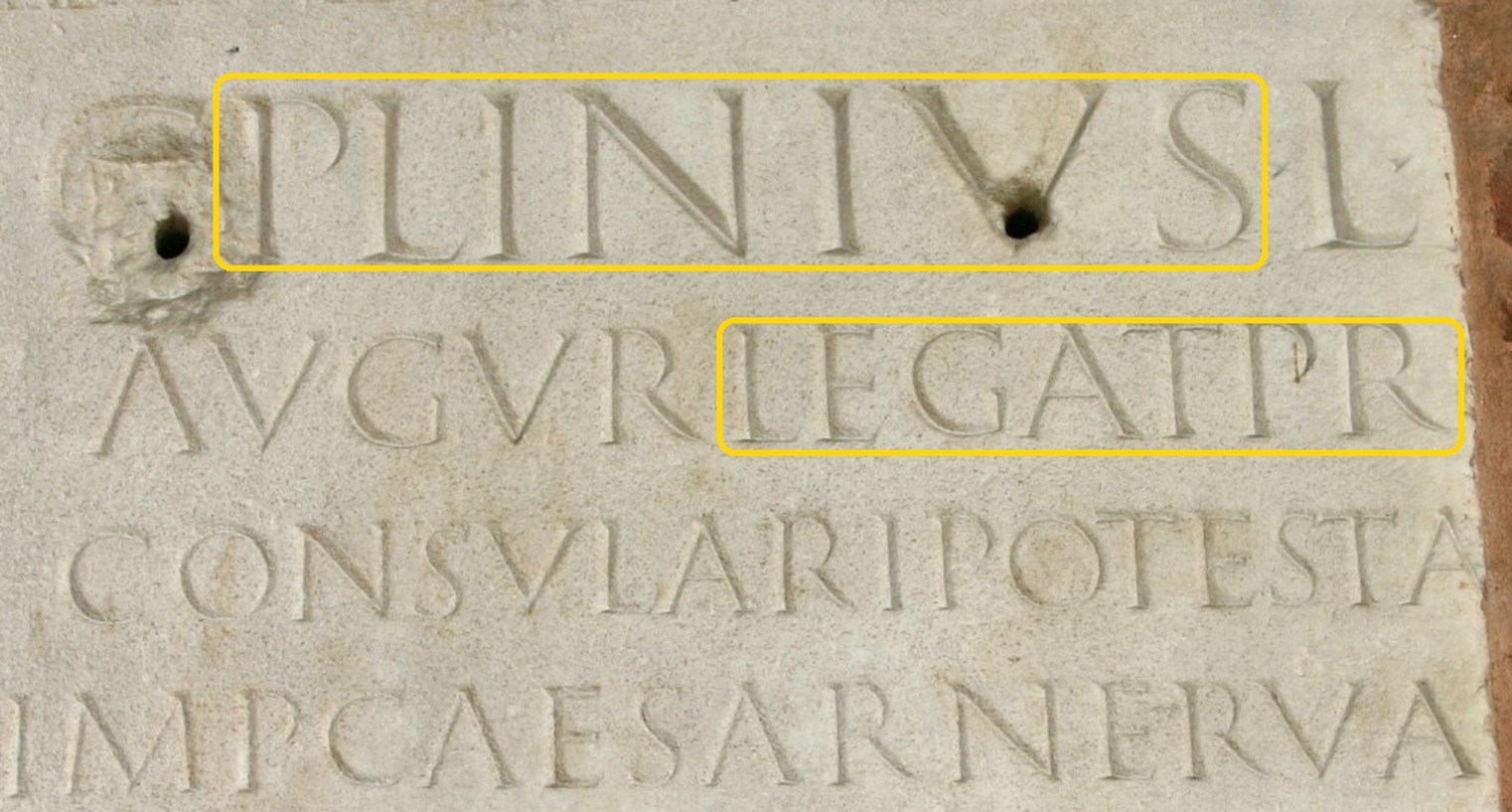
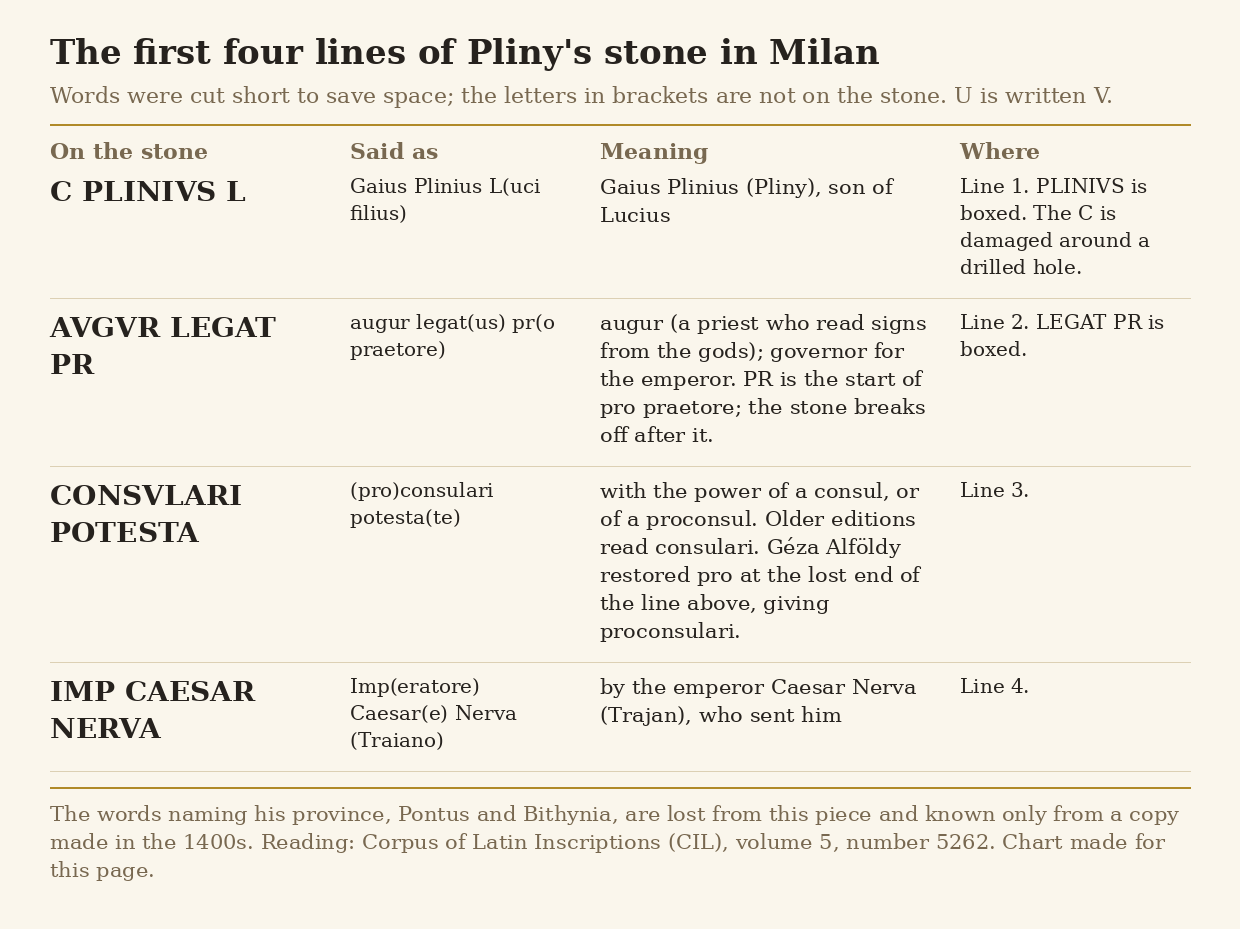
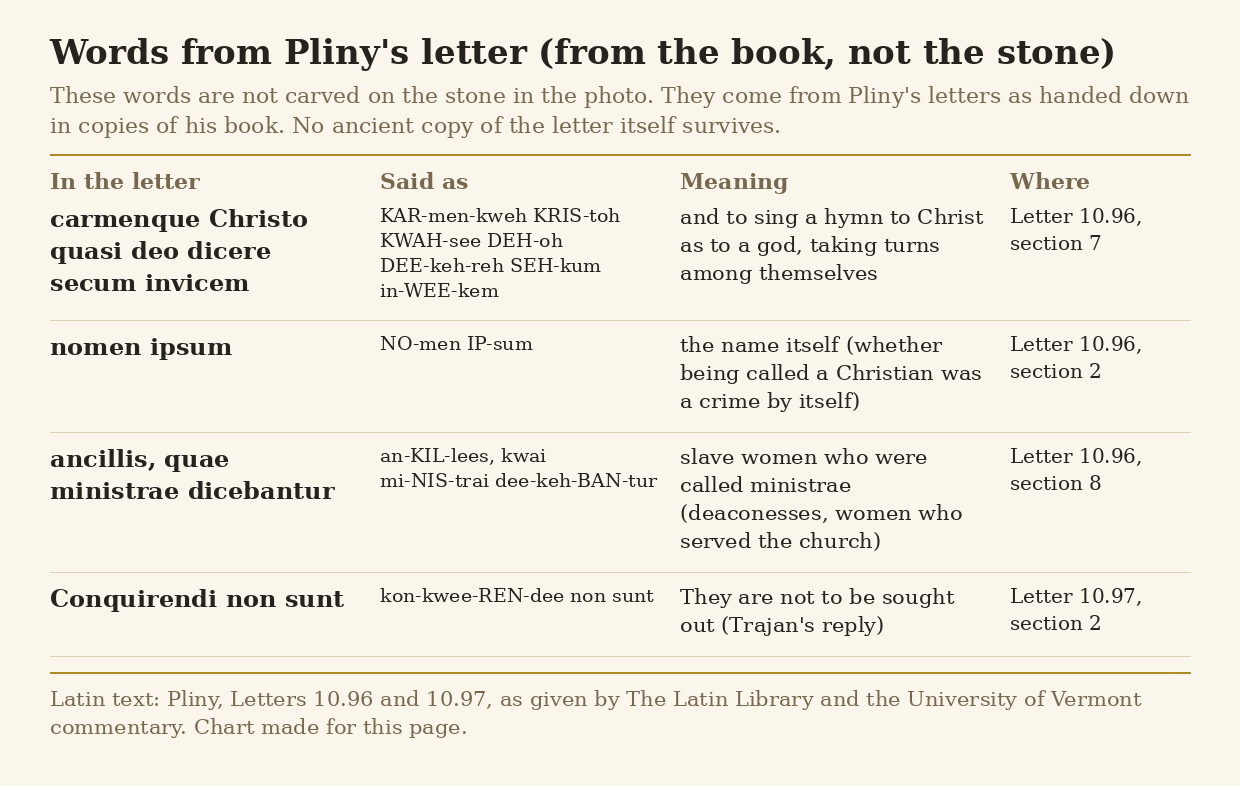
Pliny the Younger, a Roman senator, governed the province of Pontus and Bithynia, on the Black Sea coast of what is now northern Turkey, for the emperor Trajan. In about AD 110 to 112 he wrote to Trajan asking how to deal with people accused of being Christians (Letters 10.96), and Trajan's short reply also survives (10.97). Pontus and Bithynia are two of the regions to which 1 Peter 1:1 is addressed. Pliny says that Christians of every age and rank, men and women, were found in the cities, villages and farms, and that the temples had been almost deserted, though people were now coming back to them. Those who said three times that they were Christians and would not give it up were executed, and Roman citizens were sent to Rome for trial. The photo below shows Pliny's name and title on the stone; the charts give the stone's words and, separately, key words from his letter.
Photo of the top four lines of the stone set into a wall at Sant'Ambrogio in Milan, a surviving piece of a building inscription that names Pliny. The two yellow boxes were added for this page. Upper box, line 1: PLINIVS, his family name, Pliny. Lower box, line 2: LEGAT PR, the start of his title as governor for the emperor. The C before PLINIVS is damaged around a drilled hole and is not boxed. The stone does not contain any words of Pliny's letter about the Christians. Giovanni Dall'Orto, via Wikimedia Commons, CC BY-SA 2.5 Italy.The first four lines of the stone, with how they sound and what they mean. Chart made for this page, free to reuse.Key Latin words from Pliny's letter about the Christians and from Trajan's reply. These come from copies of his book of letters, not from the stone. Chart made for this page, free to reuse.
Where it is today
No ancient copy of the letter survives. Book 10 of Pliny's letters is known from printed editions made in Venice in 1502 and 1508 from an old manuscript that is now almost entirely lost; only 6 leaves of it survive, in the Morgan Library, New York (M.462), and they are not from book 10. The stone in the photo is set into a wall of the Basilica of Sant'Ambrogio, Milan.
Date
Letter: about AD 110 to 112. Pliny reached his province between AD 109 and 111. The inscription in the photo: set up after Pliny died, probably soon after AD 112, because it lists gifts he left in his will.
Why this label: Scholars generally accept the letters as genuine, and the Christian writer Tertullian already used them in AD 197. They show real Christians in Pontus and Bithynia about 50 years after the traditional date of 1 Peter (the early 60s AD), and less if 1 Peter was written later, but they say nothing about who first brought the faith there.
Good to know
What Christians did: Former Christians told Pliny that they used to "meet on a fixed day before dawn and sing responsively a hymn to Christ as to a god" (responsively means taking turns), and bound themselves by oath "not to commit fraud, theft, or adultery" or break their word. Afterwards they met again "to partake of food", which they said was "ordinary and innocent food". Pliny had two slave women "who were called deaconesses" (Latin ministrae) tortured, and found nothing but "depraved, excessive superstition". (Quotations from the translation on James O'Donnell's Georgetown University page; the translator is not named there.)
The name itself: Pliny asked whether "the name itself" should be punished even without crimes. Trajan replied that Christians "are not to be sought out", but if accused and proved guilty they must be punished, unless they prove they are not Christians by worshipping the Roman gods. Anonymous accusations were to be ignored. This fits the words of 1 Peter 4:16 about suffering "as a Christian", but it does not date 1 Peter. Scholars disagree on when 1 Peter was written, and only some link it to Pliny's time.
Other views: Most scholars accept the letters as genuine. One recent computer study of Pliny's writing style found that Pliny did write the letter, but argued that large parts of it were added later. This is not the common view.
Other links: Acts 16:7 says Paul tried to go into Bithynia, "but the Spirit suffered them not". About AD 170 Dionysius, bishop of Corinth, wrote a letter to the Christians of Nicomedia, Bithynia's leading city (Eusebius, Church History 4.23).
Gortyn, Roman capital of Crete, and the letter to Titus
Titus 1:5 · Titus 1:12-13 · Acts 27:7-8
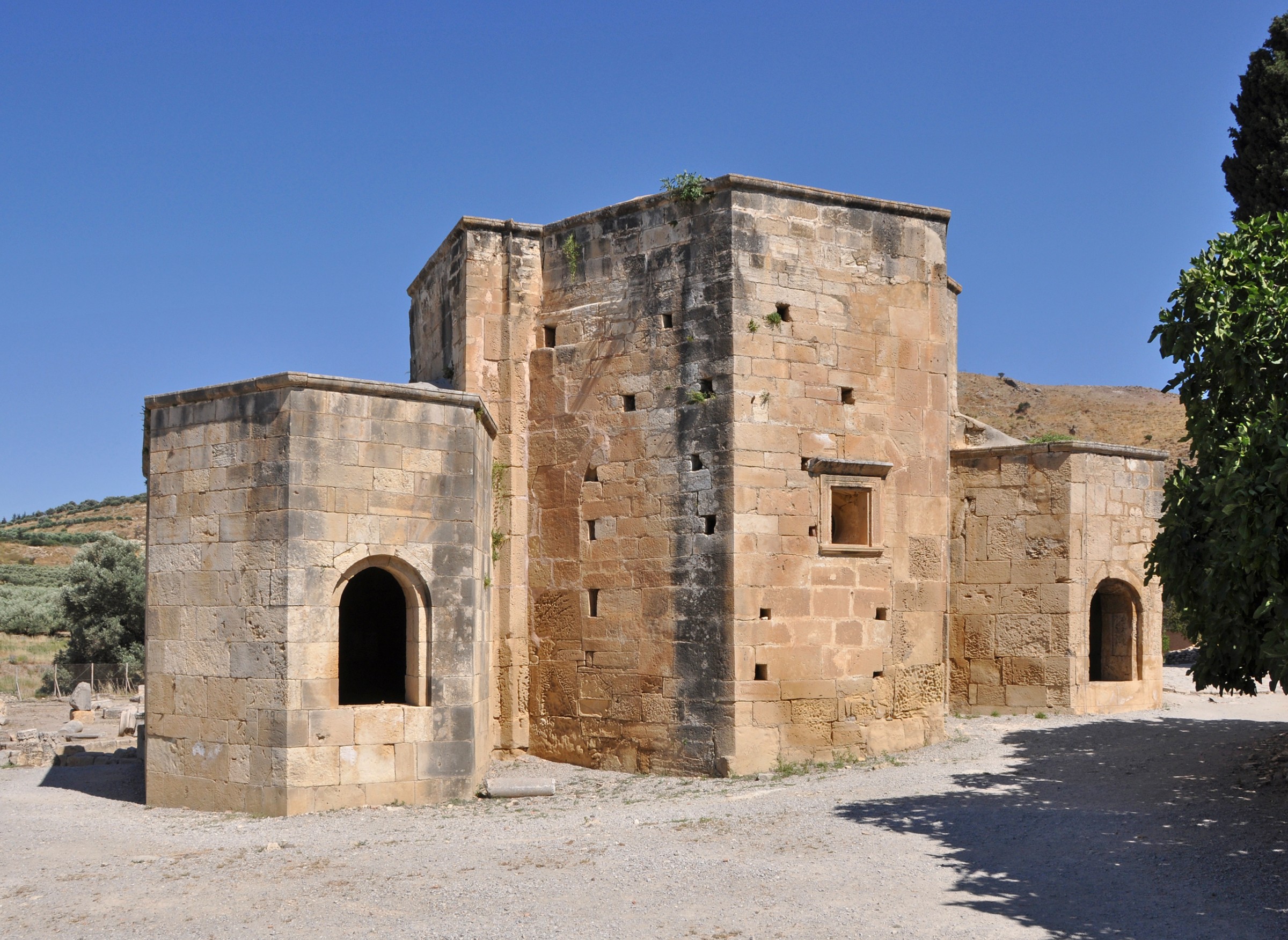
BackgroundThe ruined church of St Titus at Gortyn, Crete, built in the 500s AD. Its east end still stands to full height. Marc Ryckaert (MJJR), via Wikimedia Commons, CC BY 3.0.
For this cause left I thee in Crete, that thou shouldest set in order the things that are wanting, and ordain elders in every city, as I had appointed thee:
Titus 1:5, KJV
Titus 1:5 says Paul left Titus in Crete to appoint elders "in every city". In Roman times the leading city of Crete was Gortyn (also called Gortyna), in the Messara plain in the south centre of the island. It was the capital of the Roman province of Crete and Cyrene (Cyrene is in what is now Libya). Its ruins include the Roman governor's headquarters (the praetorium), first built in the first century AD, a Greek law code carved in stone, and the standing ruin of the church of St Titus from the 500s AD. The Bible does not name Gortyn.
Where it is today
Gortyn archaeological site, beside the village of Agioi Deka, Heraklion regional unit, Crete, Greece, about 45 km from Heraklion. Some blocks of the law code are in the Louvre, Paris.
Date
Law code: first half of the 400s BC. Roman capital: after Rome conquered Crete in the 60s BC. Church of St Titus: 500s AD. The city was destroyed when Arab invaders took Crete in about AD 828.
Why this label: Crete is certainly the island named in Titus 1:5, and Gortyn was its Roman capital, but the Bible never names Gortyn. The link between Titus and Gortyn comes from later tradition, and nothing found at the site names Titus from his own time.
Good to know
Titus and Gortyn: The Bible says only that Titus was left in Crete (Titus 1:5) and later went to Dalmatia (2 Timothy 4:10). Eusebius, writing in the early 300s, says it was recorded that Titus was the first bishop of "the churches in Crete" (Church History 3.4). Later tradition made Gortyn his seat.
The church at Gortyn: About AD 170 Dionysius, bishop of Corinth, wrote to "the church that is in Gortyna" and praised its bishop Philip (Eusebius, Church History 4.23). So a church with a bishop existed there within about 100 years of Paul. The church of St Titus that visitors see was built in the 500s, more than 400 years after Titus.
The law code: About 600 lines of laws on marriage, divorce, children, inheritance and slaves, carved in 12 columns on a curved stone wall in the 400s BC. The lines run from right to left and then from left to right, turning back at the end of each line. A first piece was found in 1857. In 1884 the Italian archaeologist Federico Halbherr found 4 columns, and his team then uncovered 8 more. The stones had been reused in the foundations of a later Roman building. It shows that Crete had written laws and organized cities long before Titus came, but it is far older than Titus.
Cretans are liars: Titus 1:12 quotes "a prophet of their own": Κρῆτες ἀεὶ ψεῦσται (Kretes aei pseustai), "Cretans are always liars". Clement of Alexandria, about AD 200, is the first known writer to say this prophet was Epimenides, a Cretan wise man and poet, partly a figure of legend, of the 600s or 500s BC.
Doubting view: The same opening words appear in the Hymn to Zeus of the Greek poet Callimachus (200s BC), where the Cretans lie by claiming to have Zeus's tomb. The early Christian writers Athenagoras and Origen quote the line from Callimachus, and John Chrysostom (about AD 400) names both Callimachus and Epimenides. Erkki Koskenniemi (2011) argues that "Cretans are always liars" began as a well-known saying, and that the link with Epimenides was added later and is not historical. Standard editions of the Greek New Testament and some commentaries still name Epimenides.
Paul at Crete: Acts 27:7 to 8 says Paul's ship sailed along Crete and stopped at Fair Havens, near the city of Lasea.
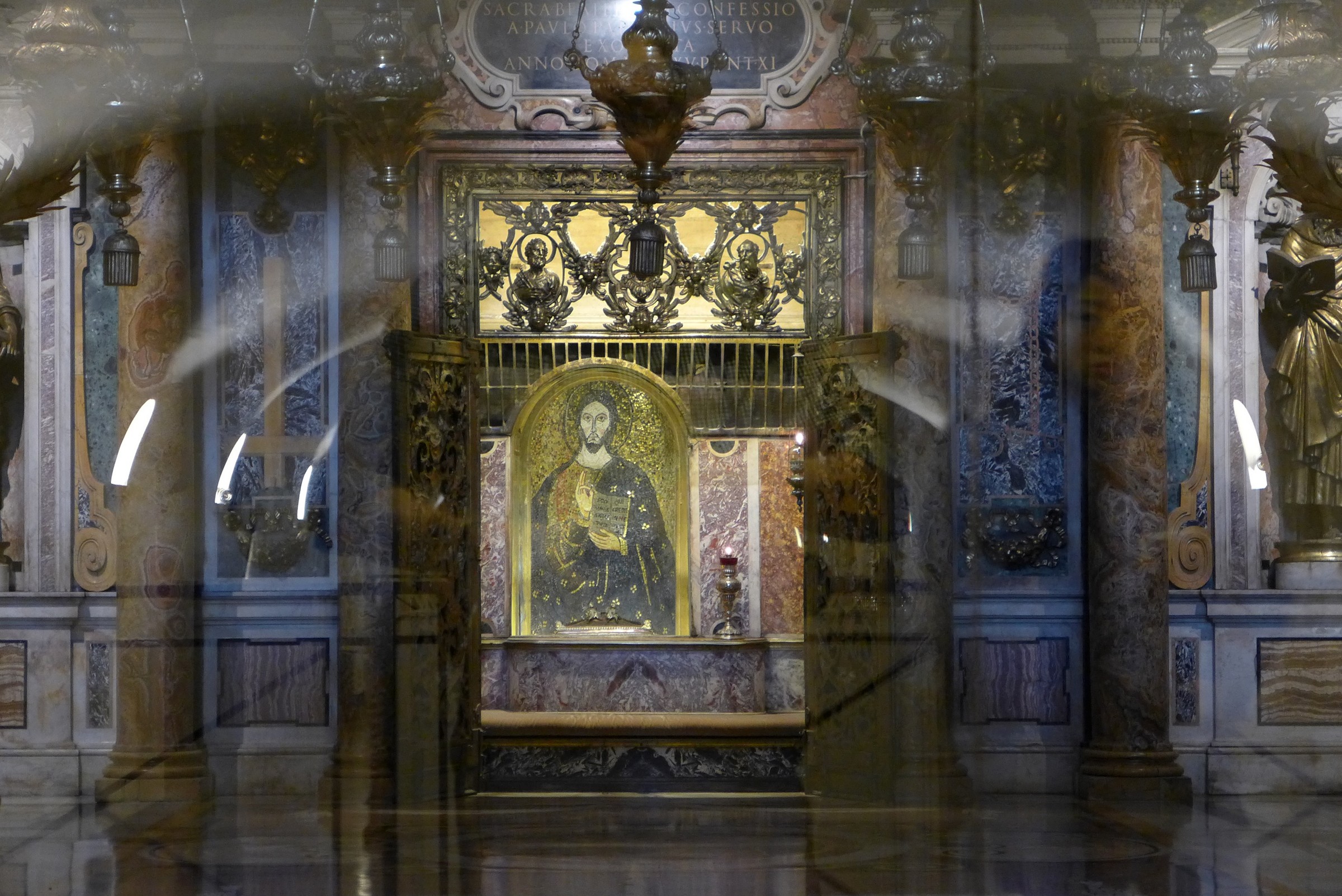
Traditional siteUnder the papal altar of St Peter's, seen through glass: the Niche of the Pallium, with a mosaic of Christ. This niche is the top part of the ancient shrine that marks Peter's traditional grave. The grave itself lies lower down and is not seen. Dnalor 01, via Wikimedia Commons, CC BY-SA 3.0 at.
Verily, verily, I say unto thee, When thou wast young, thou girdedst thyself, and walkedst whither thou wouldest: but when thou shalt be old, thou shalt stretch forth thy hands, and another shall gird thee, and carry thee whither thou wouldest not. This spake he, signifying by what death he should glorify God. And when he had spoken this, he saith unto him, Follow me.
John 21:18-19, KJV
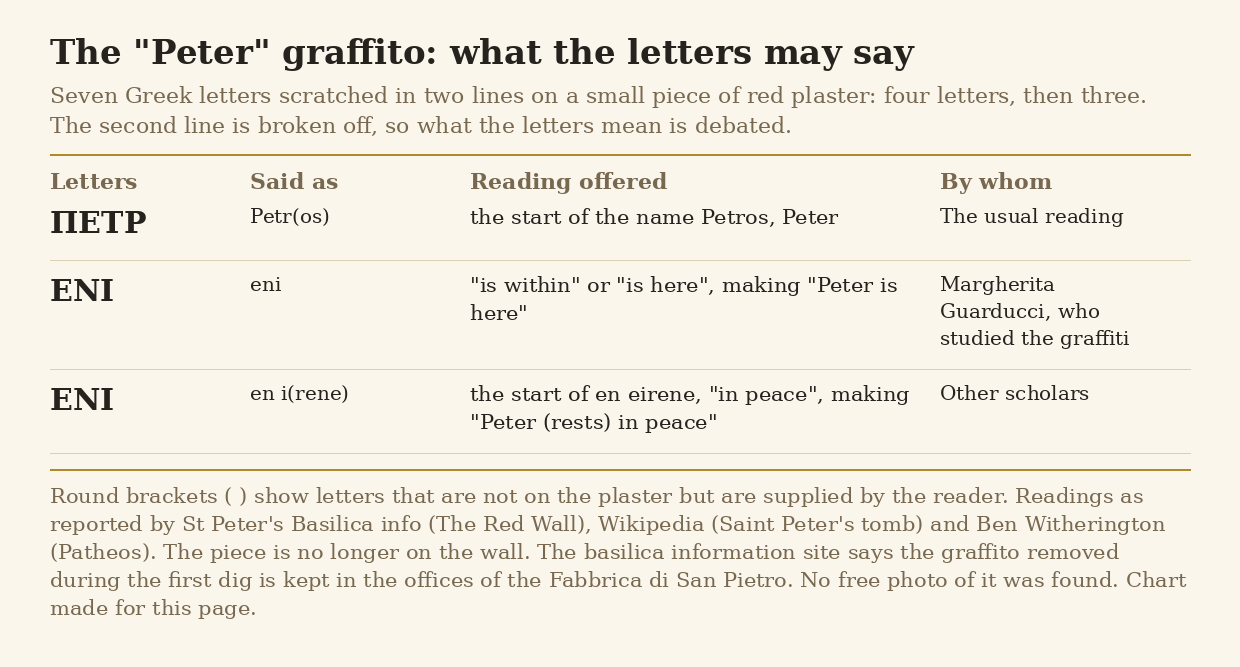
Jesus told Peter what kind of death he would die (John 21:18 to 19), but the Bible does not record his death or burial. First Clement, a letter sent from Rome in the late first century, speaks of his death but does not say where it happened. From about AD 170 onward, Christian writers say plainly that he died in Rome. From 1939 to 1949 the Vatican dug under St Peter's Basilica and found a Roman cemetery used from the 100s into the early 300s. Right under the high altar they found a small shrine built against a red-plastered wall in about AD 160. Constantine later built his church so that its altar area stood over this shrine. A Roman church leader named Gaius, writing about AD 200, said he could show the 'trophies' (memorials) of the apostles on the Vatican hill and on the road to Ostia. Eusebius quotes him in his Church History (2.25), written in the early 300s. Most scholars think the shrine under the altar is the one Gaius meant.
The seven Greek letters of the small graffito from the red wall, and the two main readings scholars have offered. Round brackets show letters that are not on the plaster but are supplied by the reader. With so few letters, the meaning is debated. Chart made for this page, free to reuse.
Where it is today
Vatican City, under St Peter's Basilica. The dig area is called the Vatican Necropolis or the Scavi. It can be seen only on a guided tour booked ahead with the Excavations Office (Ufficio Scavi). Numbers are limited.
Date
Peter's death is usually placed under Nero. Some put it in AD 64, when Nero punished Christians after the Great Fire of Rome (Tacitus tells of this, but does not name Peter). Others follow later church tradition, which places it about AD 67 or 68. The red wall and the shrine (the Trophy of Gaius) date to about AD 160; the date comes from makers' stamps on bricks in the red wall. Gaius wrote about AD 200. The graffiti wall was added in the 200s. Constantine's church was begun in the 320s. The dig ran from 1939 to 1949, and its report came out in 1951. Pope Paul the Sixth spoke about the bones on 26 June 1968.
Why this label: The shrine shows that Christians in Rome were honouring this spot as Peter's grave by about AD 160, only about a hundred years after his death. No inscription found in place names the grave beyond doubt, and whether the bones are Peter's is strongly disputed.
Good to know
The bones: The grave under the shrine held the remains of four people and some farm animals. A separate set of bones came from a marble-lined niche in the graffiti wall, which was built long after Peter died. During the dig, someone gathered these bones into a wooden box without the archaeologists knowing, and the box was stored away. Margherita Guarducci traced the box in 1953. In 1962 and 1963 a specialist, Venerando Correnti, said the bones came from one robust man aged about 60 to 70. Bits of purple cloth woven with gold were found with them. In 1950 Pope Pius the Twelfth said the tomb had been found but the bones could not be proven to be Peter's. In 1968 Pope Paul the Sixth said they had been identified in a way the church could consider convincing.
The case for: Christians cared for this spot from about AD 160. Later graves are placed close around the shrine without cutting into it, which suggests respect for it. Constantine cut away part of a hillside cemetery so his church could stand exactly here. From Gaius on, writers name the Vatican hill as Peter's resting place.
The case against: Antonio Ferrua, one of the dig's archaeologists, did not accept that the bones were Peter's, and other scholars also doubted it. The bones were moved before they were properly recorded, and nothing proves they ever lay in the first grave. Encyclopaedia Britannica says that if a grave was there, nothing that can be identified of it survives today. In the 250s Christians also honoured Peter and Paul at a site on the Appian Way. Some think their remains were moved there for a time, but there is no proof of this. A few scholars, such as Otto Zwierlein, doubt that Peter was ever in Rome at all, but most scholars reject that view.
The tomb of Paul at St Paul Outside the Walls, Rome
2 Timothy 4:6-8 · Acts 28:16 · Acts 28:30-31
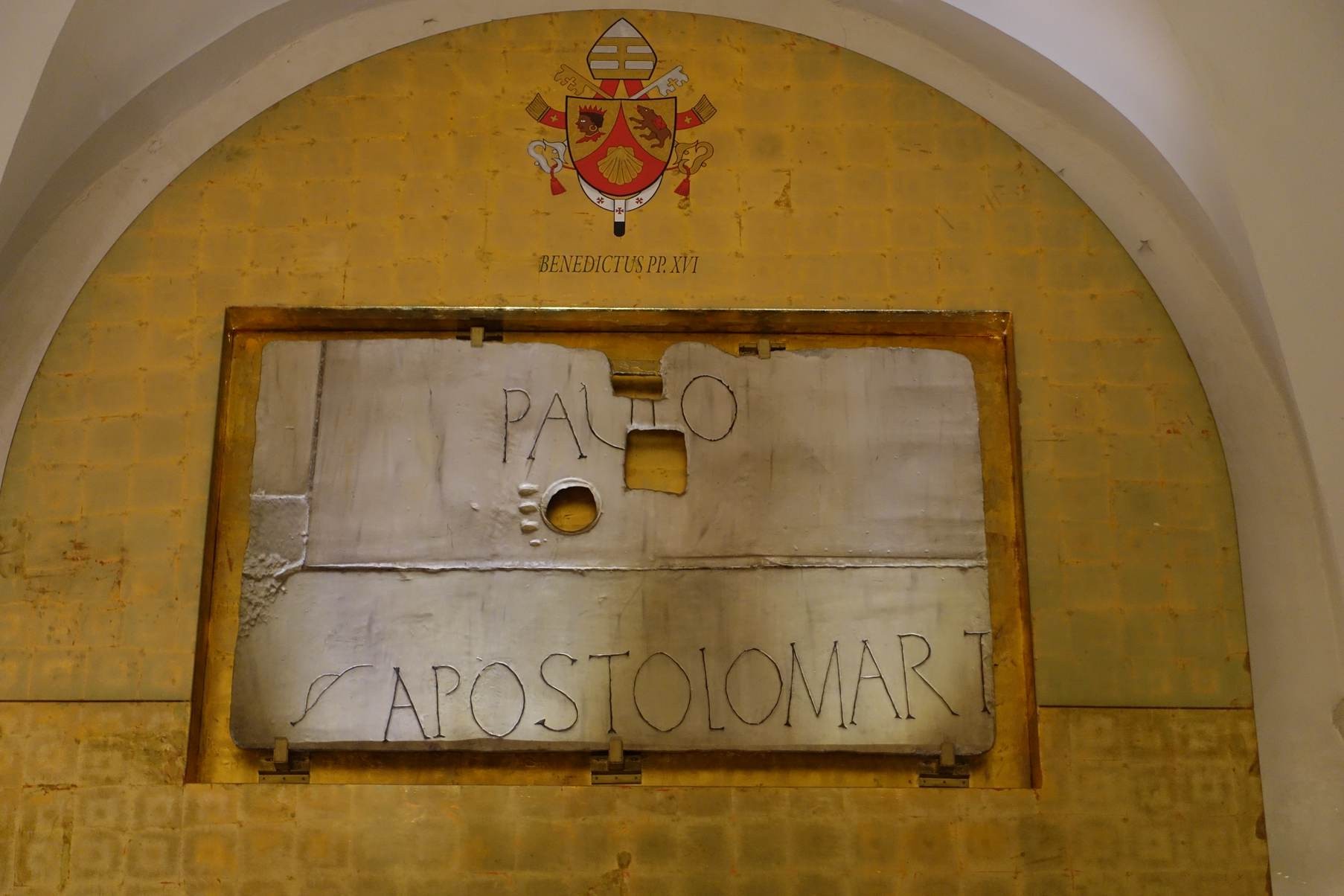
Traditional siteA copy of the marble slab reading PAVLO APOSTOLO MART, set upright in a wall niche at the basilica. The original lies flat under the papal altar, 1.37 m down. Gerhard77, via Wikimedia Commons, CC BY-SA 4.0.
For I am now ready to be offered, and the time of my departure is at hand. I have fought a good fight, I have finished my course, I have kept the faith: Henceforth there is laid up for me a crown of righteousness, which the Lord, the righteous judge, shall give me at that day: and not to me only, but unto all them also that love his appearing.
2 Timothy 4:6-8, KJV
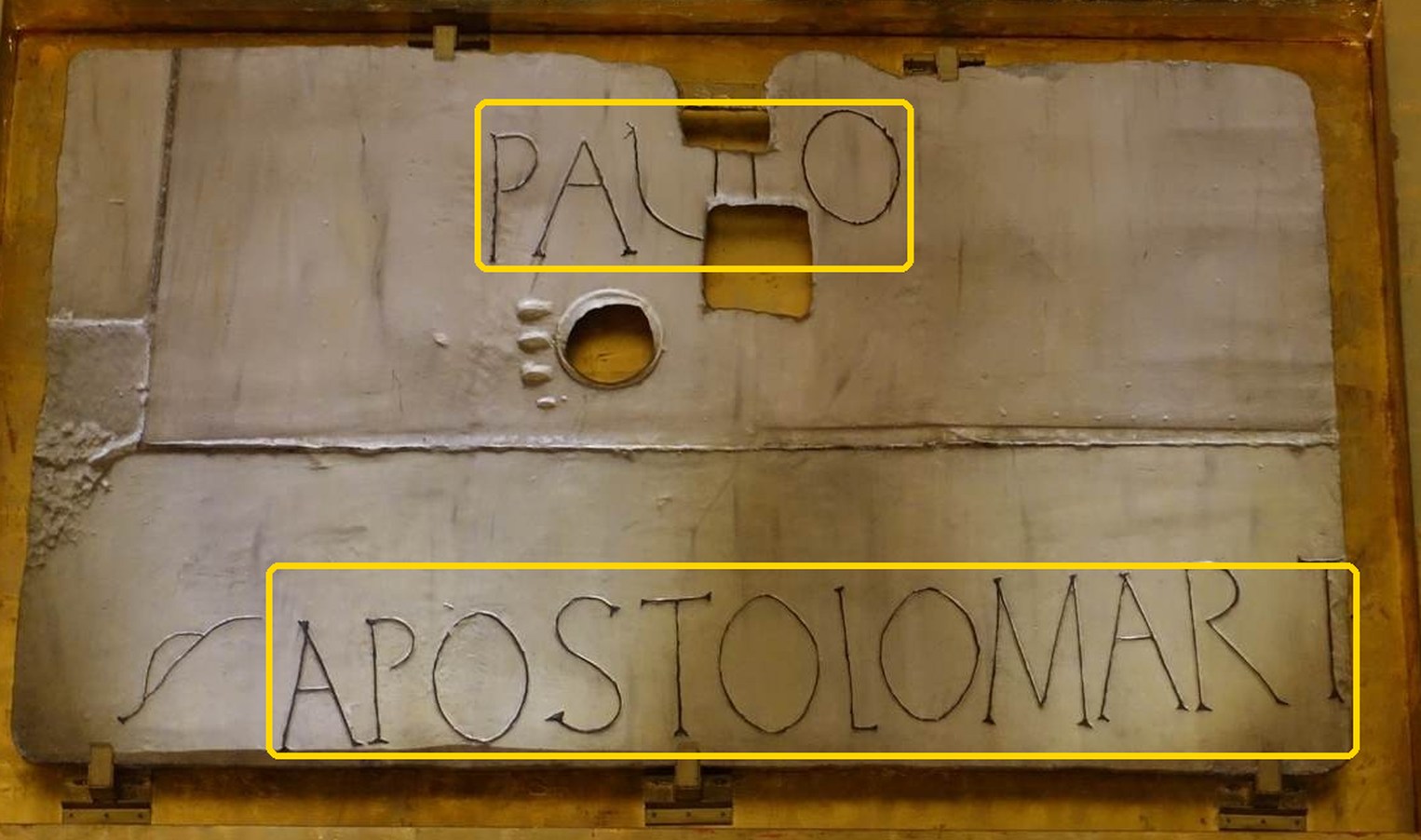
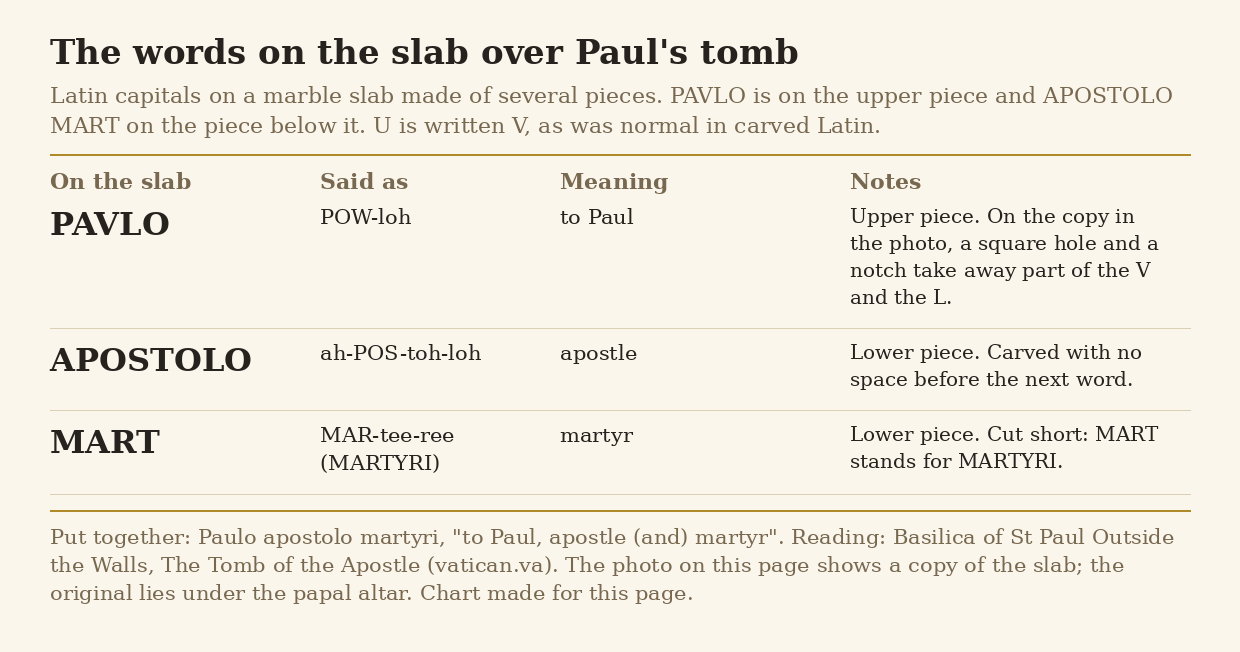
In 2 Timothy 4:6 to 8 Paul writes that his death is near. Acts ends with him still alive in Rome, so the Bible does not record his death or burial. Later writers say he was beheaded in Rome under Nero and buried beside the road to Ostia. About AD 200 Gaius said the 'trophy' (memorial) of Paul could be seen on that road. Constantine built a small church over the spot, and a much larger one was begun in AD 386. Under today's altar lies a marble slab with the Latin words PAVLO APOSTOLO MART, 'to Paul, apostle and martyr'. Under that is a large stone coffin (sarcophagus). The photo below shows the words PAVLO APOSTOLO MART on a copy of the slab.
Photo of a copy of the marble slab, shown in the basilica. The original lies flat under the papal altar and is not shown here. The two yellow boxes were added for this page. Upper box: PAVLO, "to Paul", on the upper piece. Lower box: APOSTOLO MART, "apostle (and) martyr", on the lower piece, carved with no space between the two words. On this copy, part of the V and the L of PAVLO is missing where a square hole and a notch were cut into the slab. The round hole below the name is one of the holes described on the original. Gerhard77, via Wikimedia Commons, CC BY-SA 4.0.The three words on the slab, with how they sound and what they mean. MART is short for MARTYRI, "martyr". Chart made for this page, free to reuse.
Where it is today
Italy, Rome: the Basilica of St Paul Outside the Walls, on the Via Ostiense. Visitors can see one side of the sarcophagus through an opening under the papal altar. A plaster copy of the slab, the same size as the original, is listed by the Museo della Civiltà Romana in Rome (inventory MCR 534, museum website).
Date
Paul's death is usually placed between about AD 64 and 68. Those who link it with Nero's attack on the Christians after the fire of AD 64 favour the earlier date; later church tradition gives about AD 67 or 68. Gaius wrote about AD 200. Constantine's church was dedicated in 324 (by tradition). The larger church was begun in 386, and its transept floor dates to about AD 390. Dates given for the slab range from the late 300s to the middle 400s: the basilica's own page says 300s to 400s, and Vatican Radio linked it with Pope Leo the Great (440 to 461). The basilica burned in 1823 and was rebuilt. The Vatican dig ran from 2002 to 22 September 2006. The bone dating was announced in June 2009.
Why this label: Christians honoured Paul's grave on this road from at least about AD 200, and the sarcophagus has been honoured as his tomb since about AD 390. The excavator himself said that which grave was the first one is still an open question, and no test can show whose bones are inside.
Good to know
The digs: From 2002 to 2006 Vatican archaeologist Giorgio Filippi uncovered part of Constantine's church and found the large sarcophagus again. It had been lost from view after the rebuilding of the 1800s. Filippi's report says that by tradition the church stands over the apostle's tomb, but that which grave was the first one remains an open question. The aim of the dig was to check what survived of the churches of the 300s and to let pilgrims see the tomb, not to test the remains.
The bone tests: In 2009 Pope Benedict the Sixteenth said a probe had been put through a small hole into the closed sarcophagus. It found purple linen with gold, a blue cloth, grains of red incense, and tiny pieces of bone. Experts who did not know where the bones came from dated them by carbon-14 to someone who lived in the first or second century AD. The Pope said this 'seems to confirm' the tradition that these are Paul's remains.
What it shows: The bones are old enough to belong to Paul, so the test does not rule him out.
What it cannot show: A range of about 200 years fits a great many people in Rome, and the test cannot give a name. AsiaNews, reporting the remarks of the Vatican Museums laboratory director, summed them up as saying the test 'neither confirms nor denies' that the remains are Paul's, and that more tests would be needed.
The tomb of John at Ephesus (Basilica of St John, Selcuk)
Revelation 1:9 · John 21:22-24 · Revelation 2:1
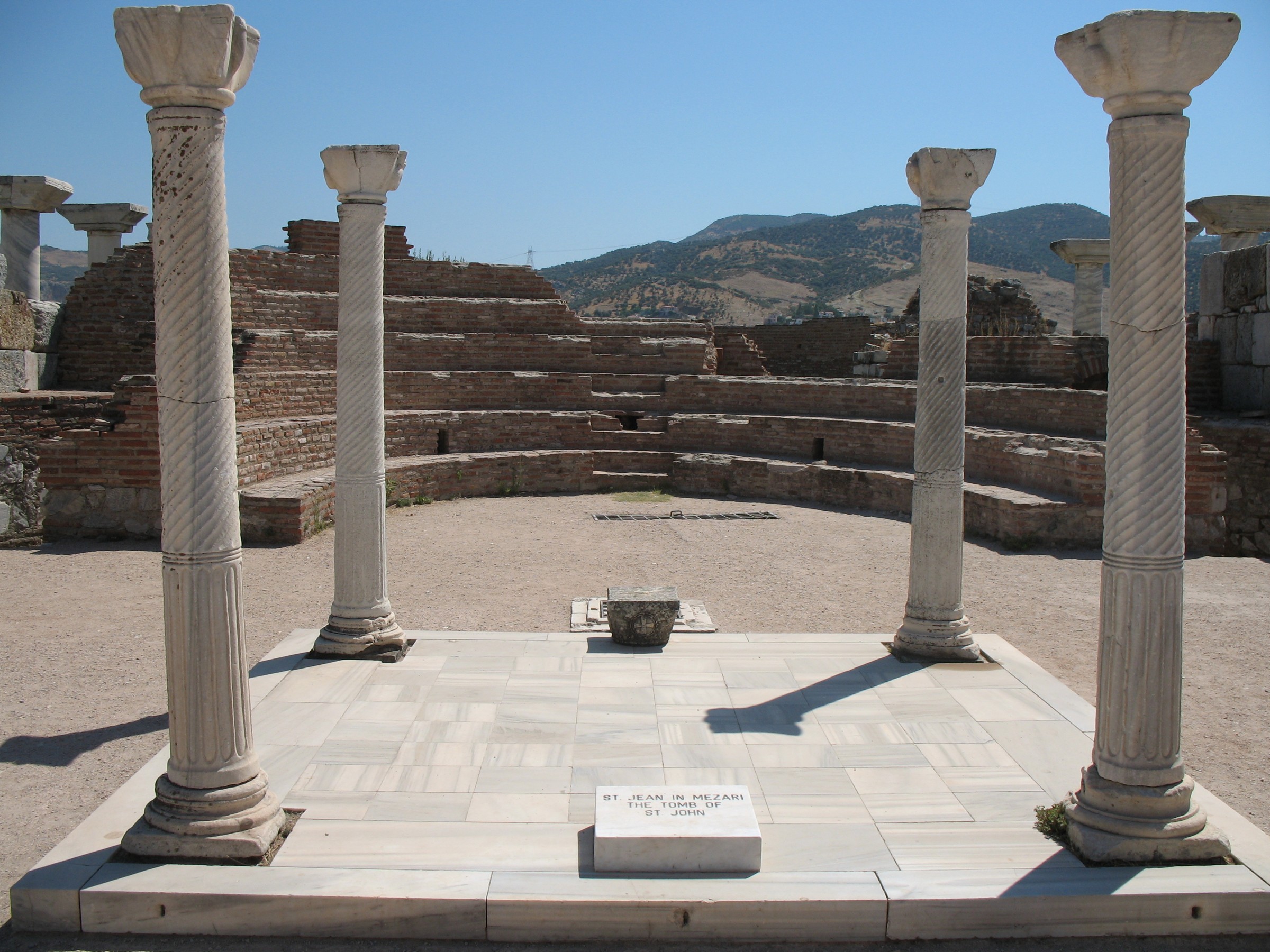
Traditional siteThe marked place of John's tomb in the ruins of the Basilica of St John, Selcuk. An English Wikipedia user (own photo), via Wikimedia Commons, Public domain.
I John, who also am your brother, and companion in tribulation, and in the kingdom and patience of Jesus Christ, was in the isle that is called Patmos, for the word of God, and for the testimony of Jesus Christ.
Revelation 1:9, KJV
Early Christian writers say the apostle John spent his last years at Ephesus and was buried there. About AD 190 Polycrates, bishop of Ephesus, wrote to the bishop of Rome that John, 'who reclined upon the bosom of the Lord,' 'sleeps at Ephesus.' Eusebius quotes this in his Church History (3.31 and 5.24; McGiffert's translation). Irenaeus, about AD 180, says John stayed at Ephesus until the time of Trajan (AD 98 to 117). A small memorial over the grave was followed by a church in the 300s. Emperor Justinian then built a huge cross-shaped church with domes, finished by 565, with the tomb under the altar.
Where it is today
Turkey, Izmir Province: the ruins of the Basilica of St John on Ayasuluk Hill in the town of Selcuk, about 3.5 km from ancient Ephesus. The tomb place is marked at the east end of the central aisle, in front of the apse (the rounded end of the church).
Date
John is said to have died about AD 100. Polycrates wrote about AD 190. A church was built over the grave in the 300s. Justinian's basilica was built between about 548 and 565. Greek archaeologists first studied the site in 1921 to 1922. The Austrian Archaeological Institute worked there in 1927 to 1930. Turkish restoration started in 1957 to 1958, and work still goes on.
Why this label: A bishop of Ephesus placed John's grave there by about AD 190, and the church was built on the spot believed to be the grave. No body or inscription naming John has been reported, and early writers already knew of two tombs at Ephesus called John's.
Good to know
Which John: Papias, a bishop in the same region in the early 100s, names a 'John' among the apostles and also 'the presbyter John' (the elder John). About AD 325 Eusebius said there were 'two tombs in Ephesus, each of which, even to the present day, is called John's.' He used this to argue that the elder John might have written Revelation. Earlier, Dionysius of Alexandria (middle 200s) had also heard of 'two monuments in Ephesus, each bearing the name of John.' So it is possible the tomb honoured here was first the grave of the elder John.
The other view: Irenaeus, who knew Polycarp, speaks of only one John at Ephesus. The Catholic Encyclopedia of the early 1900s, for example, argued that Papias meant the same John twice. Scholars still disagree.
What was found: The sources checked report the church, the crypt area under the altar, later burials and pottery. They do not report bones or an inscription that name John. Later legends said John's body was not in the grave at all. Pilgrims collected 'manna', a dust said to rise from the grave, in small flasks.
James the son of Zebedee: Jerusalem and the Santiago de Compostela tradition
Acts 12:1-2 · Mark 10:38-39 · Matthew 4:21
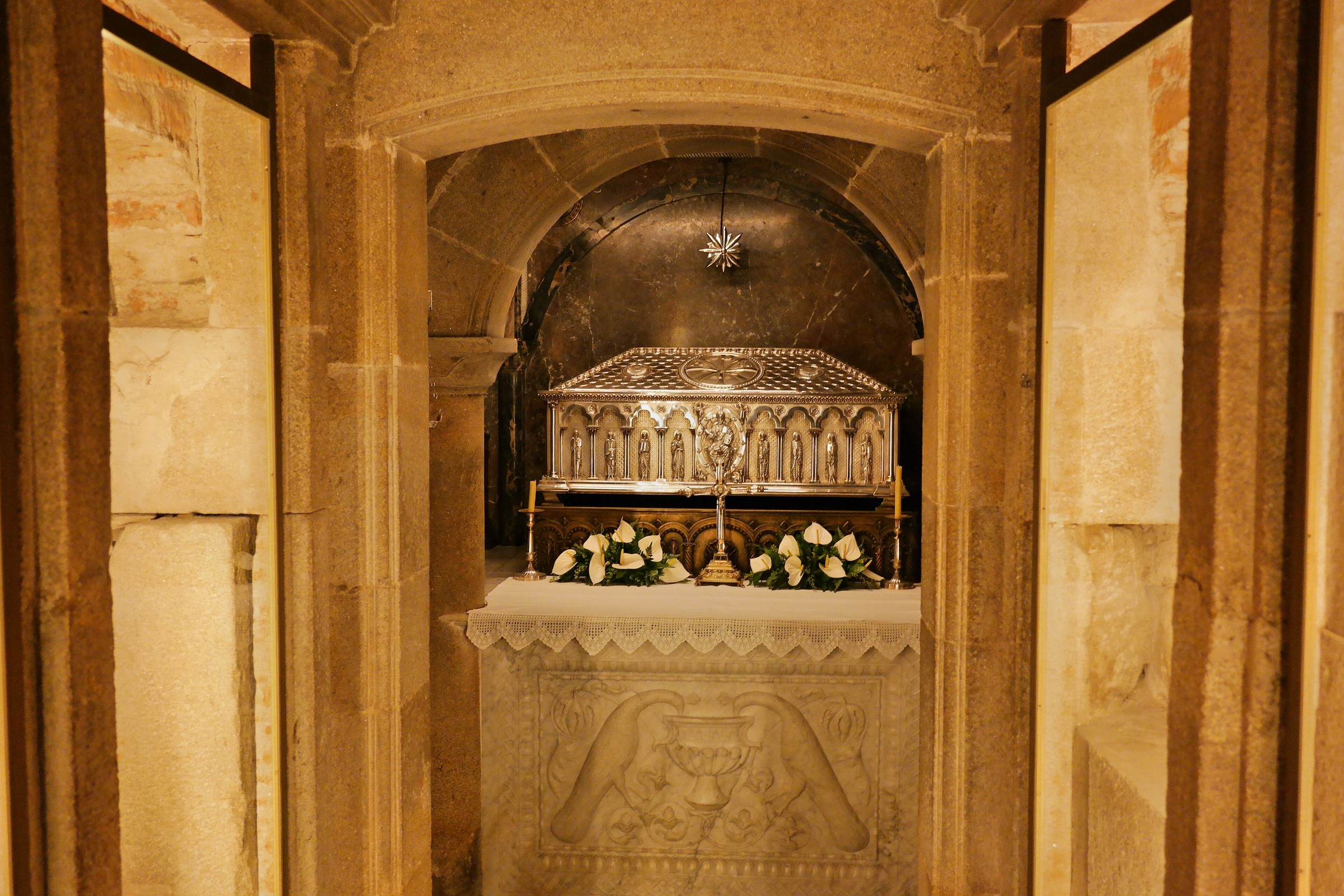
DisputedThe casket said to hold the bones of St James, in the crypt of Santiago de Compostela Cathedral. Roy r lindman, via Wikimedia Commons, CC BY 4.0.
And he killed James the brother of John with the sword.
Acts 12:2, KJV
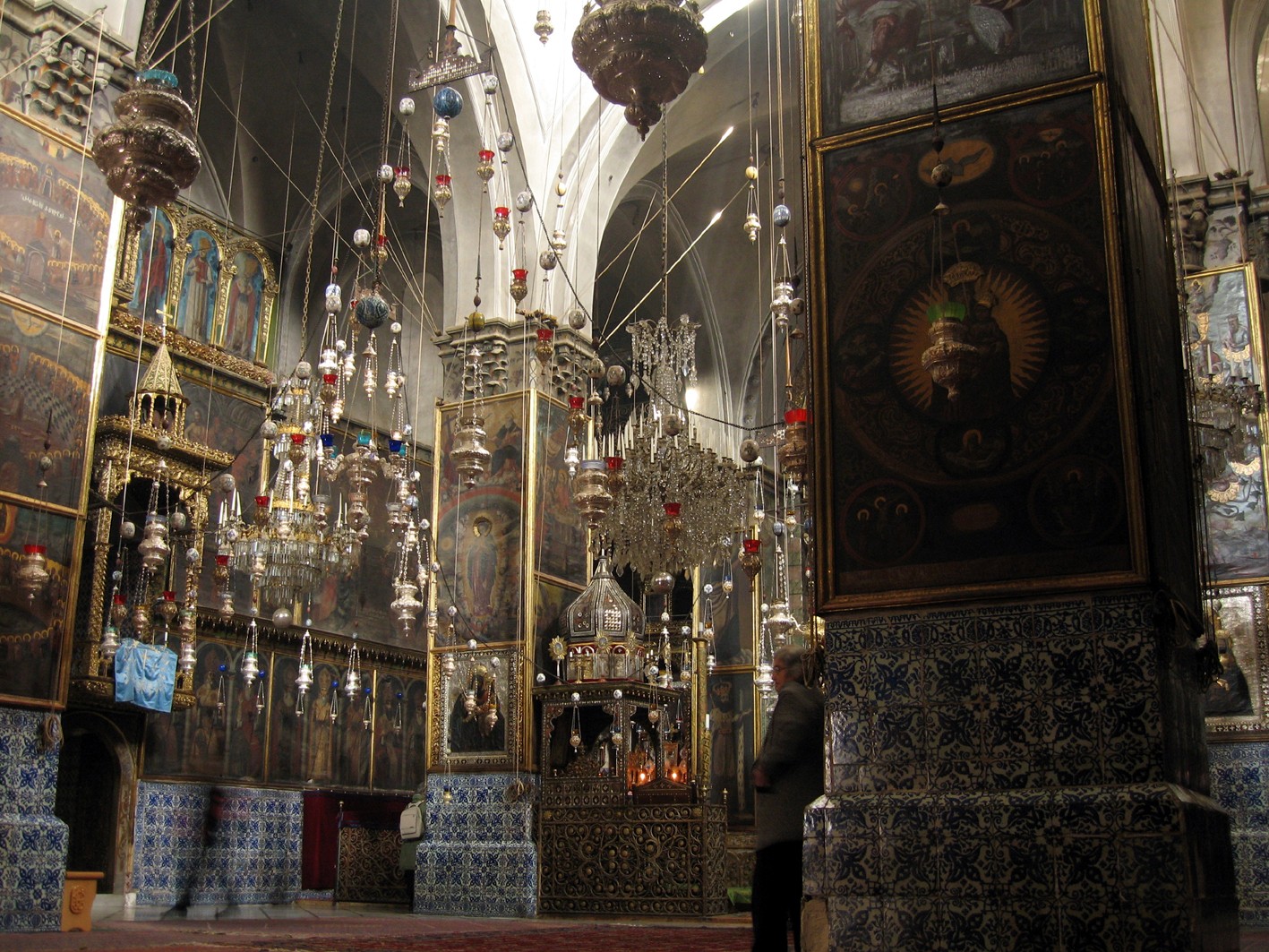
Acts 12:1 to 2 says King Herod (Herod Agrippa the First) killed James the brother of John with the sword. He is the only one of the twelve apostles whose death for the faith the New Testament records. (The death of Judas is also recorded, but he was not a martyr.) The Bible says nothing about where James was buried. Two places now claim him. In Jerusalem, the Armenian Cathedral of St James marks the traditional place of his death. Its tradition says his head is buried under an altar there. In Spain, the cathedral of Santiago de Compostela claims his body.
Where it is today
Spain, Galicia: Santiago de Compostela Cathedral, where a casket in the crypt under the high altar holds the bones claimed to be his. Jerusalem: the Armenian Cathedral of St James in the Armenian Quarter, a 12th-century church.
Date
James died shortly before Herod Agrippa the First, who died in AD 44. The first writing to say James preached in Spain is a Latin list of the apostles' lives (the Breviarium Apostolorum) from the 500s or 600s. The tomb in Spain was 'found' in the 800s under Bishop Theodemir of Iria (died 847). Traditional dates are 812 to 814; a more cautious dating puts it between 818 and 842. A church followed in 829. The present cathedral was begun in 1075.
Why this label: The claim that James is buried in Spain is first recorded in the 800s, more than 750 years after his death. Later accounts of the find tell of a hermit led to the spot by a light in the sky. Scholars are divided, and some deny that James ever went to Spain at all.
Good to know
How late it is: Nothing in the first 500 years of Christian writing places James's grave in Spain. The idea that he preached there first appears in the 500s or 600s. The New Catholic Encyclopedia calls that source of 'debatable historical value'. The grave itself was announced only in the 800s.
The digs: Excavations under the cathedral in 1878 to 1879 led Pope Leo the Thirteenth to recognize the relics in 1884. Later digs found burials from the first to the 1100s, but the encyclopedia notes the earliest 'may not be Christian'.
The defence: The same Catholic encyclopedia says the best explanation may be that real relics of James were brought to Galicia in ancient times. It admits the nature of the relics and their date of arrival are debated. Bible Odyssey (a site of the Society of Biblical Literature) treats the discovery stories as legends. The James ossuary, which is about a different James, is covered on Gospels page 2.
James the brother of the Lord: his death in Josephus
Galatians 1:19 · Acts 15:13 · 1 Corinthians 15:7
ConfirmedInside the Armenian Cathedral of St James, Jerusalem, which is dedicated to James the son of Zebedee and James the brother of the Lord. Claudius Prößer, via Wikimedia Commons, CC BY 2.0.
But other of the apostles saw I none, save James the Lord's brother.
Galatians 1:19, KJV
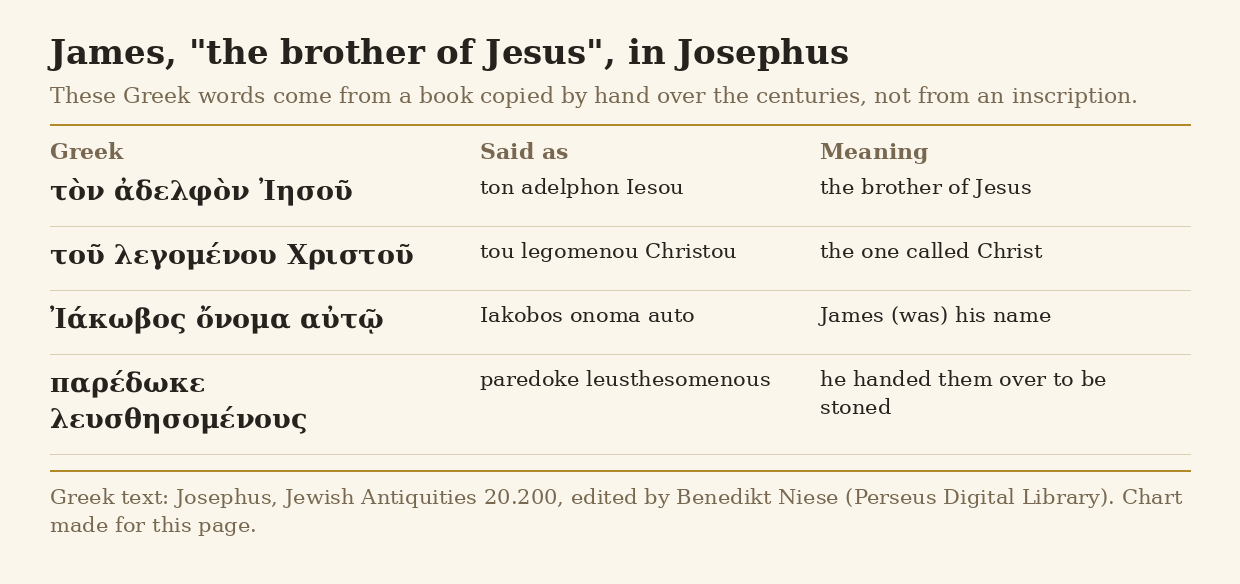
Paul met 'James the Lord's brother' in Jerusalem (Galatians 1:19), and James led the church there (Acts 15). The Bible does not record his death. The Jewish historian Josephus does. In his Antiquities of the Jews (book 20, section 200), he writes that the high priest Ananus called a council and brought before it 'the brother of Jesus, who was called Christ, whose name was James, and some others', and had them stoned (William Whiston's translation). The governor Festus had died and the new governor had not yet arrived, which places this in AD 62. Josephus adds that the most fair-minded people of the city were upset, and Ananus lost his office after three months.
The key Greek words of Josephus, Antiquities 20.200, with how they sound and what they mean. These words come from a book copied by hand, not from an inscription. Chart made for this page, free to reuse.
Where it is today
The passage is in Josephus, Jewish Antiquities 20.200 (also numbered 20.9.1). The oldest Greek manuscript that has book 20 is in the Ambrosian Library, Milan (Ambrosianus F 128, 1000s). No grave of James is known for certain. The Armenian Cathedral of St James in Jerusalem is dedicated to him and to James the son of Zebedee.
Date
By Josephus's account James died in AD 62. Hegesippus, a Christian writer of the 100s, places his death just before the Roman siege of Jerusalem, which some read as about AD 69; most scholars prefer Josephus's date. Josephus finished the Antiquities in AD 93 or 94. Origen (200s) and Eusebius (early 300s) knew the passage. A Latin translation was made in the 500s. The oldest surviving Greek copy of book 20 is from the 1000s.
Why this label: This label covers a written record, not a grave or object. A first-century historian, Josephus, records that James, "the brother of Jesus, who was called Christ", was handed over to be stoned to death in Jerusalem in about AD 62. Most scholars, including many who doubt other Christian passages in Josephus, accept this sentence as genuine. No tomb of James is confirmed.
Good to know
How sure: The sentence is in the Greek text of Josephus as printed from the manuscripts, and Origen quotes its key words in the 200s. It calls Jesus 'the one called Christ', which is not how a Christian copyist would praise him, and it calls James 'the brother of Jesus' rather than the Christian phrase 'the Lord's brother'. These are reasons most scholars accept it. It is different from Josephus's longer passage about Jesus, which most scholars think a Christian later added to. A few scholars argue the words 'who was called Christ' were added later, but this is a minority view. Origen and Eusebius also quote another sentence about James that is not in any surviving copy of Josephus; that sentence is not the one shown here.
Another account: Hegesippus says James was thrown down from the temple, stoned, and struck with a club, and was buried beside the temple, where a marker stood. Most scholars trust Josephus's shorter account more.
The tomb: No grave of James is known. A later tradition linked him with the Bene Hezir tomb in the Kidron Valley, covered on the Wisdom Books and Prophets page. The James ossuary is covered on Gospels page 2. The Israel Antiquities Authority called its inscription a forgery; its owner was acquitted in 2012, but the court did not find it genuine.
First Clement: the letter of the church of Rome to Corinth
Philippians 4:3 · John 21:18-19 · 2 Timothy 4:6
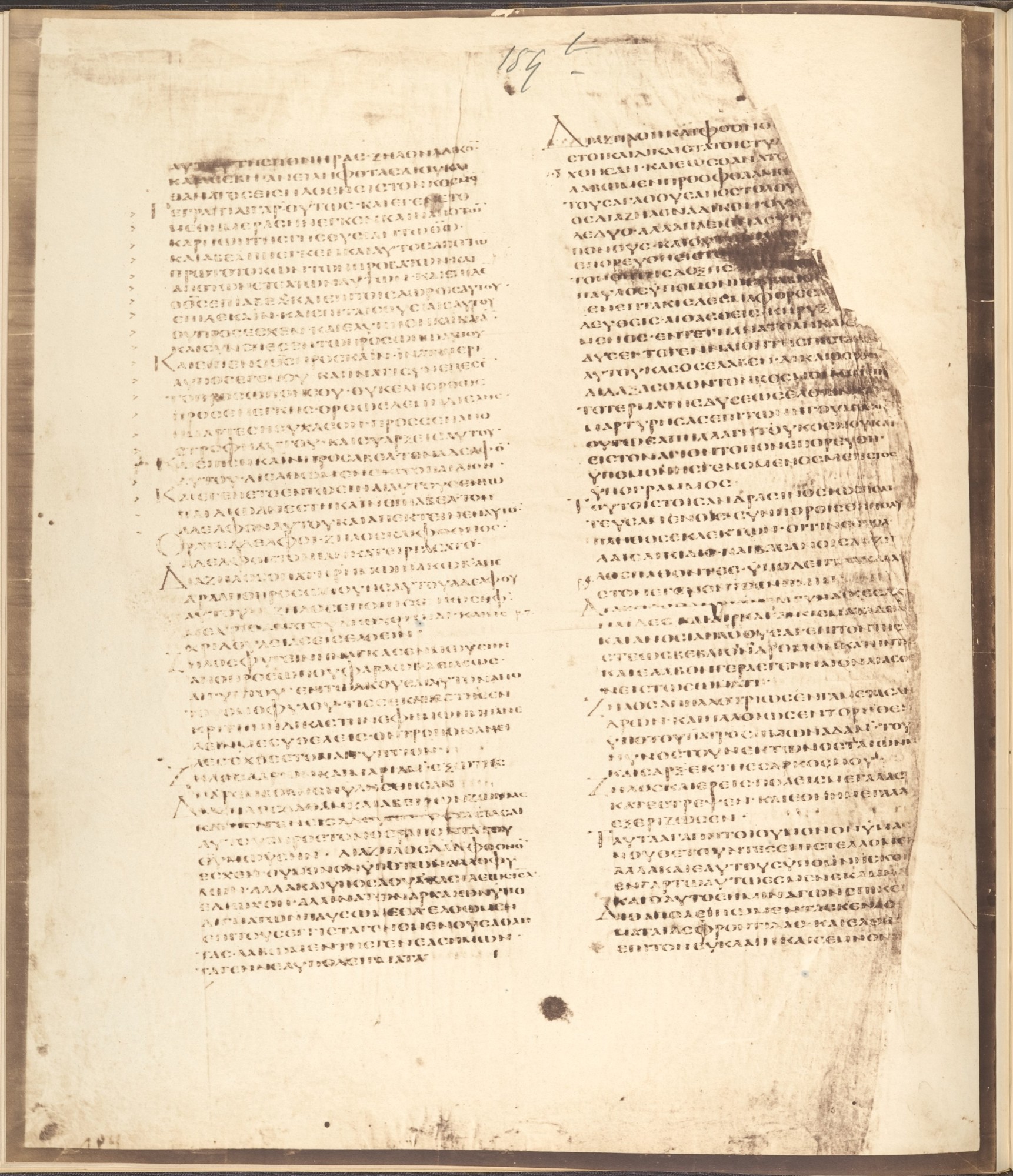
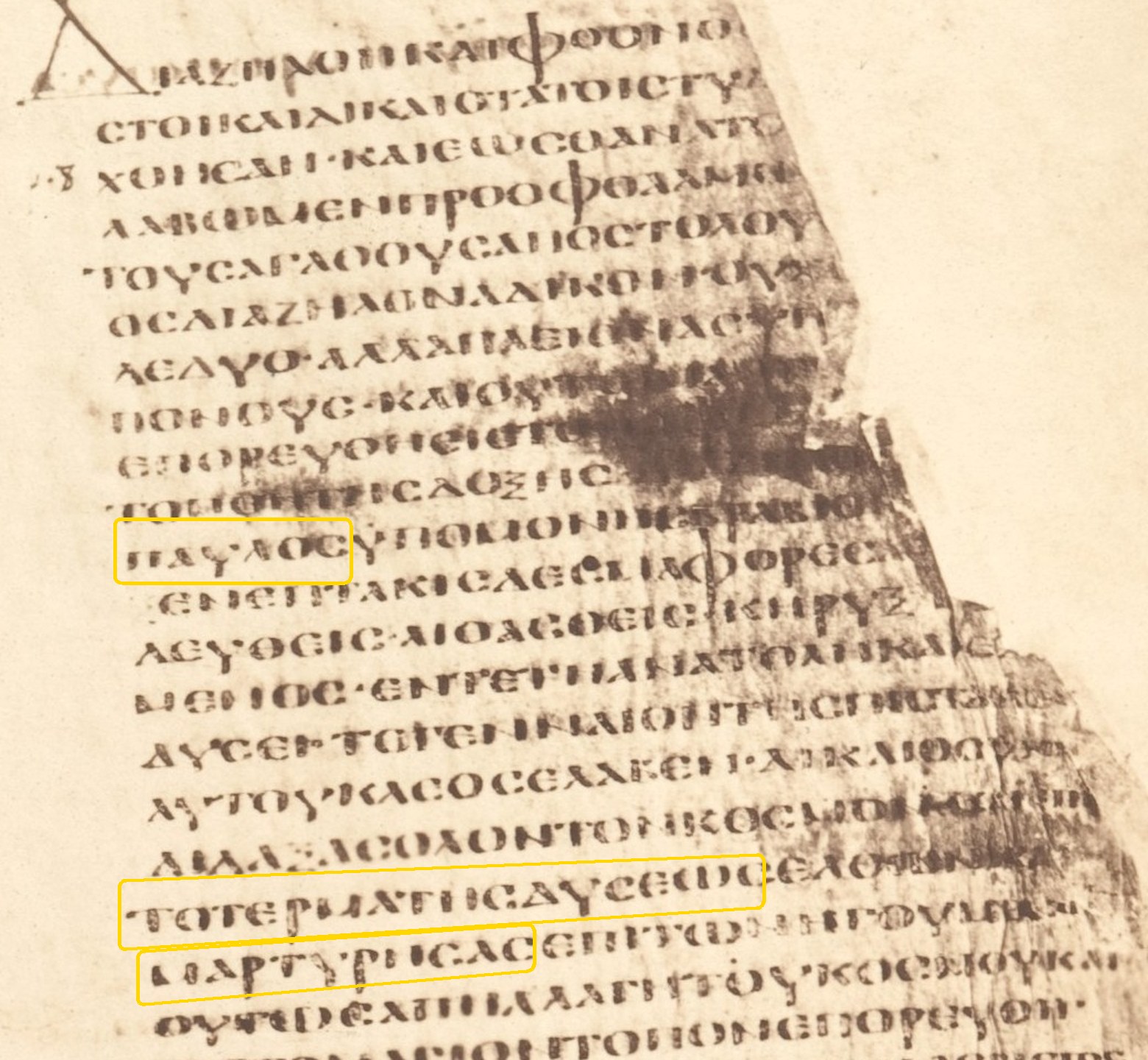
BackgroundAn 1856 photograph of the page of Codex Alexandrinus with 1 Clement chapter 5, the passage on Peter and Paul. Roger Fenton, 1856 photograph of the Codex Alexandrinus. The Metropolitan Museum of Art, Purchase, Alfred Stieglitz Society Gifts, 2009, Public domain.
And I intreat thee also, true yokefellow, help those women which laboured with me in the gospel, with Clement also, and with other my fellowlabourers, whose names are in the book of life.
Philippians 4:3, KJV
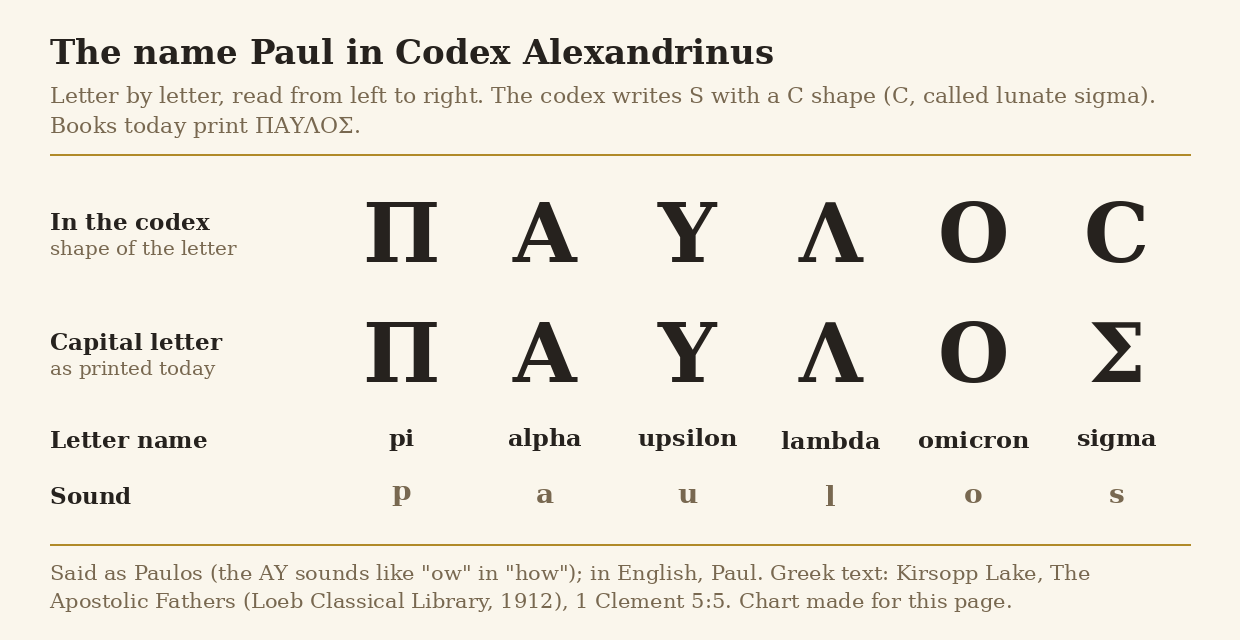
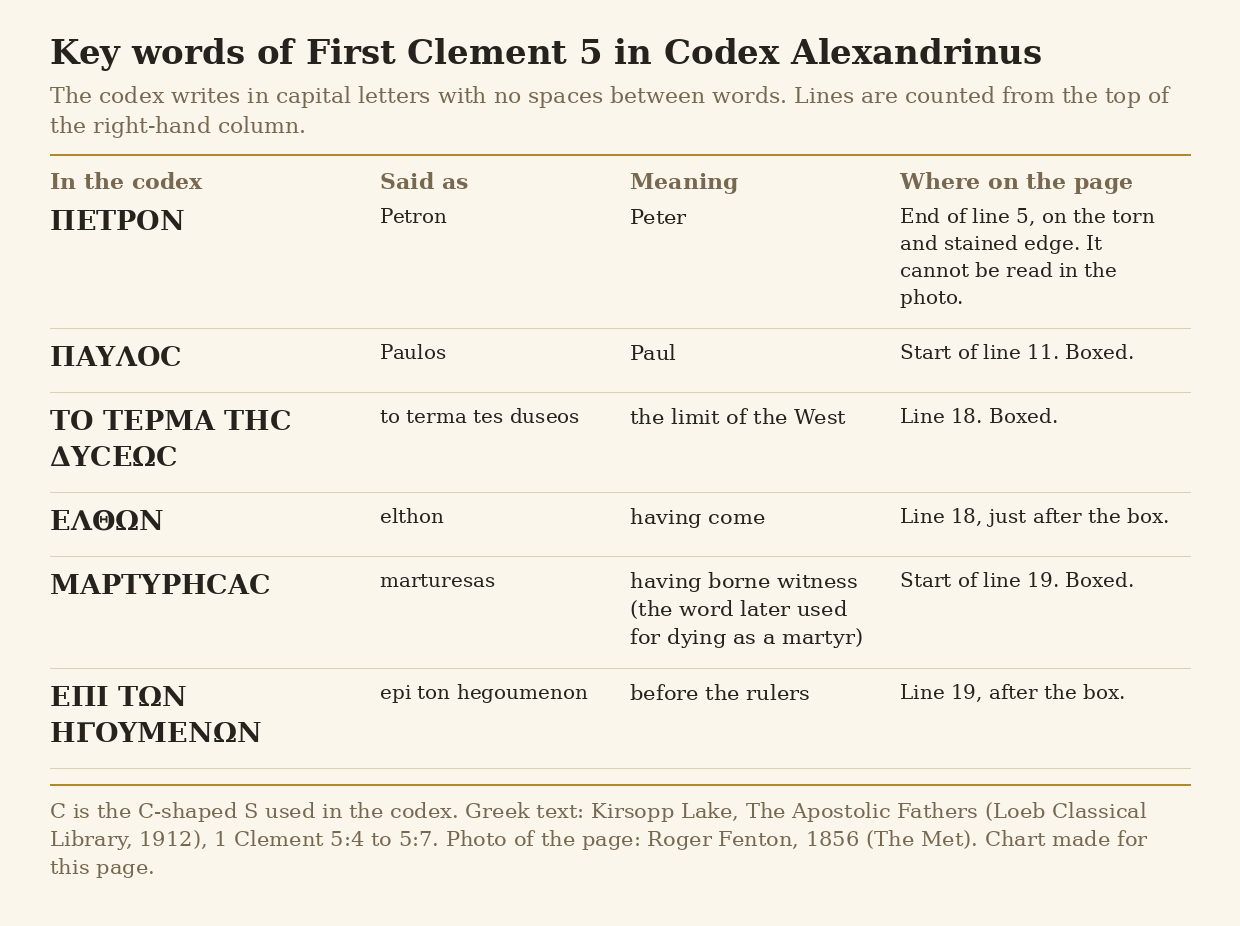
First Clement is a letter from the church in Rome to the church in Corinth, written because the Corinthians had removed some of their elders. The letter does not give the writer's name, but from the 100s it has been linked with Clement, a leader in the Roman church. Some writers in the 200s and 300s thought he was the Clement of Philippians 4:3; modern scholars say this cannot be shown. Chapter 5 is usually seen as the earliest writing outside the New Testament to speak of the deaths of Peter and Paul. In the Ante-Nicene Fathers translation, it says Peter 'departed to the place of glory due to him', and that Paul preached 'both in the east and west', came 'to the extreme limit of the west', and 'suffered martyrdom under the prefects'. The Greek word behind 'suffered martyrdom' means 'bore witness'; it later became the word for dying for the faith. The letter is not Scripture, but it is one of the oldest Christian writings outside the New Testament. The photo and charts below show Paul's name and the words "the limit of the West" as they are written in Codex Alexandrinus.
Photo of the right-hand column of a page of Codex Alexandrinus, a Greek Bible copied by hand in the 400s, from Roger Fenton's photograph of 1856. This column holds First Clement chapter 5. The codex writes in capital letters with no spaces between words, and writes S with a C shape (Ϲ). The three yellow boxes were added for this page. Top box: ΠΑΥΛΟϹ (Paulos, "Paul"), at the start of line 11. Middle box: ΤΟ ΤΕΡΜΑ ΤΗϹ ΔΥϹΕΩϹ, "the limit of the West", on line 18. Bottom box: ΜΑΡΤΥΡΗϹΑϹ, "having borne witness", at the start of line 19. Peter's name falls at the end of line 5, on the torn and stained right edge, and cannot be read here, so it is not boxed. Roger Fenton, 1856, The Metropolitan Museum of Art, Public domain.The name Paul as written in the codex, letter by letter, with each letter's name and sound. The codex writes the last letter, S, with a C shape. Chart made for this page, free to reuse.The key words of the passage as written in the codex, with how they sound, what they mean and which line they are on. Chart made for this page, free to reuse.
Where it is today
The oldest Greek copy is in Codex Alexandrinus, a Greek Bible of the 400s in the British Library, London (catalogue number Royal MS 1 D 5 to 8), where it follows the book of Revelation. One leaf near the end of the letter (57:7 to 63) is lost. The only complete Greek copy is in a manuscript dated 1056 (Codex Hierosolymitanus), found in 1873. There are also early Latin, Syriac and Coptic translations.
Date
Most scholars date the letter to about AD 96, near the end of Emperor Domitian's reign. Some argue for the late 60s, and others for anywhere from AD 80 to 140. Codex Alexandrinus was copied in the 400s.
Why this label: This is a real, early letter, but it is a historical source, not an object or site that proves an event. It shows that the church in Rome, within a few decades, remembered Peter and Paul as having died for their faith.
Good to know
The usual date: The letter speaks of 'sudden and repeated misfortunes' (Kirsopp Lake's translation) that had come on the Roman church (1:1). Many take this as trouble under Domitian, about AD 96. Irenaeus (about AD 180) also links the letter with Clement's time.
The doubts: Laurence Welborn notes that the evidence for a persecution under Domitian is weak. He allows a date anywhere from AD 80 to 140, and holds that it cannot be earlier than the last decades of the first century.
The early date: Some scholars argue for the late 60s. Alvar Ellegard points out that the letter speaks of the temple service in the present tense and calls Peter and Paul examples 'of our own generation'. Thomas Herron has argued for a date of about AD 70, while the temple still stood. Others answer that Hebrews also uses the present tense for the temple, and that 'our generation' may only mean the Christian age.
What the chapter says: Peter and Paul suffered 'through envy and jealousy' (Ante-Nicene Fathers translation). Paul was in chains seven times, was driven out and was stoned.
What it leaves out: It does not name Rome as the place of death, though the letter comes from Rome. It does not name Nero. It does not say how either man died. Crucifixion upside down and beheading come from later writers. 'The limit of the west' may mean Rome or Spain; scholars disagree.
Traditional siteThe agora (market square) of ancient Smyrna in Izmir, on the lower slope of the Pagos hill. Carole Raddato from FRANKFURT, Germany, via Wikimedia Commons, CC BY-SA 2.0.
Fear none of those things which thou shalt suffer: behold, the devil shall cast some of you into prison, that ye may be tried; and ye shall have tribulation ten days: be thou faithful unto death, and I will give thee a crown of life.
Revelation 2:10, KJV
Polycarp was the bishop (church leader) of Smyrna, one of the seven churches in Revelation. Irenaeus, who heard him as a boy, says he had known apostles. A letter from the church at Smyrna to the church at Philomelium, called the Martyrdom of Polycarp, tells how the old man was brought into the stadium of Smyrna and refused to swear by the emperor's guardian spirit (his 'genius'). The crowd shouted for him to be burned alive, and a fire was built. The letter says the fire did not harm him, so he was stabbed, and his body was then burned. In J. B. Lightfoot's translation he says: "Fourscore and six years have I been His servant, and He hath done me no wrong." The Bible does not record his death; Revelation 2:10 is the promise Jesus gave to this same church years earlier.
Where it is today
Izmir, Turkey (ancient Smyrna). The stadium stood on the south-west slope below Kadifekale, the ancient Pagos hill. Almost nothing of it can be seen today. The agora (market square) of Smyrna, shown in the photo, is the main ancient site open to visitors in the city.
Date
Polycarp died on a Saturday in February, most likely 23 February AD 155 or 22 February AD 156. Some date it as late as about AD 166 or 167. The letter was probably written soon after his death, but some scholars date it about AD 200 or later.
Why this label: Smyrna is certain, and the letter plainly says Polycarp died in the city's stadium. But the stadium has almost vanished, and no inscription or dig marks the exact spot where he died.
Good to know
The date: Chapter 21 of the letter says he died on the second day of the month Xanthicus, on a 'great Sabbath', when Statius Quadratus was governor. The scholar Waddington worked out from other records that Quadratus governed the province of Asia around AD 154 to 155, and 23 February fell on a Saturday in AD 155, which points to that year. Others, such as C. H. Turner, argued for 22 February AD 156. Eusebius, writing in the early 300s, placed the death about AD 166 or 167, but most scholars now set that date aside. The chapter with the date may be a later addition, which is one reason the debate goes on.
How far trusted: Most scholars accept the letter as an early account; Kirsopp Lake called it 'obviously genuine and contemporary'. Candida Moss points out how closely it follows the Gospel accounts of Jesus's death, and dates it about AD 200 or later. Others note that the trial, held in a stadium with no formal charge or sentence, does not fit normal Roman practice. The miracles in it, such as the fire forming an arch around him, are the parts historians trust least.
The stadium: The French traveller Tournefort, who visited Izmir in 1702, wrote that all the marble had been taken away and only traces remained.
The martyrs of Lyon and Vienne and the Amphitheatre of the Three Gauls
Romans 8:18 · Hebrews 11:36-37
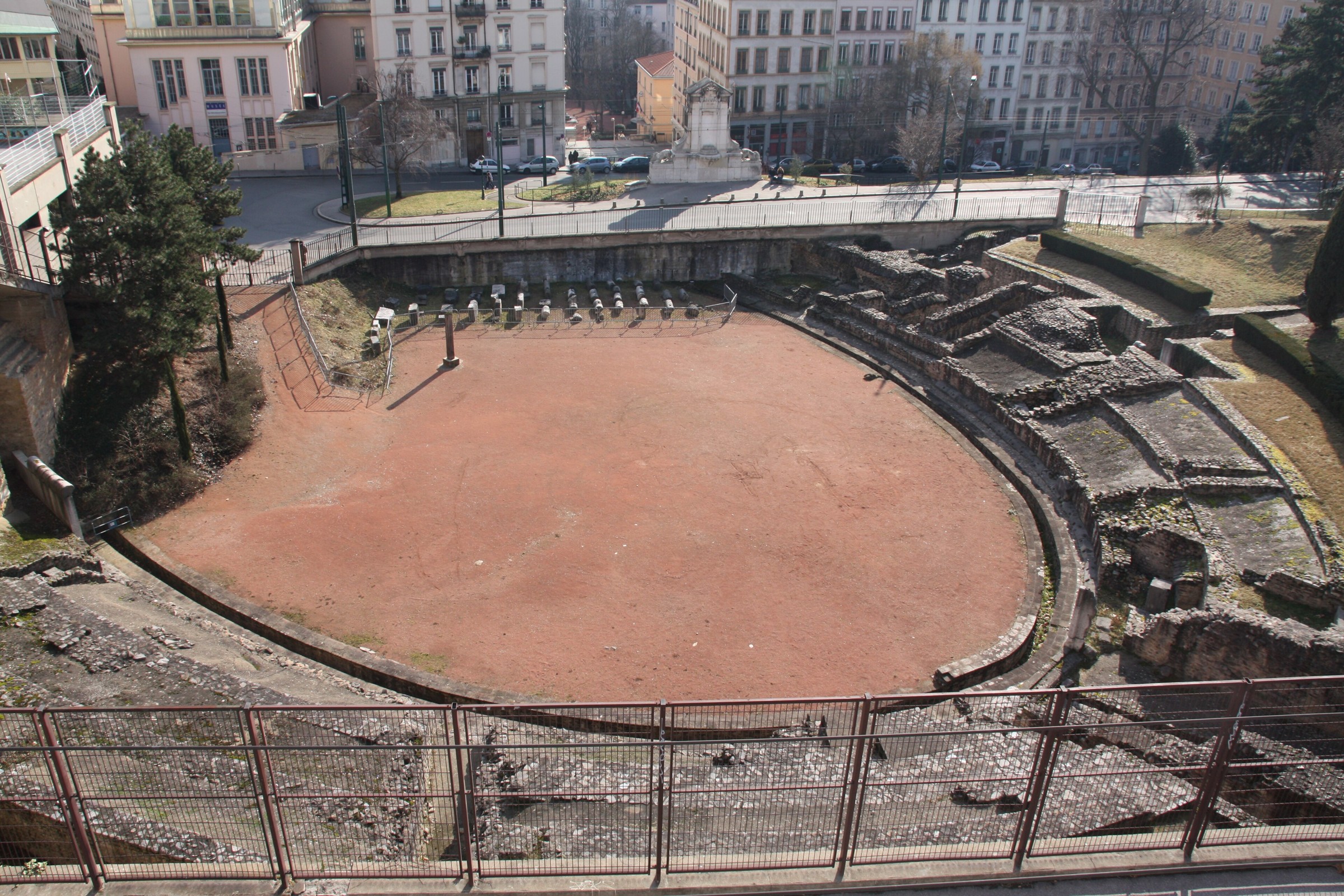
Traditional siteThe Amphitheatre of the Three Gauls in Lyon, with the memorial post in the arena. Otourly, via Wikimedia Commons, CC BY-SA 3.0.
For I reckon that the sufferings of this present time are not worthy to be compared with the glory which shall be revealed in us.
Romans 8:18, KJV
In AD 177 the Christians of Lyon and Vienne in Gaul (today's France) were attacked by crowds, arrested and tortured. Their churches sent a letter about it to the churches in Asia and Phrygia, and Eusebius copied much of it into his Church History (book 5, chapter 1). It tells how Blandina, a slave woman, was hung on a post before wild beasts and was killed on the last day of the games. The bishop, Pothinus, over ninety years old, was beaten and died in prison two days later. The letter itself quotes Romans 8:18, which is why that verse is given here. The Bible does not record these events.
Where it is today
Lyon, France. The remains of the Amphitheatre of the Three Gauls lie at the foot of the Croix-Rousse hill, in the Jardin des Plantes, rue Lucien Sportisse. A post in the arena remembers the martyrs.
Date
The persecution took place in AD 177, which Eusebius gives as the seventeenth year of the emperor (Marcus Aurelius). The amphitheatre was built in AD 19 and enlarged in the 100s.
Why this label: The letter says the martyrs died in "the amphitheater" at Lyon, and this is the only Roman amphitheatre known there, so most historians accept it. But nothing found at the site names the martyrs, and before the late 1950s people looked for the place elsewhere.
Good to know
The source: The letter was written by Christians at Lyon and Vienne soon after the events. Eusebius copied much of it more than a century later. Where he shortened it, he gave the rest in his own words. Historians treat it as an early and serious source, while noting that it is written to honour the martyrs. Quotes here are from the translation by Arthur Cushman McGiffert (1890).
Where exactly: The letter names no building beyond "the amphitheater". Gregory of Tours, in the 500s, placed the martyrdom at Athanaco, which is Ainay in Lyon, and for a long time people searched on Fourvière hill and at Ainay. In 1957 or 1958 (sources differ) a dedication carved on a building stone was found, and Jules Guey and Amable Audin used it to show that the ruins at the foot of the Croix-Rousse were the amphitheatre of the Three Gauls. Since then this has been accepted as the place of the martyrdoms.
Not everyone died there: Pothinus died in prison, and the governor had those who were Roman citizens beheaded.
The beasts: The letter speaks of wild beasts in general, not lions. Blandina was finally put in a net and tossed by a bull.
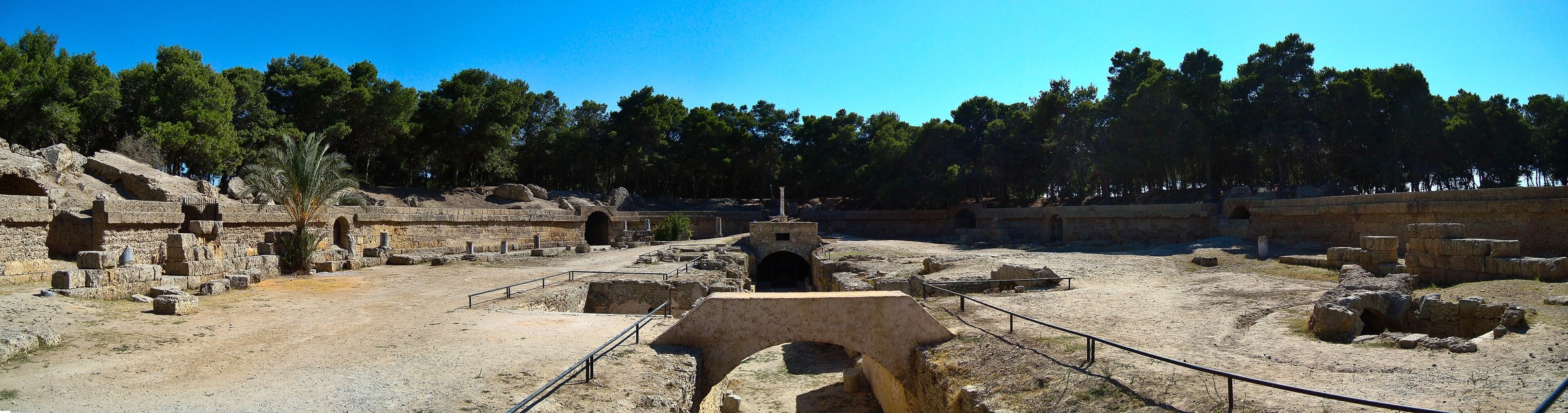
Traditional siteInside the Roman amphitheatre of Carthage, looking south. The column standing on a small stone building in the distance is the memorial to the martyrs put up in 1893. Elena Tatiana Chis, via Wikimedia Commons, CC BY-SA 4.0.
And they overcame him by the blood of the Lamb, and by the word of their testimony; and they loved not their lives unto the death.
Revelation 12:11, KJV
In about AD 203 a group of new believers in Roman North Africa (today's Tunisia) was arrested. Some copies of their story name the town of Thuburbo Minus. Among them were Vibia Perpetua, a young mother of good family about 22 years old, and Felicity, a slave who gave birth in prison. They were put to wild animals and then killed with the sword at games held for the birthday of Geta, the emperor's son. The Passion of Perpetua and Felicity tells their story. Much of it claims to be Perpetua's own prison diary, which the editor says is "her own, just as she left it written out by her own hand" (translation given in the University of Oxford's Cult of Saints database). The Bible does not record these events.
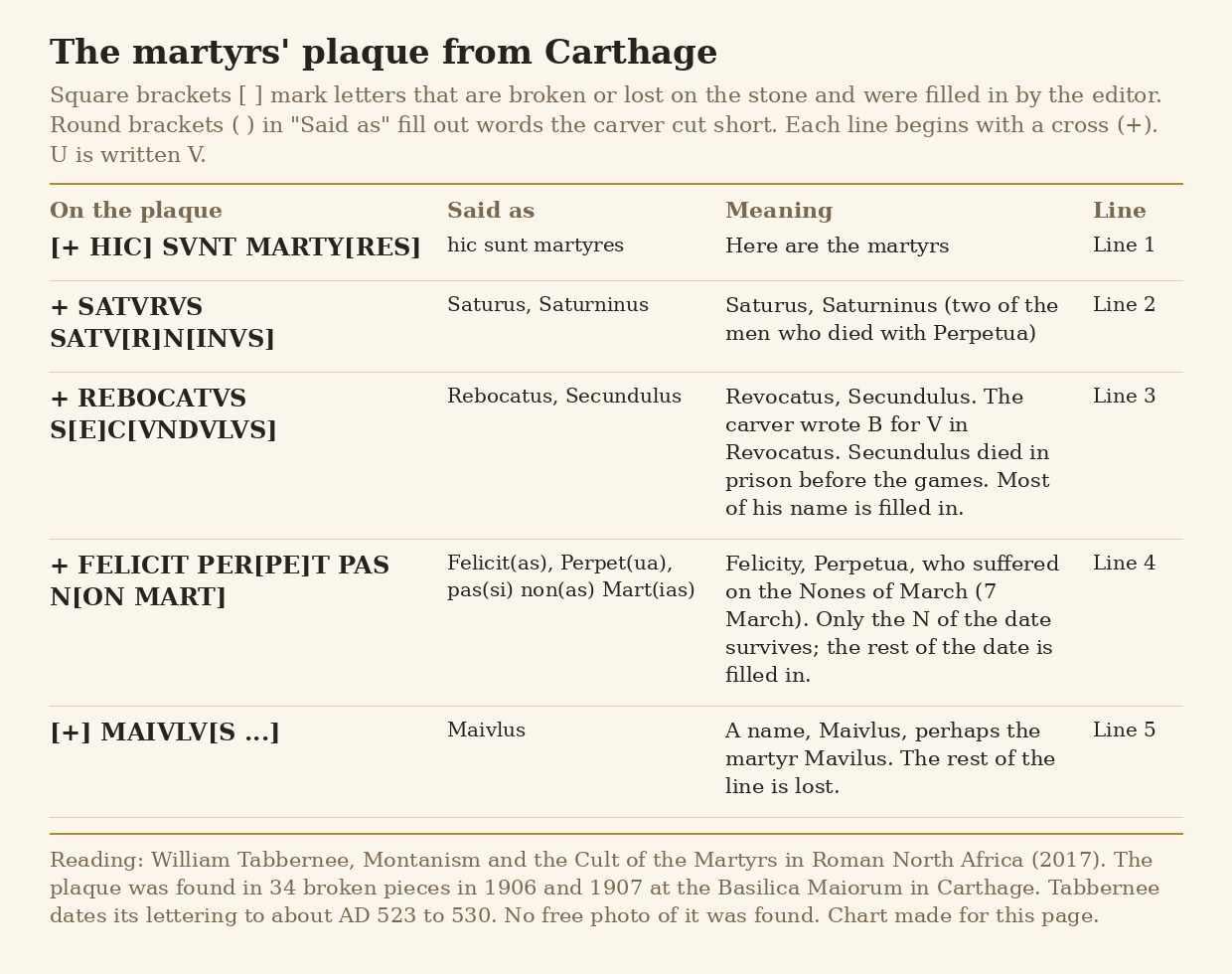
The five lines of the martyrs' plaque found at Carthage, following William Tabbernee's reading, with how they sound and what they mean. Square brackets mark letters that are broken or lost on the stone and were filled in by the editor. Chart made for this page, free to reuse.
Where it is today
Carthage, near Tunis, Tunisia. The amphitheatre of Carthage can be visited. Cardinal Lavigerie put up a memorial column at the south end of the arena and a chapel there in 1893. The marble plaque naming the martyrs was found in 34 broken pieces in 1906 and 1907 at the Basilica Maiorum, in the Mcidfa area of Carthage. This church was built over the tomb of the martyrs. Where the plaque is kept today could not be confirmed.
Date
The martyrs died on 7 March, almost certainly in AD 203. The day comes from Geta's birthday, which the Passion names, and from a Roman list of martyrs of AD 354 that gives 7 March. The Passion was written soon after their deaths; Tertullian refers to it only a few years later. The plaque naming them is much later, probably from about AD 523 to 530.
Why this label: An early source tells of the deaths in detail. But the Passion does not name the city, and it speaks only of "the amphitheatre" without saying which one. Carthage is the usual view, and its city amphitheatre is the traditional spot, but this is not proven. The plaque marks a later church where the martyrs were honoured, not the place of death.
Good to know
The source: The Passion has three parts. There is an editor's opening and ending, Perpetua's own account of her arrest, trial and visions, and a short account by a fellow martyr, Saturus. Most scholars accept Perpetua's part as truly hers, which makes it one of the earliest writings by a Christian woman. Some think the editor was Tertullian, and many see signs of the Montanist movement, which stressed new prophecy; neither point is proven.
The place of death: The Passion says they were moved to a military prison near the camp where the games were to be held, and that on the day they went into the amphitheatre. Some think this means an arena at the army camp rather than the big city amphitheatre.
The plaque: Father Alfred Louis Delattre found its 34 broken pieces in 1906 and 1907 at the Basilica Maiorum. William Tabbernee dates its lettering to about AD 523 to 530, when the church was restored, so it probably replaced an older marker. It names six members of the group of 203. Many of its letters are broken, and the editor has to fill them in. A broken fifth line has the name Maivlus, which Tabbernee links with a martyr called Mavilus; who he was is uncertain.
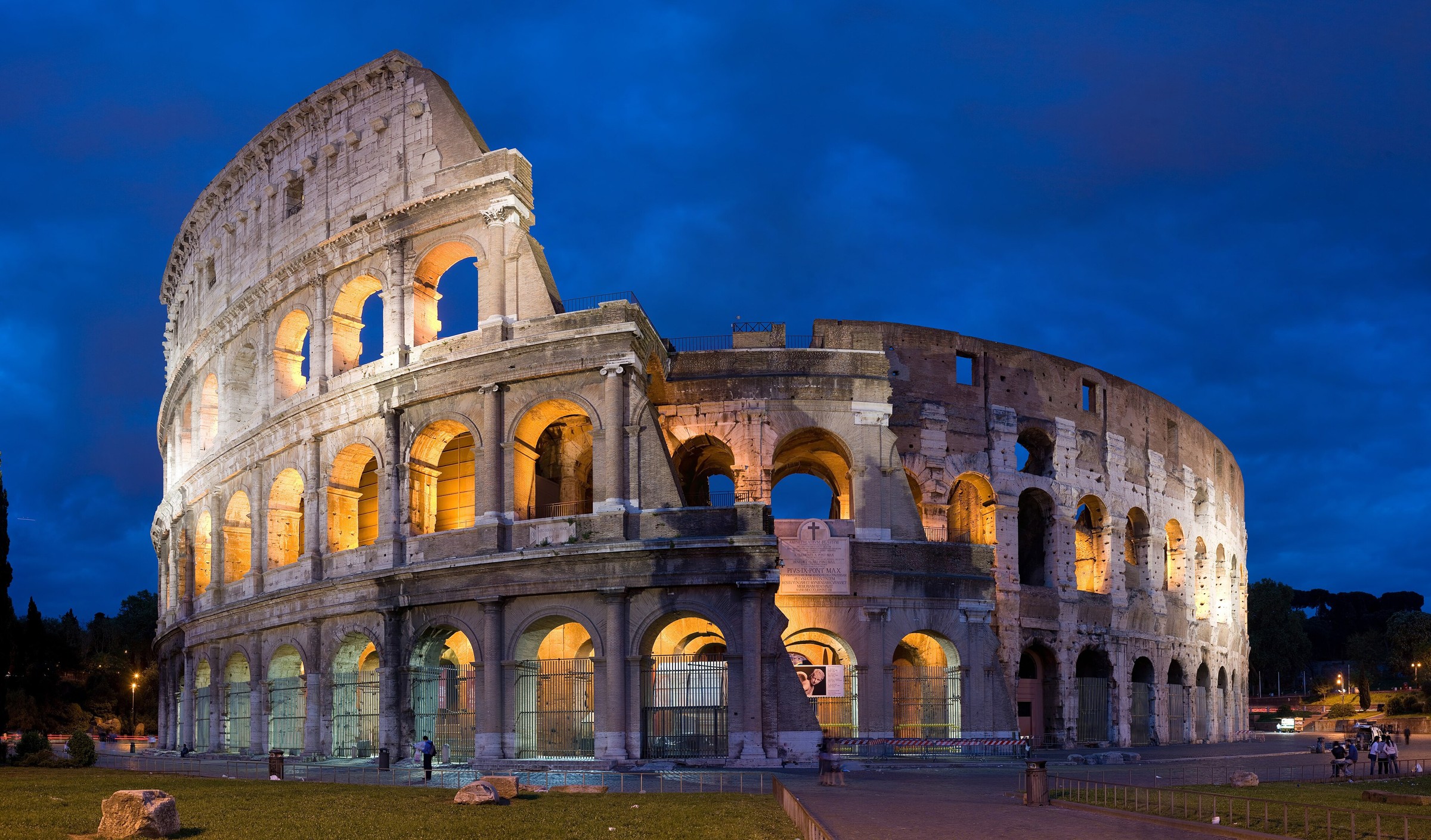
DisputedThe Colosseum in Rome at dusk. Photo by David Iliff, via Wikimedia Commons, CC BY-SA 2.5.
For I think that God hath set forth us the apostles last, as it were appointed to death: for we are made a spectacle unto the world, and to angels, and to men.
1 Corinthians 4:9, KJV
Many people picture Christians dying before lions in the Colosseum. Christians were certainly put to death in Rome, some by wild beasts, but no early record names the Colosseum as the place where any Christian died. The Colosseum (the Flavian Amphitheatre) was begun about AD 72 and opened in AD 80, after Nero's attack on the Christians in AD 64, which took place in Nero's gardens. The link between the Colosseum and the martyrs grew up from the 1600s onward. The Bible does not mention the Colosseum.
Where it is today
Rome, Italy, run by the Colosseum Archaeological Park. A Good Friday Way of the Cross has been held there since Pope Paul the Sixth revived it in 1965.
Date
Built about AD 72 to 80. Games and animal hunts went on into the early 500s. The belief that martyrs died there spread from the middle 1600s, and the arena was dedicated to the martyrs in the 1700s.
Why this label: It is possible, even likely, that some Christians condemned to the beasts died in Rome's largest arena, but no ancient source says so, and Rome had other places for public killings. The Catholic Encyclopedia of 1908, following the Jesuit scholar Hippolyte Delehaye, concluded that "we know nothing on the subject one way or the other".
Good to know
Early sources: Ignatius of Antioch, writing on his way to Rome in the early 100s (usually placed under the emperor Trajan, AD 98 to 117), begged: "Allow me to become food for the wild beasts" (Letter to the Romans 4, Roberts and Donaldson translation). He does not name a building. Later writers, such as John Chrysostom, speak of his death before the crowds of Rome, but their words do not clearly name the Colosseum. Some legends of Roman martyrs, written from the 400s on, say certain martyrs died "in the amphitheatre", but scholars do not trust these stories for such details. The story of the monk Telemachus, killed while trying to stop the games, is told only by Theodoret, who says it happened "in the stadium".
How the belief grew: In the Middle Ages the Colosseum was used as a fortress and a stone quarry, and it is missing from the pilgrim guides of the time, which shows no one then saw it as a holy place. Pope Pius the Fifth (1566 to 1572) is said to have called its sand soaked with martyrs' blood, but even in 1671 a cardinal allowed bullfights there. A writer named Martinelli listed it among places of the martyrs in 1653, and Carlo Tomassi's pamphlet led Pope Clement the Tenth to close the arches for the jubilee of 1675, when a cross was raised in the arena. Pope Benedict the Fourteenth set up the fourteen Stations of the Cross and dedicated the arena to Christ's Passion and the martyrs. The Colosseum park gives the jubilee of 1750 for this; some other sources give 1749 or 1756.
Scholars: The Jesuit scholar Hippolyte Delehaye found no historical grounds for the belief, but did not deny that martyrs may have died there. Federica Rinaldi, the archaeologist in charge of the Colosseum, said in 2022 that Christians being killed there cannot be ruled out, but that no data or sources confirm it beyond doubt.
The other side: Rome condemned many criminals to the beasts, and the Colosseum was the city's main arena for such shows, so some Christians may well have died there without any record. In short, it is possible, even likely, but not recorded.
Its survival: The belief helped save the building, since later popes paid for supports to keep it from falling.
The Alexamenos graffito: a mocking drawing of a Christian
1 Corinthians 1:23 · Galatians 5:11
BackgroundThe Alexamenos graffito on its piece of plaster, Palatine Museum, Rome. Unknown author, via Wikimedia Commons, Public domain.
But we preach Christ crucified, unto the Jews a stumblingblock, and unto the Greeks foolishness;
1 Corinthians 1:23, KJV
This rough drawing was scratched into the plaster of a wall on the Palatine Hill in Rome. It shows a figure with a donkey's head hanging on a cross, and a man below raising his hand toward it. The Greek words under it say "Alexamenos worships [his] god". Most scholars think someone made it to mock a fellow servant who was a Christian. It is one of the earliest known pictures of a crucifixion, and it shows how strange a crucified God seemed to outsiders, as 1 Corinthians 1:23 says. The photo and chart below show the scratched Greek words "Alexamenos worships god".
Photo of the original piece of plaster in the Palatine Museum, Rome, enlarged three times; the only free photo is small, so it is soft. The yellow box, added for this page, surrounds the four short lines of Greek below and beside the cross: ΑΛΕ, then ΞΑΜΕΝΟϹ (together the name Alexamenos), then ϹΕΒΕΤΕ ("worships", with its last two letters standing apart to the right), then ΘΕΟΝ ("god"). One box is drawn around the whole block because the scratched letters are faint and cross each other and the drawing, so single words cannot be marked with confidence. The post of the cross and other scratches run through the same area. Photographer unknown, via Wikimedia Commons, Public domain.The three Greek words, with how they sound and what they mean. The writer used the C-shaped S (lunate sigma), the usual handwritten S of the time. Chart made for this page, free to reuse.
Where it is today
Palatine Museum (Museo Palatino), Rome, Italy. It was found in the building known as the Paedagogium, a part of the imperial palace on the Palatine where palace servants probably lived or trained. The plaster piece is about 33.5 by 38 centimetres.
Date
About AD 200. The Colosseum park dates it to the time of the Severan emperors (late 100s to early 200s). Other dates, earlier and later, have been proposed. It was found in 1856 or 1857 (sources differ).
Why this label: It does not name Jesus, but most scholars read it as a pagan joke about a Christian who worshipped a crucified man. It shows what outsiders said about Christians; it proves nothing about the events of the Gospels.
Good to know
The donkey charge: Tertullian and Minucius Felix, Christian writers of about AD 200, both say pagans claimed Christians worshipped a donkey's head. The same false story had been told about the Jews, and Josephus answered it.
The words: The verb is spelled sebete, most likely a common spelling slip for sebetai, "worships". Some read it instead as a command, "worship God". A Y-shaped mark at the upper right has been read as a cry of pain or as a pitchfork; its meaning is unclear.
A reply: In the next room a different hand wrote "Alexamenos fidelis", meaning "Alexamenos is faithful", which may be an answer to the joke, though this is not certain.
Other views: Some writers of the 1800s thought the figure was the Egyptian god Anubis. Most scholars today still read it as mockery of a Christian.
In the museum: The lines are very faint and hard to see without enhanced photos.
The Megiddo prayer hall mosaic: "to God Jesus Christ"
Titus 2:13 · 1 Corinthians 11:23-26
BackgroundThe Akeptous inscription in the Megiddo mosaic floor. Vesafis Tzferris, via Wikimedia Commons, CC BY-SA 4.0.
Looking for that blessed hope, and the glorious appearing of the great God and our Saviour Jesus Christ;
Titus 2:13, KJV
In 2005, during a dig in the grounds of Megiddo Prison in northern Israel, archaeologist Yotam Tepper uncovered the mosaic floor of a Christian prayer hall at the Roman village of Kefar Othnay, near the army camp of Legio. One panel says that a woman named Akeptous "has offered the table to God Jesus Christ as a memorial". Another names a Roman centurion (army officer), Gaianus, who paid for the floor, and a third remembers four women. A round panel shows two fish, an early Christian symbol. If the early date is right, this is one of the earliest inscriptions anywhere to call Jesus God. The photo and chart below show the words "God Jesus Christ" as they are laid in the mosaic.
Photo of the Akeptous panel in the mosaic floor of the prayer hall at Megiddo. The photo was taken at an angle, so it has been turned here to make the lines run level; the dark corner at the top left is outside the photo. The yellow box, added for this page, marks ΘΩ ΙΥ ΧΩ at the end of line 5: short forms of "God Jesus Christ", with a line above them to show they are holy names. The six lines read ΠΡΟϹΗΝΙΚΕΝ, ΑΚΕΠΤΟΥϹ, Η ΦΙΛΟΘΕΟϹ, ΤΗΝ ΤΡΑΠΕ, ΖΑΝ ΘΩ ΙΥ ΧΩ, ΜΝΗΜΟϹΥΝΟΝ. The only free photo is small, so the enlarged image is soft. Vesafis Tzferris, via Wikimedia Commons, CC BY-SA 4.0.The key words of the Akeptous panel. The chart shows how ΘΩ, ΙΥ and ΧΩ are short forms of the Greek words for God, Jesus and Christ, keeping only the first and last letter of each word, with a line above. Chart made for this page, free to reuse.
Where it is today
The site lies inside the grounds of a working prison, so it cannot be visited. The mosaic was lifted and lent by the Israel Antiquities Authority to the Museum of the Bible in Washington, DC, where it was shown from late 2024 into 2025. It is to return to Israel; check where it is on display before planning a visit.
Date
About AD 230 according to the excavators, based on coins, pottery and the style of the letters. The floor was covered over about AD 300. Some scholars prefer a date in the late 200s or early 300s.
Why this label: The inscription is real and clearly Christian, and it shows what early believers in Galilee said about Jesus. It is not a place named in the Bible, and its exact date is debated.
Good to know
The writing: "God Jesus Christ" is written in the short form early Christians used for holy names: the first and last letter of each word with a line above. The edited text and translation are from Tepper and Di Segni's report (Israel Antiquities Authority, 2006), as given in the Inscriptions of Israel and Palestine database.
The dating debate: The excavators date the hall to about AD 230. Others question this. Joe Zias suggested it might be a Roman building turned into a church later, and the archaeologist Vassilios Tzaferis argued for a date in the last quarter of the 200s or the first quarter of the 300s.
The table: Many take the "table" to be a table for the Lord's Supper, but the report does not say this for certain.
Prayer hall or church: The excavators used the name "prayer hall". It was a room for worship, not a church building of the later kind.
BackgroundBaptistery wall painting of the Good Shepherd carrying a ram, with his flock, about AD 232. Adam and Eve, faint at lower left, were probably added a little later. Yale University Art Gallery, Yale-French Excavations at Dura-Europos (1932.1200), Public domain (CC0).
Salute the brethren which are in Laodicea, and Nymphas, and the church which is in his house.
Colossians 4:15, KJV
Dura-Europos was a Roman frontier town on the Euphrates River in eastern Syria. In 1932 a Yale and French dig found an ordinary house there that Christians had changed into a meeting place. Two rooms were joined into a hall, and another room became a baptistery (a room for baptism) with a tank for the water and painted walls. It is the oldest Christian meeting place whose date is secure. It shows the kind of "church in the house" that Paul's letters mention.
Where it is today
The wall paintings and the baptistery were moved to the Yale University Art Gallery in New Haven, Connecticut, USA, where the baptistery paintings are on view (the Good Shepherd painting is object 1932.1200). Only the walls and outline of the building remain at the site in Syria. Access is limited, so check before planning a visit.
Date
A date written in the wet plaster of the house gives year 545 of the local calendar, which is AD 232 or 233. It was changed into a church after that, about AD 240 according to Yale. The town was abandoned in AD 256, when the Persians besieged it.
Why this label: It is a real, securely dated Christian building, but it is not a place named in the Bible. It shows how early Christians met and what Bible stories they painted.
Good to know
What it shows: The paintings include the Good Shepherd carrying a sheep, Adam and Eve, Jesus healing the paralyzed man, Jesus and Peter walking on the water, David and Goliath, a woman at a well, and a line of women walking toward a large tomb. The healing and walking-on-water scenes are among the oldest known pictures of Jesus.
Its limits: It does not show that all churches looked like this, and some scenes are uncertain. The women may be those who came to Jesus's tomb or the wise virgins of Jesus's parable. The woman at the well is usually taken as the Samaritan woman of John 4, but in 2016 Michael Peppard argued she is Mary at the moment of the angel's message.
The dating debate: The scholar Carl Kraeling held that the house was built in AD 232 and later turned fully into a church. In 2024 David Pettegrew argued that it was built earlier, in the late 100s or early 200s, and stayed partly a home while Christians used it.
Oldest: It is the oldest securely dated house church known. Other places, such as the house of Peter at Capernaum and the Megiddo prayer hall, are sometimes also called the earliest, so it depends on what is counted.
1 Thessalonians 4:13-18 · John 10:11 · Hebrews 6:19
BackgroundPainting of a woman holding a child, with a man beside them raising his hand. He is usually described as pointing to a star, which is hard to make out in this scan. Catacomb of Priscilla, Rome. Unknown author, via Wikimedia Commons, Public domain.
But I would not have you to be ignorant, brethren, concerning them which are asleep, that ye sorrow not, even as others which have no hope. For if we believe that Jesus died and rose again, even so them also which sleep in Jesus will God bring with him.
1 Thessalonians 4:13-14, KJV
The catacombs are underground cemeteries dug in the soft rock outside the walls of Rome, where burial inside the city was forbidden. There are at least forty, among them the catacombs of Callixtus, Domitilla and Priscilla. Christians cut long passages lined with shelf graves, and painted or carved signs of their hope on the walls and grave covers. These include the Good Shepherd, the fish, the anchor and the praying figure. They show the faith in the resurrection that 1 Thessalonians 4 speaks of.
Where it is today
Rome, Italy. Several catacombs are open for guided visits, including Callixtus and Domitilla on and near the Appian Way and Priscilla on the Via Salaria.
Date
Christian burials underground began in the 100s. The catacomb of Priscilla was used from the late 100s to the 300s. Callixtus began about the middle of the 100s and became the church's official cemetery in the early 200s, when the deacon Callixtus was put in charge of it by Pope Zephyrinus. Burials there stopped in the early 400s.
Why this label: The catacombs are real and many of their paintings and symbols date from before AD 313. They show the faith and burial customs of early Christians, but they are not places named in the Bible.
Good to know
Burial not hiding: Films often show Christians hiding or holding secret services in the catacombs. Scholars reject this. L. V. Rutgers calls it a myth, and L. Michael White says Christians did not hold secret worship there. Roman authorities knew where the cemeteries were, and Christians went there to bury their dead and hold memorial meals, as their pagan neighbours did at family tombs.
Not only Christians: Jews and pagans also had underground burial places in Rome.
Fractio Panis: In the Greek Chapel of the Priscilla catacomb a painting shows people sharing a meal. It is called the Fractio Panis, "breaking of bread", and is often taken as a picture of the Lord's Supper, though some see it as a funeral meal. It is usually dated to the 200s, from its painting style.
The oldest Mary: Also in Priscilla is a painting of a woman holding a child, with a man standing beside them and pointing to a star. It is often called the oldest picture of Mary, usually dated to the early 200s. The man is usually taken to be a prophet foretelling Christ's birth, named as Isaiah or as Balaam. No name is written on it, and the date rests on painting style. A painting at Dura-Europos has also been claimed as the oldest Mary.
The popes: The Crypt of the Popes in Callixtus still has the original Greek grave labels of five bishops of Rome from the 200s.
 LearnAboutHim