Evidence You Can See: The Gospels, Jerusalem, the Cross and the Empty Tomb
Real places you can visit and real objects you can see in museums, connected to Jesus in Jerusalem, His last week, His death on the cross and the empty tomb, as told in Matthew, Mark, Luke and John. Each one is marked honestly, so you can tell solid evidence from tradition and from claims that are still argued over.
ConfirmedThe place or object is real and is clearly the one the Bible names. For a written object, such as an inscription or a scroll, it means the object is genuine and its words are read with confidence, not that every event it mentions is proven.5
Traditional siteA real place that long tradition links to the Bible, but the exact spot cannot be proven.4
DisputedInformed people disagree, or the claim rests on weak evidence.7
BackgroundShows the world the Bible describes, but does not name a Bible person or event.4
Jerusalem in Jesus' Time
1
Herod's Temple Platform, the Western Wall and the Fallen Stones
John 2:20 · Mark 13:1-2 · Matthew 24:1-2
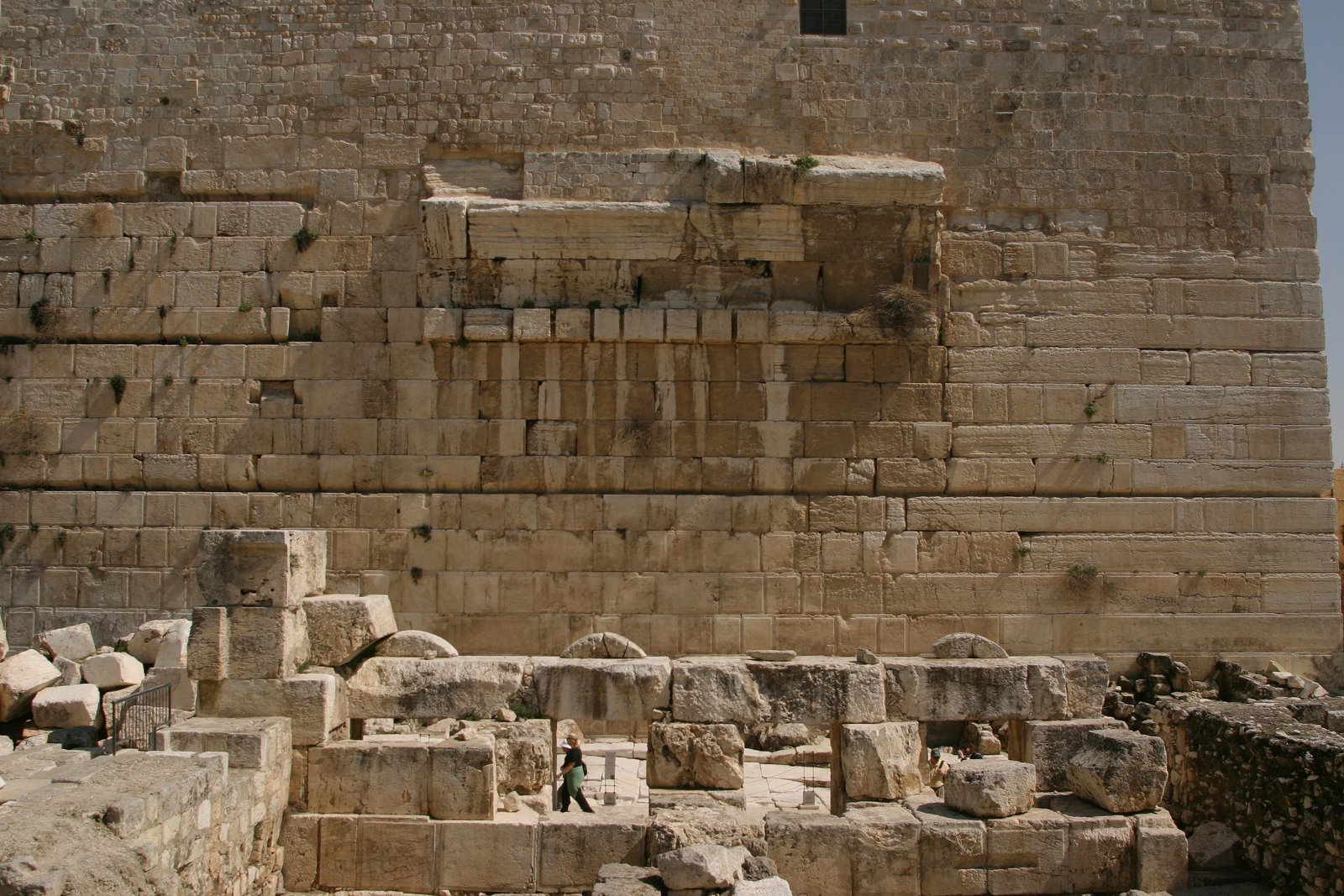
ConfirmedThe stub of Robinson's Arch on the western wall of the Temple Mount. The rows of very large stones in the lower part of the wall are from Herod's time; the smaller stones higher up are later. In front are the remains of the stone base that held up the arch, with some of the large fallen stones on the left. Brian Jeffery Beggerly, via Wikimedia Commons, CC BY 2.0.
And Jesus answering said unto him, Seest thou these great buildings? there shall not be left one stone upon another, that shall not be thrown down.
Mark 13:2, KJV
Herod the Great began rebuilding the temple in about 20 or 19 BC and made the platform around it about twice as big. The Western Wall is part of the huge retaining wall he built to hold up that platform, and its lowest rows of very large stones are his work. Just south of the prayer area, the stub of Robinson's Arch shows where a wide stairway once crossed over the street up to the temple courts. On the paved street below, diggers found hundreds of large stones, some weighing several tonnes, that were knocked down from the top of the wall when the Romans took Jerusalem in AD 70.
Where it is today
Jerusalem, Old City. The Western Wall prayer area is open to visitors. Robinson's Arch and the street from Herod's time with the fallen stones are in the Jerusalem Archaeological Park (Davidson Center) at the southwest corner of the Temple Mount. Access to the top of the platform is limited, so check before planning a visit.
Date
Begun about 20 or 19 BC; work near Robinson's Arch went on until after AD 17 or 18, and Josephus says the whole project was finished only under Agrippa the Second, in the AD 60s; thrown down in AD 70.
Why this label: The platform walls are Herod's work, they match the descriptions of the Jewish historian Josephus, and scholars agree this is the temple site Jesus knew. No inscription on the wall names the temple, but the identification is not seriously questioned.
Good to know
What the verses say: In Mark 13:1-2 the disciples point to the stones and buildings, and Matthew 24:1 calls them "the buildings of the temple." The temple building, its courts and its porches were burned and pulled down in AD 70. Nothing of them stands today. What survives is the lower part of the outer wall that held up the platform. So the standing Western Wall is not one of the temple buildings, although some critics still point to it as a stone left standing.
Still being built: Coins of the Roman governor Valerius Gratus from AD 17 or 18 were found under the street beside Robinson's Arch. So this corner was finished after Herod died. This fits the words "Forty and six years was this temple in building" in John 2:20.
Dating clue: Counted from Herod's start in 20 or 19 BC, the 46 years of John 2:20 come to about AD 27 to 29, and scholars usually say AD 28 or 29. Some scholars read the Greek as "this temple was built 46 years ago" and count from the end of work on the main building in about 18 or 17 BC, which gives about AD 29 or 30. So the verse fits the history, but it does not settle the date of Jesus' ministry by itself.
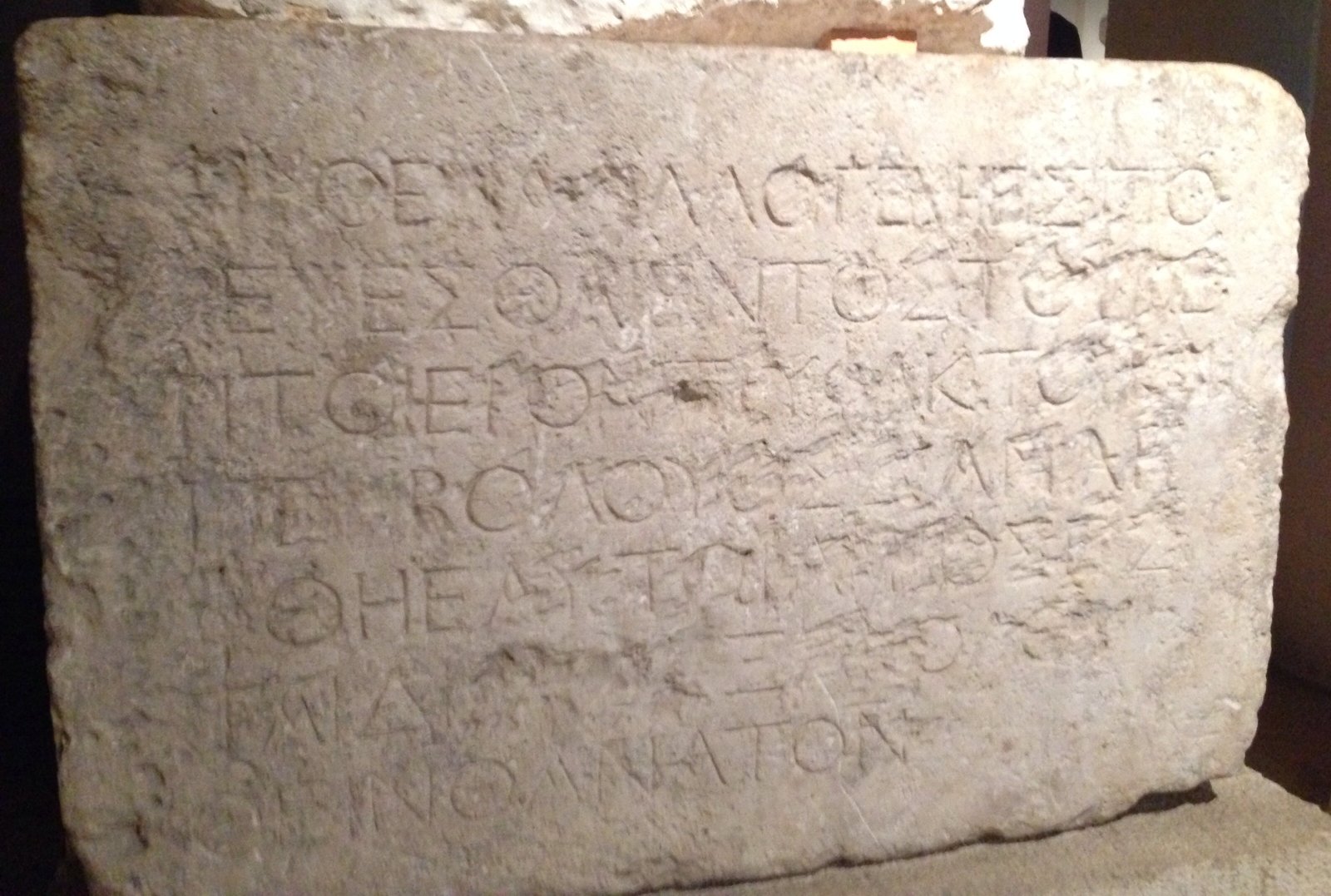
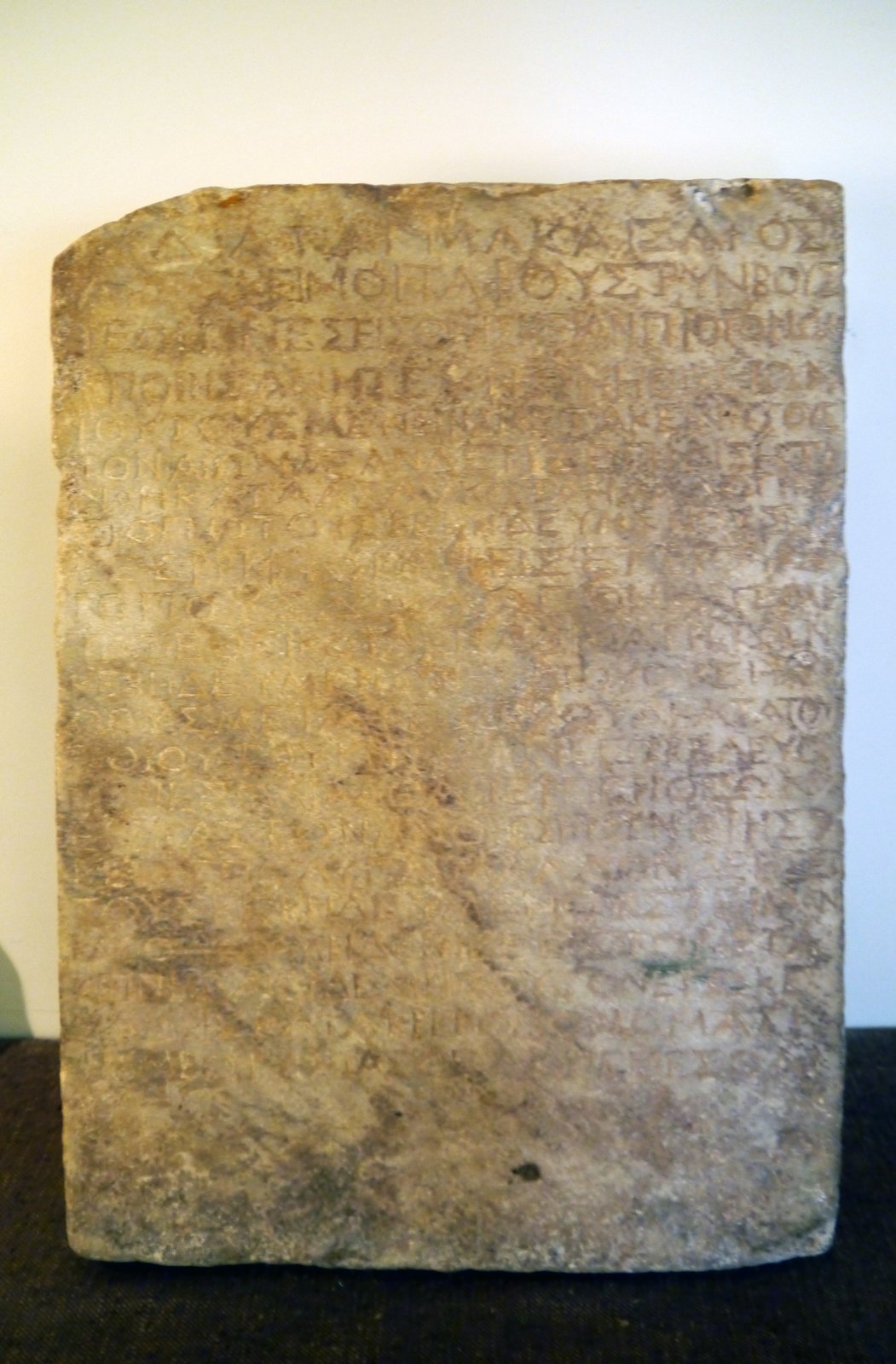
ConfirmedThe complete Greek temple warning stone in the Istanbul Archaeology Museums. Oncenawhile, via Wikimedia Commons, CC BY-SA 3.0.
Crying out, Men of Israel, help: This is the man, that teacheth all men every where against the people, and the law, and this place: and further brought Greeks also into the temple, and hath polluted this holy place.
Acts 21:28, KJV
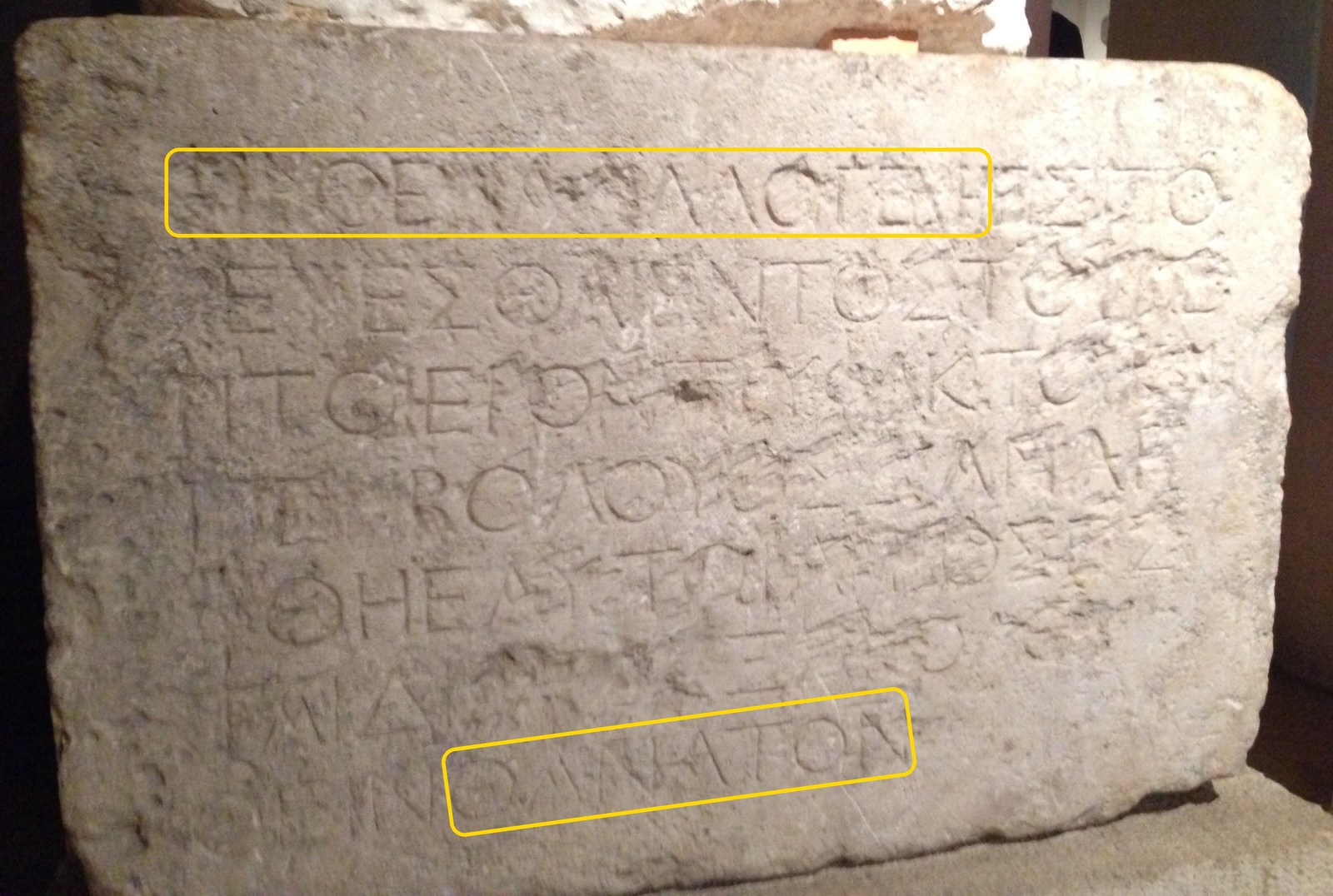
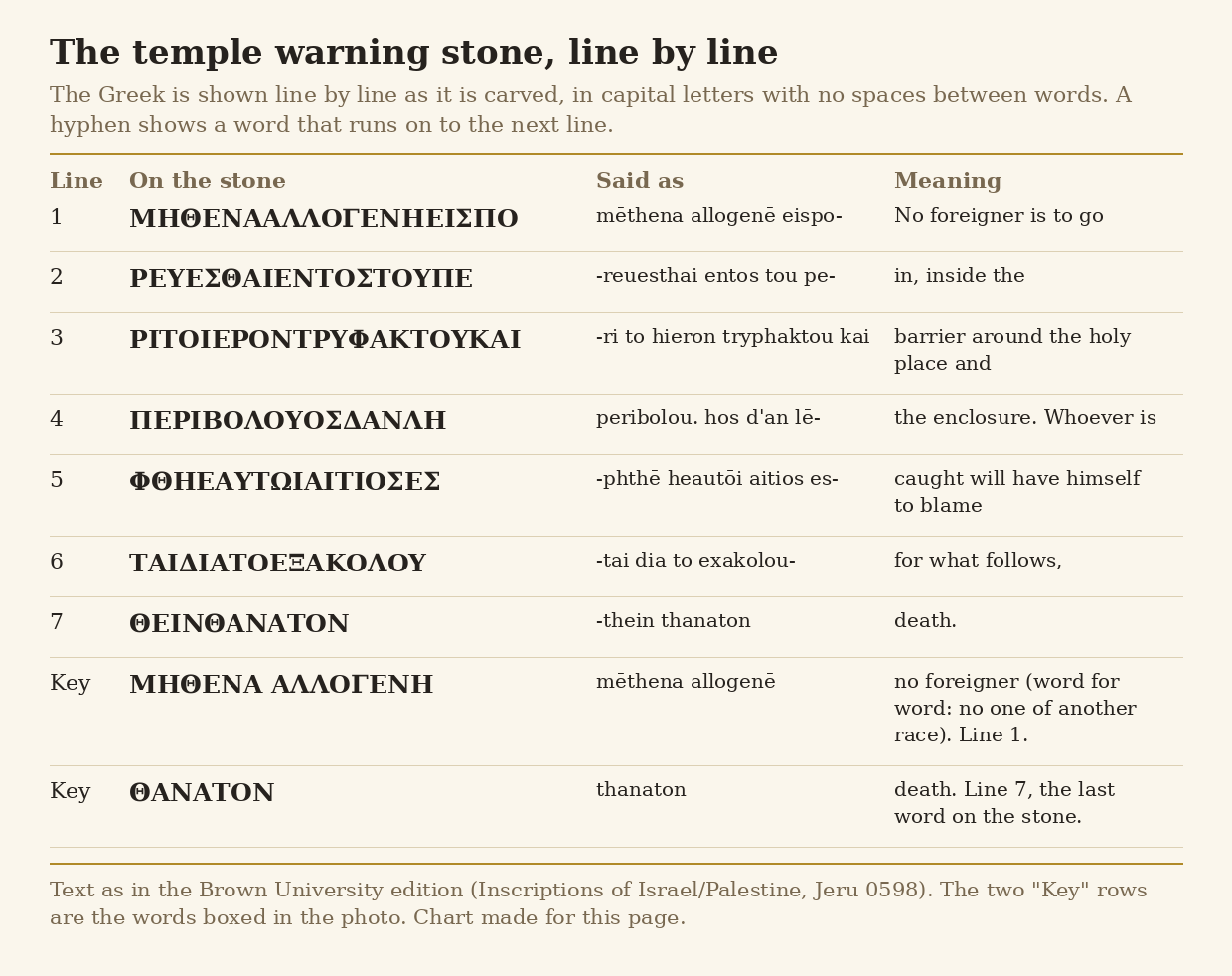
This stone block was one of the warning signs set on the low stone barrier that divided the outer court of Herod's temple, open to everyone, from the inner courts, open only to Jews. In Greek it tells any foreigner not to go past the barrier and warns that anyone caught will have only himself to blame for the death that follows. Josephus, a Jewish historian of the first century, describes these warning pillars, some in Greek and some in Latin. This is the rule behind the riot in Acts 21, when a crowd claimed Paul had taken Trophimus, a Greek from Ephesus, into the temple. The photo and chart below show the Greek words for "no foreigner" and "death" as they are carved on the stone.
Photo of the complete warning stone in the Istanbul Archaeology Museums. The yellow boxes were added for this page. The top box marks the start of line 1, the Greek words ΜΗΘΕΝΑ ΑΛΛΟΓΕΝΗ (said mēthena allogenē), "no foreigner". The bottom box marks ΘΑΝΑΤΟΝ, "death", the last word on the stone, at the end of line 7. The stone has no spaces between words, and line 1 is worn, so the right end of the top box was placed by counting the letters. Oncenawhile, via Wikimedia Commons, CC BY-SA 3.0.The full Greek text of the warning stone, line by line, with how it sounds and what it means. Chart made for this page, free to reuse.
Where it is today
Complete stone: Istanbul Archaeology Museums, Turkey (inventory number 2196 T). Broken second copy: Israel Museum, Jerusalem (IAA 1936-989).
Date
Herod's temple period, about 23 BC to AD 70.
Why this label: The complete stone was found in 1871 beside the Temple Mount, and its words match Josephus' description of the warning signs of Herod's temple. It records the rule behind the charge in Acts 21:28, though it does not mention Paul, and the link to Ephesians 2:14 is a likely reading rather than something Paul states.
Good to know
The find: Charles Clermont-Ganneau found the complete stone in 1871, built into the wall of an old Muslim school just outside a gate on the north side of the Temple Mount, and the Ottoman authorities took it to Istanbul. A second, broken and less carefully cut copy turned up in 1936 outside the Lions' Gate, and some of its letters still show traces of the red paint that once made them stand out.
Ephesians link: Paul wrote that Christ "hath broken down the middle wall of partition" between Jews and Gentiles. Many readers think he had this barrier in mind, since he was arrested over it, but he does not say so.
Beware of copies: Several fakes were made soon after 1871, so only the Istanbul stone and the Jerusalem fragment count as evidence; plaster copies in other museums are modern.
The Southern Steps, the Huldah Gates and the Trumpeting Stone
Luke 2:22 · Luke 2:27 · Acts 3:1
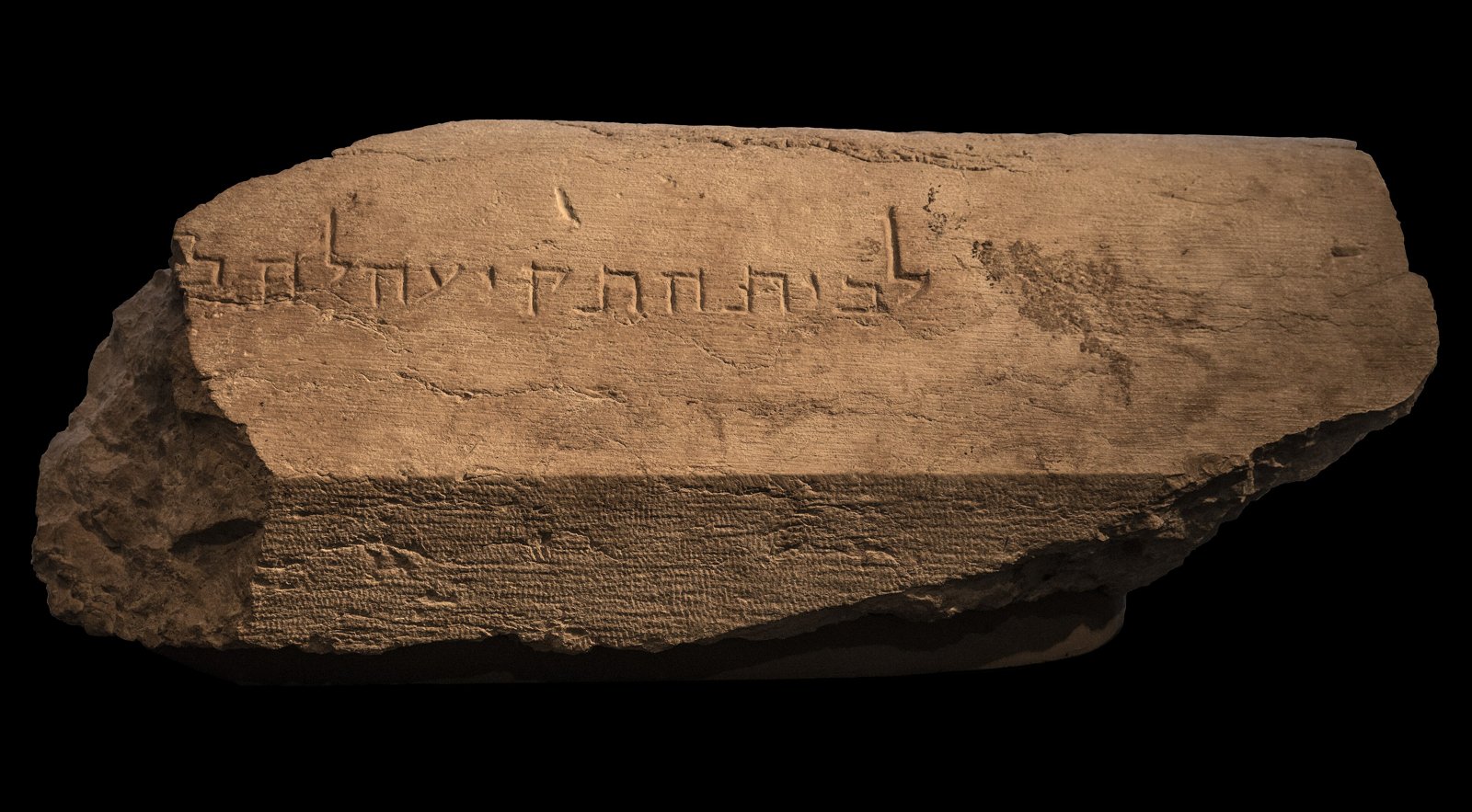
BackgroundThe trumpeting stone in the Israel Museum, with its one line of Hebrew. The steps and gates are not shown in this photo. Andrey Zeigarnik, via Wikimedia Commons, CC BY-SA 2.0.
Now Peter and John went up together into the temple at the hour of prayer, being the ninth hour.
Acts 3:1, KJV
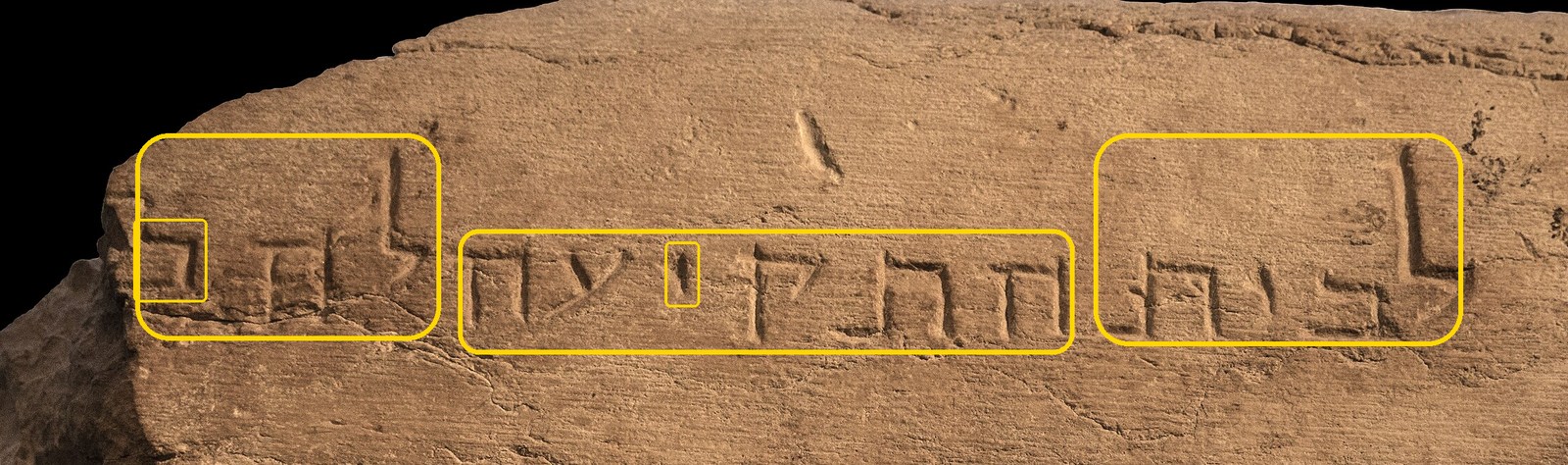
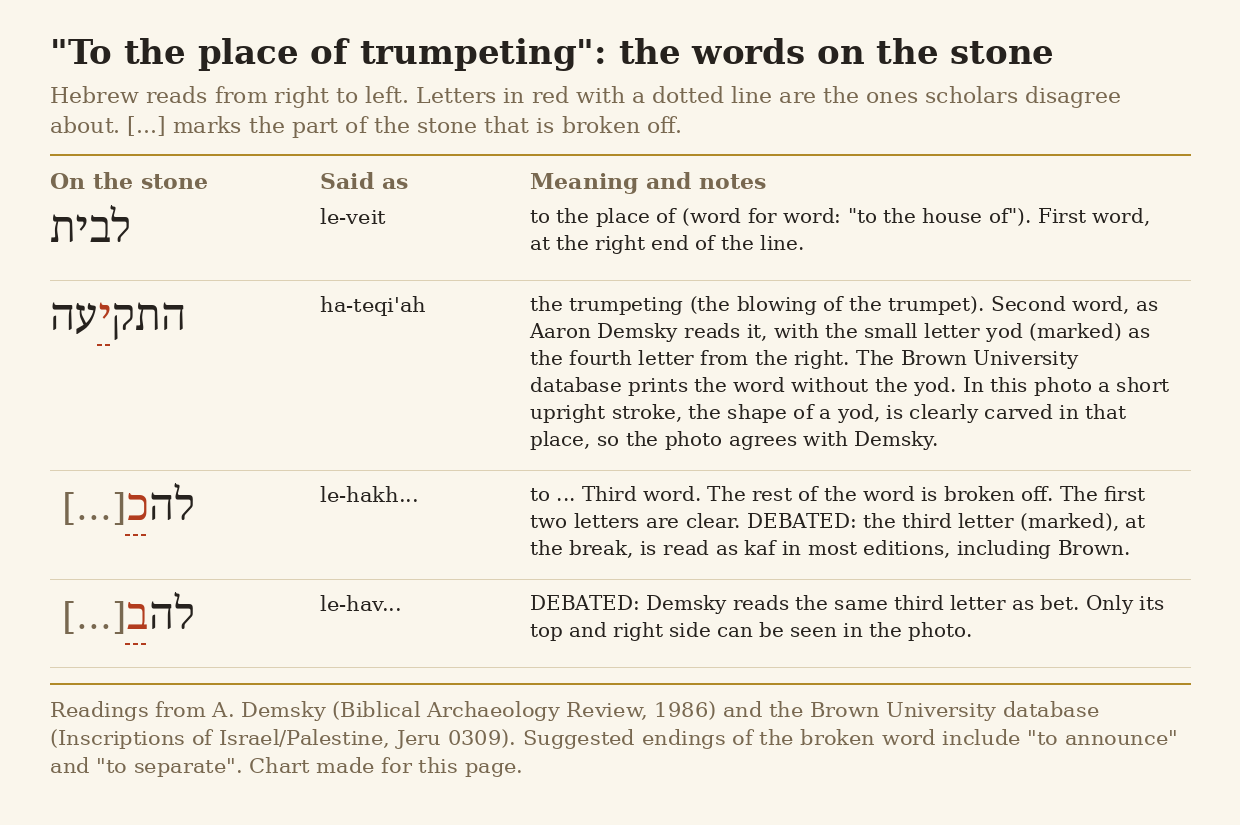
The main way into Herod's temple for ordinary worshippers was from the south. A very wide stairway led up to two sets of gates in the southern wall, now called the Double Gate and the Triple Gate, which led through tunnels up into the temple courts; they are usually linked with the "Huldah Gates" named in the Mishnah, an early Jewish law book. Many ritual baths were dug near the foot of the steps, where people washed before going up. In the rubble on the street below the southwest corner, Benjamin Mazar's team found a large stone carved in Hebrew "to the place of trumpeting", which most likely marked the spot where a priest blew a trumpet to announce the start and end of the Sabbath. The photo and chart below show the Hebrew words "to the place of trumpeting" as they are carved on the stone.
Photo of the trumpeting stone on display in the Israel Museum. The yellow boxes were added for this page. Hebrew reads from right to left. The three large boxes mark the words: on the right, לבית, "to the place of"; in the middle, התקיעה, "the trumpeting"; and on the left, the broken word that begins להכ. The small box in the middle word marks the small letter yod (י): a short upright stroke that can be clearly seen in this photo. The small box on the left marks the last letter before the break, which scholars read in two ways (kaf or bet). Only its top and right side can be seen in this photo. Andrey Zeigarnik, via Wikimedia Commons, CC BY-SA 2.0.The words on the trumpeting stone, with how they sound and what they mean. Letters that scholars disagree about are marked in red. Chart made for this page, free to reuse.
Where it is today
Jerusalem Archaeological Park, along the southern wall of the Temple Mount: the steps, the blocked gates and the ritual baths can be seen there. The trumpeting stone is in the Israel Museum, Jerusalem (IAA 78-1439); a copy lies at the southwest corner where it was found.
Date
Steps and gates: Herod's rebuilding, from about 20 BC; the stairway was uncovered in 1971. Trumpeting stone: carved between about 20 BC and AD 70, thrown down in AD 70, and found in the dig Benjamin Mazar began in 1968.
Why this label: These are real parts of Herod's temple that worshippers used in Jesus' day, but no Bible verse names the southern steps, the Huldah Gates or the trumpeting place. They show the setting of the temple visits in Luke and Acts, not a specific event.
Good to know
What the Bible says: Luke 2 and Acts 3 say people went up to the temple or came into it, but they never say by which gate or stairway. The only named parts of the temple area in the New Testament are the gate called Beautiful and Solomon's porch (Acts 3:2, Acts 3:11, John 10:23), and neither has been shown to be at these southern gates.
Popular claims: Guides often say Jesus surely walked these steps, or that Peter preached on them at Pentecost and baptized the 3,000 in the nearby baths. That is possible because this was a main entrance, but it is a guess; the Bible and the digs do not show it.
The broken word: The first two words of the trumpeting stone are clear, but the third is cut off. Mazar suggested "for the priest", Yadin "toward the sanctuary", Ben-Hayyim "to announce", and Aaron Demsky "to separate" the holy day from ordinary days; none can be proven.
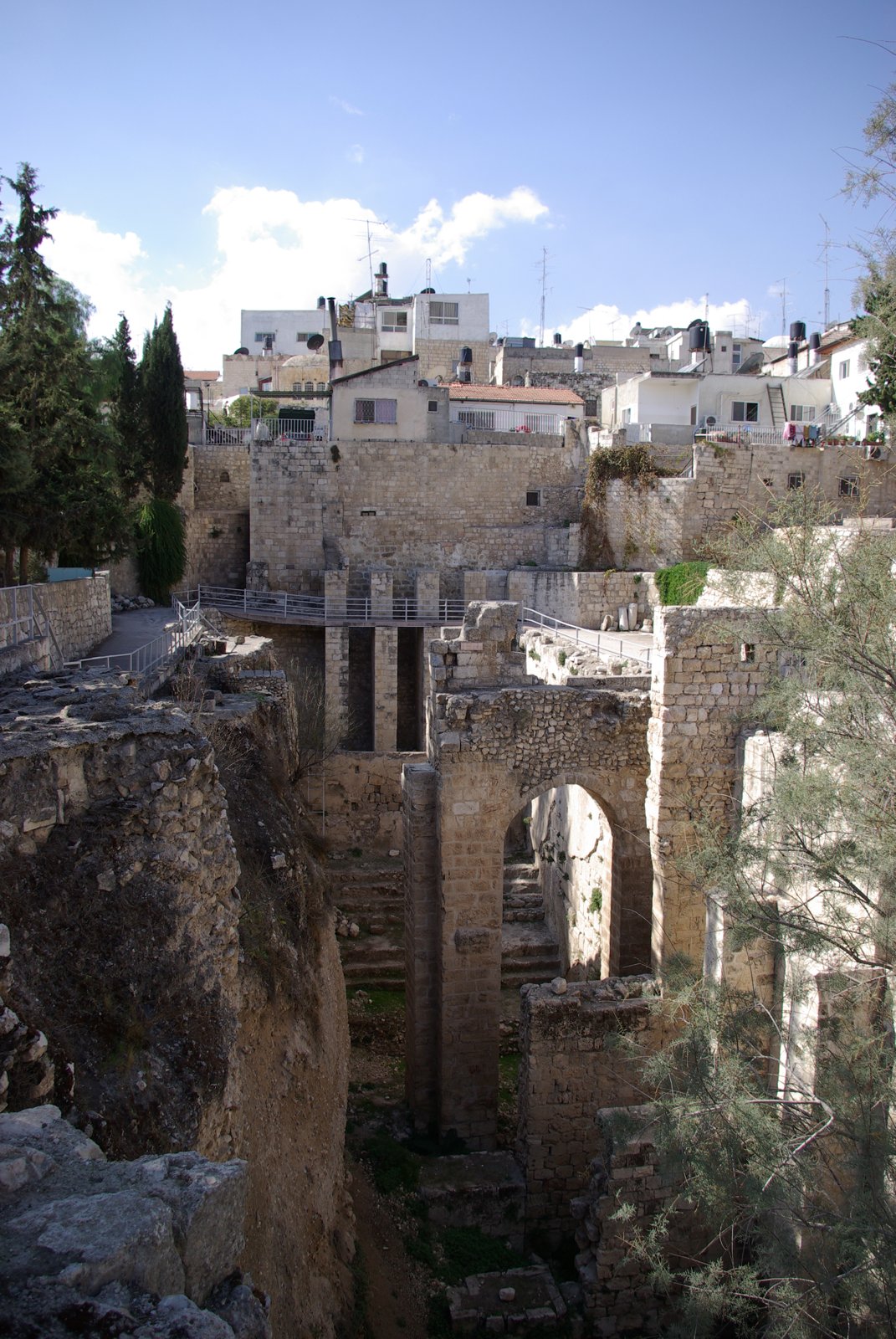
ConfirmedLooking down into the dig at the Pool of Bethesda, in the grounds of St Anne's Church, Jerusalem. The arch and the walls are later building work, most likely from the churches that once stood over the pools. Berthold Werner, via Wikimedia Commons, Public domain.
Now there is at Jerusalem by the sheep market a pool, which is called in the Hebrew tongue Bethesda, having five porches.
John 5:2, KJV
John says the pool of Bethesda was by the sheep market and had five porches, where many sick people lay. There Jesus healed a man who had been ill for 38 years. Digs in the grounds of St Anne's Church, just inside the Lions' Gate, uncovered two large pools side by side, divided by a wide dam wall. Covered walkways on the four outer sides plus one along the dividing wall would make five porches, which fits John's description.
Where it is today
Jerusalem, Old City, in the grounds of St Anne's Church near the Lions' Gate (also called St Stephen's Gate). The ruins can be visited.
Date
Northern pool: dam built about the 8th century BC. Southern pool: added about 200 BC. In use in Jesus' day. Roman healing shrine east of the pools: perhaps first century BC, made into a temple of Asclepius and Serapis after AD 135. Church on the site by the 5th century AD; the church of St Anne nearby, built by the Crusaders (the European Christians who ruled Jerusalem from 1099), was finished in 1138.
Why this label: Scholars broadly agree that the twin pools at St Anne's are John's Bethesda: they lie near the area of the sheep gate, and by the 5th century a church called the church of the Sheep Pool stood there. No inscription with the name Bethesda has been found on site.
Good to know
Old doubt: Before the digs, some scholars, such as Alfred Loisy, held that John made up the five porches as a symbol of the five books of Moses.
The digs: The two pools with a dam between them give a layout that matches five porches, so many scholars now treat John's detail as real knowledge of Jerusalem before AD 70. Little of the rows of columns survives, though, so their exact form is a reconstruction.
Pagan healing shrine: After AD 135 the Romans built a shrine to the healing gods Asclepius and Serapis beside the pools, and offerings to these gods were found there. Some scholars think smaller healing baths stood there already in Jesus' day, which would help explain why the sick gathered at the pool, but that early date is debated.
Other view: Some scholars, such as Urban von Wahlde, see the southern pool, with its broad steps, as a ritual bath fed from the northern pool.
ConfirmedStone steps and paving at the edge of the Pool of Siloam from Jesus' time, found in 2004. Much of the pool has not yet been dug. Markbarnes, via Wikimedia Commons, CC BY-SA 4.0.
And said unto him, Go, wash in the pool of Siloam, (which is by interpretation, Sent.) He went his way therefore, and washed, and came seeing.
John 9:7, KJV
Jesus put clay on the eyes of a man born blind and sent him to wash in the pool of Siloam, and he came back seeing. In 2004, workers repairing a water pipe near the south end of the City of David exposed stone steps, and archaeologists Ronny Reich and Eli Shukron showed they belonged to a large stepped pool from the time of Jesus. A wide street of stone steps climbed from the pool north toward the temple. The pool is fed by water from the Gihon Spring that runs through Hezekiah's tunnel, which is covered on an earlier page.
Where it is today
Jerusalem, at the south end of the City of David site (in Silwan, just south of the Old City). Part of the pool's steps can be seen; much of the pool is still being dug. Parts of the stepped street have been uncovered in tunnels. Access can change, so check before planning a visit.
Date
Pool rebuilt in the first century BC (coins of the Jewish king Alexander Jannaeus, who ruled 103 to 76 BC, were found in its plaster); in use in Jesus' day; buried after AD 70 (the latest coin found by it is from AD 69). Stepped street: first century AD, possibly built about AD 30.
Why this label: The name Siloam has stayed with this spot (Silwan in Arabic), the water comes through Hezekiah's tunnel, and the newly found pool is from the right time. Scholars broadly agree it is the pool of John 9, though no inscription naming it has been found.
Good to know
Wrong pool before: For centuries visitors were shown a smaller pool built in the 5th century for the empress Eudocia, about 65 metres (70 yards) away; it was thought to be the Gospel pool until the 2004 find.
Pool or bath: Many think it served pilgrims as a large ritual bath, while one scholar has argued it was a swimming pool, so its exact use is debated.
Pilate street: A 2019 study of more than 100 coins found under the paving argued the street was built while Pontius Pilate governed Judea, about AD 30. The archaeologist Jodi Magness doubts this, because the coins came from fill that could have been brought in from elsewhere.
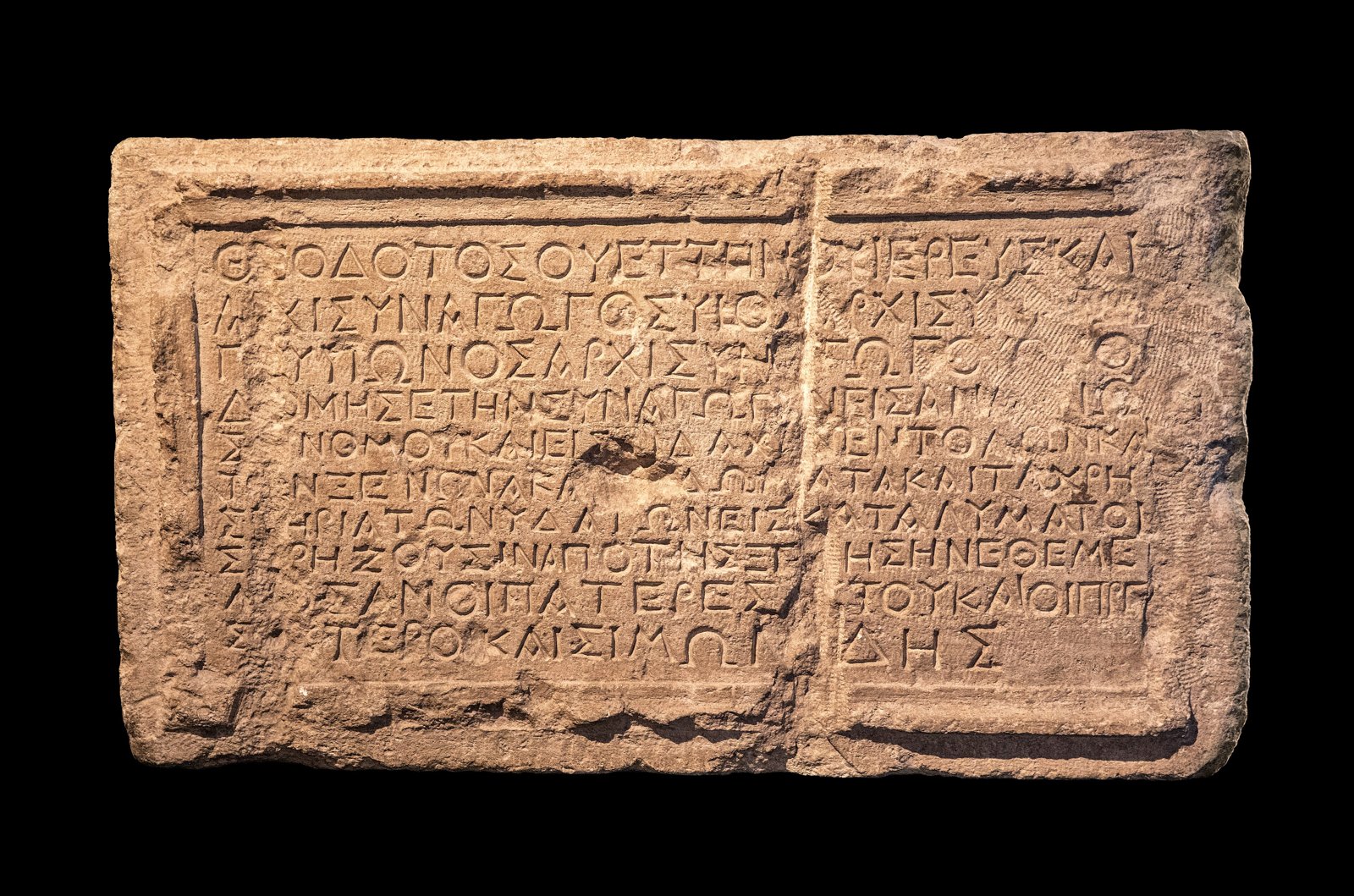
BackgroundThe Theodotus inscription, 10 lines of Greek on a limestone block. Andrey Zeigarnik, via Wikimedia Commons, CC BY-SA 2.0.
Then there arose certain of the synagogue, which is called the synagogue of the Libertines, and Cyrenians, and Alexandrians, and of them of Cilicia and of Asia, disputing with Stephen.
Acts 6:9, KJV
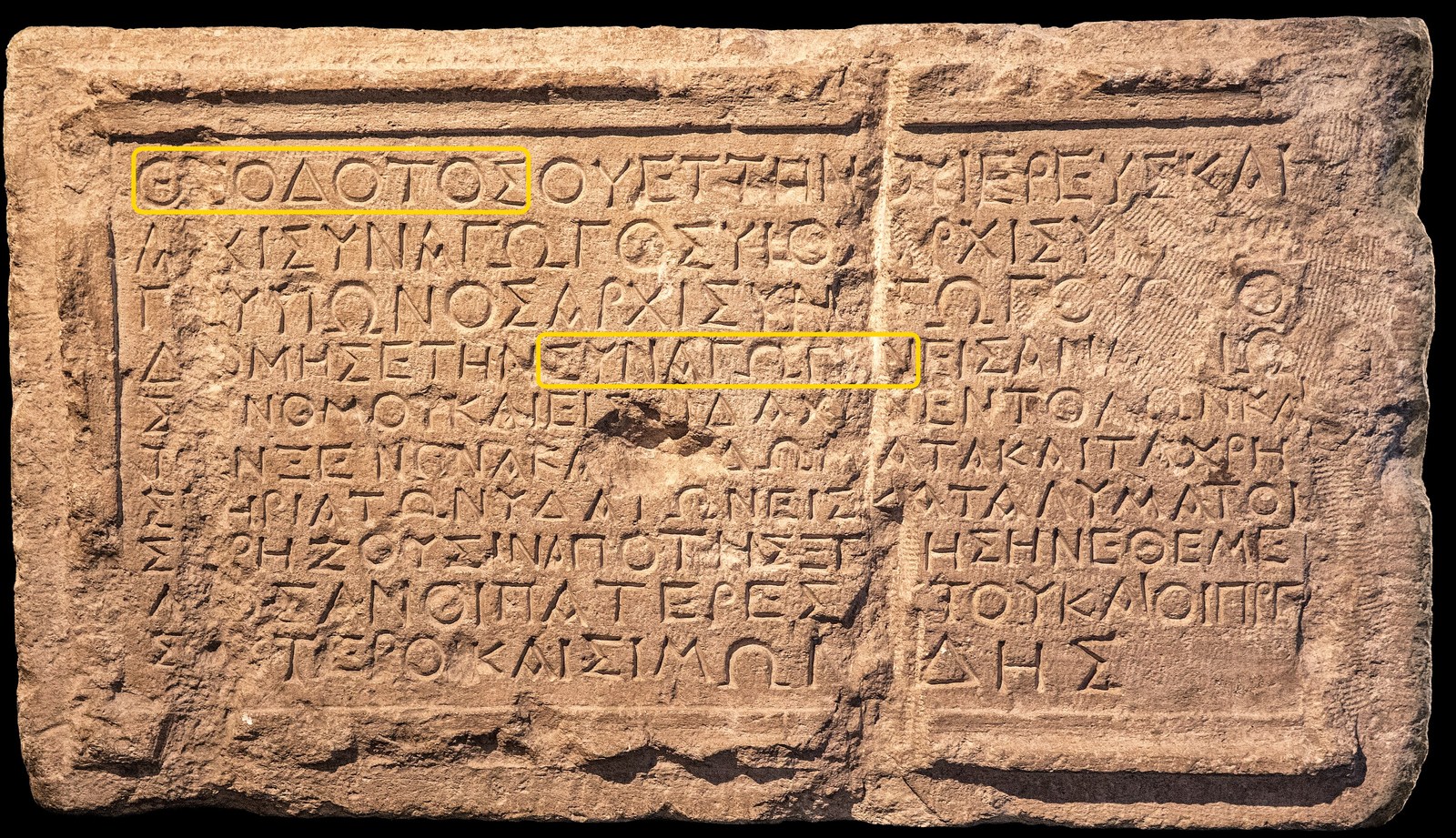
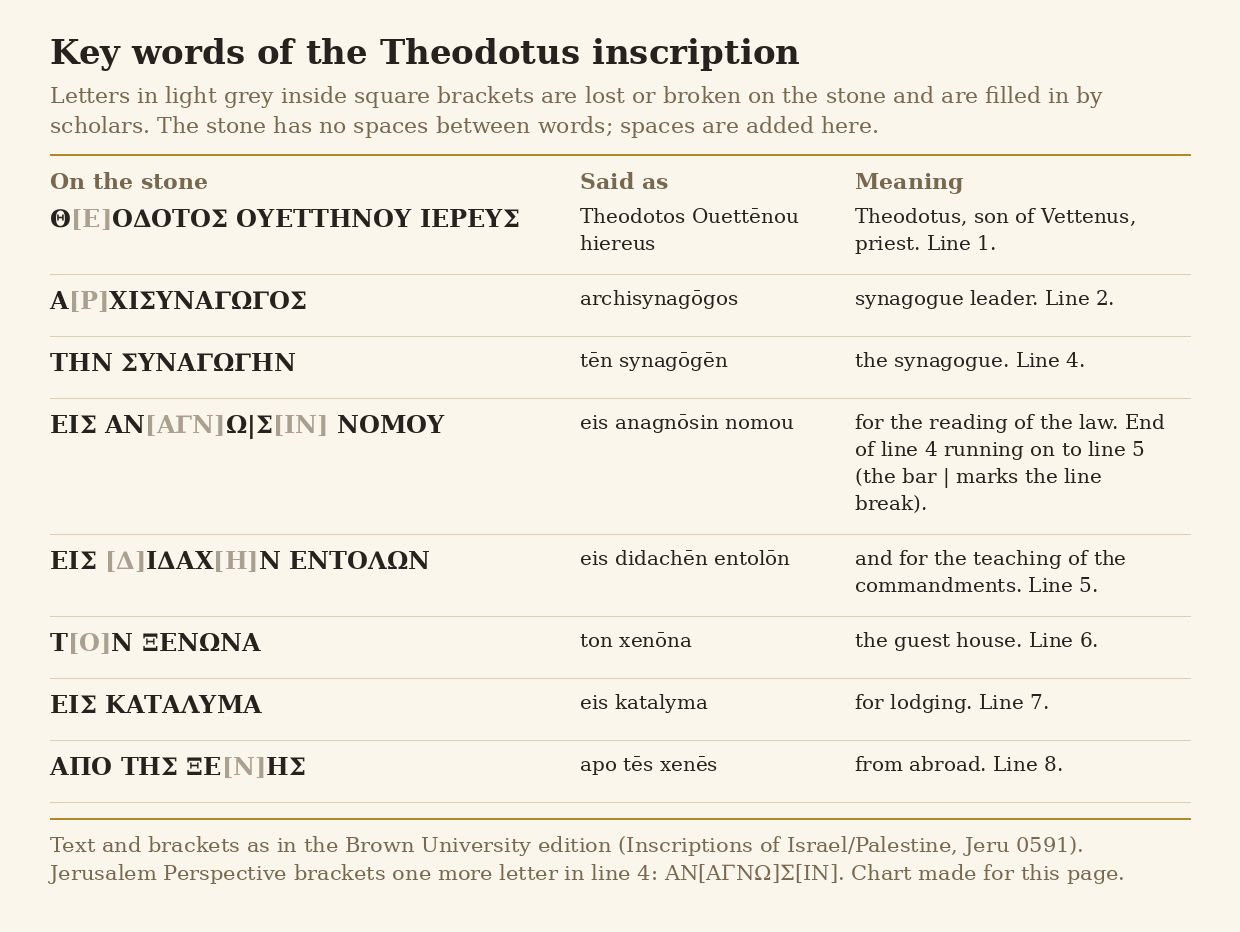
This limestone slab, carved in Greek, says that Theodotus son of Vettenus, a priest and synagogue leader whose father and grandfather held the same title, built a synagogue "for the reading of the law and the teaching of the commandments." It also names a guest house, rooms and water installations as lodging for people in need coming from abroad. It was found in a filled-in cistern (an underground water tank) on the Ophel hill (the City of David), just south of the Temple Mount, in Raymond Weill's dig of 1913 to 1914. It is the only known inscription that directly shows a synagogue building in Jerusalem while the temple still stood, which fits the Gospels and Acts, where synagogues are in use alongside the temple. The photo and chart below show the name Theodotus and the word "synagogue" as they are carved on the stone.
Photo of the Theodotus inscription. The yellow boxes were added for this page. The top box marks the name ΘΕΟΔΟΤΟΣ, Theodotus, at the start of line 1. Its second letter (Ε) is lost, which is the worn patch after the first letter. The lower box marks ΣΥΝΑΓΩΓΗΝ, "synagogue", in line 4. In this photo the letter Η near the end of the word, beside the crack in the stone, is damaged and hard to see. Andrey Zeigarnik, via Wikimedia Commons, CC BY-SA 2.0.Key words of the Theodotus inscription, with how they sound and what they mean. Letters in light grey inside square brackets are lost and filled in by scholars. Chart made for this page, free to reuse.
Where it is today
Israel Antiquities Authority collection (IAA S-842), Jerusalem. In 2016 it was on display in the Israel Museum, Jerusalem, while older books and the Brown University database list it at the Rockefeller Archaeological Museum, so check before visiting.
Date
Most scholars: before AD 70, in the time of Herod or the early Roman governors (late first century BC to AD 70), based on the letter shapes and the building pieces in the style of Herod's time found with it. A minority have argued for a date after AD 70.
Why this label: It is a genuine synagogue inscription from Jerusalem, most likely from before AD 70, and it shows the kind of synagogue the Gospels and Acts describe. It does not name any synagogue in the Bible, so the link to the synagogue of the Libertines in Acts 6:9 is only a possibility.
Good to know
Libertines link: "Libertines" means freed slaves. Theodotus's father had a Latin name, Vettenus, and some scholars suggest the family were Jews taken to Rome as slaves and later freed, which could make this the synagogue of Acts 6:9; but the inscription does not say so, and Jerusalem had many synagogues.
Dating debate: A minority of scholars argued that the Greek word for synagogue meant a gathering of people, not a building, until after AD 70, and so dated the stone later. John Kloppenborg replied that a synagogue building is named in an inscription from Berenice in Libya dated AD 55 or 56, and that the Ophel was used as a quarry and not lived on after AD 70.
Square brackets: In the writing above, letters in square brackets are worn away and filled in by editors, and the editions differ slightly on which letters are worn. The stone has no spaces between words; the spaces are added here to make the words easier to see.
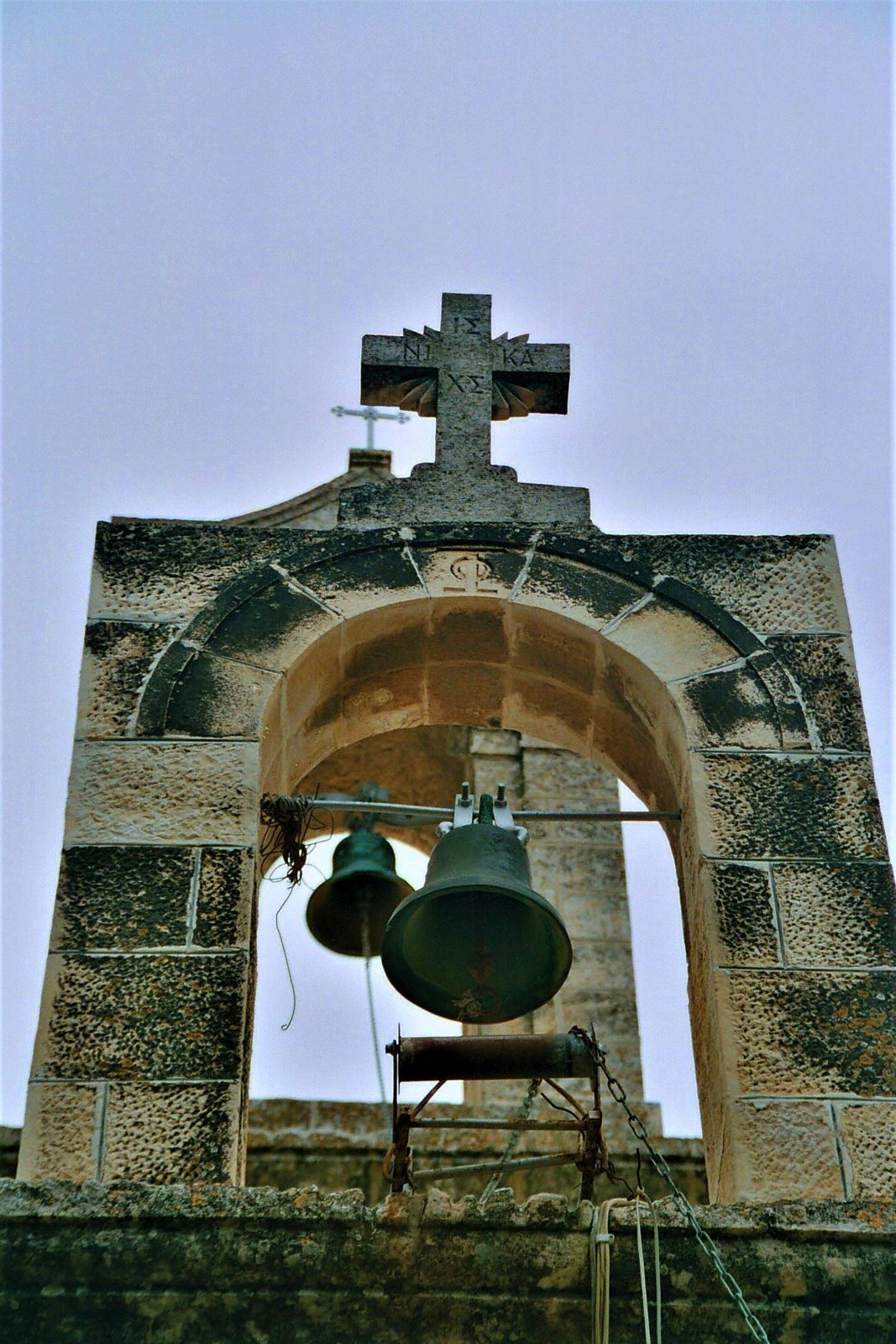
Traditional siteA church bell gable at al-Eizariya (Bethany), the town of the traditional tomb of Lazarus. The Greek letters on the cross, IC XC NIKA, mean "Jesus Christ conquers". The tomb itself is not shown. Israel Zeller, PikiWiki Israel, via Wikimedia Commons, CC BY 2.5.
Jesus therefore again groaning in himself cometh to the grave. It was a cave, and a stone lay upon it.
John 11:38, KJV
John 11 tells how Jesus raised Lazarus from the dead at Bethany, the village of Mary and Martha. John 11:18 says Bethany was about 15 furlongs from Jerusalem, which is about 2.8 kilometres. Today the town on that spot, on the southeast slope of the Mount of Olives, is called al-Eizariya, which means "place of Lazarus". A rock-cut tomb in the town has been shown to visitors as the tomb of Lazarus since at least the early 300s AD.
Where it is today
Al-Eizariya, on the southeast slope of the Mount of Olives, about 3 kilometres east of the Old City of Jerusalem. The tomb is reached by steep rock-cut steps from the street. The Franciscan Church of Saint Lazarus (built 1952 to 1955) stands beside it, over the remains of the older churches. Check access before planning a visit.
Date
Tradition recorded from about AD 300 to 333 (Eusebius and the Bordeaux pilgrim). First church (the Lazarium) built between about AD 333 and 390. Larger church in the 500s. Convent built by the Crusaders (the European Christians who ruled Jerusalem from 1099) from AD 1138. The tomb itself may be older than the churches, but its date is not proven.
Why this label: Scholars broadly agree that Bethany was in this area, and the tradition of the tomb goes back at least to the early 300s AD. But nothing at the tomb names Lazarus, so it cannot be shown that this is the very cave of John 11.
Good to know
How old: Eusebius, writing about AD 300 to 330, says that at Bethany "Lazarus' place is still shown". The Bordeaux pilgrim (AD 333) also mentions the tomb. Jerome, about AD 390, mentions a church there called the Lazarium, and the pilgrim Egeria (about AD 381 to 384) describes crowds so large on Lazarus Saturday that they filled "not only the Lazarium itself, but all the fields around".
The digs: Franciscan digs from 1949 to 1953 found four churches built one on top of another just east of the tomb, the earliest from the 300s or 400s AD. They also found rock-cut tombs, houses, wine presses and storage pits, and the area was used as a cemetery in the first century.
Honest caution: In 1907 the Catholic Encyclopedia said that naming this cave as the tomb of Lazarus is "merely possible". The old village of Jesus' day may have stood a little higher up the hill than the present town, which grew up around the tomb.
Later history: A small mosque stood over the tomb by AD 1384, and the larger al-Uzair Mosque was built in the 1500s and named after Lazarus. Between 1566 and 1575 the Franciscans were allowed to cut the present entrance from the street.
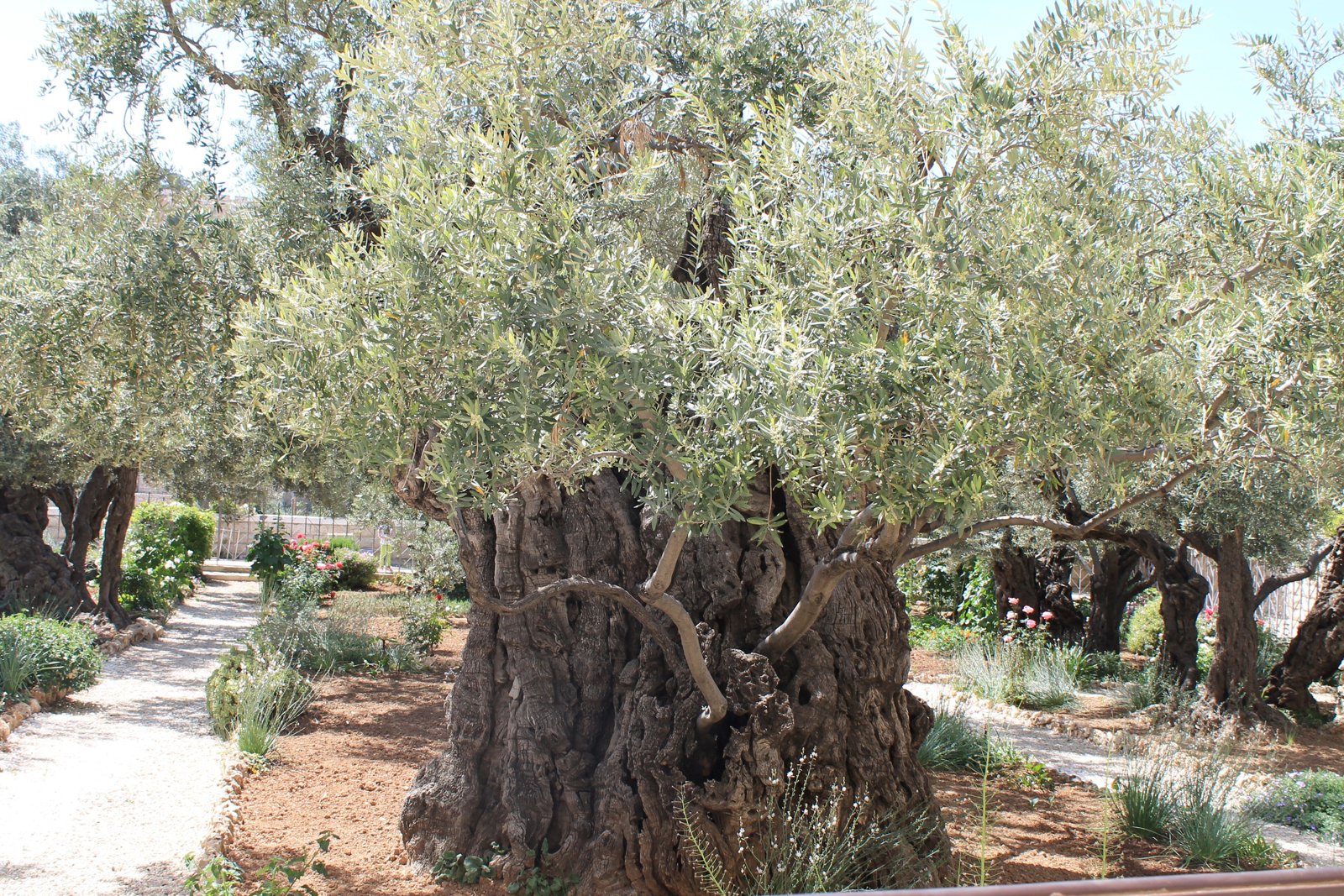
Traditional siteOne of the oldest olive trees in the garden of Gethsemane. Wikimedia Commons user קרן, CC BY-SA 3.0.
Then cometh Jesus with them unto a place called Gethsemane, and saith unto the disciples, Sit ye here, while I go and pray yonder.
Matthew 26:36, KJV
Matthew and Mark say Jesus prayed at a place called Gethsemane on the night He was arrested. John says He crossed the brook Cedron (the Kidron Valley) to a garden. The name comes from Aramaic or Hebrew words meaning "oil press". Today a walled garden of very old olive trees at the foot of the Mount of Olives, beside the Church of All Nations, is shown as the place.
Where it is today
Foot of the Mount of Olives, across the Kidron Valley from the Old City of Jerusalem. The garden and the Church of All Nations (also called the Basilica of the Agony) are cared for by the Franciscans. Other churches show three more nearby gardens.
Date
Prayers at the site recorded about AD 300 (Eusebius). A church there is mentioned in the late 300s (Egeria, about AD 381 to 384, and Jerome, about AD 390). Oldest olive wood dated to about AD 1092 to 1198. Present church built 1919 to 1924.
Why this label: Gethsemane was clearly at the foot of the Mount of Olives, across the Kidron, and Christians have prayed at this spot since about AD 300. But no find pins down the exact garden, and most modern scholars agree the exact spot is not known.
Good to know
Tree dating: A study led by the Italian National Research Council (CNR), announced in 2012, dated wood from three of the eight old trees by radiocarbon (a lab test that measures how long ago wood grew). The dates were about AD 1092, 1166 and 1198. The other five trees could not be dated because their trunks are hollow and the oldest wood is gone. DNA tests found the trees had the same genetic make-up, so they seem to have come from one parent plant, perhaps as cuttings. In his final paper the lead author, Mauro Bernabei, concluded that the dated trees all began growing around the 1100s, when the Crusaders were restoring Christian holy places.
Older roots: Olive trees can grow back from their roots after being cut down, so the roots could be older than the trunks. That is possible but not proven. Josephus also says that during the siege of AD 70 the Romans cut down all the trees around Jerusalem for about 90 furlongs (roughly 16 to 18 kilometres). So the trunks standing today did not stand there in Jesus' day. Whether any root is that old is not known.
The churches: The modern Church of All Nations was built over the remains of a Byzantine church (from the Christian Roman period) and a small Crusader chapel. The Byzantine church had mosaic floors and a block of bare rock near the altar, shown as the rock where Jesus prayed. Experts disagree on whether these remains are the church Egeria saw or a later one.
The digs: In 1956 a Franciscan dig in the nearby Gethsemane Grotto found signs of olive oil work from the years shortly before AD 70, which fits the name "oil press".
Another view: In 1859 the missionary William Thomson thought the true garden lay in a quieter valley a few hundred metres to the northeast.
The Caiaphas family tomb and the ossuary of "Joseph son of Caiaphas"
Matthew 26:57 · John 18:13 · Luke 3:2
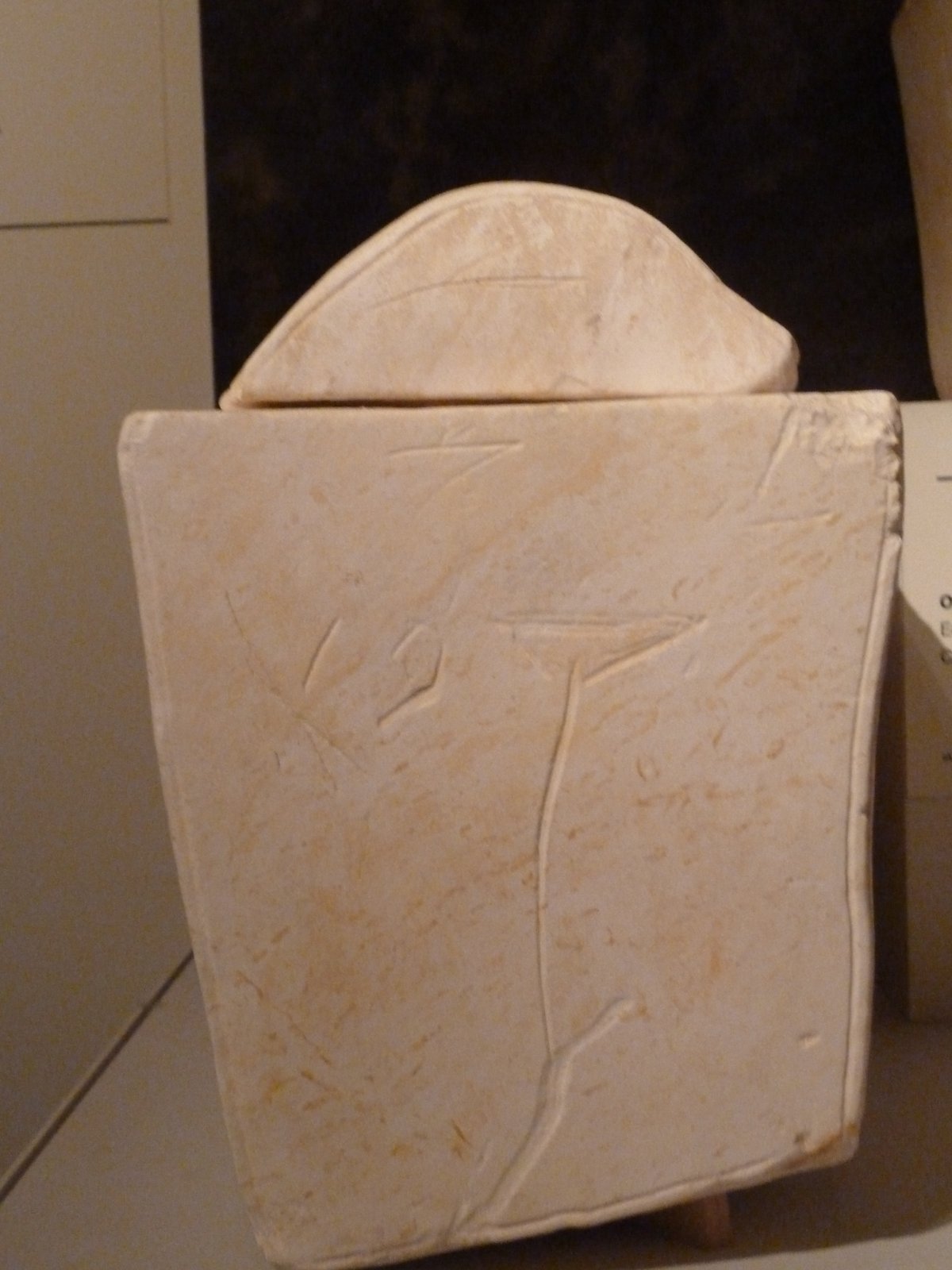
DisputedThe second, plainer ossuary from the Caiaphas family tomb, photographed in the Israel Museum. The family name Qafa (Caiaphas) is scratched in large, rough letters on its narrow end. This is not the finely decorated ossuary. Deror avi, via Wikimedia Commons, CC BY-SA 3.0.
And they that had laid hold on Jesus led him away to Caiaphas the high priest, where the scribes and the elders were assembled.
Matthew 26:57, KJV
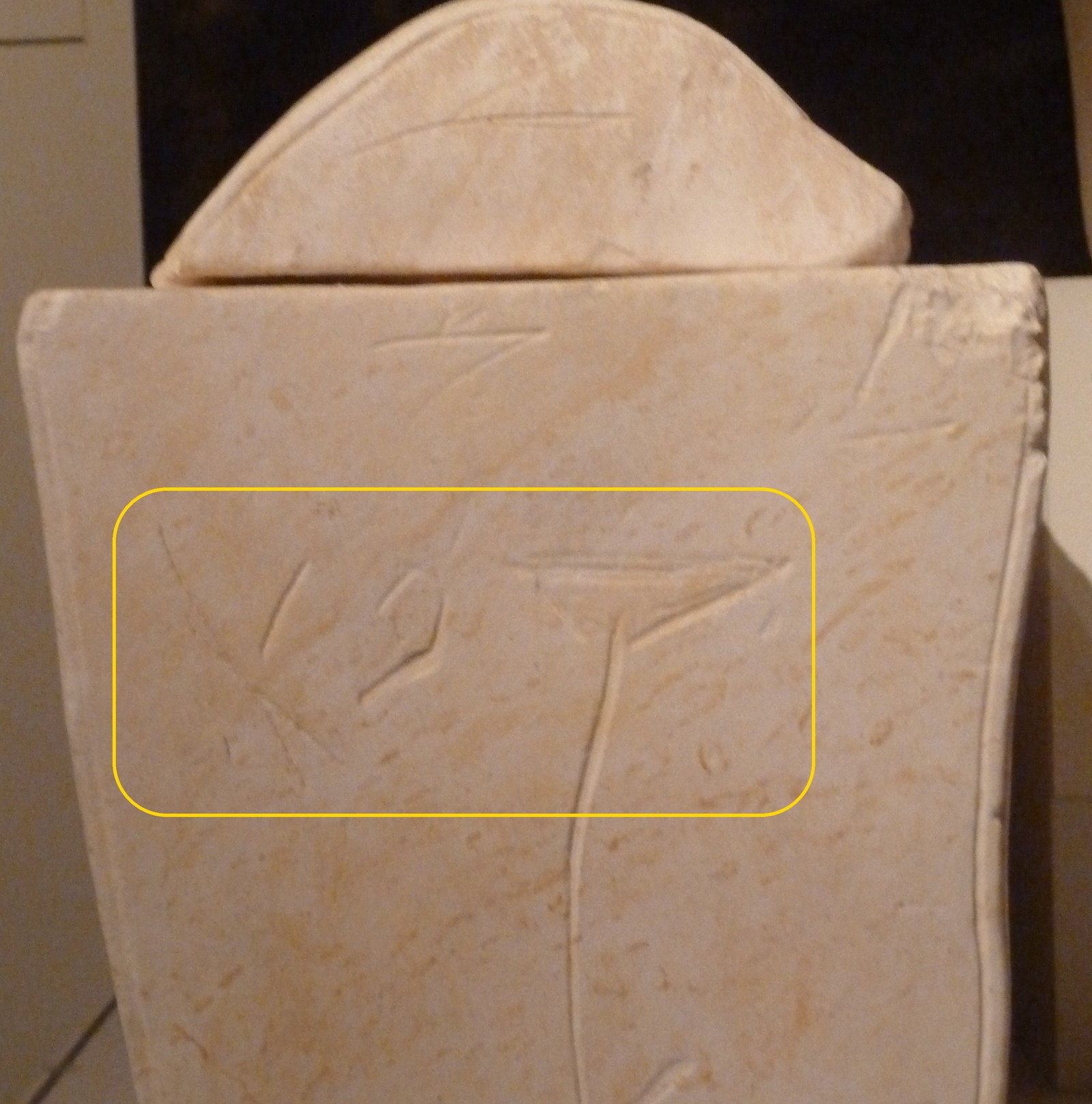
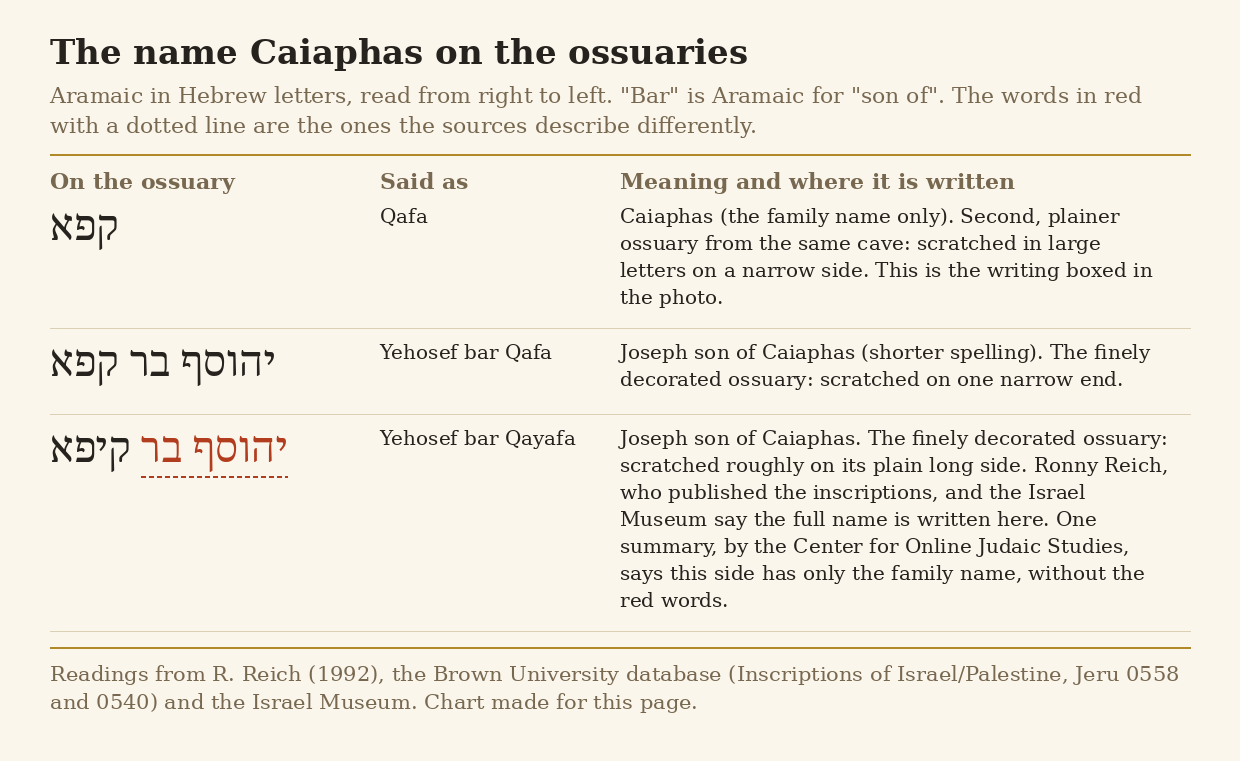
An ossuary is a stone box used to hold a person's bones about a year after burial, a Jewish custom in Jerusalem in the century before AD 70. In November 1990 builders in Jerusalem's Peace Forest broke into a family burial cave with 12 ossuaries. The finest one is carved with rosettes and has the name "Joseph son of Caiaphas" scratched on it twice in Aramaic. Josephus gives the high priest's full name as "Joseph, who was also called Caiaphas", the same man who questioned Jesus in the Gospels. The photos below show the family name Caiaphas scratched on the second, plainer ossuary from the cave, and the chart gives the writing on both ossuaries.
Photo of the narrow side of the second, plainer ossuary from the Caiaphas family tomb, in the Israel Museum. This is not the finely decorated ossuary. The yellow box, added for this page, marks the family name קפא, Qafa (Caiaphas), scratched in large, rough letters. Hebrew reads from right to left, so the first letter (ק) is the large one on the right, with a long scratched line running down from it. Deror avi, via Wikimedia Commons, CC BY-SA 3.0.The name Caiaphas as it is written on the two ossuaries, with how it sounds and what it means. The words in red are the ones the sources describe differently. Chart made for this page, free to reuse.
Where it is today
Israel Museum, Jerusalem. The bones were later reburied on the Mount of Olives.
Date
First century AD. Caiaphas was high priest from about AD 18 to 36, according to Josephus.
Why this label: Many scholars think this was very probably the tomb of the high priest's family, and perhaps his own ossuary. But the box does not call him high priest, the spelling of the name has been read in more than one way, and some scholars doubt the link.
Good to know
What was inside: The ornate box held the bones of six people: two infants, a child of 2 to 5, a boy of 13 to 18, an adult woman and a man of about 60. Many take the man to be Caiaphas himself, but nothing on the box says which bones are his. A second, plainer ossuary in the same cave has the family name "Qafa" scratched on one narrow end. That is the box in the photos on this page.
The spelling: The two spellings on the ornate box (Qayafa and Qafa) are both taken as forms of the Greek name Kaiaphas. Some scholars have proposed other readings of the letters.
Doubting view: Some point out that a high priest's title would be expected, and that the cave is fairly plain for so rich a family.
Supporting view: The name is rare, the date fits, the box is one of the finest ever found, and Josephus uses the same pairing of "Joseph" and "Caiaphas".
The Miriam ossuary: In 2011 the Israel Antiquities Authority got back a looted ossuary inscribed "Miriam daughter of Yeshua son of Caiaphas, priests of Maaziah from Beth Imri". Maaziah was one of the 24 priestly groups (1 Chronicles 24:18). Tests of the crust on the stone led the researchers to call the writing authentic, but the box came through the illegal antiquities trade, so where it was found (said to be the Valley of Elah) cannot be checked, and it adds family background, not proof about the high priest.
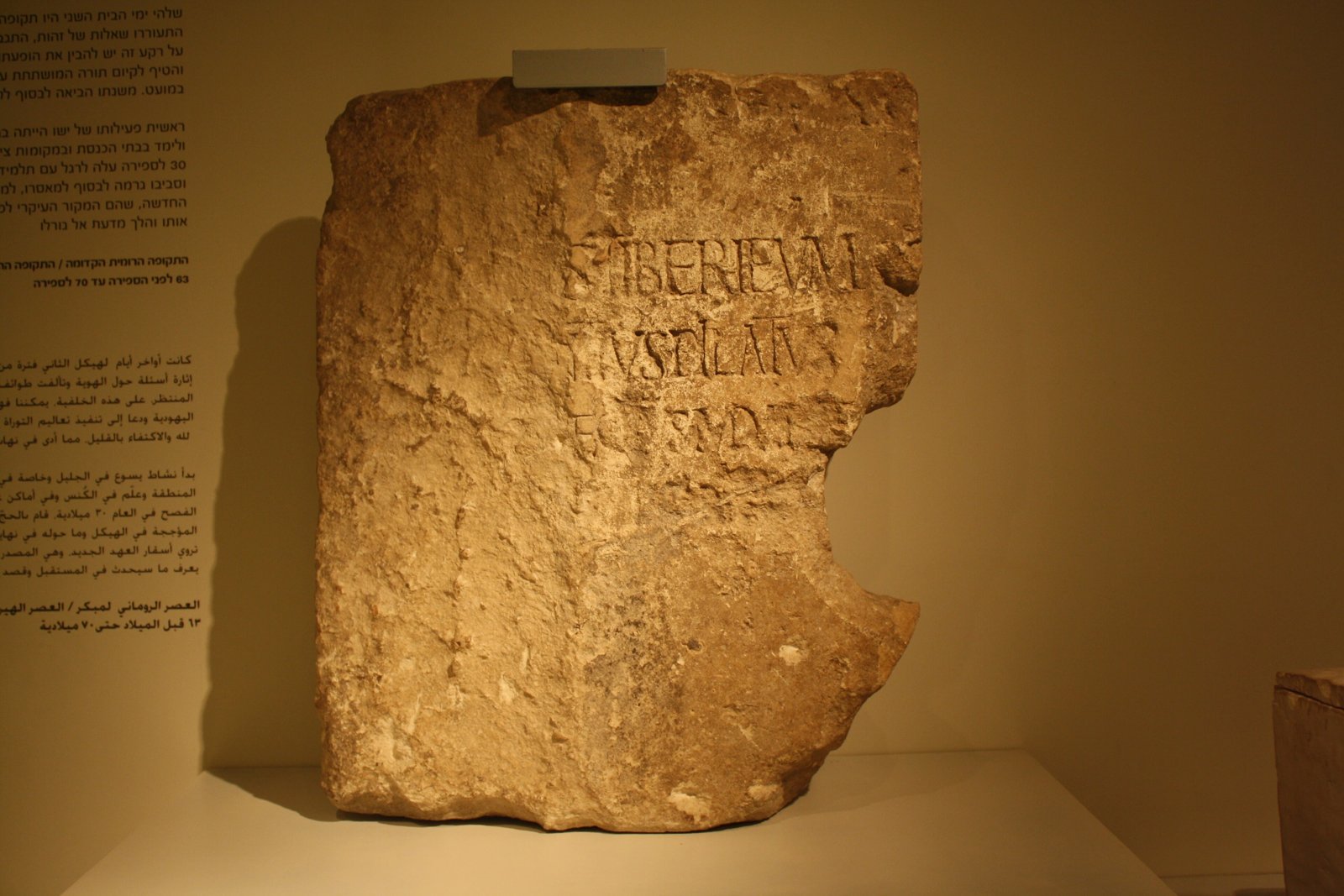
ConfirmedThe original Pilate stone in the Israel Museum, Jerusalem. BRBurton, via Wikimedia Commons, CC0.
And when they had bound him, they led him away, and delivered him to Pontius Pilate the governor.
Matthew 27:2, KJV
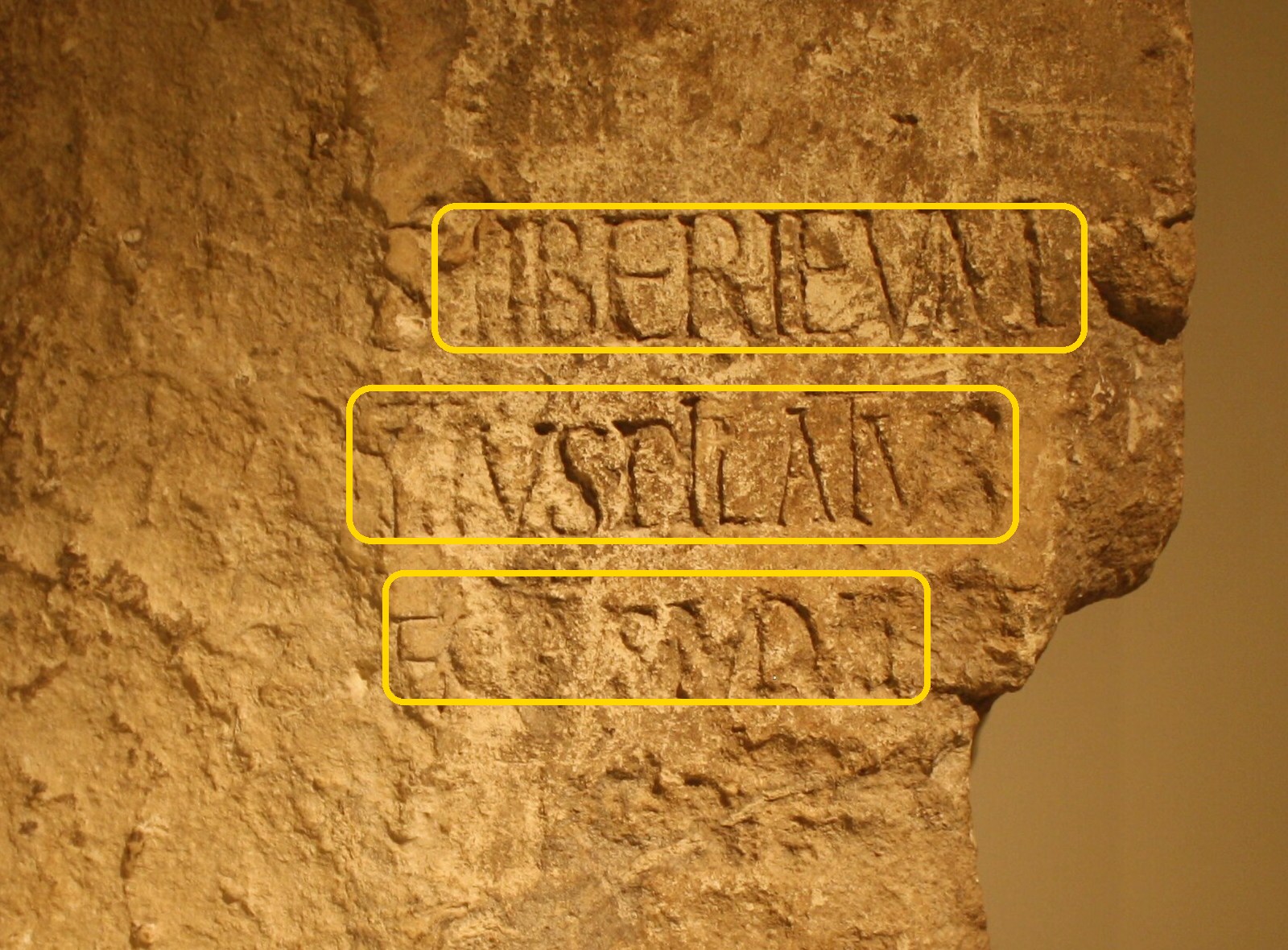
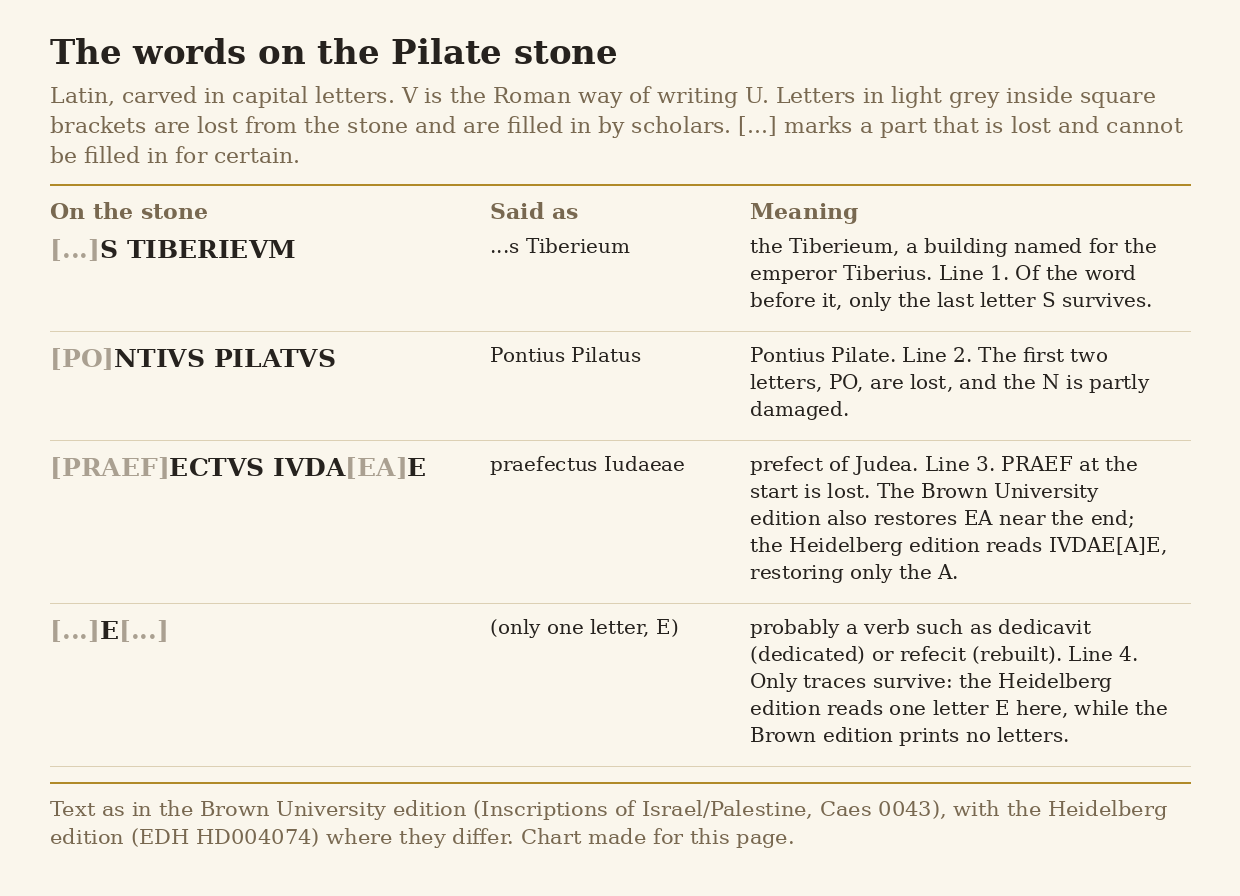
A limestone block found in 1961 at Caesarea, the Roman capital of Judea, with a Latin building inscription naming "Pontius Pilatus, prefect of Judea". A prefect was the Roman officer who governed the province. The stone records a building called a Tiberieum, probably a building in honour of the emperor Tiberius. It is the only known inscription from Pilate's own time that clearly names him. The photo and chart below show the name Pontius Pilatus and his title, prefect of Judea, as they are carved on the stone.
Photo of the original Pilate stone in the Israel Museum, Jerusalem. The yellow boxes were added for this page and mark the three lines that survive best. Top: TIBERIEVM, the Tiberieum, the building named for Tiberius. Middle: ...NTIVS PILATVS, Pontius Pilate; the first letters, PO, are lost. Bottom: ...ECTVS IVDA..E, prefect of Judea; the start of the first word (PRAEF) is lost, and the letters near the end of the line are lost or worn. BRBurton, via Wikimedia Commons, CC0 (public domain).The words on the Pilate stone, with how they sound and what they mean. Letters in light grey inside square brackets are lost from the stone and filled in by scholars. Chart made for this page, free to reuse.
Where it is today
Israel Museum, Jerusalem (published in the yearly list of new Latin inscriptions, L'Année épigraphique 1963, no. 104, and Lehmann and Holum, Caesarea inscriptions no. 43). Plaster copies are on display at Caesarea and in the Archaeological Museum in Milan.
Date
About AD 26 to 36, the years Pilate governed Judea.
Why this label: The stone is a genuine Roman inscription found in a controlled dig, and it names Pontius Pilate as prefect of Judea, the same governor the Gospels name. It confirms the man and his office; it says nothing about the trial of Jesus.
Good to know
The find: An Italian team led by Antonio Frova found it in June 1961 in the Roman theatre at Caesarea. It had been reused as a step, and the left half of the face had been chiselled away, so many letters are lost.
His title: The stone calls Pilate praefectus (prefect). The Roman writer Tacitus, about 80 years later, called him procurator, the title later used for the governors of Judea from the time of the emperor Claudius, which explains why later writers used it.
The missing letters: Scholars agree on lines 2 and 3. Line 1 is restored in different ways, for example DIS AVGVSTIS ("to the divine Augusti") or NAVTIS ("for the sailors"), and line 4 as DEDICAVIT ("dedicated") or REFECIT ("rebuilt"). So whether Pilate built or repaired the Tiberieum, and what it was, is not certain.
His coins: Pilate also struck small bronze coins in AD 29/30, 30/31 and 31/32; they name the emperor Tiberius in Greek but never Pilate himself.
And straightway in the morning the chief priests held a consultation with the elders and scribes and the whole council, and bound Jesus, and carried him away, and delivered him to Pilate.
Mark 15:1, KJV
A thin, cheap copper-alloy sealing ring (a ring pressed into wax or clay to mark goods or letters) found in 1968 to 1969 at the Herodium, Herod the Great's palace-fortress near Bethlehem. Cleaning and special photography later showed a krater (a wine-mixing bowl) with Greek letters read as ΠΙΛΑΤΟ, "of Pilate". It was published in 2018. It may have belonged to a servant or official who worked for Pilate, or to another man named Pilate, not to Pontius Pilate himself.
Where it is today
Excavated by the Hebrew University of Jerusalem (Gideon Foerster's dig); its present display or storage place could not be confirmed.
Date
Between the first century BC and the middle of the first century AD, based on its style and where it was found.
Why this label: The excavators themselves said it is unlikely that the powerful prefect wore such a cheap ring, and a later study doubts that the letters even spell "Pilato". It does not add proof about Pontius Pilate beyond what the Pilate stone already shows.
Good to know
The excavators: In the Israel Exploration Journal (2018) the team wrote that it is "unlikely that Pontius Pilatus, the powerful and rich prefect of Judaea, would have worn a thin, all copper-alloy sealing ring." They noted the name Pilatus is rare and that part of the Herodium was in use in his time, so a link to his staff is possible.
Doubting view: In 2023 Werner Eck and Avner Ecker argued in the journal Atiqot that the reading "Pilato" is possible but very unlikely, that the two lines of letters may not form one word, and that a Roman governor would not use a poorly written Greek seal with a krater, which was a Jewish symbol at the time.
Misunderstanding: Some news headlines in 2018 called it "Pilate's ring". That goes further than the evidence.
Gabbatha, the Pavement: where did Pilate judge Jesus?
John 19:13 · John 18:28 · Mark 15:16
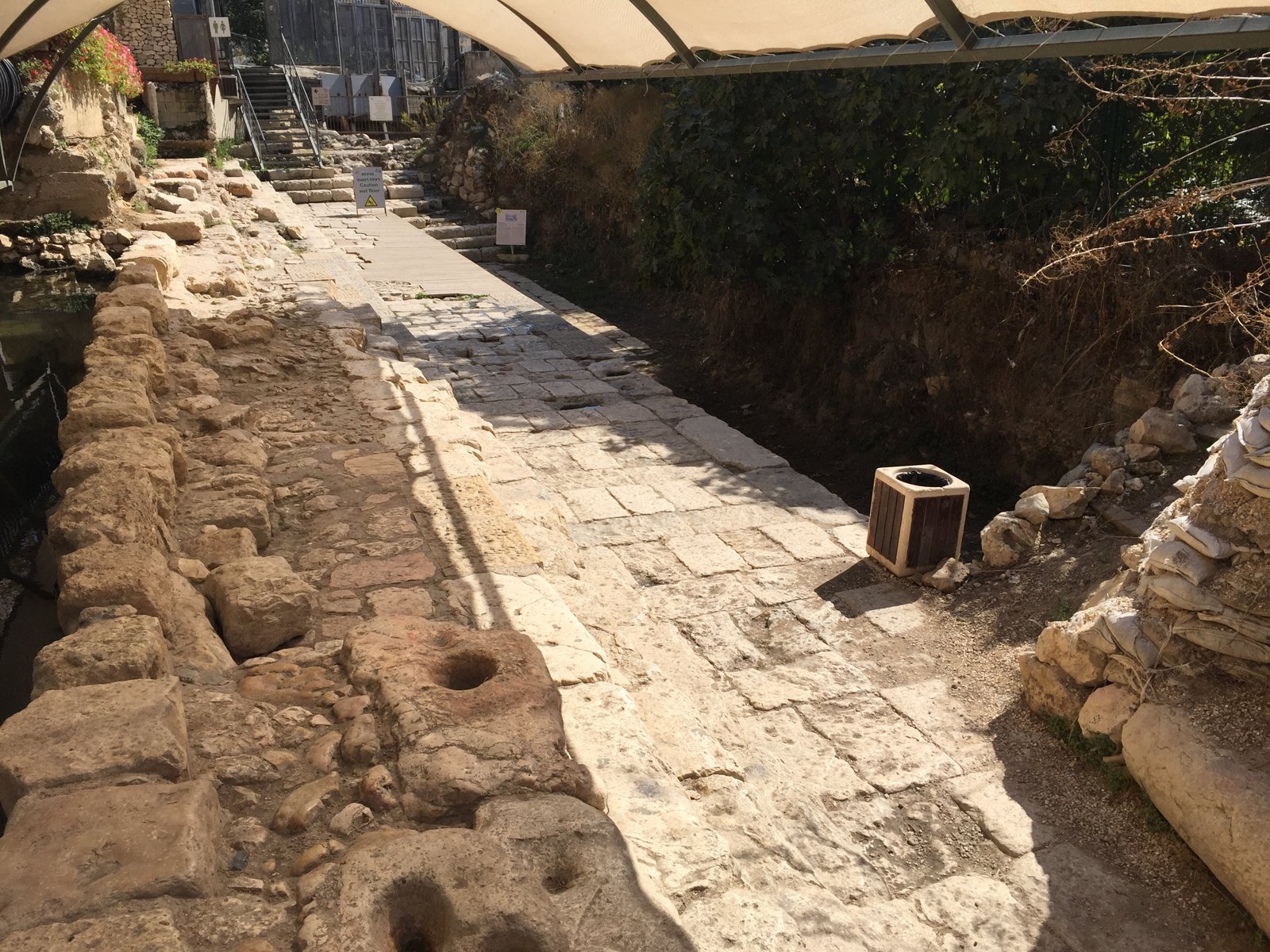
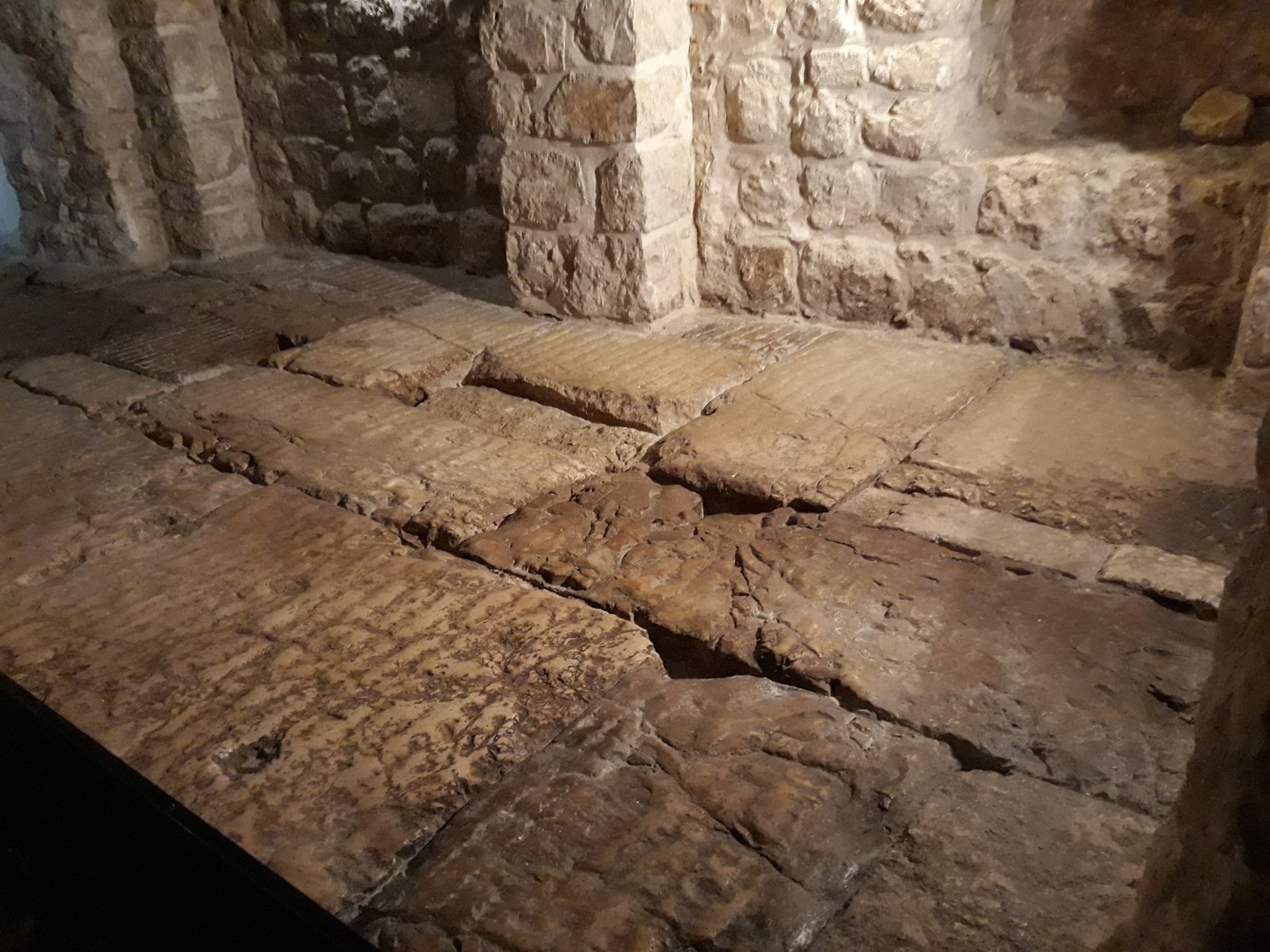
DisputedThe Roman pavement under the Convent of the Sisters of Zion, from Hadrian's time. BMNorris, via Wikimedia Commons, CC BY-SA 4.0.
When Pilate therefore heard that saying, he brought Jesus forth, and sat down in the judgment seat in a place that is called the Pavement, but in the Hebrew, Gabbatha.
John 19:13, KJV
John says Pilate sat on the judgment seat at a place called the Pavement (Greek Lithostrotos), in Aramaic Gabbatha, which may mean a raised place. Mark calls the governor's headquarters the Praetorium. There are two main views on where this was: the Antonia fortress beside the temple, or Herod's palace on the west side of the city by today's Jaffa Gate.
Where it is today
View 1: the Convent of the Sisters of Zion and the Ecce Homo arch on the Via Dolorosa, north of the Temple Mount, where a Roman stone pavement can be seen. View 2: the Tower of David Museum by the Jaffa Gate, where foundations of Herod's palace can be seen under the old Ottoman prison called the Kishle.
Date
The trial took place during Pilate's rule (AD 26 to 36), usually placed about AD 30 or 33. The pavement under the Sisters of Zion dates from Hadrian's city, about AD 130 to 135.
Why this label: No inscription or find marks the spot. Most archaeologists now favour Herod's palace, but the Antonia view is old and still held by some, and neither can be proven.
Good to know
Antonia view: Since the Middle Ages, Christians have placed the trial at the Antonia fortress, which overlooked the temple, and the Via Dolorosa starts there. The large Roman flagstones under the Sisters of Zion were long shown as the Pavement of John 19:13.
The pavement: Studies by Pierre Benoit (published 1971) showed that this pavement belongs to a public square (forum) of Aelia Capitolina, the Roman city Hadrian built about AD 130 to 135, laid over a pool that Josephus mentions. The arch called Ecce Homo is also Hadrian's gate. Benoit allowed that some stones might have been reused from earlier work, but as it lies now it is not the pavement of Jesus' day.
Palace view: Philo and Josephus say Roman governors stayed in Herod's palace when in Jerusalem, and Josephus says the governor Florus set up his judgment seat in front of the palace in AD 66. Excavations by Amit Re'em in 1999 to 2001 under the Kishle found foundation walls and drains of Herod's palace. Scholars such as Shimon Gibson and Jodi Magness say the Praetorium was most likely this palace compound.
Caution: Very little of the palace above ground survives, so the actual spot of the judgment seat is still unknown.
And after this Joseph of Arimathaea, being a disciple of Jesus, but secretly for fear of the Jews, besought Pilate that he might take away the body of Jesus: and Pilate gave him leave. He came therefore, and took the body of Jesus.
John 19:38, KJV
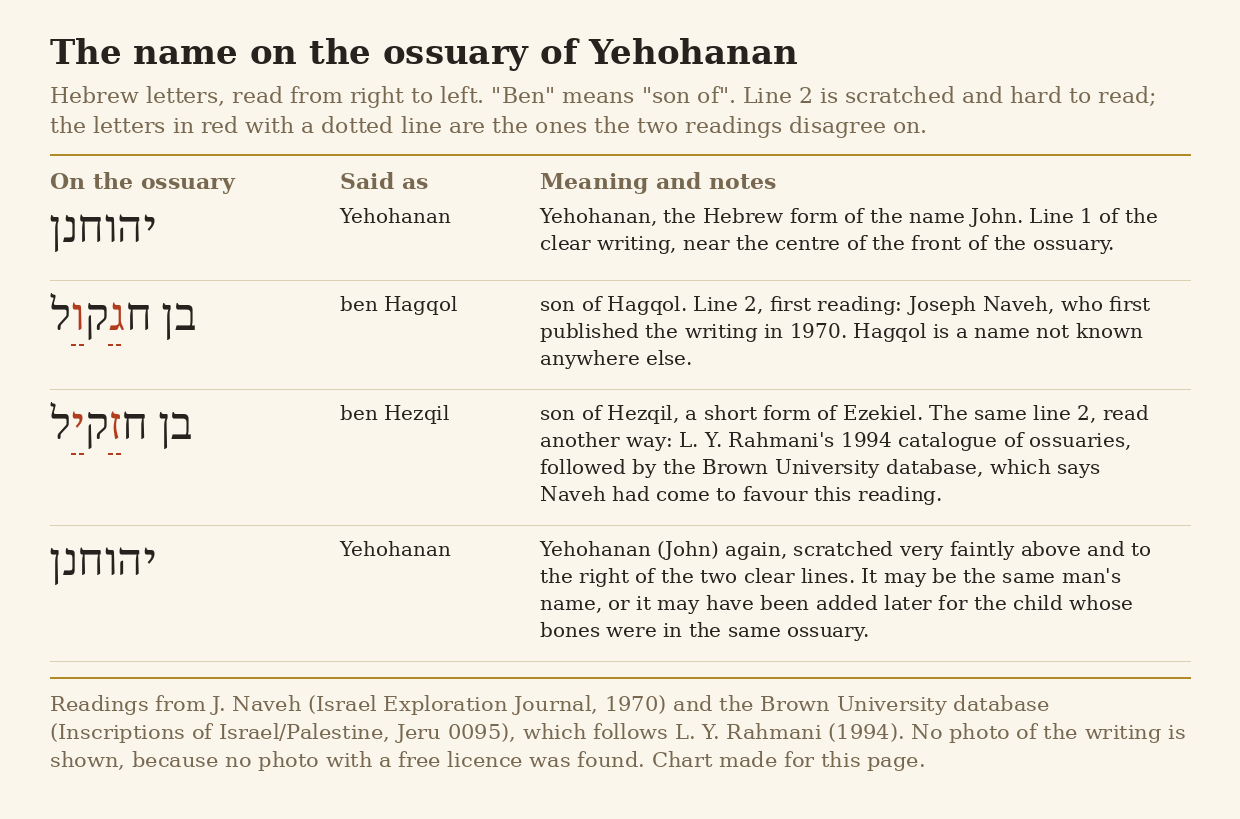
In 1968 builders at Giv'at ha-Mivtar, in north-east Jerusalem, broke into a group of Jewish family tombs, and the archaeologist Vassilios Tzaferis dug them out. In one tomb, a stone box for bones (an ossuary) held the bones of a child of 3 or 4, some bones of another adult, and the bones of a man aged about 24 to 28, and an iron nail 11.5 centimetres long was still stuck through the man's right heel bone, with bits of wood at both ends. The nail shows that he was crucified, and he is still the only clear case of a crucified man whose bones have been found in the land of Israel. His family took his body down, laid it in their tomb, and about a year later put his bones in the ossuary with his name scratched on it. So a man put to death on a Roman cross could still be buried in a family tomb, which fits the Gospel account of Joseph of Arimathea asking Pilate for the body of Jesus and burying Him in a tomb (John 19:38-42). The chart below shows the name on the ossuary, with the two ways the father's name has been read.
The name scratched on the ossuary of Yehohanan, with the two ways scholars read line 2. The letters the two readings disagree on are marked in red. Chart made for this page, free to reuse.
Where it is today
Israel Museum, Jerusalem. The ossuary is on display, with a copy (replica) of the heel bone and nail. The bones from the tomb were studied for only a short time and then reburied.
Date
First century AD, before the Romans destroyed Jerusalem in AD 70. The pottery in the tomb dates from the late 100s BC to AD 70, and the ossuary is dated about 20 BC to AD 70. So the find cannot be dated closely enough to say whether he died before, during or after the time of Jesus.
Why this label: A real crucified man from Roman Jerusalem, who shows how crucifixion and burial could happen in the world of the Gospels. He has no link to Jesus, and the find does not prove any Gospel event.
Good to know
Two studies: The first report, in 1970, said one nail went through both heels and that nails had also gone through the forearms. A new study in 1985 by Joe Zias and Eliezer Sekeles found that the nail went through only the right heel, from the side, and saw no clear sign of nails in the arms, so his arms may have been tied to the cross.
The name: The father's name is hard to read because one letter has many scratches. Joseph Naveh, who first published the writing in 1970, read it as Hagqol, a name not known anywhere else. L. Y. Rahmani's 1994 state catalogue of ossuaries, which the Brown University inscriptions database follows, reads Hezqil, a short form of Ezekiel, and says that Naveh had come to favour this reading. Yigael Yadin thought the word was not a name at all but a term for a man hanged with his knees apart.
Other finds: A few other cases of crucifixion have been found elsewhere in the Roman world, such as a man buried at Fenstanton in England with a nail through his right heel. He died between AD 130 and 360, long after the time of Jesus.
Golgotha and the tomb in the Church of the Holy Sepulchre
John 19:17-20 · John 19:41-42 · Hebrews 13:12
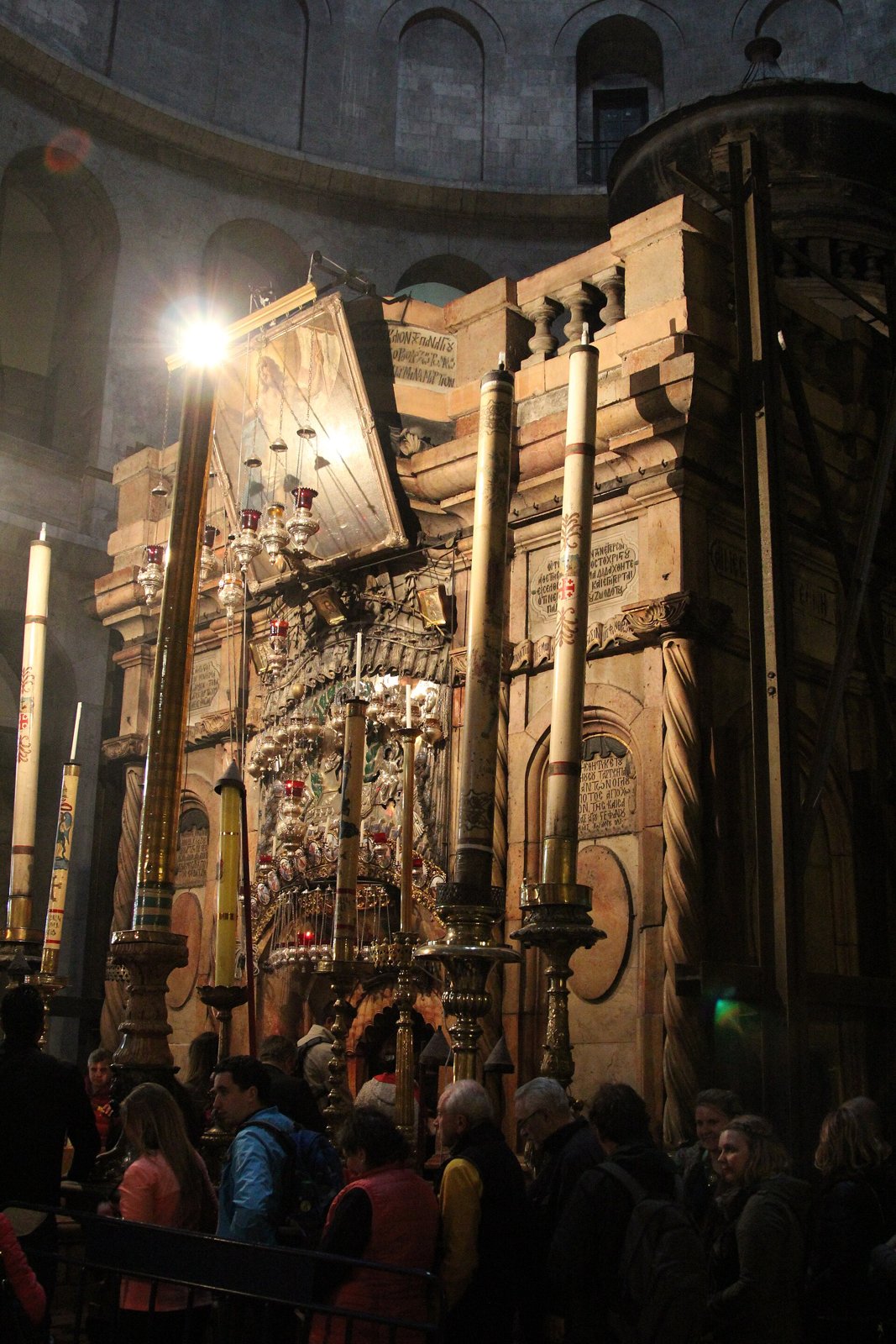
Traditional siteThe front of the Edicule, the shrine built over the tomb, with pilgrims. Fallaner, via Wikimedia Commons, CC BY-SA 4.0.
This title then read many of the Jews: for the place where Jesus was crucified was nigh to the city: and it was written in Hebrew, and Greek, and Latin.
John 19:20, KJV
The Church of the Holy Sepulchre in Jerusalem's Old City holds a rock that Christians have honoured as Golgotha since the 300s AD, and a rock-cut tomb honoured as the tomb of Jesus. The Bible places His death near the city but outside the gate, with a garden and a new tomb close by (John 19:20, John 19:41-42, Hebrews 13:12). Digs under the church found an old stone quarry with Jewish tombs cut into its rock walls, and since Jews buried their dead outside the city, this ground was most likely outside the city wall in Jesus' time. About AD 135 the Roman emperor Hadrian built a temple over the spot. Eusebius, a bishop who lived at the time, wrote that when Emperor Constantine's workers pulled that temple down, about AD 326, they found the tomb under it, "contrary to all expectation".
Where it is today
Church of the Holy Sepulchre, Christian Quarter, Old City of Jerusalem. The rock of Golgotha is in a raised chapel, where it can be seen under glass. The tomb is inside the Edicule, a small shrine built over it. The church is open to visitors, but hours vary, so check before planning a visit.
Date
The ground was a stone quarry in the Iron Age (the time of the kings of Judah), more than 2,600 years ago. Jewish rock-cut tombs in the old quarry date from before or around the time of Jesus. Hadrian's temple was built about AD 135, and Constantine's church about AD 326 to 335. Mortar under the marble cover of the tomb has been dated to about AD 345. The present Edicule dates from the 1800s and was repaired in 2016 and 2017.
Why this label: The tradition is old: it goes back at least to about AD 326, and the site fits the Gospel details of a place outside the wall with tombs nearby. But no writing names the spot, so it cannot be proven that this is the very rock or the very tomb.
Good to know
The case for: The ground lay outside the city wall in Jesus' time and held Jewish tombs, as the Gospels require. The wall was moved further out a few years later, about AD 41 to 44, which is why the church is inside the Old City today. A nearly complete Jewish tomb with long burial niches cut into the rock, often dated to the first century, can still be seen inside the church. Hadrian's temple marked the spot about 100 years after the crucifixion, and Christians in Jerusalem may have kept the memory of the place until Constantine's time. Early reports from new digs under the church floor, led by Francesca Romana Stasolla, describe olive and grape remains from a garden in the old quarry, which fits John 19:41.
The tests: The tomb was opened in October 2016 during repairs, for the first time in centuries. Mortar between the rock bench of the tomb and a marble slab on top of it was dated to about AD 345. This shows that the shrine goes back to Constantine's time, as the old histories say, but it cannot show whose body once lay there.
Doubting view: Some scholars, such as Jeffrey Chadwick of Brigham Young University, argue that Jews would not have cut a new tomb so close to the west side of the city in Jesus' day, that the tombs there were cut a century or more before Jesus, that the bare quarry could not have been a real garden, and that the line of the old wall is not known for certain. Chadwick himself thinks Skull Hill, beside the Garden Tomb, fits Golgotha better.
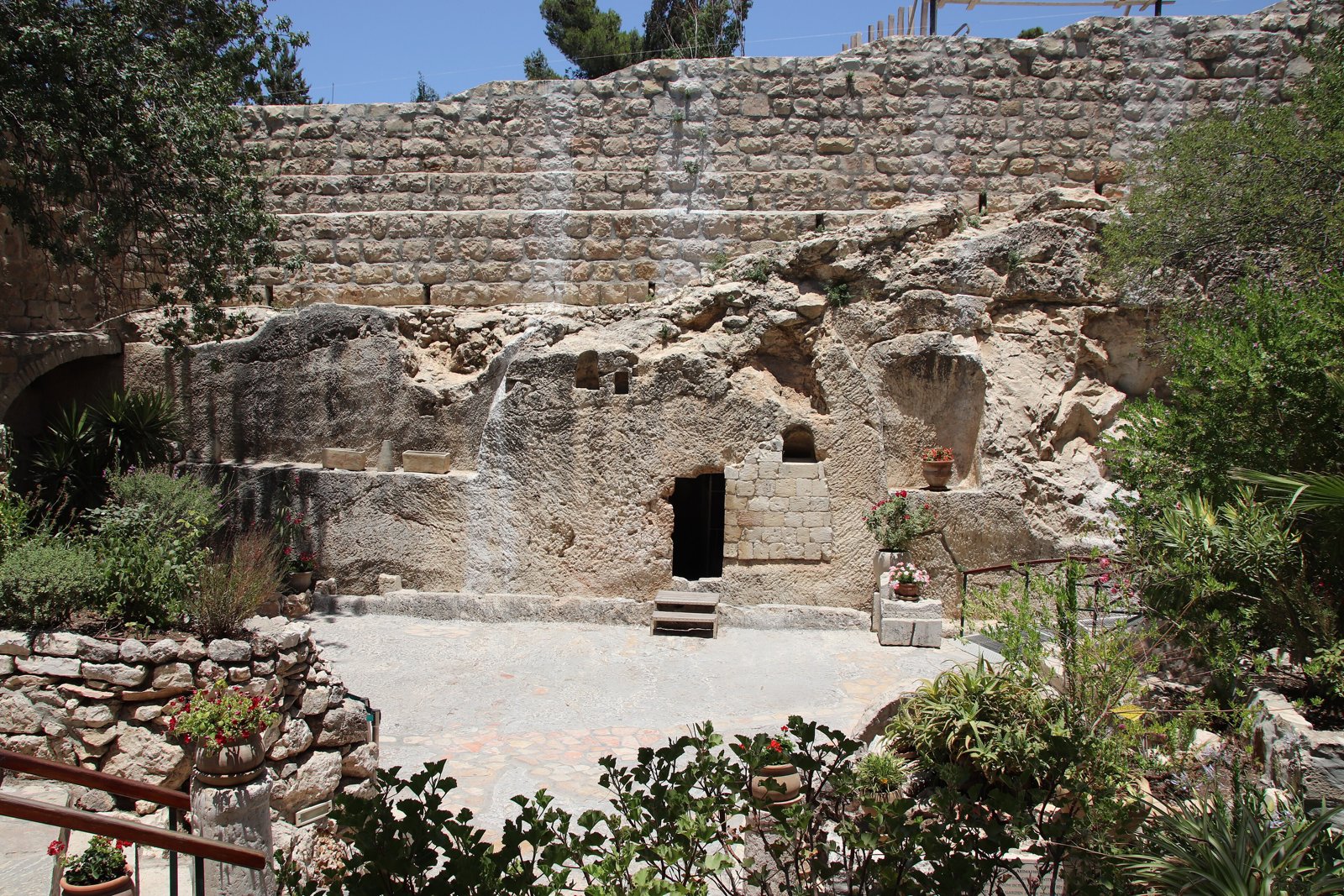
DisputedThe entrance to the rock-cut Garden Tomb. Gary Todd, via Wikimedia Commons, CC0.
Now in the place where he was crucified there was a garden; and in the garden a new sepulchre, wherein was never man yet laid.
John 19:41, KJV
About 200 metres north of the Damascus Gate of Jerusalem's Old City is a quiet garden with an old tomb cut into the rock, close to a cliff that looks like a skull. In 1842 the German scholar Otto Thenius suggested that this cliff, now called Skull Hill, was Golgotha, "the place of a skull" (John 19:17), and the tomb was uncovered around 1867. General Charles Gordon backed the idea after he came to Jerusalem in 1883, so the hill became known as "Gordon's Calvary". A British Christian charity, the Garden Tomb (Jerusalem) Association, bought the land in 1894. Hundreds of thousands of visitors come each year, many of them Protestants, because the peaceful garden helps them picture the Gospel story and gives them a place to pray and worship.
Where it is today
The Garden Tomb, East Jerusalem, a short walk north of the Damascus Gate. It is run by the Garden Tomb (Jerusalem) Association and is open to visitors; check opening hours before planning a visit.
Date
The tomb was cut in the late Iron Age, about the 700s or 600s BC, according to the archaeologist Gabriel Barkay. It was used again for burials in Byzantine (Christian Roman) times, about AD 400 to 700. It has been linked with Jesus only since the late 1800s.
Why this label: Many sincere Christians love this place, but the case that it is the tomb of Jesus is weak. Archaeologists date the tomb to centuries before Jesus, so it could not be the new tomb the Gospels describe, and the link to Jesus began only in the 1800s.
Good to know
The dating: In 1986 the Israeli archaeologist Gabriel Barkay showed that the tomb's plan, with stone benches along the walls of its rooms, matches other Jerusalem tombs from the 700s and 600s BC, and that it was reused for Christian burials in Byzantine times. He also found that the groove in front of the door was a water channel from the Crusader period (the 1100s), not a track for a rolling stone.
Changed mind: Jeffrey Chadwick of Brigham Young University first wrote in defence of the tomb, but after his own study of Jerusalem tombs he agreed with Barkay on every point. The Italian archaeologist Riccardo Lufrani dates the tomb later, to the 300s to 100s BC, which would still be far too early for a new tomb in Jesus' day.
Skull Hill: Chadwick still thinks the skull-shaped cliff itself may well be Golgotha. In Jesus' day it stood outside the city wall, beside 2 main roads near a city gate, where many people would see a crucifixion. He thinks Jesus' tomb was somewhere nearby, but not this one.
The keepers: The Garden Tomb Association does not insist that this is the tomb of Jesus. It points to an old winepress as a sign that the area was once a garden, and it says that what matters is not the place but the Person of Jesus Christ, and many visitors find it a helpful place to picture the Gospel story and to pray.
The East Talpiot tomb (the claimed "Jesus family tomb")
Matthew 13:55 · Mark 6:3 · Luke 24:2-3
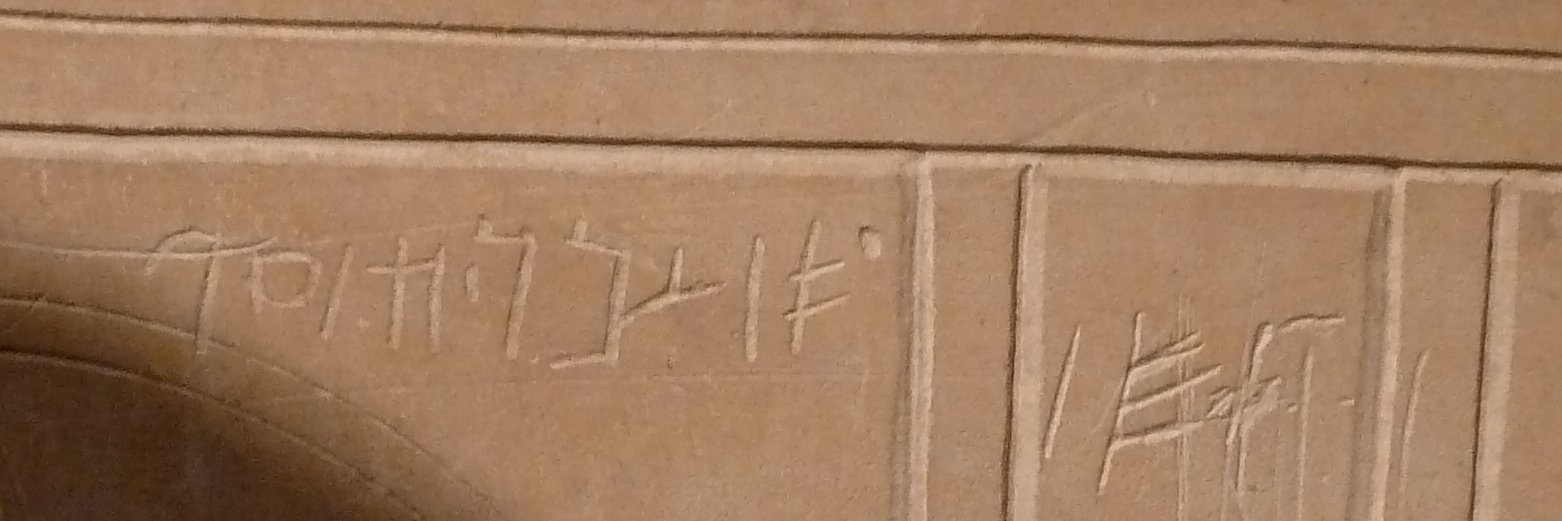
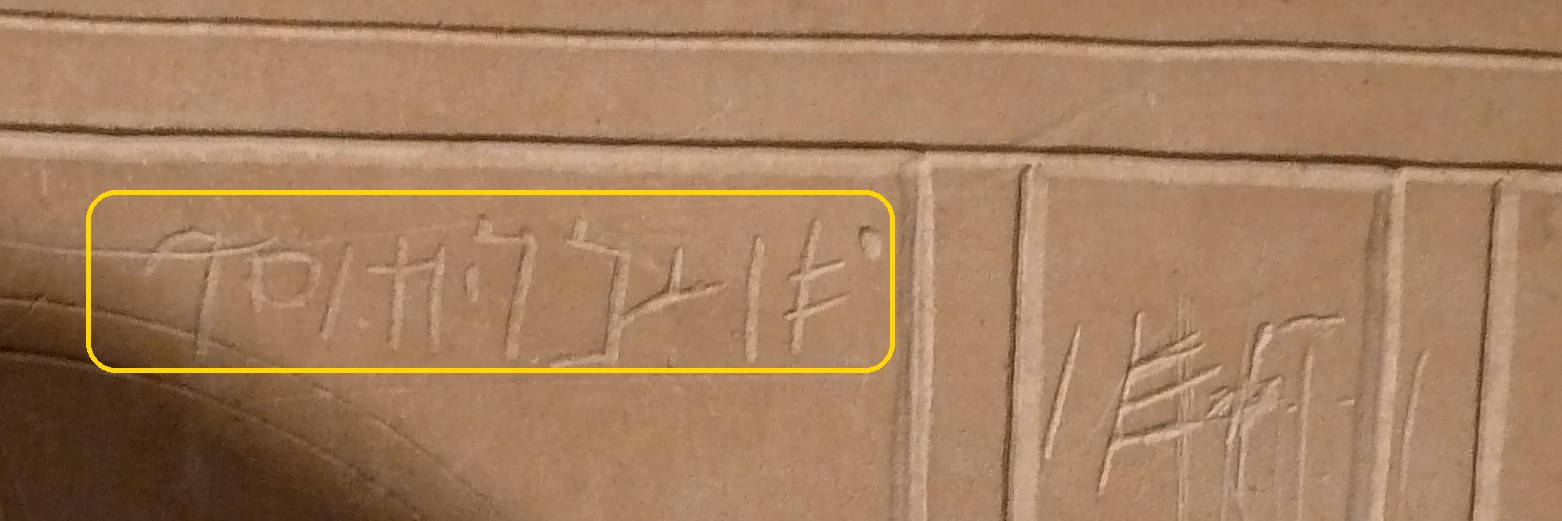
DisputedThe writing "Yeshua son of Yehosef" on the East Talpiot ossuary. Deror avi, via Wikimedia Commons, CC BY-SA 3.0.
Is not this the carpenter's son? is not his mother called Mary? and his brethren, James, and Joses, and Simon, and Judas?
Matthew 13:55, KJV
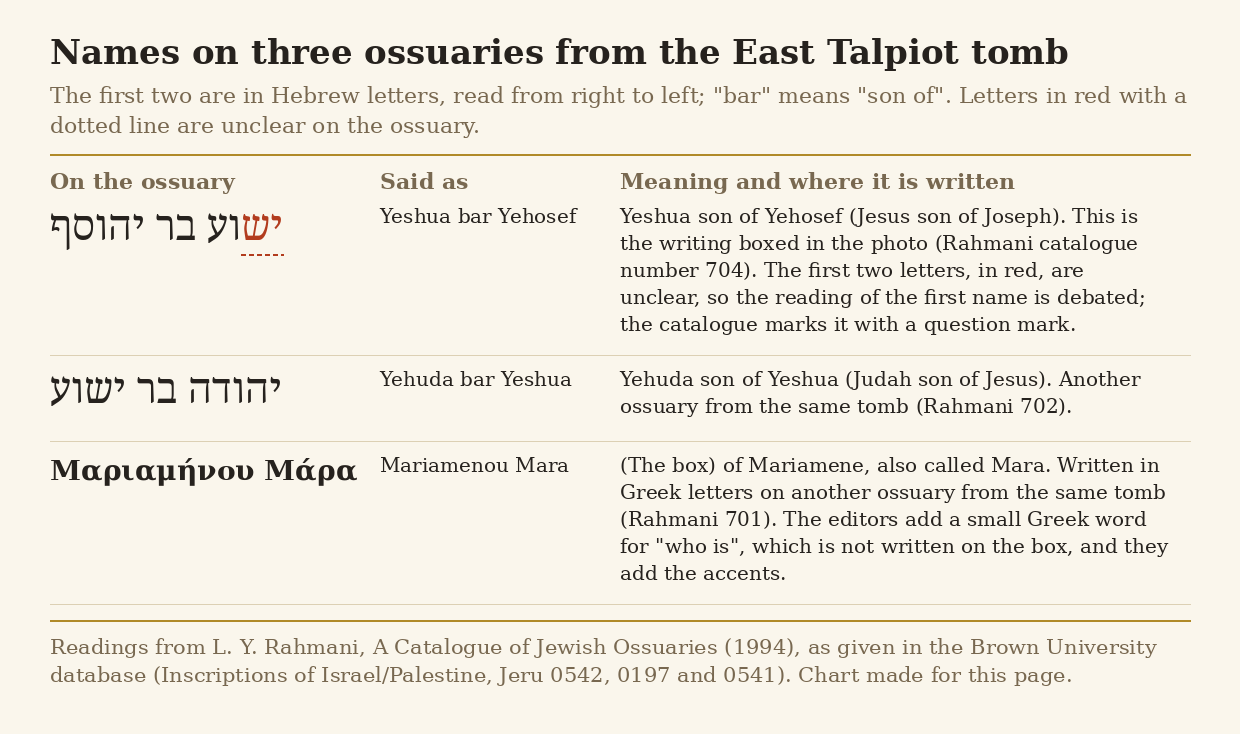
On March 28, 1980, builders in East Talpiot, a neighbourhood about 5 kilometres south of Jerusalem's Old City, broke into a Jewish family tomb cut in the rock. Archaeologists found 10 ossuaries (stone boxes for bones), and 6 had names scratched on them: Yeshua son of Yehosef, Yehuda son of Yeshua, Marya, Mariamene Mara (written in Greek and usually read as Mariamene, also called Mara), Yose and Matya. In 2007 a documentary, The Lost Tomb of Jesus, made by Simcha Jacobovici and James Cameron, claimed that this was the family tomb of Jesus of Nazareth, with His mother Mary, His brother Joses (Mark 6:3), Mary Magdalene and even a son. The claim implied that His body stayed in a tomb, against the Gospel record of the empty tomb (Luke 24:2-3). The photo and chart below show the writing "Yeshua son of Yehosef" on one of the ossuaries, with its unclear first letters marked.
Photo of the writing on the East Talpiot ossuary that reads Yeshua son of Yehosef, in the Israel Museum. The yellow box was added for this page. Hebrew reads from right to left. The name Yehosef (Joseph) on the left is clear. The first two letters of Yeshua, at the right end of the box, are unclear, which is why the reading of that name is debated. The scratches in the panel to the right are not boxed. Deror avi, via Wikimedia Commons, CC BY-SA 3.0.Names on three ossuaries from the East Talpiot tomb, with how they sound and what they mean. The unclear letters are marked in red. Chart made for this page, free to reuse.
Where it is today
The tomb is sealed under a concrete slab in the courtyard of an apartment building in East Talpiot, Jerusalem, and is not open to the public. The ossuaries belong to the state collections of Israel (catalogue numbers 701 to 709 in L. Y. Rahmani's 1994 catalogue). Photos used on English Wikipedia show the Yeshua and Yehuda ossuaries at the Israel Museum, but whether they are on display changes, so check before planning a visit.
Date
Ossuaries like these were used in Jerusalem from about 20 BC to AD 70, with a few later. The tomb was found in 1980, the excavation report was published in 1996, and the documentary came out in 2007.
Why this label: The tomb and its ossuaries are real, but the claim that it belonged to the family of Jesus rests on common names and on guesses. Nearly all archaeologists reject it, including Amos Kloner, who wrote the excavation report.
Good to know
Common names: The names in this tomb were among the most common Jewish names of the time. In Tal Ilan's list of ancient Jewish names, about 1 woman in 3 was called Mary and about 1 man in 20 was called Yeshua. Amos Kloner said that the name Yeshua son of Yehosef has turned up on several other ossuaries, and that Jesus' family came from Galilee and had no family tomb in Jerusalem.
The statistics: The film's statistician, Andrey Feuerverger of the University of Toronto, said there was only a 1 in 600 chance that another family had this group of names. But he said himself that by far the most important guess behind that figure was that Mariamene meant Mary Magdalene, and most scholars do not accept that guess. Stephen Pfann, a scholar of old handwriting, reads the Greek as "Mariame and Mara", two separate women. If he is right, the rare name Mariamene is not on the box at all.
Supporters: A few scholars, such as James Tabor, still argue that the tomb may belong to the family of Jesus and deserves more study. In 2013 Feuerverger wrote that a link to the family in the New Testament is at least a possibility that should be taken seriously.
Archaeologist view: Jodi Magness points out that people from outside Jerusalem were usually named with their home town on ossuaries, and none of these names has one. She adds that if the family of Jesus could have paid for a rock-cut tomb, it would have been in Nazareth, not Jerusalem.
The name itself: The Yeshua writing is clumsy and badly scratched, and its first two letters are unclear, so the catalogue puts a question mark after the name. The Yehuda son of Yeshua box from the same tomb supports the reading Yeshua, but the reading is still debated.
The Nazareth Inscription (an order against robbing tombs)
Matthew 27:62-66 · Matthew 28:11-15
BackgroundThe Nazareth Inscription on display in the Cabinet des Médailles, Paris. Poulpy, via Wikimedia Commons, CC BY-SA 3.0.
Saying, Say ye, His disciples came by night, and stole him away while we slept.
Matthew 28:13, KJV
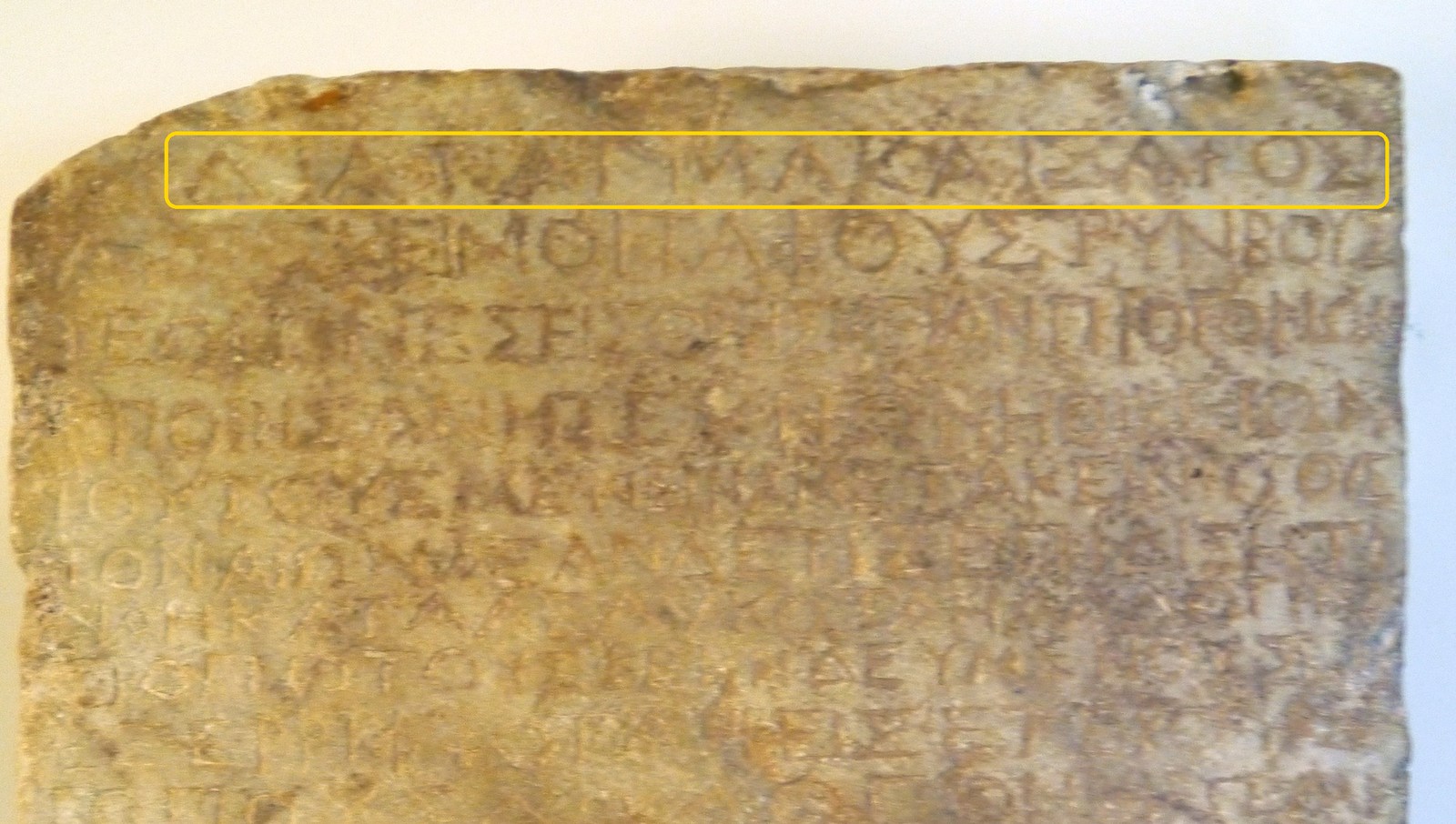
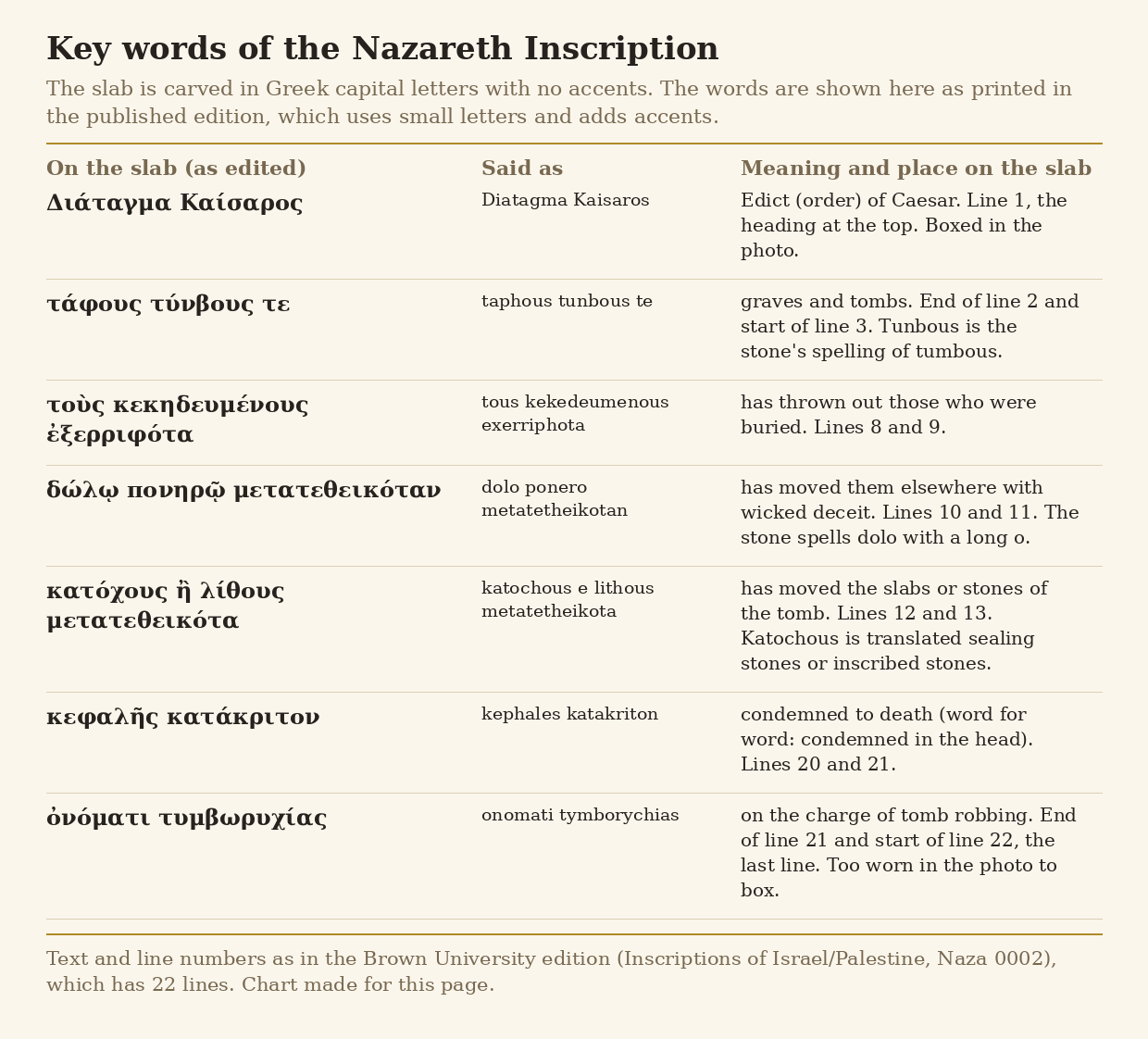
A marble slab carved with a Greek order from an unnamed Caesar. It says graves and tombs must stay undisturbed forever, and that anyone who throws out the buried dead, moves them to another place with wicked intent, or moves the stones of a tomb is to be put to death for tomb robbing. Because the collector who bought it noted that it was sent from Nazareth, some writers linked it to the empty tomb of Jesus and to the story in Matthew 28 that the disciples stole His body. The slab itself does not name Jesus, Nazareth or any Bible event. The photo and chart below show the heading "Edict of Caesar" carved on the slab and the key words of the order.
Photo of the upper part of the Nazareth Inscription, the marble slab in the Cabinet des Médailles, Paris. The yellow box, added for this page, marks the heading in line 1: ΔΙΑΤΑΓΜΑ ΚΑΙΣΑΡΟΣ, "Edict of Caesar". The words for tomb robbing are on the last two lines, at the bottom of the slab, which is too worn in this photo to mark them. Poulpy, via Wikimedia Commons, CC BY-SA 3.0.Key words of the Nazareth Inscription, with how they sound and what they mean, in the form printed in the published edition. Chart made for this page, free to reuse.
Where it is today
Paris, France: Bibliothèque nationale de France, Département des Monnaies, médailles et antiques (the Cabinet des Médailles), from the collection of Wilhelm Froehner. Some news reports and the opening lines of the English Wikipedia article say the Louvre, but the 2020 study was done on the slab at the Bibliothèque nationale. The slab is about 60 cm tall and 37.5 cm wide, with 22 lines of Greek.
Date
By the style of its letters and its wording, from the late first century BC to the first century AD (the Brown University edition gives 27 BC to AD 100). If the 2020 Kos theory is right, it was issued by Augustus in the years after 31 BC. Bought by Froehner in Paris in 1878; first published in 1930.
Why this label: The slab is a real Roman order that shows how seriously Roman rulers treated tomb robbing. It names no Bible person or event, and since a 2020 study found that its marble most likely came from the Greek island of Kos, the old idea that it was a reaction to the empty tomb looks unlikely.
Good to know
Old view: Franz Cumont, who first published it in 1930, thought it might belong to the efforts of Augustus to restore religion and order, but he also allowed that it might reflect the dispute over Christian claims that Jesus rose from the tomb. Some later writers took it as the emperor's answer to the empty tomb, perhaps under Claudius (AD 41 to 54).
The Kos study: In 2020 Kyle Harper and others tested tiny samples from the back of the slab. The marble matches the upper quarry on the Greek island of Kos, and they suggest Augustus issued the order after the people of Kos broke into the tomb of their former ruler Nikias and dragged out his body.
Still open: The authors say they cannot fully rule out other marbles not yet tested, and they note that Herod's family had close ties with Kos, so marble from Kos could have been shipped to Galilee. The collector's note says only that the slab was sent from Nazareth, not that it was found there, and Nazareth was a trading town for antiquities in the 1870s. One scientist quoted in the news, Robert Tykot, raised the idea of a modern fake, but the published editions treat it as ancient.
What it does show: Whatever its origin, the slab shows that robbing or emptying a tomb was a crime that could bring the death penalty. This helps explain why the charge in the guards' story in Matthew 28, that the disciples stole the body, was a serious one.
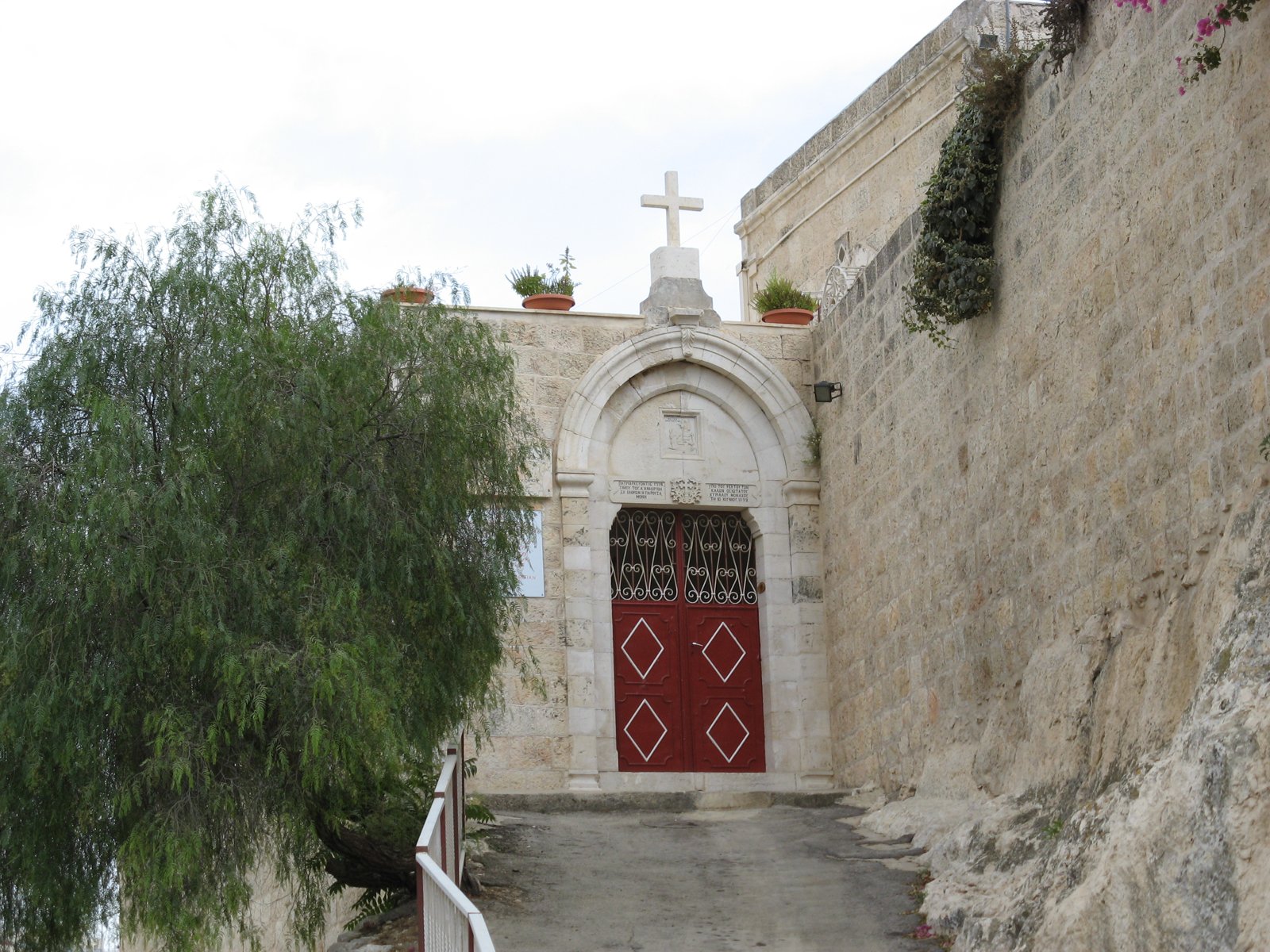
Traditional siteThe entrance of the Greek Orthodox monastery of St Onuphrius, on the traditional site of Akeldama in the Hinnom Valley, Jerusalem. The rock-cut tombs are not shown. Avi Nahmias, via Wikimedia Commons, Attribution.
And it was known unto all the dwellers at Jerusalem; insomuch as that field is called in their proper tongue, Aceldama, that is to say, The field of blood.
Acts 1:19, KJV
Matthew says the chief priests used the thirty pieces of silver that Judas threw back to buy the potter's field as a place to bury strangers, and that it was called the field of blood. Acts says the people of Jerusalem called the field Aceldama, Aramaic for field of blood. Tradition places it on the south side of the Hinnom Valley, south of old Jerusalem, where the Greek Orthodox monastery of St Onuphrius now stands among many rock-cut tombs. Matthew 27:9-10 links the purchase to the words of the prophet (compare Zechariah 11:12-13).
Where it is today
Jerusalem, on the southern slope of the Hinnom Valley, near where it meets the Kidron Valley. The monastery of St Onuphrius (built in 1892) stands on the site, and the ruins of a large Crusader charnel house (a building for the bones of the dead) are close by. The three family tombs dug in 1989 are nearby in the lower valley. Opening times vary, so check before planning a visit.
Date
Tombs: from the time of the second temple, in use until AD 70, and reused in Roman and Byzantine (Christian Roman) times. Tradition: recorded by the early 300s (Eusebius). Charnel house: 1100s. Monastery: 1892.
Why this label: The field has been pointed out in this part of the Hinnom Valley since at least Eusebius in the early 300s, and the spot has stayed the same since. No inscription or find shows that this is the field the priests bought.
Good to know
The tradition: Eusebius, writing in the early 300s, places the field near Tophet in the valley of Hinnom; in one entry he wrote north of Mount Sion, and Jerome, translating his work about AD 390, corrected it to south of Mount Sion. A pilgrim from Piacenza (about AD 570) and the pilgrim Arculf (about AD 670) describe it as a burial ground for pilgrims, and the Crusaders built a charnel house there in the 1100s that was used for burials until the early 1800s.
The digs: In 1989 road work exposed three rich Jewish family tombs that had not been robbed. Gideon Avni and Zvi Greenhut of the Israel Antiquities Authority studied them and found pottery, glass, jewellery and 39 complete ossuaries (stone bone boxes), many decorated and some with names in Hebrew and Greek; one family seems to have come from Apamea in Syria. These tombs show that the area was a large burial ground in the time of Jesus, but they are ordinary family tombs and do not name the field of blood.
Two accounts: Matthew says the priests bought the field, while Acts says Judas "purchased a field with the reward of iniquity" (Acts 1:18). Many readers take this to mean the field was bought with his money; both books agree on the name.
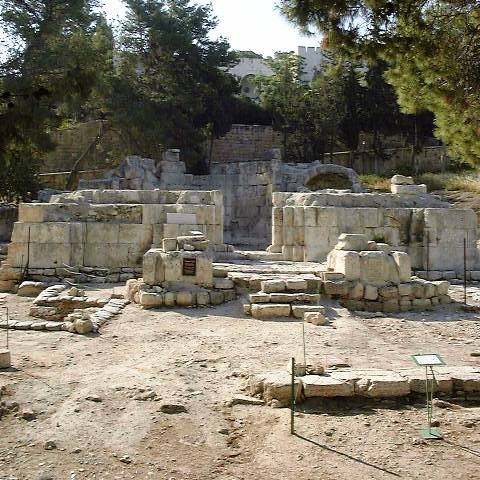
DisputedChurch ruins at Emmaus Nicopolis, near Latrun. Wikimedia Commons user Emmaus, CC BY-SA 3.0.
And, behold, two of them went that same day to a village called Emmaus, which was from Jerusalem about threescore furlongs.
Luke 24:13, KJV
Luke says that on the day Jesus rose, two disciples, one named Cleopas, walked from Jerusalem to a village called Emmaus. Jesus walked with them, and they knew Him when He broke bread. Luke gives the distance as threescore (60) furlongs, about 11 to 12 km. Several places have been put forward as Emmaus, and none has an inscription or find that settles the question.
Where it is today
The main candidates are all west or northwest of Jerusalem. Emmaus Nicopolis (Imwas), near Latrun, is about 30 km away and has ruins of a Byzantine (Christian Roman) church with a smaller Crusader church of the 1100s inside, in Canada Park. Abu Ghosh, about 11 to 15 km away depending on the count, has a Crusader church. El-Qubeibeh, about 11 to 12 km northwest, has a Franciscan church built in 1902. Motza (ancient Colonia), about 6 to 8.5 km west, has a first-century village site but no church. Access to El-Qubeibeh can be limited, so check before planning a visit.
Date
The event: the first Easter Sunday (about AD 30 or 33, depending on the dating of Jesus' ministry). Nicopolis church: Byzantine, with a Crusader church of the 1100s built inside it. Abu Ghosh church: about 1140. El-Qubeibeh: a tradition from 1280, church of 1902. Motza: first-century Jewish village.
Why this label: Scholars still disagree about which place Luke meant, and the copies of Luke disagree on the distance. Each candidate is a real ancient site, but none has a find that names it as Luke's Emmaus.
Good to know
The manuscript difference: Most Greek copies of Luke, including the earliest, say 60 stadia (furlongs), about 11 km. Some copies, including Codex Sinaiticus, a handwritten Bible from the 300s, say 160 stadia, about 30 km, which fits Nicopolis. Many scholars think a copyist changed 60 to 160 to match Nicopolis, which Christians of the 300s already took to be Emmaus; those who favour 160 reply that copyists were more likely to change a hard reading into an easy one, so the harder number, 160, is more likely to be the original. Luke 24:33 says the two went back to Jerusalem the same hour, which is hard after a walk of 30 km, though some argue a fit walker could do it.
Nicopolis: Eusebius and Jerome name it as Emmaus, and Jerome speaks of a church there on the site of the house of Cleopas, so it has the oldest tradition.
Abu Ghosh and El-Qubeibeh: The Crusaders took Abu Ghosh to be Emmaus in the 1100s, and El-Qubeibeh was first proposed in about 1280. Neither place is known to have been called Emmaus in the first century.
Motza: The historian Josephus says the emperor Vespasian settled 800 old soldiers at a place called Emmaus near Jerusalem (copies of Josephus give 30 or 60 stadia). Carsten Peter Thiede dug there from 2001 and found a first-century Jewish village, and several scholars now favour it, but it has no early Christian tradition and the distance is shorter than Luke gives unless Luke meant the trip there and back.
The James ossuary (James son of Joseph, brother of Jesus)
Galatians 1:19 · Matthew 13:55 · Mark 6:3
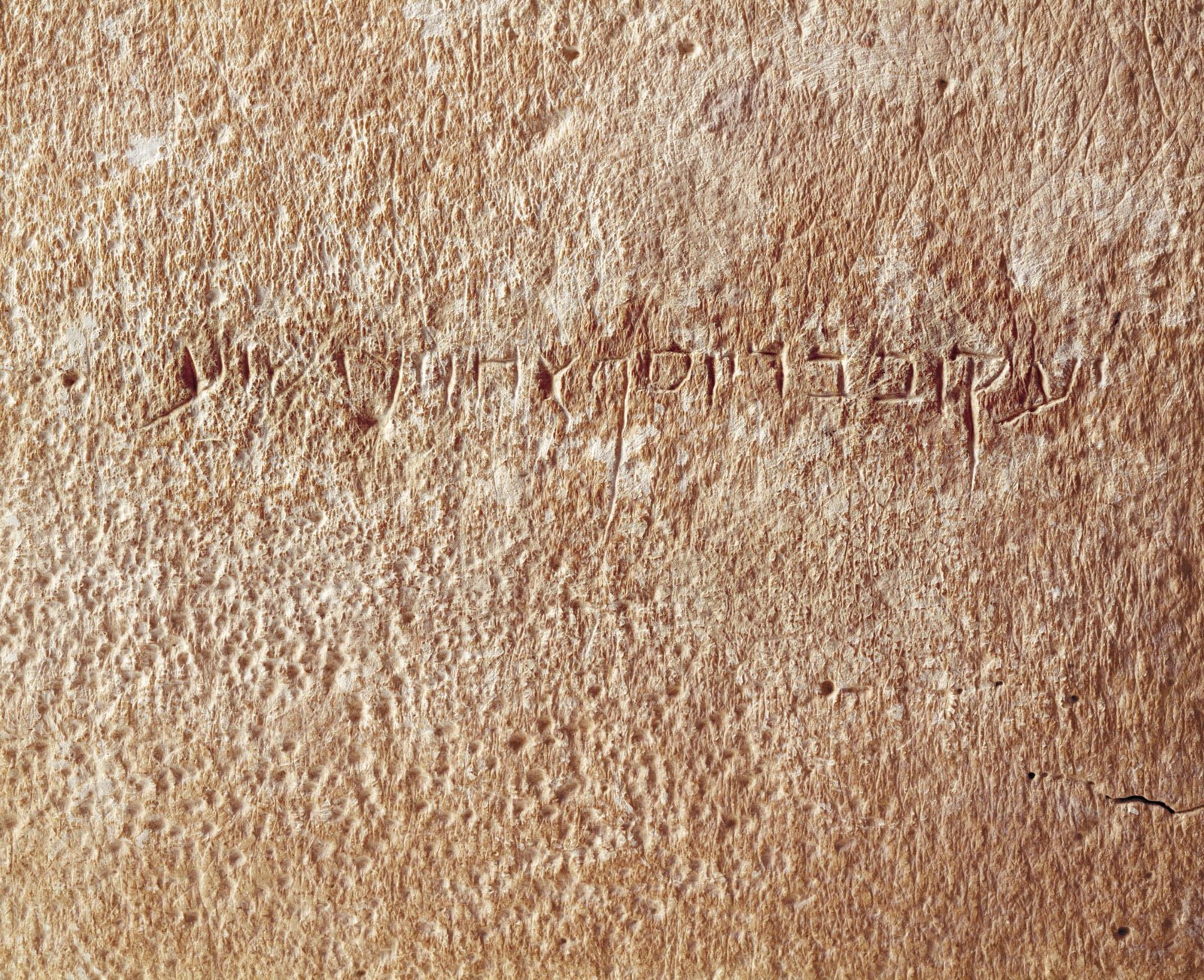
DisputedClose-up of the Aramaic inscription on the James ossuary. Paradiso, via Wikimedia Commons, Attribution.
But other of the apostles saw I none, save James the Lord's brother.
Galatians 1:19, KJV
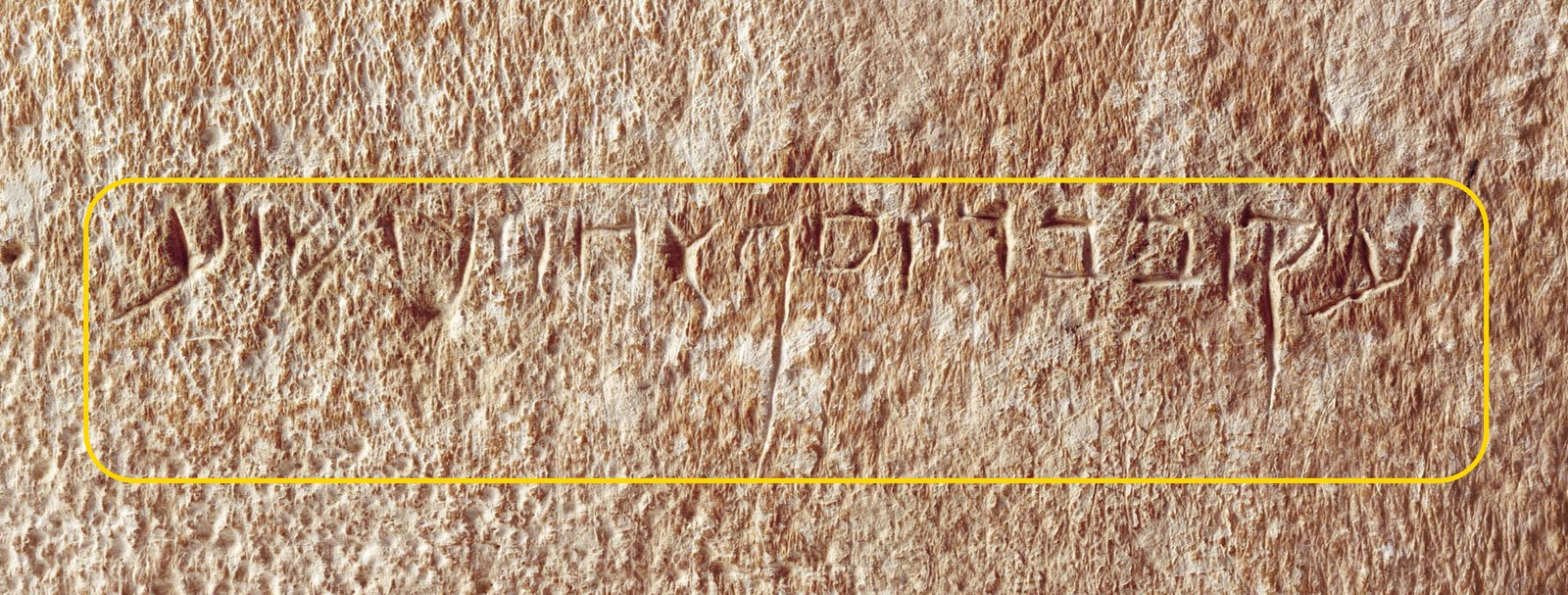
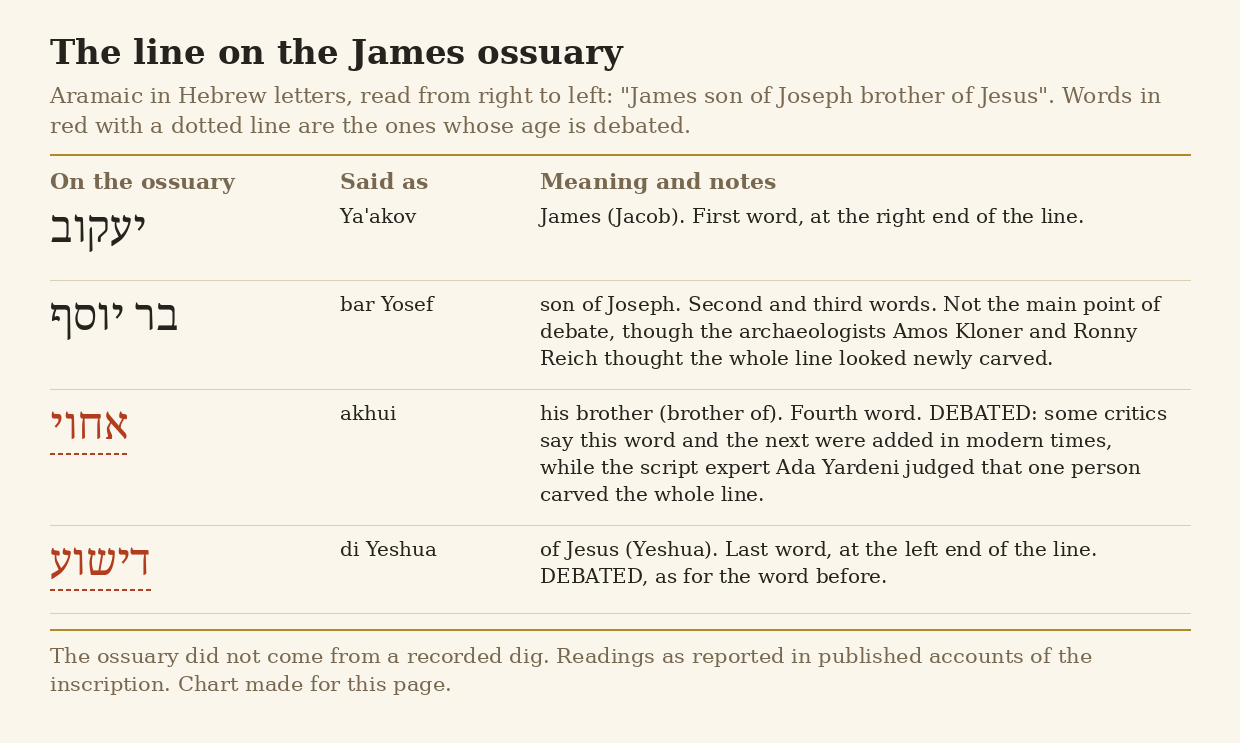
A limestone bone box (ossuary) of the kind Jewish families around Jerusalem used in the time of Jesus. On one long side is a short Aramaic line that reads James son of Joseph brother of Jesus. Paul calls James the Lord's brother, Matthew 13:55 names James among the brothers of Jesus, and James later led the church in Jerusalem (Acts 15:13, Acts 21:18). If the whole line is genuine and refers to that James, it would be the oldest known object to name Jesus; but the box did not come from a recorded dig, so no one knows which tomb it came from. The photos and chart below show the line as it is carved, with the debated words "brother of Jesus" marked.
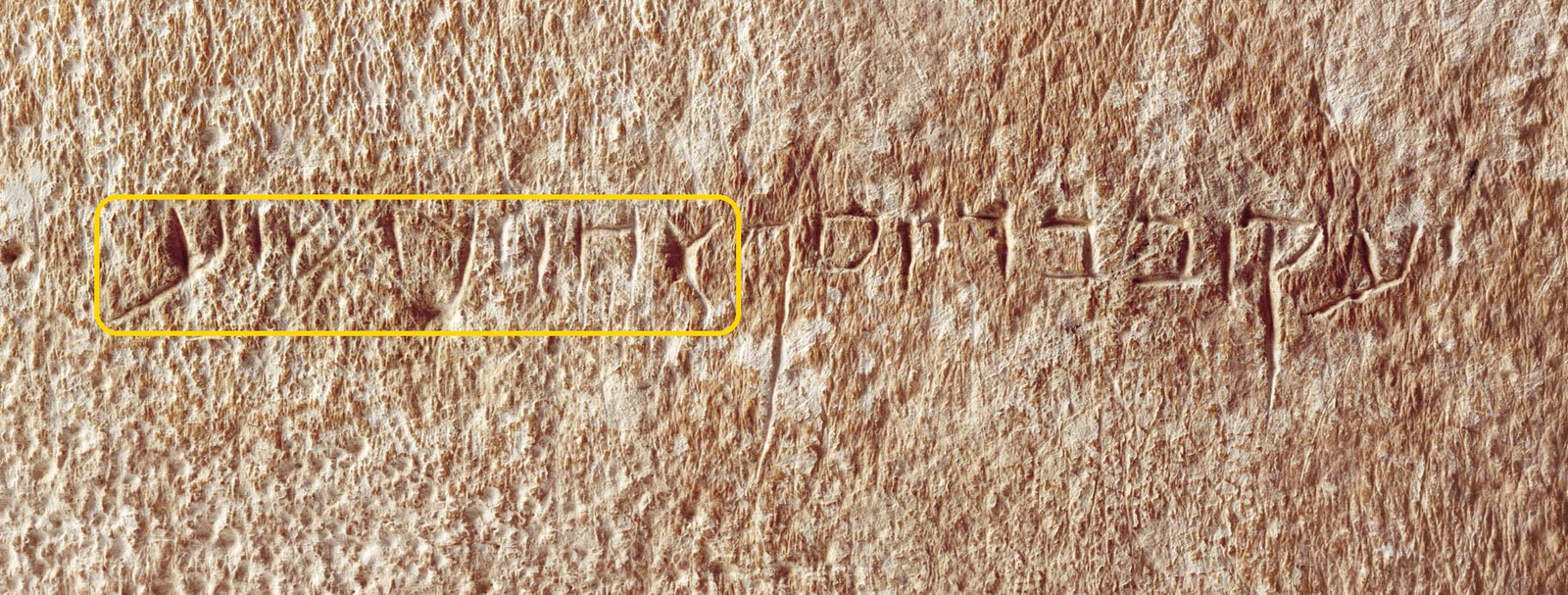
Close-up photo of the Aramaic line on the James ossuary. The yellow box, added for this page, marks the whole line: James son of Joseph brother of Jesus. Hebrew letters read from right to left, so James is at the right end. Paradiso, via Wikimedia Commons, Attribution.The same photo. Here the yellow box, added for this page, marks only the last two words, אחוי דישוע, "brother of Jesus", at the left end of the line. These are the words some critics say were added in modern times, while others judge that one person carved the whole line. Paradiso, via Wikimedia Commons, Attribution.The words on the James ossuary, with how they sound and what they mean. The debated words are marked in red. Chart made for this page, free to reuse.
Where it is today
Israel: in the private collection of Oded Golan, to whom it was returned after the trial. It was shown at the Royal Ontario Museum in Toronto in late 2002. It measures about 50.5 by 25 by 30.5 cm.
Date
The box: first century AD by its style. The inscription: debated, either first century or modern. Made public on 21 October 2002.
Why this label: Experts still disagree on whether the inscription, or only the words brother of Jesus, was carved in modern times. A court found that forgery was not proven, but the judge said this does not show the inscription is genuine.
Good to know
The case for: The Sorbonne scholar André Lemaire, who first published it, and Ada Yardeni of the Hebrew University judged the letters to fit the first century, and at the trial Yardeni said that one person carved the whole line. Later tests by Amnon Rosenfeld, Howard Feldman and Wolfgang Krumbein reported old crust (patina) inside the letters.
The case against: In June 2003 the Israel Antiquities Authority said the inscription was a modern fake, and a 2004 study by Avner Ayalon, Miryam Bar-Matthews and Yuval Goren reported isotope results (a test of the chemical make-up of the crust) which, they said, did not fit a natural ancient coating in the letters. The archaeologists Amos Kloner and Ronny Reich wrote that the letters look newly carved and lack the patina found on the rest of the box.
The trial: Oded Golan was charged in December 2004. On 14 March 2012 Judge Aharon Farkash cleared him of forgery because it was not proven beyond reasonable doubt, but he said this does not mean the inscription is authentic or was written 2,000 years ago.
The names: James, Joseph and Jesus were all common names then, so a genuine box could still belong to another family, although one statistical estimate (Camil Fuchs) found that very few men in Jerusalem at that time would fit all three names.
The Talpiot idea: A 2007 film claimed the box came from the Talpiot tomb in Jerusalem, but Amos Kloner, who recorded that tomb in 1980, said the ossuary he listed there was plain.
 LearnAboutHim