Evidence You Can See: The Gospels, from Bethlehem to Galilee
Real places you can visit and real objects you can see in museums, connected to the birth of Jesus, the rulers of His time and His work around the Sea of Galilee, as told in Matthew, Mark, Luke and John. Each one is marked honestly, so you can tell solid evidence from tradition and from claims that are still argued over.
ConfirmedThe place or object is real and is clearly the one the Bible names. For a written object, such as an inscription or a scroll, it means the object is genuine and its words are read with confidence, not that every event it mentions is proven.5
Traditional siteA real place that long tradition links to the Bible, but the exact spot cannot be proven.4
DisputedInformed people disagree, or the claim rests on weak evidence.5
BackgroundShows the world the Bible describes, but does not name a Bible person or event.6
The Birth and Childhood of Jesus
1
Bethlehem and the cave under the Church of the Nativity
Matthew 2:1 · Luke 2:4-7 · Matthew 2:11
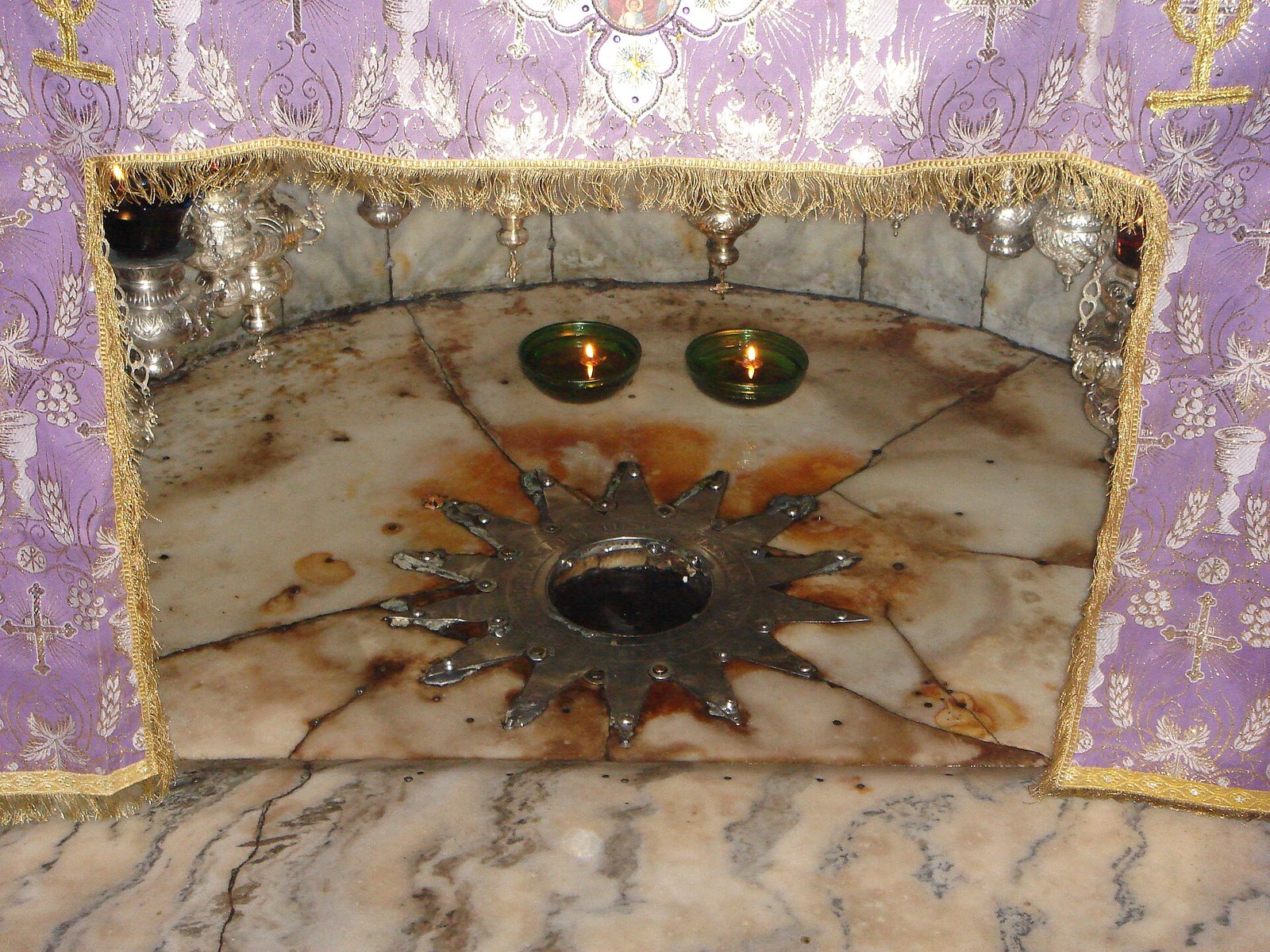
Traditional siteThe silver star in the Grotto of the Nativity, under the Church of the Nativity, marking the traditional spot of Jesus' birth. Mark87, via Wikimedia Commons, Public domain.
And she brought forth her firstborn son, and wrapped him in swaddling clothes, and laid him in a manger; because there was no room for them in the inn.
Luke 2:7, KJV
The Church of the Nativity in Bethlehem is built over a cave that Christians have pointed to as the place where Jesus was born. The tradition is old. Justin Martyr wrote about AD 150 that Jesus was born in a cave near the village, and Origen wrote about AD 248 that the cave and the manger were still being shown to visitors. Emperor Constantine built the first church over the cave in the AD 330s, and the church that stands today is mostly the rebuilding begun under Emperor Justinian in the 6th century.
Where it is today
Manger Square, Bethlehem, about 8.5 km south of Jerusalem. The cave (the Grotto of the Nativity) is under the main altar. Listed by UNESCO as a World Heritage Site in 2012 (Birthplace of Jesus: Church of the Nativity and the Pilgrimage Route, Bethlehem). Access can be limited, so check before planning a visit.
Date
Cave tradition recorded by about AD 150; first church begun about AD 326 and dedicated in AD 339; present church rebuilt in the 6th century (wood in its walls has been dated to between AD 545 and 665).
Why this label: Bethlehem itself is confirmed as the town the Bible names, but no inscription or find shows that this exact cave is the birthplace. The cave tradition is old (written down about 150 years after the birth), which makes it worth taking seriously, but it is still tradition.
Good to know
Early writers: Jerome, who lived in Bethlehem, wrote about AD 395 that the cave had been covered by a grove for the pagan god Adonis (Tammuz) before Constantine. He mentions this in the same passage as the pagan shrines set up in Jerusalem from the time of Emperor Hadrian, so many link the Bethlehem grove to Hadrian too, though Jerome does not say plainly who planted it. Those who accept the cave argue that if the grove goes back to Hadrian (about AD 135), the cave was already a Christian holy place by then, and the grove was planted to wipe out its memory.
Doubting view: Some scholars, such as Joan Taylor, read the same facts the other way. They think the cave may have been a shrine of Adonis first and only later claimed by Christians, and that Justin may have pictured a cave because caves were used as stables in that land, not because a cave was being shown.
The digs: Digs in 1932, 1934 and 1949 uncovered the plan and floor mosaics of Constantine's church under the present one. Its east end stood right over the cave, and many scholars think it had a round opening through which visitors could look down into the cave, though some doubt this. A restoration that began in 2013 studied the building again.
Keep in mind: The Gospels do not mention a cave. Luke speaks of a manger, and Matthew 2:11 says the wise men came into "the house." A cave used for animals would fit Luke's manger, but the Bible does not say there was a cave.
And he came and dwelt in a city called Nazareth: that it might be fulfilled which was spoken by the prophets, He shall be called a Nazarene.
Matthew 2:23, KJV
The Gospels say Jesus grew up in Nazareth, a town in Galilee. Digs show a small Jewish village there in the first century. In 2009 Yardenna Alexandre of the Israel Antiquities Authority uncovered a small house next to the Church of the Annunciation, with two rooms, a courtyard, a rock-cut water cistern, pottery of the first and second centuries AD, and pieces of stone (chalk) vessels that Jews used for ritual purity. At the Sisters of Nazareth convent nearby, Ken Dark of the University of Reading restudied the old digs and concluded that a partly rock-cut building there was a first-century house, perhaps a courtyard house.
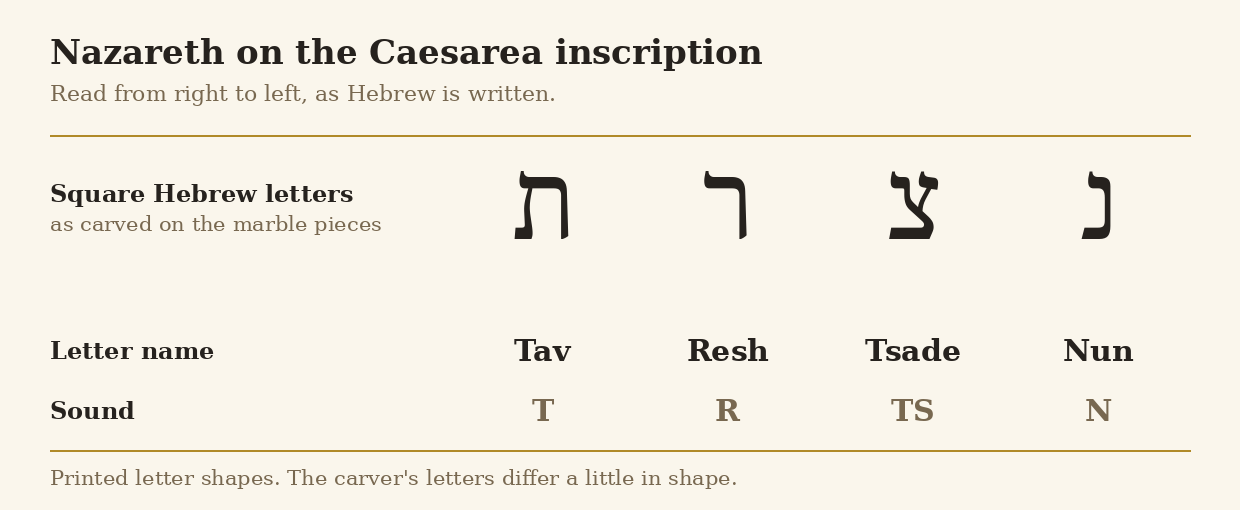
The name Nazareth as written on the Caesarea inscription, letter by letter. Chart made for this page, free to reuse.
Where it is today
Nazareth, Lower Galilee, Israel. The 2009 house is beside the Basilica of the Annunciation (at the International Marian Center site). The Sisters of Nazareth convent, with its first-century house and later tombs, is a short walk away. The pieces of the Caesarea inscription were found at Caesarea, on the coast. Where they are shown today could not be confirmed.
Date
Houses: first century AD (Early Roman period). Caesarea inscription: about AD 200 to 500 (usually dated to the 3rd or 4th century).
Why this label: Nazareth has kept its name and place, and digs show it was a small Jewish village in the first century, so it is clearly the town the Gospels name. No find links any house to Jesus or His family.
Good to know
The inscription: Small grey marble pieces of a Hebrew inscription, found at Caesarea (mostly in the 1962 dig), list the 24 groups of priests (the "courses" of 1 Chronicles 24) and the Galilee towns where they settled after Jerusalem fell. The 18th course, Happizzez (called Aphses in the KJV, 1 Chronicles 24:15), is listed at Nazareth. It is the oldest known inscription naming Nazareth, written about two or more centuries after Jesus. Luke 1:5 also mentions one of these priestly courses, the course of Abia.
Doubting view: Some writers, such as René Salm, have argued that Nazareth did not exist in Jesus' day, since it is not named in the Old Testament, in Josephus, or in Jewish writings before about the 3rd century. The silence is real, but it fits a small farming village (one estimate is no more than about 480 people).
The answer: Archaeologists point to the first-century houses, tombs, pottery and stone vessels. Ken Dark, who led the Nazareth Archaeological Project, says the remains do not support the no-Nazareth view.
Keep in mind: Dark himself says it is impossible to tell whether the convent house was Jesus' childhood home, even though some news stories said otherwise.
Herod the Great, the Herodium and the tomb found in 2007
Matthew 2:1 · Matthew 2:16 · Matthew 2:19
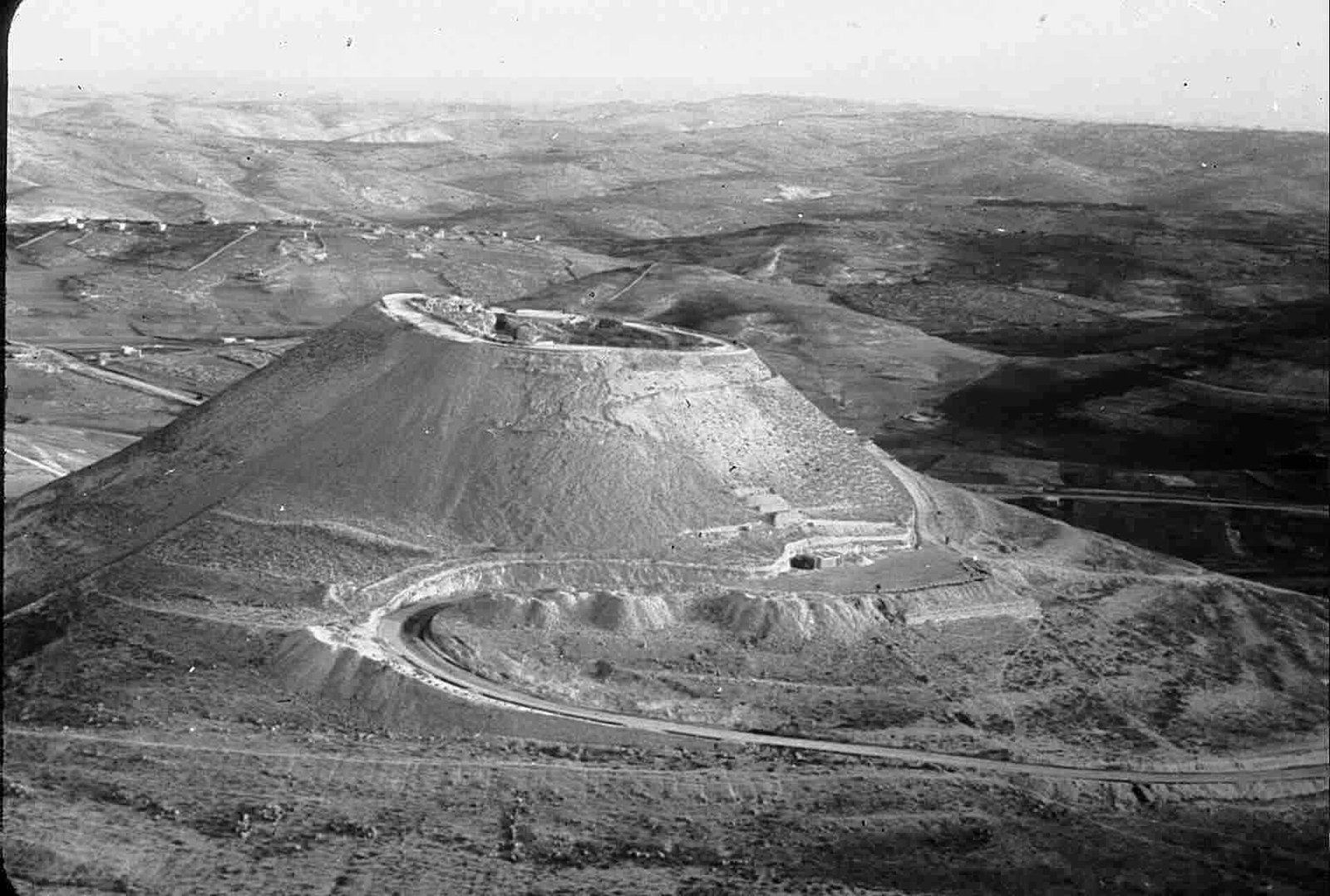
DisputedThe Herodium, Herod's hill palace and fortress, seen from the air in an older photo. Ronnie Kenigsberg, PikiWiki Israel, via Wikimedia Commons, CC BY 2.5.
But when Herod was dead, behold, an angel of the Lord appeareth in a dream to Joseph in Egypt,
Matthew 2:19, KJV
Herod the Great is the king Matthew names at the time of Jesus' birth. He built the Herodium, a palace fortress on a cone-shaped hill about 5 km southeast of Bethlehem, and the historian Josephus says Herod was buried there. In 2007 Ehud Netzer of the Hebrew University found a fine tomb building halfway up the hill, with pieces of three stone coffins, and identified it as Herod's tomb. One reddish coffin, decorated with rosettes and found smashed into hundreds of pieces, was thought to be Herod's own.
Where it is today
Herodium (Herodion) National Park, about 12 km south of Jerusalem and 5 km southeast of Bethlehem. The reddish coffin has been displayed at the Israel Museum, Jerusalem. Access can be limited, so check before planning a visit.
Date
Herodium built about 23 to 15 BC. Herod's death is usually dated to 4 BC (some scholars argue for 1 BC). Tomb found in 2007.
Why this label: Herod is a well-known historical king, and the Herodium is clearly his palace where Josephus says he was buried. But no inscription names the person in the tomb found in 2007, and respected archaeologists disagree about whether it is Herod's.
Good to know
What is confirmed: Herod was real, he ruled Judea, he built the Herodium, and Josephus says he was buried there.
Doubting view: Joseph Patrich and Benjamin Arubas of the Hebrew University argue the tomb is too small for Herod, has no proper gateway or open space for the large funeral crowd Josephus describes, and had part of its garden later built over by a stairway, which they think Herod would not have planned. They suggest his real grave is still hidden, perhaps inside the hill or in the great east tower at the top.
Supporting view: Netzer's team, led after his death in 2010 by Roi Porat with Rachel Chachy and Yakov Kalman, stand by the identification and published the final report in 2015. Porat sees the whole hill as a great burial mound, so the crowd could gather at its base.
Date of death: Most scholars date Herod's death to 4 BC, mainly because the lengths of reign that Josephus gives for Herod himself and for his sons point to that year. Josephus also says an eclipse of the moon came shortly before Herod died, and there was one in March 4 BC. Others, such as Andrew Steinmann, argue for 1 BC. They say there is too little time between the eclipse of 4 BC and the Passover that followed for all the events Josephus describes, they point to coin evidence, and they suggest the sons counted their reigns from a time before Herod died. Either way, Matthew places Jesus' birth before Herod's death.
The census when Cyrenius (Quirinius) was governor of Syria
Luke 2:1-3 · Acts 5:37 · Luke 1:5
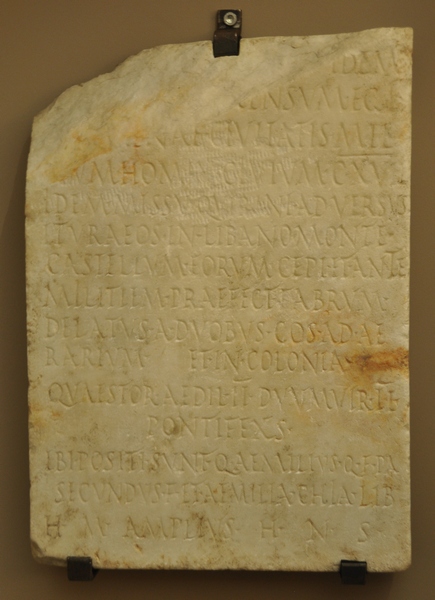
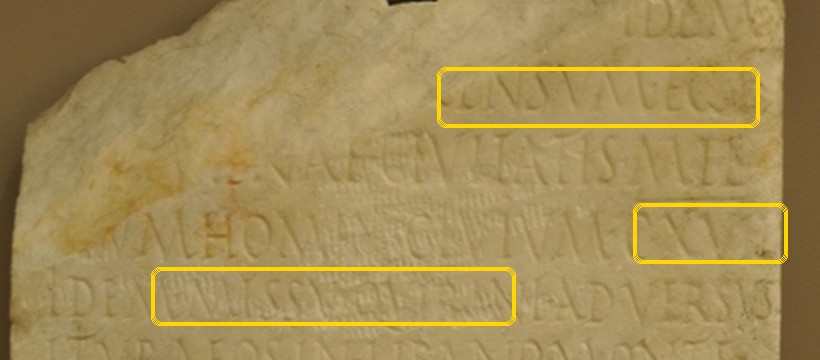
DisputedThe surviving lower part of the Lapis Venetus, the tombstone of Quintus Aemilius Secundus, who took a census for Quirinius, in the National Archaeological Museum, Venice. Jona Lendering, Livius.org, CC0 1.0.
(And this taxing was first made when Cyrenius was governor of Syria.)
Luke 2:2, KJV
Luke says Joseph went to Bethlehem because of a Roman registration (taxing) made when Cyrenius, known in Latin as Publius Sulpicius Quirinius, was governor of Syria. Quirinius was a real Roman official. Josephus says that after Herod's son Archelaus was removed, Quirinius came to Syria and Judea to take a count of property, which dates that census to about AD 6, and that it led to the revolt of Judas of Galilee (also named in Acts 5:37). The difficulty is that Matthew places Jesus' birth while Herod was still king, and Luke places the events just before it "in the days of Herod, the king of Judaea" (Luke 1:5). That is about 7 to 11 years before AD 6, depending on which date is taken for Herod's death.
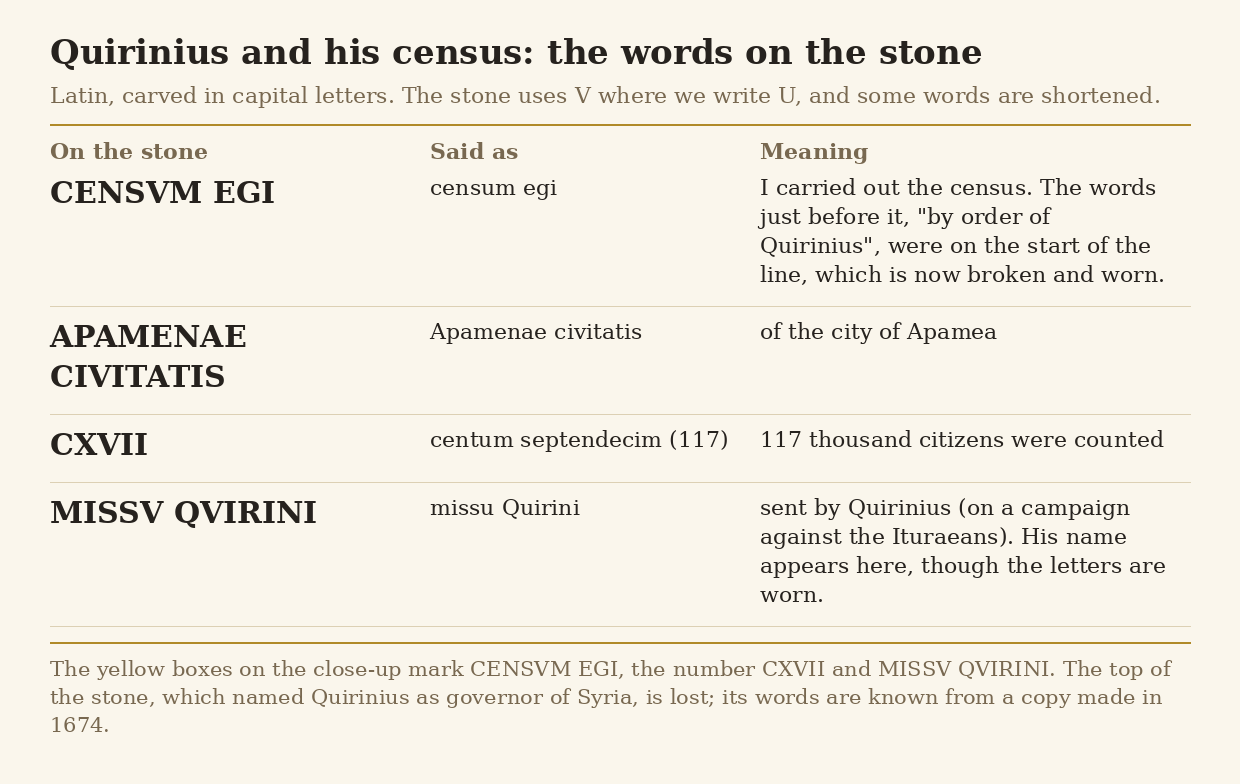
Close-up of the top of the surviving stone. The yellow boxes, added for this page, mark "CENSVM EGI" (I carried out the census; its first letters are worn at the broken edge), the number CXVII (117; the word for "thousand" comes just before it, so it means 117,000 citizens), and "MISSV QVIRINI" (sent by Quirinius), where his name appears in worn letters. Jona Lendering, Livius.org, CC0 1.0.The key words on the stone, how they are said, and what they mean. Chart made for this page, free to reuse.
Where it is today
Lapis Venetus (tombstone of Quintus Aemilius Secundus): National Archaeological Museum, Venice, Italy (Corpus of Latin Inscriptions, volume 3, number 6687). Lapis Tiburtinus: Vatican Museums, Christian Lapidarium (catalogue 31401).
Date
Josephus's census of Judea: about AD 6. Lapis Venetus: early first century AD (about AD 20). Lapis Tiburtinus: from the time of Augustus or soon after; found near Tivoli in 1764.
Why this label: Quirinius and his census of about AD 6 are confirmed, but how Luke's census fits with a birth under Herod is one of the most debated questions in New Testament history. Both sides have serious, informed scholars.
Good to know
The inscriptions: The Lapis Venetus is the tombstone of an officer who says that, on the order of Quirinius as governor of Syria, he took a census of the city of Apamea in Syria, counting 117,000 citizens. Only the lower part of the stone survives. The upper lines, with his name and Quirinius's title as the emperor's governor of Syria, are known only from a copy made in 1674; the stone was then lost, and its lower part was found again in Venice in 1880. The surviving part still shows the words for the census, the number 117 and the name of Quirinius. It confirms Quirinius ran a census in Syria, but it gives no year. The Lapis Tiburtinus, found near Tivoli, honours an official who served as the emperor's legate (his appointed governor or deputy) "again" (Latin iterum), with Syria named, but his name is lost. The Vatican Museums say it probably belonged to Quirinius and may point to an earlier post in Syria; other scholars think it was another man, such as Sentius Saturninus or Calpurnius Piso.
No conflict view: Some argue Quirinius held an earlier office or special command in the region while Herod was alive. Others read the Greek word for "first" as "before," so the verse would mean this census took place before the one under Quirinius. The early writer Tertullian connected the census with Sentius Saturninus, governor of Syria a few years before Herod died. A Roman order from Egypt in AD 104 did tell people to return to their homes for a census, though that was about the place where they lived and farmed.
Doubting view: Many historians say there is no record of a single census of the whole empire under Augustus, that Rome did not tax kingdoms like Herod's directly, since they ruled themselves under Rome, that the known governors of Syria in Herod's last years were Saturninus and Varus, and that there is no gap before AD 6 when Quirinius could have governed Syria. They think Luke joined the AD 6 census to the birth story.
Keep in mind: Luke also knew of the AD 6 census (Acts 5:37), and he calls the one at Jesus' birth the "first," so he may have meant to tell the two apart. The question is still open.
Caesar Augustus and the Priene calendar inscription
Luke 2:1 · Luke 2:10
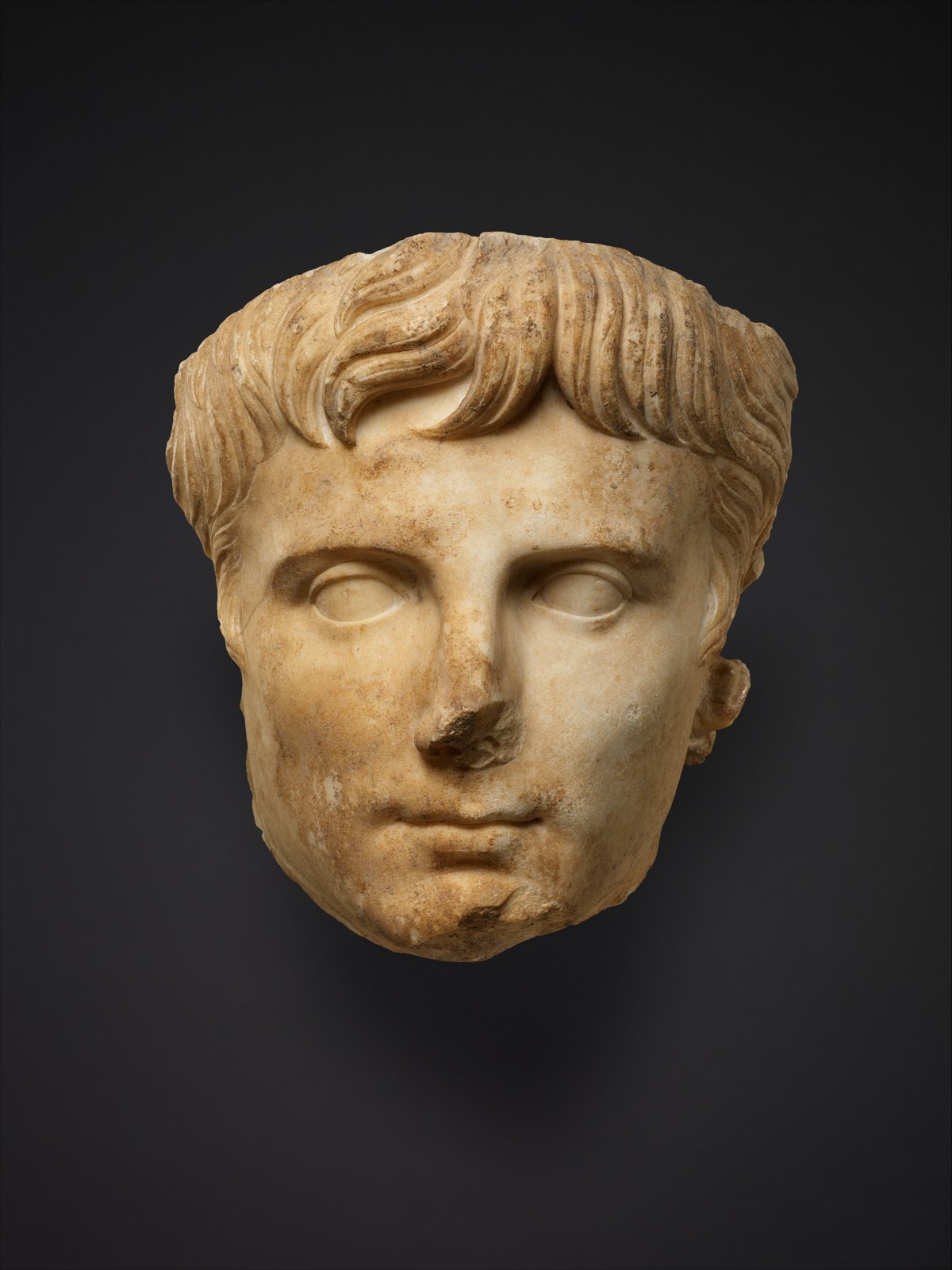
BackgroundMarble portrait head of the emperor Augustus, made after his death, in the reign of Tiberius (about AD 14 to 37); this is not the Priene inscription. The Metropolitan Museum of Art, New York, Rogers Fund, 1907 (07.286.115), Public domain (The Met Open Access).
And it came to pass in those days, that there went out a decree from Caesar Augustus, that all the world should be taxed.
Luke 2:1, KJV
Caesar Augustus, the first Roman emperor, held power from 31 BC (he took the name Augustus in 27 BC) until his death in AD 14. He is the ruler Luke names at Jesus' birth. In 9 BC the province of Asia (in modern Turkey) passed a decree, found carved in stone at Priene, that started the new year on Augustus's birthday, 23 September. It praises him as a bringer of peace and says the birthday of "the god" began the "good tidings" (Greek euangelia, the plural of euangelion, the word later used for the gospel) for the world. Luke 2:10 uses a word from the same Greek root when the angel brings "good tidings of great joy, which shall be to all people".
Where it is today
Priene inscription: the main copy, from the market place at Priene, belongs to the Berlin museums (it is number 105 in the published collection of Priene inscriptions); other copies were found at Apamea, Eumeneia and Metropolis in Turkey. Res Gestae: best copy on the Temple of Rome and Augustus, Ankara, Turkey. Photo object: The Metropolitan Museum of Art, New York (07.286.115).
Date
Priene decree: 9 BC. Res Gestae: written by AD 14. Met portrait: about AD 14 to 37.
Why this label: Augustus is a well-known historical ruler, but these inscriptions do not mention the census of Luke 2 or the birth of Jesus. They show the world and the language of the time in which Luke wrote.
Good to know
The Res Gestae: Augustus's own record of his deeds, set up on bronze pillars in Rome and copied in stone in what is now Turkey, says he took a census of Roman citizens three times, in 28 BC, 8 BC and AD 14, counting 4,063,000, then 4,233,000, then 4,937,000 citizens. These were counts of Roman citizens, not of people in Judea, so they do not prove Luke's census, but they show that counting people was part of his rule.
Keep in mind: Some writers see Luke as setting the true good news beside the claims made for the emperor. That is an interpretation, and Luke does not say so directly.
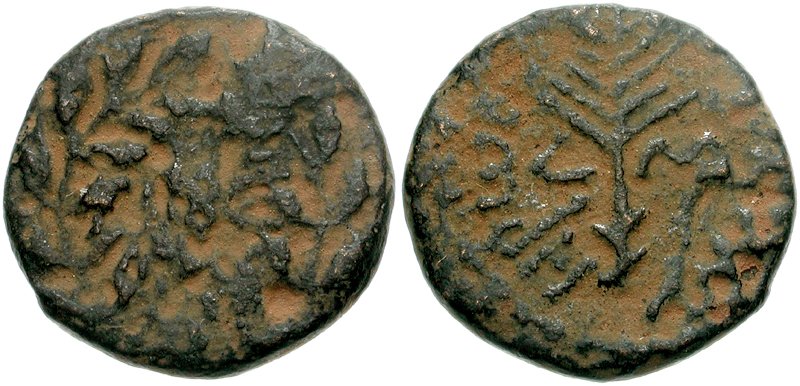
ConfirmedA bronze coin of Herod Antipas: the name Tiberias inside a wreath on one side, and a palm branch with his name and the year of his rule on the other. Classical Numismatic Group (CNG), via Wikimedia Commons, CC BY-SA 3.0.
And he said unto them, Go ye, and tell that fox, Behold, I cast out devils, and I do cures to day and to morrow, and the third day I shall be perfected.
Luke 13:32, KJV
Herod Antipas was a son of Herod the Great. Rome let him rule Galilee and Perea (the land east of the Jordan) as a "tetrarch", a ruler of part of a kingdom under Rome, from 4 BC to AD 39. Jesus called him "that fox" when some Pharisees warned that Herod wanted to kill Him (Luke 13:31-32). Antipas built the city of Tiberias on the west shore of the Sea of Galilee and named it after the emperor Tiberius; John 6:23 mentions boats from Tiberias, and John also calls the lake "the sea of Tiberias" (John 6:1, John 21:1).
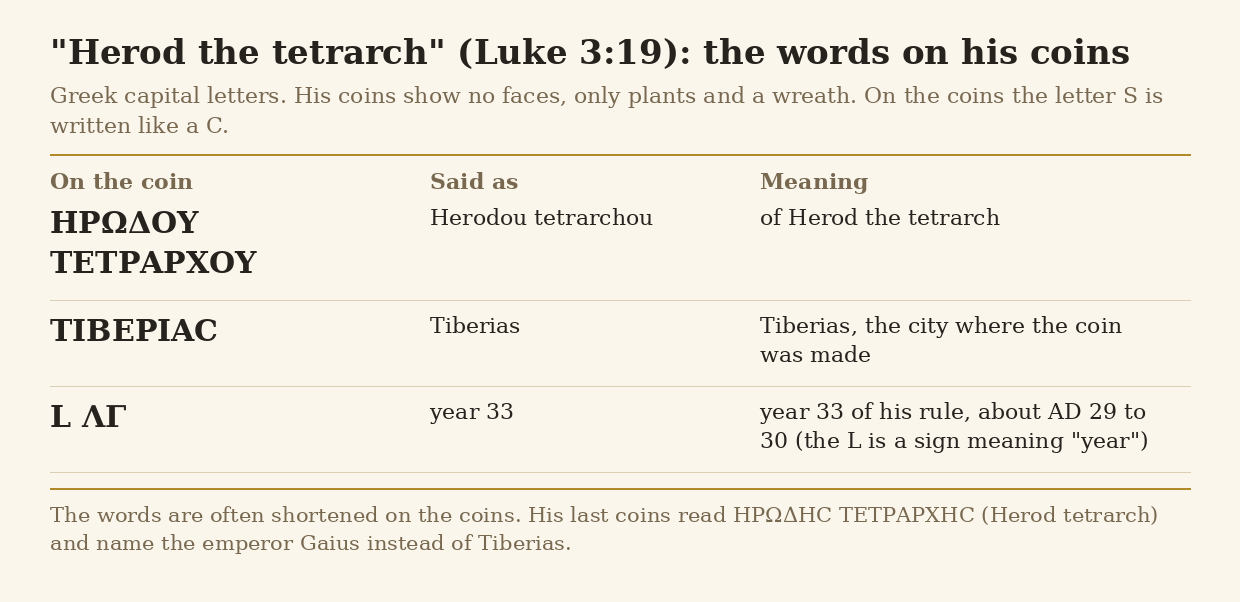
The Greek words on the coins of Herod Antipas. Chart made for this page, free to reuse.
Where it is today
Tiberias is still a city on the west shore of the Sea of Galilee. Remains of the Roman city, including a theatre and a city gate, lie south of the modern town. Antipas's coins are held in many museums and collections; the Roman Provincial Coinage project at Oxford lists the known types (for example volume 1, number 4930).
Date
Antipas ruled 4 BC to AD 39. Tiberias was founded about AD 18 to 20. His dated coins run from the 24th year of his rule (about AD 20) to his 43rd year (about AD 39); the last ones name the emperor Gaius (Caligula).
Why this label: Antipas is named in the Gospels, in the Jewish historian Josephus, and on his own coins, which also name his city of Tiberias. The ruler and the city are clearly the ones the Bible names; this does not by itself confirm any single event in the Gospels.
Good to know
Josephus says: Josephus, a Jewish historian writing about AD 93 to 94, says Antipas built Tiberias where old graves had to be cleared, so under Jewish law its people counted as unclean, and he had to bring in settlers, some of them by force. He also says Antipas put a wall around Sepphoris, about 6 km from Nazareth, and made it the chief city of Galilee. The Gospels never mention Sepphoris and never say Jesus went into Tiberias.
The coins: His coins call him "Herod the tetrarch", the same title the Gospels use for him (Luke 3:19), and give the year of his rule. Most also carry the name "Tiberias"; the last ones, from his 43rd year, name the emperor Gaius instead. They show plants, such as a reed, a palm branch, a palm tree or a bunch of dates, and a wreath, but never a human face, probably out of respect for the Jewish law against images.
His end: Josephus says the emperor Gaius took away his land in AD 39 and sent him into exile, in Gaul in one of his books and in Spain in the other.
Machaerus, the fortress where Josephus says John the Baptist died
Matthew 14:1-12 · Mark 6:17-29 · Luke 3:19-20
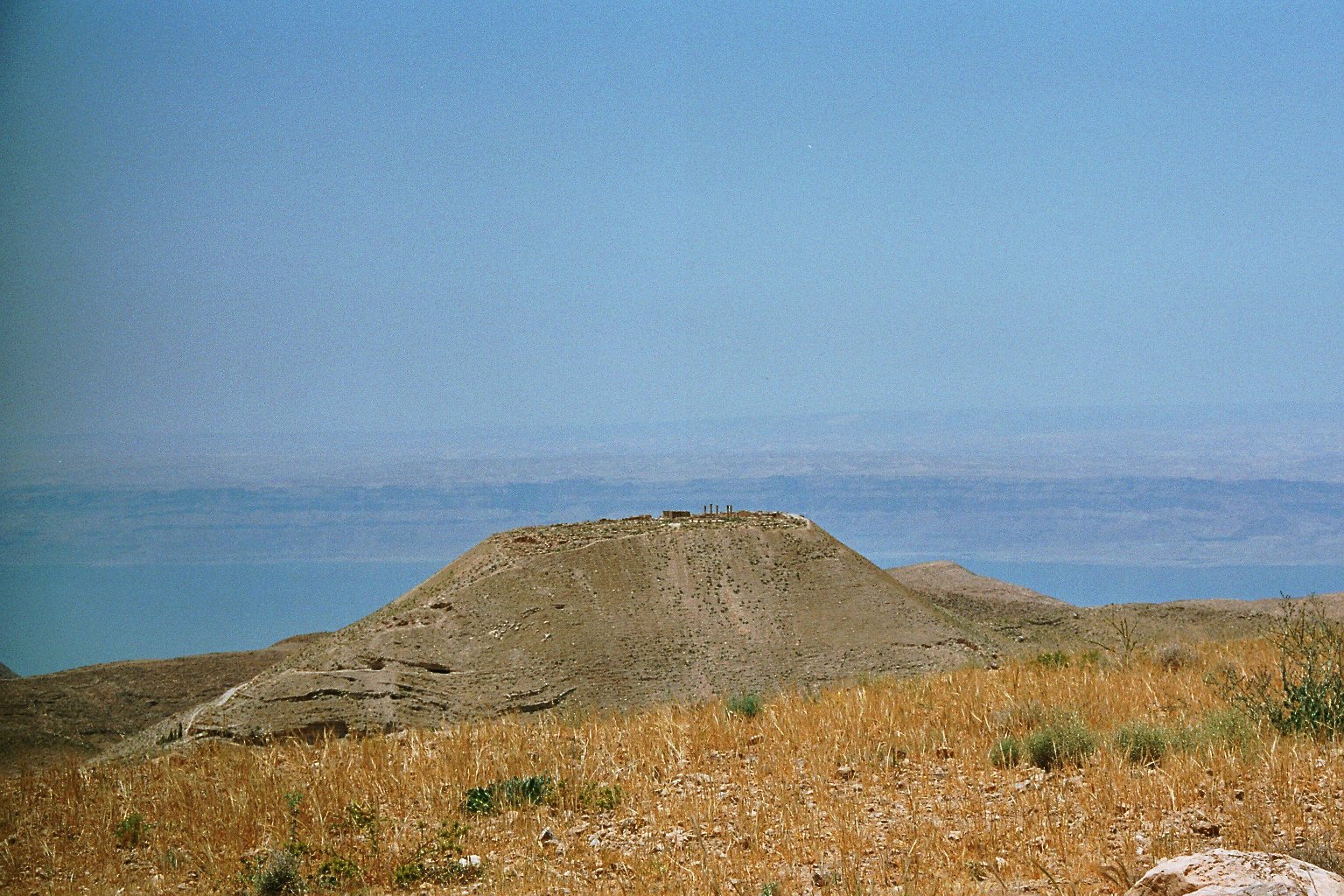
Traditional siteThe hill of Machaerus with the Dead Sea in the background. Wikimedia Commons (Machaerus_Panorama.jpg), Public domain.
And he sent, and beheaded John in the prison.
Matthew 14:10, KJV
Machaerus is a ruined hilltop palace and fortress east of the Dead Sea. The Jewish king Alexander Jannaeus first built it, Herod the Great rebuilt it, and it then passed to his son Herod Antipas. The Gospels tell how Antipas put John in prison and later had him beheaded after the dance of Herodias's daughter, but they do not say where this happened. The place name comes from the Jewish historian Josephus, who says John "was sent a prisoner ... to Macherus, the castle I before mentioned, and was there put to death."
Where it is today
On a steep hill above the village of Mukawir, Jordan, east of the Dead Sea, about 25 km southeast of where the Jordan River enters the Dead Sea. Visitors can climb to the ruins, which include the palace courtyard, re-erected columns, water cisterns and a bath with mosaic floors.
Date
First built about 90 BC; rebuilt by Herod the Great about 30 BC; destroyed by the Romans in AD 71 or 72. Dates suggested for John's death range from about AD 28 to about AD 32.
Why this label: The ruin is clearly the Machaerus that Josephus describes. Josephus wrote about 60 years after John died and did not copy the Gospels, so his word is stronger than later church tradition. But the Gospels do not name the place, nothing found on the site names John, and the link rests on this one ancient writer.
Good to know
Two accounts: Josephus and the Gospels agree that Antipas put John in prison and had him killed, but they give different reasons. The Gospels say John told Antipas it was wrong to marry Herodias, his brother's wife; Josephus says Antipas feared that John's hold on the crowds might lead to a revolt. Almost all scholars accept this passage in Josephus as genuine, partly because it does not simply copy the Gospels. One line nearby is hard to fit: Josephus says that when Antipas's first wife fled, Machaerus "was subject to her father", Aretas, king of the Nabataean Arabs. Scholars explain this in different ways, for example as a copying error, but it shows that his account has small problems of its own.
The digs: Digging began in 1968 and Franciscan archaeologists carried it on from 1978. Since 2009 the Hungarian archaeologist Győző Vörös has led the work for Jordan's Department of Antiquities. His team set two of the palace columns back up and drew a reconstruction of the palace.
A caution: Vörös believes he can point to the very courtyard where the girl danced. That is his reading of the ruins; no find on the site records the banquet. Mark 6:21 says the guests included the chief men of Galilee, which does not settle the place, since Antipas ruled both Galilee and Perea.
The "penny" shown to Jesus: the silver denarius of Tiberius
Matthew 22:19-21 · Mark 12:15-17 · Luke 20:24-25
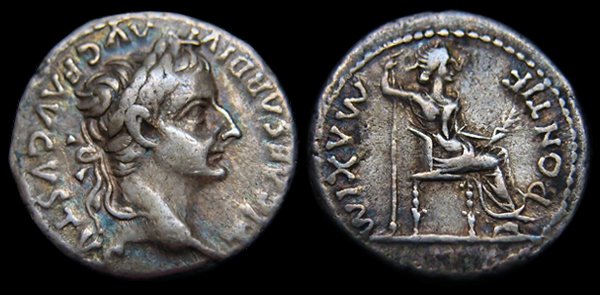
BackgroundSilver denarius of Tiberius, the type known as the "tribute penny": his head on the front, and a seated woman with the words PONTIF MAXIM on the back. DrusMAX, via Wikimedia Commons, CC BY-SA 3.0.
They say unto him, Caesar's. Then saith he unto them, Render therefore unto Caesar the things which are Caesar's; and unto God the things that are God's.
Matthew 22:21, KJV
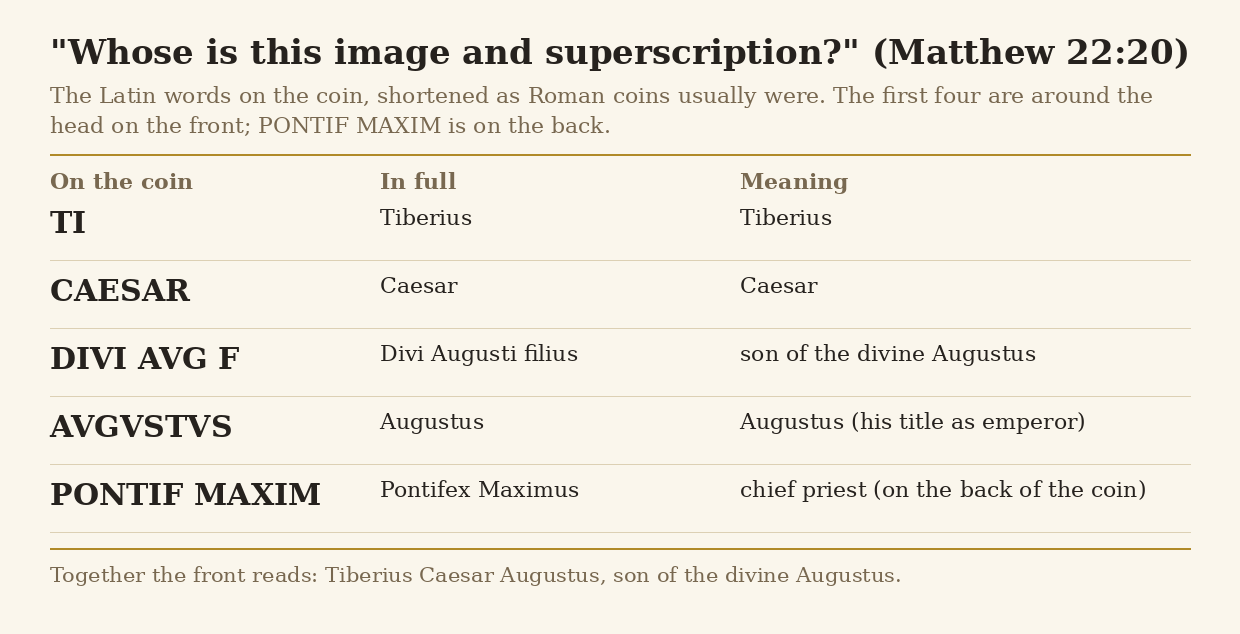
When Jesus was asked whether it was right to pay tax to Caesar, He asked to see the coin used for the tax. The Greek word that the KJV translates "penny" is denarion, the Roman silver denarius, which was a labourer's pay for one day (Matthew 20:2). The coin most often linked to this story is the denarius of the emperor Tiberius, who ruled AD 14 to 37. Its front shows his head and the words TI CAESAR DIVI AVG F AVGVSTVS ("Tiberius Caesar Augustus, son of the divine Augustus"), and its back shows a seated woman and the words PONTIF MAXIM ("chief priest").
The "superscription" on the coin: the Latin words around the emperor's head, in full and in English. Chart made for this page, free to reuse.
Where it is today
Many examples survive in museums and private collections. One is in Museums Victoria in Melbourne, Australia: a coin struck at Lugdunum (now Lyon, France), 19 mm across and weighing 3.72 g. The type is number 30 in the standard catalogue, Roman Imperial Coinage, volume 1 (second edition, 1984).
Date
Struck at Lugdunum during Tiberius's rule, AD 14 to 37. The question about tax came in Jesus' last days in Jerusalem, usually dated AD 30 or AD 33.
Why this label: The Tiberius denarius is real and fits the story well, but no one can know which coin was shown to Jesus. Experts still debate whether this coin was even common in Judea at the time.
Good to know
Usual view: The Tiberius denarius is the favourite choice because it was struck by the emperor then ruling, it is a denarius as the Gospels say, and it carries his image and his title.
Doubting view: Oliver Hoover of the American Numismatic Society (a society for the study of coins) notes that finds give no sign that denarii were used in Judea in any large number before AD 70. He suggests the Gospel writers may have named a coin their readers knew, rather than the exact coin used.
Other candidates: Some suggest a large silver coin of Tiberius struck at Antioch in Syria (a tetradrachm, worth about 4 denarii), which shows both Tiberius and Augustus, but none of the few known examples has been found in Israel. Others suggest a denarius of Augustus, the emperor before Tiberius.
The widow's two mites: the smallest coins of the time
Mark 12:41-44 · Luke 21:1-4
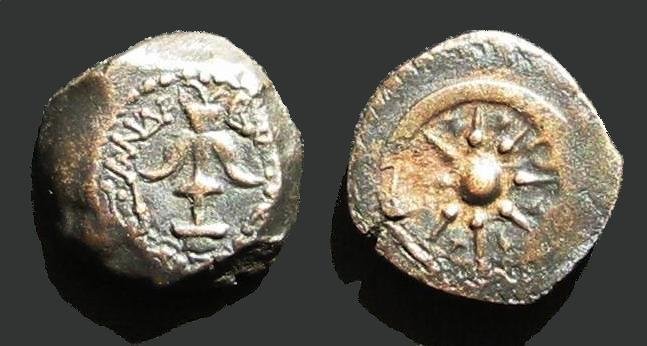
BackgroundSmall bronze coin of Alexander Jannaeus: anchor on one side, star on the other. Wikimedia Commons (JanaeusCoinPhoto.jpg), CC BY-SA 3.0.
And there came a certain poor widow, and she threw in two mites, which make a farthing.
Mark 12:42, KJV
Jesus watched a poor widow put two "mites" into the temple treasury and said she had given more than all the rich. The Greek word behind "mite" is lepton, meaning "small" or "thin", the smallest bronze coin in use; Mark adds that two of them made a "farthing", the Roman quadrans, the smallest Roman coin. In Hebrew a small bronze coin of this kind was called a prutah. Among the coins found most often at digs in the land are the small bronzes of the Jewish king Alexander Jannaeus, who ruled 103 to 76 BC; they were made in huge numbers and stayed in use long after his death.
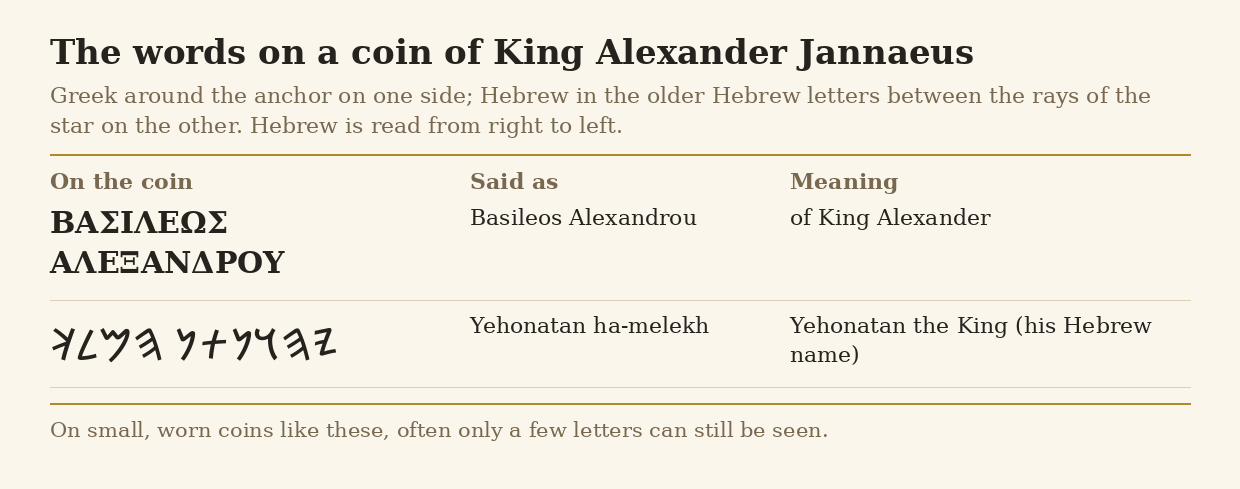
The Greek and Hebrew words on the common coin of Alexander Jannaeus. Chart made for this page, free to reuse.
Where it is today
These coins are common. Thousands survive in museums and private collections, and dealers often sell them as "widow's mites".
Date
Coins of Alexander Jannaeus: 103 to 76 BC (some similar coins may have been struck as late as about 40 BC). Small bronze coins were also struck by the Herod family and by Roman governors such as Pontius Pilate (AD 26 to 36). The widow's gift took place in Jesus' last days in Jerusalem, usually dated AD 30 or AD 33.
Why this label: These coins show the kind of tiny coin the widow gave, but nobody can know which coins she used. They help a reader picture the story; they do not prove it.
Good to know
The word mite: "Mite" comes from the name of a tiny coin used in Flanders (now part of Belgium) in the 1300s. English Bibles used it for the smallest coin. It was not the name of any coin in Jesus' day.
Which coin: Coin experts say the widow's coins could have been any small bronze coin then in use, old or new. Coins of Jannaeus are sold as "widow's mites" mainly because they are the most common and cheapest examples, not because of any proof.
The design: The common Jannaeus coin shows an anchor with the Greek words "of King Alexander" on one side, and on the other a star or wheel with Hebrew letters reading "Yehonatan the King".
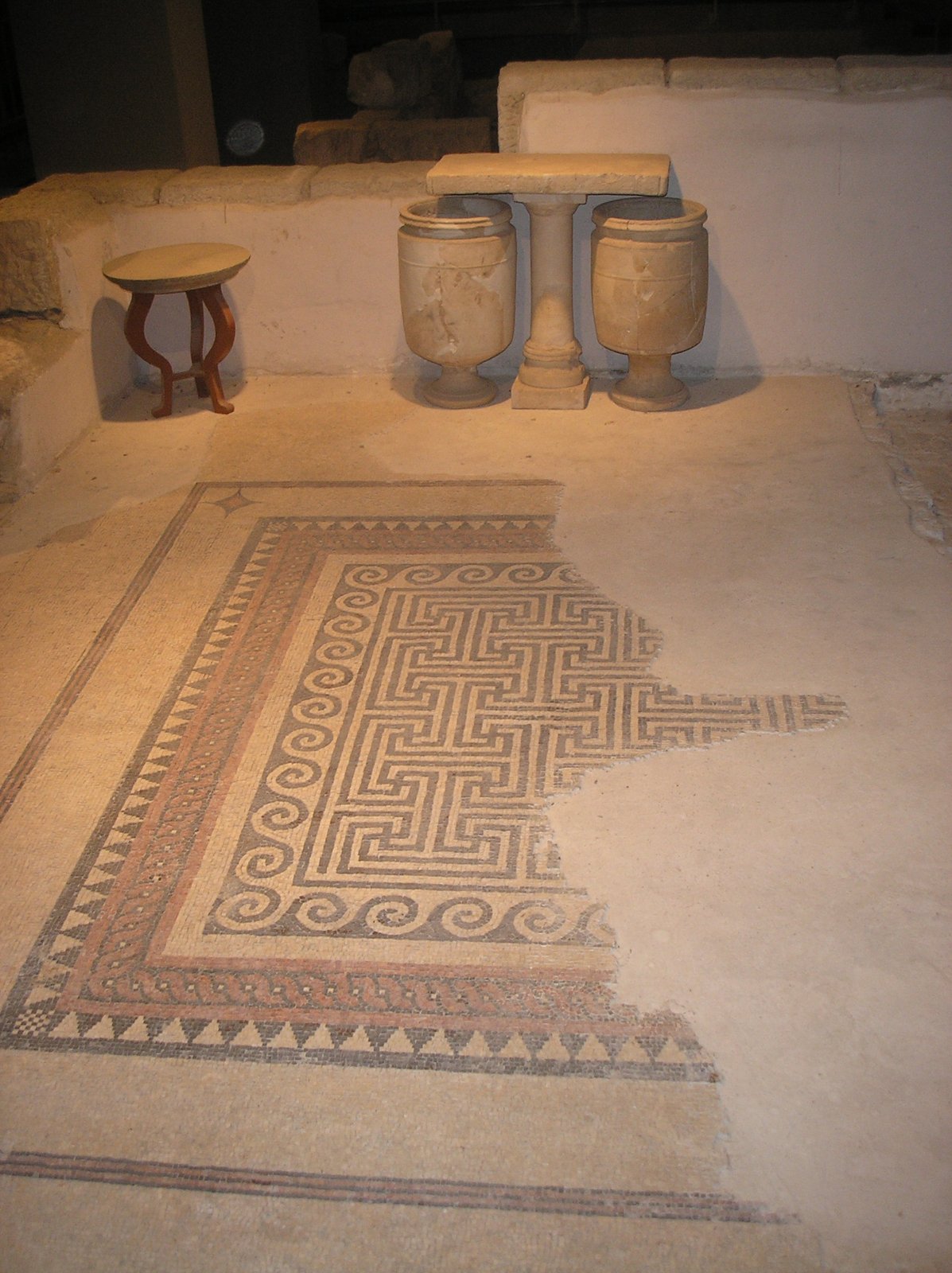
BackgroundTwo large stone jars and a stone table in the Herodian Quarter museum, Jerusalem, set above a mosaic floor. Deror avi, via Wikimedia Commons, Attribution.
And there were set there six waterpots of stone, after the manner of the purifying of the Jews, containing two or three firkins apiece.
John 2:6, KJV
At the wedding in Cana, John says there were "six waterpots of stone, after the manner of the purifying of the Jews". Archaeology shows this custom was real: in the first century, Jews in Judea and Galilee used many cups, bowls and large jars carved from soft chalk stone. They did this because, under the Jewish purity rules of the time, stone could not become ritually unclean, while a clay pot that became unclean had to be broken (Leviticus 11:33). Caves where these vessels were cut have been dug at Einot Amitai, just south of Kafr Kanna (one of the places suggested for Cana), at Reineh in Lower Galilee, and on Mount Scopus and at Hizma near Jerusalem.
Where it is today
Large stone jars and smaller stone vessels found in first-century houses are on display in the Herodian Quarter museum and in the Burnt House, both in the Jewish Quarter of Jerusalem's Old City. The workshop caves at Einot Amitai and Reineh are excavation sites in Lower Galilee; check before planning a visit.
Date
Stone vessels came into use in the early 1st century BC. In Judea their use ended about AD 135; in Galilee some were still used until about the 4th century AD. The Einot Amitai workshop was dug from 2016 and the Reineh workshop in 2017.
Why this label: These finds show that the custom John describes was real and common in Galilee and Judea. They do not show the miracle at Cana, and no find can be tied to that wedding.
Good to know
What it shows: Stone vessels have been found at more than 250 sites, wherever Jews lived, so John's remark fits the real life of the time.
What it does not: No jar from the wedding has been found, and the miracle itself is not something digging can test. Where Cana stood is itself debated (see the Cana entry).
The big jars: Large stone jars shaped on a lathe (a turning machine), about 65 to 80 cm tall, have been found in Jerusalem houses. Some scholars think these are the kind John means, since their size fits his "two or three firkins" (modern translations give about 20 to 30 gallons, roughly 75 to 115 litres). So far the Galilee workshops have turned up mainly small mugs and bowls.
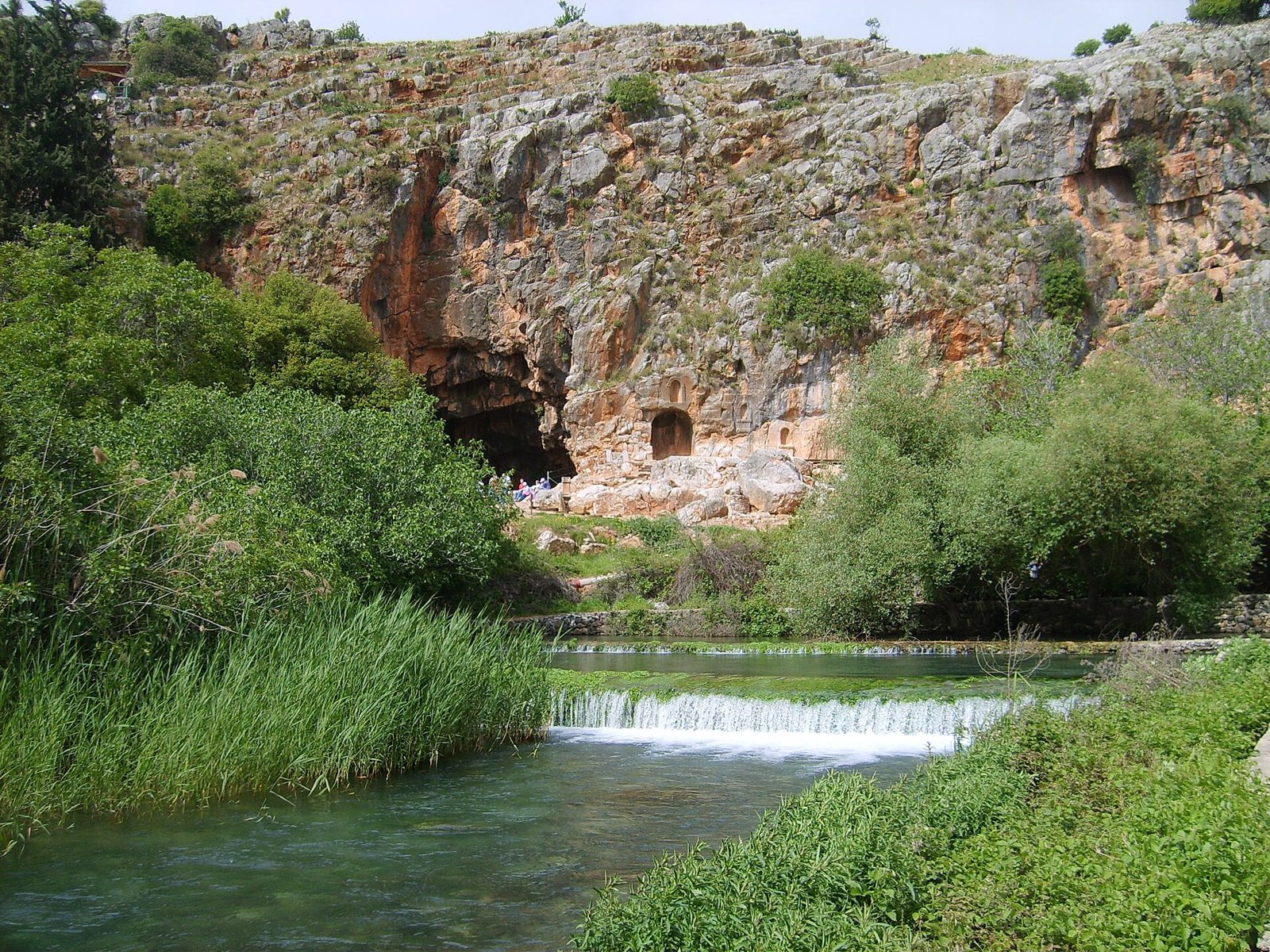
ConfirmedThe cliff and cave of Pan at Banias, with niches cut in the rock, and the stream from the spring below. gugganij, via Wikimedia Commons, CC BY-SA 3.0.
When Jesus came into the coasts of Caesarea Philippi, he asked his disciples, saying, Whom do men say that I the Son of man am?
Matthew 16:13, KJV
Caesarea Philippi was the area where Jesus asked His disciples who people said He was, and Peter answered, "Thou art the Christ, the Son of the living God" (Matthew 16:16). The city lay at a large spring, one of the main sources of the Jordan River, at the foot of Mount Hermon. From the 3rd century BC people worshipped the Greek god Pan at a cave there, so the place was called Paneas; the name survives today as Banias. Josephus says Herod the Great built a temple of white stone near the cave in honour of the emperor Augustus, and that Herod's son Philip the tetrarch built up Paneas as a city and named it Caesarea.
Where it is today
The ruins are in the Banias national park at the foot of Mount Hermon. Visitors can see the cave of Pan, niches cut in the cliff for statues, the remains of shrines along the cliff, and parts of the Roman city, including the remains of a palace of the Herod family. Check access before planning a visit.
Date
Pan shrine from about the 3rd century BC; Herod's temple to Augustus about 20 BC or soon after; Philip's city built early in his rule (4 BC to AD 34), with coins struck there from about AD 1; renamed Neronias by King Agrippa the Second in AD 61. Jesus' visit came during the years of His public work, usually placed between about AD 27 and AD 33.
Why this label: Josephus, the coins Philip struck there, and the name Banias, which comes straight from the old name Paneas, all point to this site, and scholars broadly agree it is the Caesarea Philippi of the Gospels. No inscription on the site names Caesarea Philippi; this confirms the place, not the words spoken there.
Good to know
The coins: Philip's coins struck here carry the emperor's head, Philip's own head, and a temple with four columns. Unlike his brother Antipas, Philip put faces on his coins.
The temple of Augustus: Josephus places Herod's temple near the cave, but its exact spot is debated. New digs at the cave, reported in 2025, found that the paved court in front of the cave was built in the late 1st century AD, probably under King Agrippa the Second, and was not Herod's temple. Some scholars place Herod's temple at Omrit, about 4 km to the southwest.
The gates of hell: Some teachers link Jesus' words about "the gates of hell" (Matthew 16:18) to the cave of Pan. The Gospel does not mention the cave, so this link is a guess.
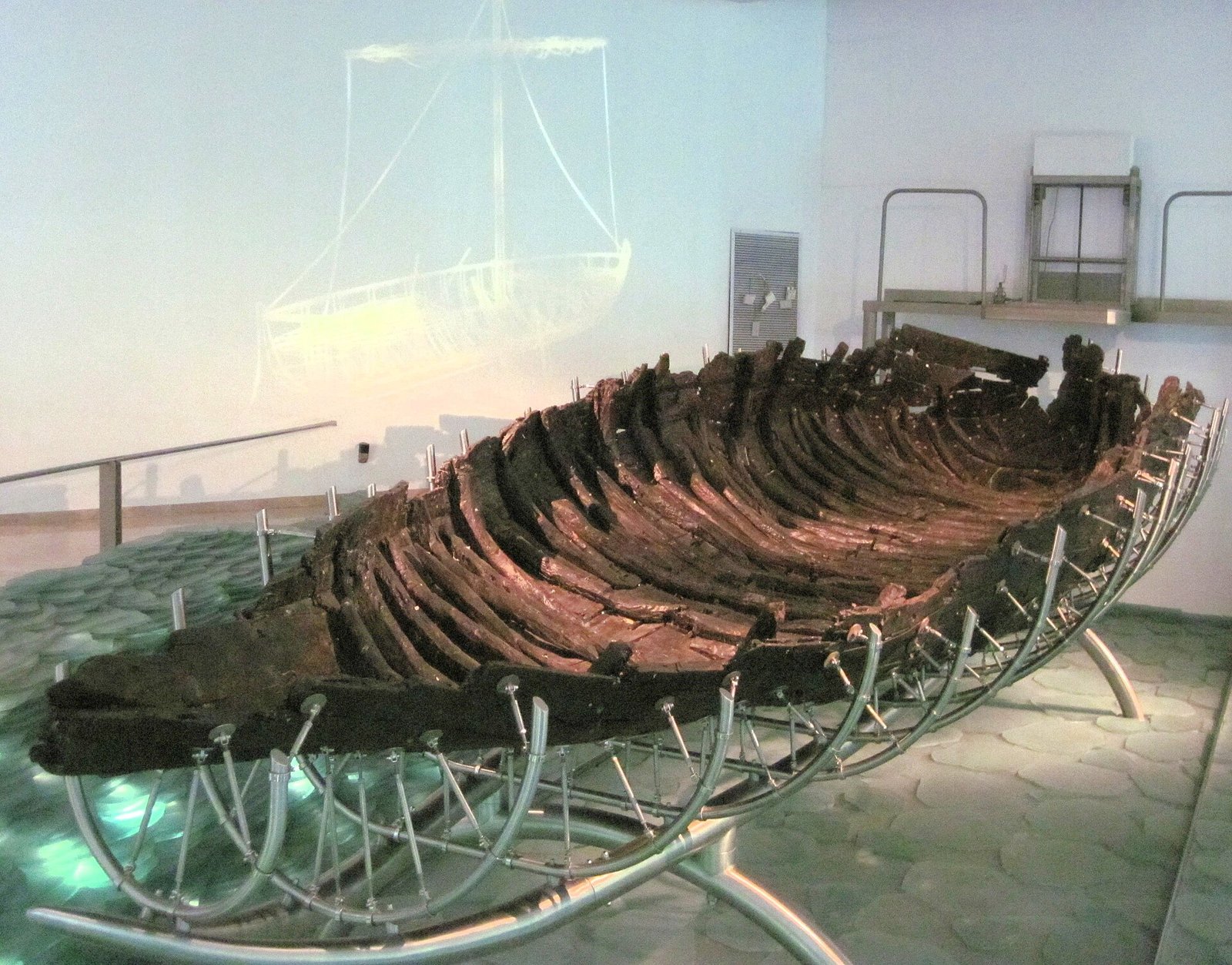
BackgroundThe ancient Galilee boat on display in the Yigal Allon Museum, Kibbutz Ginosar. The drawing of a whole boat on the wall behind is a modern picture of how it may have looked. Travellers & Tinkers, via Wikimedia Commons, CC BY-SA 4.0.
And there arose a great storm of wind, and the waves beat into the ship, so that it was now full.
Mark 4:37, KJV
In January 1986 a drought lowered the Sea of Galilee, and two brothers from Kibbutz Ginosar, Moshe and Yuval Lufan, saw the outline of an old wooden boat in the mud of the north-west shore. Archaeologists dug it out in 11 days and spent 11 more years drying and preserving the waterlogged wood. It is a working fishing boat about 8.2 metres long and 2.3 metres wide, built of cedar planks with oak frames and patched many times with other woods. Experts think it had a crew of five (four rowers and a man at the steering oar) and could carry about 15 people in all, so it gives a real picture of the boats in the Gospel scenes of fishermen at work (Mark 1:16-20) and of a boat filling with water in a storm (Mark 4:35-41).
Where it is today
Yigal Allon Museum, Kibbutz Ginosar, on the north-west shore of the Sea of Galilee, Israel. On display since 2000.
Date
In use some time between about 100 BC and AD 70. Radiocarbon tests on the wood gave 40 BC, plus or minus 80 years (about 120 BC to AD 40). Pottery found in and around the boat dates from the late first century BC to about AD 70.
Why this label: A real fishing boat from the right lake and the right period, of the kind the Gospels describe. Nothing links this boat to Jesus or the disciples, and the nickname "Jesus boat" is popular, not scientific.
Good to know
No link to Jesus: The boat carries no name, mark or object that ties it to Jesus or to any disciple; it shows only what a boat of their time was like.
Dating care: Some of the pottery came from the mud inside the boat and some from around it, but the excavators say none of it can be tied to the boat itself. It shows when people were active at that spot; the wood tests and the building method are what date the boat.
Gospel details: The Gospels say Jesus slept in the back part of the boat (Mark 4:38), and Zebedee worked with hired men (Mark 1:20); this boat type probably had a small deck at each end and needed several crew, though the deck itself was not preserved.
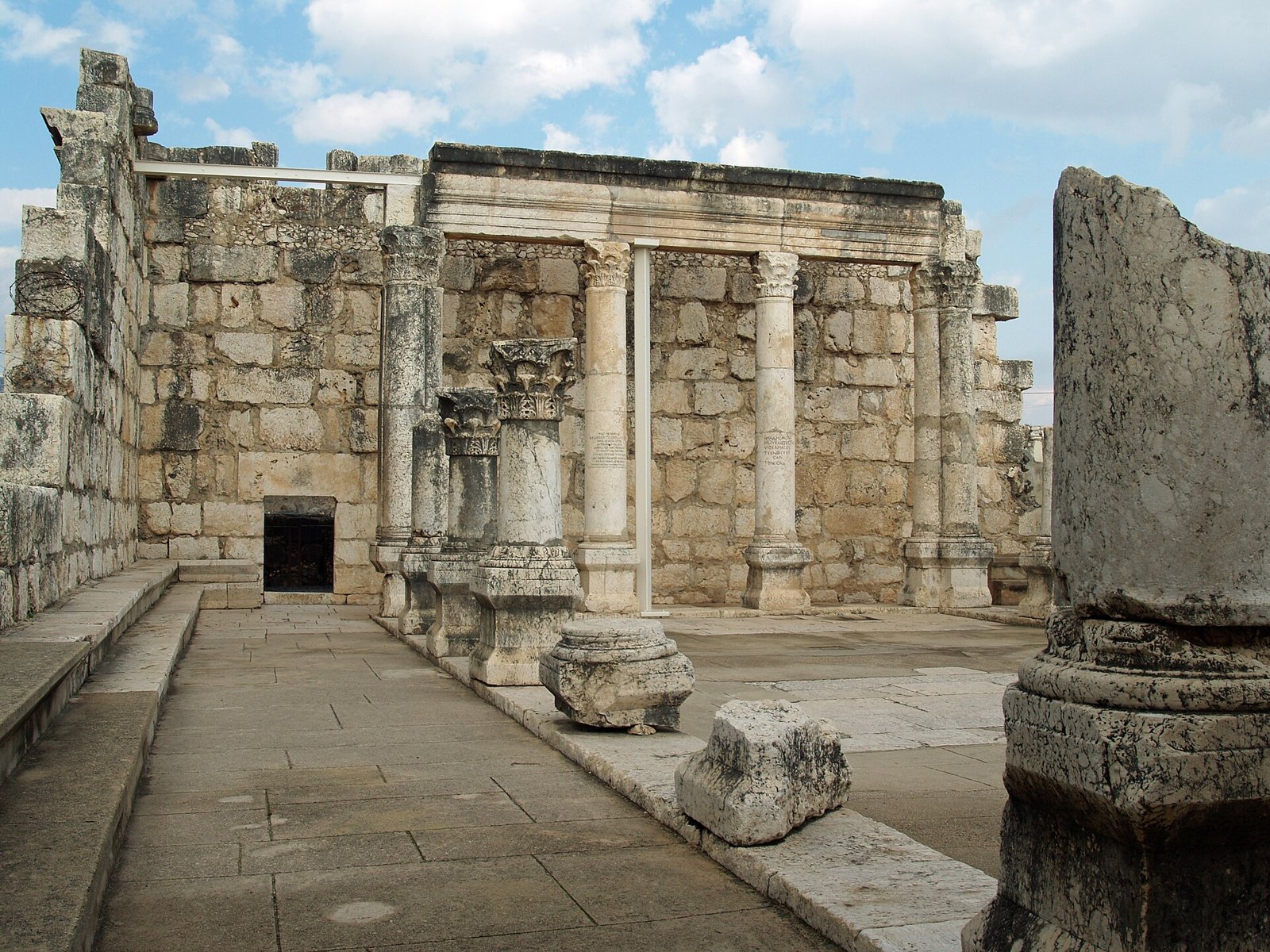
ConfirmedInside the white limestone synagogue at Capernaum (late 300s or 400s AD), with its columns and stone benches. David Shankbone, via Wikimedia Commons, CC BY-SA 3.0.
And they went into Capernaum; and straightway on the sabbath day he entered into the synagogue, and taught.
Mark 1:21, KJV
Capernaum was the lakeside fishing town where Jesus made His home after leaving Nazareth (Matthew 4:13) and where He taught in the synagogue (Mark 1:21). The large white limestone synagogue that visitors see today was built long after Jesus, in the late 300s or 400s AD. Under its floor, digs in 1981 found a cobbled floor of black basalt stone and basalt walls from an older building, with pottery from the first century AD or earlier, and many think this was the synagogue of Jesus' day, the one Luke says a centurion (an army officer) built for the town (Luke 7:5). About 30 metres away, under a modern church raised on pillars, are the remains of a first-century house that early Christians honoured as Peter's house (Mark 1:29).
Where it is today
Capernaum (Kefar Nahum, Tell Hum), on the north-west shore of the Sea of Galilee, Israel. The western part with the synagogue and the "house of Peter" is cared for by the Franciscans; the eastern part belongs to a Greek Orthodox monastery.
Date
Town: lived in from the 100s BC until it was left empty in the 1000s AD. White synagogue: late 300s to 400s AD (some scholars argue for the late 100s to 200s). Basalt floor beneath it: first century AD or a little earlier. House honoured as Peter's: first century BC to first century AD, turned into a church hall by the 300s, with an eight-sided church built over it in the mid-400s.
Why this label: Scholars broadly agree that these ruins are Capernaum, based on the old name of the site (Kefar Nahum, later Tell Hum), its place on the north shore and early pilgrim reports; no inscription naming the town has been reported. The town is confirmed, but which building was Jesus' synagogue and which house was Peter's rest on tradition and on reasoning from the finds, not on proof.
Good to know
Peter house tradition: One room of this house was enlarged in the later first century, given plastered walls and floor (rare in the town) and filled with oil lamps instead of kitchen pots, which suggests it became a meeting place. The pilgrim Egeria, about AD 383, wrote that Peter's house had been made into a church with its old walls still standing. This is an early and steady tradition, but nothing on the site names Peter for certain.
Graffiti debate: The excavators reported scratched writing on the plaster in Greek, Syriac and other languages, including the name of Peter; other scholars say very little of it can be read clearly.
Synagogue floor debate: The first-century basalt floor may belong to an earlier synagogue, but some scholars think it was an open paved market area, and the white synagogue on top is not the building Jesus knew.
Magdala: the first-century synagogue and the Magdala stone
Matthew 15:39 · Luke 8:2 · Mark 8:10
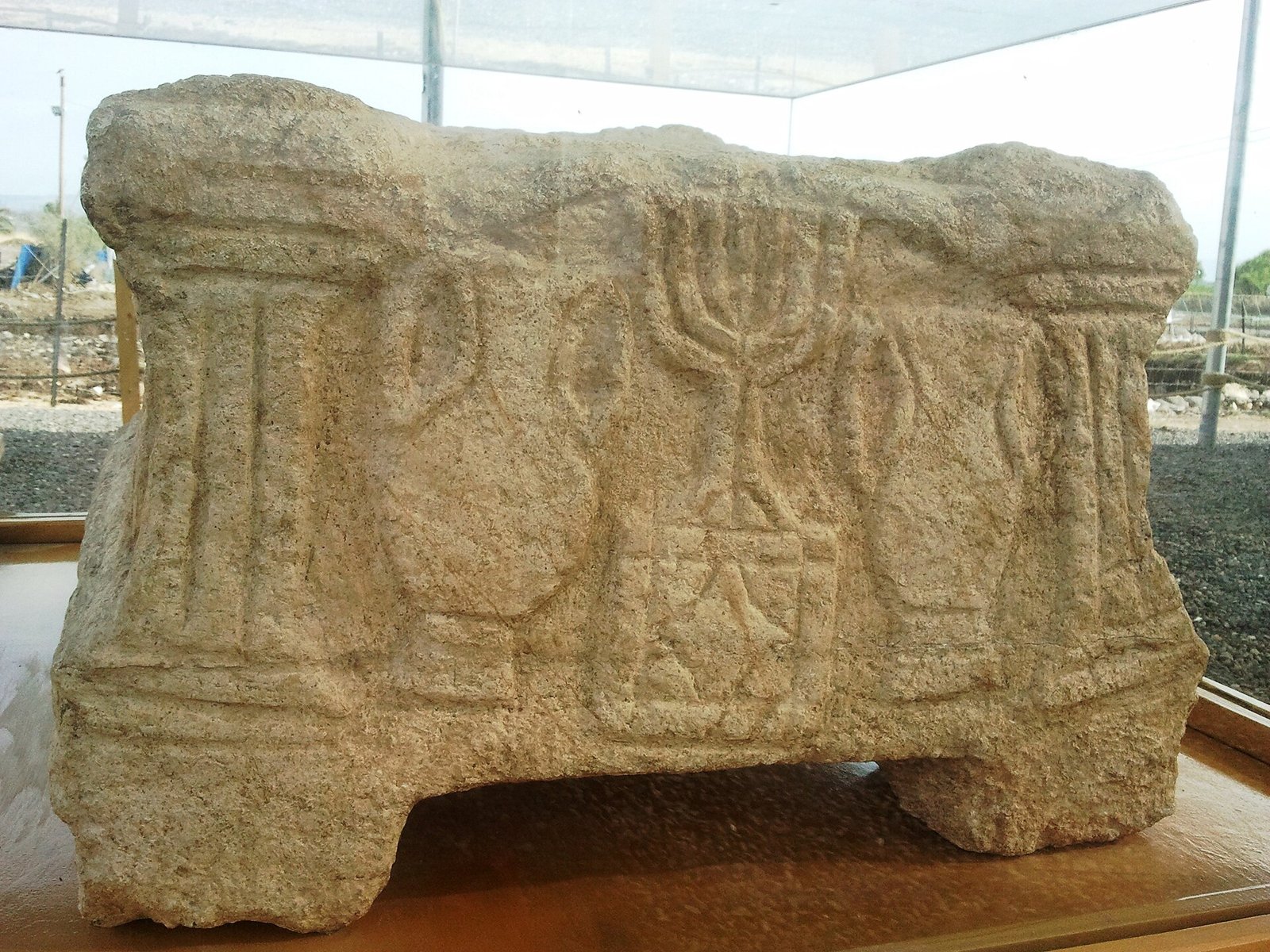
BackgroundThe front of the Magdala stone, with the seven-branched lampstand between two jars and two pillars, in a glass case at the Magdala site. A copy is kept at the site, so this may be the copy rather than the original. Hanay, via Wikimedia Commons, CC BY-SA 3.0.
And he sent away the multitude, and took ship, and came into the coasts of Magdala.
Matthew 15:39, KJV
Magdala (Migdal in Hebrew, meaning "tower") was a fishing town on the west shore of the Sea of Galilee, and most scholars take it to be the home town of Mary Magdalene (Luke 8:2). In 2009 a rescue dig at the site of a planned hotel, led by Dina Avshalom-Gorni of the Israel Antiquities Authority, found a synagogue in use in the first century, with stone benches along the walls of a main hall of about 120 square metres, a mosaic floor and painted walls. In the middle of the hall stood a carved stone block, now called the Magdala stone, showing the seven-branched lampstand of the temple between two jars and two pillars, with a six-petal rosette on top. It was carved while the temple in Jerusalem still stood, and it is the oldest known carving of the temple lampstand found in a synagogue.
Where it is today
Magdala archaeological site, beside Migdal on the west shore of the Sea of Galilee, Israel. A copy of the stone stands in the synagogue; the original was removed for safekeeping and has been lent for exhibitions (for example in Rome in 2017).
Date
Synagogue: about 50 BC to AD 100, according to the Israel Antiquities Authority. Stone: carved before AD 70. Josephus tells of the Romans taking the lake town of Taricheae in AD 67; many scholars think Taricheae and Magdala were the same town.
Why this label: A real synagogue and carving from the time of Jesus, so they show the kind of place where Jesus taught. Nothing here names Jesus or Mary Magdalene, the only verse that may name Magdala (Matthew 15:39) reads differently in older copies, and a minority of scholars think this ruin was not called Magdala in Jesus' day.
Good to know
Bible text difference: The King James Version reads "Magdala" in Matthew 15:39, following the later Greek copies it was translated from. Modern Greek editions, based on what they judge the older copies, read "Magadan", and the New American Standard Bible says "the region of Magadan". Mark 8:10 calls the same place Dalmanutha, and no one knows for sure where Magadan or Dalmanutha were, so this verse cannot be used to prove that Jesus visited Magdala.
No Jesus link: The Gospels say Jesus taught in synagogues all over Galilee (Mark 1:39), but there is no evidence that He taught in this one.
Which town debate: Josephus and Roman writers name a lake town called Taricheae. Many scholars, such as Richard Bauckham, think Magdala and Taricheae were two names, Aramaic and Greek, for this same town. Joan Taylor argues that the ruins here are Taricheae, that no ancient source calls it Magdala, and that Mary's home was more likely a small village near Tiberias called Migdal Nunya. Most excavators still call the site Magdala.
Chorazin: the basalt synagogue and the "seat of Moses"
Matthew 11:21 · Luke 10:13 · Matthew 23:2
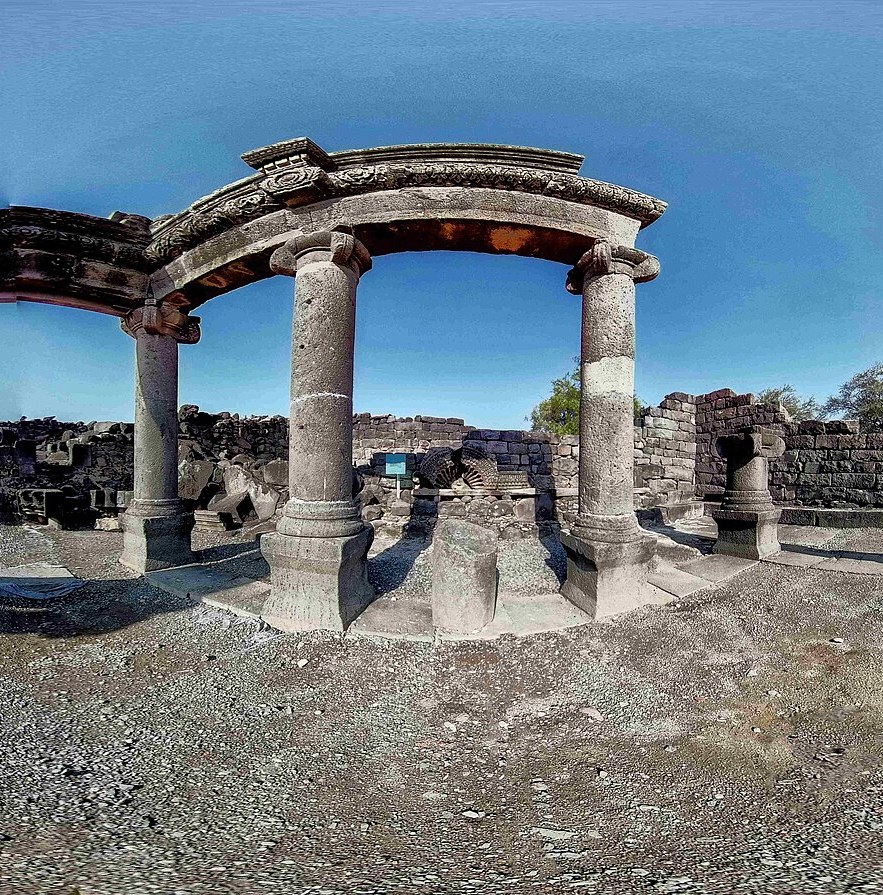
ConfirmedThe basalt synagogue at Chorazin (built late 200s or early 300s AD), part of a wide panorama. Zeev Stein, PikiWiki Israel, via Wikimedia Commons, CC BY 2.5.
Woe unto thee, Chorazin! woe unto thee, Bethsaida! for if the mighty works, which were done in you, had been done in Tyre and Sidon, they would have repented long ago in sackcloth and ashes.
Matthew 11:21, KJV
Chorazin was one of the towns near the lake where Jesus did mighty works and which He warned because its people did not repent (Matthew 11:20-24). Its ruins lie on a hill a few kilometres north of Capernaum, and the town is built of the local black volcanic stone called basalt. The best-known ruin is a basalt synagogue with stone benches along the walls and rich carvings, built in the late 200s or early 300s AD, so it is later than Jesus' time. In 1926 a stone chair carved from one block of basalt was found near its south wall; it has an Aramaic note honouring a donor, "Yudan, son of Ishmael", and scholars have called it the "seat of Moses" after Jesus' words in Matthew 23:2.
Where it is today
Korazim National Park, north of the Sea of Galilee, Israel. The original stone seat is in the Israel Museum, Jerusalem; a copy stands in the synagogue ruins.
Date
Synagogue: first built in the late 200s or early 300s AD, damaged (probably by an earthquake) in the later 300s, and in use again into the 500s. Seat: the Israel Museum dates it to the 300s to 500s AD.
Why this label: Scholars broadly agree that the ruins called Khirbet Karazeh are Chorazin, because the old name survives in the Arabic name Khirbet Karazeh and the site lies close to Capernaum; no inscription naming the town has been reported. The synagogue and the seat date from about 200 to 500 years after Jesus, so they show later Jewish life in the town, not the building Jesus knew.
Good to know
Later than Jesus: What visitors see at Chorazin comes mostly from the centuries after Jesus. The synagogue and the seat were built centuries later, so they do not show where Jesus stood or taught.
Name of the seat: The words "seat of Moses" are a modern label; the inscription only names the donor, and the Israel Museum describes it more carefully as a seat probably used by an elder or synagogue official. Similar stone seats were found at Hammat Tiberias and on the Greek island of Delos.
What Jesus meant: Many translators take "Moses' seat" in Matthew 23:2 to mean the right to teach the law of Moses, so the verse may speak of authority rather than a real chair.
Ruins and prophecy: The church writer Eusebius said in the 300s that Chorazin lay in ruins, but the town was lived in again for centuries afterward, so its ruins should not be offered as a simple proof of Jesus' warning.
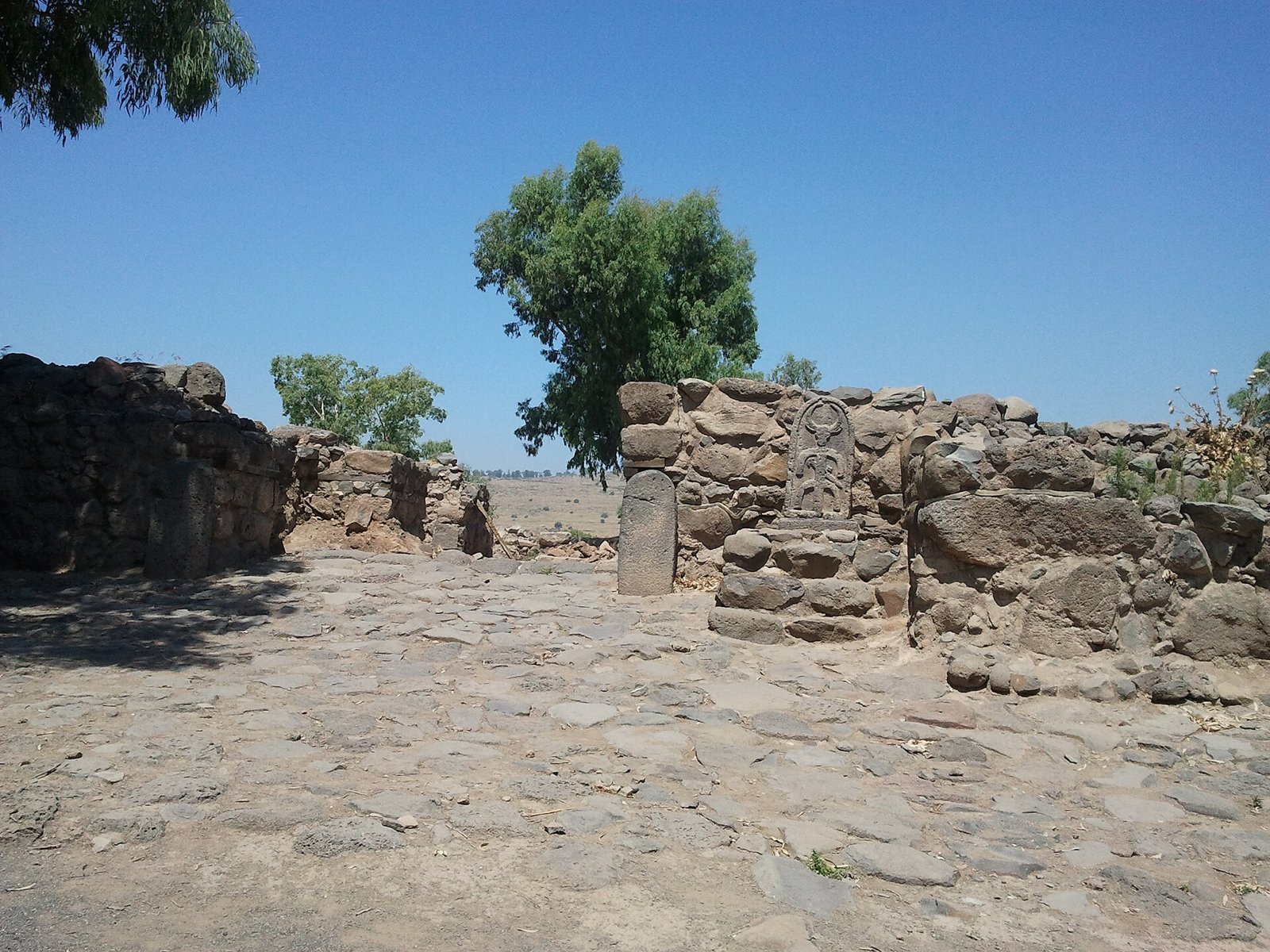
DisputedInside the Iron Age city gate at et-Tell, with a standing stone and a carved stone showing a figure with a bull's head. Hanay, via Wikimedia Commons, CC BY-SA 3.0.
Now Philip was of Bethsaida, the city of Andrew and Peter.
John 1:44, KJV
Bethsaida was the home town of the apostles Philip, Andrew and Peter (John 1:44). Jesus healed a blind man there (Mark 8:22), Luke 9:10 links the feeding of the 5,000 to it, and Matthew 11:21 names it in Jesus' warning to the lakeside towns. The Jewish historian Josephus says Herod Philip, a son of Herod the Great, raised the village to a city and renamed it Julias. Two ruins about 2 kilometres apart, near the point where the Jordan River enters the Sea of Galilee from the north, are each put forward as Bethsaida: et-Tell (Arabic for "the mound"), which now lies inland, and el-Araj, right by the lake.
Where it is today
Both sites are in the Bethsaida Valley Nature Reserve, near the north-east shore of the Sea of Galilee. The et-Tell ruins can be visited; el-Araj is still being dug, so check before planning a visit.
Date
et-Tell: a large walled town of the Iron Age (about 1000 to 700 BC), with smaller later remains through the Greek and early Roman periods. el-Araj: a Roman-period layer of the 1st to 3rd centuries AD, a church of the Byzantine period (the Christian Roman empire, about AD 330 to 640) about 1,500 years old, and a sugar works of the 1200s.
Why this label: Bethsaida was certainly a real town, named in the Gospels and by Josephus, but no inscription naming it has been found at either ruin. Experienced archaeologists dig at both sites, and each team argues that its own site is the one.
Good to know
Inland mound case: Rami Arav, who has led digs at et-Tell since the late 1980s, points to a house with lead net weights, anchors and fish hooks, Jewish-style lamps and stone vessels, a city wall he dates to Herod Philip, and a building he believes was a Roman temple linked to Julia (Livia), wife of the emperor Augustus. His team found lake clay at the foot of the mound and argues that the shore once reached it, until a disaster, probably the earthquake of AD 363, washed rock and soil across the plain.
Lakeshore site case: Mordechai Aviam and Steven Notley, digging at el-Araj since 2016, found a Roman layer of the 1st to 3rd centuries AD with coins, pottery, fishing weights and parts of a bathhouse, and in 2019 a Byzantine church with a mosaic floor. The pilgrim Willibald (about AD 725) wrote that Bethsaida had a church built over the house of Peter and Andrew, and Aviam says et-Tell has no Byzantine layer where such a church could have stood. In 2022 a mosaic inscription was found in the church in which a donor named Constantine asks the "chief and commander of the heavenly apostles" (that is, Peter) to pray for him, and in 2023 the team reported a 1st-century wall under the church.
Points against each: Critics say et-Tell's remains from the time of Jesus are thin and that it is too far from the water for a fishing village. The geologist John Shroder, writing in a book honouring Arav, argues that much of el-Araj was under the lake in the 1st century, and Arav suggests the Roman finds there may come from a short-lived army camp from the time of the Jewish revolt against Rome (AD 66 to 73).
Other views: Some scholars think et-Tell was the town and el-Araj its harbour, while others say it is too early to decide.
What it shows: A church at el-Araj shows where Christians of the Byzantine period believed Bethsaida was; it does not by itself prove where the town of Jesus' day stood.
Kursi and the country of the Gadarenes (the swine miracle)
Matthew 8:28-34 · Mark 5:1-20 · Luke 8:26-39
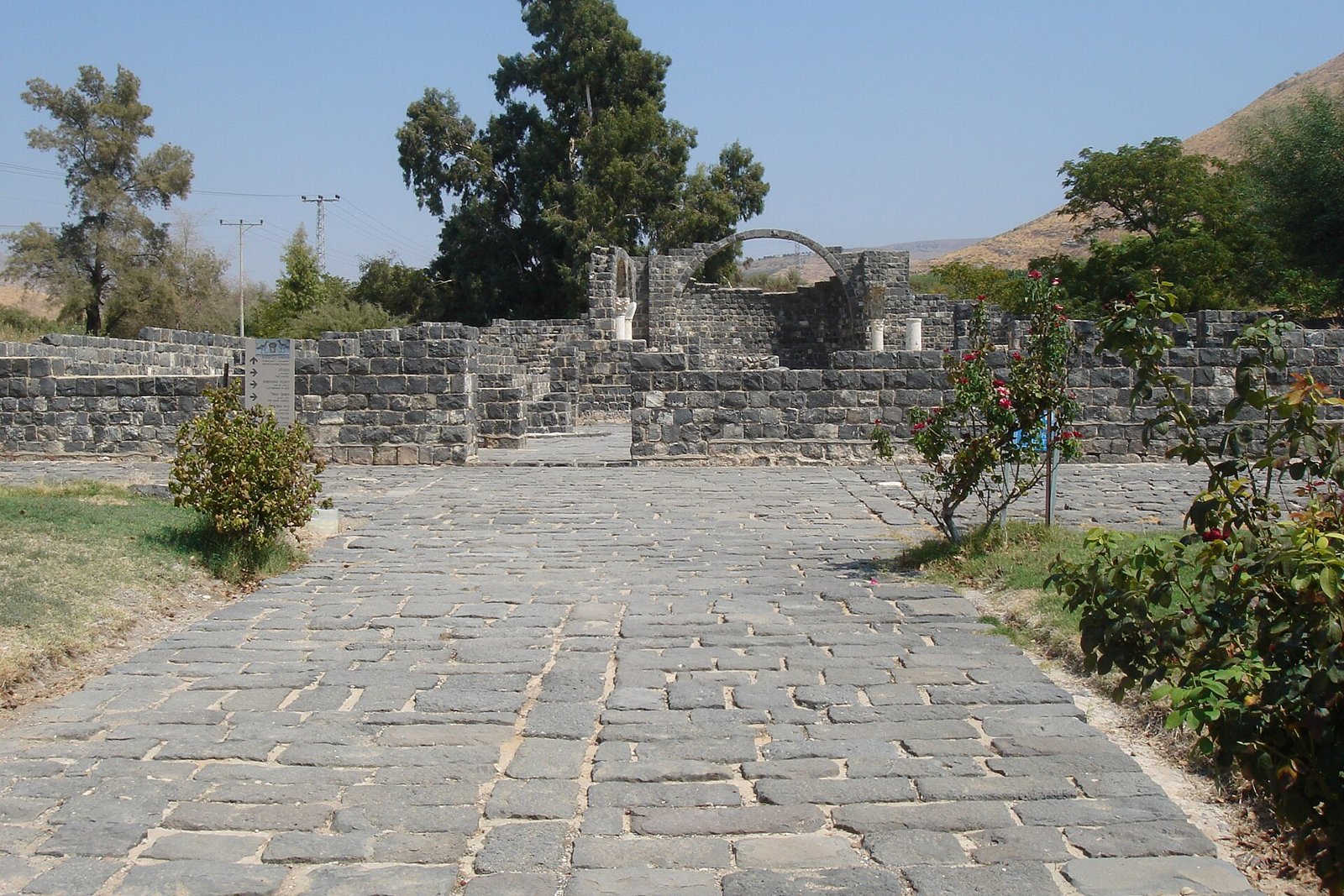
Traditional siteThe ruins of the Byzantine church at Kursi, seen along the paved path that leads to it. Goldstar, via Wikimedia Commons, CC BY-SA 3.0.
And when he was come to the other side into the country of the Gergesenes, there met him two possessed with devils, coming out of the tombs, exceeding fierce, so that no man might pass by that way.
Matthew 8:28, KJV
Matthew, Mark and Luke tell how Jesus crossed the Sea of Galilee, freed a man (two men in Matthew) from many devils, and let the devils go into a herd of about 2,000 pigs, which "ran violently down a steep place into the sea" (Mark 5:13). The place name differs between the Gospels and between the old hand-copied Greek manuscripts: the KJV reads "Gergesenes" in Matthew 8:28 and "Gadarenes" in Mark 5:1 and Luke 8:26, while most modern Bibles, such as the NASB, read "Gadarenes" in Matthew and "Gerasenes" in Mark and Luke. Kursi is a ruin on the east shore of the lake where Christians of the Byzantine period (the Christian Roman empire, about AD 330 to 640) built a large walled monastery in the 400s AD to mark the event.
Where it is today
Kursi National Park, on the east shore of the Sea of Galilee, about 5 to 6 kilometres north of Kibbutz Ein Gev. Gadara is today the town of Umm Qais and Gerasa is Jerash, both in Jordan. Finds from Kursi are shown at the Golan Archaeological Museum in Katzrin.
Date
Monastery and church built in the 400s AD; a mosaic in the baptism room is dated AD 585. Damaged in AD 614, repaired, and ruined by the earthquake of AD 749. Found by road builders in 1970 and excavated 1971 to 1974.
Why this label: The Gospels place this event on the east side of the lake, in non-Jewish country, and Kursi is a real place there that Christians honoured from at least the 400s AD, perhaps earlier. But the Gospel copies disagree on the place name, other spots on the east and south-east shore have been suggested, and nothing found on the site ties the event to this exact spot.
Good to know
The three names: Gerasa (Jerash) was a large Greek-style city roughly 50 kilometres from the lake, and Gadara (Umm Qais) was about 10 kilometres away, so neither town stood on the shore. The Gospels speak of the "country" of these people rather than the town itself, and a city's farmland could reach far beyond its walls; Gadara's lands may have reached the lake.
Early writers: In the 230s AD the scholar Origen wrote that Gerasa had no lake near it, and that at an old town called Gergesa by the lake "there is a steep place abutting on the lake" which was pointed out as the spot. Eusebius, in the early 300s, also says a village on the hills by the lake was shown as the place. Some scholars think the name "Gergesenes" entered later copies because of Origen's suggestion, while others think it keeps the true local name.
The site: Kursi has a walled monastery, a church with mosaic floors, a bathhouse for pilgrims, and a small chapel on the hill about 200 metres to the south, built against a large boulder, which may have marked where the herd was believed to have run down.
Doubting view: The archaeologist Rami Arav has pointed out that no remains from the time of Jesus were found at the monastery, and on that ground he called it a most unlikely place for the event, though he allowed that the chapel on the hill might mark it.
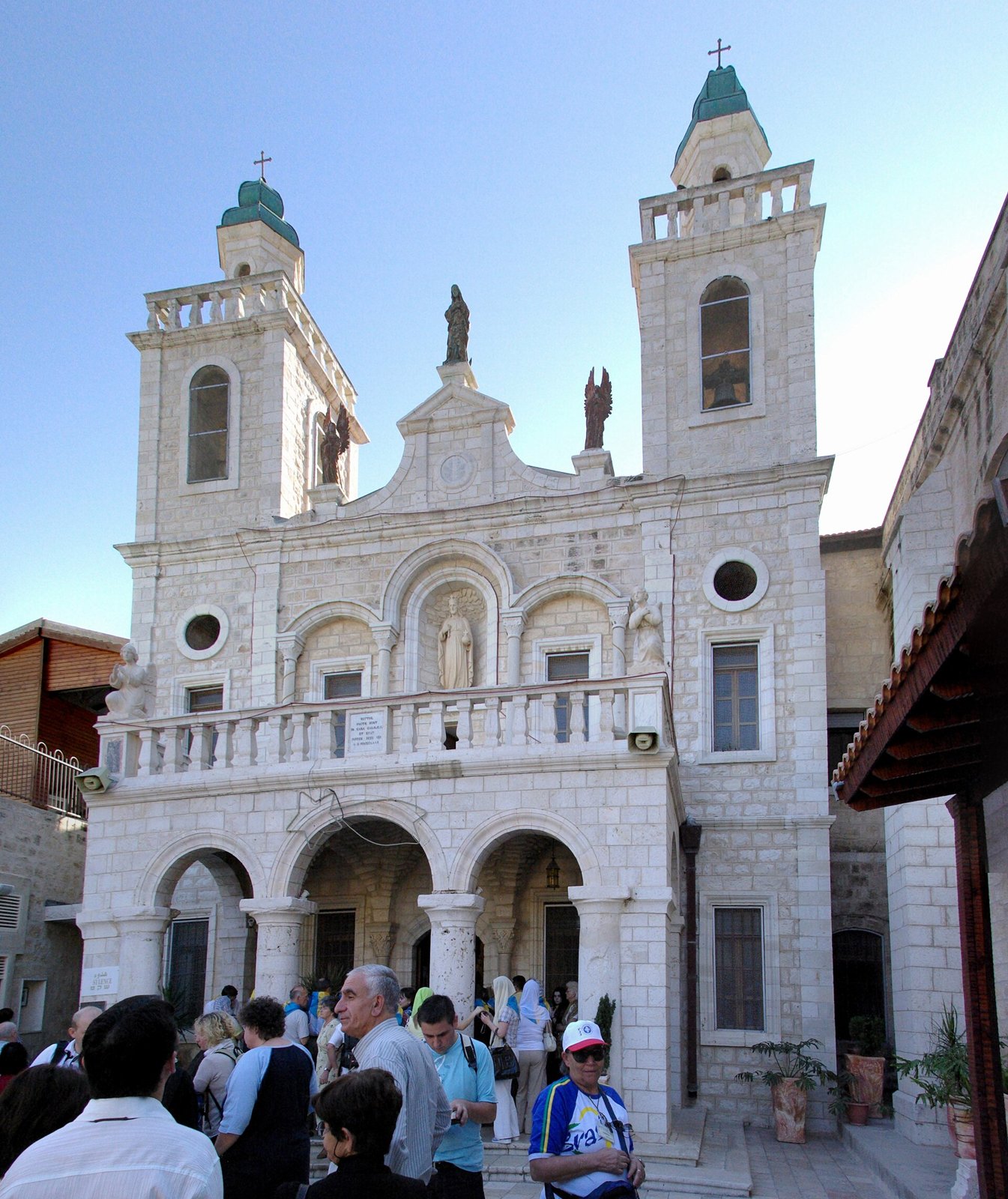
DisputedThe Catholic Wedding Church in Kafr Kanna. Berthold Werner, via Wikimedia Commons, Public domain.
This beginning of miracles did Jesus in Cana of Galilee, and manifested forth his glory; and his disciples believed on him.
John 2:11, KJV
John's Gospel says Jesus did His first miracle, turning water into wine at a wedding, at Cana of Galilee (John 2:1-11). He was at Cana again when He healed an official's son who lay sick at Capernaum (John 4:46), and the disciple Nathanael came from Cana (John 21:2). Two places near Nazareth are the main candidates: Kafr Kanna, a town a few kilometres north-east of Nazareth with churches built to mark the wedding, and Khirbet Qana ("the ruin of Cana"), an abandoned hilltop village about 12 to 13 kilometres north of Nazareth.
Where it is today
Lower Galilee, northern Israel. Kafr Kanna is a living town with the Catholic (Franciscan) Wedding Church and a Greek Orthodox church. Khirbet Qana is an open ruin on a hill above the Beit Netofa Valley.
Date
Khirbet Qana: a village lived in from the 200s BC to the 600s AD, with a Christian pilgrim cave used from about the 500s to the 1100s (lab tests on material from the cave date its last major repairs to between 1024 and 1217). Kafr Kanna: a Jewish village of the Roman period at Karm er-Ras on its edge; the present Catholic church was built about 1881 and enlarged 1897 to 1905, over remains that include a synagogue of the 300s or 400s.
Why this label: Cana was a real village, but no inscription naming it has been found at either site. Each candidate now has a serious archaeological case published by its own excavators, and they disagree.
Good to know
Case for Khirbet Qana: Digs begun by Douglas Edwards in 1998 and later led by Tom McCollough found a Jewish village of Jesus' time with ritual baths and a building that may have been a synagogue. On its slope is a cave used for Christian worship, with crosses, Greek writing reading "Lord Jesus", an altar made from a stone coffin lid, and a shelf for stone jars, which recalls the six stone water pots of John 2:6. Pilgrims of the Crusader period (1100s and 1200s), such as Saewulf (about 1102) and Burchard of Mount Sion (1283), placed Cana here, and the ruin still carries the name Qana. McCollough says Kafr Kanna has given no clear sign of a Jewish village from Jesus' time.
Case for Kafr Kanna: Archaeologist Yardenna Alexandre dug at Karm er-Ras, beside Kafr Kanna, between 1999 and 2011 and found a Jewish village of the Roman period; in a 2025 Israel Antiquities Authority report she argues that this village was Cana. The earliest pilgrims put Cana close to Nazareth. A letter from Jerome's friend Paula, written in the 380s, says Cana is near Nazareth. The pilgrim Theodosius (about AD 530) puts it 5 Roman miles (about 7 km) from Nazareth, which fits Kafr Kanna better than Khirbet Qana. About AD 570 a pilgrim from Piacenza saw two of the jars and washed in a spring there. A Franciscan scholar notes that Kafr Kanna has a spring and Khirbet Qana does not. Both sides read the same old pilgrim reports in their own favour.
Other candidates: Qana in southern Lebanon and a spring near Reineh, north-east of Nazareth, have also been suggested, but they have fewer supporters.
What it shows: A real Jewish village, stone jars or a pilgrim cave shows where people believed Cana was and how they lived; it cannot prove the miracle.
Tabgha (loaves and fishes) and the Mount of Beatitudes
Matthew 5:1 · Mark 6:30-44 · Luke 9:10
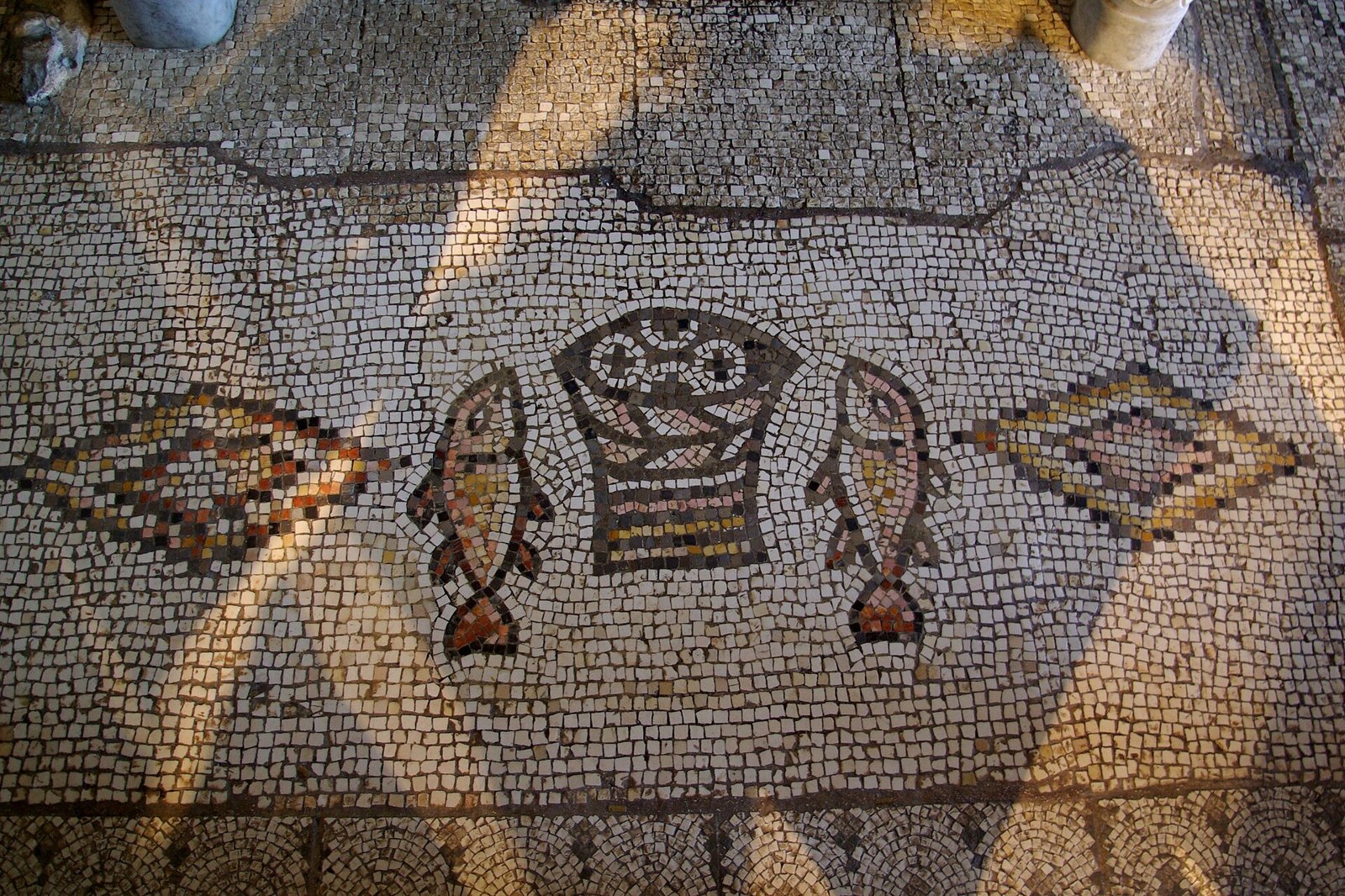
Traditional siteThe mosaic of a basket of loaves between two fish, Church of the Multiplication, Tabgha. Berthold Werner, via Wikimedia Commons, Public domain.
And when he had taken the five loaves and the two fishes, he looked up to heaven, and blessed, and brake the loaves, and gave them to his disciples to set before them; and the two fishes divided he among them all.
Mark 6:41, KJV
Tabgha is a spot on the north-west shore of the Sea of Galilee, about 3 kilometres south-west of Capernaum; its name comes from the Greek Heptapegon, "seven springs". Since at least the late 300s AD Christians have honoured it as the place where Jesus fed the 5,000 with five loaves and two fishes (Mark 6:30-44). The Church of the Multiplication stands there over the remains of churches of the Byzantine period (the Christian Roman empire, about AD 330 to 640) and keeps a well-known floor mosaic of a basket of loaves between two fish. On the hill above, the Mount of Beatitudes is the traditional place where Jesus "went up into a mountain" and gave the Sermon on the Mount (Matthew 5:1).
Where it is today
Tabgha, on the north-west shore of the Sea of Galilee in northern Israel. The Church of the Multiplication is cared for by Benedictine monks. The Church of the Beatitudes on the hill above is cared for by Franciscan sisters. Both are open to visitors.
Date
Tabgha: a small church about AD 350, enlarged about AD 480 with mosaic floors, probably destroyed in AD 614; excavated in 1932; the present church was finished in the early 1980s. Mount of Beatitudes: a small Byzantine church of the late 300s lower on the slope, used until the 600s; the present church was built 1936 to 1938.
Why this label: Both are real holy places of the Byzantine period with a tradition reaching back to at least the late 300s AD. No inscription or Gospel detail shows that either event happened at these exact spots.
Good to know
How old: The pilgrim Egeria, in the early 380s, described a grassy field by seven springs where the Lord fed the people, with the stone on which He laid the bread made into an altar, and "near there on a mountain" a cave where He spoke the Beatitudes. Her words on Galilee survive only because a monk, Peter the Deacon, copied them into his own book in the 1100s, so some details may be his.
The mosaic: The loaves and fish mosaic was laid in the 400s or 500s, more than 400 years after Jesus. It shows what Byzantine Christians believed, not proof of the spot.
A Gospel question: Luke 9:10 places the feeding in "a desert place belonging to the city called Bethsaida", and John 6:17 says the disciples then "went over the sea toward Capernaum", which points to the north-east shore rather than Tabgha. But Mark 6:45 sends them by boat "to the other side before unto Bethsaida", which some read as pointing the other way, and the Gospels never name the exact field. Jerome Murphy-O'Connor, author of an Oxford archaeological guide to the Holy Land, suggested that because Tabgha was a well-watered spot where Byzantine pilgrims stopped to eat, the food miracles came to be placed there, and the sermon was then placed on the nearby hill.
The sermon: Other proposed hills include Mount Arbel and the Horns of Hattin. Luke 6:17 says Jesus "stood in the plain", which some read as a level place on a hillside.
The mountain of the Transfiguration: Mount Tabor or Mount Hermon?
Matthew 17:1-9 · Mark 9:2-8 · Luke 9:28-36
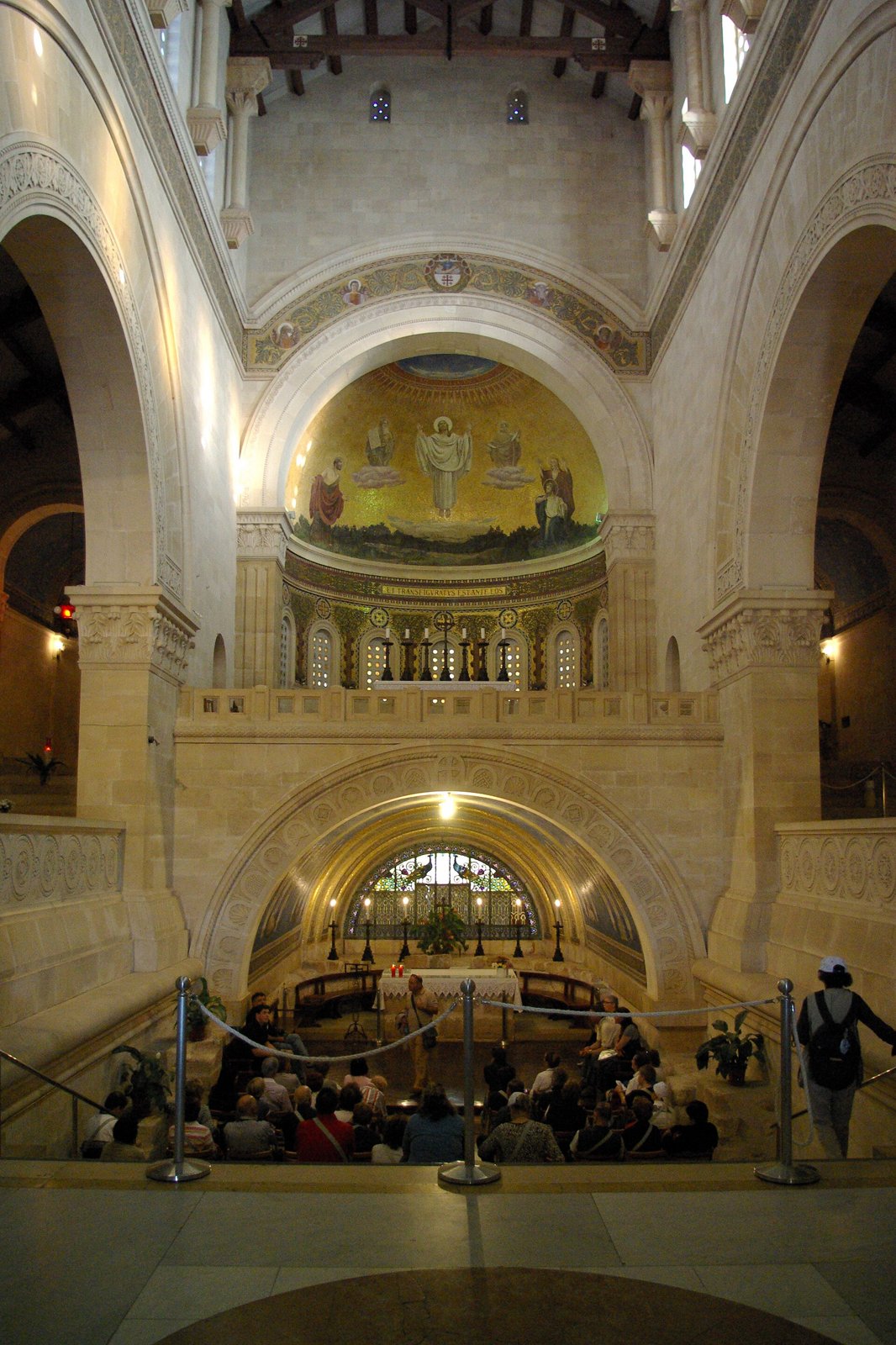
DisputedInside the Church of the Transfiguration on Mount Tabor: the mosaic of the Transfiguration above the altar, and the lower chapel below it. Berthold Werner, via Wikimedia Commons, Public domain.
And after six days Jesus taketh with him Peter, and James, and John, and leadeth them up into an high mountain apart by themselves: and he was transfigured before them.
Mark 9:2, KJV
Matthew, Mark and Luke tell how Jesus took Peter, James and John up "an high mountain apart", where His face shone and Moses and Elijah (Elias in the KJV) appeared with Him. None of the Gospels names the mountain, and 2 Peter 1:18 calls it only "the holy mount". Since the 300s AD Christians have pointed to Mount Tabor, a lone rounded hill in Lower Galilee, where the Franciscan Church of the Transfiguration now stands. Many scholars since the 1800s have preferred Mount Hermon, the high, snow-capped mountain above Caesarea Philippi, where the Gospels place Jesus about a week before (Mark 8:27).
Where it is today
Mount Tabor rises about 575 metres above sea level in Lower Galilee, east of Nazareth, in northern Israel; on its top are the Franciscan Church of the Transfiguration and a Greek Orthodox church. Mount Hermon, about 2,814 metres high, rises north of the Sea of Galilee above the springs of Banias (ancient Caesarea Philippi).
Date
Tradition for Tabor: in writing from about AD 348 (Cyril of Jerusalem), possibly earlier. Churches on Tabor: Byzantine, that is, Christian Roman (300s to 500s), Crusader (1100s), and the present Franciscan church, finished in 1924 (architect Antonio Barluzzi).
Why this label: The Gospels do not name the mountain, so every choice is a reasoned guess. The Tabor tradition is first written down for certain about 300 years after the event (an earlier mention credited to Origen is doubted), while Mount Hermon fits the places named in the Gospel story, and informed scholars still disagree.
Good to know
Case for Tabor: Cyril of Jerusalem named Tabor in his teaching lectures of about AD 348, and Jerome wrote in AD 404 that his friend Paula climbed "mount Tabor whereon the Lord was transfigured". A comment on Psalm 89:12, which names "Tabor and Hermon" together, is credited to Origen in the 200s and also names Tabor, though not all scholars accept that Origen wrote it. Defenders say the "six days" leave time to travel south from Caesarea Philippi, and that the crowd with scribes Jesus met on coming down (Mark 9:14) fits a Jewish area better than Hermon.
Case for Hermon: Mark 8:27 places Jesus in the towns of Caesarea Philippi just before, Hermon is the high mountain right there, and only afterward do the Gospels say "they departed thence, and passed through Galilee" (Mark 9:30). Josephus says he fortified Tabor during the war of AD 66 to 67, and some take this to mean people lived on the top, making it a poor place to be "apart". Others answer that Josephus speaks of fortifying the hill, not of a town on it.
Other views: Some suggest Mount Meron (Jebel Jarmaq), the highest mountain inside Galilee itself.
The church: The present Church of the Transfiguration stands on the ruins of a Byzantine church and a Crusader church. Mount Tabor itself is covered on the Joshua, Judges and Ruth page.
 LearnAboutHim