Real places you can visit and real objects you can see in museums, connected to the books of Ezra, Nehemiah and Esther: King Cyrus and the return from exile, the rebuilding of the temple and the walls of Jerusalem, the Jews in the Persian court, and the tombs of the kings and prophets of that time. Each one is marked honestly, so you can tell solid evidence from tradition and from claims that are still argued over.
ConfirmedThe place or object is real and is clearly the one the Bible names. For a written object, such as an inscription or a scroll, it means the object is genuine and its words are read with confidence, not that every event it mentions is proven.11
Traditional siteA real place that long tradition links to the Bible, but the exact spot cannot be proven.6
DisputedInformed people disagree, or the claim rests on weak evidence.2
BackgroundShows the world the Bible describes, but does not name a Bible person or event.4
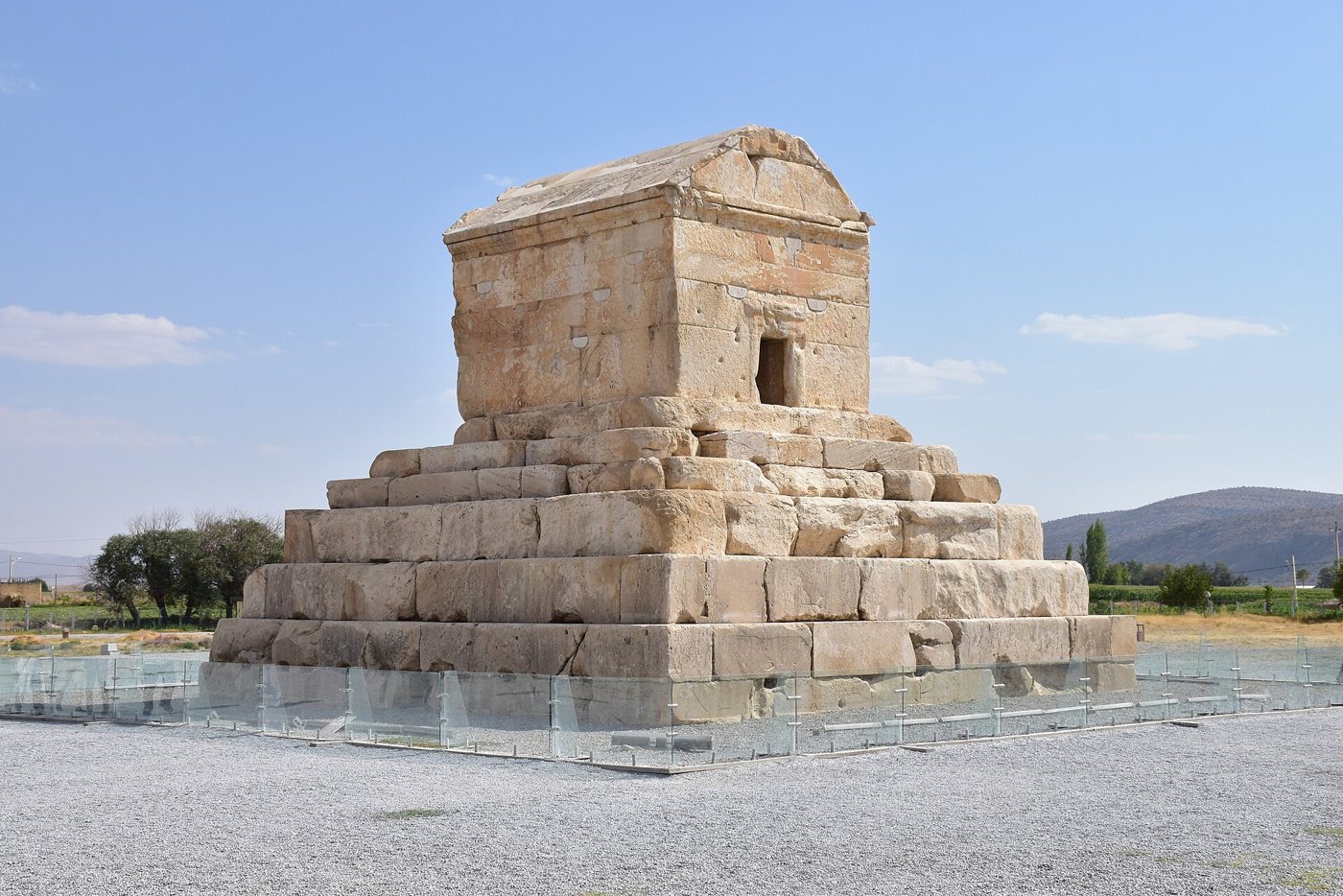
ConfirmedThe stepped stone tomb of Cyrus the Great at Pasargadae, Iran. Bernd81, via Wikimedia Commons, CC BY-SA 4.0.
That saith of Cyrus, He is my shepherd, and shall perform all my pleasure: even saying to Jerusalem, Thou shalt be built; and to the temple, Thy foundation shall be laid.
Isaiah 44:28, KJV
This small stone building with a two-sloped (gabled) roof sits on top of six huge stone steps on the plain at Pasargadae in southern Iran. Pasargadae was the first royal capital of the Persian Empire, founded by Cyrus the Great in the 500s BC. The Bible names Cyrus as the king who let the Jews go home and rebuild the temple in Jerusalem (Ezra 1:1-4; 2 Chronicles 36:22-23). Isaiah calls him the LORD's "shepherd" and "anointed" (Isaiah 44:28; 45:1). The Bible does not mention his death or his tomb.
Where it is today
Pasargadae, Fars province, Iran, about 1 km south-west of the palace ruins. It is part of the Pasargadae World Heritage Site, which UNESCO listed in 2004. Access can change, so check before planning a visit.
Date
Built about 540 to 530 BC, judging by its building methods, which match other buildings from Cyrus's reign. Cyrus died about 530 BC. Alexander the Great saw the tomb in 330 BC and came back in early 324 BC.
Why this label: No inscription naming Cyrus survives on the tomb, but scholars broadly accept it as his. It matches the description handed down from Aristobulus, who went inside it, it stands in Cyrus's own capital, and its building methods fit the time of Cyrus. A few scholars have proposed a different building at Pasargadae, but most do not accept this.
Good to know
Arrian and Strabo: Aristobulus travelled with Alexander the Great and went inside the tomb himself. His own book is lost, but two later writers used it: Arrian (Anabasis 6.29, written in the 100s AD) and Strabo (Geography 15.3.7, written around the time of Jesus). They describe a stone base with a small roofed room on top. The door was so narrow that one small man could only just squeeze through. Inside were a golden coffin and a couch with golden feet. When Alexander came back in 324 BC, the tomb had been robbed. He ordered Aristobulus to repair it and to close the door with stone and plaster.
The inscription: Arrian gives it as: "O man, I am Cyrus son of Cambyses, who founded the empire of Persia and ruled over Asia. Do not grudge me my monument." Strabo, also quoting Aristobulus, gives almost the same words.
Other versions: Strabo also reports a different account by Onesicritus, another man who travelled with Alexander. Onesicritus said the tomb was a tower of ten storeys and gave a shorter inscription: "Here I lie, Cyrus, king of kings." Plutarch (Life of Alexander 69) gives a longer version that ends: "Do not, therefore, begrudge me this little earth which covers my body." So the ancient writers do not agree word for word, and Aristobulus may have written his version from memory.
No inscription: No trace of any of these inscriptions has been found on the tomb or anywhere else at Pasargadae. Short labels on the palaces there do read "I am Cyrus the king, an Achaemenid" (the name of the Persian royal family) in three languages, but scholars debate whether Cyrus or a later king had them carved. Nothing of Cyrus's body or coffin has been found.
Other names: From at least the 1400s local people called the building the tomb of the "Mother of Solomon", and in the early 1200s a local ruler made it part of a small mosque. In 1812 the British diplomat James Morier pointed out that it looked like Arrian's description. Other travellers and scholars took up the idea, and by the early 1900s most scholars agreed that it was the tomb of Cyrus. A few scholars, writing in the 1950s and 1960s, argued that a stone tower at Pasargadae (the Zendan-e Soleyman) was the real tomb, but most do not accept this.
Isaiah and Cyrus: The traditional view is that Isaiah wrote about 700 BC, so naming Cyrus was a prophecy given long before he was born. Many scholars instead date Isaiah chapters 40 to 55 to near the end of the exile, about 540 BC. The tomb does not settle that question either way.
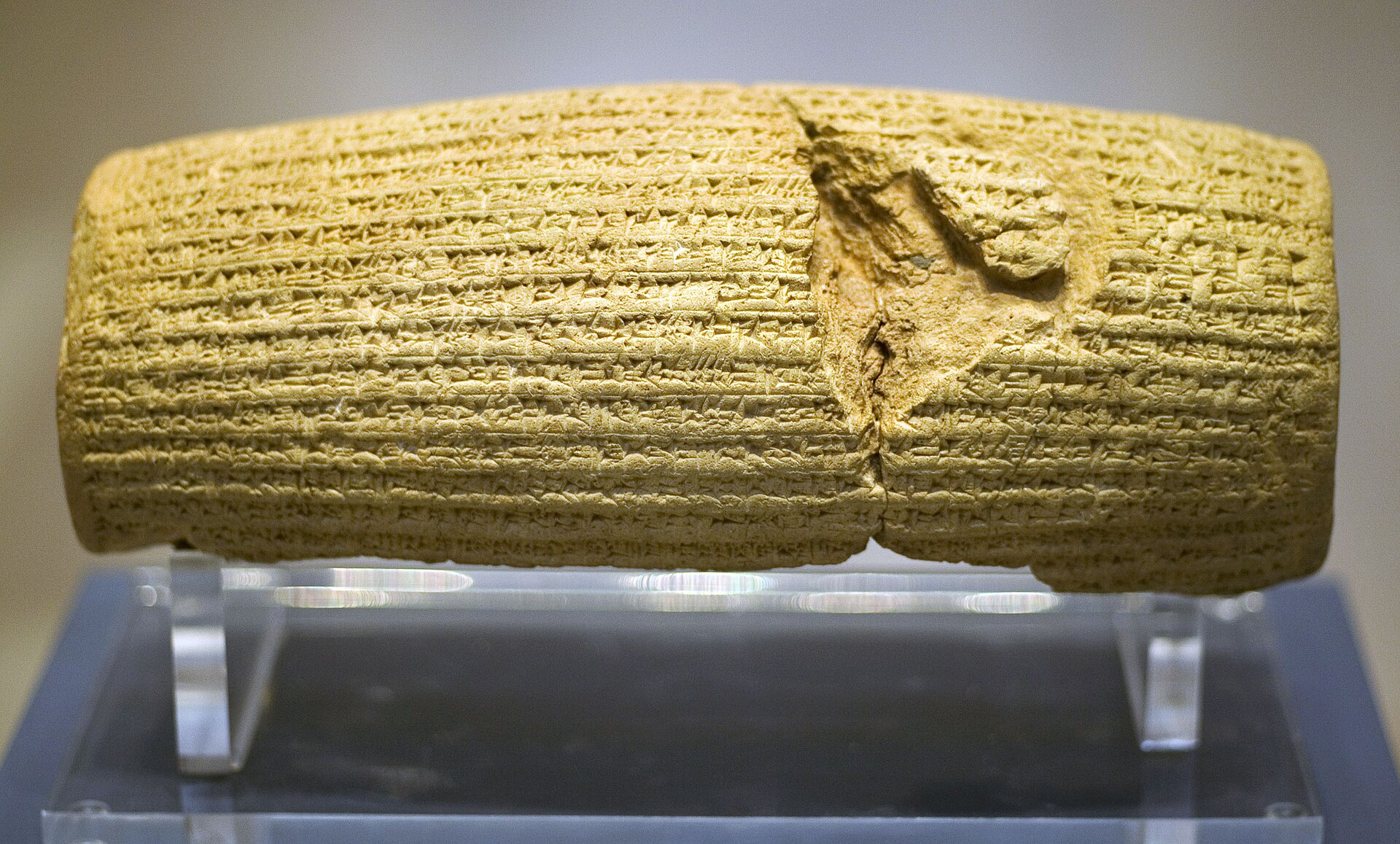
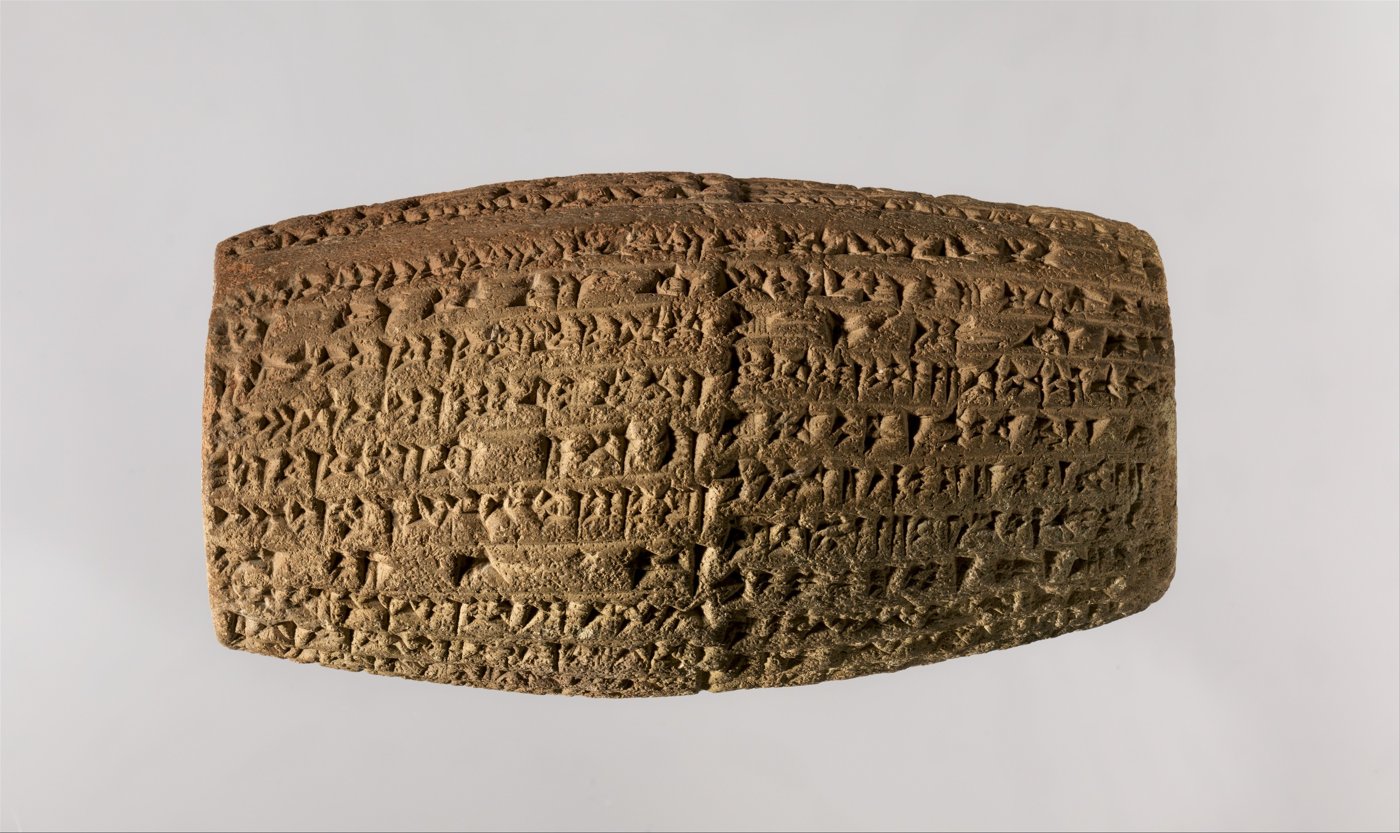
ConfirmedFront of the Cyrus Cylinder, British Museum. Prioryman, via Wikimedia Commons, CC BY-SA 3.0.
Thus saith Cyrus king of Persia, The LORD God of heaven hath given me all the kingdoms of the earth; and he hath charged me to build him an house at Jerusalem, which is in Judah.
Ezra 1:2, KJV
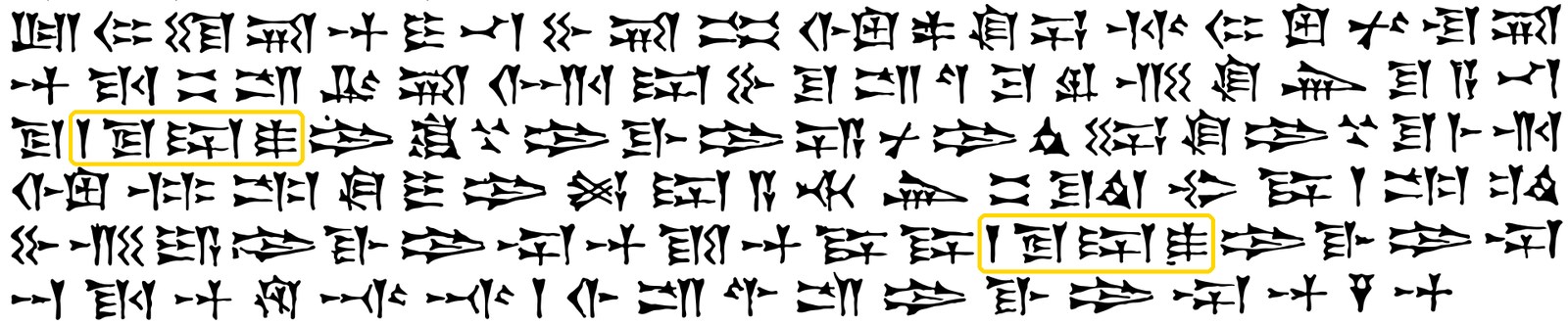
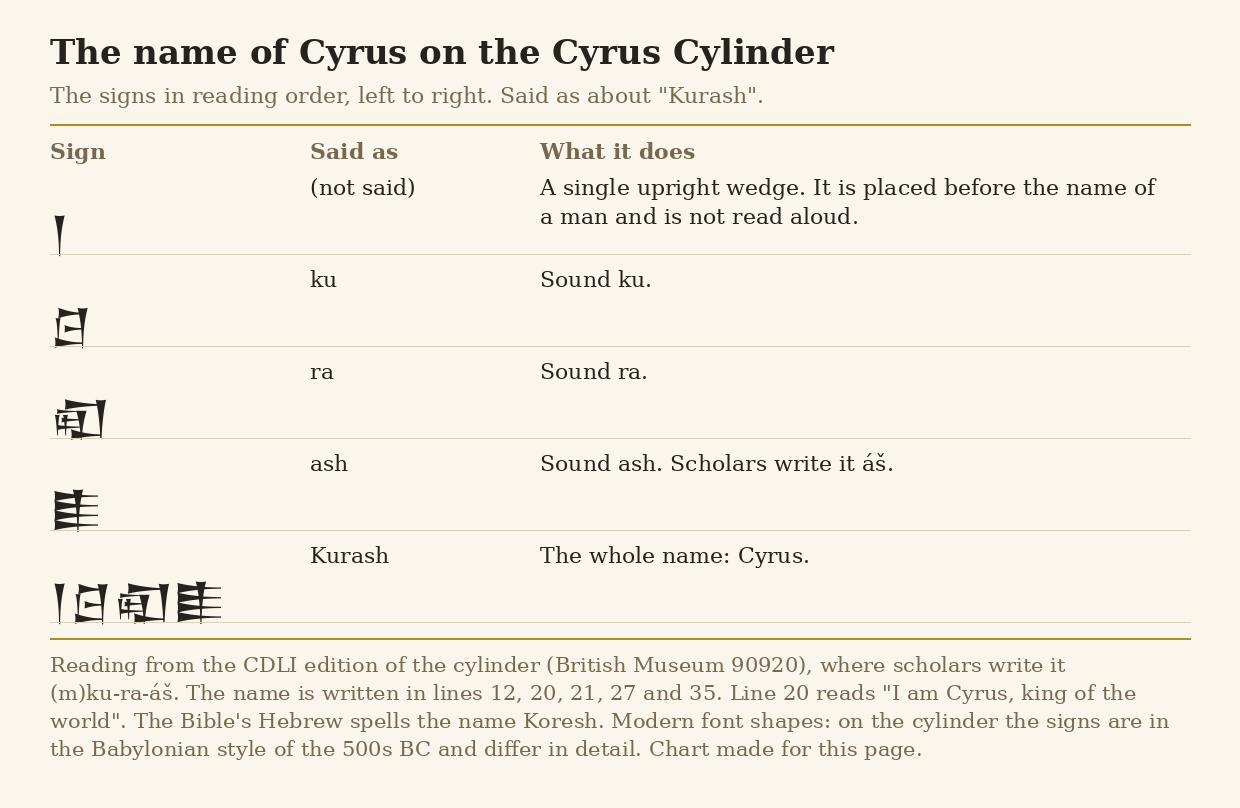
The Cyrus Cylinder is a barrel-shaped clay object about 22 centimetres long. It is written in cuneiform (writing made of wedge-shaped marks pressed into clay) in the Babylonian language, soon after Cyrus captured Babylon in 539 BC. It was made to be buried in the foundations of Babylon's city wall. In it Cyrus says that Marduk, the chief god of Babylon, chose him, that he entered Babylon without a battle, that he sent the images of gods back to their own temples, and that he gathered their peoples and returned them to their homes. It does not name the Jews, Judah or Jerusalem. The Bible says that in his first year Cyrus let the Jews go home, rebuild the temple in Jerusalem and take back the temple vessels (Ezra 1:1-11; 6:3-5). The images below show the name of Cyrus as it is written in the cylinder's text, in a drawing of lines 15 to 21 and in a chart of its signs.
A drawing, not a photo. This is part of a drawing of lines 15 to 21 of the Cyrus Cylinder, made in 2012 by Charon77 after the copy in E. A. Wallis Budge's book Babylonian Life and History (1884). The drawing runs the text on in rows that do not match the lines on the cylinder. The yellow boxes, added for this page, mark the two places in this passage where the name Cyrus is written: line 20, "I am Cyrus, king of the world", and line 21, "grandson of Cyrus". Each box holds the four signs of the name, explained in the chart below. Charon77, via Wikimedia Commons, after E. A. Wallis Budge (1884), Public domain.The four signs that spell the name Cyrus on the cylinder, with how each one is said. Chart made for this page, free to reuse.
Where it is today
British Museum, London, museum number 90920 (registration number 1880,0617.1941). Hormuzd Rassam found it at Babylon, in Iraq, in 1879. A small piece that had broken off ended up at Yale University (NBC 2504); it was identified in 1970 and joined to the cylinder in 1972.
Date
Written soon after Cyrus took Babylon in October 539 BC. The British Museum dates it to after 539 BC.
Why this label: The object is real, well studied and clearly comes from Cyrus's government, and it shows that he publicly sent gods and peoples back to their homes. It does not name the Jews or Jerusalem, so it supports the kind of policy Ezra describes, not the Jewish decree itself.
Good to know
The key lines: In Irving Finkel's British Museum translation, Cyrus names cities such as Ashur and Susa, and "the sanctuaries across the river Tigris", whose gods he sent back to their shrines. Then he goes on to say: "I collected together all of their people and returned them to their settlements." All the places named are in Mesopotamia and the lands next to it.
Silent on the Jews: The cylinder never mentions the Jews, Judah, Jerusalem or the God of Israel.
Fitting view: Many Bible scholars see the cylinder as evidence that Cyrus really did send peoples home and restore temples, which fits Ezra 1:1-4 and 6:3-5. In Ezra, Cyrus gives the credit to "the LORD God of heaven", while in the cylinder he gives the credit to Marduk. Supporters say this fits a king who spoke to each people in the words of their own religion. The British Museum's own notes say that the return of the Jews and of other peoples was a major change from the earlier Assyrian and Babylonian practice. The cylinder returns the images of gods, and Ezra 1:7-11 says Cyrus gave back the temple vessels that Nebuchadnezzar had taken; the temple in Jerusalem had no image of God.
Doubting view: Other historians stress that the cylinder is royal propaganda (a message written to make the king look good) aimed at Babylonians. It follows the pattern of older Babylonian royal inscriptions, describes the last Babylonian king, Nabonidus, as wicked, and does not describe a rule for the whole empire. Some say it offers no proof at all about the Jewish exiles. Some, such as Lester Grabbe, also doubt that the decree as Ezra gives it is genuine, and think the return was a slow trickle over many years. The decree for the Jews is known only from Ezra and 2 Chronicles.
Copies on tablets: In January 2010 the British Museum announced that two clay fragments in its collection since 1881, from Dailem near Babylon, belong to a tablet with the same text. Wilfred Lambert and Irving Finkel identified them. The museum says this shows the text was probably a proclamation spread widely across the empire, not only buried in a wall.
Human rights claim: The cylinder is sometimes called the first charter of human rights. Most historians say this reads modern ideas into it.
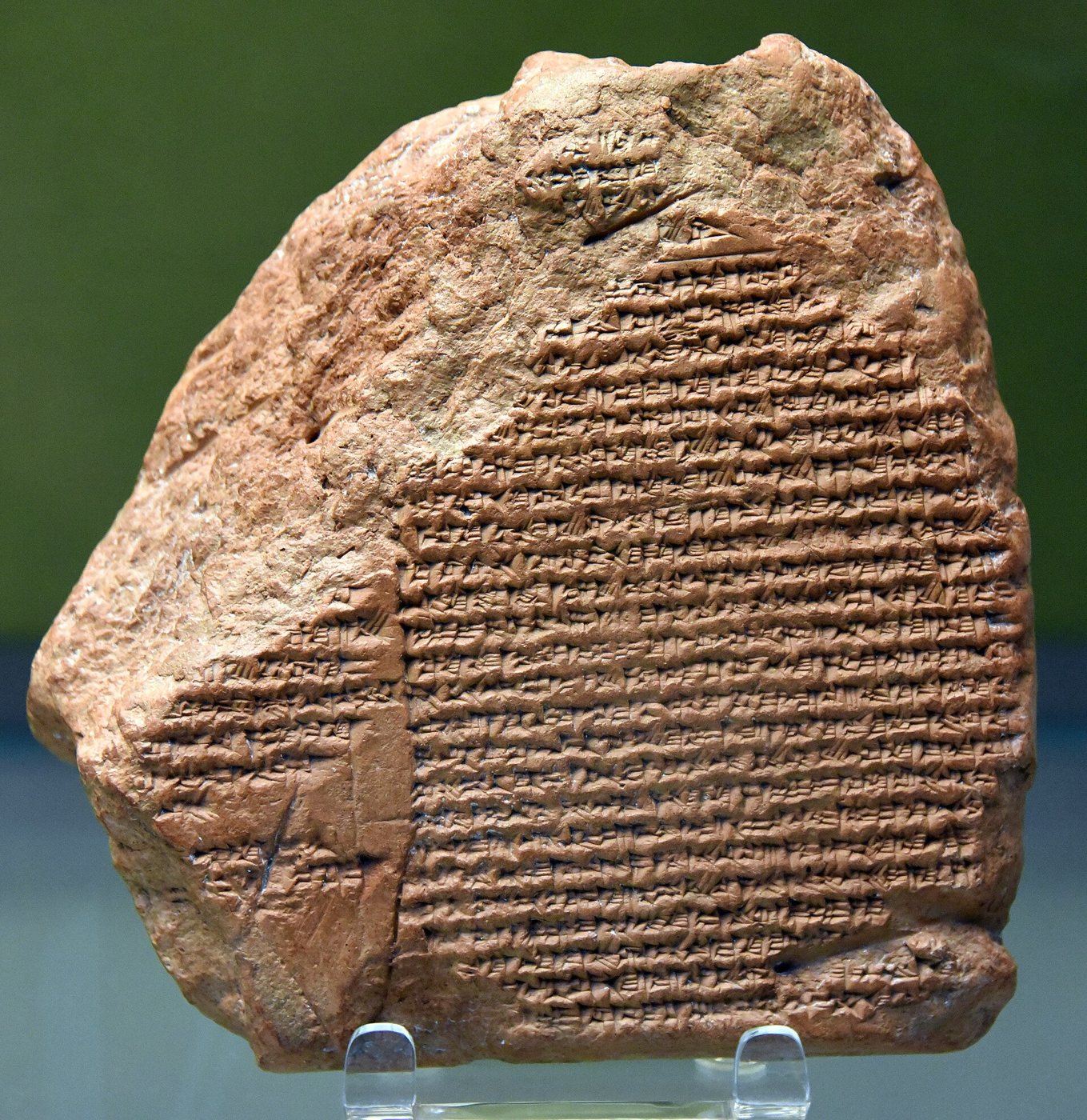
ConfirmedThe back of the Nabonidus Chronicle tablet, British Museum. The large column on the right is column 3, which tells of the fall of Babylon in 539 BC. The lines about "the king's son" are on the other side. Osama Shukir Muhammed Amin, via Wikimedia Commons, CC BY-SA 4.0.
Then commanded Belshazzar, and they clothed Daniel with scarlet, and put a chain of gold about his neck, and made a proclamation concerning him, that he should be the third ruler in the kingdom.
Daniel 5:29, KJV
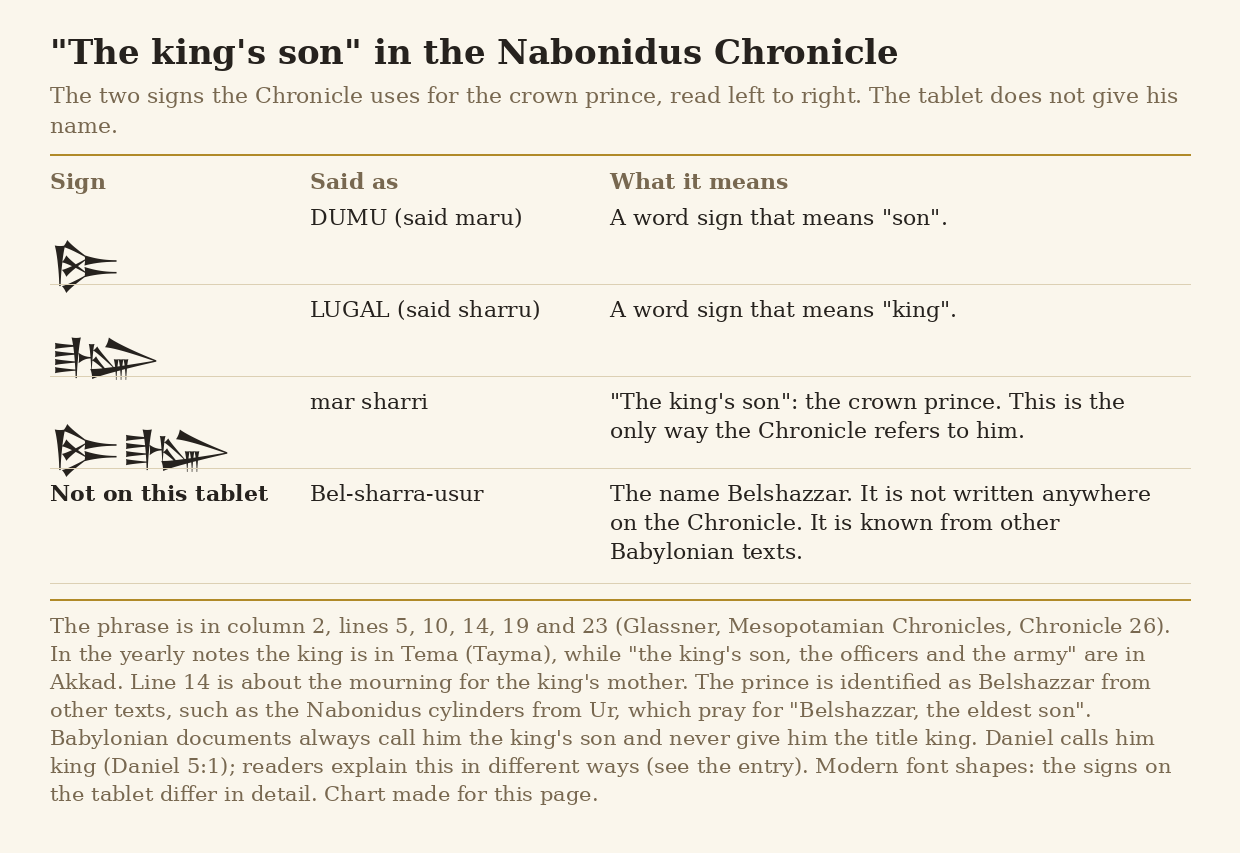
The Nabonidus Chronicle is a damaged clay tablet that records, year by year, the reign of Nabonidus, the last king of Babylon (556 to 539 BC). It says that for many years the king stayed at the oasis of Tayma in Arabia, while "the prince" stayed in Babylonia with the officers and the army. In 539 BC Cyrus beat the Babylonian army at Opis on the Tigris. His army then took Sippar and entered Babylon "without battle", and Cyrus himself entered the city 17 days later. Daniel 5 tells of Belshazzar's last night as ruler of Babylon, and clay cylinders of Nabonidus from Ur name Belshazzar as the king's eldest son. The chart below shows the two signs the Chronicle uses for "the king's son"; the name Belshazzar itself is not written on the tablet.
The two signs the Nabonidus Chronicle uses for the crown prince, "the king's son". The chart also makes clear that the name Belshazzar is not written on this tablet. Chart made for this page, free to reuse.
Where it is today
British Museum, London, museum number 35382 (registration Sp 2, 964). The museum bought it from the dealers Spartali and Co. in 1879 and gives Babylon as the findspot. Four cylinders of Nabonidus naming Belshazzar were found at Ur in 1854; at least one is in the British Museum.
Date
The events run from 556 to 539 BC. Babylon fell on 12 October 539 BC, and Cyrus entered the city on 29 October. The British Museum tablet is a later copy, probably made in the 200s or 100s BC; the original text was probably written in the late 500s or early 400s BC.
Why this label: This Babylonian record agrees with the Bible that Babylon fell to the Persians quickly, and other Babylonian texts confirm that Belshazzar was the king's son who ruled at home. Daniel's account of the feast, the writing on the wall and Belshazzar's death is not recorded outside the Bible.
Good to know
Belshazzar named: The clay cylinders of Nabonidus from Ur end with a prayer to the moon god for "Belshazzar, the eldest son, my offspring". Henry Rawlinson announced his reading of these cylinders in 1854. Other Babylonian documents show Belshazzar acting for his father while the king was away, and a Babylonian poem called the Verse Account of Nabonidus says Nabonidus entrusted the kingship to him.
King or prince: Daniel calls Belshazzar king (Daniel 5:1; 8:1). Babylonian records always call him "son of the king" and never give him the title king. The Chronicle also says that in the years the king stayed away, the New Year festival in Babylon, which needed the king himself, was not held, so the prince could not take his place in it. Many readers see him as the ruler in practice while his father was away, and note that this may explain why Daniel was offered the place of "third ruler in the kingdom" (Daniel 5:29). Others count the title king in Daniel as an error.
Silent points: The Chronicle does not name Belshazzar; it only speaks of "the prince". No Babylonian source says how or when he died. Daniel 5:2 calls Nebuchadnezzar his "father", but his real father was Nabonidus, who was not from Nebuchadnezzar's family. Some explain that the word "father" can also mean an earlier king or an ancestor, perhaps through his mother, but this is not proven.
Darius the Mede: Daniel 5:31 says "Darius the Median took the kingdom". No king by this name is known from Babylonian or Persian records. Some identify him with Gubaru, the officer the Chronicle says appointed the district officers in Babylon, or with Cyrus himself. Others think he cannot be identified. Babylon itself is covered on the Genesis page.
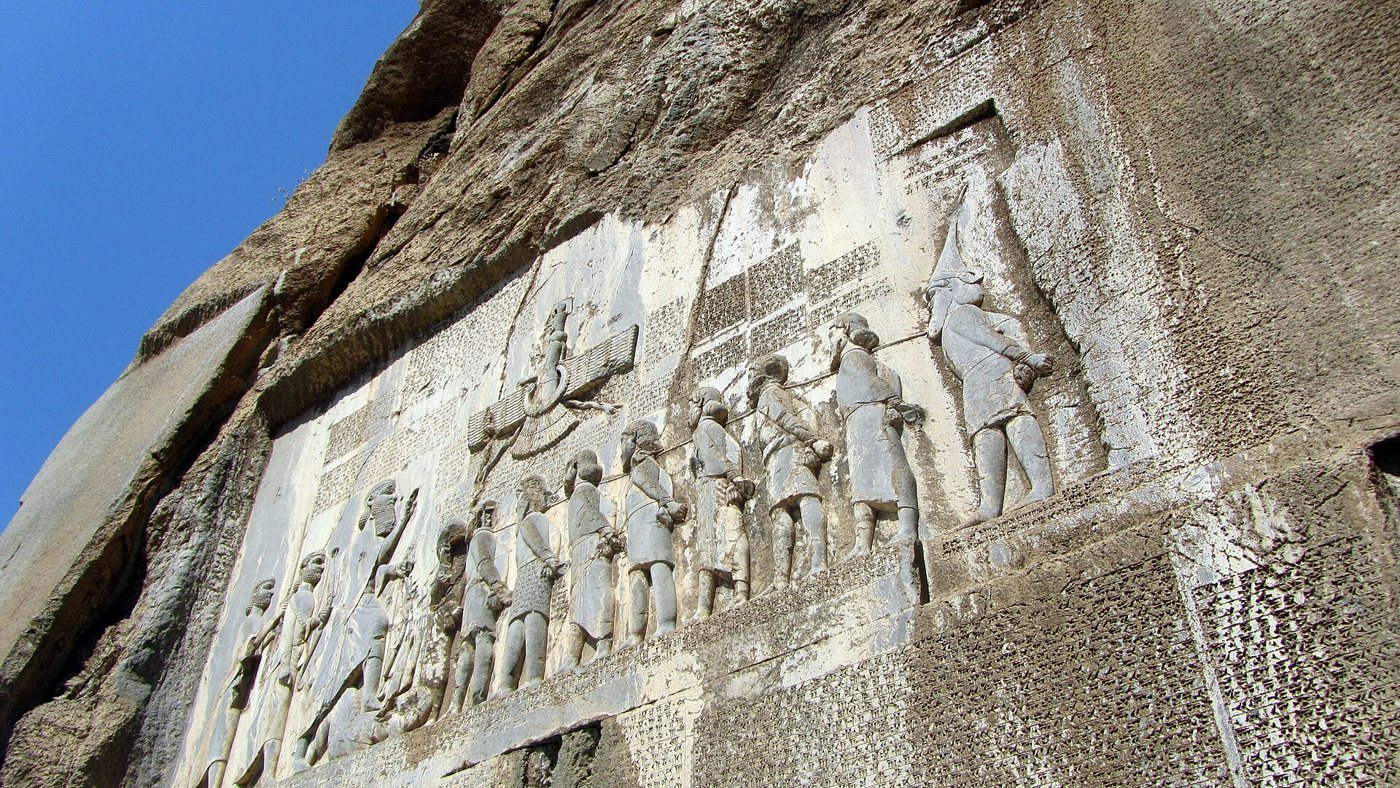
ConfirmedThe Behistun relief and inscription of Darius on the cliff at Bisotun, Iran. PersianDutchNetwork, via Wikimedia Commons, CC BY-SA 4.0.
And this house was finished on the third day of the month Adar, which was in the sixth year of the reign of Darius the king.
Ezra 6:15, KJV
High on a cliff at Bisotun (Behistun) in western Iran, Darius the Great had a large panel carved showing himself with his foot on a defeated rebel, with a long inscription in three languages: Old Persian, Elamite and Babylonian. In it Darius tells how he became king in 522 BC and put down revolts across the empire. The Bible says the work on the temple in Jerusalem started again in the second year of Darius (Ezra 4:24; Haggai 1:1). Darius then had the royal records searched, found Cyrus's decree, and ordered the work to go on; the temple was finished in his sixth year, about 515 BC (Ezra 6:1-15).
Where it is today
On the cliff of Mount Bisotun near Kermanshah in western Iran, high above the plain (UNESCO says about 60 metres; other sources say about 100 metres). It is part of the Bisotun World Heritage Site, which UNESCO listed in 2006. Access can change, so check before planning a visit.
Date
Carved about 520 BC (UNESCO gives 521 BC). Darius reigned from 522 to 486 BC. The temple in Jerusalem was finished in his sixth year, about 515 BC.
Why this label: Darius the Great is a well-known king whose own inscriptions survive, and the Bible's dates for the temple work fit his reign. His decree in Ezra 6 has not been found outside the Bible, and the Behistun inscription does not mention the Jews or Jerusalem.
Good to know
Reading cuneiform: Because the same text appears in three languages, the inscription helped scholars learn to read cuneiform writing (wedge-shaped marks pressed into clay or cut into stone), much as the Rosetta Stone did for Egyptian writing. Henry Rawlinson, a British army officer, began copying it in 1835, climbing the cliff to reach the Old Persian text, and in 1847 he sent a full and accurate copy to Europe.
Darius in his words: The inscription opens with these words: "I am Darius, the great king, king of kings, the king of Persia, the king of countries." Darius says a man named Gaumata falsely claimed to be Smerdis, the son of Cyrus, and seized the throne, and that Darius killed him and then won 19 battles in a single year. Many historians doubt parts of this story and think Darius told it this way to justify taking the throne.
Copies sent out: Darius says he sent copies of the inscription "everywhere among the provinces". A copy in Aramaic, made in the reign of Darius the Second, was found in Egypt. This shows Persian kings did send royal texts to distant provinces in Aramaic, the language of Ezra 4:8 to 6:18, where the royal letters to and from Darius appear.
The governor Tattenai: Ezra 5:3 names "Tatnai, governor on this side the river", who wrote to Darius about the building. A Babylonian tablet dated to the 20th year of Darius, 502 BC, names a servant of "Tattannu, governor of Across-the-River". Many scholars take this to be the same official.
The search: Ezra 6:2 says Cyrus's decree was found at "Achmetha", which is Ecbatana, the old capital of the Medes. The Behistun cliff stands beside the ancient road from Babylon to Ecbatana.
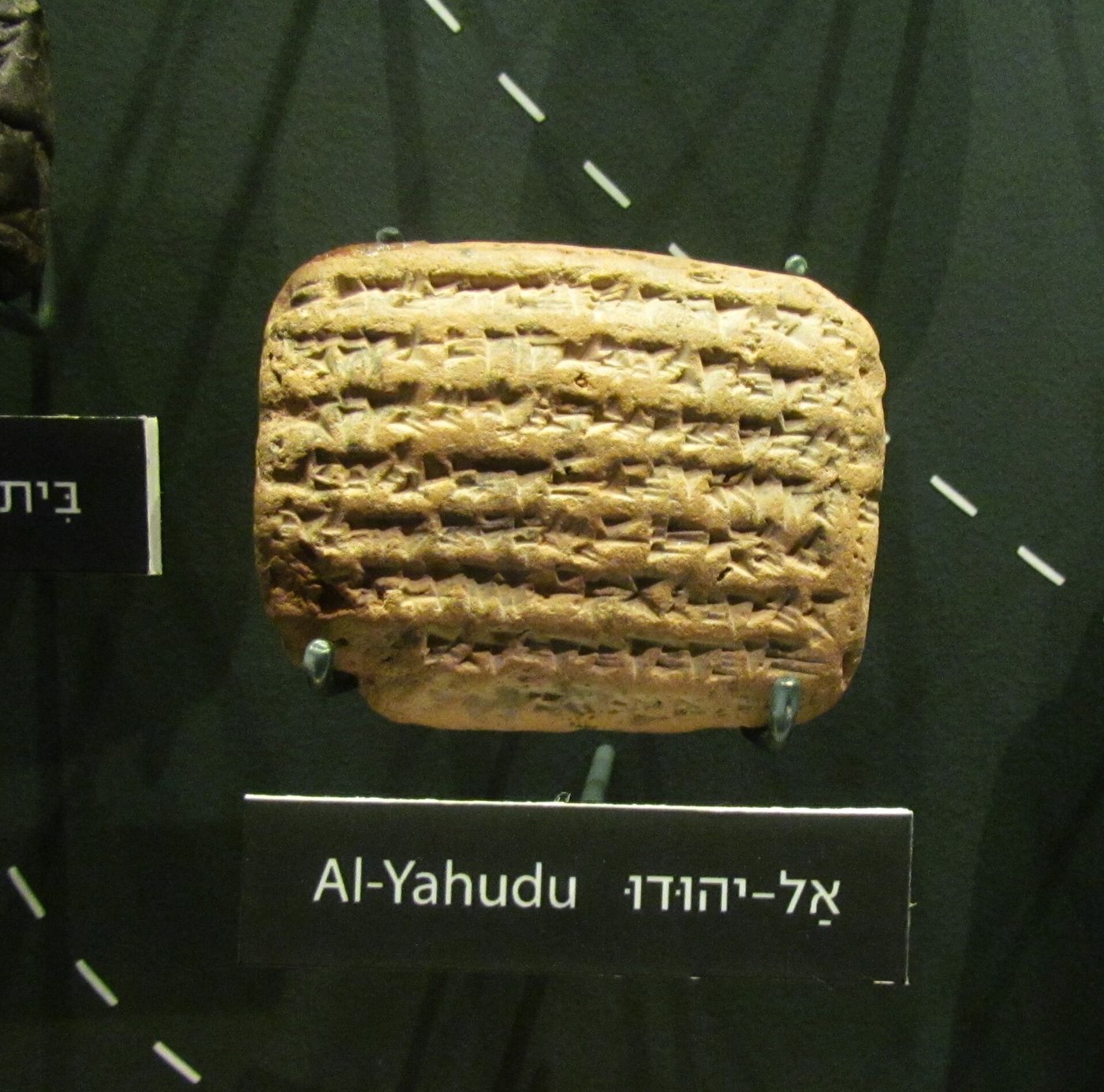
BackgroundOne clay tablet from the Al-Yahudu group on display, with its museum label. Wikimedia Commons user עמית אבידן, CC BY-SA 4.0.
Build ye houses, and dwell in them; and plant gardens, and eat the fruit of them;
Jeremiah 29:5, KJV
These are small clay tablets written in Babylonian cuneiform (writing made of wedge-shaped marks pressed into clay). They are everyday business records such as receipts, leases, loans and contracts. They are named after a village called Al-Yahudu, which means "town of Judah" or "town of the Judeans", somewhere in Babylonia. Many people in them have Hebrew names built on the name of Israel's God, written in forms like Yahu or Yama. They show families from Judah living, farming and paying taxes in Babylonia over several generations, as Jeremiah told the exiles to build houses and settle down (Jeremiah 29:5-7) and as Psalm 137 remembers them "by the rivers of Babylon".
Where it is today
Most are in a private collection in London, the collection of David Sofer. Laurie Pearce and Cornelia Wunsch published 103 texts from it in 2014, and some tablets were lent to the Bible Lands Museum in Jerusalem for an exhibition in 2015. The rest of the known texts were published in 2022.
Date
Dated from 572 BC, in the reign of Nebuchadnezzar the Second, to 477 BC, in the reign of Xerxes. Most come from the Persian period, especially the reign of Darius the Great.
Why this label: The tablets show real Judean exiles living in Babylonia in the very period the Bible describes, but they do not name any person or event from the Bible. They were not found in a recorded dig, so where exactly they came from is unknown.
Good to know
Bought not dug: The tablets did not come from a recorded excavation. They were bought on the antiquities market, and their findspot is unknown; the Bible Lands Museum in Jerusalem said only that they likely come from southern Iraq. The owner says he bought them in the United States in the 1990s from a seller who had bought them at public auctions in the 1970s. Some scholars think tablets like these were probably looted, and scholars disagree about whether objects without a clear record should be published or shown at all.
Daily life: Most of the exiles farmed rented land, growing dates and barley, and owed service and taxes to the king. A few became fairly well-off as money-lenders and middlemen. The earliest tablet was written about 15 years after Jerusalem was destroyed in 586 BC.
Limits of the tablets: The tablets do not mention the temple in Jerusalem, Cyrus's decree, or any person named in the Bible. They do show that many Judeans were still living in Babylonia long after Cyrus allowed a return. This fits Ezra 1:4-6, where those who stayed behind helped those who went, and the later return led by Ezra (Ezra 7 and 8).
Related find: The Jehoiachin ration tablets from Babylon, covered on an earlier page, list food given to the exiled king of Judah himself.
The Elephantine papyri: letters naming Johanan the high priest and the sons of Sanballat
Nehemiah 12:22-23 · Nehemiah 2:10, 19 · Ezra 10:6
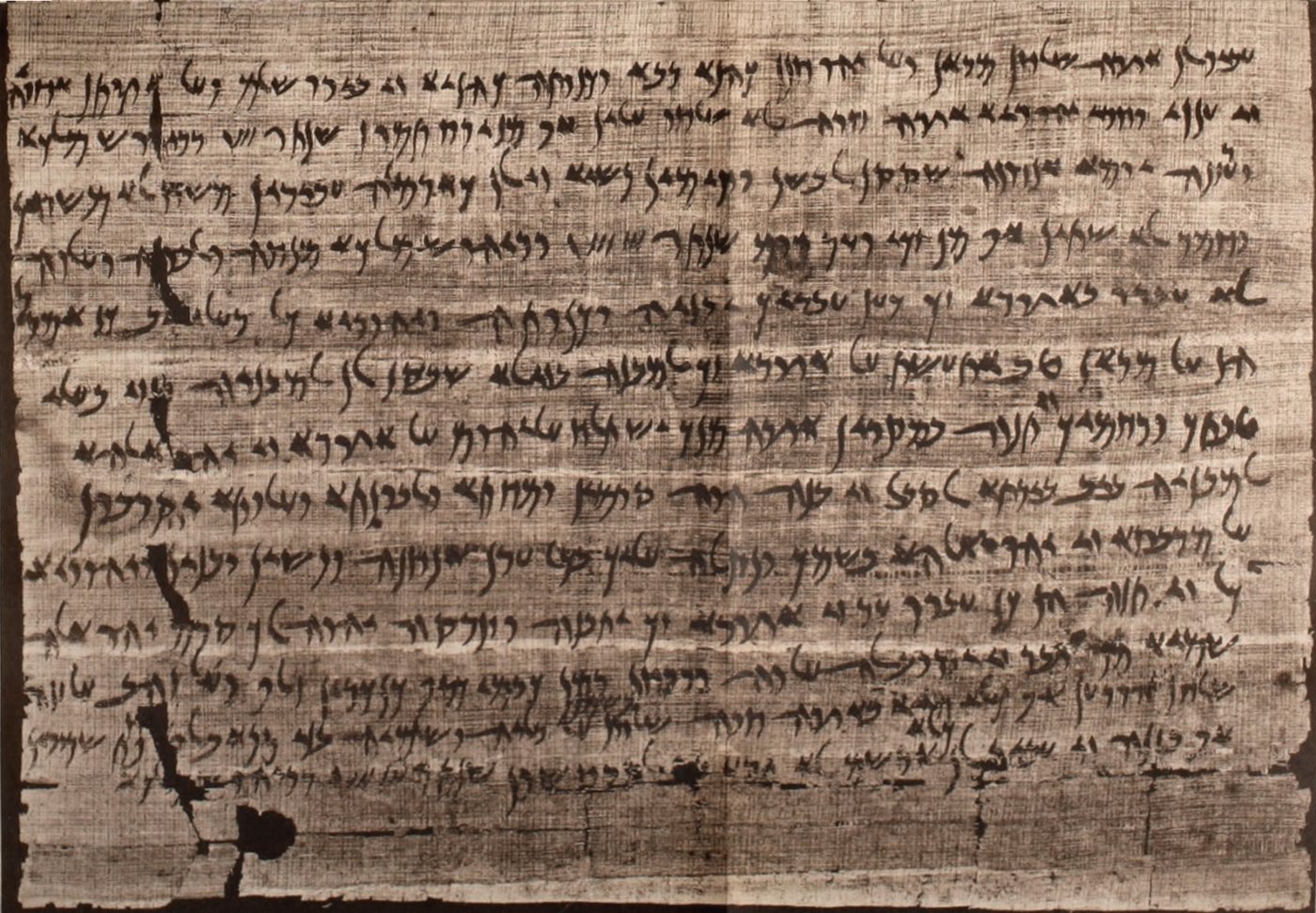
ConfirmedThe back of the 407 BC Elephantine letter to Bagohi, governor of Judah (its last 13 lines, which name Johanan the high priest and Sanballat), as photographed for its 1907 publication. Photograph published by Eduard Sachau, 1907, via Wikimedia Commons, Public domain.
The Levites in the days of Eliashib, Joiada, and Johanan, and Jaddua, were recorded chief of the fathers: also the priests, to the reign of Darius the Persian.
Nehemiah 12:22, KJV
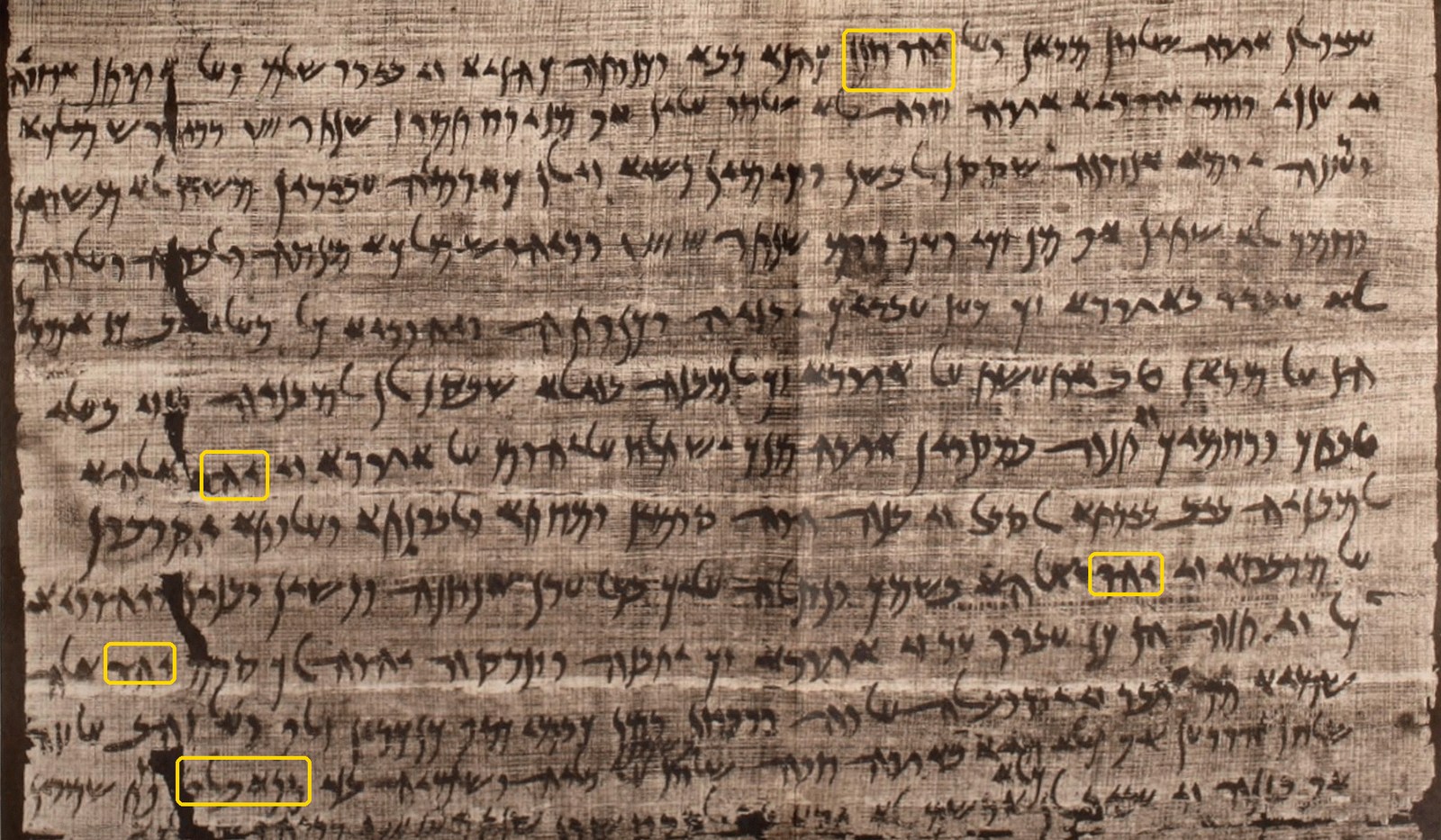
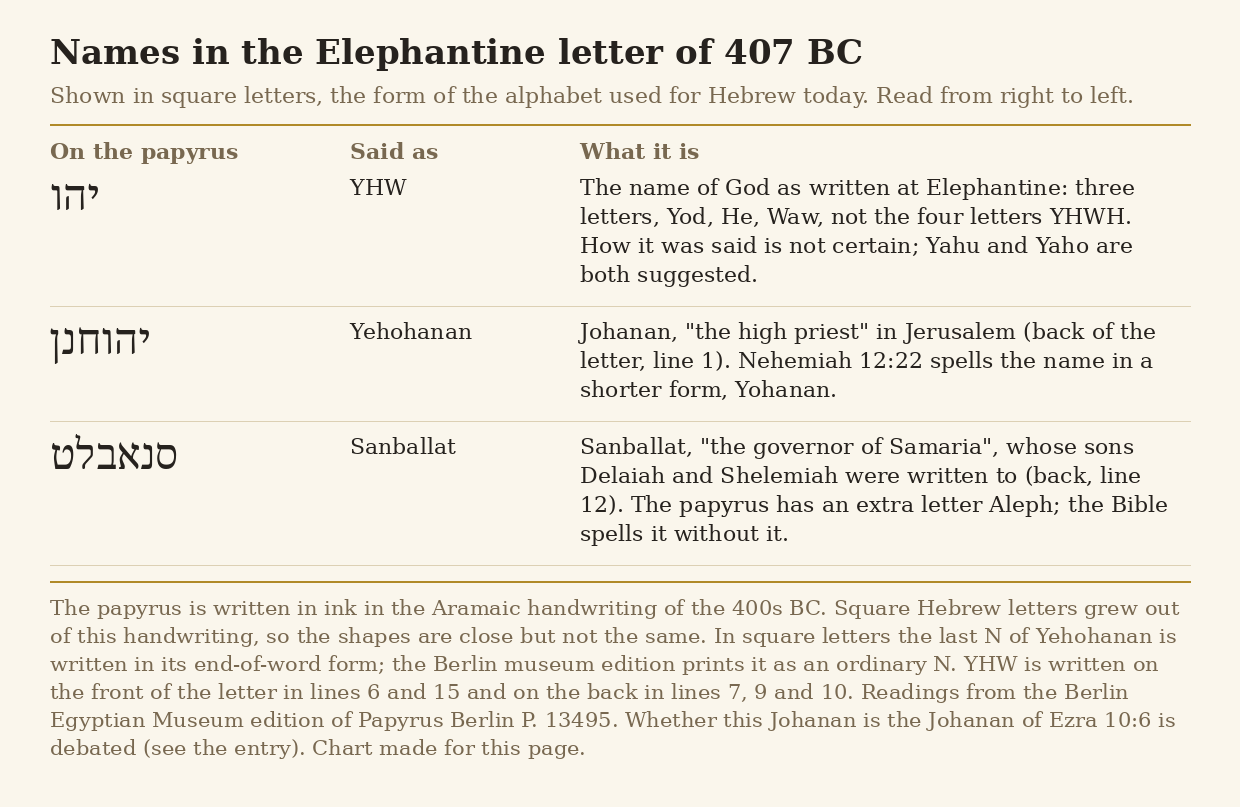
The Elephantine papyri are letters and legal papers in Aramaic, written on papyrus (an early kind of paper made from reeds) by a community of Jewish soldiers and their families stationed on Elephantine Island in the Nile at Aswan, in southern Egypt. In 407 BC the community's priests wrote to Bagohi (Bagoas), the Persian governor of Judah, asking for help to rebuild their temple, which Egyptian priests and a local Persian commander had destroyed. The letter says they had earlier written "to the high priest Johanan and his colleagues the priests in Jerusalem", and that they had also written "to Delaiah and Shelemiah, the sons of Sanballat the governor of Samaria" (translation by H. L. Ginsberg in Ancient Near Eastern Texts). Johanan appears in the line of high priests in Nehemiah 12:22-23, and Sanballat is Nehemiah's main opponent (Nehemiah 2:10, 19; 4:1). The images below show the back of the letter, with the names Johanan and Sanballat and the name of God, YHW, marked, and a chart of these words.
Photograph of the back of the letter of 407 BC (Papyrus Berlin P. 13495), as published by Eduard Sachau in 1907. The back holds the last 13 lines of the letter. The yellow boxes, added for this page, mark Yehohanan (Johanan) the high priest in the top line, the name of God, YHW, three times (back lines 7, 9 and 10), and Sanballat near the left end of back line 12. The end of the name Sanballat touches a dark stain on the papyrus. The front of the letter, where YHW is written in lines 6 and 15, is not shown here. Eduard Sachau (1907), via Wikimedia Commons, Public domain.The three names in square letters, with how they are said and what they mean. Chart made for this page, free to reuse.
Where it is today
Egyptian Museum and Papyrus Collection (Ägyptisches Museum und Papyrussammlung), Berlin. The 407 BC letter to Bagohi is Papyrus Berlin P. 13495 (Cowley 30) and is shown in the Neues Museum; a second, damaged draft of the same letter also survives (Cowley 31). The "Passover letter" is Papyrus Berlin P. 13464 (Cowley 21). The Brooklyn Museum in New York holds another group of Elephantine papyri, the family papers of a Jewish man named Ananiah and his wife Tamut.
Date
The temple letter is dated the 20th of Marheshvan in year 17 of Darius the Second, which is late November 407 BC. The "Passover letter" is dated year 5 of Darius the Second, 419 to 418 BC.
Why this label: These are original documents from the 400s BC that name a high priest Johanan in Jerusalem and a Sanballat who was governor of Samaria, matching names and roles in Nehemiah. They confirm these people and offices, but they do not mention Ezra or Nehemiah themselves.
Good to know
Why it matters: Nehemiah 2:1 dates Nehemiah's journey to "the twentieth year of Artaxerxes". By 407 BC the Elephantine priests wrote to Sanballat's grown sons rather than to him, which fits a man already in office around 445 BC under Artaxerxes the First. Both sides of the Ezra debate below accept that date for Nehemiah.
Later Ezra view: Many scholars date Ezra's arrival (Ezra 7:7, "the seventh year of Artaxerxes") to 398 BC under Artaxerxes the Second, after Nehemiah. One of their strongest points is Ezra 10:6, where Ezra goes into the room of "Johanan the son of Eliashib"; they take him to be the high priest Johanan of this letter, who was in office by 407 BC.
Traditional order view: Others keep 458 BC under Artaxerxes the First, so Ezra came before Nehemiah. They note that Johanan was a very common name, that Ezra 10:6 does not call this Johanan high priest, and that Nehemiah 8:9 and 12:26 place Ezra and Nehemiah in Jerusalem at the same time. A third group puts Ezra in Nehemiah's own time, in 438 or 428 BC, by treating "the seventh year" in Ezra 7:7 as a copying mistake for the 27th or 37th year.
Passover letter caution: The damaged letter of 419 BC passes on word from King Darius about the dates of the Festival of Unleavened Bread in the month of Nisan. The word "Passover" itself is filled in by modern editors where the papyrus is broken, and some recent scholars doubt that the letter is about Passover at all.
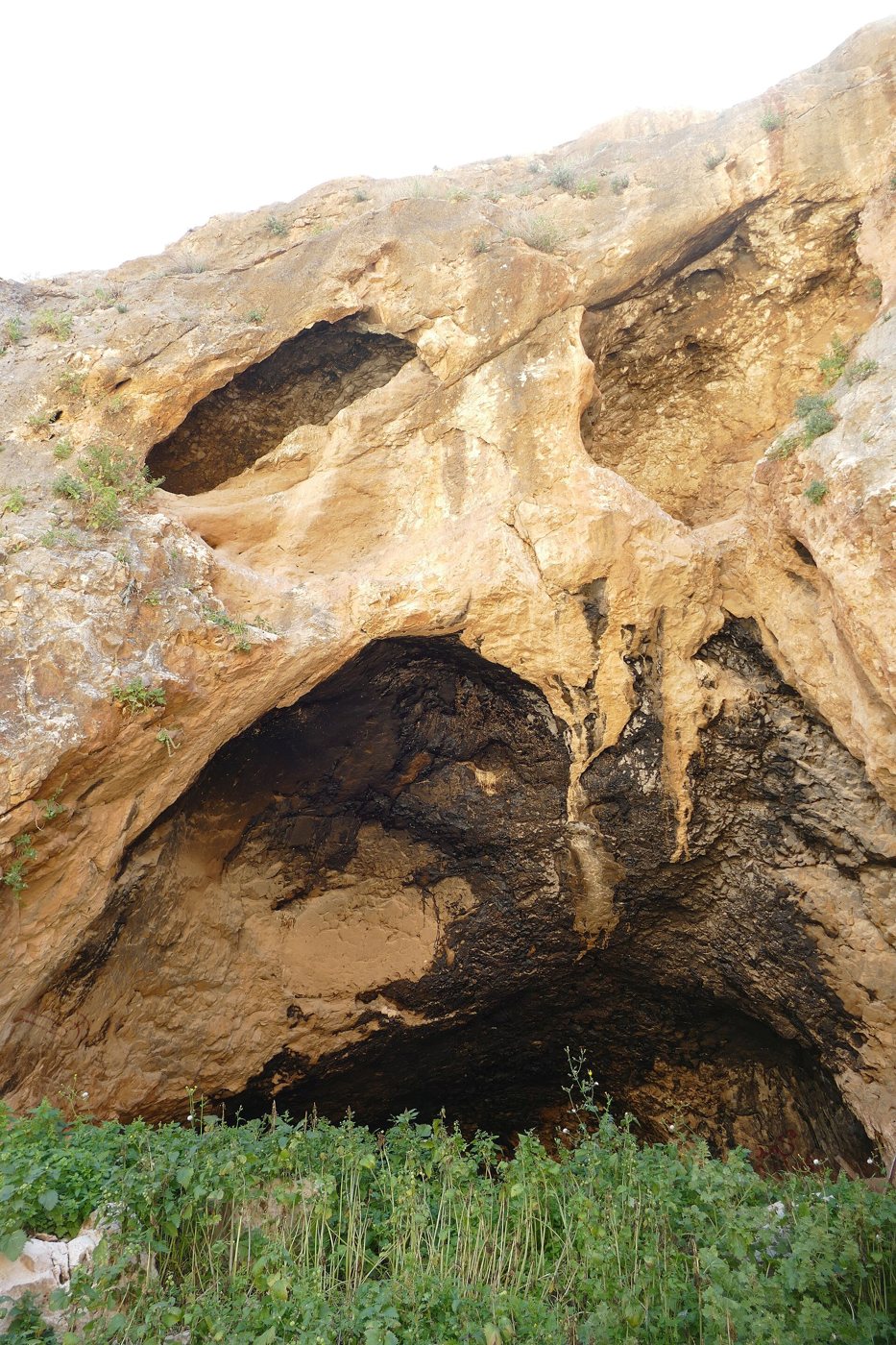
ConfirmedEntrance to the Abu Shinjeh cave in Wadi Daliyeh, where the Samaria papyri were found. Bukvoed, via Wikimedia Commons, CC BY 4.0.
But it came to pass, that when Sanballat heard that we builded the wall, he was wroth, and took great indignation, and mocked the Jews.
Nehemiah 4:1, KJV
Nehemiah names "Sanballat the Horonite" as his main opponent and shows him speaking before "the army of Samaria" (Nehemiah 4:2). The Elephantine letter of 407 BC (see the entry above) calls a Sanballat "the governor of Samaria" and names his sons Delaiah and Shelemiah. In or shortly before 1962, Bedouin found the remains of 37 Aramaic legal documents written on papyrus, many of them only in small pieces, now called the Samaria papyri, in a cave in Wadi Daliyeh about 14 kilometres north of Jericho, together with clay seal impressions (lumps of clay pressed with a seal to close a rolled document) and the bones of people who had hidden and died there. One seal impression, written in old Hebrew letters, names "[...]iah son of [San]ballat, governor of Samaria". Most scholars take it to show that the family of a Sanballat still ruled Samaria in the 300s BC.
Where it is today
The papyri are kept at the Rockefeller Museum in Jerusalem (bought for it, when it was called the Palestine Archaeological Museum, in 1962 and 1963). The seal impressions are divided between the Israel Museum in Jerusalem and the Hecht Museum in Haifa, and the Sanballat seal impression has been shown at the Israel Museum. A few more fragments are in the private Schøyen Collection.
Date
Papyri: about 375 to 335 BC; the latest dated one was written on 19 March 335 BC. The Sanballat seal impression: the 300s BC; scholars differ on its exact date within that century. Nehemiah's Sanballat: mid 400s BC, and named as governor of Samaria in 407 BC.
Why this label: The Elephantine letter, an original document of 407 BC, names Sanballat as governor of Samaria, which fits Nehemiah's opponent in name, place and time. The Wadi Daliyeh seal impression is later and its names are partly broken. Most scholars think it belonged to a later member of the family, but one scholar, Jan Dušek, thinks the Sanballat named on it may be Nehemiah's Sanballat himself.
Good to know
How it was found: The papyri and many of the seal impressions were found by Bedouin and sold through an antiquities dealer in 1962 and 1963, so they did not come from a dig. Archaeologists led by Paul Lapp then dug in the same cave and found more papyrus fragments, seal impressions and human bones, which supports the reported find-spot.
Broken names: Parts of both names on the seal are missing. Frank Moore Cross read "[Yesha]yahu son of [San]ballat", while Jan Dušek reads "[Dela]iah son of [San]ballat" and thinks the owner was Delaiah, the son named in the Elephantine letter. On his reading, the father named on the seal would be Nehemiah's Sanballat himself.
How many Sanballats: The Jewish historian Josephus, writing near the end of the first century AD, tells of a Sanballat sent as governor of Samaria by "Darius the last king", about 100 years after Nehemiah, in the time of Alexander the Great. Cross explained this with a line of governors in which grandsons were named after grandfathers, so that there were at least three men called Sanballat. Other scholars doubt the extra Sanballats and think Josephus simply placed his story about a century too late. In either view, Nehemiah's Sanballat is the earliest one.
Geshem the Arabian: the silver bowl of his son Qainu and the Dedan inscription
Nehemiah 2:19 · Nehemiah 6:1-2 · Nehemiah 6:6
ConfirmedThe silver bowl with the Aramaic line naming Qainu son of Geshem, king of Kedar. Brooklyn Museum, Charles Edwin Wilbour Fund, via Wikimedia Commons, CC BY 3.0.
Wherein was written, It is reported among the heathen, and Gashmu saith it, that thou and the Jews think to rebel: for which cause thou buildest the wall, that thou mayest be their king, according to these words.
Nehemiah 6:6, KJV
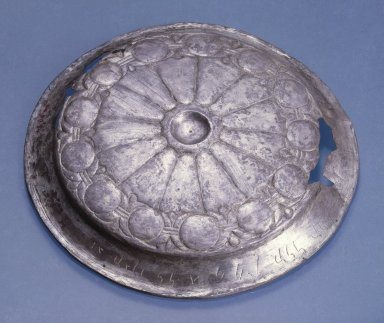
Nehemiah names "Geshem the Arabian", also spelled "Gashmu", with Sanballat and Tobiah as the leaders who opposed the rebuilding of Jerusalem's wall. A silver offering bowl in the Brooklyn Museum, said to come from Tell el-Maskhuta in the eastern Nile Delta of Egypt (a tell is a mound built up from layers of ancient ruins), carries an Aramaic line which the museum gives as "Qainu son of Geshem, King of Qedar, brought in offering to Han-Ilat" (Han-Ilat was an Arab goddess). Kedar (Qedar) was the leading Arab kingdom of north Arabia at that time, and its power reached the edge of Egypt and the land south of Judah. A rock inscription at Dedan, today al-Ula in Saudi Arabia, is dated "in the days of" Geshem son of Shahr and of Abd, governor of Dedan, which points to a powerful Geshem in north Arabia in the same general period.
Where it is today
Brooklyn Museum, New York: the Qainu bowl is accession number 54.50.34 (not on view at the time of checking). The museum acquired three of these inscribed silver bowls in 1954 and a fourth in 1957. The Dedan inscription (catalogued as JSLih 349) is carved in the rock at al-Ula, Saudi Arabia. It is listed as still in place, but scholars work from a copy made by early explorers. Tell el-Maskhuta is the site some link to Pithom (see the Exodus page).
Date
Bowl: about 410 BC according to the Brooklyn Museum, in the late 400s BC. Dedan inscription: not firmly dated; if its Geshem is Nehemiah's, it belongs to the mid 400s BC. Nehemiah's wall: 445 BC.
Why this label: Most scholars identify Nehemiah's "Geshem the Arabian" with Geshem, father of Qainu king of Kedar, because the name, the Arab people, the region and the date all fit. No inscription names him together with Nehemiah, so this is a strong match by name and time rather than direct proof.
Good to know
Bowl find spot: The bowls were acquired by the museum, not found in a recorded dig, and are only "said to have been found" at Tell el-Maskhuta. Israel Finkelstein, who doubts much of the Nehemiah account, still accepts the bowl as a text of the 400s BC naming "Gashmu the king of Kedar", while noting that it was only "ostensibly found" at Tell el-Maskhuta.
The Dedan text: It is known from a copy made by the explorers Jaussen and Savignac, who recorded it in 1909 and 1910, and they read the name differently. The reading "Geshem son of Shahr" is the one now given in OCIANA, the main online catalogue of these north Arabian inscriptions, run by Ohio State University.
One man or two: Geshem was a known Arab name, so the bowl's Geshem and the Dedan Geshem are probably, but not certainly, the same man.
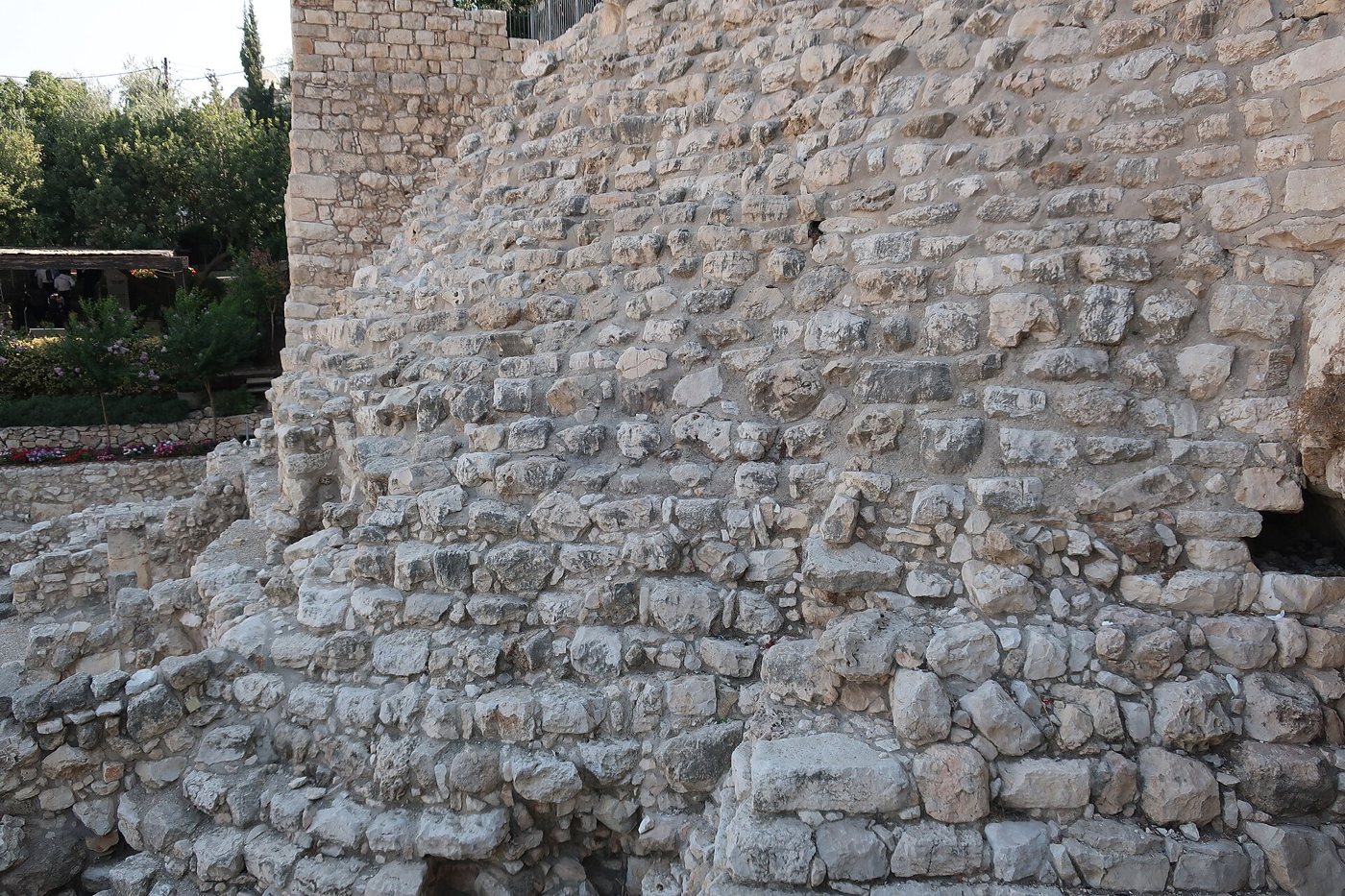
DisputedPart of the stone slope on the eastern side of the City of David (Area G), near the disputed tower. Davidbena, via Wikimedia Commons, CC BY-SA 4.0.
So the wall was finished in the twenty and fifth day of the month Elul, in fifty and two days.
Nehemiah 6:15, KJV
Nehemiah 2 to 6 tells how Nehemiah inspected Jerusalem's broken walls by night and how the people repaired them in 52 days. In November 2007 the archaeologist Eilat Mazar announced that a stone tower and a stretch of wall at the top of the eastern slope of the City of David (the oldest part of Jerusalem, just south of the Temple Mount) were part of Nehemiah's wall. Earlier diggers, Kathleen Kenyon in 1962 and Yigal Shiloh in the 1980s, had dated this tower to the Hasmonean period (the 100s BC, when Jewish rulers called the Hasmoneans governed Judea). Mazar based her earlier date on pottery and arrowheads from layers under the tower, which she dated to the late 500s and first half of the 400s BC.
Where it is today
Area G of the City of David archaeological site in Jerusalem, on the eastern slope above the Kidron Valley. The tower stands at the top of the Stepped Stone Structure (see the 1 and 2 Samuel page). The Broad Wall, a different wall from the time of the kings of Judah, is on the Assyria and Babylon page.
Date
Pottery under the tower: late 500s to first half of the 400s BC. Nehemiah's rebuilding: 445 BC. The other proposed date for the tower: the Hasmonean period, 100s BC.
Why this label: If the book of Nehemiah is accurate, his wall must have stood somewhere along this ridge, but archaeologists disagree about whether these stones belong to it. Pottery found under a wall shows only the earliest time it could have been built, not when it was actually built.
Good to know
Mazar view: The layers under the tower held pottery of the late 500s and early 400s BC, so the tower was built after that, and Mazar argued that Nehemiah in the mid 400s BC is the best fit. The first diggers here, R. A. S. Macalister and J. G. Duncan in the 1920s, had also dated the tower to the period after the exile, the 400s or 300s BC. Ephraim Stern, an expert on the Persian period, agreed that the pottery she showed him was Persian.
Finkelstein view: Israel Finkelstein replied that pottery under a wall only shows the earliest possible date, and the wall could be much later. He dates the towers and the wall to the Hasmonean period, when a city wall on this line is known from many places in Jerusalem, and he thinks the list of builders in Nehemiah 3 may describe that later wall. He also argues that Persian-period Jerusalem was a small settlement of about 2 to 2.5 hectares (a hectare is a square 100 metres on each side) with no more than a few hundred people, and that over a century of digging has found no city wall that can be dated to the Persian period.
Other estimates: Oded Lipschits puts Persian-period Jerusalem at about 3 to 5 hectares and Gabriel Barkay at about 12 hectares.
The Bible text: Nehemiah 3 mostly says the builders "repaired" sections, which suggests they mended older walls and gates rather than building a new wall on a new line.
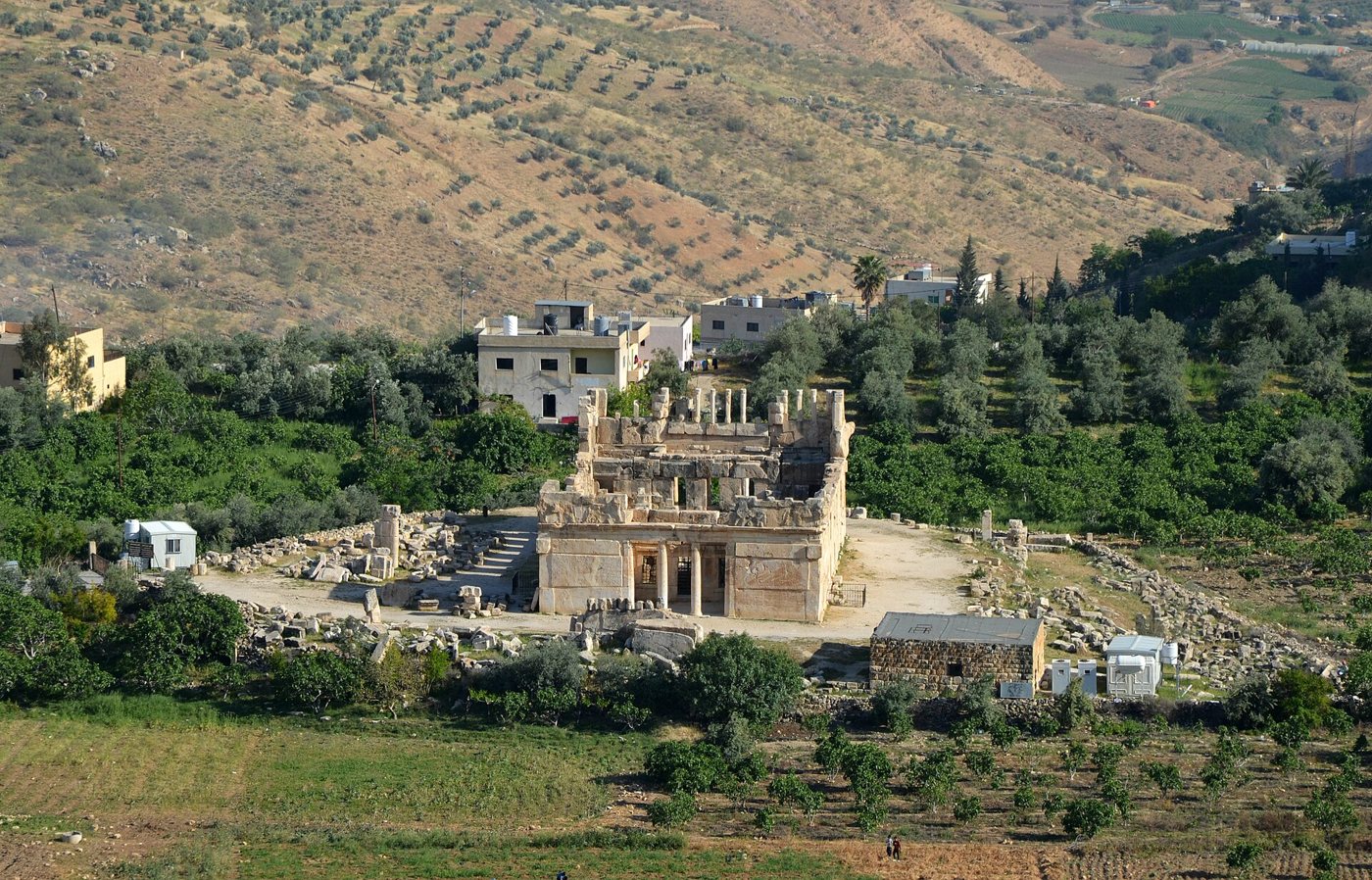
BackgroundQasr al-Abd, the Tobiad palace at Iraq al-Amir, Jordan, built about 200 to 175 BC. Carole Raddato, via Wikimedia Commons, CC BY-SA 2.0.
When Sanballat the Horonite, and Tobiah the servant, the Ammonite, heard of it, it grieved them exceedingly that there was come a man to seek the welfare of the children of Israel.
Nehemiah 2:10, KJV
Nehemiah calls Tobiah "the servant, the Ammonite", an official with marriage ties to leading families in Jerusalem, who was later given a room in the temple courts until Nehemiah threw out his goods (Nehemiah 6:17-19; 13:4-8). At Iraq al-Amir in Jordan, about 17 kilometres west of Amman, the name "Tobiah" is deeply carved in Aramaic letters beside the entrances of two caves in the cliff. Nearby stands Qasr al-Abd ("castle of the servant"), a large palace of white stone with carved lions, built in about 200 to 175 BC and generally linked to Hyrcanus, a member of the Tobiad family described by the Jewish historian Josephus. These remains show that a powerful family named after a Tobiah held land in the old Ammonite region for a long time.
Where it is today
Iraq al-Amir (also spelled Araq el-Emir), in the valley of Wadi es-Sir west of Amman, Jordan. The palace was largely restored by a French team between 1976 and 1986. Check access before planning a visit.
Date
Palace: about 200 to 175 BC. The "Tobiah" carvings: debated, with dates ranging from the 300s BC (the Persian period, which ended in 332 BC) to later. Nehemiah's Tobiah: mid to late 400s BC.
Why this label: Most of these remains come from a family that was important 200 years or more after Nehemiah's Tobiah, and nothing here names him. They fit the Bible's picture of a Tobiah family with power east of the Jordan, but they do not prove anything about Nehemiah's Tobiah himself.
Good to know
Dating the name: Scholars disagree on when the "Tobiah" carvings were made. Joseph Naveh dated them by the shape of their letters to the 300s BC, in the Persian period, while Larry Herr dates them later than the Persian period. Even an early date would not show that they name Nehemiah's Tobiah.
Family name: The name Tobiah was handed down in the family, often from grandfather to grandson. Herr thinks this family line included Nehemiah's Tobiah. Greek papyri from Egypt dated 259 BC (the Zenon papyri) tell of trade with Tobias, the chief of a fortress in the Ammon region, and Josephus tells the later story of Joseph son of Tobias and his son Hyrcanus, who built a palace of white stone with carved animals and named the place Tyre.
An Israelite name: Tobiah means "the LORD is good", so many scholars think "Ammonite" in Nehemiah describes where he lived or held office rather than his family line.
Yehud: the Persian-period name of Judah on jar stamps and small silver coins
Nehemiah 5:14-15 · Nehemiah 11:3 · Ezra 5:8
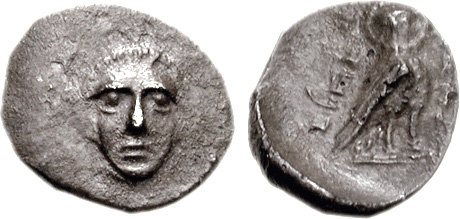
BackgroundBoth sides of a tiny silver Yehud coin of Yehezqiyah (Hezekiah) the governor, 300s BC: a face on one side and an owl on the other. Classical Numismatic Group (CNG), via Wikimedia Commons, CC BY-SA 3.0.
Moreover from the time that I was appointed to be their governor in the land of Judah, from the twentieth year even unto the two and thirtieth year of Artaxerxes the king, that is, twelve years, I and my brethren have not eaten the bread of the governor.
Nehemiah 5:14, KJV
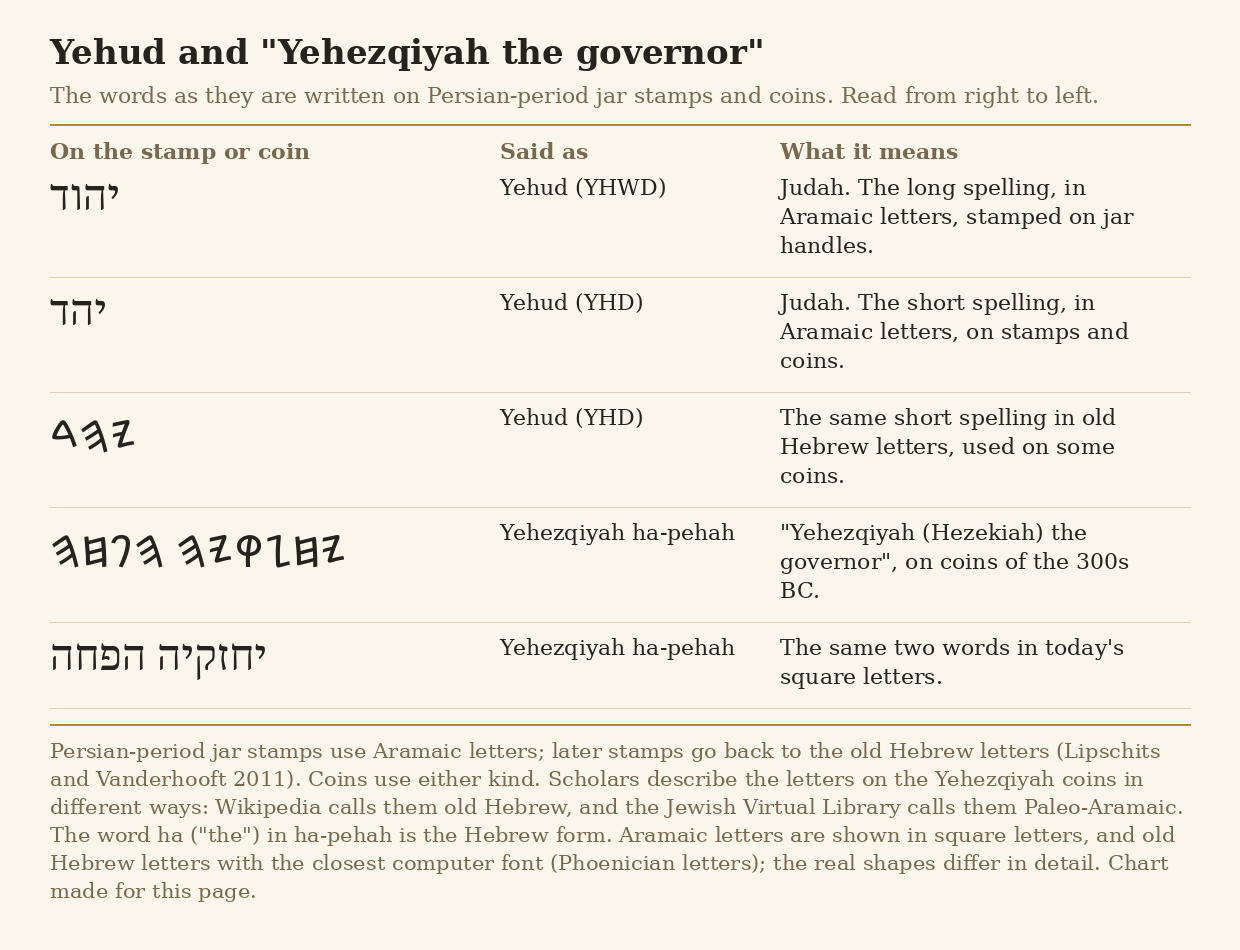
Under Persian rule Judah was a small province called Yehud, the Aramaic form of the name Judah. Officials stamped the word "yhwd" (Yehud) on the handles of storage jars as an official government mark. Scholars sort these stamps into 17 types, and some add a personal name and the title "governor", such as a handle from Ramat Rahel, just south of Jerusalem, that reads "Yehud, Yehoezer, the governor". From about the middle of the 300s BC the province also struck its main series of tiny silver coins marked "YHD", and some of them read "Yehezqiyah the governor", which matches the Bible's picture of Judah as a Persian province ruled by governors, as Nehemiah was (Nehemiah 5:14-15). The chart below shows how the words Yehud and "Yehezqiyah the governor" are written on these stamps and coins.
How the words Yehud (Judah) and "Yehezqiyah the governor" are written on Persian-period jar stamps and coins, in Aramaic letters and in old Hebrew letters. Chart made for this page, free to reuse.
Where it is today
Most of the stamped jar handles were found in Jerusalem and nearby, including Ramat Rahel, and are kept in Israeli collections. The coins are spread among many museums and private collections.
Date
Stamps: from the late 500s or early 400s BC to the 100s BC, in three groups (early, middle and late). Coins: the main series ran from about 350 BC into the 200s BC.
Why this label: These finds confirm that Judah was a separate Persian province with its own governors, as Ezra and Nehemiah describe. They do not name Nehemiah, and the coins began about a century after his time.
Good to know
Dig or market: A 2023 study lists only about 60 Yehud coins from controlled digs, and many other Yehud coins in collections have no recorded find-spot. The coins from digs were found only inside Judah, which fits a small local province.
Timing: The earliest group of stamps may reach back to Nehemiah's century, but the main coin series began about 100 years after him, and the "Yehezqiyah the governor" coins belong to the 300s BC.
Size of the province: Israel Finkelstein points out that most of the early stamps were found in and around Jerusalem, and uses this to argue that Persian-period Judah was small.
Shushan (Susa) and the palace of Darius and Xerxes
Esther 1:2-6 · Nehemiah 1:1 · Daniel 8:2
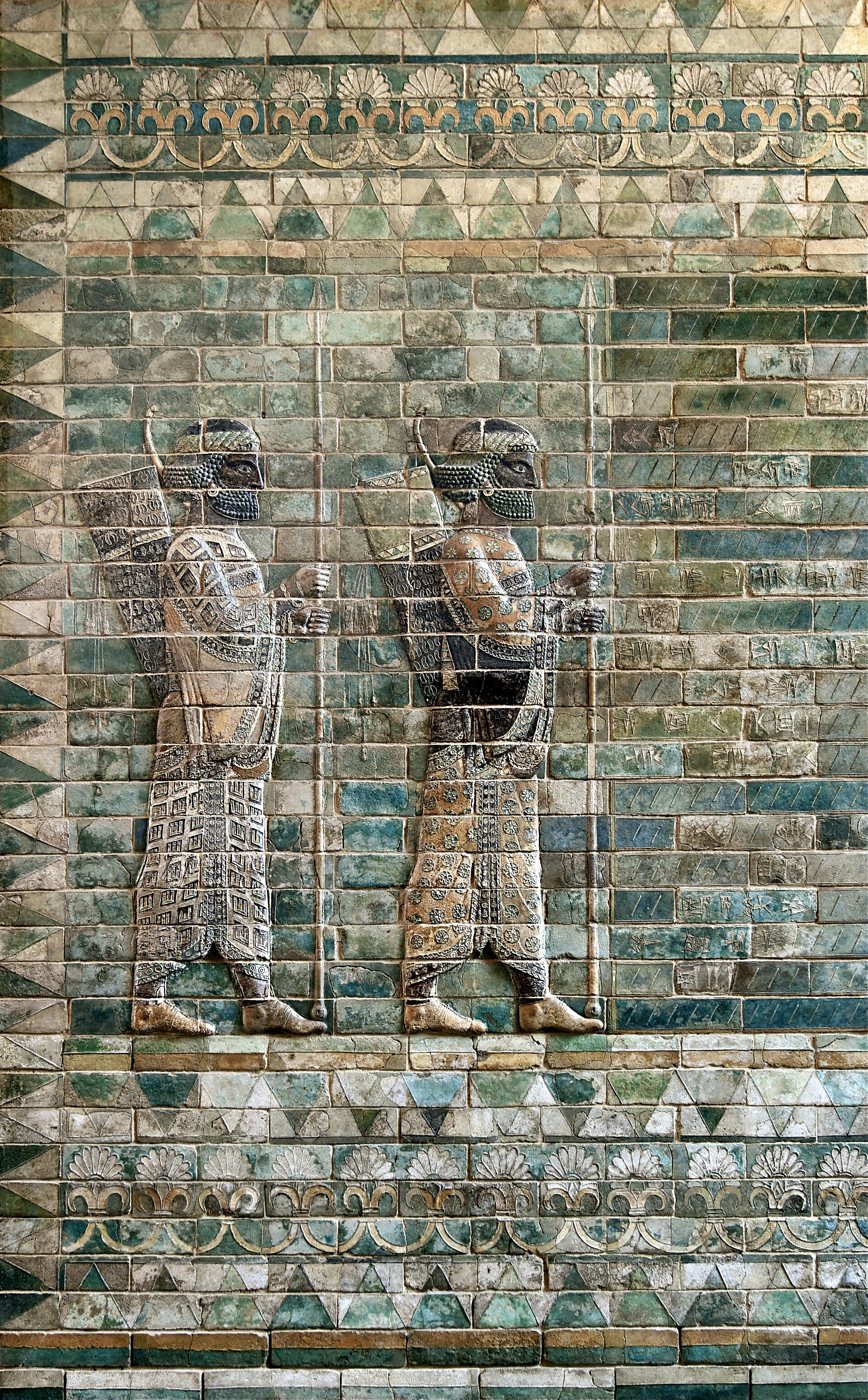
ConfirmedGlazed brick panel of Persian archers from the palace at Susa, Louvre, Paris. Jebulon, via Wikimedia Commons, Public domain.
And when these days were expired, the king made a feast unto all the people that were present in Shushan the palace, both unto great and small, seven days, in the court of the garden of the king's palace;
Esther 1:5, KJV
Shushan is Susa, a great mound at the town of Shush in south-western Iran. Darius the First built a royal palace there on a raised platform. It had a large gate on the east side, a series of courtyards, and a huge audience hall (called the apadana) about 109 metres on each side, whose roof rested on 36 tall stone columns topped by carved bulls. French digs found glazed (coloured, shiny) bricks that once covered the walls, and from them rebuilt panels of life-size archers, lions and other creatures, many now in the Louvre in Paris.
Where it is today
Susa (Shush), Khuzestan province, Iran; the Frieze of Archers and a bull column top are in the Louvre, Paris (Frieze of Archers, AOD 488). Access to sites in Iran can change, so check before planning a visit.
Date
Palace built under Darius the First (522 to 486 BC) and used by his son Xerxes; the great hall burned under Artaxerxes the First (465 to 424 BC) and was rebuilt under Artaxerxes the Second (404 to 358 BC). The city itself is thousands of years older.
Why this label: Susa is named in Persian, Elamite and Babylonian texts, and the palace is identified by the kings' own building inscriptions found there. What is confirmed is the city and the palace, not the events of the book of Esther.
Good to know
The digs: Marcel and Jane Dieulafoy dug in 1885 and 1886 and found the lion and archer brick panels, which went to the Louvre. In the early 1900s Roland de Mecquenem took over the digging of the palace of Darius, and Jean Perrot led the last French team, from 1968 to 1979.
The gate: The column bases of the east gate carry an inscription of Xerxes saying his father Darius built it, and many writers link this gate to "the king's gate" where Mordecai sat (Esther 2:19-21).
How it fits: Perrot wrote that the book of Esther's picture of the palace layout agrees well with what was dug up, and the first courtyard is often matched with "the inner court" of Esther 5:1. Which part of the ruins was "the court of the garden" (Esther 1:5) is not known for certain.
What is missing: Nothing found at Susa names Esther, Mordecai or Haman, so the palace shows that the setting is real, not that the events happened.
Other books: Nehemiah served the king at Susa (Nehemiah 1:1). Daniel's vision (Daniel 8:2) is set earlier, before this palace was built.
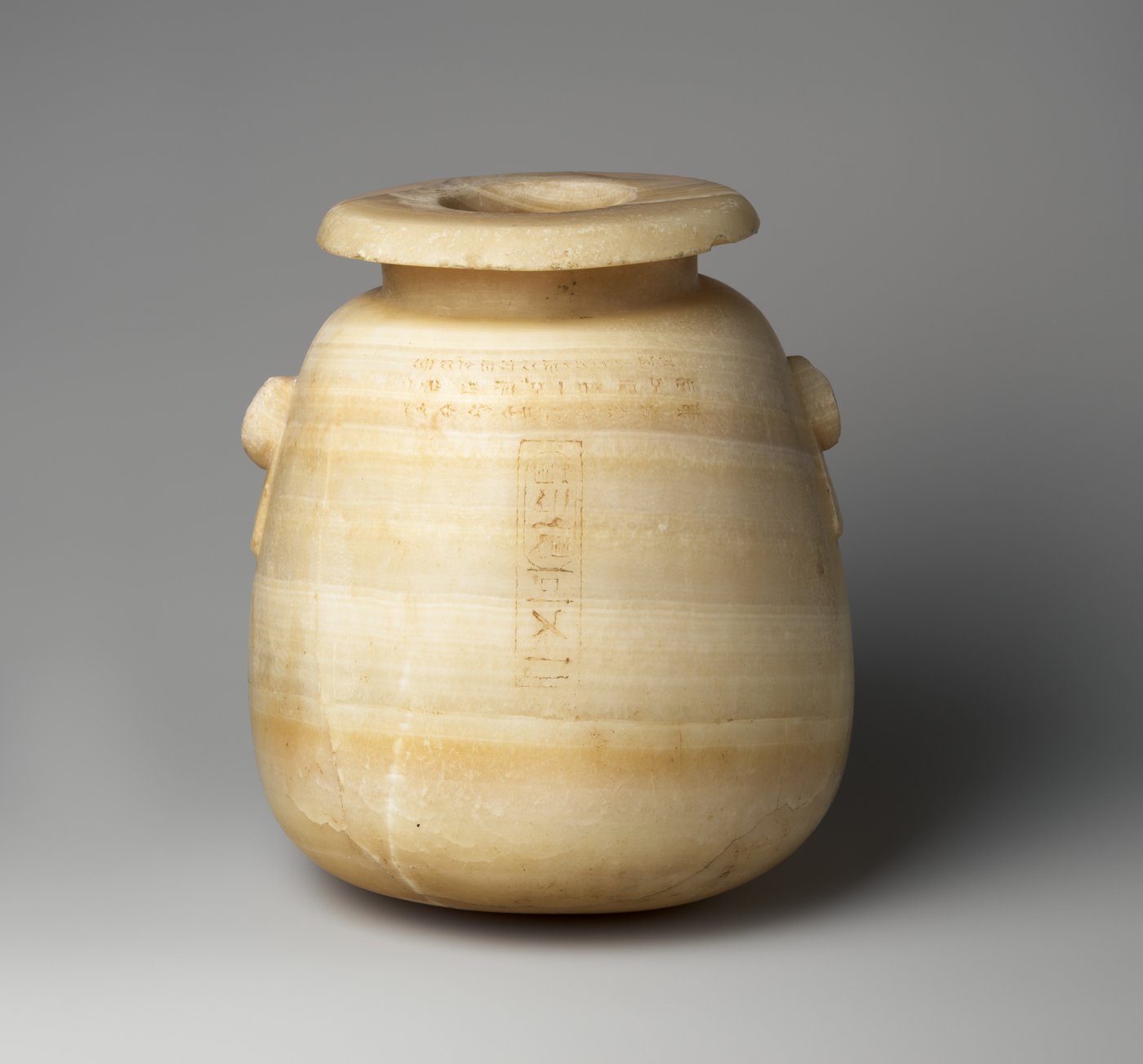
ConfirmedStone jar inscribed with the name of Xerxes the Great in four languages, found in Egypt. The Metropolitan Museum of Art, Rogers Fund, 1914 (14.2.8), Public domain (The Met Open Access, CC0).
Now it came to pass in the days of Ahasuerus, (this is Ahasuerus which reigned, from India even unto Ethiopia, over an hundred and seven and twenty provinces:)
Esther 1:1, KJV
Xerxes the First, son of Darius the First, ruled the Persian Empire from 486 to 465 BC. His own inscriptions survive. At the Gate of All Nations at Persepolis he says he built that gate, and in the "Daiva inscription" (found on stone slabs at Persepolis and Pasargadae) he lists the lands he ruled, including India and the Nubians (Kush, the land the King James Version calls Ethiopia). The Hebrew name Ahasuerus is believed to come from his Persian name, Khshayarsha, which reached Hebrew through Babylonian forms.
Where it is today
Inscriptions at Persepolis, Fars province, Iran. A stone jar inscribed with his name in four languages is in The Metropolitan Museum of Art, New York (14.2.8).
Date
Reigned 486 to 465 BC. Esther 1:3 (his third year) is about 483 BC; Esther 2:16 (the tenth month of his seventh year) is about December 479 or January 478 BC; Esther 3:7 (his twelfth year) is about 474 BC.
Why this label: Xerxes is one of the best known kings of the ancient world, from his own inscriptions and from Greek historians. Most scholars identify him with Ahasuerus because the names match, but this rests on the name and the setting, not on any Persian text that mentions Esther.
Good to know
How the dates fit: Xerxes put down a revolt in Egypt in 484 BC. Herodotus says that after Egypt was subdued he called the leading Persians together to plan the war on Greece, which many link to the great feast in his third year (Esther 1:3). His fleet was beaten at Salamis in 480 BC and his army at Plataea in 479 BC, after he had gone back to Asia. That leaves a gap of about four years before Esther became queen in his seventh year (Esther 2:16).
Other identifications: The Greek translation of Esther (the Septuagint) and the Jewish historian Josephus call the king Artaxerxes, and a few writers have suggested Artaxerxes the Second. Most scholars today prefer Xerxes.
Doubting view: Herodotus names Xerxes's queen as Amestris, not Vashti or Esther, and he says the Persian king was to marry only into a few leading Persian families. Esther 2:5-6 can also be read to say that Mordecai himself was carried away from Jerusalem in 597 BC, which would make him well over 100 years old in Xerxes's reign. For reasons like these, many scholars read the book as a story set at the Persian court rather than a record of events.
Supporting view: Others answer that Esther 2:6 can refer to Mordecai's great-grandfather Kish rather than to Mordecai himself. They also point to the book's accurate Persian names, words and palace details. Even David Clines, who reads it as a story, wrote in 1991 that its history details cannot clearly be proven wrong at any point, though he added that its plot depends on many unlikely coincidences.
In Ezra: The Ahasuerus of Ezra 4:6 is often taken to be the same king.
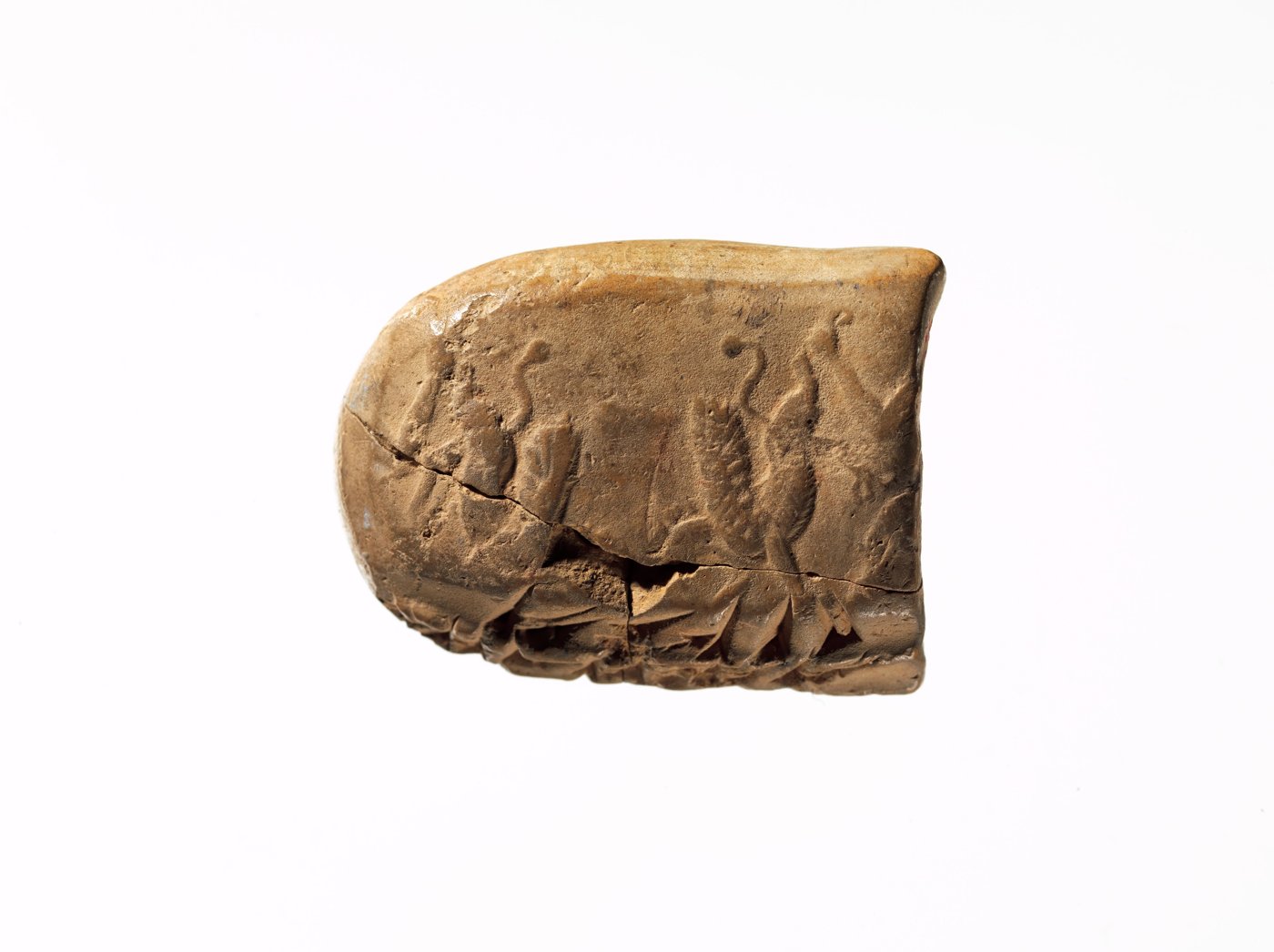
DisputedSmall sealed clay tablet in Elamite, a Persian government record from about 500 BC. It shows the kind of tablet meant here; it is not one of the tablets that name Marduka. The Metropolitan Museum of Art, Rogers Fund, 1936 (36.30.62), Public domain (The Met Open Access, CC0).
Now in Shushan the palace there was a certain Jew, whose name was Mordecai, the son of Jair, the son of Shimei, the son of Kish, a Benjamite;
Esther 2:5, KJV
Clay tablets in cuneiform (writing made of wedge-shaped marks) from the Persian period name officials called Marduka, the same name as Mordecai. In a journal article of 1940 to 1941, the expert Arthur Ungnad pointed to one tablet now in Berlin (Amherst 258), a list of payments that names "Marduka" as a scribe or official of Ushtannu, governor of Babylon and Beyond the River, and he thought this man was certainly Esther's Mordecai. Later, the government tablets from Persepolis, written in Elamite (a language used for Persian records), were found to name a Marduka about 30 times, perhaps as many as four different men, in the time of Darius the First and Xerxes; Edwin Yamauchi wrote on these in 1992.
Where it is today
Amherst tablet 258: Vorderasiatisches Museum, Berlin. The Persepolis tablets come from the government archives found at Persepolis, Iran.
Date
Late reign of Darius the First or early reign of Xerxes, about 500 to 480 BC.
Why this label: The tablets are real and show that the name Mordecai was used by Persian officials in the right period. Whether any of these men is the Mordecai of Esther is debated, and none of the tablets says he was Jewish or connected to a queen.
Good to know
Supporting view: Arthur Ungnad and Robert Gordis thought it unlikely that two important officials with the same name served at the same time and place, so they linked Marduka with Mordecai. Edwin Yamauchi wrote that this view had been widely accepted.
Doubting view: David Clines (1991) went back to the published text of the Amherst tablet and found that it has no date and no place of writing, probably comes from Borsippa near Babylon, and does not say Marduka worked at Susa or made any tour from Susa. He pointed out that Marduka served the governor of Babylon, so he most likely lived there.
Name only: The name, built on the name of the Babylonian god Marduk, was used by several men at the time, and the Persepolis tablets may refer to different people. The most the tablets show is that the name fits the time and place.
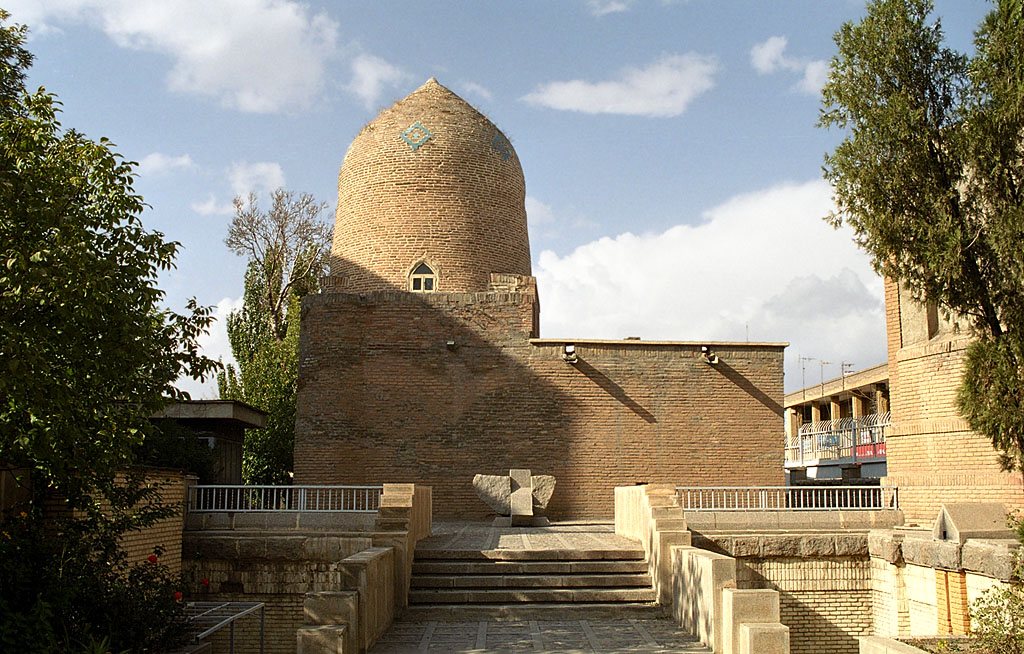
Traditional siteThe shrine of Esther and Mordecai in Hamadan, Iran. Philippe Chavin (Simorg), via Wikimedia Commons, CC BY-SA 3.0.
For Mordecai the Jew was next unto king Ahasuerus, and great among the Jews, and accepted of the multitude of his brethren, seeking the wealth of his people, and speaking peace to all his seed.
Esther 10:3, KJV
A small domed brick shrine in Hamadan, western Iran, is honoured by Jews as the burial place of Esther and Mordecai. Inside are two carved oak tomb chests inscribed in Hebrew with words from the last chapter of the book of Esther. Hamadan is ancient Ecbatana, a royal city of the Medes and Persians (called Achmetha in Ezra 6:2). Iranian Jews have long made pilgrimages there, especially at Purim.
Where it is today
Hamadan, Hamadan province, Iran. Access can change, so check before planning a visit.
Date
The tradition is written down by about 1170. The present building is dated by some to the Mongol period (the 1200s and 1300s) and by others to about 1600; earlier travellers reported dates of 1140 and 1309 or 1310 written inside.
Why this label: The Bible does not say where Esther or Mordecai were buried, and nothing at the site dates from their time. The link rests on a local Jewish tradition first written down about 1170, more than 850 years ago.
Good to know
Oldest mention: The Jewish traveller Benjamin of Tudela, writing about 1170, said that in Hamadan, "in front of a certain synagogue, there are buried Mordecai and Esther" (in the Adler translation). The Talmud does not mention the tomb, and outside Iran the tradition has had little support.
Another view: The scholar Ernst Herzfeld thought the tomb more likely belongs to Shushandukht, said to be the Jewish wife of the Persian king Yazdegerd the First (399 to 420 AD), and he believed Esther and Mordecai would have been buried at Susa. But Shushandukht is named in only one late Persian text, and some scholars think she may be a legend herself.
Other places: A medieval tradition put the graves at Kfar Bar'am in Galilee.
The building: It was renovated in 1971, when a courtyard and a small synagogue were added. In May 2020 a fire set at the site damaged a side building; officials said the hall with the tombs was not harmed.
The lot (pur) of Iahali: what "Pur" and "Purim" mean
Esther 3:7 · Esther 9:24-26
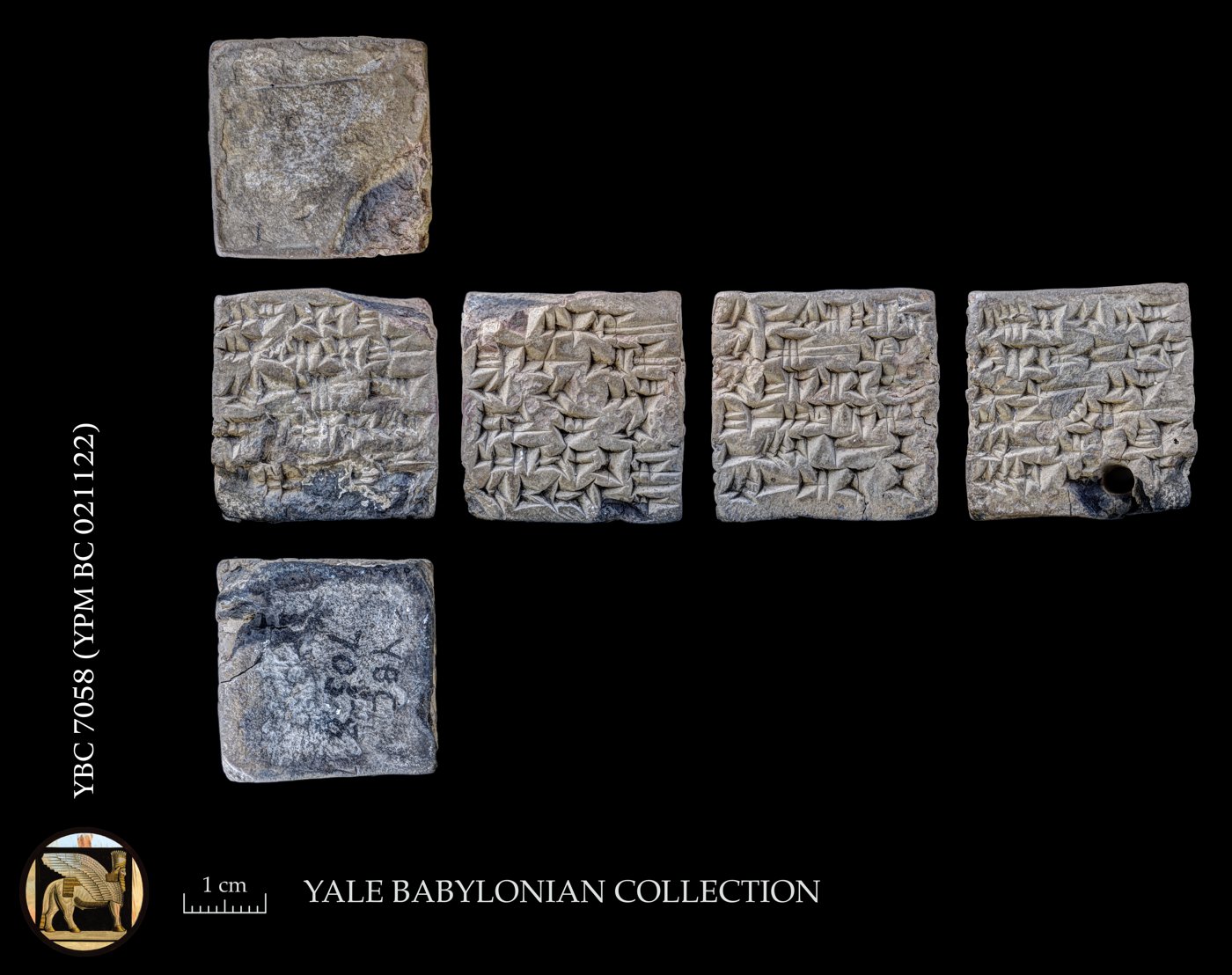
BackgroundThe six sides of the clay lot (pur) of Iahali, YBC 7058, laid out flat. Yale Babylonian Collection at the Yale Peabody Museum (via the Cuneiform Digital Library Initiative), CC0 1.0.
In the first month, that is, the month Nisan, in the twelfth year of king Ahasuerus, they cast Pur, that is, the lot, before Haman from day to day, and from month to month, to the twelfth month, that is, the month Adar.
Esther 3:7, KJV
This clay cube, about 2.8 centimetres on each side, is inscribed in cuneiform (wedge-shaped writing) in the Akkadian language (the language of Assyria and Babylon) as the "lot" (puru) of Iahali (also spelled Yahalu), a high official of the Assyrian king Shalmaneser the Third. Each year in Assyria was named after an official, and the text on the cube asks that, when Iahali's lot comes up before the gods Ashur and Adad, the harvest of Assyria will do well in his year. The Assyrian word puru is the word "Pur" in Esther, which the book itself explains as "the lot", and Purim is its plural.
Where it is today
Yale Babylonian Collection, Yale Peabody Museum, New Haven, Connecticut, United States (YBC 7058).
Date
Reign of Shalmaneser the Third (858 to 824 BC), the 800s BC.
Why this label: The cube is real and explains the word Pur used in Esther, but it is more than 300 years older than Esther's time and has nothing to do with Haman or the Jews.
Good to know
Lot or die: It is often called the "die of Iahali", but the experts Irving Finkel and Julian Reade point out that it is a lot, not a gaming die, even though it is shaped like one. They add that the word puru used for an official's year shows the official was in some way thought of as chosen by lot.
Why it matters: Esther 3:7 and 9:24-26 use a foreign word, Pur, and explain it for Hebrew readers, and this cube shows it was a real Mesopotamian word for a lot.
The royal tombs at Naqsh-e Rustam: Darius the Great and the kings after him
Ezra 6:14-15 · Haggai 1:1 · Nehemiah 2:1
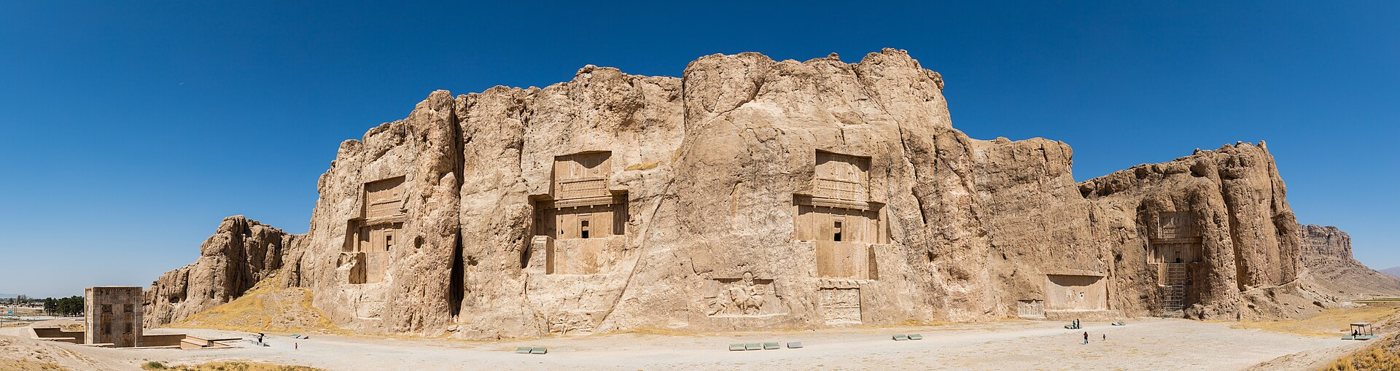
ConfirmedPanorama of the cliff at Naqsh-e Rustam showing the four cross-shaped royal tombs, with the square stone tower called the Kaaba of Zoroaster at the far left. Diego Delso, via Wikimedia Commons, CC BY-SA 4.0.
And the elders of the Jews builded, and they prospered through the prophesying of Haggai the prophet and Zechariah the son of Iddo. And they builded, and finished it, according to the commandment of the God of Israel, and according to the commandment of Cyrus, and Darius, and Artaxerxes king of Persia.
Ezra 6:14, KJV
Four huge tombs are cut high into a cliff at Naqsh-e Rustam, about 5 kilometres north-west of the ruins of Persepolis in Iran. Each front is carved in the shape of a cross, with a doorway made to look like a palace and, above it, the king standing on a platform held up by 30 men from the peoples of his empire. One tomb names its owner in its own inscriptions: Darius the Great, the king in whose reign the second temple in Jerusalem was finished (Ezra 4 to 6; Haggai; Zechariah). The other three are usually given to Xerxes (whom most scholars take to be Ahasuerus of Esther 1:1), Artaxerxes the First (Ezra 7; Nehemiah 2) and Darius the Second. The Bible does not say where any Persian king was buried.
Where it is today
Naqsh-e Rustam, near Marvdasht, Fars province, Iran. The tombs are still in the cliff face. Access can change, so check before planning a visit.
Date
Darius's tomb was cut during his reign (522 to 486 BC). The other three followed over the next 80 years or so, up to about 404 BC.
Why this label: Darius's tomb names him in its own inscriptions, so it is securely identified. The other three tombs have no such inscriptions; giving them to Xerxes, Artaxerxes the First and Darius the Second is very likely but not proven, and which tomb belongs to which of these kings is less certain.
Good to know
The inscription: Beside the carved figure of the king, Darius had a long text cut in cuneiform (wedge-shaped writing). One line reads "I am Darius the Great King, King of Kings, King of countries containing all kinds of men, King in this great earth far and wide, son of Hystaspes, an Achaemenian, a Persian, son of a Persian" (translation by Roland G. Kent, 1953).
Other tombs: From left to right the tombs are usually given to Darius the Second, Artaxerxes the First, Darius the Great and Xerxes. This order comes from their position and style, not from names on them. Which Artaxerxes sent Ezra is also debated (some argue for Artaxerxes the Second), though Nehemiah's king is widely taken to be Artaxerxes the First.
Not the same Darius: The "Darius the Median" of Daniel 5:31 is a different figure and is not the king buried here.
Inside the tombs: Each tomb had room for about 3 to 9 bodies, in graves cut in the rock. The tombs were broken open and robbed after Alexander the Great conquered Persia, about 330 BC. Later Persian kings were probably buried in similar tombs at Persepolis itself.
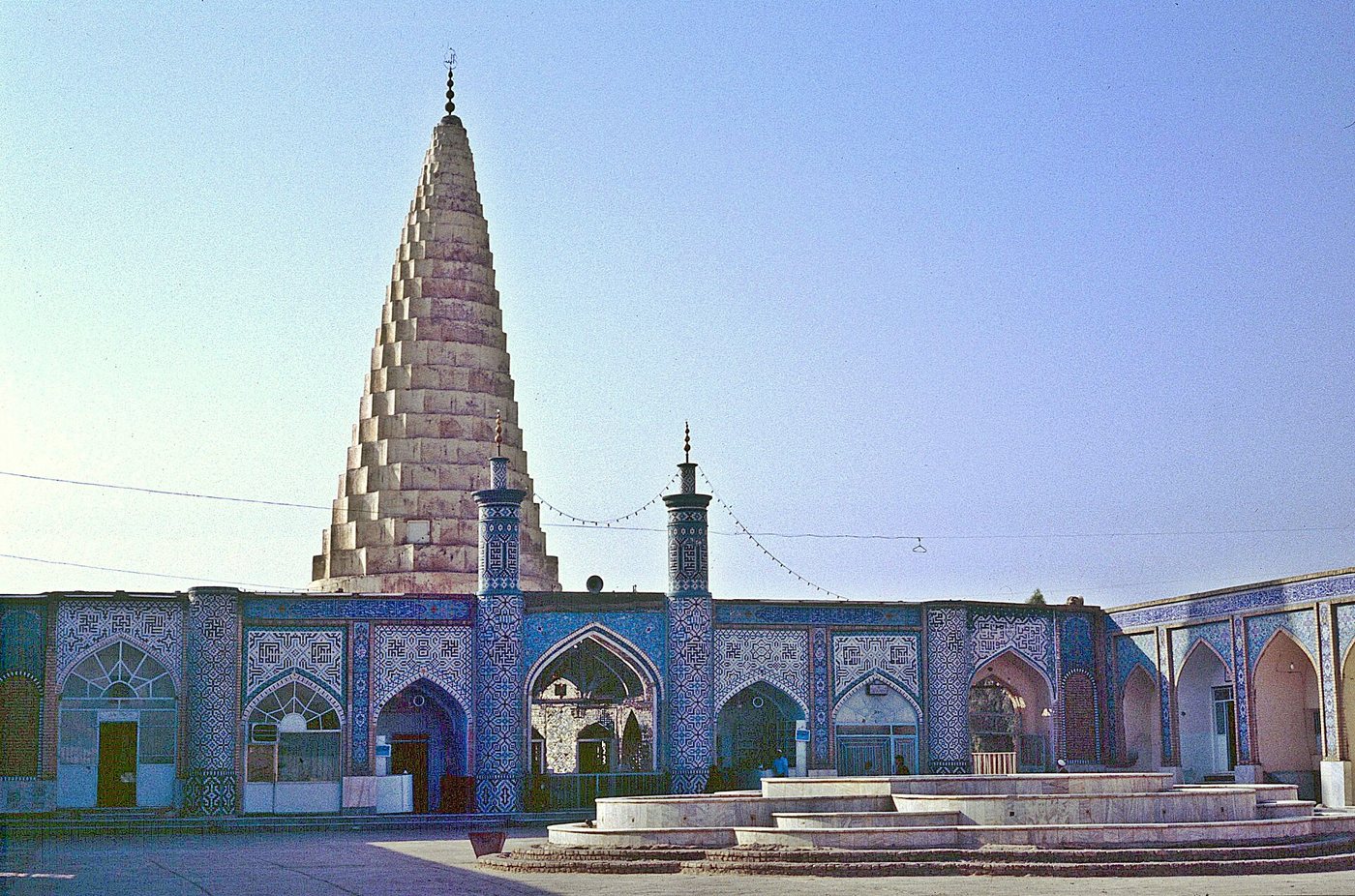
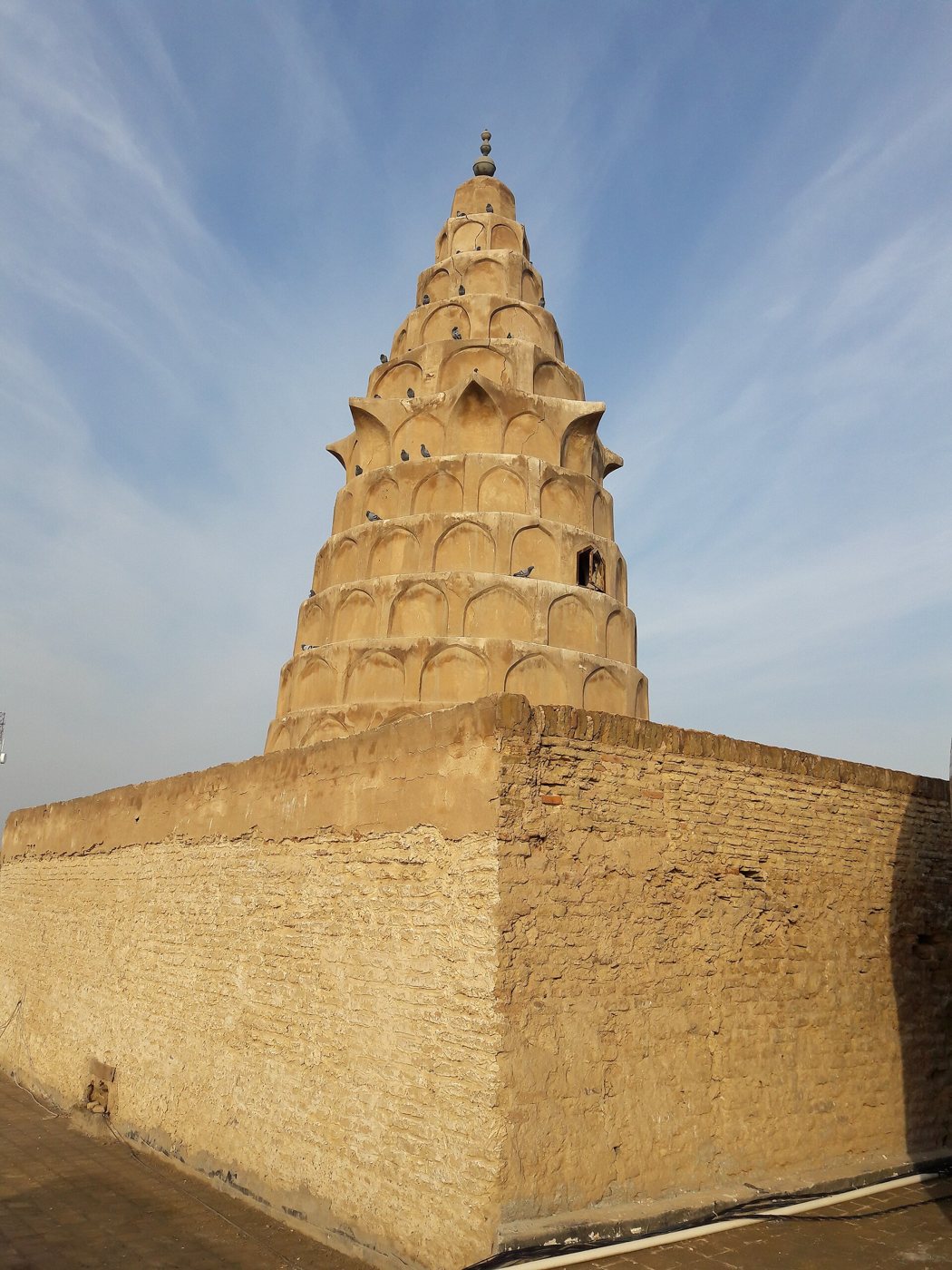
Traditional siteThe shrine of Daniel at Shush, with its tall cone-shaped dome. Ziegler175, via Wikimedia Commons, CC BY-SA 4.0.
And I saw in a vision; and it came to pass, when I saw, that I was at Shushan in the palace, which is in the province of Elam; and I saw in a vision, and I was by the river of Ulai.
Daniel 8:2, KJV
In the town of Shush in south-western Iran (ancient Susa, the Shushan of the Bible) stands a shrine that Jews and Muslims have long honoured as the tomb of the prophet Daniel. Its dome rises in a tall cone made of many stacked rows of small arched cells. Daniel 8:2 says that Daniel, in a vision, was at Shushan by the river Ulai. The Bible does not say where Daniel died or was buried.
Where it is today
Shush (ancient Susa), Khuzestan province, Iran. Access can change, so check before planning a visit.
Date
Tradition recorded from the 800s AD. The shrine may go back to about the 1100s, but the present building comes mostly from repairs after a flood in 1869 and later work.
Why this label: Jewish and Muslim tradition has placed Daniel's grave at Susa for more than a thousand years, but no inscription or find ties the grave to Daniel, and other towns claim him too. The Bible does not record where he was buried.
Good to know
Early records: The Arab historian al-Baladhuri (800s AD) tells that when Muslim armies took Susa about 638 AD they found a coffin said to hold Daniel. The caliph Umar ordered it buried, and it was sunk to the bottom of a stream.
The coffin story: In the 1100s the Jewish traveller Benjamin of Tudela heard that people on the two banks of the river quarrelled over Daniel's coffin and moved it from side to side each year, until the ruler Sanjar had it put inside a glass coffin and hung by an iron chain from the middle of the bridge. So, in the story Benjamin was told, the coffin was not in the tomb shown to him in front of a synagogue.
Rival sites: Other places also claim Daniel's grave, including a mosque in the old citadel of Kirkuk in Iraq, the very long tomb of Khoja Daniyar in Samarkand, Uzbekistan, and two sites in Tarsus, Turkey. An old Roman church calendar placed his death and burial in Babylon.
Reading the verse: Daniel 8:2 may describe where Daniel saw himself in the vision rather than where he lived, so it does not prove he was ever at Susa in person.
Traditional siteThe old cone-shaped dome, built of stacked rows of arched cells, over the tomb room honoured as Ezekiel's at al-Kifl. Farhadmirza, via Wikimedia Commons, CC BY-SA 4.0.
The word of the LORD came expressly unto Ezekiel the priest, the son of Buzi, in the land of the Chaldeans by the river Chebar; and the hand of the LORD was there upon him.
Ezekiel 1:3, KJV
In the small town of al-Kifl, on the Euphrates about 30 kilometres from the ruins of Babylon, a shrine with a tall cone-shaped dome is honoured as the tomb of the prophet Ezekiel. For centuries it was one of the most important places of Jewish pilgrimage in Iraq, and Muslims honour it too as the tomb of the prophet they call Dhu al-Kifl. The Bible places Ezekiel among the exiles in Babylonia by the river Chebar (Ezekiel 1:1 to 3; 3:15), but it does not say where he died or was buried.
Where it is today
Al-Kifl, Babil province, Iraq, between Hillah and Najaf. Access can change, so check before planning a visit.
Date
The tomb is first mentioned in the 900s AD. The tomb room and its dome probably date from about the early 1300s. Much of the larger complex was rebuilt in the 2010s.
Why this label: The tradition is old and was shared by Jews and Muslims, but no inscription or ancient find shows that Ezekiel was buried here, and the Bible is silent about his burial.
Good to know
Early records: An ancient writing called the Lives of the Prophets says Ezekiel was buried in the land of the Chaldeans, in the tomb of Shem and Arphaxad, without naming a town. The tomb itself is first mentioned by the Jewish scholar Sherira Gaon in the 900s AD. In the 1100s Benjamin of Tudela described synagogues there and Muslim visitors as well, and was told the legend that the exiled king Jehoiachin built the tomb. Rabbi Petachiah, about 1180, told of great crowds of Jewish pilgrims at the Feast of Tabernacles.
The building: The tomb room, with its cone-shaped dome of stacked arched cells, is thought to date from about the early 1300s, when a Mongol ruler built the mosque and the old leaning minaret beside it. Its exact age is not known.
Recent changes: After most of Iraq's Jews left in the early 1950s, Muslim caretakers looked after the site. In the 2010s the mosque around the tomb was rebuilt and enlarged with new domes and minarets. Much of the Hebrew writing in the inner tomb room was kept, but some Hebrew inscriptions were removed.
Rival site: A small tomb at Amadiya in northern Iraq has also been linked to Ezekiel, or to a figure called Hazana.
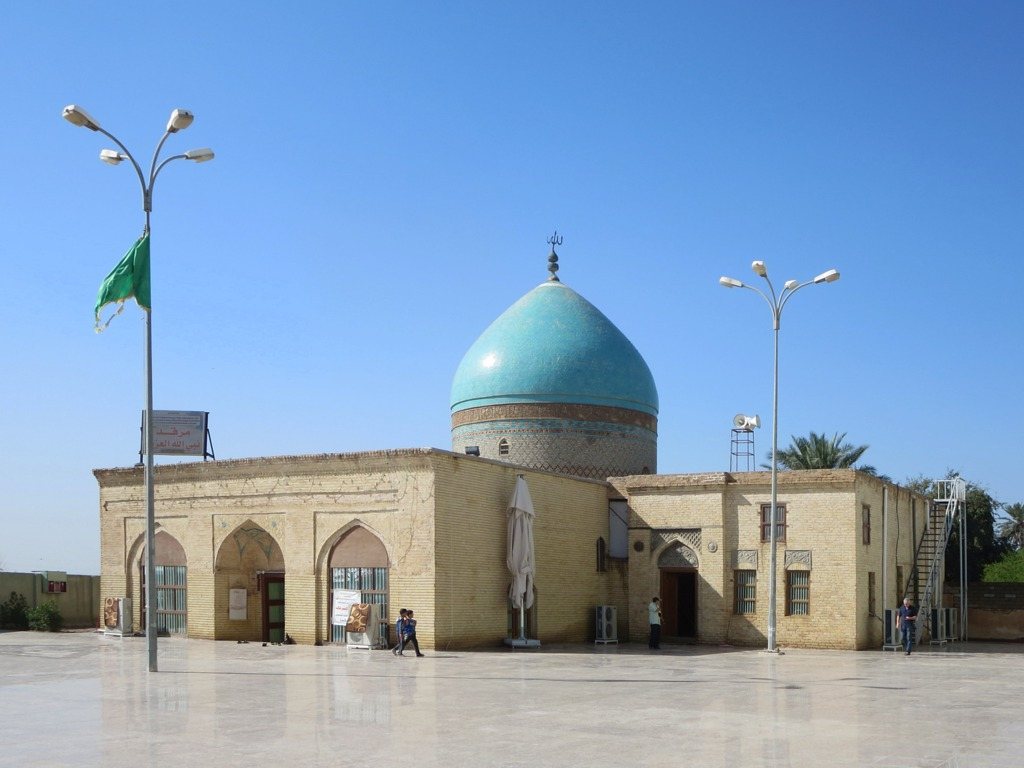
Traditional siteThe shrine at al-Uzair honoured as the tomb of Ezra. David Stanley, via Wikimedia Commons, CC BY-SA 3.0.
This Ezra went up from Babylon; and he was a ready scribe in the law of Moses, which the LORD God of Israel had given: and the king granted him all his request, according to the hand of the LORD his God upon him.
Ezra 7:6, KJV
Beside the Tigris River in southern Iraq, at the village of al-Uzair, a domed shrine is honoured as the tomb of Ezra the scribe. For centuries Jews and Muslims both visited it; today it is mainly a place of Shia Muslim pilgrimage, though Hebrew writing is still kept inside. The Bible tells how Ezra went up from Babylon to Jerusalem and read the law to the people there (Ezra 7; Nehemiah 8), but it does not record his death or burial.
Where it is today
Al-Uzair, Qal'at Saleh district, Maysan province, Iraq, on the west bank of the Tigris. Access can change, so check before planning a visit.
Date
Tradition from about 1050 AD. The present buildings probably date from the late 1700s and later.
Why this label: The grave was said to have been found about 1,500 years after Ezra's time, through a reported dream, and no inscription or find ties it to him. The Jewish historian Josephus, writing much earlier, said Ezra was buried in Jerusalem.
Good to know
How it began: The Jewish traveller Judah Alharizi, visiting about 1215, was told that a shepherd had learned the place of the grave in a dream 160 years earlier, which points to about 1050 AD. Benjamin of Tudela and Rabbi Petachiah, in the 1100s, also described the tomb and its visitors.
Other traditions: Josephus (first century AD) wrote that Ezra "died an old man, and was buried in a magnificent manner at Jerusalem" (Whiston translation). Another Jewish tradition says he died in Babylonia, and a village in Syria (Tedef) also shows a tomb of Ezra.
The building: In 1820 the traveller Claudius Rich was told that a Jew had put up the present building about 30 years before. In the 1800s Austen Henry Layard thought the older tomb had probably been washed away by the shifting Tigris, so the shrine seen today may not stand where medieval visitors saw it.
Jonah's tomb at Nineveh (Nebi Yunus, Mosul) and the Assyrian palace beneath it
Jonah 3:3 · 2 Kings 14:25 · 2 Kings 19:37
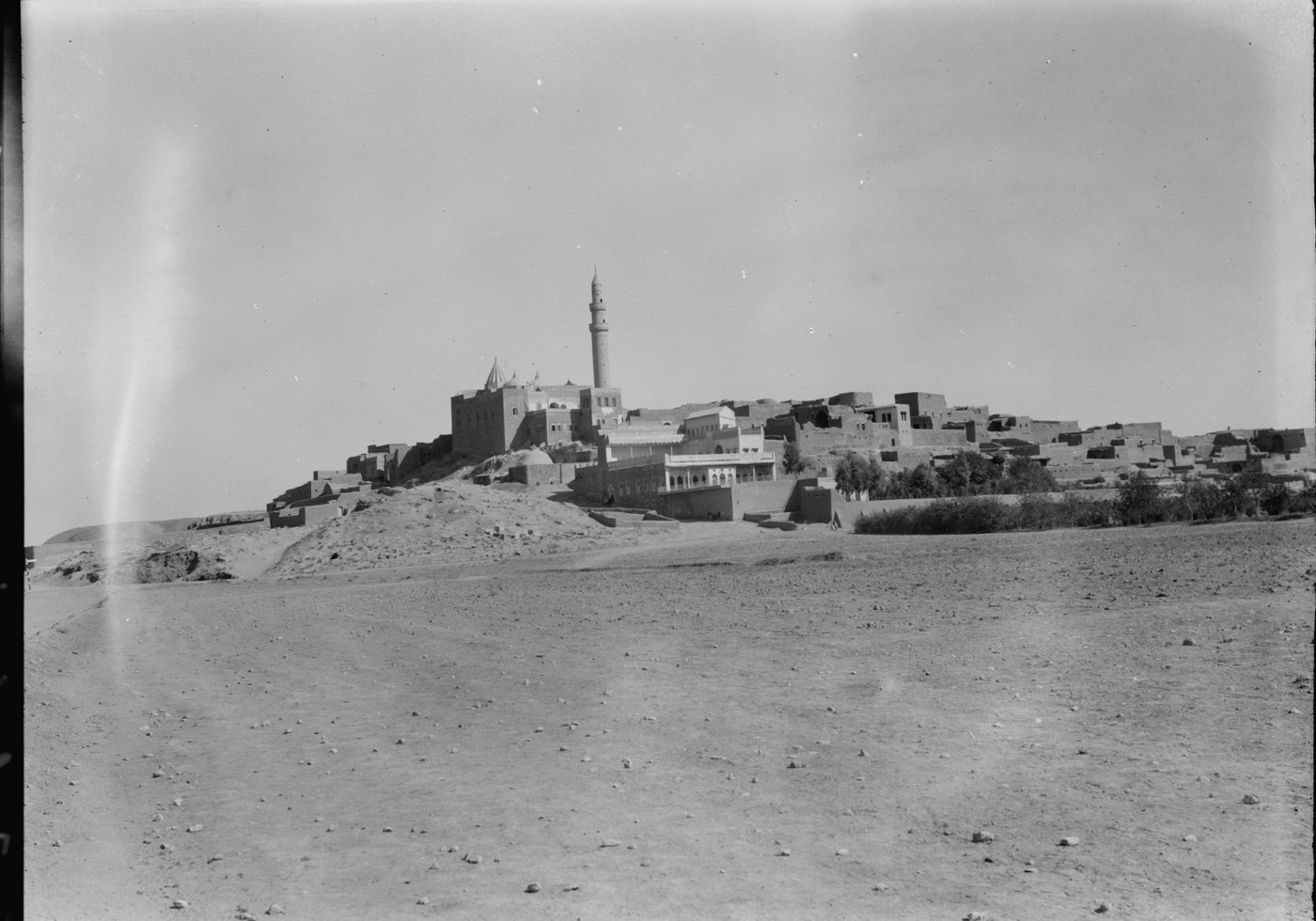
Traditional siteThe mosque of Nebi Yunus on its mound at Nineveh in 1932, long before its destruction in 2014. G. Eric and Edith Matson Photograph Collection, Library of Congress Prints and Photographs Division, LC-DIG-matpc-13210, No known restrictions on publication (Library of Congress statement).
So Jonah arose, and went unto Nineveh, according to the word of the LORD. Now Nineveh was an exceeding great city of three days' journey.
Jonah 3:3, KJV
Nebi Yunus ("Prophet Jonah") is the smaller of the two great ruin mounds of ancient Nineveh, now inside the city of Mosul. A mosque on top held a tomb shown since the 1300s as the tomb of Jonah, who preached to Nineveh (Jonah 3). The mosque was blown up on 24 July 2014, while the Islamic State group held Mosul. In 2017, tunnels dug under its ruins by looters led archaeologists into parts of a palace of Esarhaddon, the son of Sennacherib who "reigned in his stead" (2 Kings 19:37) and who is also named in Ezra 4:2.
Where it is today
Tell Nebi Yunus, on the east side of the Tigris in Mosul, Nineveh province, Iraq. The mosque lies in ruins and excavation continues. Access can change, so check before planning a visit.
Date
Palace: about 700 to 670 BC (begun under Sennacherib, who reigned 705 to 681 BC, and enlarged by his son Esarhaddon, who reigned 681 to 669 BC). Tomb tradition: from the 1300s AD. Mosque destroyed in 2014.
Why this label: The palace under the mound is real and dated by Esarhaddon's own inscriptions, and Nineveh itself is certain (see the Genesis page), but nothing ties the tomb to Jonah. The Bible does not say where Jonah died or was buried.
Good to know
The tomb story: In the Middle Ages a Church of the East monastery named after a Jonah stood on the mound, and a former head of that church, Hnanisho, was buried there; his grave was opened in 1349. Soon after, the monastery was pulled down and rebuilt as a mosque, and in 1365 the grave of the prophet Jonah was announced there. The historian David Wilmshurst suggests that the coffin later shown as Jonah's may have been Hnanisho's.
Other tradition: 2 Kings 14:25 says Jonah came from Gath-hepher in Galilee. Jerome, around 400 AD, said Jonah's tomb was shown near that village, and the village of Mashhad near Nazareth still points it out.
The palace: The palace was already partly known before 2014. Iraqi archaeologists working beside the mosque in 1987 to 1992 had found parts of it. It was a palace used as an army base, often called the Review Palace, and they found winged bull statues of Esarhaddon. In the looters' tunnels found in 2017, seven more inscriptions of Esarhaddon came to light, and a University of Heidelberg team has dug there since 2018.
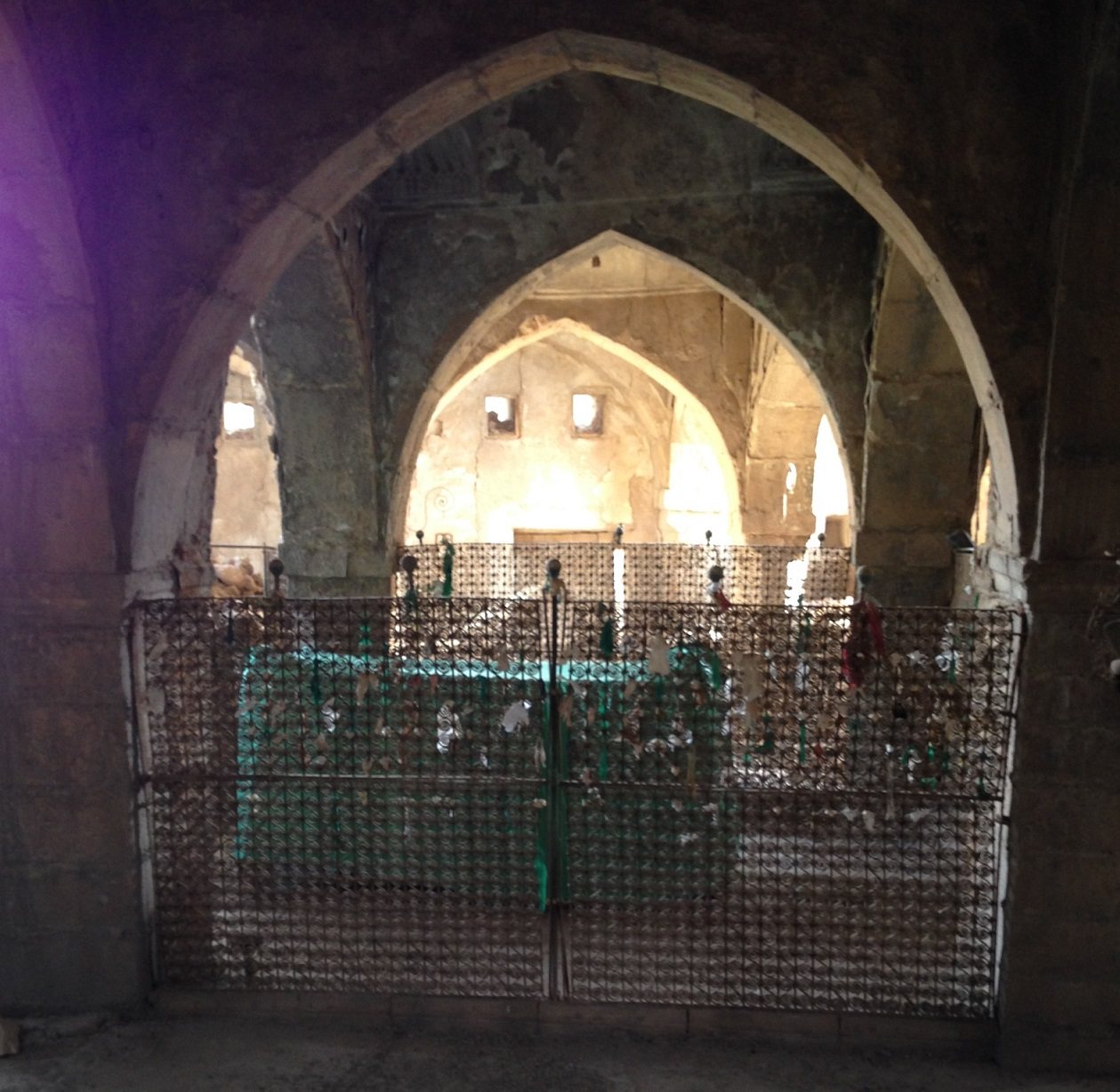
Traditional siteThe tomb of Nahum behind a metal screen inside the old synagogue at Alqosh. Wikimedia Commons user Chaldean, CC BY-SA 4.0.
The burden of Nineveh. The book of the vision of Nahum the Elkoshite.
Nahum 1:1, KJV
In the mainly Christian town of Alqosh in northern Iraq, about 45 to 50 kilometres north of Mosul, an old synagogue holds a tomb honoured as that of the prophet Nahum, who foretold the fall of Nineveh. The link comes from Nahum 1:1, which calls him "the Elkoshite", and the likeness between the names Elkosh and Alqosh. The Bible does not say where Elkosh was or where Nahum was buried.
Where it is today
Alqosh, Nineveh plains, northern Iraq. The tomb and synagogue were restored between 2018 and 2021. Access can change, so check before planning a visit.
Date
The Alqosh tomb is mentioned in a letter of the scholar Andreas Masius in the 1500s (according to McClintock and Strong's Cyclopedia), and it was repaired in 1796. When the tradition began is not known. The building is old, but its exact date is uncertain. Restored 2018 to 2021.
Why this label: Jews and local Christians have honoured the tomb, but the link to Alqosh rests on a likeness of names. Medieval Jewish travellers were shown Nahum's grave in other places, and several towns claim to be Elkosh.
Good to know
Older claims: In the 1100s Benjamin of Tudela was shown a "sepulchre of Nahum the Elkoshite" at a place called Ain Siptha, not at Alqosh, and Rabbi Petachiah (about 1180) was shown Nahum's grave not far from the tomb of Ezekiel. Benjamin also mentions a synagogue of Nahum at Mosul.
Rival sites: Jerome, around 400 AD, was shown a village in Galilee called Helkesei as Elkosh, an old writing called the Lives of the Prophets places Elkosh near Beth Gabre (Beit Jibrin) in the south of Judah, in the land of the tribe of Simeon, and a grave of Nahum has also been shown at Kefr Tanchum near Tiberias. Capernaum's Hebrew name, Kefar Nahum, means "village of Nahum", but nothing shows that this Nahum was the prophet.
Recent repair: After the town's Jews left around 1948 to 1950, Christian neighbours kept the keys and cared for the tomb, but the roof and walls began to fall in. A rescue led by the Alliance for the Restoration of Cultural Heritage (ARCH), working with the Czech firm GEMA ART, stabilized the building from 2018, and the restoration was finished in 2021.
Nebuchadnezzar: no tomb found, but his name is stamped on the bricks of Babylon
Daniel 4:30 · Ezra 5:12 · Isaiah 14:19
ConfirmedClay cylinder with Nebuchadnezzar's inscription about building the outer city wall of Babylon. The Metropolitan Museum of Art, New York, Purchase, 1886 (86.11.60), Public Domain (The Met Open Access, CC0).
The king spake, and said, Is not this great Babylon, that I have built for the house of the kingdom by the might of my power, and for the honour of my majesty?
Daniel 4:30, KJV
No tomb of Nebuchadnezzar has been found, and where he was buried is not known. The Bible does not record his death or burial. What survives in huge numbers is his name on the buildings of Babylon. Excavators found great numbers of baked bricks stamped with a short text: "Nebuchadnezzar, King of Babylon, fosterer of Esagila and Ezida, son of Nabopolassar, King of Babylon" (Esagila and Ezida were the chief temples of Babylon and nearby Borsippa). His longer building inscriptions, on clay cylinders and stone tablets in cuneiform (wedge-shaped writing), list the temples, palaces and walls he built, which fits the boast the Bible gives him in Daniel 4:30.
Where it is today
Babylon, near Hillah, Iraq, where his bricks are still in the ruins. Stamped bricks and inscribed cylinders are in many museums. For example, The Metropolitan Museum of Art in New York holds a clay cylinder about the outer city wall of Babylon (86.11.60), and the British Museum holds the East India House stone tablet (BM 129397).
Date
Reigned 605 to 562 BC; he died in 562 BC.
Why this label: Nebuchadnezzar and his building works at Babylon are confirmed by great numbers of his own stamped bricks and many inscriptions. Only his tomb is unknown: none has been found or identified.
Good to know
His own words: One kind of inscribed brick from his palace at Babylon reads "The palace, the dwelling place of my Majesty I built" and asks that he "be satisfied with the fullness of the house that I have built" (translation by Friedrich Delitzsch, quoted by the excavator Robert Koldewey).
The building work: The modern edition of his inscriptions says that in Babylon he worked on at least 13 temples, renovated one palace and built two more, and finished the inner and outer city walls, nearly doubling the size of the city. The East India House inscription, a stone tablet found at Babylon before 1803, sums up many of these works.
The Bible: Isaiah 14 is a mocking song against "the king of Babylon" (Isaiah 14:4), which says "thou art cast out of thy grave" (Isaiah 14:19). It does not name the king, and readers differ on whether it means Nebuchadnezzar, a later king, or the kings of Babylon in general. It does not say where any grave was.
Not covered here: The Ishtar Gate, his best-known building, is described on the Genesis page.
What it shows: These finds confirm that Nebuchadnezzar was a great builder, as Daniel 4:30 assumes. They do not speak about the other events of Daniel 4.
 LearnAboutHim