Real places you can visit and real objects you can see in museums, connected to the book of Exodus. Each one is marked honestly, so you can tell solid evidence from tradition and from claims that are still argued over.
ConfirmedThe place or object is real and is clearly the one the Bible names.2
Traditional siteA real place that long tradition links to the Bible, but the exact spot cannot be proven.2
DisputedInformed people disagree, or the claim rests on weak evidence.7
BackgroundShows the world the Bible describes, but does not name a Bible person or event.9
Israel in Egypt
1
Raamses: the city of Pi-Ramesses at Qantir
Exodus 1:11 · Genesis 47:11 · Exodus 12:37
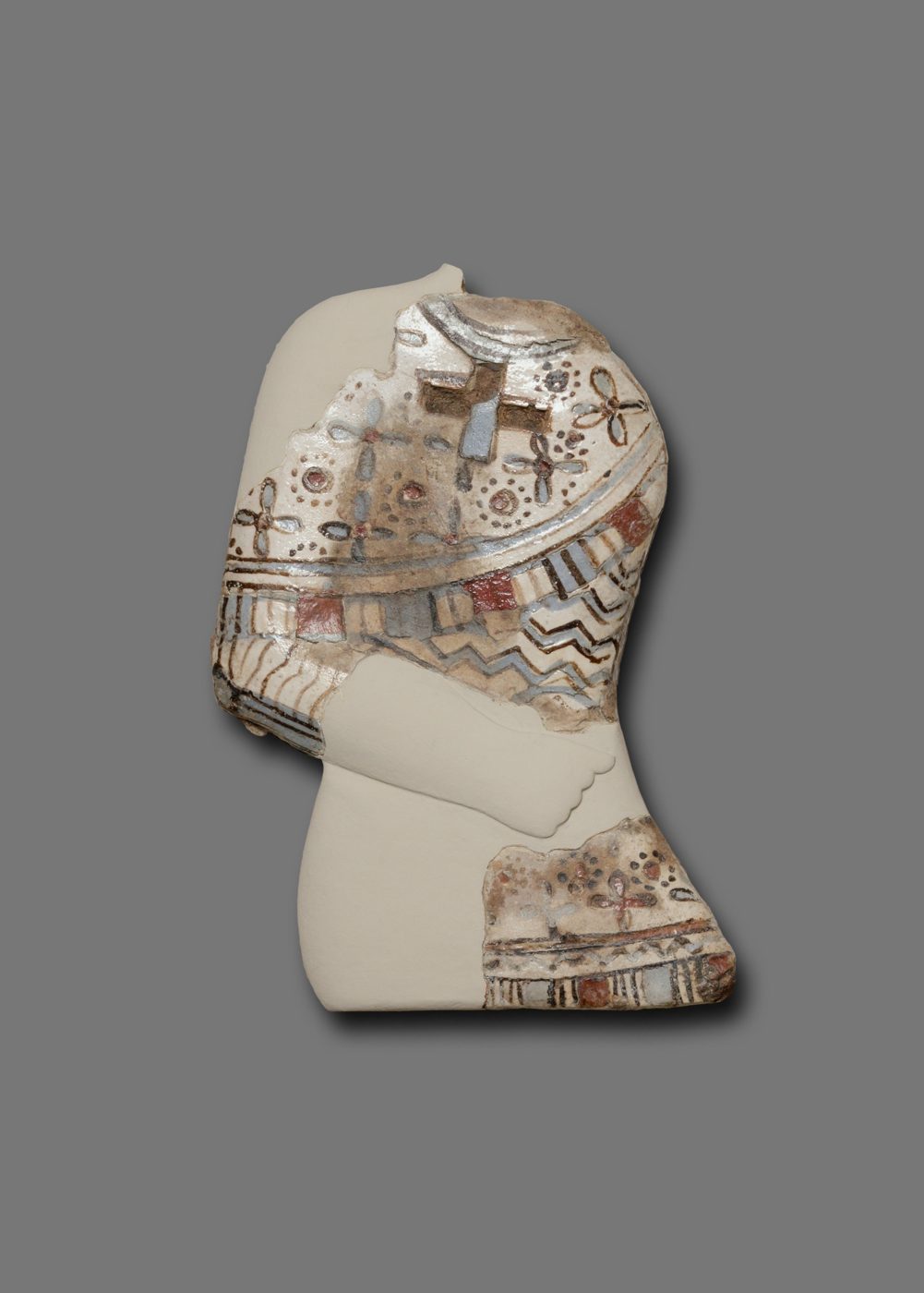
ConfirmedGlazed tile from the palace of Ramesses the Second at Qantir (Pi-Ramesses): the upper body of a captive from Mesopotamia or Syria in a patterned robe. The head is missing, and the old glazed pieces are set into a plain modern backing. The Metropolitan Museum of Art, New York, 35.1.56 (Purchase, Rogers Fund, Edward S. Harkness Gift and by exchange, 1922, 1929, 1935), Public Domain (Met Open Access).
Therefore they did set over them taskmasters to afflict them with their burdens. And they built for Pharaoh treasure cities, Pithom and Raamses.
Exodus 1:11, KJV
Exodus 1:11 says the Israelites built two store cities for Pharaoh, Pithom and Raamses. Exodus 12:37 and Numbers 33:3 and 33:5 name Rameses as the place they set out from. Most scholars take Raamses to be the Egyptian city Pi-Ramesses, which means "House of Ramesses". It was a great capital city in the Nile Delta (the wide, flat land where the Nile splits into branches before it reaches the sea), built mainly by Ramesses the Second. Its ruins lie under the fields around the village of Qantir in the eastern Delta, next to the older city of Avaris. A German team has mapped and dug the site since 1980, led by Edgar Pusch until 2015 and since then by Henning Franzmeier. They have found workshops and large stables for horses. Glazed tiles from a palace of Ramesses the Second have also come from the site.
Where it is today
Qantir, Sharqia Governorate, eastern Nile Delta, Egypt. Most of the city is buried under farmland, and many of its stone monuments were later moved to Tanis. Glazed tiles from the palace of Ramesses the Second are in The Metropolitan Museum of Art, New York. Access to the site is limited, so check before planning a visit.
Date
A small palace of Seti the First stood here first (he reigned about 1294 to 1279 BC). The great city was built under Ramesses the Second (reigned 1279 to 1213 BC). It was the main royal city from about 1270 BC to about 1135 BC. After that it was slowly abandoned, mainly because the branch of the Nile beside it filled up with silt.
Why this label: Most scholars agree that the Raamses or Rameses of Exodus is Pi-Ramesses, a city well known from Egyptian texts, whose ruins are at Qantir. Only the place is confirmed: nothing found there names Israel or Hebrew workers, and the date of the Exodus is a separate debate (see below).
Good to know: Late-date view: The city carried the name of Ramesses only from the 1200s BC, so many scholars take Exodus 1:11 as a sign that the Exodus happened in that century. Early-date view: Scholars who hold the earlier date, about 1446 BC, think a later scribe used the name readers knew in place of an older place name. They note that Genesis 47:11 already speaks of "the land of Rameses" in Joseph's time, long before any king named Ramesses under either dating. Doubting view: A few scholars, such as Donald Redford and Bernd Schipper, question whether the Bible's Raamses is Pi-Ramesses at all. They point to differences in spelling and argue that the name could have entered the story centuries later. An old mistake: Tanis was once thought to be Pi-Ramesses, because so many of its monuments were carried there. The digs at Qantir have since shown where the city really was.
Therefore they did set over them taskmasters to afflict them with their burdens. And they built for Pharaoh treasure cities, Pithom and Raamses.
Exodus 1:11, KJV
Pithom comes from the Egyptian name Per-Atum, meaning "House of Atum". Atum was an Egyptian god, and the name may first have belonged to his temple. An Egyptian report from about 1200 BC places "the pools of Per-Atum" in Tjeku, the district of the Wadi Tumilat. This is a valley that runs east from the Nile Delta toward the desert. Two ancient mounds in this valley are the main candidates for Pithom. Each is called a "tell", an Arabic word for a mound built up from the ruins of towns rebuilt on the same spot over many centuries. Tell el-Maskhuta was dug by Édouard Naville in 1883 and by a University of Toronto team from 1978 to 1985. Tell er-Retaba, about 14 km to the west, has been dug by a Polish-Slovak team since 2007.
Where it is today
Wadi Tumilat, Ismailia region, Egypt. Tell el-Maskhuta is about 16 km west of Ismailia, and Tell er-Retaba is about 14 km west of Tell el-Maskhuta. Access is limited, so check before planning a visit.
Date
Tell er-Retaba: first settled about 1650 to 1550 BC. Walls, a fort, storerooms and a temple of Atum were built there from the time of Ramesses the Second (1200s BC), and larger walls under Ramesses the Third. Tell el-Maskhuta: settled about 1700 to 1600 BC; the excavated area then shows no town until it was rebuilt in the late 600s BC. In 2010 a large tomb of an Egyptian official from the 1200s BC was found just north of that area.
Why this label: Pithom (Per-Atum) was a real place in the Wadi Tumilat, but scholars disagree on which of the two mounds it was. Inscriptions naming "Atum, Lord of Tjeku" were found at both sites, so they do not settle the question.
Good to know: Later Pithom view: The Toronto team found no town of the 1200s BC at Tell el-Maskhuta. So some scholars, such as Donald Redford, think the Bible's Pithom is Tell el-Maskhuta as rebuilt in the 600s BC, and that the Exodus account reflects that later time. Earlier Pithom view: Others, such as Manfred Bietak, Kenneth Kitchen and James Hoffmeier, place the Pithom of Exodus at Tell er-Retaba, which was in use under Ramesses the Second, and think the name moved to Maskhuta later. Hoffmeier also points to the tomb found in 2010 as a sign that people lived at Maskhuta in the 1200s BC, and some of these scholars think Maskhuta was Succoth (Exodus 12:37).
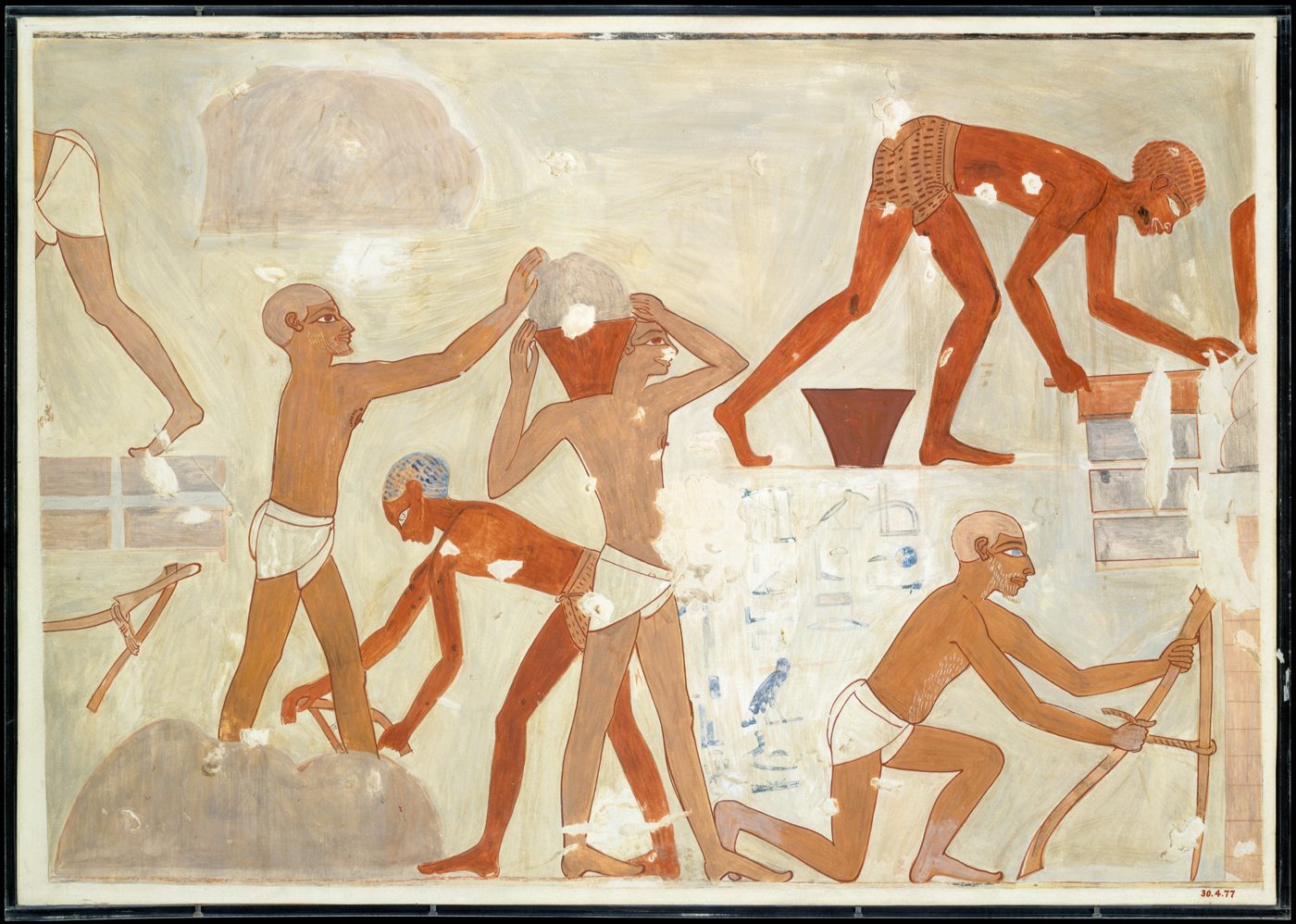
BackgroundBrickmakers at work: men hoeing and mixing mud, carrying it in a basket, and shaping bricks in a wooden mould beside a stack of bricks, in a full-size painted copy of a scene in the tomb of Rekhmire, Thebes. Nina de Garis Davies, The Metropolitan Museum of Art, New York, 30.4.77 (Rogers Fund, 1930), copy of the tomb painting, Public Domain (Met Open Access).
Go therefore now, and work; for there shall no straw be given you, yet shall ye deliver the tale of bricks.
Exodus 5:18, KJV
Exodus says the Israelites made mud bricks under taskmasters. They had to meet a set daily number of bricks (the KJV word "tale" means "count"), and later had to gather their own straw. A wall painting in the tomb of Rekhmire, chief minister (vizier) of Egypt, at Thebes shows workers making bricks for building work at the temple of Amun at Karnak. Among them are Syrians and Nubians, and Egyptian overseers with sticks watch over them. A leather roll in the Louvre, from year 5 of Ramesses the Second, lists 40 junior officers who each had a target of 2,000 bricks from the men under them. Beside some names it records the bricks delivered and how many were still missing. Two texts used to train scribes, copied about 1200 BC, also speak of men "making their quota of bricks daily" (Papyrus Anastasi 3) and of a district with "no men to mould bricks and no straw" (Papyrus Anastasi 4).
Where it is today
Painting: Tomb of Rekhmire (TT 100), Sheikh Abd el-Qurna, on the west bank at Luxor (ancient Thebes), Egypt. Full-size painted copies by Nina de Garis Davies, bought by the museum in 1930, are in The Metropolitan Museum of Art, New York (30.4.77 and 30.4.89). Leather roll: Louvre, Paris (catalogue number not confirmed). Papyrus Anastasi 3 and 4: British Museum, London (EA 10246 and EA 10249).
Date
Rekhmire painting: about 1479 to 1425 BC (reigns of Thutmose the Third and early Amenhotep the Second). Leather roll: year 5 of Ramesses the Second, about 1275 BC. Papyrus Anastasi 3 and 4: about 1210 to 1200 BC.
Why this label: These are real Egyptian records of brickmaking by gangs under overseers, with daily targets and concern about straw, which matches the work described in Exodus 1 and 5. None of them names Israel or the Hebrews.
Good to know: The workers in the Rekhmire painting are a mix of Syrians, Nubians and Egyptians. A caption over one Syrian calls him one of the captives the king brought back for the temple work. Nothing in the scene identifies any of them as Israelites. The "no straw" line in Papyrus Anastasi 4 is part of a mocking description of a miserable border post, not a report of a work punishment.
Brooklyn Papyrus 35.1446: Semitic servants and the name Shiphrah
Exodus 1:15 · Genesis 39:1
Background
And the king of Egypt spake to the Hebrew midwives, of which the name of the one was Shiphrah, and the name of the other Puah:
Exodus 1:15, KJV
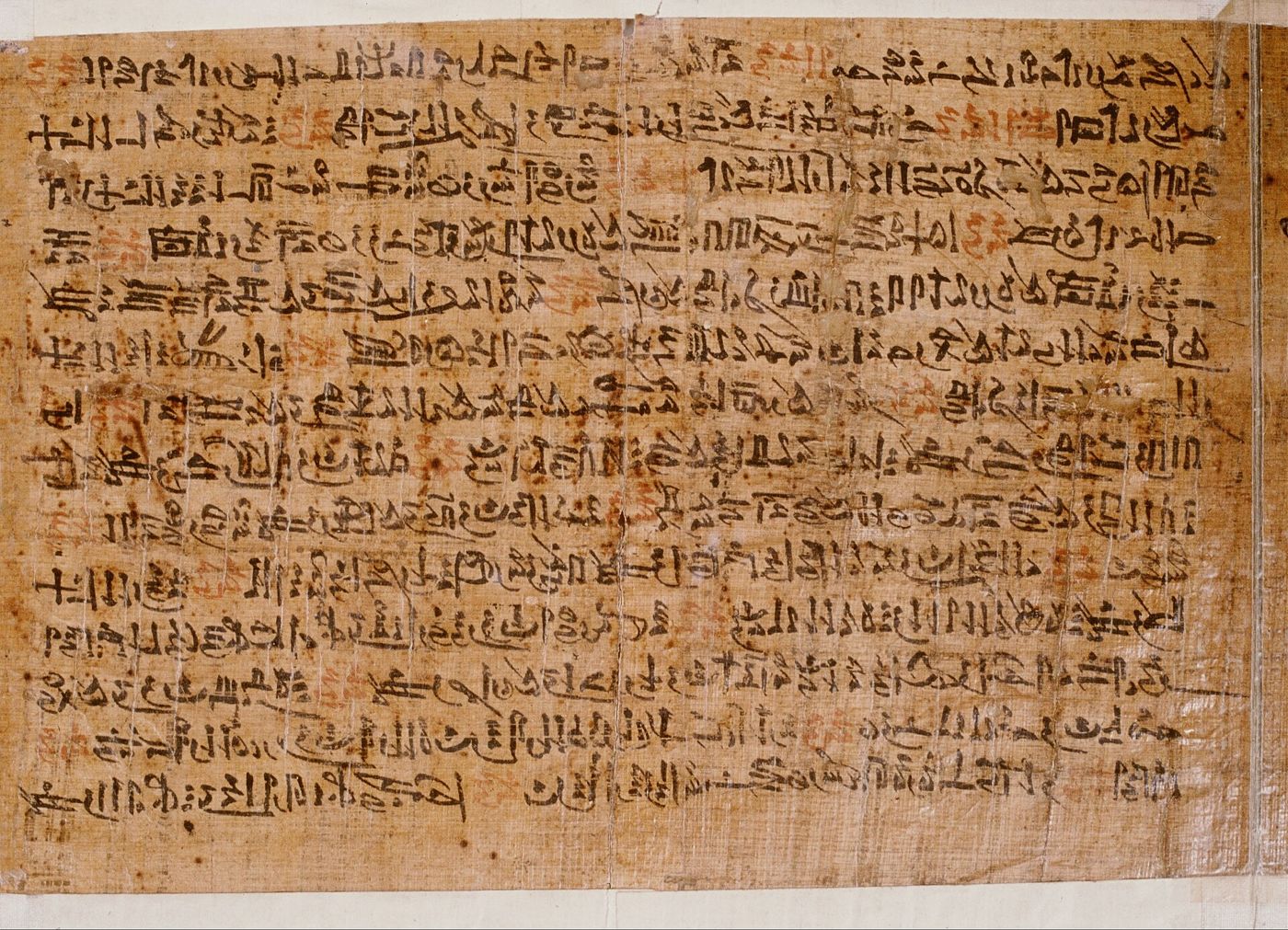
This long papyrus roll, now in pieces, is an Egyptian government record. It is written in hieratic, a fast handwritten form of Egyptian writing. On its back is a list of 95 household servants handed over to a Theban noblewoman named Senebtisi. The museum says 45 of them were "Asiatics", the Egyptian term for people from Canaan and Syria. One servant's name, read as Shp-ra, is a Semitic name (from the family of languages that includes Hebrew) that matches Shiphrah, the name of one of the two midwives in Exodus 1:15.
Where it is today
Brooklyn Museum, New York, accession number 35.1446a-e. Check the museum's website to see whether it is on display.
Date
About 1809 to 1743 BC (Brooklyn Museum). The list of servants is usually placed in the reign of King Sobekhotep the Third, about 1745 BC.
Why this label: It shows that many Semitic people worked in Egyptian homes before the time of Moses, and that Shiphrah was a real name in that world. It does not name the Shiphrah of Exodus, and it does not mention Hebrews or Israel.
Good to know: Under either of the two Bible-based datings, the list is about 200 years or more older than the midwives of Exodus, so this woman cannot be the same person. Some websites say the list proves there were Hebrew slaves in Egypt. But scholars, including those who defend the Bible's history, describe these servants as "Asiatics" or Semites, not as Hebrews. The museum's web page says scholars take Shp-ra to be "the Hebrew name 'Shiphra'", and adds that it cannot be certain it is the same person. It is safer to call it a Semitic name that was later also used in Hebrew.
Photo: One section (part d) of Papyrus Brooklyn 35.1446, written in hieratic script (Brooklyn Museum, Gift of Theodora Wilbour, 35.1446a-e (Photo: Brooklyn Museum, 35.1446d_PS20.jpg), No known copyright restrictions (Brooklyn Museum))
Papyrus Anastasi 6: herders from Edom let in to the pools of Pithom
Genesis 47:4 · Exodus 1:11 · Exodus 12:37
Background
They said moreover unto Pharaoh, For to sojourn in the land are we come; for thy servants have no pasture for their flocks; for the famine is sore in the land of Canaan: now therefore, we pray thee, let thy servants dwell in the land of Goshen.
Genesis 47:4, KJV
Papyrus Anastasi 6 holds copies of letters used to train Egyptian scribes. One is a report from a border official. He says he has let the Shasu tribes of Edom pass the fortress of King Merneptah in Tjeku and go on "to the pools of Per-Atum", to keep them and their herds alive. (Shasu was the Egyptian word for nomad herders.) It shows Egypt letting hungry herders from the east enter through a guarded border to find water and pasture. This is much like Jacob's sons asking to graze their flocks in Goshen during a famine (Genesis 47:4). Hoffmeier and Rendsburg call it the earliest known mention of Per-Atum (Pithom) in the Wadi Tumilat.
Where it is today
British Museum, London, EA 10245. Probably from Memphis, but the exact find-place is not known.
Date
About 1205 BC. The report is dated to year 8, most likely of King Merneptah. The copy was made about 1200 BC.
Why this label: It names Edomite herders and the place Per-Atum (Pithom), but not Israel or any person in the Bible. It shows a real border practice like the one described in Genesis 47.
Good to know: Tjeku is often linked with the Succoth of Exodus 12:37, and some English translations of this papyrus write "Succoth" for Tjeku. Many scholars accept this link, but it is not certain. The papyrus as a whole opens with the name of King Seti the Second, Merneptah's successor, but the "year 8" in this report is most likely Merneptah's. Either way, it comes from the late 1200s BC.
The Merneptah Stele: the earliest generally accepted mention of Israel outside the Bible
Judges 21:25 · Exodus 1:7
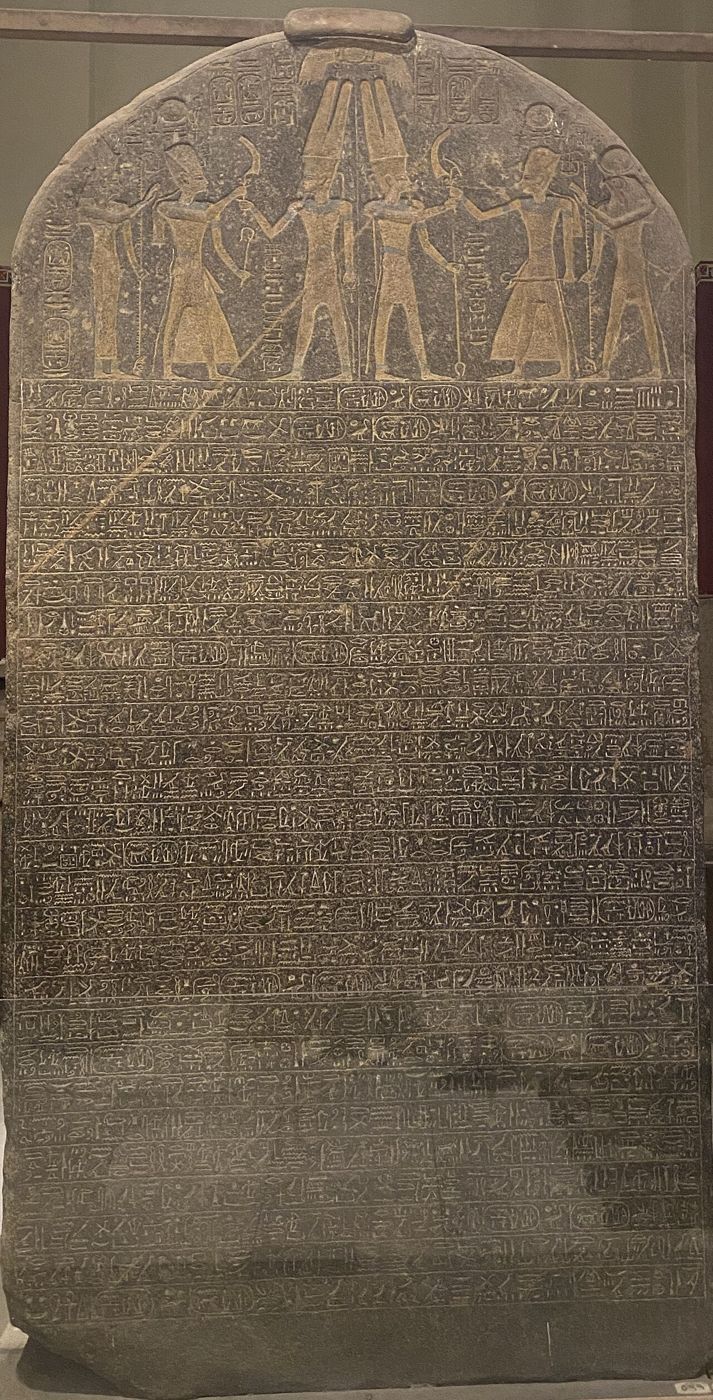
ConfirmedThe Merneptah Stele on display in the Egyptian Museum, Cairo (2023). Wikimedia Commons user 𐰇𐱅𐰚𐰤, CC BY-SA 4.0.
In those days there was no king in Israel: every man did that which was right in his own eyes.
Judges 21:25, KJV
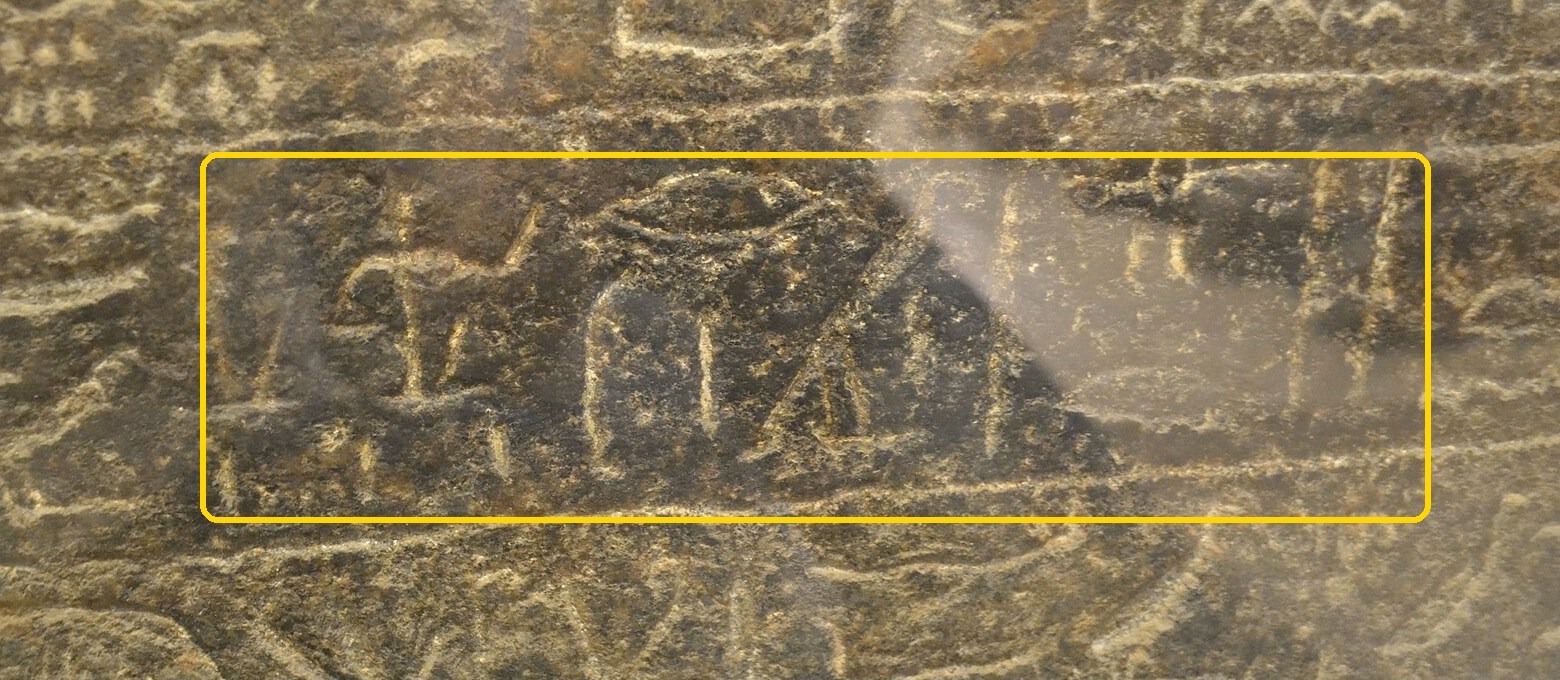
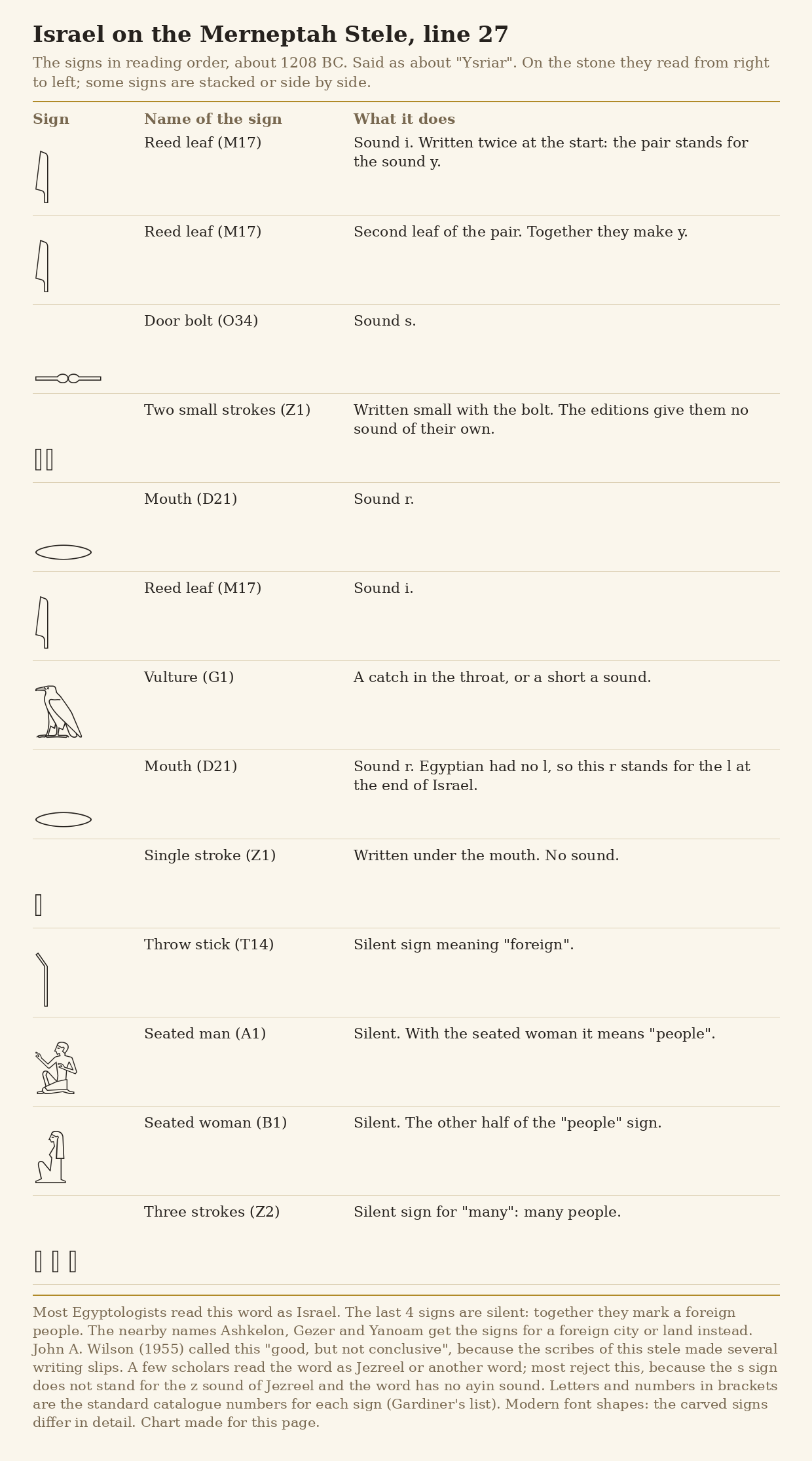
This tall granite slab is a stele, an upright stone carved with writing. Merneptah's text was carved on the back of an older stele of Amenhotep the Third, in Merneptah's 5th year as king, about 1208 BC. Most of its 28 lines praise his victory over Libyan invaders. Near the end, line 27 says, in one common translation, "Israel is laid waste, his seed is not." It is the earliest generally accepted mention of the name Israel outside the Bible (a possible earlier one, on the Berlin pedestal relief, is still debated). In the hieroglyphs, the name Israel carries a sign used for a people (a seated man and woman). The nearby names Ashkelon, Gezer and Yanoam carry the sign used for a city or foreign land instead. This fits the Bible's picture of early Israel in Canaan, as tribes without a king. The close-up photos below show the word Israel in line 27, and the chart lists its signs.
A close-up photo of the Merneptah Stele in the Egyptian Museum, Cairo. The yellow box, added for this page, marks the word Israel in line 27: the signs that spell its sounds, and the 4 silent signs after them that mark a foreign people. On the stone the signs read from right to left, so the word starts at the right end of the box. A reflection on the display glass covers the right end of the word. The name Israel appears once on the stele. Darer101, via Wikimedia Commons, CC BY-SA 4.0. The yellow box was added for this page..The 13 signs of the word Israel on the Merneptah Stele, in reading order, with the sound or job of each one. The chart also explains why most Egyptologists read the word as Israel and what the minority views are. Chart made for this page, free to reuse.
Where it is today
Egyptian Museum, Tahrir Square, Cairo, Egypt, catalogue number JE 31408, where it was on display at least until 2023. A July 2025 news report said it had "until recently" been there and pointed to the new Grand Egyptian Museum in Giza, so check which museum holds it before visiting. A broken second copy was found at the Temple of Karnak in Luxor.
Date
About 1208 BC (5th year of Merneptah, who reigned about 1213 to 1203 BC). Found by Flinders Petrie at Thebes (Luxor) in 1896.
Why this label: The stele is genuine, and most Egyptologists read the name as Israel, a people living in Canaan by about 1208 BC. It confirms that a people called Israel was there by then. It does not confirm the details of any Bible event.
Good to know: The stele does not mention Moses, the Exodus or slavery in Egypt. It does not say how long Israel had been in Canaan, so it fits both the early and the late date for the Exodus. "His seed is not" is a boast Egyptian kings often made about beaten enemies; Israel clearly was not wiped out. Scholars also debate whether "seed" here means children or grain. Egyptian scribes were not always careful with these signs, so the "people" sign strongly suggests, but does not prove, that Israel was a people rather than a city or a land.
The Berlin pedestal relief: an earlier mention of Israel?
Joshua 11:23 · 1 Kings 6:1
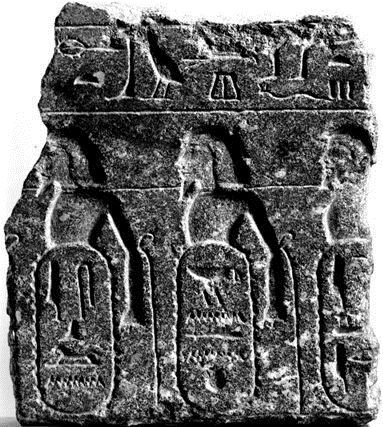
DisputedThe Berlin pedestal relief fragment with three bound prisoners and name rings. Unknown photographer, via Wikimedia Commons, Public domain.
So Joshua took the whole land, according to all that the LORD said unto Moses; and Joshua gave it for an inheritance unto Israel according to their divisions by their tribes. And the land rested from war.
Joshua 11:23, KJV
This is a broken piece of a granite statue base, about 40 by 46 centimetres. It shows three bound prisoners, each with an oval ring holding the name of his land. Two names are usually read as Ashkelon and Canaan. The third ring is partly broken. In 2001 Manfred Görg proposed that it reads "Israel" once a missing bird sign is filled in. In 2010 Peter van der Veen, Christoffer Theis and Görg argued that the piece is about 200 years older than the Merneptah Stele. If they are right, Israel was already known in Canaan well before Merneptah, perhaps by about 1400 BC. That would fit the early date for the Exodus and the conquest under Joshua, and would be hard to fit with the late date.
Where it is today
Egyptian Museum of Berlin (Ägyptisches Museum), Germany, catalogue number ÄM 21687. Bought in 1913 by Ludwig Borchardt from an antiquities dealer; where it was found is unknown.
Date
Not certain. In 2010 its supporters dated it to about 1400 BC or somewhat earlier, mainly because its spelling looks like that of the 18th Dynasty (about 1550 to 1292 BC). In 2017 Peter van der Veen and Wolfgang Zwickel placed it in the 1300s or early 1200s BC, and some scholars suggest the reign of Horemheb (about 1319 to 1292 BC) or Ramesses the Second (about 1279 to 1213 BC).
Why this label: The object is real, but whether the broken name says Israel is debated by qualified Egyptologists, and the piece cannot be dated securely because nobody knows where it was found.
Good to know: For the Israel reading: the names sit next to Ashkelon and Canaan, the same neighbours named on the Merneptah Stele, and supporters say newer images show the missing sign is the vulture they expected. Against it: even with that sign, this spelling of Israel would be unique in Egyptian writing, and scholars such as James Hoffmeier, Faried Adrom (2016) and Robert Ritner (2020) have rejected the reading. The date: This is also open. Some argue it belongs to the 1300s or 1200s BC, and even some supporters allow that the names may have been copied later from an older list.
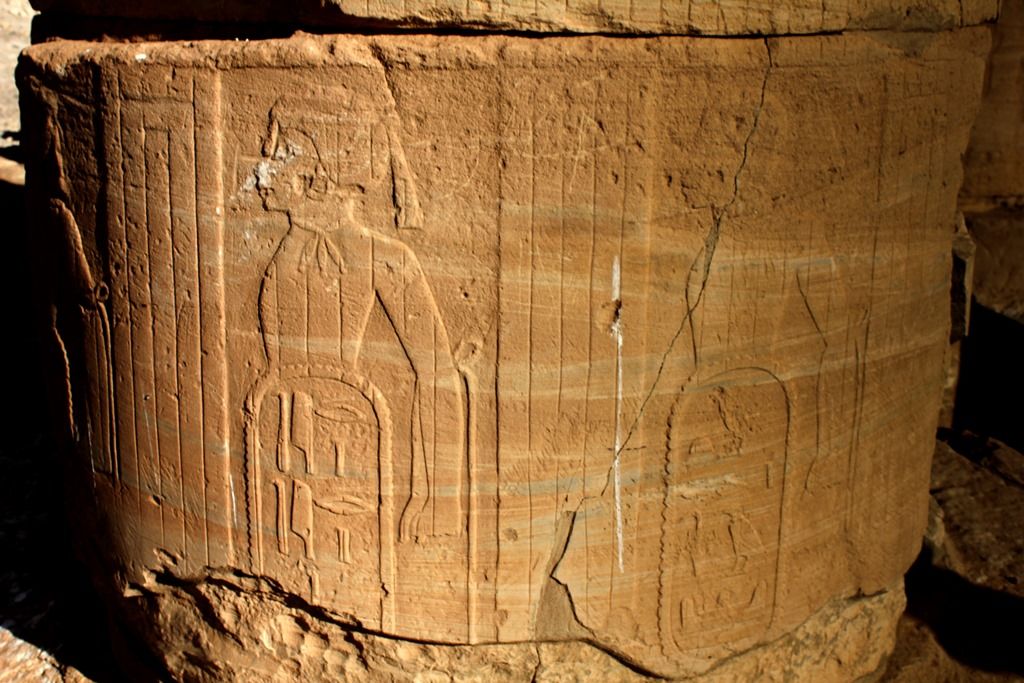
DisputedTwo bound prisoners with oval name labels, carved on a column in the hall of columns at Soleb. These are other names: the Yhw label is not shown in this photo. Clemens Schmillen, CC BY-SA 4.0.
And God said moreover unto Moses, Thus shalt thou say unto the children of Israel, The LORD God of your fathers, the God of Abraham, the God of Isaac, and the God of Jacob, hath sent me unto you: this is my name for ever, and this is my memorial unto all generations.
Exodus 3:15, KJV
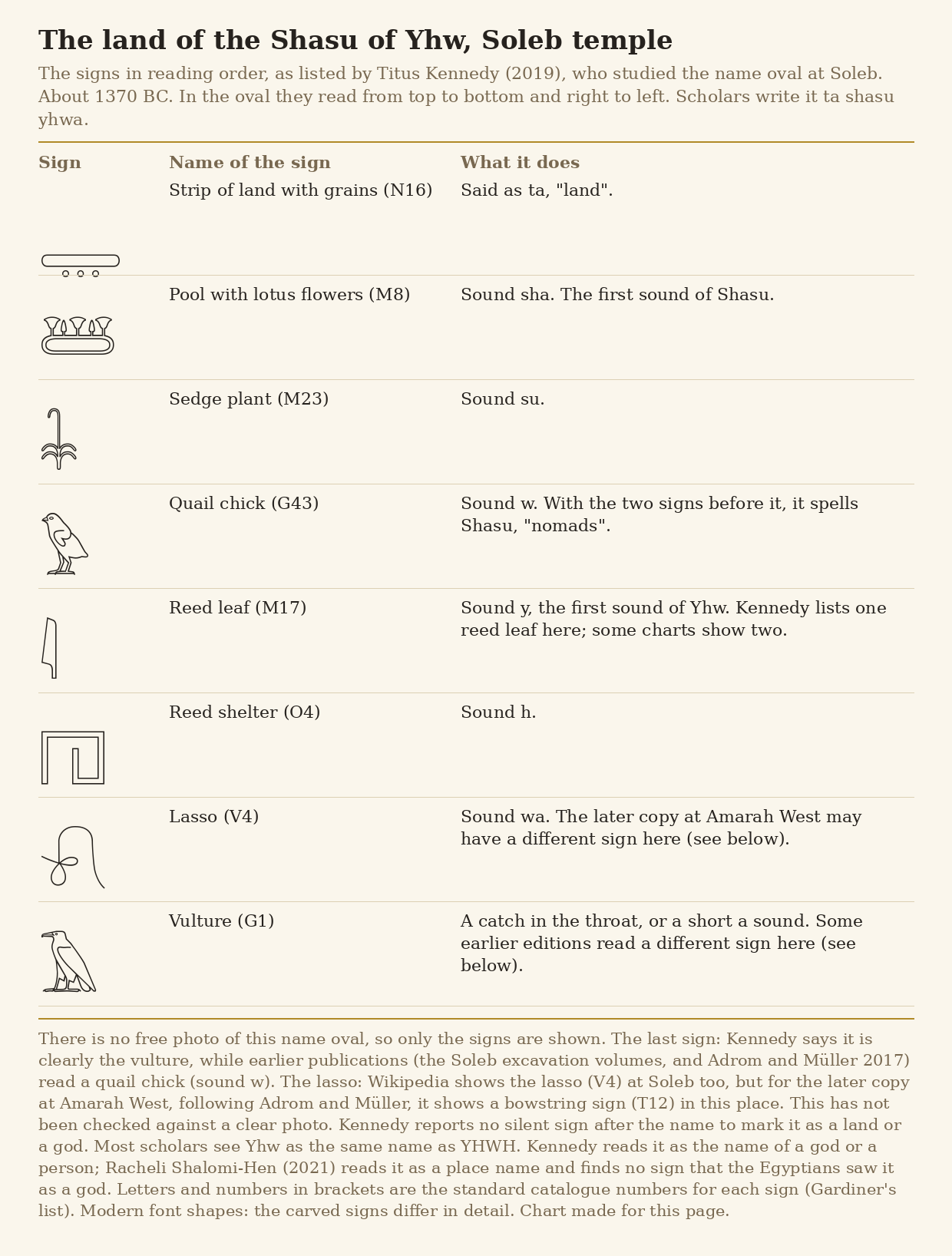
Amenhotep the Third built a large temple to the god Amun at Soleb in Nubia (now Sudan). In its hall of columns, carvings show bound prisoners, each labelled with the name of a land Egypt claimed to have beaten. One label reads "the land of the Shasu of Yhw". Shasu was the Egyptian word for nomad herders who lived east and south of Canaan. Many scholars think "Yhw" is the same name as YHWH, God's name, which the KJV shows as "the LORD" (and as "JEHOVAH" in Exodus 6:3). If so, it is the earliest known writing of that name outside the Bible. The chart below shows the signs of the name label, and the two places where scholars read the signs differently.
The signs of the name label at Soleb, "the land of the Shasu of Yhw", in reading order, as read by Titus Kennedy (2019). No free photo of this label could be found, so only the signs are shown. Scholars read two of the signs differently, and the chart explains both readings. Chart made for this page, free to reuse.
Where it is today
Soleb temple ruins, on the west bank of the Nile north of the Third Cataract, Northern Sudan. The name is on a column of the hypostyle hall (the hall of columns). A later copy of a similar list is at the temple of Amarah West, also in Sudan. The site is remote, so check access before planning a visit.
Date
Reign of Amenhotep the Third, about 1390 to 1353 BC (often given as about 1370 BC; dates vary a little between scholars). The Amarah West copy dates to Ramesses the Second, about 1279 to 1213 BC.
Why this label: The inscription is real and securely dated. What is debated is what "Yhw" means here: a place, a tribe, or the God of Israel, and whether these Shasu had any link to the Israelites.
Good to know: Tebes (Biblical Archaeology Review, 2022) writes that most scholars see this as the earliest known use of the name Yahweh, but adds that the texts do not tell us whether it was the name of a place, a tribe or a god. Titus Kennedy (2019) argues it is most likely God's name and that these Shasu could be early Israelites. Racheli Shalomi-Hen (2021) disagrees: she finds no sign that the Egyptians treated Yhw as a god, and says the records show only that the name was linked to an area of the Shasu. The Amarah West list also names "the Shasu land of Seir", which some connect with verses that say the LORD "rose up from Seir" (Deuteronomy 33:2) and went "out of Seir" (Judges 5:4).
Which pharaoh? The early and late dates for the Exodus
1 Kings 6:1 · Exodus 1:11 · Exodus 14:28
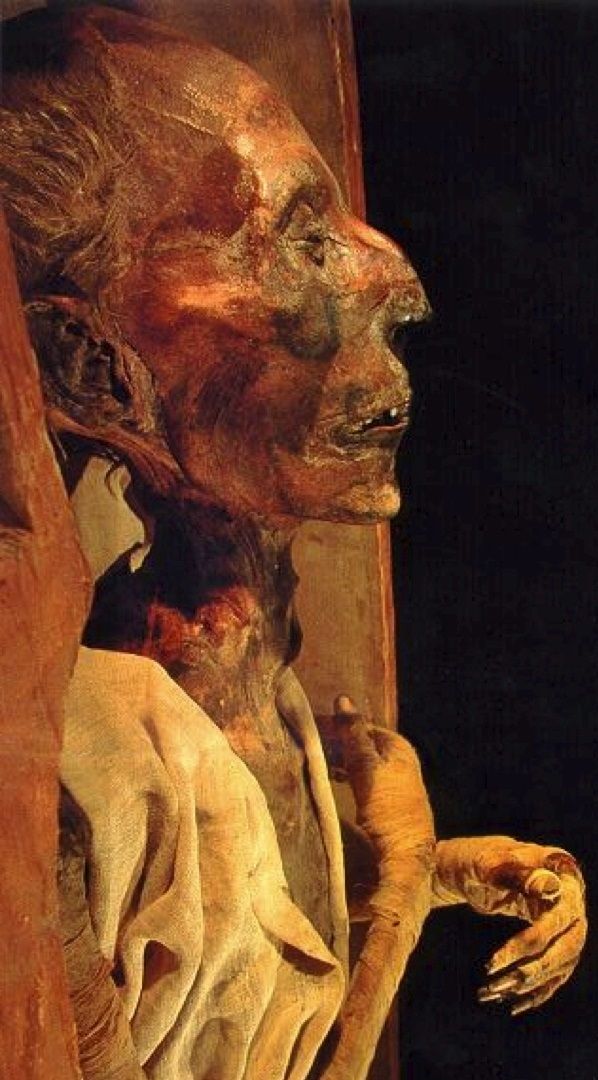
DisputedThe mummy of Ramesses the Second, one of the kings named in this debate. Speedster, CC BY-SA 4.0.
And it came to pass in the four hundred and eightieth year after the children of Israel were come out of the land of Egypt, in the fourth year of Solomon's reign over Israel, in the month Zif, which is the second month, that he began to build the house of the LORD.
1 Kings 6:1, KJV
The Bible never gives the personal name of the pharaoh who oppressed Israel or of the pharaoh of the Exodus. It calls each one "Pharaoh", or "a new king over Egypt" (Exodus 1:8). The early date counts back 480 years from Solomon's 4th year (about 966 BC), which gives about 1446 BC. On this view, Thutmose the Third is often named as the oppressor and Amenhotep the Second as the pharaoh of the Exodus. The late date puts the Exodus in the 1200s BC under Ramesses the Second. Its main reasons are that Exodus 1:11 names the store city "Raamses", a name linked to that king, and that its supporters see little sign of Israel in Canaan before that century. The mummies of all three of these kings survive and can be seen in Cairo.
Where it is today
Royal Mummies Hall, National Museum of Egyptian Civilization (NMEC), Fustat, Old Cairo, Egypt. The mummies of Ramesses the Second, Thutmose the Third and Amenhotep the Second are all shown there. They were moved there from the Egyptian Museum on 3 April 2021. The mummy of Ramesses the Second is not in the Grand Egyptian Museum, which holds his giant standing statue instead.
Date
Thutmose the Third reigned about 1479 to 1425 BC, Amenhotep the Second about 1427 to 1401 BC, and Ramesses the Second about 1279 to 1213 BC. The mummies of Thutmose the Third and Ramesses the Second were among the royal mummies hidden near Deir el-Bahari (Luxor), made known to Egyptologists in 1881. Amenhotep the Second was found in his own tomb in 1898.
Why this label: Both views are held by serious scholars, including evangelical scholars, and no Egyptian record names the pharaoh of the Exodus. Most scholars place the story in the 1200s BC, in the time of Ramesses the Second, while many conservative scholars hold the early date.
Good to know: Early date: Supporters take the 480 years in 1 Kings 6:1 as a plain count, and point to the 300 years in Judges 11:26. Late date: Supporters read the 480 years as 12 generations of 40 years, and point to Raamses (Exodus 1:11) and to cities destroyed in Canaan in the late 1200s BC. Problems on both sides: For the early date, there is little sign of cities destroyed around 1400 BC; its supporters reply that the Bible says Joshua burned only 3 cities, Jericho, Ai and Hazor (Joshua 6:24, 8:28, 11:13). For the late date, the time left for the judges is short; its supporters reply that some judges ruled at the same time in different areas. On the drowning: Exodus 14:28 says the waters covered "all the host of Pharaoh that came into the sea after them", and Psalm 136:15 says God "overthrew Pharaoh and his host in the Red sea". Neither verse plainly says that Pharaoh himself drowned, so a surviving mummy does not by itself prove or disprove any candidate.
DisputedA page of the Ipuwer Papyrus (Papyrus Leiden 344) in Leiden, in hieratic handwriting with some words in red ink. Rijksmuseum van Oudheden, Leiden, via Google Arts and Culture, Public domain.
And Moses and Aaron did so, as the LORD commanded; and he lifted up the rod, and smote the waters that were in the river, in the sight of Pharaoh, and in the sight of his servants; and all the waters that were in the river were turned to blood.
Exodus 7:20, KJV
The Admonitions of Ipuwer is an Egyptian poem. In it a wise man named Ipuwer complains to a figure called "the Lord of All" that Egypt has fallen into chaos. One line reads, in one translation, "Indeed, the river is blood, yet men drink of it." It also speaks of servants becoming rich and of general disorder. Some writers claim it is an Egyptian eyewitness report of the plagues and the Exodus. Immanuel Velikovsky made this claim in the 1950s. More recently David Rohl and the 2014 film Patterns of Evidence: Exodus have made it too.
Where it is today
Rijksmuseum van Oudheden (National Museum of Antiquities), Leiden, Netherlands, where it is Papyrus Leiden 344 (the poem is on the front side). The Dutch government bought it from Giovanni Anastasi in 1828.
Date
The surviving copy was written about 1250 BC (19th Dynasty). The poem itself is older. It was composed no earlier than the late part of the 12th Dynasty, which ended about 1803 BC.
Why this label: The papyrus is real, but most Egyptologists reject the link to the Exodus. They see it as a poem built on a common theme in Egyptian writing, the world turned upside down, not as a record of one event.
Good to know: Most Egyptologists point out three problems. The poem was composed centuries before either Bible-based Exodus date in the usual Egyptian timeline. It never mentions Israel, Moses or Hebrew slaves. And it speaks of foreigners (Asiatics) arriving in Egypt rather than leaving. "The river is blood" may describe red mud in the Nile during a bad flood, or may simply be a way of describing disorder. Writers who link the poem to the Exodus usually also change the standard Egyptian dates, which most Egyptologists do not accept.
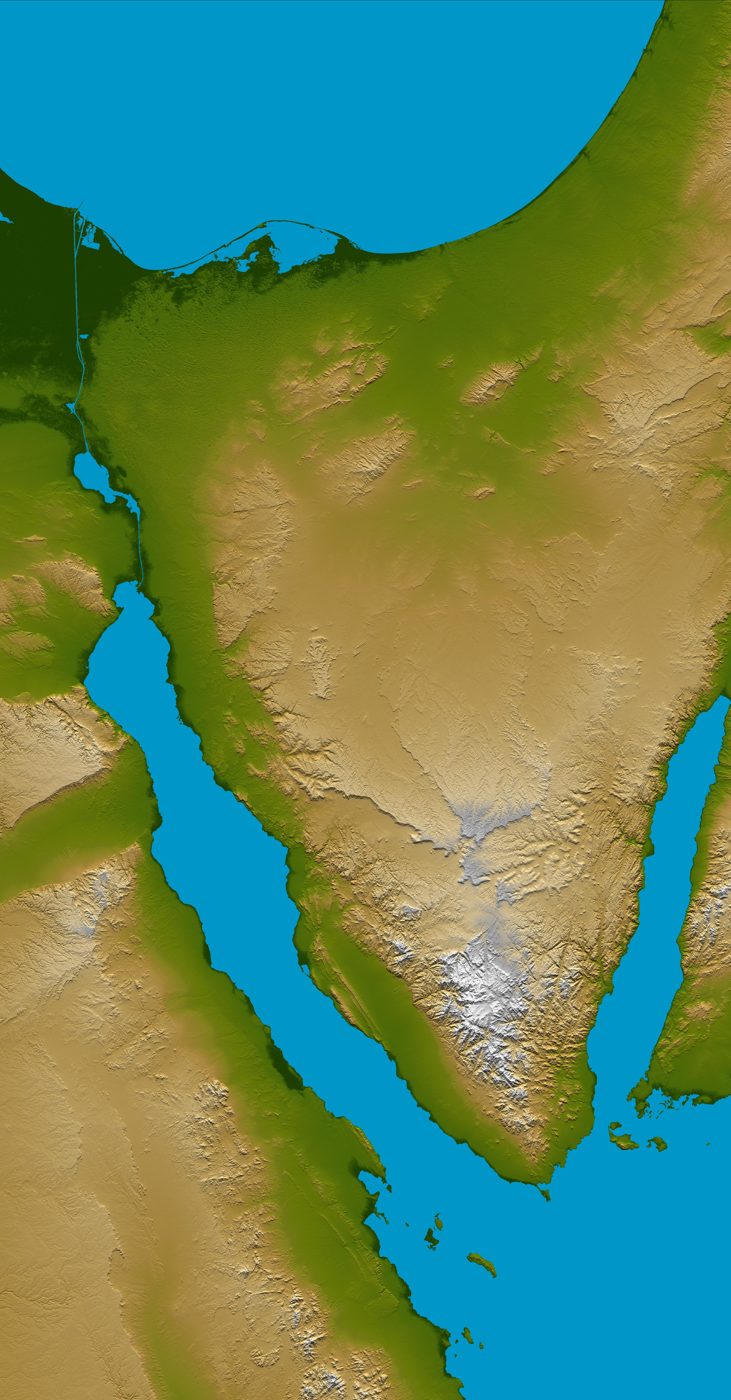
DisputedA map of the Sinai Peninsula made from space shuttle radar measurements. The Gulf of Suez is on the left, the Gulf of Aqaba on the right, the Mediterranean Sea at the top and the Suez Canal at the top left. The lagoon on the north coast is Lake Bardawil. NASA/JPL/NIMA, Shuttle Radar Topography Mission (PIA04957), Public domain (NASA).
And the children of Israel went into the midst of the sea upon the dry ground: and the waters were a wall unto them on their right hand, and on their left.
Exodus 14:22, KJV
Exodus 14 tells how Israel crossed the sea on dry ground and Pharaoh's army drowned behind them. The KJV calls it the "Red sea". The Hebrew words are Yam Suph. Suph means "reeds", so many translate it "Sea of Reeds". The Bible names places on the route, such as Pi-hahiroth, Migdol and Baal-zephon, but none of them has been found for certain. So the spot cannot be matched on a map today. Many places have been proposed. Some point to the reedy lakes along the line of today's Suez Canal (the Ballah Lakes, Lake Timsah or the Bitter Lakes). Others point to lagoons on the Mediterranean coast, such as Lake Bardawil, or to the north end of the Gulf of Suez. Others choose the Gulf of Aqaba. There, Nuweiba Beach is the spot most often named, but some suggest the north end of the gulf near Eilat, or the Straits of Tiran.
Where it is today
Most of the proposed places are in Egypt. The lakes north of Suez now lie along the Suez Canal. Lake Bardawil is a lagoon on the north coast of the Sinai. The Gulf of Suez lies west of the Sinai Peninsula. Nuweiba is a town on the Gulf of Aqaba, on the east side of the Sinai; across that gulf is Saudi Arabia. Eilat, in Israel, is at the north end of the Gulf of Aqaba.
Date
There is no agreed date for the Exodus. Read as an exact count, the 480 years of 1 Kings 6:1 point to about 1446 BC. Others read that number as 12 generations of 40 years. Because Exodus 1:11 names the city of Raamses, they prefer about 1260 BC.
Why this label: People who study the question, including many who believe the Bible, place the crossing in different bodies of water. No find has fixed the spot, and no object from the crossing has been recovered and confirmed.
Good to know: Which sea: The Bible uses Yam Suph for more than one body of water. In 1 Kings 9:26 it means the Gulf of Aqaba. In Numbers 33:10 Israel camps beside it after leaving Elim, which many take to mean the Gulf of Suez. Chariot wheel claims: From 1978 Ron Wyatt claimed he had seen chariot wheels and bones covered in coral in the sea off Nuweiba. Later writers such as Lennart Möller repeated the claim. One diver told the fact-checking site Truth or Fiction that bones from the site were tested at Stockholm University and found to be human. But Truth or Fiction found that the support is mostly photos, "most of which are of coral formations", and that no documented objects have been brought up from the site and kept. The wheel Wyatt said he raised cannot be found. Richard Rives, who leads Wyatt's own research group, warned: "All kinds of people are finding coral and calling it chariot parts."
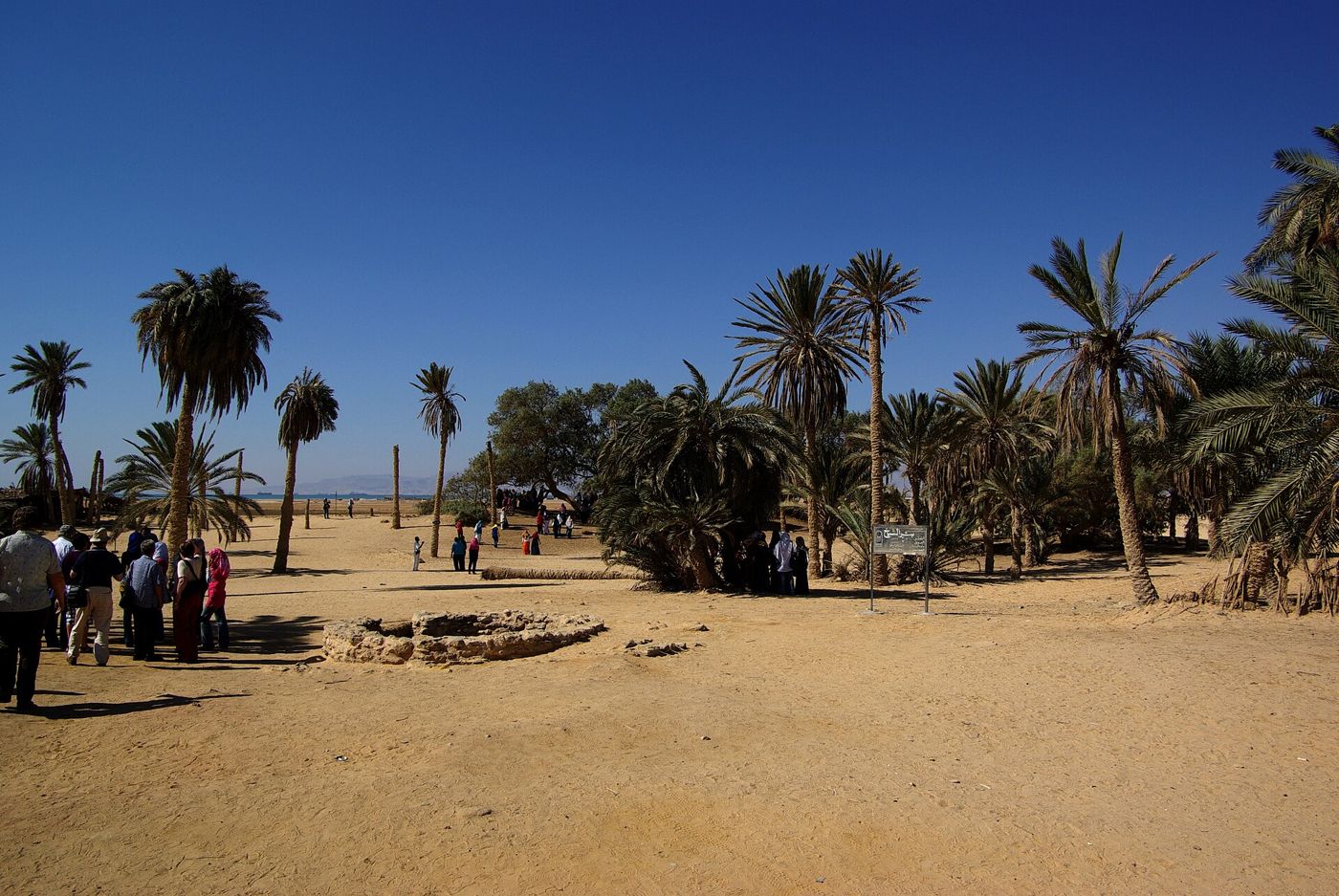
Traditional sitePalm trees and a low ring of stones around one of the springs at Ayun Musa (Oyun Musa), South Sinai. Berthold Werner, CC BY-SA 3.0.
And they came to Elim, where were twelve wells of water, and threescore and ten palm trees: and they encamped there by the waters.
Exodus 15:27, KJV
After crossing the sea, Israel walked 3 days without finding water (Exodus 15:22). They found bitter water at Marah. Then they camped at Elim, which had 12 springs (the KJV says "wells") and 70 palm trees. Ayun Musa ("Springs of Moses") is a small oasis on the east shore of the Gulf of Suez, a short way southeast of the city of Suez. Some of its springs are not fit to drink, and the others are slightly salty. Popular tradition links it with Marah or with Elim. Marah has long been placed at Ain Hawarah, a salty, bitter spring about 75 km (47 miles) southeast of Suez. Elim is most often placed at Wadi Gharandel, an oasis about 100 km southeast of Suez.
Where it is today
Egypt, South Sinai. Ayun Musa lies on the east shore of the Gulf of Suez, about 12 km from the city of Suez, beside the main road to Sharm el-Sheikh and behind a Bedouin village of the same name.
Date
The springs are natural. Linking them with Moses is a popular tradition. When it began is not known.
Why this label: Ayun Musa is a real oasis that tradition ties to Moses, but no inscription or find fixes Marah or Elim there. Scholars do not agree whether these springs fit Marah, Elim or neither.
Good to know: Marah or Elim: The Jewish Encyclopedia (1906) said the popular link between Ayun Musa and Marah is "not very plausible", because only some of its springs are undrinkable. It said scholars more often linked Ayun Musa with Elim. Professor Menashe Har-El argued for Elim in 1968. He noted that a geologist counted 12 springs and date palms there in 1907. Another view: Some scholars suggest Bir el-Mura, near Suez, for Marah, because its Arabic name is closely related to the Hebrew name Marah, which means "bitter". James Hoffmeier objects that Ayun Musa is only about 12 km (7 miles) from the stop before it, so it is too close to be Elim. Keep in mind: All these spots depend on where the sea crossing and Mount Sinai really were, and both are disputed.
Serabit el-Khadim: Egyptian turquoise mines and early alphabet
Exodus 24:4 · Exodus 17:14 · Numbers 33:12
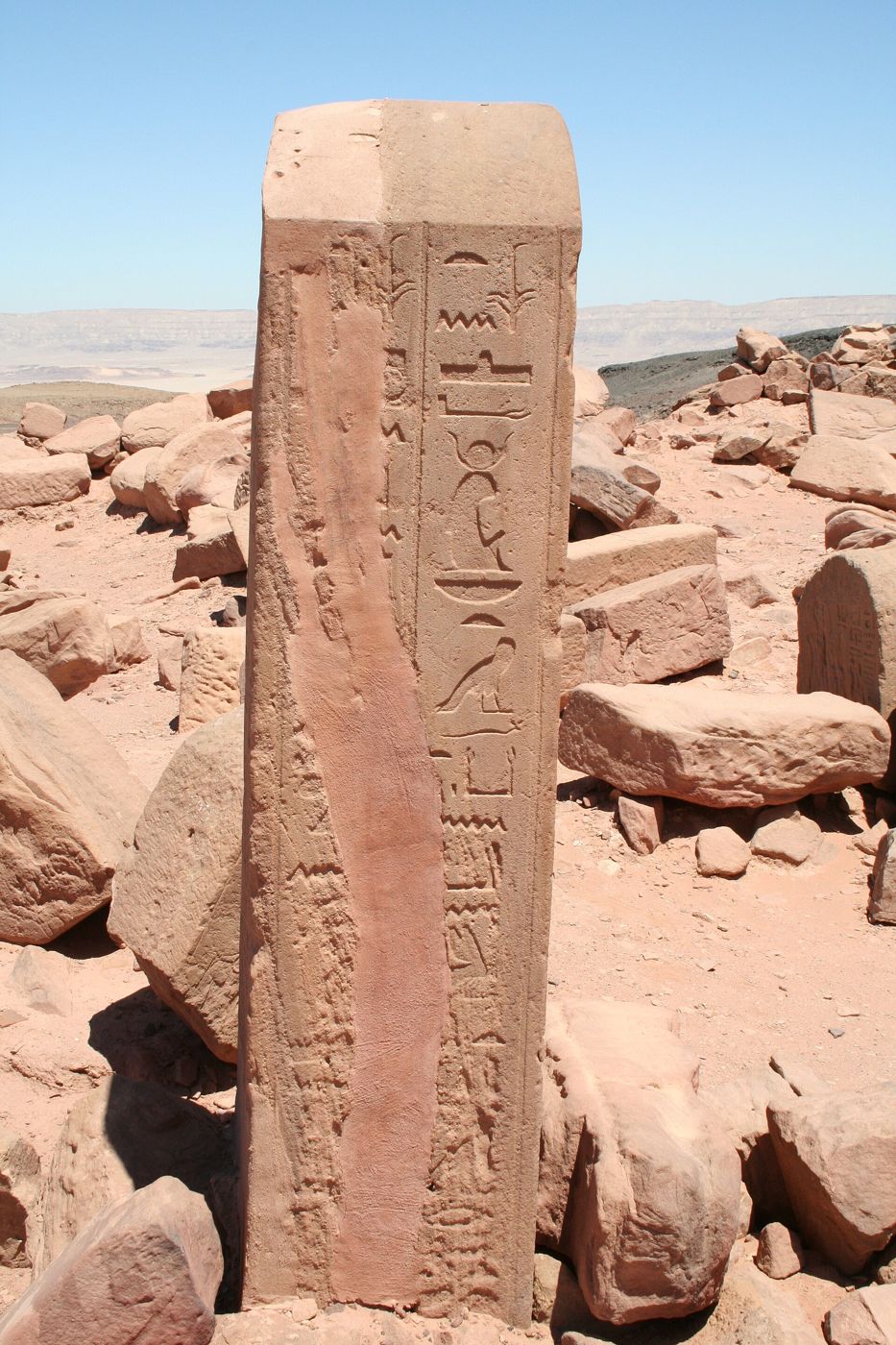
BackgroundA standing stone slab carved with Egyptian hieroglyphs, among the fallen blocks of the Temple of Hathor at Serabit el-Khadim. This is Egyptian writing, not the early alphabet. Einsamer Schütze, CC BY-SA 3.0.
And Moses wrote all the words of the LORD, and rose up early in the morning, and builded an altar under the hill, and twelve pillars, according to the twelve tribes of Israel.
Exodus 24:4, KJV
Serabit el-Khadim is a hilltop in the southwest Sinai. Egyptians mined turquoise and copper there and built a temple to the goddess Hathor, "mistress of turquoise". In 1904 to 1905 Flinders and Hilda Petrie found the first group of short inscriptions there (words cut into stone). They were written by workers who spoke a Semitic language (the family of languages that includes Hebrew and Arabic), in a new kind of writing now called Proto-Sinaitic. About 30 to 40 such inscriptions are known today. This writing is one of the earliest known forms of the alphabet. It is an early step toward the Phoenician and old Hebrew letters. It does not name any Bible person. But it shows that people working in Sinai wrote with an alphabet before the time when the Bible says Moses wrote down God's words.
Where it is today
Egypt, South Sinai: the temple ruins and mines are on a high plateau about 43 km east of the town of Abu Zenima. Several of the inscribed objects are in the Egyptian Museum, Cairo. A small sandstone sphinx with both Egyptian and Proto-Sinaitic writing (Sinai 345) is in the British Museum, London, number EA 41748 (not on display).
Date
The temple was begun under Senusret the First (reigned about 1971 to 1926 BC). The mines were used on and off until about 1150 BC. Experts disagree on the date of the inscriptions. Many date them to about 1850 to 1800 BC, around the reign of Amenemhat the Third. Others place most of them in the 1600s or 1500s BC.
Why this label: The site, the mines and the inscriptions are real and well studied, and they show early alphabet writing in Sinai. Claims that the inscriptions are Hebrew or name Moses are disputed, and most specialists who have replied to them reject them.
Good to know: Hebrew claim: In 2016 Douglas Petrovich argued that the inscriptions are an early form of Hebrew that names Bible figures, including Joseph, his wife Asenath, and Moses. He set this out in his book The World's Oldest Alphabet (Carta, 2017). Christopher Rollston said the Hebrew claim is "starved for evidence", because there is no way to tell which of several related languages the script records. A 2020 review by Aren Wilson-Wright in the Journal of the American Oriental Society called the Hebrew claim "fundamentally flawed". It also noted that the names Moses and Asenath most likely come from Egyptian. Moses claim: In 2025 Michael Bar-Ron claimed that two inscriptions read "this is Moses" and "a saying of Moses". Other scholars called the readings unproven. They also noted that Mose was a fairly common Egyptian name, so even a correct reading need not mean the Moses of the Bible. Dophkah: Some Bible reference works link the Israelite camp at Dophkah (Numbers 33:12) with this mining area, but that is unproven too.
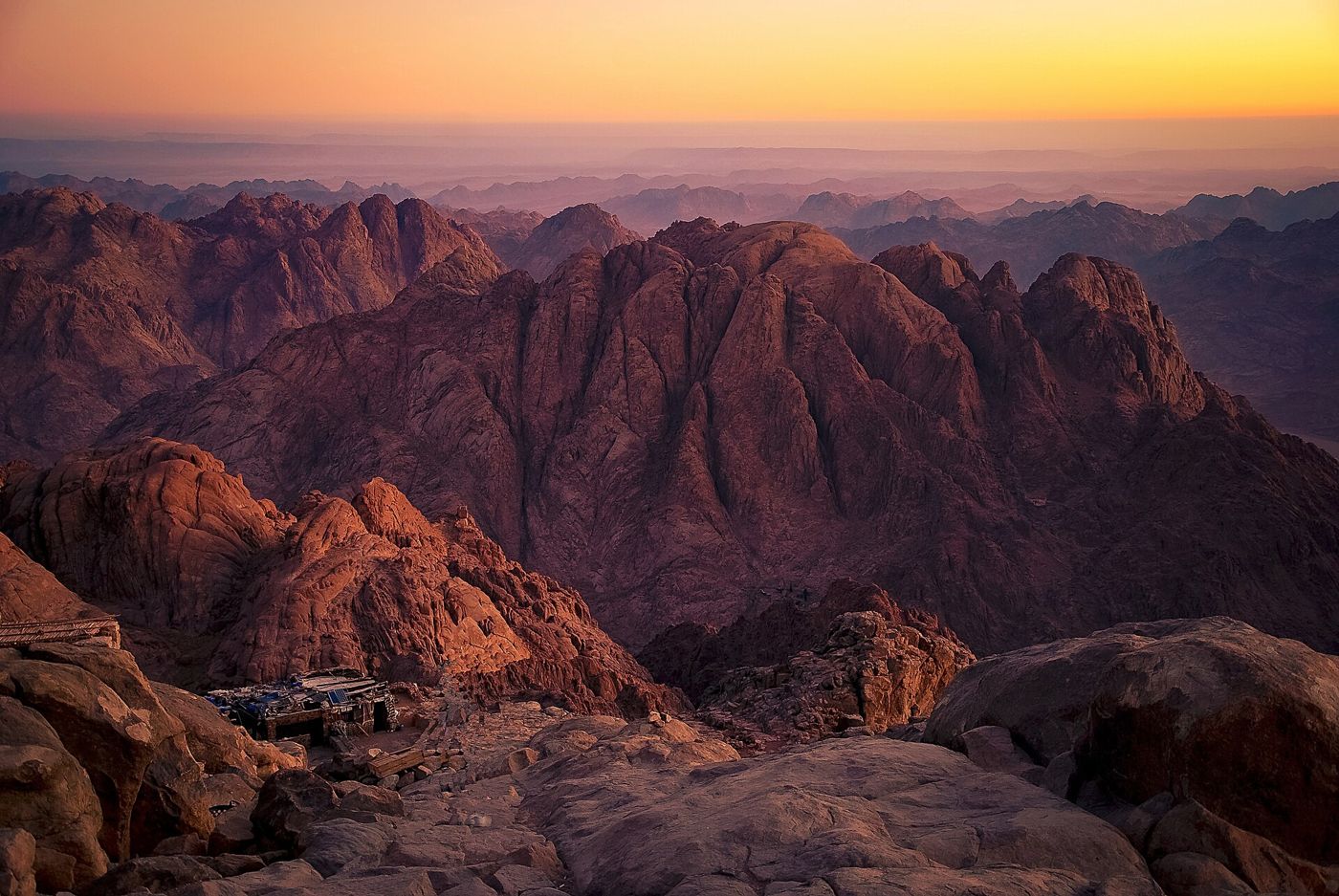
DisputedView from near the top of Jebel Musa, the traditional Mount Sinai, over the mountains of the southern Sinai. A small hut stands beside the path at lower left. Mohammed Moussa, CC BY-SA 3.0.
And mount Sinai was altogether on a smoke, because the LORD descended upon it in fire: and the smoke thereof ascended as the smoke of a furnace, and the whole mount quaked greatly.
Exodus 19:18, KJV
Mount Sinai, also called Horeb, is where God gave the Ten Commandments (Exodus 19 to 20). The Bible does not say exactly where it is, and many mountains have been proposed. Three that are often discussed are Jebel Musa, Jebel al-Lawz and Har Karkom. Jebel Musa ("Mountain of Moses", 2,285 metres high) is in the south of the Sinai Peninsula in Egypt. Jebel al-Lawz is in northwest Saudi Arabia, in the old land of Midian. Har Karkom is in the Negev desert of southern Israel. Paul writes that Sinai is "in Arabia" (Galatians 4:25), and people read that phrase in different ways.
Where it is today
Jebel Musa: Egypt, South Sinai, above the town of Saint Catherine; pilgrims climb it, and a chapel and a mosque stand on top. Jebel al-Lawz: Saudi Arabia, near the Gulf of Aqaba. Har Karkom: Israel, Negev desert. Access to these places can be limited, so check before planning a visit.
Date
Christian monks and pilgrims linked Jebel Musa with Sinai by the 300s AD. The pilgrim Egeria visited in about AD 383 to 384. Some scholars, such as Graham Davies, argue that Jewish pilgrims linked it with Sinai even earlier. Jebel al-Lawz has been promoted since the 1980s. Har Karkom has been argued for by Emmanuel Anati, who worked there for more than 30 years.
Why this label: No inscription or find names any of these mountains as the Sinai of Exodus, and scholars have not agreed. Jebel Musa has a Christian tradition going back to the 300s AD, but tradition alone does not settle the question.
Good to know: Jebel Musa: This has been the Christian choice since the 300s AD. Scholars such as James Hoffmeier argue that the Bible's travel times fit the south of the Sinai, such as the 11 days from Horeb to Kadesh-barnea (Deuteronomy 1:2). But no remains of Israel's camp have been found there. Northwest Arabia: Some scholars place Sinai in the old land of Midian, because Moses came to the mountain while keeping the flock of Jethro, the priest of Midian (Exodus 3:1). Hershel Shanks adds that northwest Arabia was thriving in the 1100s BC, while the Sinai shows almost no sign of people at that time. Ron Wyatt, Larry Williams, Bob Cornuke and Lennart Möller pointed to Jebel al-Lawz. They noted its dark top, rock drawings of cattle, piles of stones and what they called an altar. Scholar Allen Kerkeslager answers that such drawings and stone piles are found all over northwest Arabia. He says some of the stonework may come from the much later Nabataeans (an Arab people who lived there from about 200 BC to AD 200), and that none of it can be dated without proper digging. Kerkeslager has also written that Jebel al-Lawz "may also be the most convincing option" for Mount Sinai and should be studied, but he says these finds prove nothing so far. Har Karkom: Anati found about 40,000 rock carvings and many places of worship. But the site was busiest as a place of worship before 2000 BC, many centuries before either Bible-based date for the Exodus. Anati answers by moving the Exodus itself back before 2000 BC, a view other scholars have rejected. Paul and Arabia: In Paul's day the word Arabia covered a wide area. The Greek historian Herodotus called all the land east of the Nile, including the Sinai Peninsula, Arabia. Paul probably meant the Nabataean kingdom, which reached into both the Sinai and northwest Saudi Arabia. So the verse does not by itself point to modern Saudi Arabia.
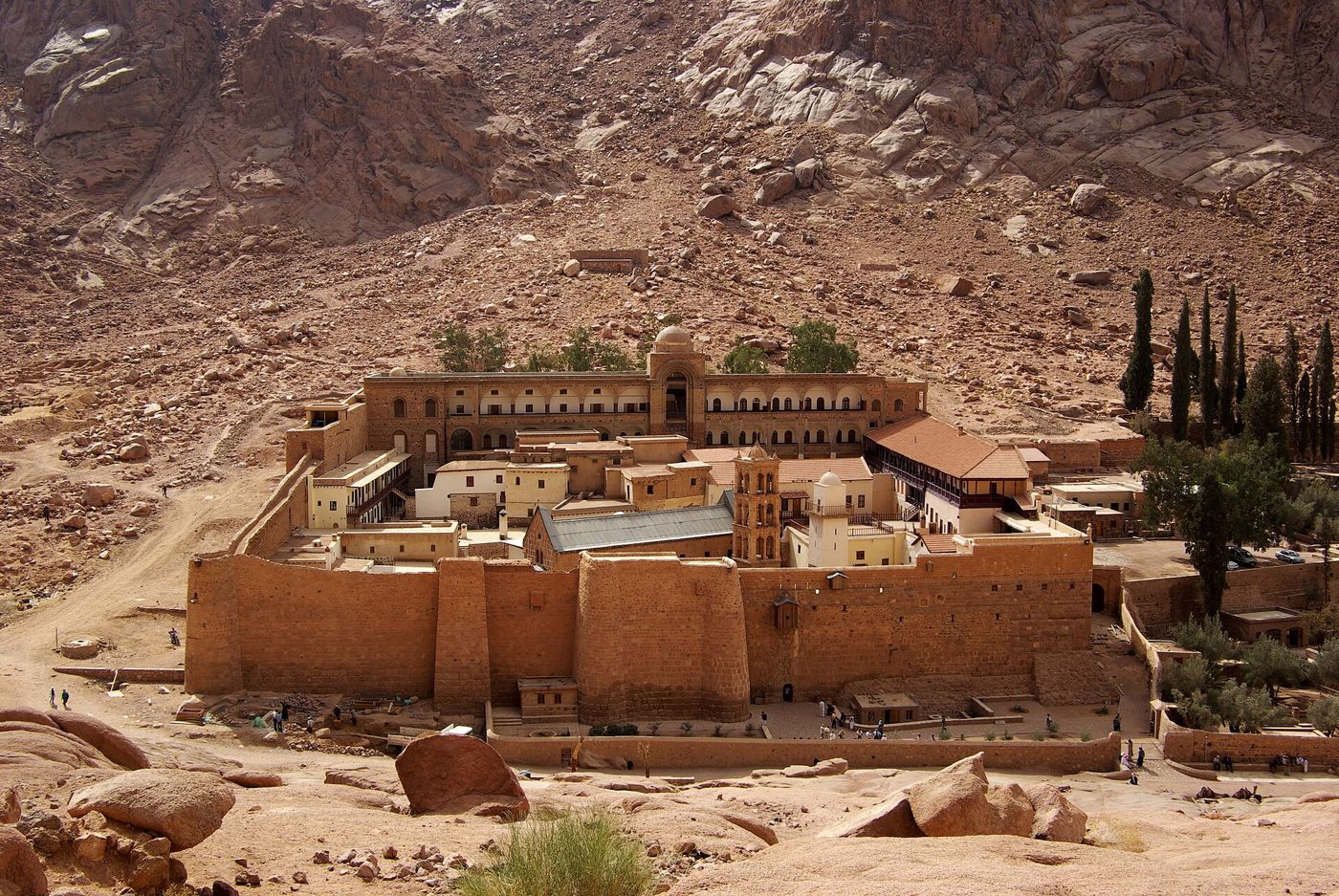
Traditional siteSt Catherine's Monastery at the foot of Jebel Musa, the traditional Mount Sinai, seen from the slope above. Berthold Werner, CC BY-SA 3.0.
And the angel of the LORD appeared unto him in a flame of fire out of the midst of a bush: and he looked, and, behold, the bush burned with fire, and the bush was not consumed.
Exodus 3:2, KJV
St Catherine's Monastery stands at the foot of Jebel Musa, the traditional Mount Sinai. The eastern Roman emperor Justinian had it built in the mid 500s AD. Its walls enclose an older chapel at the spot where tradition says Moses saw the burning bush. It is often called the oldest Christian monastery still in use, though the Monastery of St Anthony in Egypt makes the same claim. Its library is said to hold the second-largest collection of early handwritten books in the world, after the Vatican Library. Much of Codex Sinaiticus, a Greek Bible copied by hand in the 300s AD, was found here by Constantin von Tischendorf in 1844 and 1859.
Where it is today
Egypt, South Sinai, near the town of Saint Catherine. It is part of the UNESCO World Heritage Site "Saint Catherine Area" (listed 2002). Codex Sinaiticus is now divided: 347 leaves in the British Library (London), 43 in Leipzig University Library, parts of 6 in the National Library of Russia (St Petersburg), and further leaves and pieces at the monastery. Visiting hours are limited, so check before planning a visit.
Date
The walls and church were built under Justinian; most sources date them between AD 548 and 565. The Burning Bush chapel tradition is older: the pilgrim Egeria saw the bush in about AD 383 to 384. Codex Sinaiticus: 300s AD.
Why this label: The monastery is real and its age is well recorded. But the burning bush spot rests on tradition going back to the 300s AD, not on proof, and the location of Mount Sinai itself is disputed.
Good to know: The bush: Tradition says the living bramble bush shown at the monastery is the burning bush. Nothing can show that it is the same plant Moses saw. The codex: How Codex Sinaiticus left the monastery was argued over for a long time. In 1859 Tischendorf took the main part to Russia as a loan. A document giving it to the Tsar was signed in 1869. In 1933 the Soviet government sold it to the British Museum. In 1975 monks clearing a forgotten room under St George's Chapel found more leaves and pieces of the codex.
At Sinai: the Law, the Tabernacle and the Golden Calf
16
The Code of Hammurabi stele compared with the law given at Sinai
Exodus 21:23-25 · Exodus 21:26-27 · Exodus 20:1-2
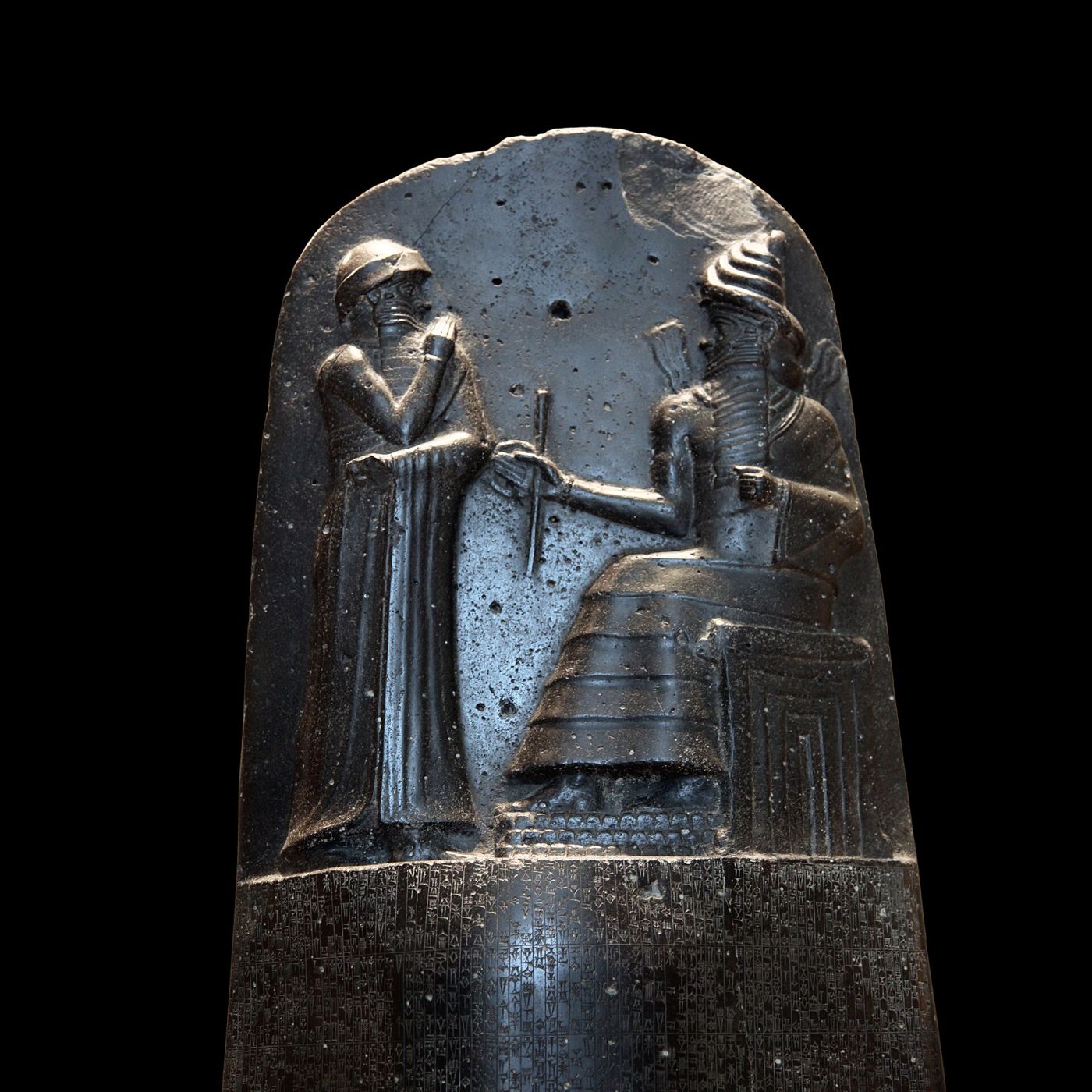
BackgroundThe top of the Code of Hammurabi stele (Louvre Sb 8). Hammurabi stands before the seated god Shamash, and the laws begin below in cuneiform, a writing made of wedge-shaped marks. Rama, CC BY-SA 3.0 fr.
Eye for eye, tooth for tooth, hand for hand, foot for foot,
Exodus 21:24, KJV
This tall slab of black stone, called a stele, holds about 280 laws of Hammurabi, king of Babylon. At the top, Hammurabi stands before the sun god Shamash, the god of justice. Some of its laws look like laws in Exodus 21 to 23. Law 196 says that if a man puts out the eye of another man of the same rank, his own eye shall be put out. This is much like Exodus 21:24. The laws about an ox that gores a person (laws 250 to 252) are close to Exodus 21:28-32. There are also real differences. Hammurabi's penalties change with a person's rank (upper class, commoner or slave). If a commoner lost an eye, the penalty was a payment of silver. For a slave, the silver went to the slave's owner. In Exodus a master who knocks out a slave's eye or tooth must set the slave free (Exodus 21:26-27). Hammurabi says the gods chose him to bring justice. In Exodus, God himself gives the law to the whole people as part of his covenant (binding agreement) with them.
Where it is today
Louvre Museum, Paris, France (inventory number Sb 8).
Date
About 1750 BC (the Louvre gives 1792 to 1750 BC, the reign of Hammurabi). Several hundred years later, Shutruk-Nahhunte, king of Elam (in what is now southwest Iran), carried it off to Susa as war booty. He reigned about 1185 to 1160 BC. French excavators found it at Susa in 1901 to 1902.
Why this label: The stele is a real and well-dated law collection from the same wider world as the Bible. It shows how laws were written in that region, but it says nothing about Moses, Israel or Sinai.
Good to know: Scholars explain the likeness in different ways. A few, such as David P. Wright, argue that the writer of Exodus 21 to 23 worked directly from Hammurabi's laws. Others think any link was indirect. The most common view is that both drew on a shared legal custom of the region. The likeness alone does not show that Moses copied Hammurabi. The two sets of laws also differ a great deal in what they value and in the place they give to God.
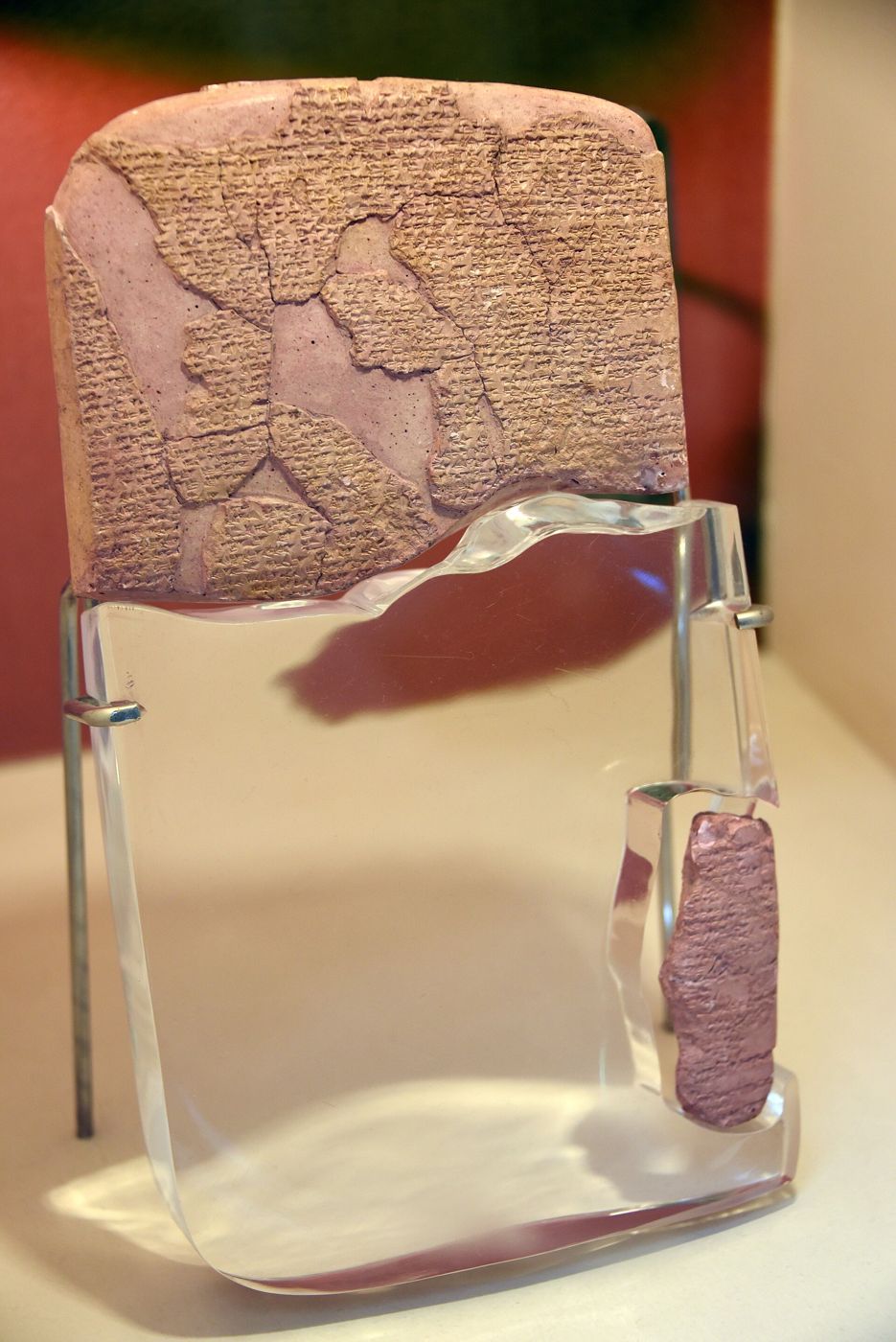
BackgroundPieces of a clay tablet of the Kadesh peace treaty between the Hittites and Egypt, set in a clear modern stand. It is written in Akkadian, the shared written language of the time, and comes from Hattusa, the Hittite capital, near today's Bogazkale in Turkey. Osama Shukir Muhammed Amin, CC BY-SA 4.0.
And he took the book of the covenant, and read in the audience of the people: and they said, All that the LORD hath said will we do, and be obedient.
Exodus 24:7, KJV
Hittite kings of the 1400s to 1200s BC made written treaties with the smaller kings who served them. In the 1950s George Mendenhall pointed out that these treaties often follow a set order. They give the great king's name and titles, then a history of what he had done for the lesser king, and then the laws the lesser king must keep. They also have a rule to store the treaty and read it out regularly, a list of gods called as witnesses, and blessings for keeping the treaty and curses for breaking it. Scholars have compared this order with the covenant (binding agreement) at Sinai. Exodus 20:2 opens with who God is and what he did ("which have brought thee out of the land of Egypt") before the commands. Exodus 24 has the covenant read aloud and accepted. In Exodus the match is only partial. Deuteronomy as a whole, with its blessings and curses in chapter 28, is often said to show the pattern most fully. The photo shows one of the best-known treaty tablets from the Hittite capital: the peace treaty between the Hittite king Hattusili the Third and Ramesses the Second of Egypt. It was made between two equal kings, not between a great king and a lesser one, but it has some of the same parts. It calls on "a thousand gods" as witnesses and closes with curses and blessings.
Where it is today
Two of the Hittite tablets of the Kadesh treaty are in the Museum of the Ancient Orient (part of the Istanbul Archaeology Museums), Istanbul, Turkey. A third is in the State Museums of Berlin, Germany. The Egyptian version is carved on temple walls at Karnak and the Ramesseum in Luxor, Egypt.
Date
Hittite treaties with lesser kings: about 1400 to 1200 BC. The Kadesh peace treaty: about 1259 BC.
Why this label: The treaties are real documents that show how agreements between a great king and the lesser kings under him were written in that world. Comparing them with Exodus and Deuteronomy is a matter of interpretation. They do not name Israel or prove any event at Sinai.
Good to know: Scholars disagree on which treaties are the closer match, and this matters for when the covenant texts were written. Older treaties view: Kenneth Kitchen argued that the Hittite treaties of 1400 to 1200 BC are the closest match, because the later Assyrian treaties lack the history section, the blessings and the rule for storing the text. If he is right, this supports an early date for the covenant texts. Later treaties view: Others, such as Moshe Weinfeld, point to Assyrian treaties of the 600s BC. The best known is Esarhaddon's Succession Treaty of 672 BC. Its curses look very like Deuteronomy 28, and its demands for loyalty have been compared with Deuteronomy 13. A copy found in 2009 at Tell Tayinat in southern Turkey (a tell is a mound made of the ruins of an ancient town) shows that kings in the west received this treaty. Some scholars think King Manasseh of Judah received one too, and that parts of Deuteronomy were written soon after, between 672 and 622 BC.
Tutankhamun's Anubis shrine and the Ark of the Covenant
Exodus 25:10-22 · Exodus 37:1-9
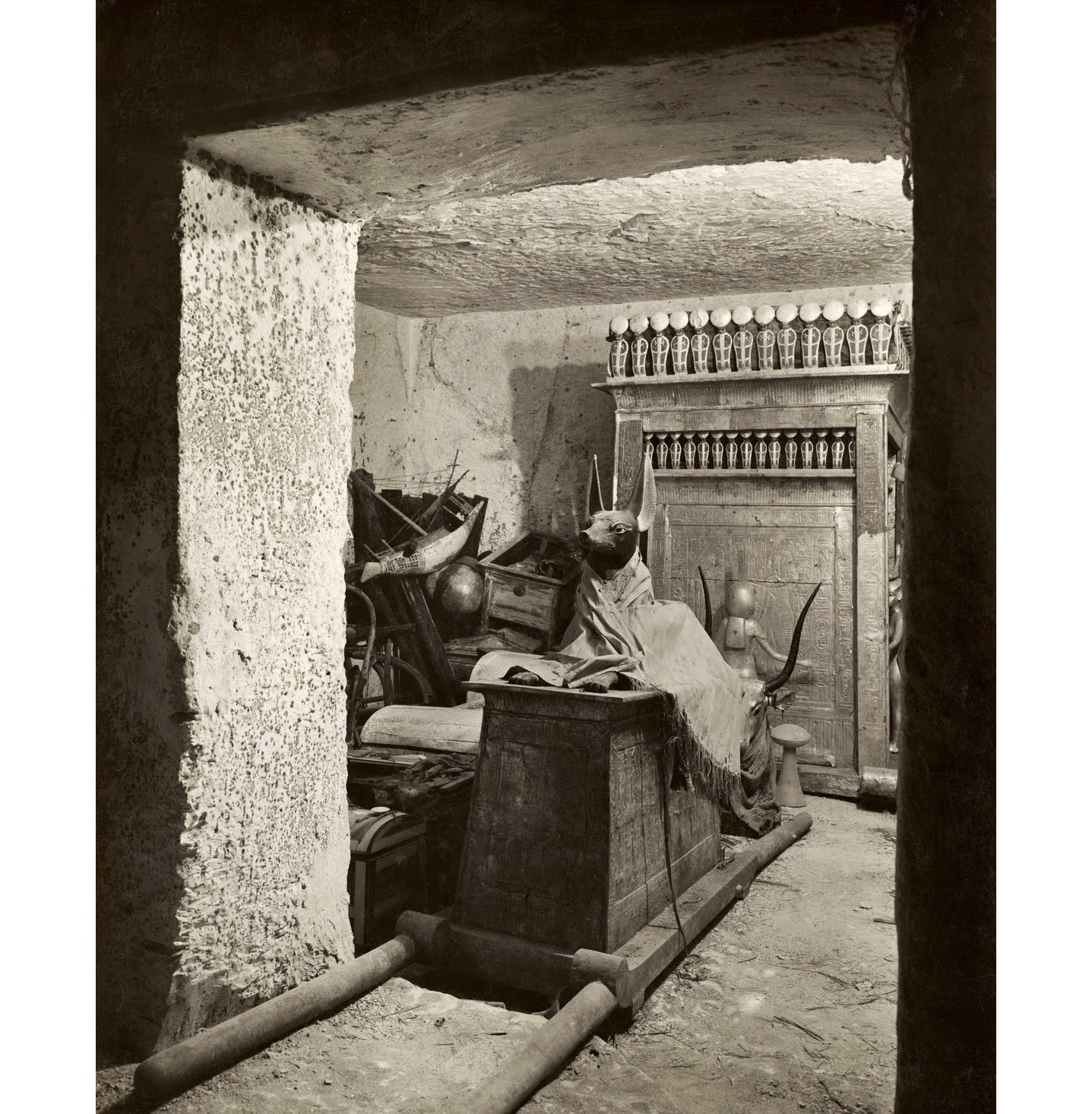
BackgroundThe original Anubis shrine where it was found in Tutankhamun's tomb, photographed by Harry Burton for Howard Carter in 1926. The jackal figure of Anubis lies on the chest, still wrapped in a linen cloth, with its carrying poles on the floor. Behind it stands the gilded canopic shrine that held the king's inner organs. The shrine is now in the Egyptian Museum, Cairo (number JE 61444). Harry Burton, 1926, via Wikimedia Commons, Public domain.
And thou shalt put the staves into the rings by the sides of the ark, that the ark may be borne with them.
Exodus 25:14, KJV
This wooden chest, covered with gold, comes from the tomb of Tutankhamun, which was found in 1922. It stood at the doorway to the room Howard Carter called the treasury, and his team recorded and moved it in 1926. A black wooden figure of the jackal god Anubis lies on its lid, and two long poles let it be carried on people's shoulders. With the poles it is about 2.7 metres long. Inside were compartments holding religious objects and jewellery. David Falk and others compare it with the Ark of the Covenant. The Ark was also a wooden chest covered with gold, carried on poles, and used to hold sacred things (the tablets of the law). Egyptian thrones and shrines also showed winged figures guarding a god. This has been compared with the two cherubim (winged heavenly beings) on the Ark's lid.
Where it is today
Egypt. It is catalogued as Egyptian Museum JE 61444 (Carter number 261). Tutankhamun's tomb treasures have been moved from the Egyptian Museum in Cairo to the Grand Egyptian Museum at Giza, so check which museum is showing it before you visit.
Date
About 1325 BC (reign of Tutankhamun, 18th Dynasty).
Why this label: The shrine is a real object that shows how sacred chests were built and carried in Egypt in the period. It has no link to Israel and says nothing about the Ark itself.
Good to know: Where the Ark went: The Ark itself has never been found, and the Bible does not say plainly what became of it. Its last mention in the Bible's history books is in the time of King Josiah (2 Chronicles 35:3), about 35 years before the Babylonians destroyed Jerusalem in 587 or 586 BC. A later Jewish writing, 2 Maccabees, which is not part of the Hebrew Bible, says Jeremiah hid it in a cave on Mount Nebo. Claims about where it is now, such as Ron Wyatt's claim of a cave under the Garden Tomb area in Jerusalem, or the Ethiopian Orthodox Church's claim that it is kept at Axum, have never been backed by evidence that anyone could check. A key difference: The Anubis shrine carries a figure of a god. The Ark had no image of God at all.
The Ashkelon calf and the Apis bull: calf and bull worship
Exodus 32:1-6 · 1 Kings 12:28-29
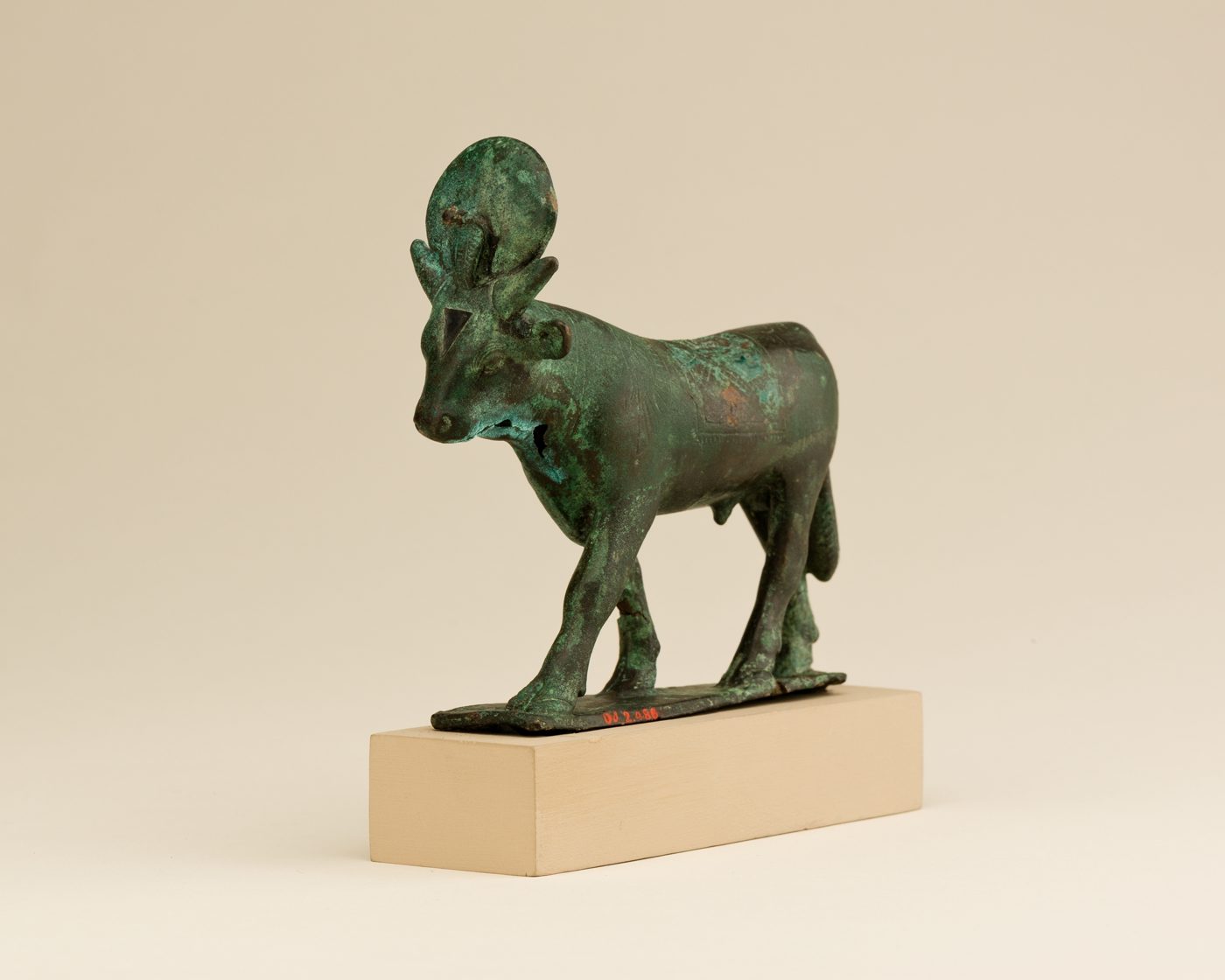
BackgroundCopper-alloy figure of the Apis bull, Egypt, 664 to 30 BC. This is an Egyptian Apis figure, not the Ashkelon calf. The Metropolitan Museum of Art, Gift of Darius Ogden Mills, 1904 (04.2.486), Public Domain (Met Open Access).
And he received them at their hand, and fashioned it with a graving tool, after he had made it a molten calf: and they said, These be thy gods, O Israel, which brought thee up out of the land of Egypt.
Exodus 32:4, KJV
In 1990 Lawrence Stager's team found a small bronze calf, plated with silver, at Ashkelon on the coast of Canaan. It was inside a pottery model shrine, in the ruins of a small temple on the slope of the city's earth wall. It is thought to stand for the Canaanite god El or Baal, who were linked with the young bull. In Egypt, a living bull called Apis was worshipped at Memphis from very early times. Dead Apis bulls were later buried in huge underground tombs at Saqqara. These finds show that calf and bull images were well known in both Canaan and Egypt. That is the setting of the golden calf of Exodus 32 and of the two gold calves King Jeroboam set up at Beth-el and Dan (1 Kings 12:28-29).
Where it is today
Ashkelon calf and its pottery shrine: Israel Museum, Jerusalem. Apis: many bronze Apis figures are in museums, including the one in the photo at The Metropolitan Museum of Art, New York (04.2.486). The Serapeum, the underground burial galleries of the Apis bulls, is at Saqqara, Egypt.
Date
Ashkelon calf: about 1600 to 1550 BC. Apis worship: from about 3000 BC (Egypt's First Dynasty, its first line of kings) to about AD 400.
Why this label: These are real objects and customs that show calf and bull worship in the lands around Israel. They do not show the golden calf itself or prove any event at Sinai.
Good to know: What the calf meant: Scholars disagree on what the golden calf was modelled on. Some point to Egypt's Apis bull, others to the Canaanite bull of El or Baal. Some, such as Michael Coogan, think the calf was meant as a stand for the unseen God, not an image of another god. In Exodus 32:5 Aaron calls the next day "a feast to the LORD". Two accounts: Aaron's people and Jeroboam use almost the same words: "thy gods, O Israel, which brought thee up out of the land of Egypt" (Exodus 32:4; 1 Kings 12:28). Some scholars think one account was shaped by the other, while others read them as two separate events.
The Timna mining shrine: from Egyptian temple to Midianite tent shrine
Exodus 2:15 · Exodus 3:1 · Numbers 21:9
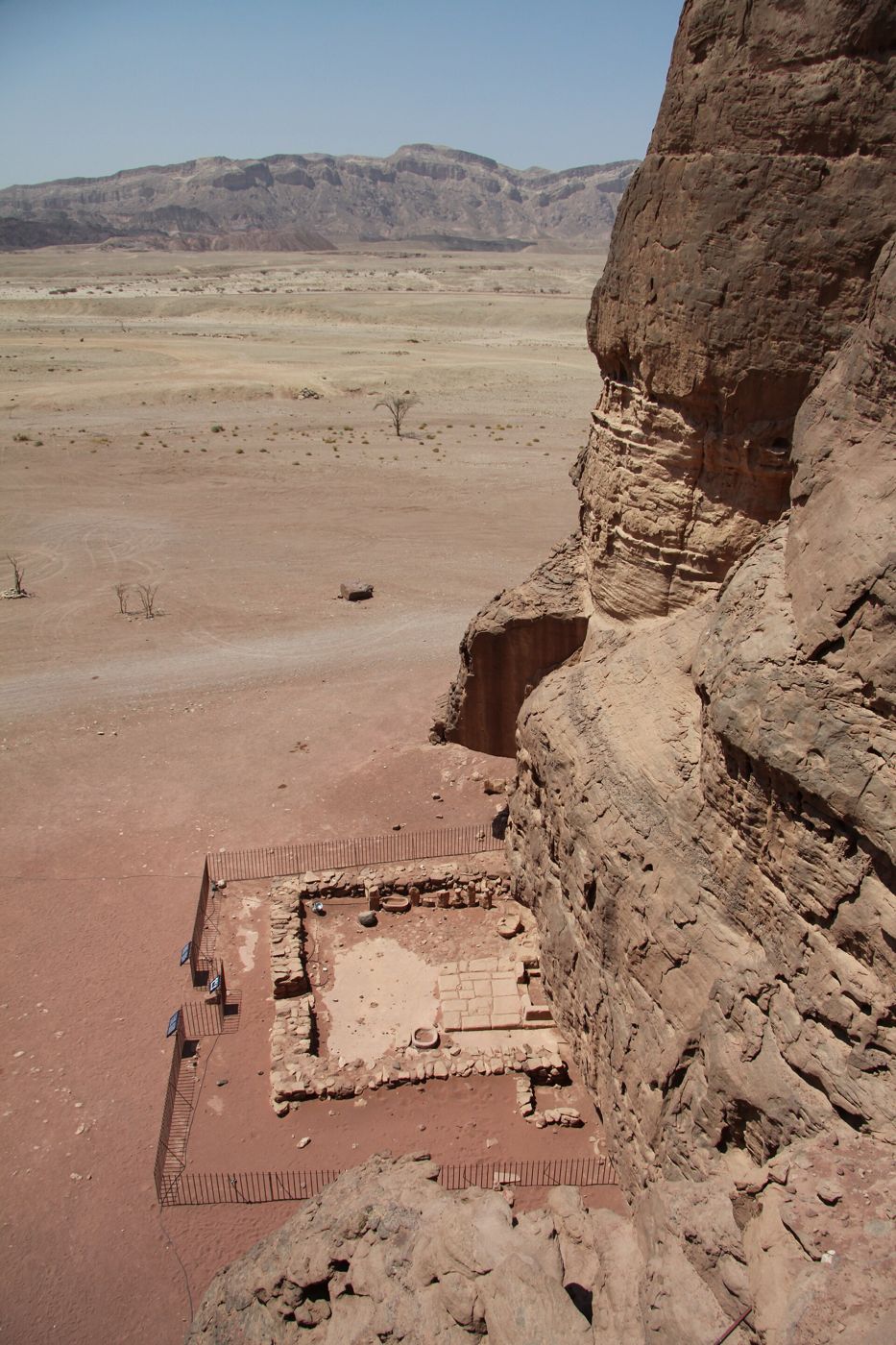
BackgroundRemains of the Hathor shrine at Timna Park, seen from above, at the foot of the cliffs known as Solomon's Pillars. Chmee2, CC BY 3.0.
Now Moses kept the flock of Jethro his father in law, the priest of Midian: and he led the flock to the backside of the desert, and came to the mountain of God, even to Horeb.
Exodus 3:1, KJV
At the Timna copper mines in southern Israel, Egyptian miners built a small shrine to Hathor, their goddess of mining. It dates to the time of Seti the First (about 1290 to 1279 BC). After earthquake damage it was rebuilt under Ramesses the Second. The Egyptians left in the mid-1100s BC. Then people who used Midianite pottery (a painted pottery from northwest Arabia, the old land of Midian) took over the shrine. They defaced the images of Hathor, set up a row of standing stones, and turned the shrine into a tent shrine. Archaeologist Beno Rothenberg found remains of wool cloth along the walls. Among the finds from this later shrine was a small copper snake with a gold-covered head. This matters for the Bible because Moses lived in Midian with Jethro, the priest of Midian (Exodus 2:15 to 3:1). Michael Homan sees this tent shrine as one of the closest known matches to the tabernacle. This tent shrine dates to about 1150 BC. That is about 100 years after the late dating of the Exodus and about 300 years after the early dating.
Where it is today
The shrine ruins are in Timna Park, in the Arabah valley north of Eilat, Israel. The copper snake and other finds are in the Nechushtan (copper) pavilion of the Eretz Israel Museum (MUZA), Tel Aviv.
Date
Egyptian shrine: built under Seti the First, about 1290 BC by today's usual dates (Rothenberg, using older dates, put it at the end of the 1300s BC), and used until about the mid-1100s BC. Midianite tent shrine: soon after, in the 1100s BC.
Why this label: The shrine and its finds are real and well excavated. They show Midianite presence and a tent shrine in the region, but nothing there names Moses, Jethro, Israel or the tabernacle.
Good to know: The copper snake: It is often compared with the serpent of brass that Moses set on a pole (Numbers 21:9). But this is only a comparison; nothing links the Timna snake to Moses. Who was worshipped in the Midianite shrine is hard to tell. Location: Midian itself lay mostly east of the Gulf of Aqaba, in today's Saudi Arabia. Timna lies outside that area, to the northwest. Dates: Newer scientific dating at Timna has moved much of the copper smelting later, into the 1000s and 900s BC, so some dates for the site may still change. Modern model: The full-size "tabernacle" in Timna Park is a modern teaching model, not an ancient find.
 LearnAboutHim