Evidence You Can See: Assyria, Babylon and the Fall of Jerusalem
Real places you can visit and real objects you can see in museums, connected to the second half of 2 Kings and 2 Chronicles: the Assyrian conquest of Israel, King Hezekiah and Sennacherib, King Josiah and Pharaoh Necho, and the fall of Jerusalem to Babylon. Each one is marked honestly, so you can tell solid evidence from tradition and from claims that are still argued over.
ConfirmedThe place or object is real and is clearly the one the Bible names. For a written object, such as an inscription or a scroll, it means the object is genuine and its words are read with confidence, not that every event it mentions is proven.15
Traditional siteA real place that long tradition links to the Bible, but the exact spot cannot be proven.0
DisputedInformed people disagree, or the claim rests on weak evidence.4
BackgroundShows the world the Bible describes, but does not name a Bible person or event.3
Israel and the Assyrians
1
Tiglath-pileser the Third (Pul) names the kings of Israel and Judah
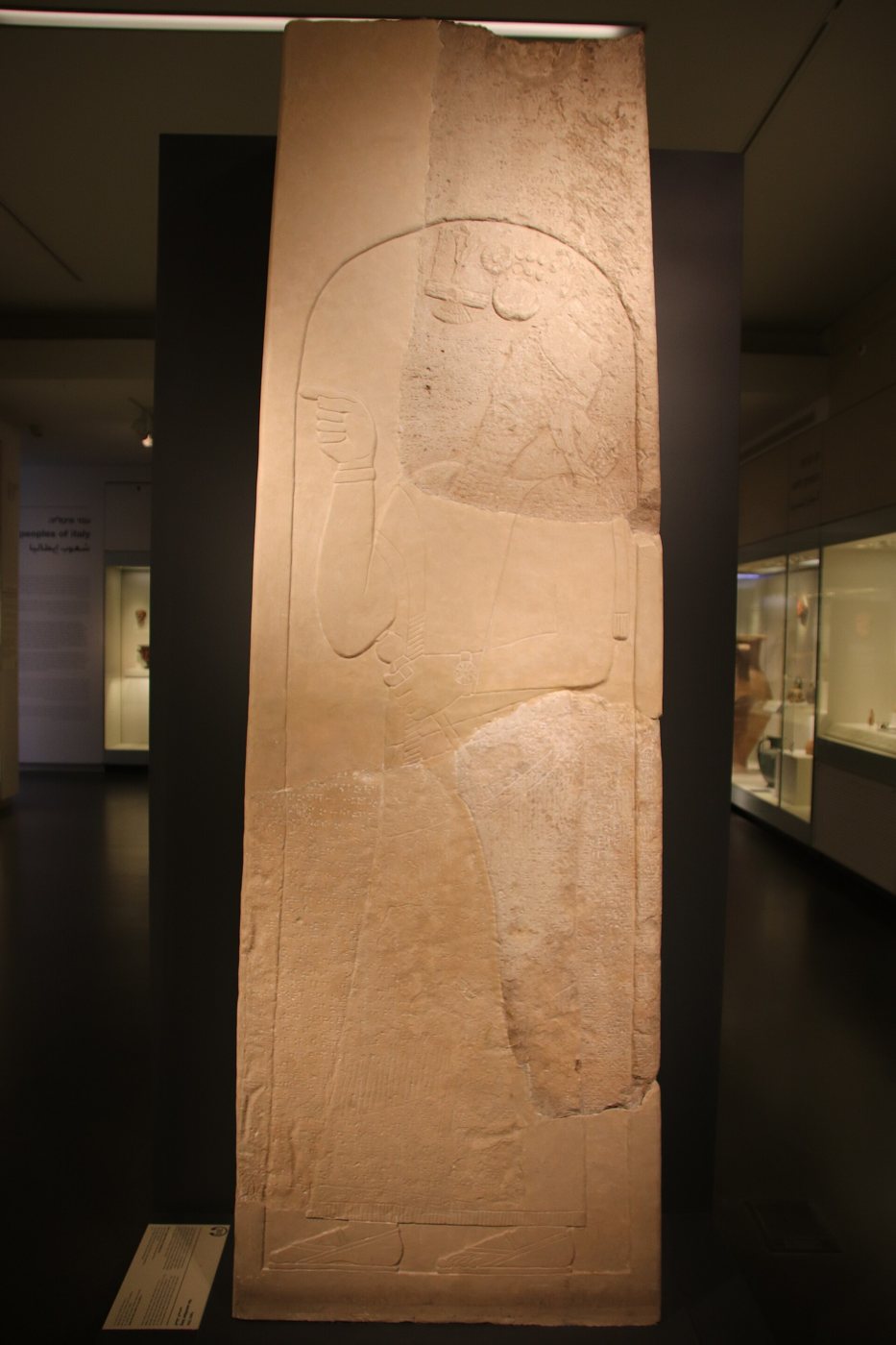
ConfirmedThe Iran Stele of Tiglath-pileser the Third on display in the Israel Museum, Jerusalem. Gary Todd, via Wikimedia Commons, CC0.
And Pul the king of Assyria came against the land: and Menahem gave Pul a thousand talents of silver, that his hand might be with him to confirm the kingdom in his hand.
2 Kings 15:19, KJV
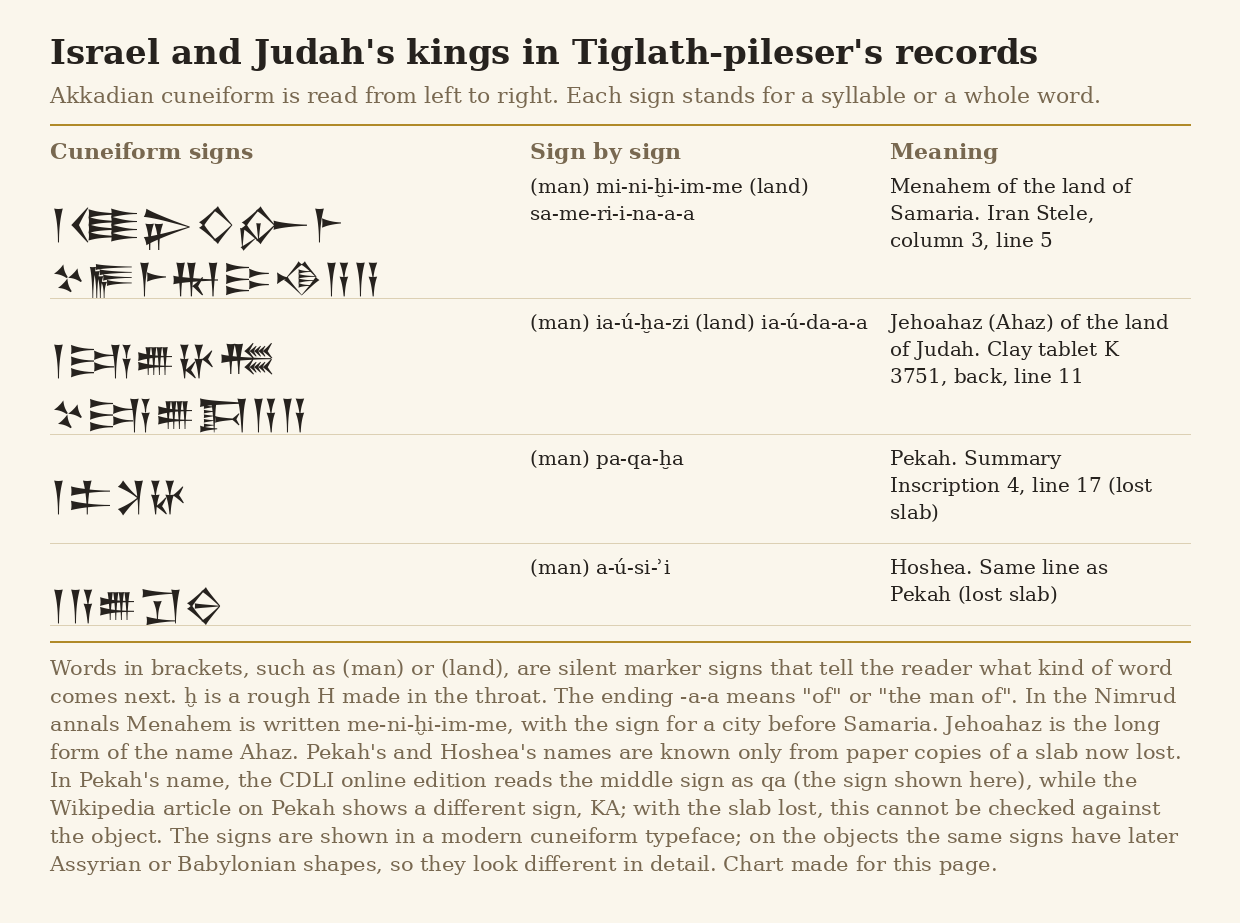
Tiglath-pileser the Third ruled Assyria from 745 to 727 BC. His inscriptions from his palace at Nimrud (ancient Calah, in Iraq) and a stone stele (an upright carved stone slab) said to come from western Iran list the kings who paid him tribute, and they name "Menahem of Samaria" (2 Kings 15:19-20). Summary Inscription 4 (one of his short records that sum up his deeds land by land) says of Israel, in Mordecai Cogan's translation: "Pekah, their king, [I/they ki]lled ... and Hoshea [as king] I appointed over them" (2 Kings 15:29-30). Summary Inscription 7 (a clay tablet) lists "Jehoahaz of the land Judah" among the kings who paid him (translation in the Royal Inscriptions of the Neo-Assyrian Period, volume 1, text 47); Jehoahaz is the full form of the name of King Ahaz, who sent a gift to Tiglath-pileser in 2 Kings 16:7-8. The chart below shows how these kings' names are written in cuneiform, sign by sign.
Chart of the four names in Tiglath-pileser the Third's records: Menahem of Samaria, Jehoahaz (Ahaz) of Judah, Pekah and Hoshea. It shows the cuneiform signs (in a modern typeface), how each sign is read, and what the words mean. The footer notes a sign in Pekah's name that sources read differently. Chart made for this page, free to reuse.
Where it is today
Summary Inscription 7 is a clay tablet in the British Museum, London (K 3751). Summary Inscription 4 was cut on a stone slab that was left at Nimrud in the 1850s; it is known only from paper copies pressed onto it at the time, which were published in 1875 and have since been lost. Many of the Nimrud wall slabs with his annals were damaged or lost. Two of the three pieces of the Iran Stele are in the Israel Museum, Jerusalem.
Date
Reign 745 to 727 BC. The Iran Stele dates to about 737 BC; the summary inscriptions to about 733 to 729 BC.
Why this label: These are Assyrian royal inscriptions from the king's own lifetime. They name Menahem, Pekah, Hoshea and Ahaz (as Jehoahaz) in the same roles 2 Kings gives them, and scholars broadly agree on these identifications.
Good to know
Broken text: In Summary Inscription 4 the word about Pekah's death is damaged, so it may have said "I killed" or "they killed". 2 Kings 15:30 says Hoshea killed him, which fits the second reading.
Pul: 1 Chronicles 5:26 names "Pul king of Assyria" and "Tilgathpilneser king of Assyria" side by side, and some once took them as two kings. Babylonian king lists call Tiglath-pileser "Pulu", and a Phoenician inscription from Incirli in Turkey, published in 2007, supports the view that the two names belong to one man.
Uncertain findspot: All three pieces of the Iran Stele came through private collections, so the exact place it was found is not known.
The fall of Samaria in Assyrian and Babylonian records
2 Kings 17:3-6 · 2 Kings 18:9-11 · 2 Kings 17:24
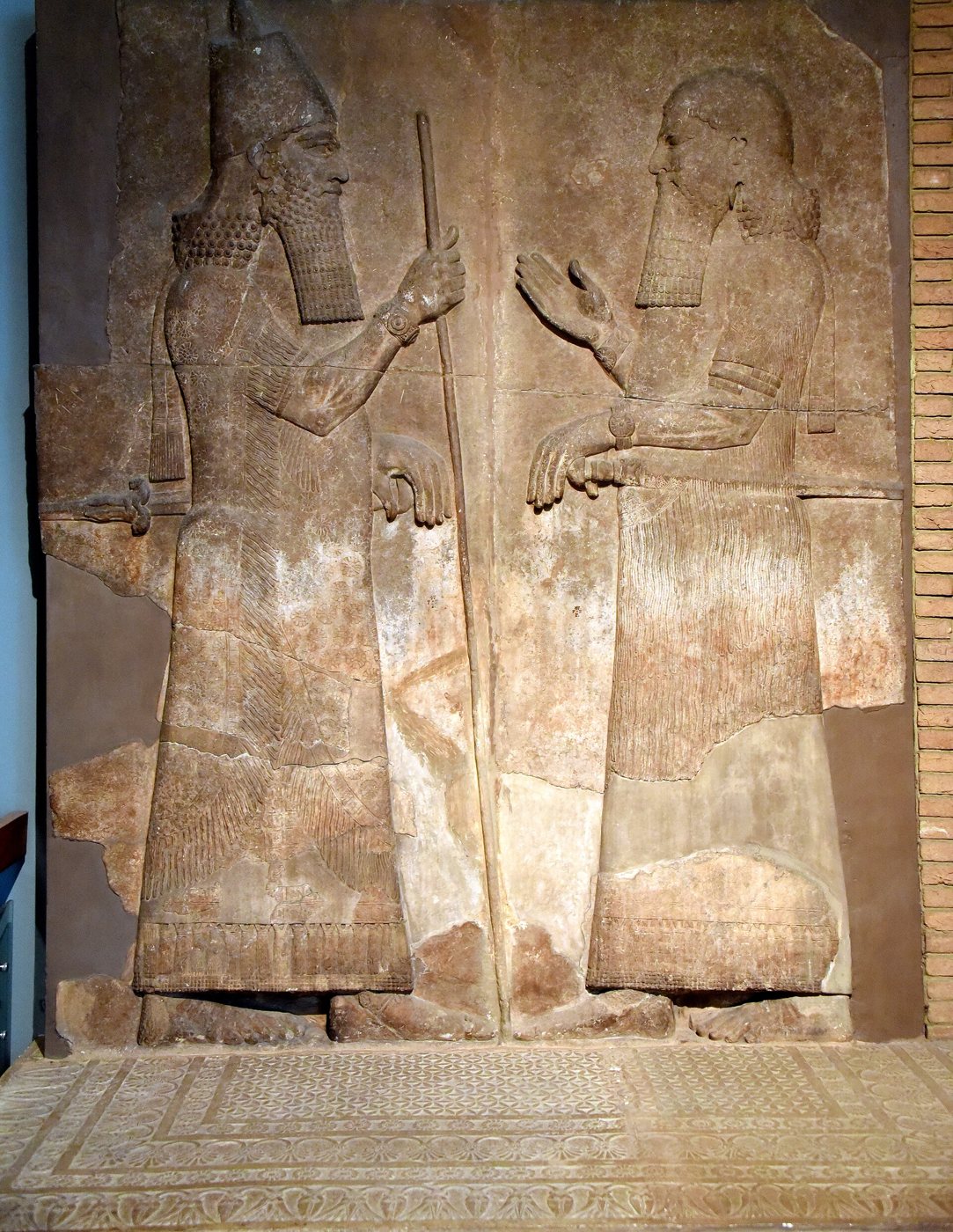
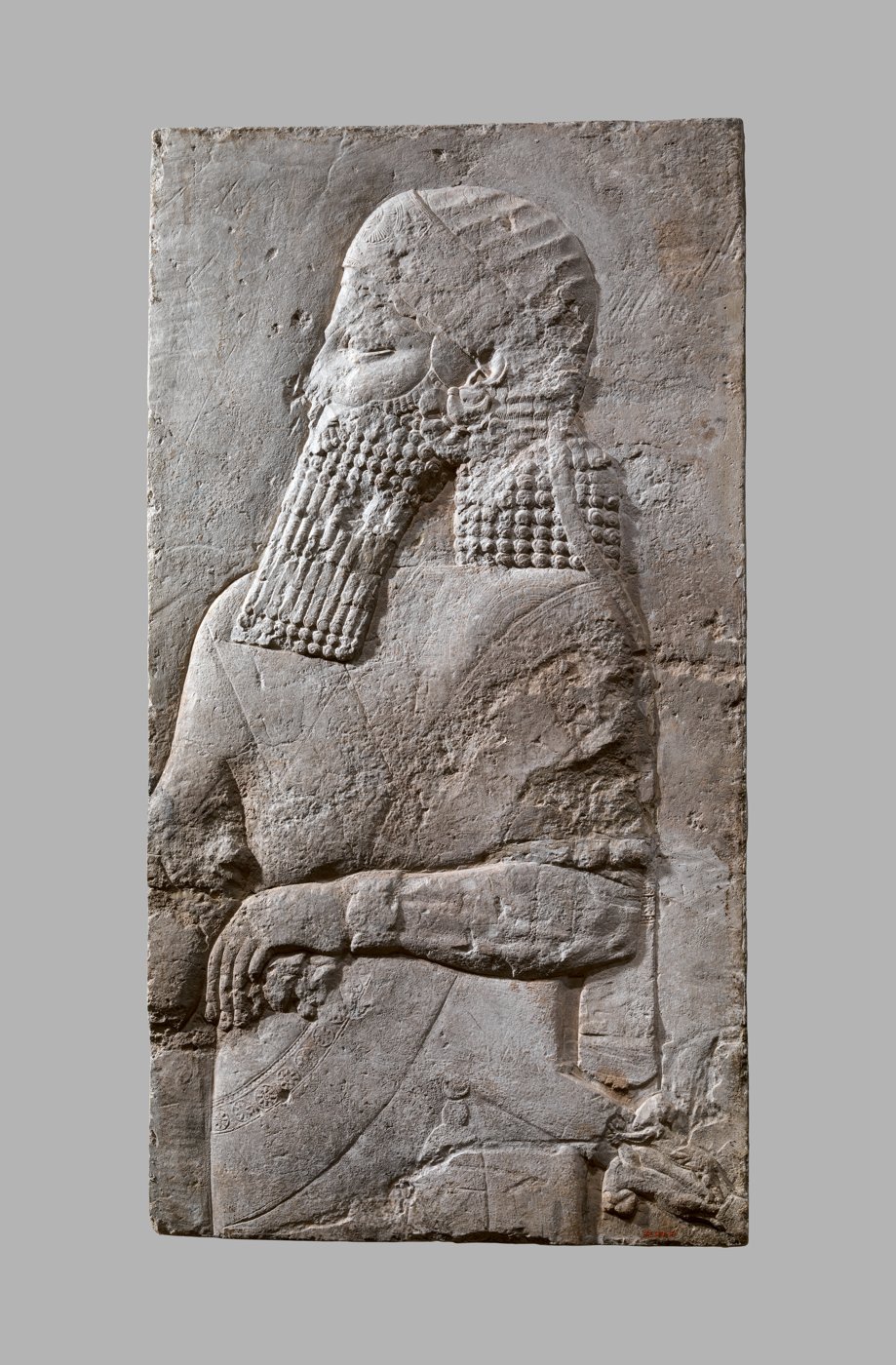
ConfirmedWall carving of Sargon the Second and a crown prince from his palace at Khorsabad, now in the British Museum. Osama Shukir Muhammed Amin, via Wikimedia Commons, CC BY-SA 4.0.
In the ninth year of Hoshea the king of Assyria took Samaria, and carried Israel away into Assyria, and placed them in Halah and in Habor by the river of Gozan, and in the cities of the Medes.
2 Kings 17:6, KJV
2 Kings says Shalmaneser king of Assyria besieged Samaria for 3 years, and that the city fell in the 9th year of King Hoshea and the people of Israel were taken to Assyria. A Babylonian chronicle says of Shalmaneser the Fifth (727 to 722 BC): "He ravaged Samaria" (translation adapted from A. K. Grayson, 1975). His successor Sargon the Second later claimed the victory for himself; his Great Display Inscription from his palace at Khorsabad says: "I besieged and conquered Samarina (Samaria). I took as booty 27,290 people who lived there ... I set my eunuch over them" (translation by K. Lawson Younger Jr.). A eunuch here means a trusted royal official. Sargon's Nimrud Prism adds: "I repopulated Samerina more than before. I brought into it people from countries conquered by my hands", which matches 2 Kings 17:24.
Where it is today
The Babylonian chronicle (known as ABC 1, BM 92502) is in the British Museum, London. The Khorsabad inscriptions were found on the walls of Sargon's palace at Khorsabad, Iraq, in the 1840s. The Nimrud Prism pieces were found at Nimrud, Iraq, in the early 1950s; a piece is shown in the British Museum.
Date
Siege about 725 to 722 BC; the city fell about 722 BC (some date it to 723 or 720 BC). Sargon's claims were written late in his reign, about 710 to 706 BC.
Why this label: Assyrian and Babylonian records from the time agree that Assyria captured Samaria and moved its people away, as 2 Kings says. Which Assyrian king actually took the city is debated, but the conquest itself is not.
Good to know
Which king: Many historians think Shalmaneser the Fifth took the city shortly before he died and that Sargon later took the credit, because the chronicle links Samaria to Shalmaneser and Sargon's claims appear only late in his reign.
Other view: Others think Sargon finished the siege, or had to retake Samaria in 720 BC after it joined a revolt led by the ruler of Hamath. The Bible fits either view, because 2 Kings 17:6 and 18:10 say only "the king of Assyria" and "they took it".
The numbers: The Nimrud Prism gives 27,280 people and 200 chariots, while the Khorsabad text gives 27,290 people and 50 chariots.
Reading the chronicle: One sign in the city name can be read two ways, and a few scholars have asked whether it names Samaria or another town; most read it as Samaria (see Peter Dubovsky, Orientalia 80, 2011).
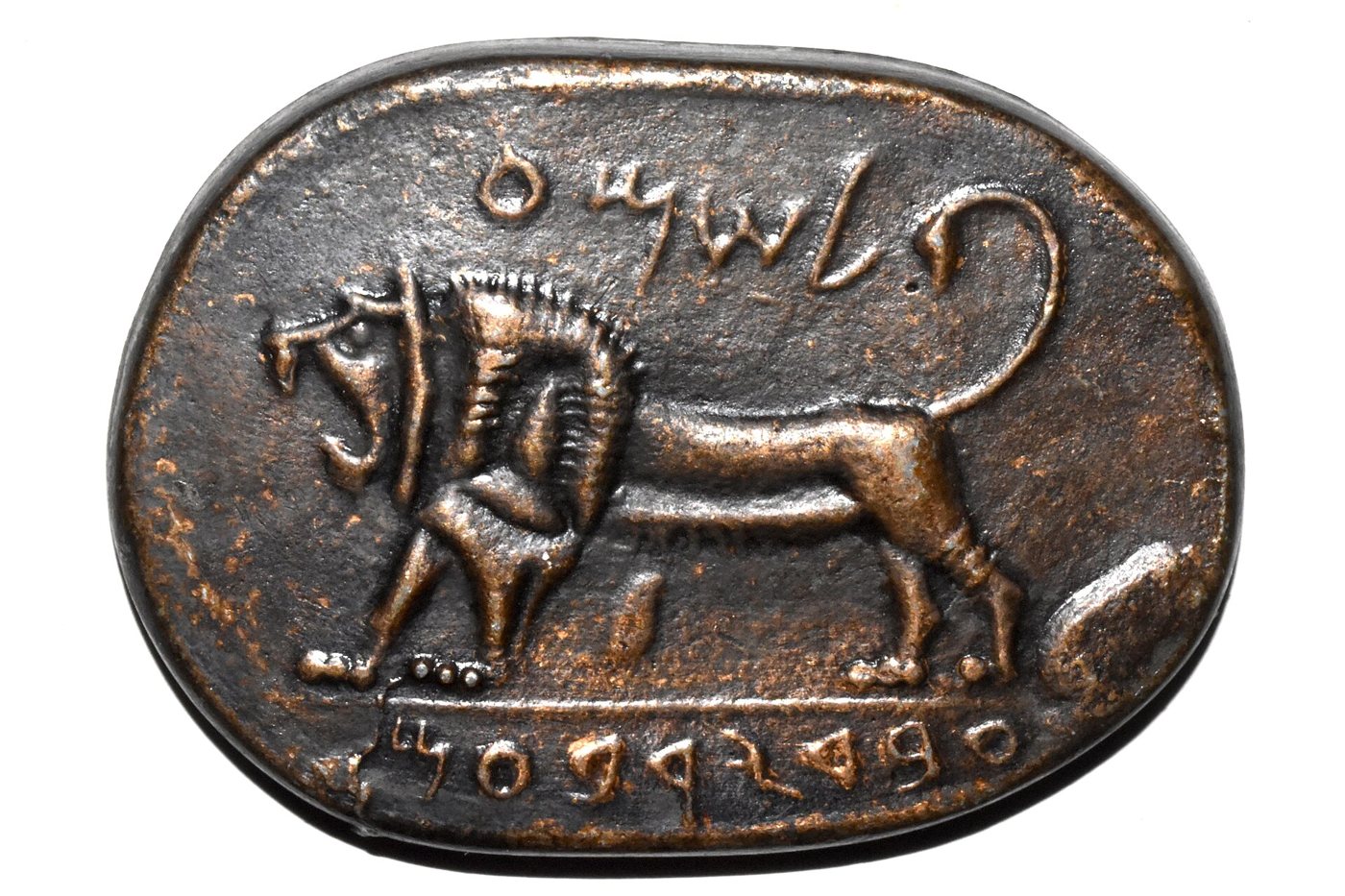
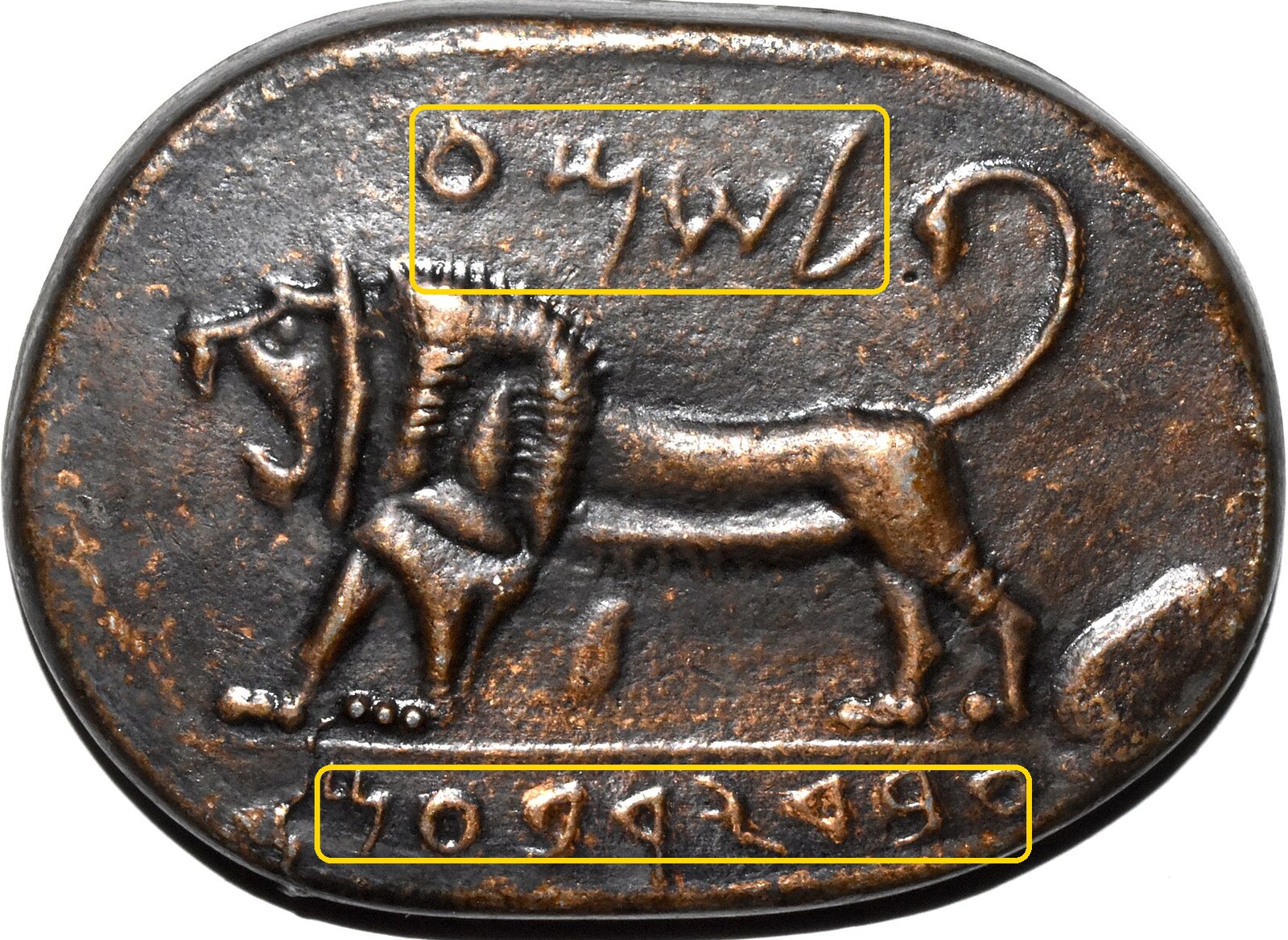
ConfirmedA bronze replica of the Shema seal showing the roaring lion and the inscription. Fred Cherrygarden, via Wikimedia Commons, CC BY-SA 4.0.
In the fifteenth year of Amaziah the son of Joash king of Judah Jeroboam the son of Joash king of Israel began to reign in Samaria, and reigned forty and one years.
2 Kings 14:23, KJV
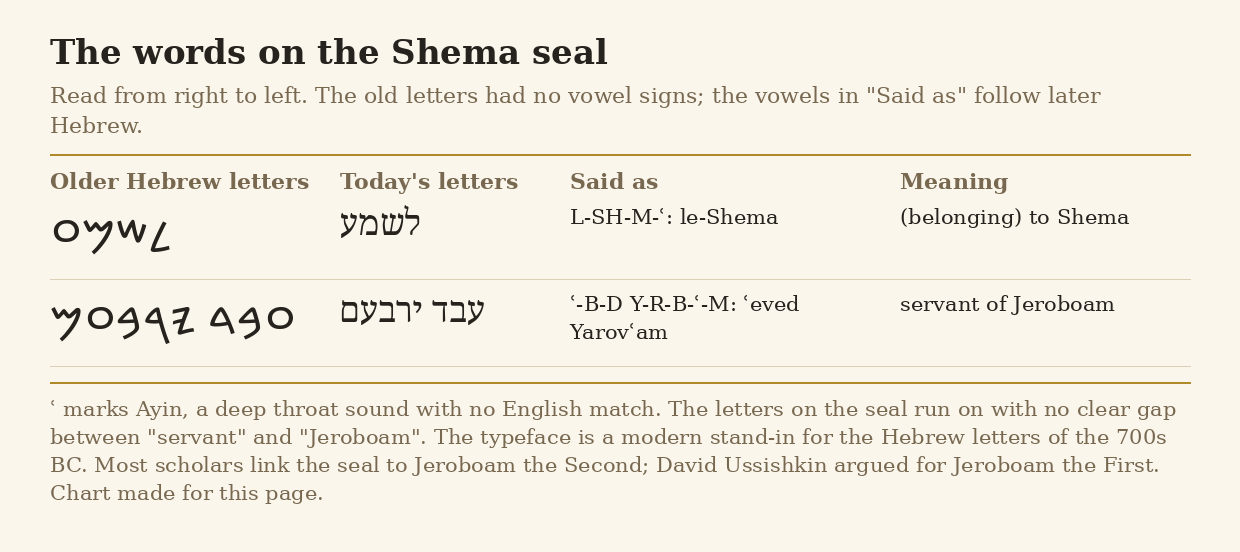
In 1904 Gottlieb Schumacher's dig at Megiddo found a large jasper seal, about 37 by 27 millimetres, carved with a roaring lion. Its old Hebrew letters read: "(Belonging) to Shema, servant of Jeroboam." On seals like this, "servant of" a named man usually marks a high official of a king. Israel had two kings named Jeroboam: Jeroboam the First (1 Kings 12:20) and Jeroboam the Second, who reigned 41 years in the 700s BC (2 Kings 14:23). The pictures below show the words on a replica of the seal, with each line marked, and a chart of what they say.
Photo of a modern bronze replica of the Shema seal, not the original. The replica is about 85 by 61 millimetres, larger than the lost original (about 37 by 27 millimetres). The top yellow box marks "(belonging) to Shema" above the lion. The bottom box marks "servant of Jeroboam" below it. The letters on this replica read normally, from right to left, as they would on a clay impression made with the seal. The boxes were added for this page. Fred Cherrygarden, via Wikimedia Commons, CC BY-SA 4.0.Chart of the words on the Shema seal: the older Hebrew letters (shown in a modern typeface), the same words in today's Hebrew letters, how they sound and what they mean. The footer notes the debate over which King Jeroboam is meant. Chart made for this page, free to reuse.
Where it is today
The original is lost. Soon after it was found it was sent to the Ottoman sultan in Constantinople (Istanbul) and has not been seen since; one later family account says it was placed in the tomb of Sultan Abdul Hamid the Second. A cast was made before it was sent away, and copies are shown today, including one in the Israel Museum, Jerusalem.
Date
Most date it to the 700s BC, the time of Jeroboam the Second (about 789 to 748 BC); a minority view dates it to the 900s BC, the time of Jeroboam the First.
Why this label: The seal came from an excavation at Megiddo, a city of the kingdom of Israel, and names an official of a Jeroboam, almost certainly one of Israel's two kings of that name. Which Jeroboam is debated, and the original can no longer be examined.
Good to know
Which Jeroboam: Most scholars link the seal to Jeroboam the Second, and the layers it came from have been dated to the 700s BC.
Other view: Archaeologist David Ussishkin argued, from the gate area at Megiddo where it was found, that it belongs to Jeroboam the First.
A second item: A clay seal impression with the same words, said to have been bought in a market, was published as genuine in 2023 in the journal Tel Aviv by a team of scholars led by Shmuel Ahituv. In 2024 Robert Deutsch and others called it a forgery, so it should not be used as extra evidence.
So Uzziah slept with his fathers, and they buried him with his fathers in the field of the burial which belonged to the kings; for they said, He is a leper: and Jotham his son reigned in his stead.
2 Chronicles 26:23, KJV
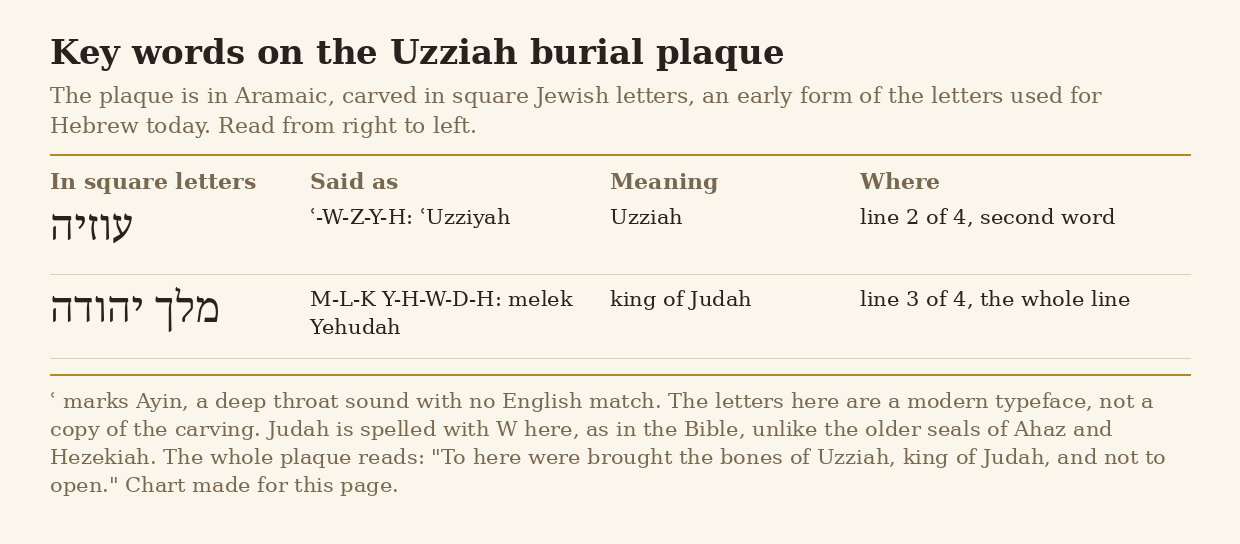
This square limestone plaque, about 35 by 34 centimetres, is carved in Aramaic in the square Jewish letters used around the time of Herod. In the Israel Museum's translation it reads: "Hither were brought the bones of Uzziah King of Judah. Do not open!" ("Hither" means "to this place".) Uzziah (also called Azariah in 2 Kings 15) reigned in the 700s BC, and 2 Chronicles 26:23 says he was buried in a field that belonged to the kings because he was a leper. The plaque seems to mark a later reburial of bones that people of that time believed were his. The chart below shows the key words of the plaque in their original letters.
Chart of the key words on the Uzziah plaque, "Uzziah" and "king of Judah": the square letters (in a modern typeface), how they sound, what they mean and where they are on the plaque. Chart made for this page, free to reuse.
Where it is today
Israel Museum, Jerusalem (bought for the museum in 1968). Where it was first found is unknown.
Date
1st century BC to 1st century AD, about 700 years after Uzziah.
Why this label: The plaque is a real ancient object, but it was carved about 700 years after Uzziah died and nobody knows where it was found. It shows what Jews living around the time of Herod believed about Uzziah's grave. Whether the bones it marked were really his cannot be known.
Good to know
How it surfaced: In 1931 Eleazar Sukenik of the Hebrew University noticed it in the museum of the Russian Orthodox convent on the Mount of Olives. It was probably collected in the late 1800s, but the museum's catalogue was lost during the First World War. So nobody knows where the plaque was found or where it first stood.
Common mistake: Some reports call it a 2,700-year-old tombstone of Uzziah; it is not from his time.
In the seventeenth year of Pekah the son of Remaliah Ahaz the son of Jotham king of Judah began to reign.
2 Kings 16:1, KJV
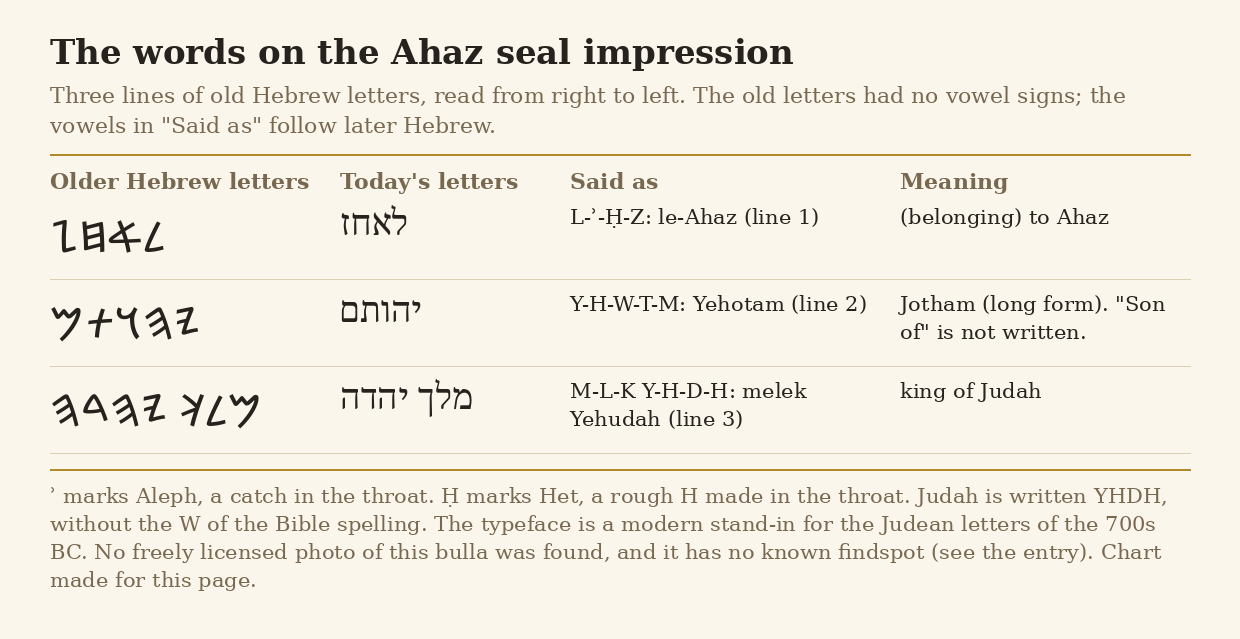
A bulla is a small lump of clay pressed with a seal to close a rolled papyrus document. This small one has 3 lines of old Hebrew letters that read, as published by Robert Deutsch: "Belonging to Ahaz (son of) Yehotam, king of Judah." The word "son" is not written but is understood, and Yehotam is the Hebrew form of Jotham, so the wording matches "Ahaz the son of Jotham king of Judah" in 2 Kings 16:1. The back shows the texture of papyrus and the marks of the string, and there is a fingerprint on one edge. The chart below shows the three lines of the seal impression in the old Hebrew letters.
Chart of the three lines on the Ahaz seal impression, "(belonging) to Ahaz, Yehotam, king of Judah": the older Hebrew letters (shown in a modern typeface), the same words in today's Hebrew letters, how they sound and what they mean. Chart made for this page, free to reuse.
Where it is today
Last reported in the private collection of Shlomo Moussaieff, London. It is not in a public museum.
Date
Ahaz reigned about 735 to 716 BC; if genuine, the bulla comes from his reign.
Why this label: It has no known findspot: it surfaced with an antiquities dealer in the mid-1990s, so its age cannot be checked against an excavation. Many specialists accept it, but forged seals and bullae from the antiquities market are known.
Good to know
For it: Robert Deutsch, who published the bulla in Biblical Archaeology Review in 1998 and who also dealt in antiquities, argued that bullae cannot be faked, because real ones were hardened in fires and show wear, small cracks and tiny crystals that a forger could not copy.
Doubting view: Scholars such as Andrew Vaughn and Christopher Rollston have warned that some market bullae are forgeries and that seals and bullae without a findspot should not be trusted on their own. Vaughn agreed that a bulla would be hard to fake, but not impossible.
Firm evidence elsewhere: King Ahaz does not depend on this object, because he is named as Jehoahaz of Judah in an Assyrian inscription of Tiglath-pileser the Third, and a bulla found in a Jerusalem dig and announced in 2015 reads "Belonging to Hezekiah (son of) Ahaz king of Judah".
Kuntillet Ajrud: "Yahweh of Samaria and his Asherah"
2 Kings 17:16 · 2 Kings 13:6 · 1 Kings 16:33
Background
And they left all the commandments of the LORD their God, and made them molten images, even two calves, and made a grove, and worshipped all the host of heaven, and served Baal.
2 Kings 17:16, KJV
Kuntillet Ajrud is a small hilltop fort or way station in the north Sinai desert, used around 800 BC and dug by Ze'ev Meshel in 1975 and 1976. Ink writing on a large storage jar ends, in the translation given by Emile Puech (2014): "blessed are you all to Yahweh of Samaria and to his Asherah". Another text there names "Yahweh of Teman and his Asherah". The pottery, spelling and personal names link most of the people there to the northern kingdom of Israel, though some of the inscribed jars seem to have come from Judah. The texts show some Israelites joining an "asherah" to the worship of the LORD. This is the practice 2 Kings 13:6 and 17:16 condemn (the KJV word "grove" stands for the Hebrew word asherah).
Where it is today
After the dig the finds were handed over to Egypt. In 2011 the Sinai finds that had been returned to Egypt were reported moved to the Egyptian Museum in Cairo for safekeeping. The Kuntillet Ajrud finds are thought, but not confirmed, to be among them, and they are not on public display. The site itself is a remote hill in north Sinai, Egypt.
Date
About 800 BC (carbon dating of the site gives about 801 to 770 BC).
Why this label: The inscriptions are real and come from an excavation, and they show how some Israelites around 800 BC worshipped. They do not name any Bible person or event.
Good to know
Goddess or object: Scholars disagree whether "his Asherah" means the goddess Asherah as a partner of Yahweh, or a wooden pole or sacred tree used in worship. Hebrew of the time did not normally add "his" to a personal name, which favours an object, though related languages did.
The drawings: The figures painted on the same jar are not proven to show Yahweh and Asherah; many scholars think they show the Egyptian god Bes or similar figures, and they may not belong with the writing.
Uncertain words: The opening of the text is broken, and the word read as "the king" is partly restored.
What it shows: The find shows what some Israelites did, which matches what the Bible says they did and condemned; it does not tell us what the prophets taught.
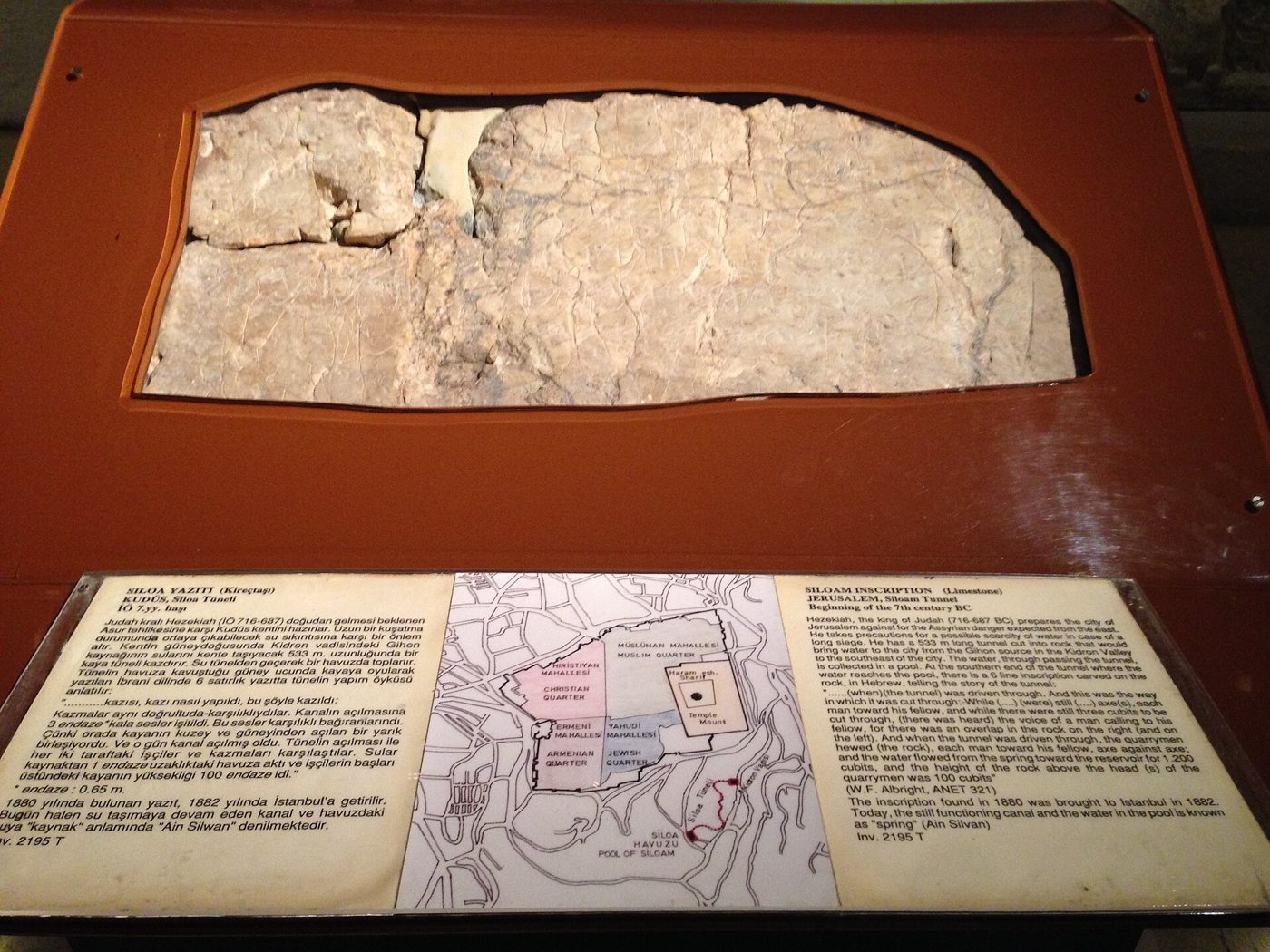
ConfirmedThe Siloam inscription in its display case at the Istanbul Archaeology Museums, 2014. Oncenawhile, via Wikimedia Commons, CC0.
And the rest of the acts of Hezekiah, and all his might, and how he made a pool, and a conduit, and brought water into the city, are they not written in the book of the chronicles of the kings of Judah?
2 Kings 20:20, KJV
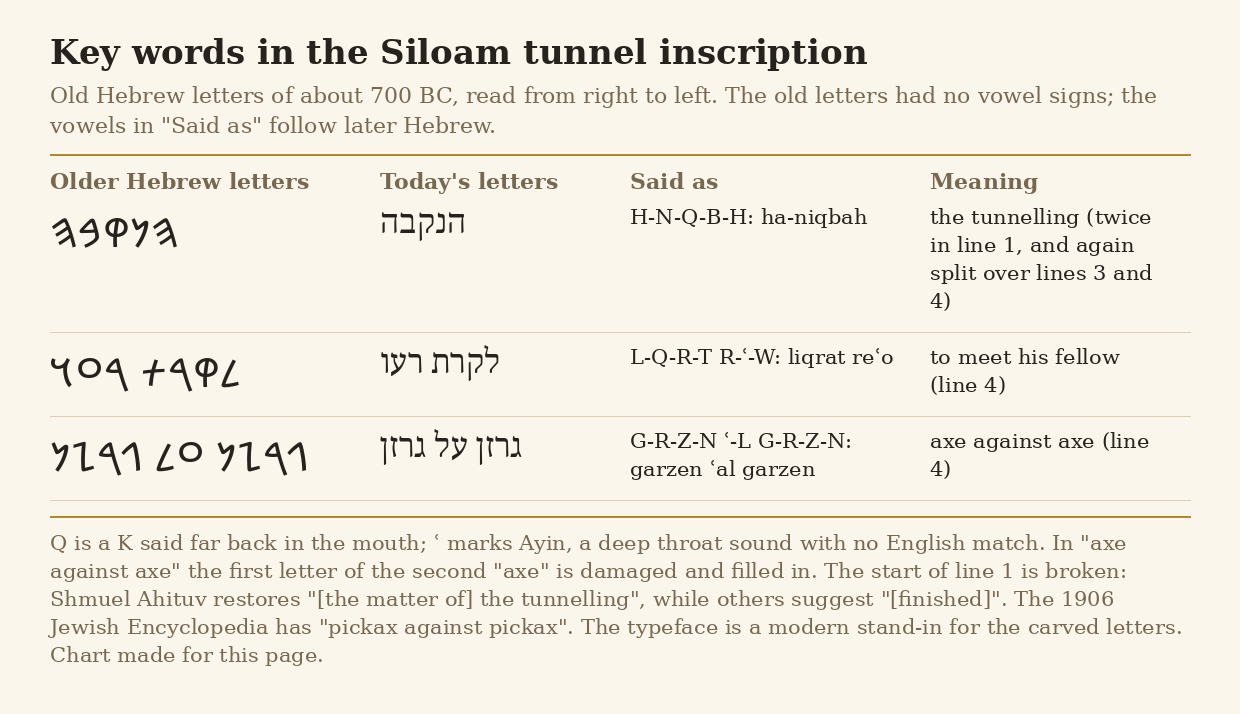
Hezekiah's tunnel is a water channel cut through solid rock under the City of David in Jerusalem. It winds for about 533 metres from the Gihon spring to the Pool of Siloam, and its floor drops only about 30 centimetres from one end to the other. The Bible says Hezekiah made "a conduit" and brought the water of Gihon "straight down to the west side of the city of David" to keep it from the Assyrians. In 1880 a teenage pupil exploring the tunnel found a 6-line Hebrew inscription cut into the rock near the south end, describing how two teams dug from opposite ends until they met. The chart below shows key words of the tunnel inscription in the old Hebrew letters.
Chart of three key phrases in the Siloam inscription, "the tunnelling", "to meet his fellow" and "axe against axe": the older Hebrew letters (shown in a modern typeface), the same words in today's Hebrew letters, how they sound and what they mean. The footer notes the damaged and restored places. Chart made for this page, free to reuse.
Where it is today
The tunnel is in the City of David, just south of the Old City walls of Jerusalem. Visitors can wade through it; check opening times before planning a visit. The inscription was cut out of the tunnel wall in 1890 (it broke into pieces) and is now in the Istanbul Archaeology Museums, Turkey (number 2195 T). A copy sits in the tunnel and another is at the Israel Museum.
Date
About 700 BC by most dating (script, radiocarbon tests and the Bible's account). A minority view puts the tunnel about 800 BC.
Why this label: The tunnel is real, matches the Bible's description of Hezekiah bringing the Gihon water to the west side of the City of David, and scientific tests date it to about his time. The inscription itself does not name Hezekiah or any king, so the link to him rests on the Bible, the dating and broad scholarly agreement.
Good to know
The inscription: In the translation by Christopher Rollston (Bible Odyssey, Society of Biblical Literature) it says in part: "while there were still three cubits to tunnel through, the voice of a man was heard calling out to his co-worker ... each of the stonecutters was striking (the stone) forcefully so as to meet his co-worker, pick after pick. And then the water began to flow from the source to the pool, a distance of 1200 cubits." The first line is damaged, and one word in line 3 (zadah) is uncertain; Rollston reads it as a crack (fissure) in the rock. A cubit was about 45 centimetres, so 1,200 cubits fits the real length of about 533 metres.
The dating: In 2003 Amos Frumkin, Aryeh Shimron and Jeff Rosenbaum reported in the journal Nature on radiocarbon (carbon-14) tests of bits of plant in the tunnel's original plaster, which gave dates between about 800 and 510 BC. They also used uranium-thorium tests on mineral growths that formed on the ceiling after the tunnel was cut, which give a latest possible date for the cutting. Together the results point to about 700 BC and ruled out the claim of John Rogerson and Philip Davies that the tunnel was cut in the 100s BC.
Earlier date view: Ronny Reich and Eli Shukron, who dug near the spring, argued in 2011 from pottery in fill that blocked a connecting channel that the tunnel was cut in the late 800s or early 700s BC, decades before Hezekiah. They suggest the Bible's words about his pool and conduit might refer to other waterworks. Others reply that the pottery only gives the earliest possible date for the fill, and that Hezekiah had time to cut the tunnel during his revolt.
Earlier pages: The Gihon spring, its tower and the older Warren's Shaft system are covered on the Samuel and Solomon pages.
Sennacherib's prisms: the Assyrian account of 701 BC
2 Kings 18:13-16 · 2 Kings 19:35-36 · Isaiah 36:1
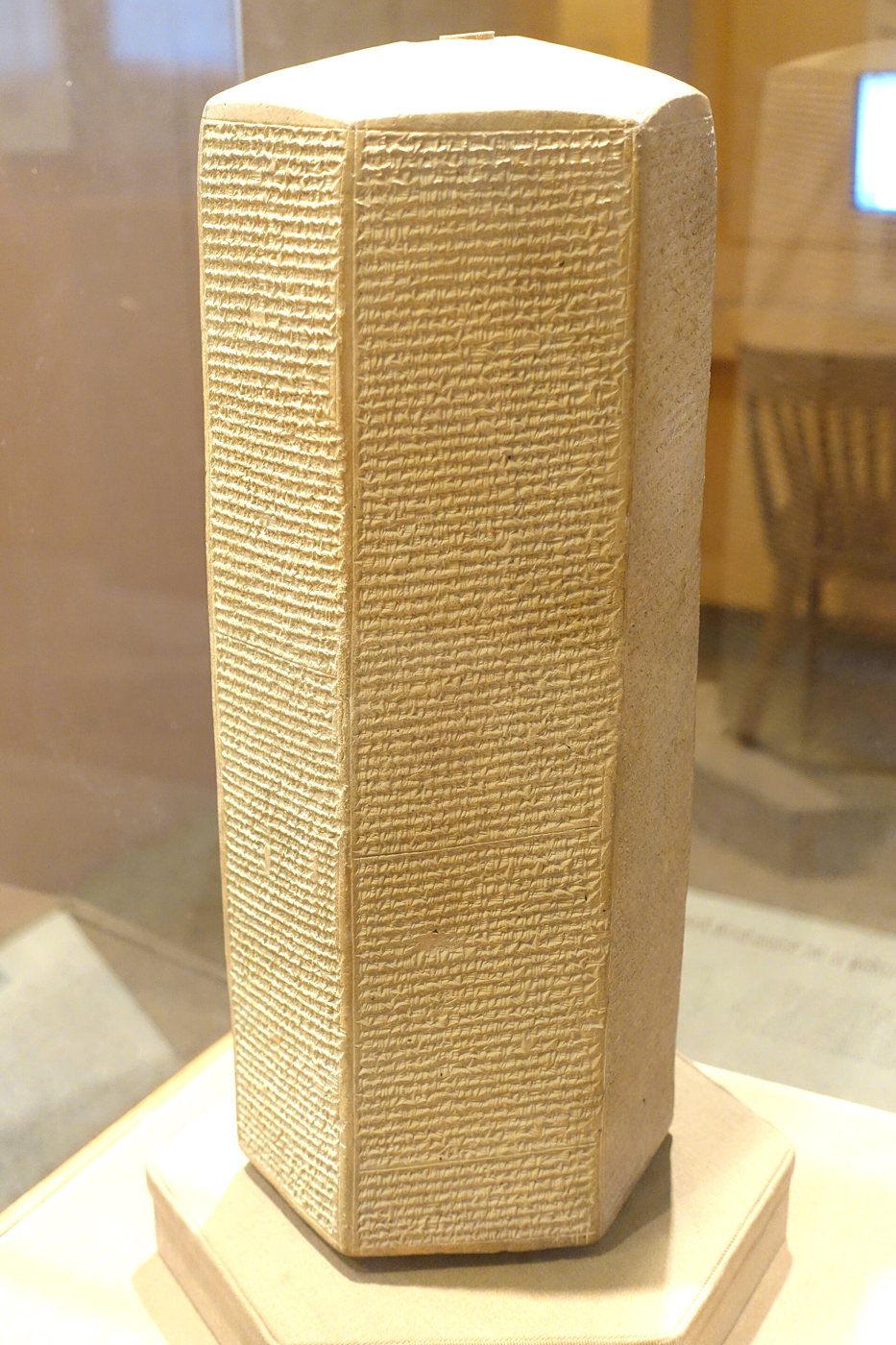
ConfirmedThe Chicago copy of Sennacherib's 6-sided clay prism, one side shown. Daderot, via Wikimedia Commons, CC0.
Now in the fourteenth year of king Hezekiah did Sennacherib king of Assyria come up against all the fenced cities of Judah, and took them.
2 Kings 18:13, KJV
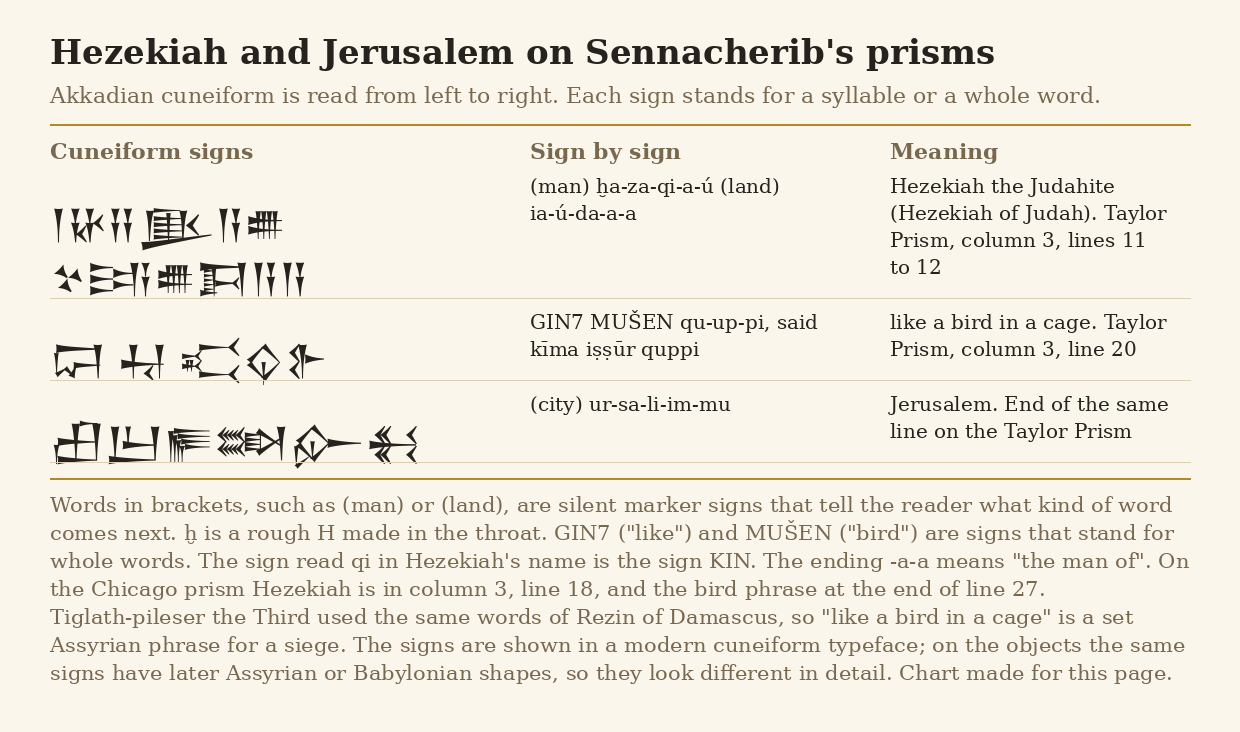
Sennacherib, king of Assyria, had his war records written in cuneiform (wedge-shaped writing pressed into clay) on 6-sided clay prisms about 31 to 38 centimetres tall. Three nearly complete copies of his final edition survive: the Taylor Prism in London, the Chicago prism and the Jerusalem prism. They describe his third campaign, in 701 BC, against the Phoenician cities, the Philistines and "Hezekiah, the Jew" (that is, of Judah). Like 2 Kings 18:13-16, they say he took Judah's walled towns and received heavy tribute from Hezekiah. The prisms add that he shut Hezekiah up in Jerusalem, and 2 Kings 18:17 to 19:8 tells of an Assyrian army sent to Jerusalem. Neither account says Jerusalem was captured. The pictures below show Hezekiah's name and the word Jerusalem in cuneiform, with the key words marked, and a chart of how they are read.
The words "Hezekiah of Judah" from Sennacherib's account, as printed in cuneiform type in the British Museum's guide of 1900. This is a printed copy, not a photo of a prism. The left yellow box marks Hezekiah's name: 6 signs, the first a silent marker for a man's name. The right box marks "of Judah": the first sign is a silent marker for a land. The old-fashioned readings under the signs come from the 1900 book ("D.P." means a silent marker sign). Today the words are read Ḫa-za-qi-a-ú and Ia-ú-da-a-a; the book reads the last sign "ai", where modern editions read a-a. The boxes were added for this page. oncenawhile, via Wikimedia Commons, from the British Museum's Guide to the Babylonian and Assyrian Antiquities (1900), Public domain.The word Jerusalem (Ursalimmu) from Sennacherib's account, as printed in cuneiform type in the British Museum's guide of 1900. This is a printed copy, not a photo of a prism. The yellow box marks the 6 signs of the name, starting with the silent marker for a city. The signs after it, outside the box, read "his royal city". The box was added for this page. oncenawhile, via Wikimedia Commons, from the British Museum's Guide to the Babylonian and Assyrian Antiquities (1900), Public domain.Chart of "Hezekiah the Judahite", "like a bird in a cage" and "Jerusalem" on Sennacherib's prisms: the cuneiform signs (in a modern typeface), how each sign is read, what the words mean and where they are on the Taylor Prism. Chart made for this page, free to reuse.
Where it is today
Taylor Prism: British Museum, London (museum number 91032). Chicago prism: Institute for the Study of Ancient Cultures (formerly the Oriental Institute), University of Chicago. Jerusalem prism: Israel Museum, Jerusalem (IMJ 71.72.249). None came from a recorded dig: the Taylor Prism was bought at Mosul by Colonel Taylor in 1830 and is said to come from the Nebi Yunus mound of Nineveh; the Chicago prism was bought from a Baghdad dealer around 1919 to 1920; the Jerusalem prism was bought at auction in 1970. An earlier version of the same account (on the Rassam cylinder of 700 BC) and broken pieces of dozens of other copies are also known, so the text does not depend only on these 3 bought prisms.
Date
Taylor and Jerusalem prisms 691 BC; Chicago prism 689 BC. The campaign they describe took place in 701 BC.
Why this label: The prisms are genuine Assyrian royal records that name Hezekiah, Judah and Jerusalem, so they clearly speak of the events in 2 Kings 18 and 19. Confirmed here means the objects and their words are secure, not that every claim in them, or every detail of the Bible's account, is proven by them.
Good to know
What it says: In the translation in Ancient Near Eastern Texts Relating to the Old Testament (J. B. Pritchard, editor, pages 287 to 288) the Chicago prism reads: "As to Hezekiah, the Jew, he did not submit to my yoke, I laid siege to 46 of his strong cities, walled forts and to the countless small villages in their vicinity, and conquered (them) ... Himself I made a prisoner in Jerusalem, his royal residence, like a bird in a cage." It says he took away 200,150 people and gave the captured towns to the kings of Ashdod, Ekron and Gaza.
The tribute: The prism says Hezekiah later sent to Nineveh "30 talents of gold, 800 talents of silver", precious stones, ivory furniture, his daughters and musicians. (A talent was a large weight, roughly 30 kilograms.) 2 Kings 18:14 gives 30 talents of gold and 300 talents of silver. Scholars explain the silver gap in different ways, such as different weight standards or counting, or an inflated Assyrian figure. The two accounts also differ on timing. In 2 Kings 18:14-16 Hezekiah sends word to Sennacherib at Lachish and pays, while the prism says the payment was sent after the king to Nineveh.
Where they differ: The Bible says that after the payment Sennacherib still sent officers and an army to Jerusalem, and that the angel of the LORD struck 185,000 men in the Assyrian camp, so he went home to Nineveh. The prism says nothing about losses or about why Jerusalem was not taken; it simply ends with the tribute.
Disaster view: Those who accept the Bible's account point out that Assyrian kings did not record defeats in their royal inscriptions, so the prism's silence is what one would expect. On this view the Bible explains why a city that had rebelled was spared. Some historians also think a sudden sickness struck the army. They point to the Greek writer Herodotus, who told an Egyptian story of mice gnawing the Assyrian bowstrings, which some read as a memory of disease in the camp.
Tribute view: Many historians think Sennacherib accepted Hezekiah's surrender and tribute and went home because his aims were met. Some add that the Egyptian and Kushite army mentioned in 2 Kings 19:9 played a part. Both sources agree that Jerusalem was not taken; they differ on why.
The siege of Lachish: the reliefs and the siege ramp
2 Kings 18:14 · 2 Kings 19:8 · 2 Chronicles 32:9
ConfirmedPanorama of the Lachish reliefs in the British Museum, showing the attack on the city, the captives and the spoils (joined together from several photos). Shadsluiter, via Wikimedia Commons, CC BY-SA 4.0.
After this did Sennacherib king of Assyria send his servants to Jerusalem, (but he himself laid siege against Lachish, and all his power with him,) unto Hezekiah king of Judah, and unto all Judah that were at Jerusalem, saying,
2 Chronicles 32:9, KJV
Lachish was the second most important city of Judah. The Bible says Sennacherib was besieging Lachish when Hezekiah sent his payment and when the Assyrian officers went up to Jerusalem (2 Kings 18:17). Sennacherib lined a whole room of his South-West Palace at Nineveh with carved stone panels (reliefs) showing archers and slingers attacking Lachish, battering rams on a ramp, the city's fall and families being led away. At Tel Lachish (a tell is a hill built up from the ruins of earlier towns), digs uncovered the Assyrian siege ramp, a counter-ramp built by the defenders inside the wall, and more than 800 arrowheads where the attack was fiercest.
Where it is today
Reliefs: British Museum, London, in Room 10, the gallery called "Assyria: Lion hunts, Siege of Lachish and Khorsabad" (panels numbered 124904 to 124915). Site: Tel Lachish National Park, in the low hills southwest of Jerusalem, Israel; the remains of the ramp can be seen at the southwest corner of the mound.
Date
Siege in 701 BC. Reliefs carved about 700 to 692 BC (British Museum date).
Why this label: The Assyrian caption on the reliefs names both Sennacherib and Lachish, matching the Bible. No inscription found on the mound itself names the city, but its location, the reliefs and the digs fit so well that scholars broadly accept Tel Lachish as biblical Lachish.
Good to know
The caption: A short caption in cuneiform (wedge-shaped writing) beside the seated king names the city. In the translation given by the Center for Online Judaic Studies it reads: "Sennacherib, king of the world, king of Assyria, sat upon a nimedu throne and passed in review the booty from Lachish." A nimedu was a kind of chair or throne. Other translations word it slightly differently.
The ramp: The Assyrian ramp was about 55 to 60 metres wide at its base and about 16 metres high, built of small boulders. A 2021 study led by Yosef Garfinkel estimated that about 3 million stones were needed. The Hebrew University calls it the only surviving physical example of an Assyrian siege ramp in the whole Near East.
The digs: A British team led by James Starkey in the 1930s first cut into the ramp but did not recognize it. David Ussishkin's Tel Aviv University team (1973 to 1994) showed it was the Assyrian ramp, found the defenders' counter-ramp in 1983, and confirmed that the city layer called Level 3 was destroyed in 701 BC. An iron chain about 37 centimetres long was found in the burnt debris in front of the city wall. Ussishkin wrote that it must have had some use in the battle, but that its use is not known.
Honest notes: Among the Assyrian records, only the reliefs name Lachish; Sennacherib's prisms do not. Nothing written on the ramp gives its date. Its link to 701 BC rests on the destroyed city layer of that time, the arrowheads and the close match with the reliefs.
Now it came to pass in the third year of Hoshea son of Elah king of Israel, that Hezekiah the son of Ahaz king of Judah began to reign.
2 Kings 18:1, KJV
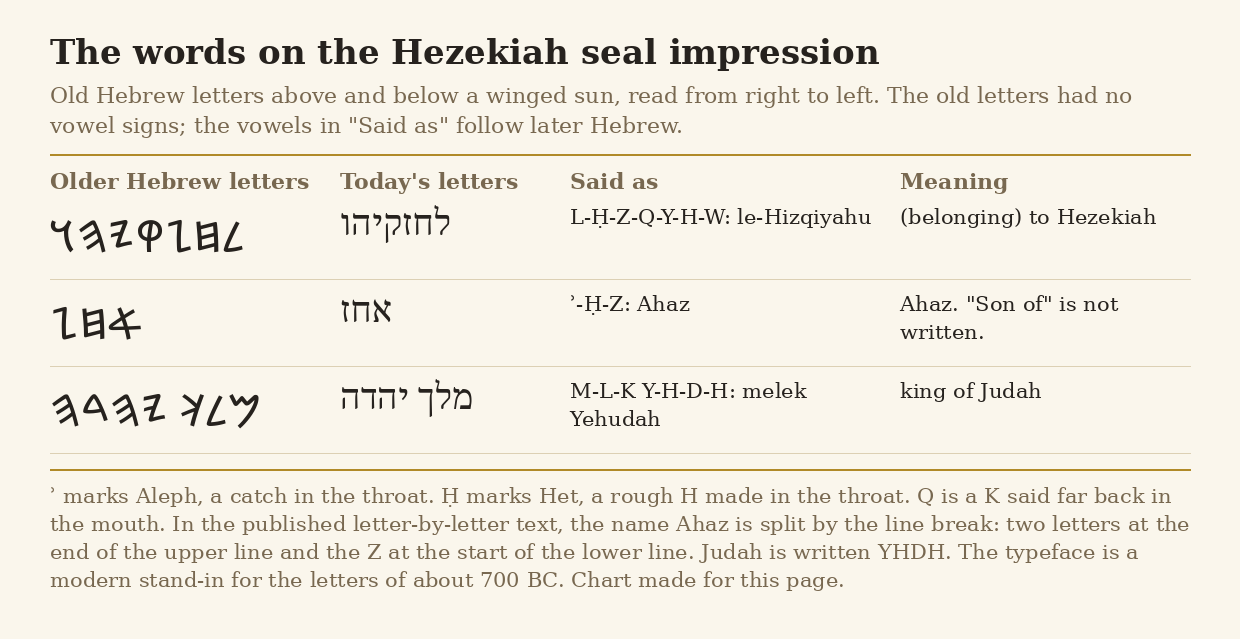
A bulla is a small lump of clay pressed with a seal to close a document or a bag. This one, about 13 by 12 millimetres, carries the mark of King Hezekiah's own seal, and the back shows it once sealed a rolled papyrus document. It was dug up in the 2009 season of Eilat Mazar's Hebrew University excavation in the Ophel, just south of the Temple Mount in Jerusalem, spotted later when the soil was washed through sieves, and announced in December 2015. It names Hezekiah as the son of Ahaz and king of Judah, as the Bible does. The chart below shows the words of the seal impression in the old Hebrew letters.
Chart of the words on the Hezekiah seal impression, "(belonging) to Hezekiah, (son of) Ahaz, king of Judah": the older Hebrew letters (shown in a modern typeface), the same words in today's Hebrew letters, how they sound and what they mean. Chart made for this page, free to reuse.
Where it is today
Jerusalem, with the finds of the Ophel excavations of the Hebrew University of Jerusalem's Institute of Archaeology. I found no record of a permanent public display.
Date
During Hezekiah's reign: Mazar dates it to 727 to 698 BC; other scholars date his reign about 715 to 686 BC.
Why this label: The bulla comes from a recorded, scientific dig, and its writing names Hezekiah, his father Ahaz and the kingdom of Judah, exactly matching the Bible's king.
Good to know
What it says: In the excavators' translation the Hebrew reads "Belonging to Hezekiah [son of] Ahaz king of Judah." The words in brackets, son of, are supplied by the translators; they are not written on the seal. Below the words is a sun with 2 wings turned downward, with an Egyptian life sign (an ankh) beside each wing.
Why it matters: Seal impressions with Hezekiah's name had been sold on the antiquities market since the mid-1990s, but those have no known findspot and cannot be checked in the same way. This is the first seal impression of an Israelite or Judean king found in a scientific dig.
Honest notes: It was found in a refuse dump from Hezekiah's time or shortly after, next to a royal storage building, not where it was first used. Mazar's idea that the winged sun shows a change in Hezekiah's symbols after his illness (2 Kings 20) is her interpretation, not something the seal says.
And he sent Eliakim, which was over the household, and Shebna the scribe, and the elders of the priests, covered with sackcloth, to Isaiah the prophet the son of Amoz.
2 Kings 19:2, KJV
A second small bulla (a lump of clay pressed with a seal) came from the same Ophel dig in Jerusalem, found less than 3 metres from the Hezekiah bulla and published by Eilat Mazar in 2018. Its top part is missing and its left edge is damaged. The middle line clearly reads "Belonging to Yesha'yah[u]", the Hebrew form of the name Isaiah, and the bottom line has the Hebrew letters n-b-y (often written nvy). Mazar suggested that, with a missing last letter, the text read "Belonging to Isaiah the prophet", the prophet who advised Hezekiah.
Where it is today
Jerusalem, with the finds of the Ophel excavations of the Hebrew University of Jerusalem's Institute of Archaeology. I found no record of a permanent public display.
Date
About 750 to 675 BC, judging by the style of its letters.
Why this label: The bulla is genuine, comes from a recorded dig, and the name Isaiah is clear. Whether the damaged last word means "prophet", which would point to the Bible's Isaiah, is debated by experts.
Good to know
Prophet view: Mazar, and later William Schniedewind, read nby as the word for prophet. Schniedewind notes that the name Isaiah was not common at that time, that this spelling of prophet is possible, and that there is no word for son of before nby, which suggests a title rather than a father's name.
Cautious view: Christopher Rollston notes that names like Isaiah were common, and that the last letter is broken off, so the word could end in another letter and be a personal name. There is no word for the before it (Mazar suggested it stood in the broken part), no father's name such as son of Amoz, and the vowel letter needed for prophet is rare in Hebrew writing of that time. He thinks the most likely reading is Isaiah son of Nby, an otherwise unknown man.
Excavator caution: Mazar herself wrote that the missing final letter "requires that we leave open the possibility that it could just be the name Navi."
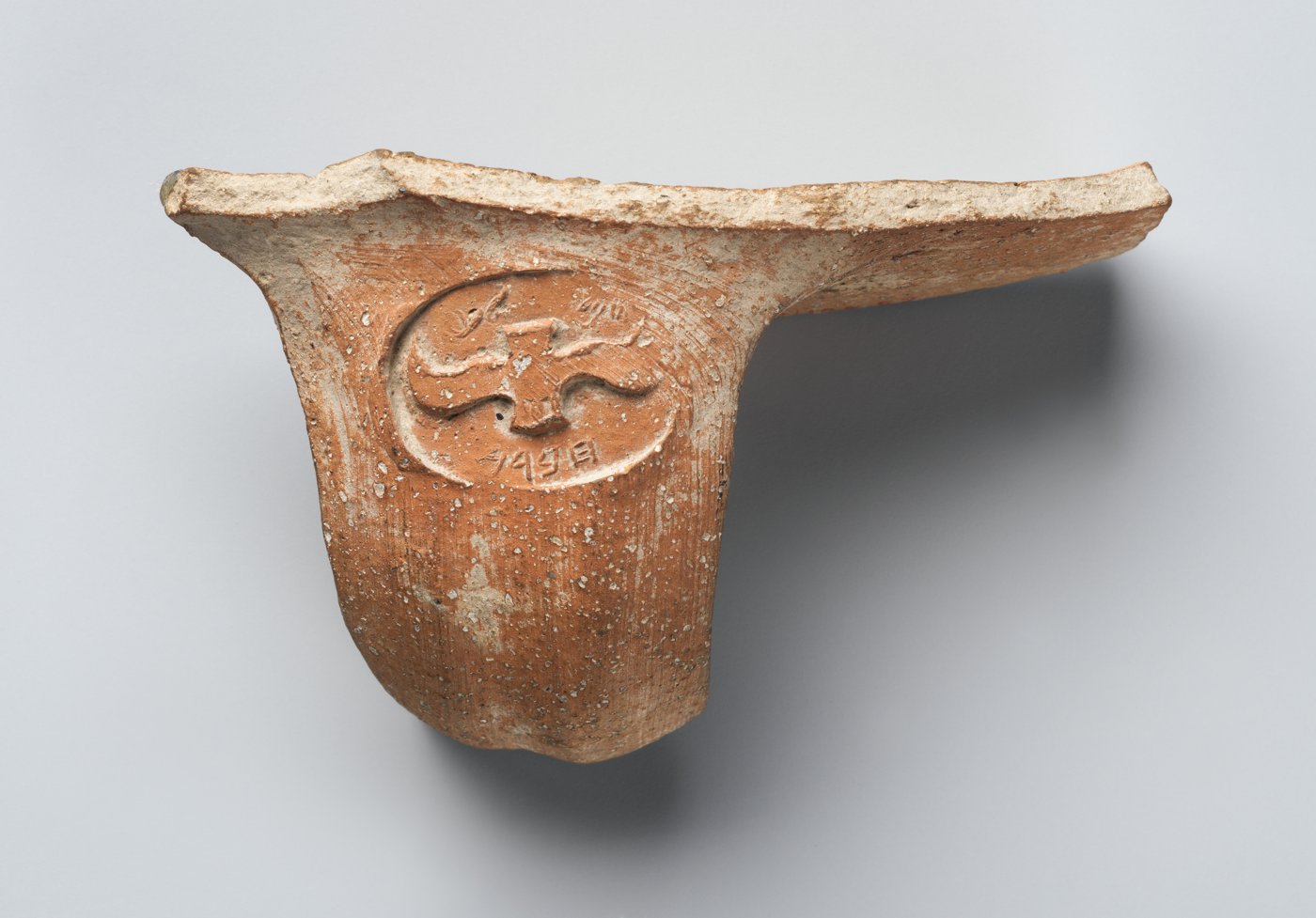
BackgroundJar handle from Lachish stamped with a 2-winged royal emblem with writing above and below. The Metropolitan Museum of Art, Gift of Harris D. and H. Dunscombe Colt, 1934 (34.126.67), Public Domain (The Met Open Access, CC0).
Storehouses also for the increase of corn, and wine, and oil; and stalls for all manner of beasts, and cotes for flocks.
2 Chronicles 32:28, KJV
Large storage jars of the kingdom of Judah were stamped on their handles, before firing, with a royal seal reading lmlk, Hebrew for "belonging to the king". Each stamp also has an emblem (a beetle with 4 wings, or a sun disc with 2 wings) and usually one of four names: Hebron, Ziph, Socoh or mmst (a word whose meaning is still unknown). About 2,000 stamped handles from at least 21 different seals have been published, and Lachish alone produced more than 400. Many scholars link them with the storehouses and war preparations of Hezekiah described in 2 Chronicles 32.
Where it is today
In many museums and excavation stores. Examples are on display at the Israel Museum, Jerusalem, and the Hecht Museum, Haifa. The Metropolitan Museum of Art, New York, holds stamped handles from the 1930s dig at Lachish (for example 34.126.67).
Date
Late 700s BC, with some stamp types possibly continuing into the early 600s BC.
Why this label: The stamps are genuine royal marks of Judah, and many lay in the Lachish layer destroyed in 701 BC, so they belong to Hezekiah's time. But they do not name any king, and whether they were made for his war preparations or for a longer supply or tax system is debated.
Good to know
Hezekiah view: At Lachish, jars with these stamps were found crushed in the city layer destroyed by Sennacherib in 701 BC. David Ussishkin concluded that all the royal jars were made in Hezekiah's reign, shortly before the attack, and many scholars still link them to his preparations.
Longer-use view: Oded Lipschits, Omer Sergi and Ido Koch argue that the system began in the last quarter of the 700s BC, when Judah was paying tribute to Assyria, and carried on after 701 BC with new stamp types found only at sites that were not destroyed. On this view the stamps belong to a royal supply system that ran for many years, not only to war preparation.
Honest notes: What the four names mean is still debated; they may be four places or districts, or something else. Socoh's stamps were mentioned briefly on the Samuel page.
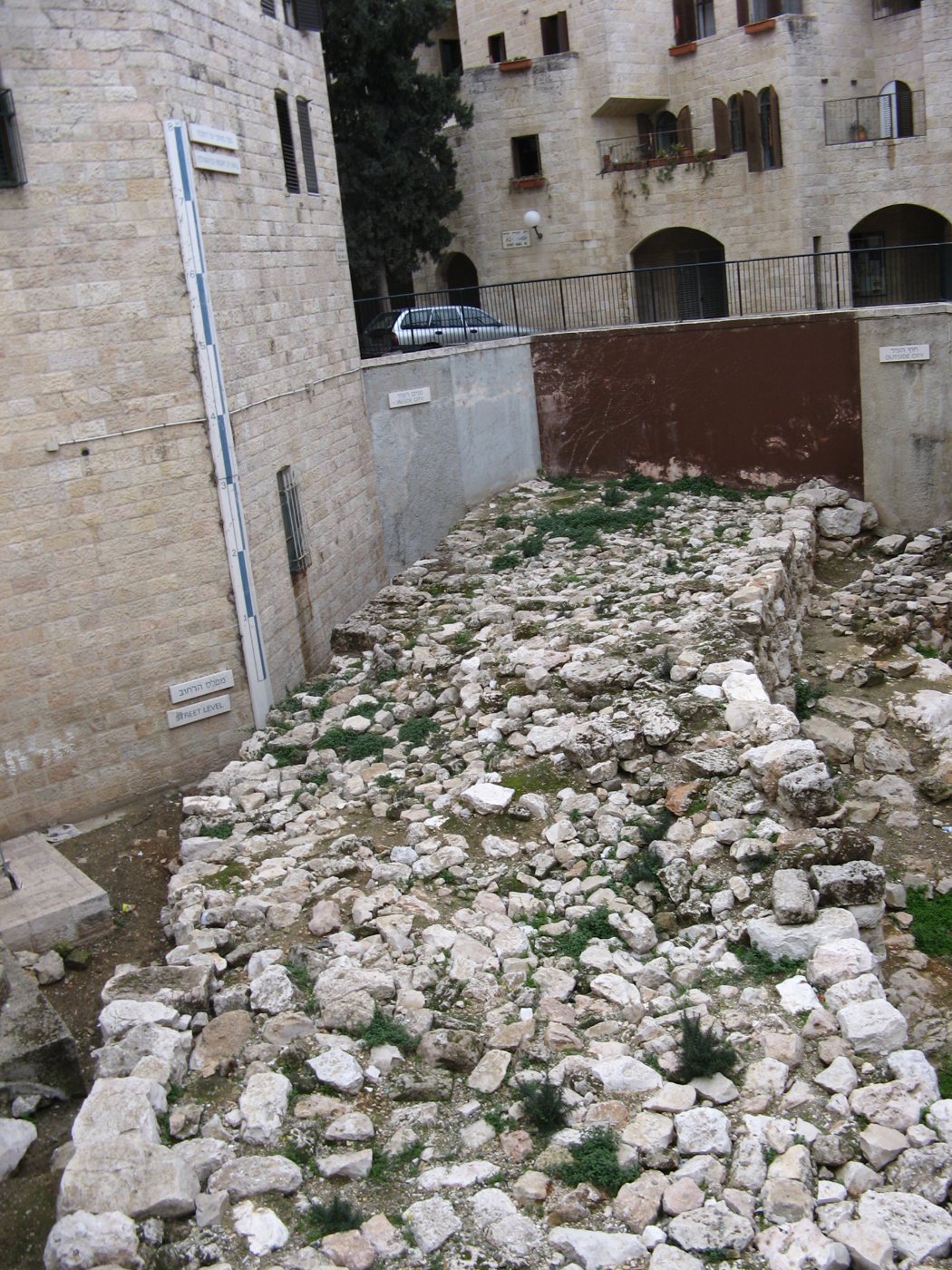
DisputedThe Broad Wall in the Jewish Quarter of Jerusalem. Wikimedia Commons user יעקב, CC BY-SA 3.0.
And ye have numbered the houses of Jerusalem, and the houses have ye broken down to fortify the wall.
Isaiah 22:10, KJV
In 1970, during rebuilding in the Jewish Quarter of Jerusalem's Old City, archaeologist Nahman Avigad uncovered a massive city wall from the time of the kings of Judah. It is about 7 metres thick, and a stretch of about 65 metres survives, in places up to 3.3 metres high. Avigad named it the Broad Wall after "the broad wall" of Nehemiah 3:8. It showed that by the late 700s BC Jerusalem had spread west onto the hill where the Jewish Quarter stands, and that this area was walled in.
Where it is today
Jewish Quarter, Old City of Jerusalem. A section is kept open to view in an outdoor display.
Date
Late 700s BC. Avigad dated it to Hezekiah, shortly before 701 BC; some date it a few decades earlier.
Why this label: The wall is real and clearly belongs to Jerusalem in the time of the kings of Judah. But the name "Broad Wall" was given by the excavator, there is no inscription on it, and both its builder (Hezekiah or an earlier king) and its link to the walls named in 2 Chronicles 32:5, Isaiah 22:10 and Nehemiah 3:8 are debated.
Good to know
Hezekiah view: Avigad dated the wall to Hezekiah and linked it to 2 Chronicles 32:5, which says Hezekiah built up the broken wall "and another wall without". The wall cuts through older buildings, and Avigad saw this as a match for Isaiah 22:10, where houses were broken down to fortify the wall. Many scholars and guidebooks follow him.
Earlier date view: A 2024 radiocarbon study of Jerusalem (Regev and others) found that the city was heavily fortified after the earthquake of the mid-700s BC, and its authors suggest that major walls usually given to Hezekiah were built a few decades earlier, under Uzziah (2 Chronicles 26:9). Some scholars had already given this wall to Uzziah, and a few to Manasseh; others question the new dating.
The houses: It is not clear that the buildings under the wall were still in use when it was built, so the link to Isaiah 22:10 is possible but not proven.
ConfirmedRelief of an Assyrian crown prince, made during Sennacherib's reign (about 704 to 681 BC); which son it shows is not known. The Metropolitan Museum of Art, Gift of John D. Rockefeller Jr., 1932 (32.143.13), Public Domain (The Met Open Access, CC0).
And it came to pass, as he was worshipping in the house of Nisroch his god, that Adrammelech and Sharezer his sons smote him with the sword: and they escaped into the land of Armenia. And Esarhaddon his son reigned in his stead.
2 Kings 19:37, KJV
The Bible says Sennacherib was killed by his sons Adrammelech and Sharezer while worshipping in the house of his god, that they fled to "the land of Armenia" (Ararat in Hebrew, the kingdom of Urartu), and that his son Esarhaddon became king. A Babylonian chronicle (a year-by-year record kept by Babylonian scribes) says that in 681 BC Sennacherib "was killed by his son in a rebellion". Esarhaddon's own inscription tells how his brothers rebelled and fought for the throne, and how he defeated them and took power.
Where it is today
The Babylonian chronicle survives on clay tablets in the British Museum, London (one of its 2 copies was written out in 499 BC). Esarhaddon's account (called Nineveh A) is on several clay prisms, also mainly in the British Museum.
Date
Murder in 681 BC, 20 years after the 701 BC campaign.
Why this label: Babylonian and Assyrian records agree with the Bible that Sennacherib was murdered in a revolt by a son and that his son Esarhaddon then took the throne. The link between the name Adrammelech and the Assyrian prince Urdu-Mullissi is widely accepted, but it rests on a damaged letter and on the likeness of the names.
Good to know
The chronicle: Babylonian Chronicle 1 (A. K. Grayson's translation, as adapted on Livius.org) reads: "On the twentieth day of the month Tebetu, Sennacherib, king of Assyria, was killed by his son in a rebellion." It adds that the rebellion went on until the second day of the month Addaru and that Esarhaddon took the throne on the eighteenth day of that month.
Esarhaddon: His Nineveh A inscription, in Erle Leichty's translation (Royal Inscriptions of the Neo-Assyrian Period, volume 4, text 1), says: "my brothers went out of their minds and did everything that is displeasing to the gods and mankind, and they plotted evil, girt (their) weapons, and in Nineveh, without the gods, they butted each other like kids for (the right to) exercise kingship." "Girt their weapons" means they armed themselves, and "kids" means young goats. He never says outright who killed his father.
The murderer named: In 1980 Simo Parpola argued from a damaged letter that the plotter was Urdu-Mullissi (also written Arda-Mulissu), Sennacherib's older son who had been crown prince until he was passed over for Esarhaddon. Parpola also showed that this name could be the source of the Bible's name Adrammelech. Most scholars accept this.
Other views: Andrew Knapp argued in 2020 that Esarhaddon himself may have been behind the murder; Christopher Jones reviewed the evidence in 2023 and still concluded that Esarhaddon's brothers led the plot. The chronicle speaks of one son, while the Bible names two; Sharezer is sometimes identified with another brother, Nabu-shar-usur, but that is less certain.
Timing: 2 Kings 19:37 does not say how soon after Sennacherib's return the murder happened; the records show it was 20 years later.
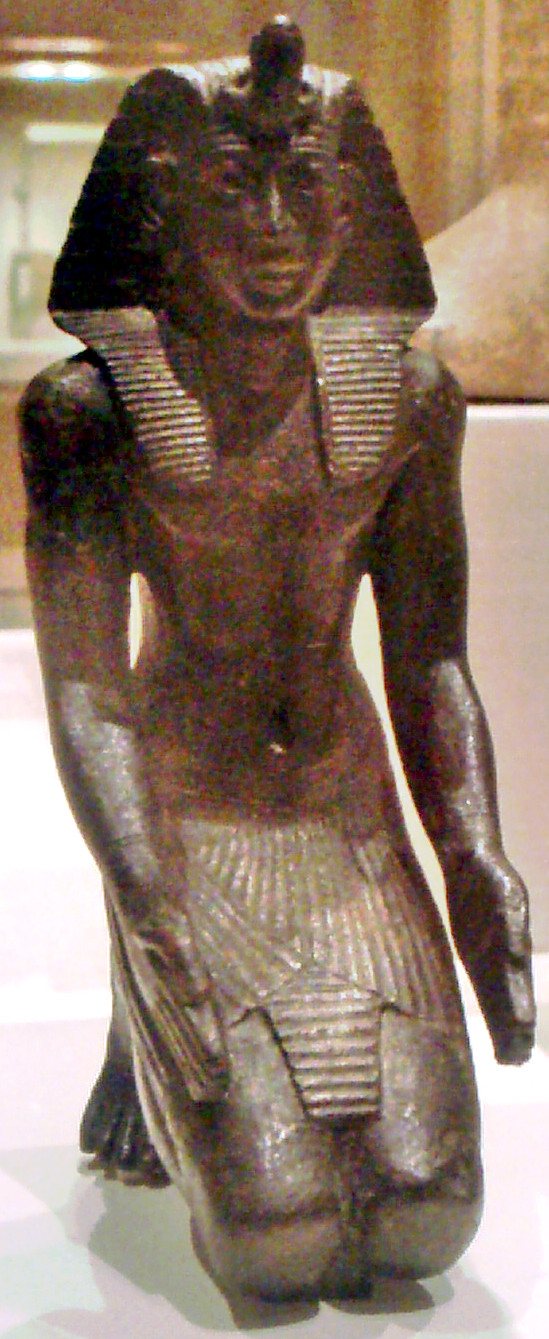
ConfirmedKneeling bronze statuette of King Necho, Brooklyn Museum. Keith Schengili-Roberts, cropped by Marku1988, via Wikimedia Commons, CC BY 2.5.
But he sent ambassadors to him, saying, What have I to do with thee, thou king of Judah? I come not against thee this day, but against the house wherewith I have war: for God commanded me to make haste: forbear thee from meddling with God, who is with me, that he destroy thee not.
2 Chronicles 35:21, KJV
Necho the Second ruled Egypt from about 610 to 595 BC. In 609 BC he marched north toward the Euphrates. The Bible says King Josiah went out against him and was killed at Megiddo. Necho then took Josiah's son Jehoahaz away to Egypt, made his brother Eliakim king under the new name Jehoiakim, and made Judah pay tribute (2 Kings 23:33-35; 2 Chronicles 36:3-4). In 605 BC Necho's army was beaten by Nebuchadnezzar at Carchemish on the Euphrates (Jeremiah 46:2).
Where it is today
Two small kneeling bronze statuettes of a king named Necho are in American museums. One is in the Brooklyn Museum, New York (accession number 71.11, about 14 cm tall). The other is in the Penn Museum, Philadelphia (object number E13004, about 22 cm tall, on a modern base).
Date
Necho the Second reigned about 610 to 595 BC. Josiah died in 609 BC. The Battle of Carchemish was in 605 BC. The Brooklyn Museum dates its statuette to about 610 to 595 BC.
Why this label: Necho the Second is a well-known king of Egypt, and Babylonian chronicles confirm that an Egyptian army went to help the last Assyrian king at Haran in 609 BC and was crushed at Carchemish in 605 BC, which fits the Bible's account (see the translation note below). The meeting at Megiddo, Josiah's death, Necho's message in 2 Chronicles 35:21 and his change of kings in Judah are known only from the Bible.
Good to know
Translation note: The King James Version says Necho went up "against the king of Assyria". The Hebrew word can also mean "to", and the NASB reads "went up to the king of Assyria". The Babylonian chronicle for 609 BC fits the second reading. It says the Assyrian king Ashur-uballit came "with a large army from Egypt", crossed the Euphrates and attacked Haran, but "achieved nothing". The chronicle does not name the pharaoh. Haran itself is covered on the Genesis page.
Two accounts: 2 Kings 23:29-30 says Necho killed Josiah at Megiddo and that his servants carried him "dead from Megiddo" to Jerusalem. 2 Chronicles 35:23-24 says archers wounded him there, his servants brought him to Jerusalem in another chariot, "and he died". Many read these as a short report and a longer report of the same event; others see a small difference over where he died. No Egyptian record of the battle or of Necho's message has been found.
The statuettes: The Brooklyn Museum label says the inscription names a King Necho. It adds that two kings had this name, the little-known Necho the First and the better-known Necho the Second, and that it is not known which one is shown. Even so, the museum dates the statuette to about 610 to 595 BC, the reign of Necho the Second. The Penn Museum describes its statuette as Necho the Second; the king's name is written on the back of his belt.
Herodotus: The Greek historian Herodotus, writing about 430 BC, says Necho stopped digging a canal from the Nile to the Red Sea and then sent Phoenician sailors who went right around Africa and came back in the third year. Herodotus did not believe their report that "they had the sun on their right hand", yet that is what sailors heading west south of the equator would see. Scholars still disagree about whether the voyage really happened.
The Babylonian Chronicle of Carchemish and the capture of Jerusalem in 597 BC
2 Kings 24:10-17 · Jeremiah 46:2 · Jeremiah 52:28
ConfirmedThe Babylonian Chronicle tablet BM 21946 in the British Museum. Osama Shukir Muhammed Amin, via Wikimedia Commons, CC BY-SA 4.0.
And Jehoiachin the king of Judah went out to the king of Babylon, he, and his mother, and his servants, and his princes, and his officers: and the king of Babylon took him in the eighth year of his reign.
2 Kings 24:12, KJV
This small clay tablet is a Babylonian record, year by year, of the first years of Nebuchadnezzar the Second. It is written in cuneiform, the wedge-shaped writing pressed into clay. It describes the Battle of Carchemish in 605 BC, where the Egyptian army was beaten, and the capture of Jerusalem in 597 BC. In the Livius translation (adapted from A. K. Grayson, 1975, and J.-J. Glassner, 2004) it says: "In the seventh year, the month of Kislîmu, the king of Akkad mustered his troops, marched to the Hatti-land, and besieged the city of Judah and on the second day of the month of Addaru he seized the city and captured the king. He appointed there a king of his own choice, received its heavy tribute and sent to Babylon." This matches 2 Kings 24:10-17, where Jehoiachin is taken to Babylon and his uncle Mattaniah is made king and renamed Zedekiah.
Where it is today
British Museum, London, museum number BM 21946. It is often called "ABC 5" (its number in A. K. Grayson's edition) or the "Jerusalem Chronicle".
Date
It records events from 605 BC to about 594 BC. Jerusalem was taken on 2 Addaru (Adar) in Nebuchadnezzar's 7th year, which works out to about 16 March 597 BC.
Why this label: The tablet is a genuine Babylonian record, and its events and dates match the Bible's account of Carchemish and of Jehoiachin's surrender closely. It calls Jerusalem "the city of Judah" and does not name the kings of Judah, but the time and the events make it very likely that these are Jerusalem and King Jehoiachin.
Good to know
Plain words: "The king of Akkad" means Nebuchadnezzar, king of Babylon. "Hatti-land" was the Babylonian name for the lands west of the Euphrates, such as Syria.
Year count: The chronicle puts the capture in Nebuchadnezzar's 7th year, as Jeremiah 52:28 also does, while 2 Kings 24:12 says "the eighth year of his reign". Some explain this by different ways of counting a king's years.
Missing record: The chronicle stops in Nebuchadnezzar's 11th year. No Babylonian chronicle has been found for his later years, so there is no Babylonian written account of the second siege and the burning of Jerusalem in 587 or 586 BC. That date comes from the Bible, and archaeology shows the burning (see the entry on the destruction of Jerusalem).
How it came: The tablet was bought from a dealer in 1896, so the place where it was dug up is not recorded. Donald Wiseman first published it in 1956. Scholars accept it as genuine, as part of a long series of similar Babylonian chronicles.
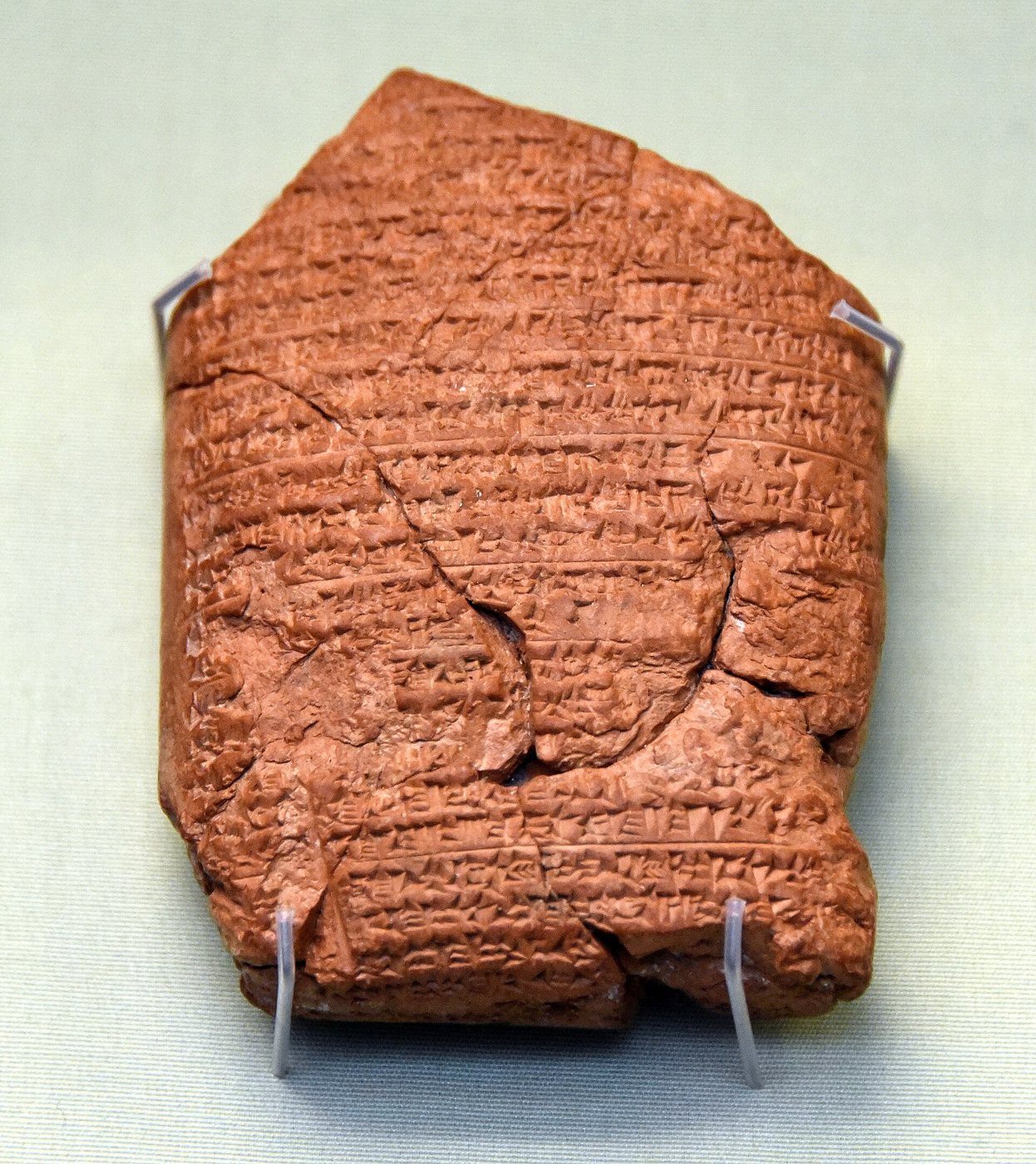
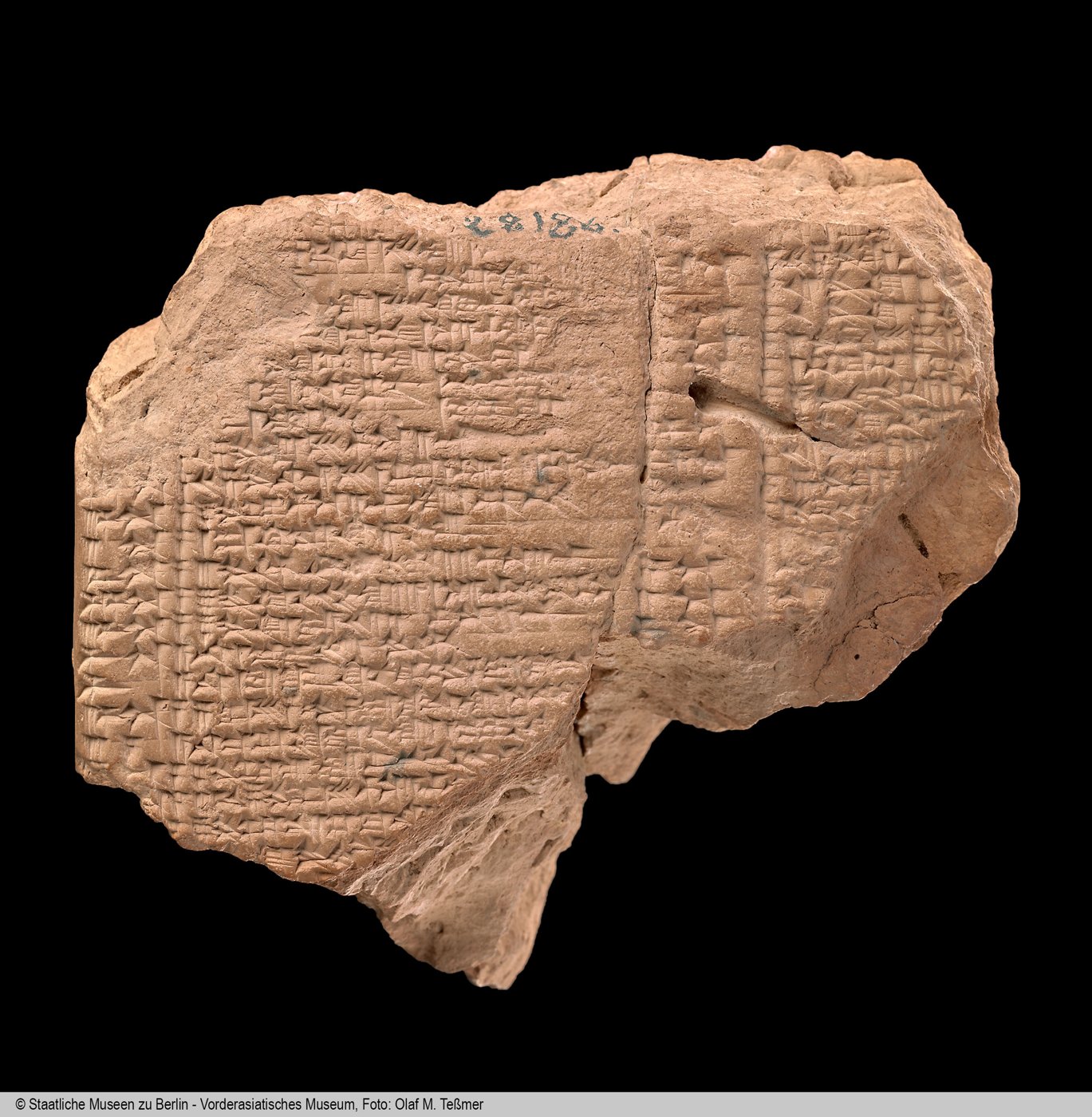
ConfirmedOne side of the clay ration tablet VAT 16378 from Babylon (its dig number, 28186, is written in ink at the top). It is one of the four tablets that mention King Jehoiachin of Judah; this one calls him "son of the king of Judah" and lists rations for "the five sons of the king of Judah". Staatliche Museen zu Berlin, Vorderasiatisches Museum / Olaf M. Teßmer, CC BY-SA 4.0.
And his allowance was a continual allowance given him of the king, a daily rate for every day, all the days of his life.
2 Kings 25:30, KJV
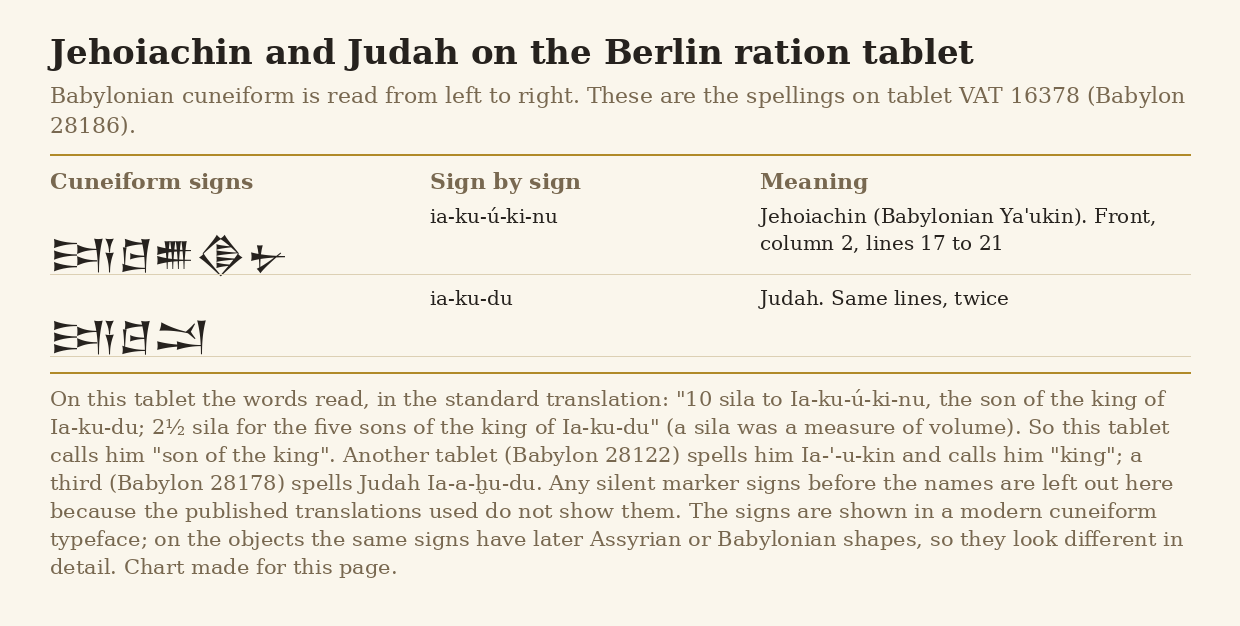
Between 1899 and 1917 a German dig at Babylon led by Robert Koldewey found nearly 300 clay tablets in a building of vaulted rooms by the royal palace, near the Ishtar Gate. The tablets are written in cuneiform, the wedge-shaped writing pressed into clay. They list rations of oil and food paid from the king's stores to foreign captives and workers. Four of them, published by Ernst Weidner in 1939, name the exiled king of Judah. The spelling differs from tablet to tablet (for example Ia-'-u-kin and Ia-ku-u-ki-nu), and one tablet calls him "king" while another calls him "son of the king of Judah". These are Babylonian ways of writing "Jehoiachin, king of Judah". This fits 2 Kings 24:15, where Jehoiachin is taken to Babylon, and 2 Kings 25:27-30, where the king of Babylon gives him a daily allowance. The chart below shows how the Babylonian scribe spelled Jehoiachin's name and Judah.
Chart of Jehoiachin's name and Judah as spelled on the Berlin ration tablet VAT 16378 (Babylon 28186): the cuneiform signs (in a modern typeface), how each is read and what they mean. The footer gives the other spellings on the other tablets. Chart made for this page, free to reuse.
Where it is today
Vorderasiatisches Museum (Museum of the Ancient Near East), Staatliche Museen zu Berlin, Germany. The tablet in the photo is museum number VAT 16378 (9.8 cm high). The dig number written on it in ink appears to read 28186, the tablet that speaks of the five sons of the king of Judah. The texts are also known by their dig numbers, such as Babylon 28122, 28178 and 28186. Check what is on display before visiting.
Date
The ration tablets date from the 10th to the 35th year of Nebuchadnezzar the Second (about 595 to 570 BC). The only one of the four Jehoiachin tablets with its date preserved is from his 13th year, about 592 BC.
Why this label: The tablets were found in a recorded dig at Babylon. They name the king of Judah and the sons of the king of Judah at the right time and place, and scholars broadly agree that this is the Jehoiachin of the Bible.
Good to know
What they say: In the standard English translation (Pritchard, Ancient Near Eastern Texts, page 308), as listed by Lawrence Mykytiuk, one tablet (Babylon 28122) calls Jehoiachin "king". A broken one (Babylon 28178) speaks of "[. . . so]ns of the king of Judah" and of "Judahites". A third (Babylon 28186) speaks of "the five sons of the king of Judah". The square brackets mark broken places where letters are missing.
Prison or freedom: 2 Kings 25:27 says Jehoiachin was brought "out of prison" in the 37th year of his exile, about 561 BC. These tablets are about 30 years earlier and show him receiving fairly large rations. Some scholars think this means he was not kept in a cell the whole time, at least in the early years. The Bible does not say when his imprisonment began.
Names: The tablets spell his name the Babylonian way. The Bible also calls the same king Jeconiah and Coniah.
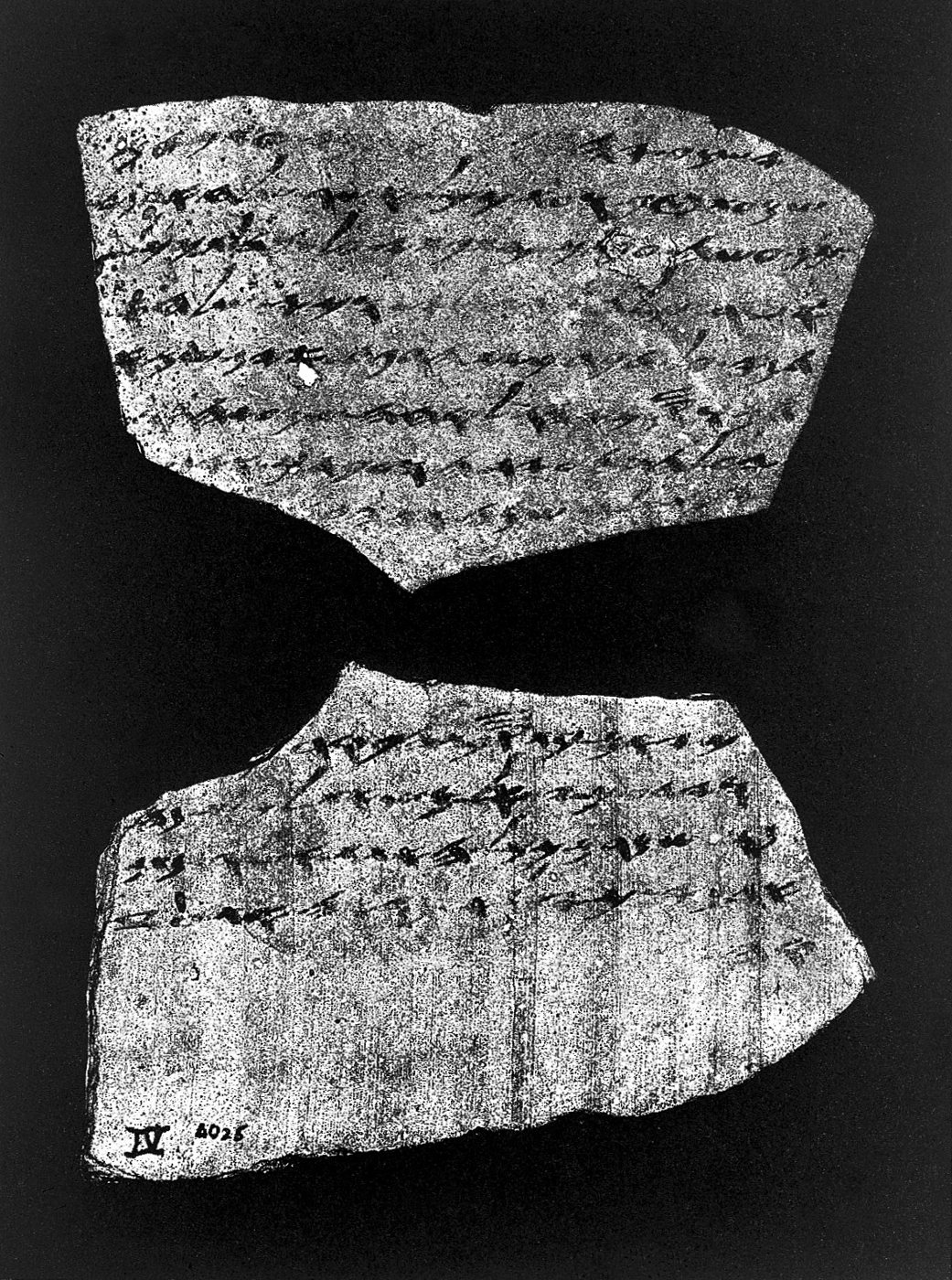
ConfirmedLachish Letter 4, both sides, from a photograph of the 1930s dig finds kept by the Wellcome Collection. Wellcome Collection, via Wikimedia Commons, CC BY 4.0.
When the king of Babylon's army fought against Jerusalem, and against all the cities of Judah that were left, against Lachish, and against Azekah: for these defenced cities remained of the cities of Judah.
Jeremiah 34:7, KJV
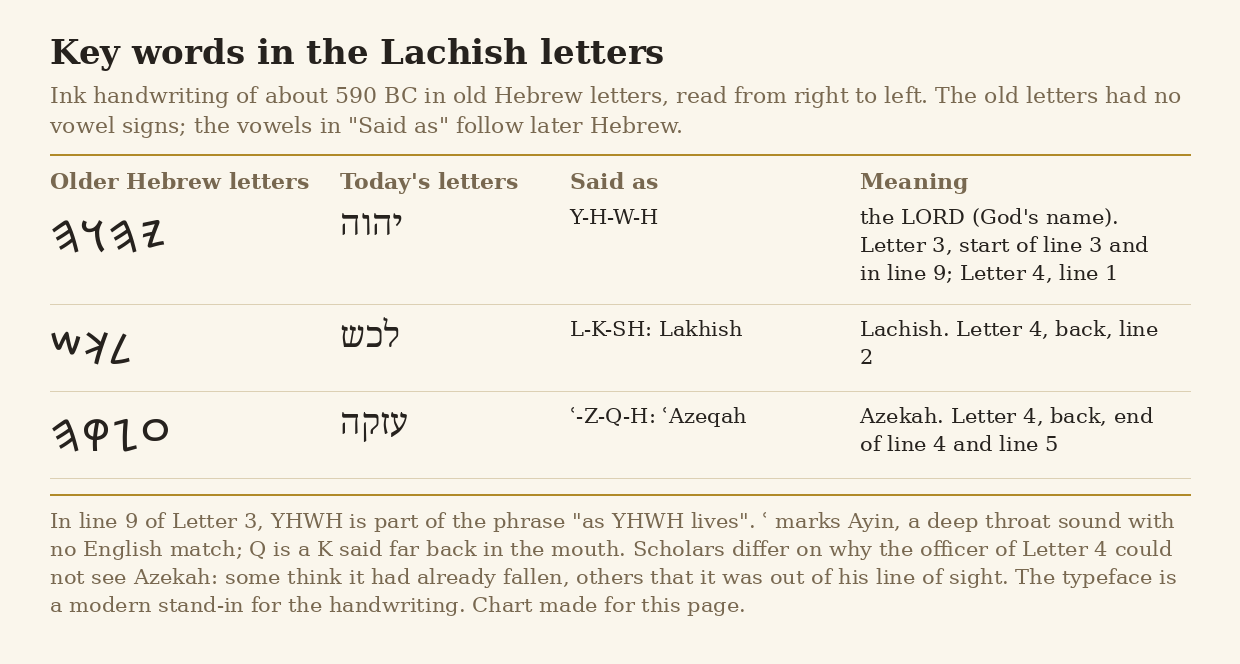
The Lachish letters are ostraca, which are broken pieces of pottery used as writing paper, with words written in ink. They were found at Tel Lachish, southwest of Jerusalem (a tell is a mound built up from the ruins of an ancient town). James Leslie Starkey's team found most of them in 1935, in the burnt ash of a guardroom in the city gate, and a few more in 1938. They are short Hebrew letters and lists written by Judean officers in the last years before the Babylonian army took Lachish. Letter 4 ends, in Anat Zammit's translation (Oxford, 2016): "And he will know that the (fire/smoke-)signals of Lachish we are watching, in accordance to all the signs which my lord has given, for we cannot see Azekah." The chart below shows God's name, Lachish and Azekah as the officers wrote them.
Chart of three key words in the Lachish letters, YHWH, Lachish and Azekah: the older Hebrew letters (shown in a modern typeface), the same words in today's Hebrew letters, how they sound and what they mean, and where each word is in Letters 3 and 4. The footer notes the debate over why Azekah could not be seen. Chart made for this page, free to reuse.
Where it is today
Most are in the British Museum, London (museum numbers in the range BM 125701 to 125715). Letters 3, 4 and 6 are in the Israel Museum, Jerusalem; Letter 4 is IAA 1938-128. The site, Tel Lachish, is in the low hills of southern Israel.
Date
Shortly before Lachish fell to Nebuchadnezzar's army, about 588 to 586 BC.
Why this label: The letters come from a recorded dig, from the burnt layer of the city's last Judean phase. They speak of Lachish and Azekah, the two towns Jeremiah 34:7 names as the last fortified cities left besides Jerusalem. What is debated is the exact meaning of some lines, not whether the letters are genuine.
Good to know
Close match: Jeremiah 34:7 says that when Babylon's army attacked, Lachish and Azekah were the last fortified cities of Judah still holding out. Letter 4 shows an officer watching for the signals of Lachish because he could not see Azekah. Jeremiah 6:1 also speaks of setting up "a sign of fire" to warn of the enemy from the north.
Two readings: Some scholars think the officer could not see Azekah because it had already fallen and its signal had gone out. Others think he simply had no clear line of sight to Azekah from where he was. The letter does not say which, so the link with Jeremiah 34:7 is a close match of time and places, not proof of a single moment.
Other letters: Letter 3, in Anat Zammit's translation, says "The commander of the army Konya[hu], son of Elnatan, has come down to go to Egypt" (the square brackets mark letters that are missing and filled in; Konyahu is the Hebrew form of Coniah), and mentions a warning from an unnamed prophet. Some link this to Elnathan's trip to Egypt to bring back the prophet Urijah (Jeremiah 26:20-23), but that happened under King Jehoiakim, who died about ten years before these letters were written, so the link is uncertain. Not all of the ostraca are letters: some are lists of names, and several are too faded to read in full.
BackgroundArad ostracon 18, the letter that mentions the house of YHWH. Wikimedia Commons user פעמי-עליון, CC BY-SA 4.0.
Remember, O LORD, the children of Edom in the day of Jerusalem; who said, Rase it, rase it, even to the foundation thereof.
Psalm 137:7, KJV
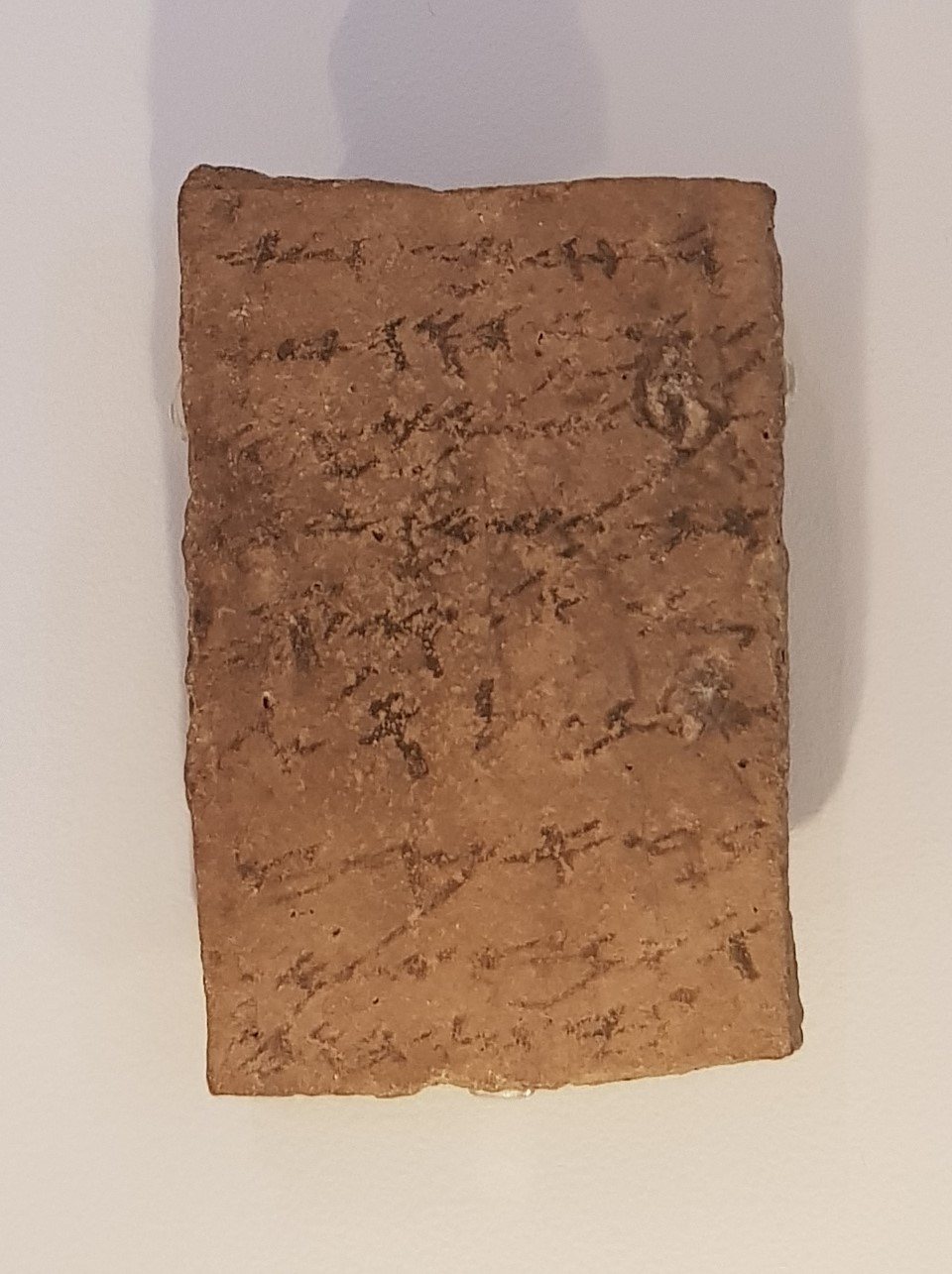
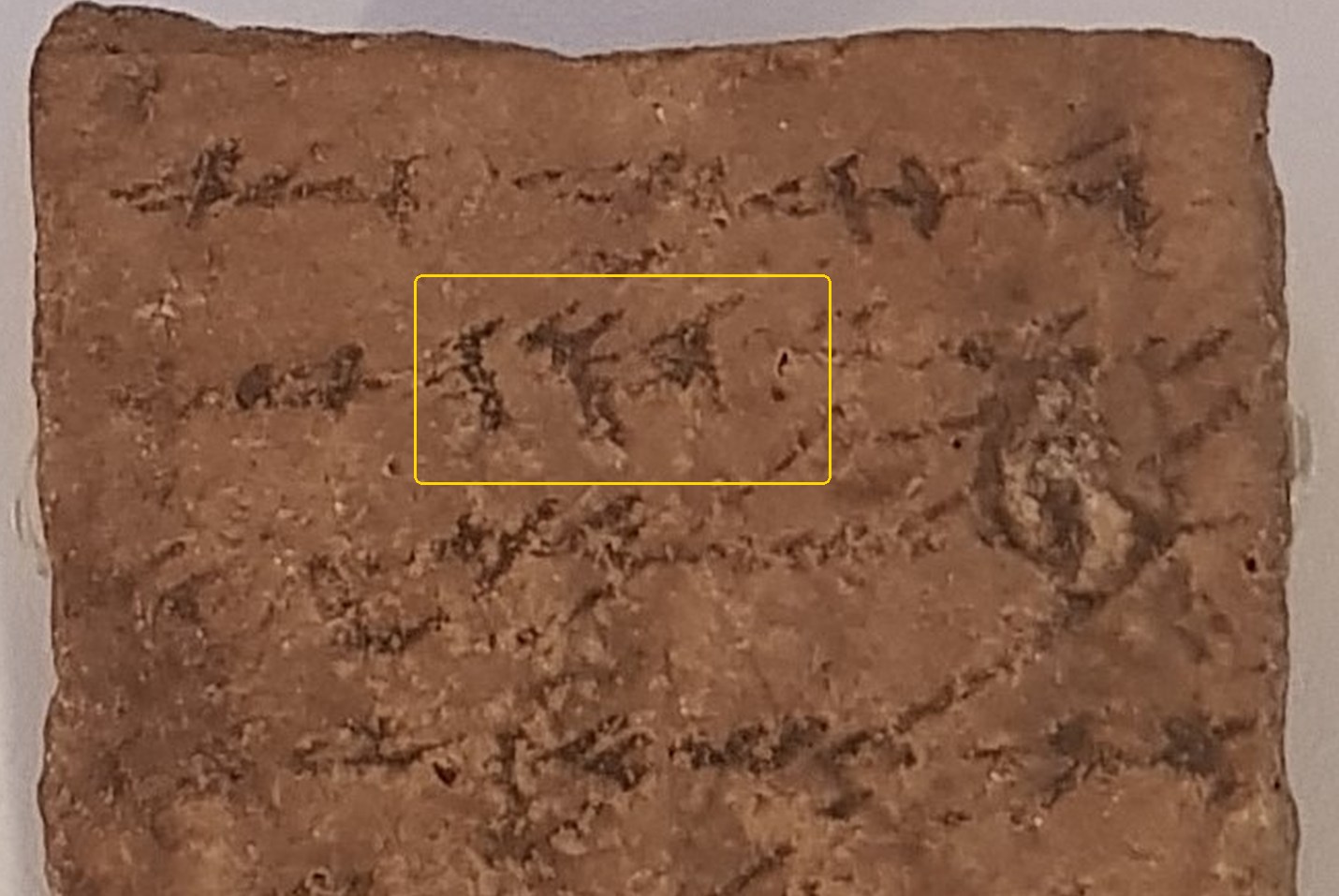
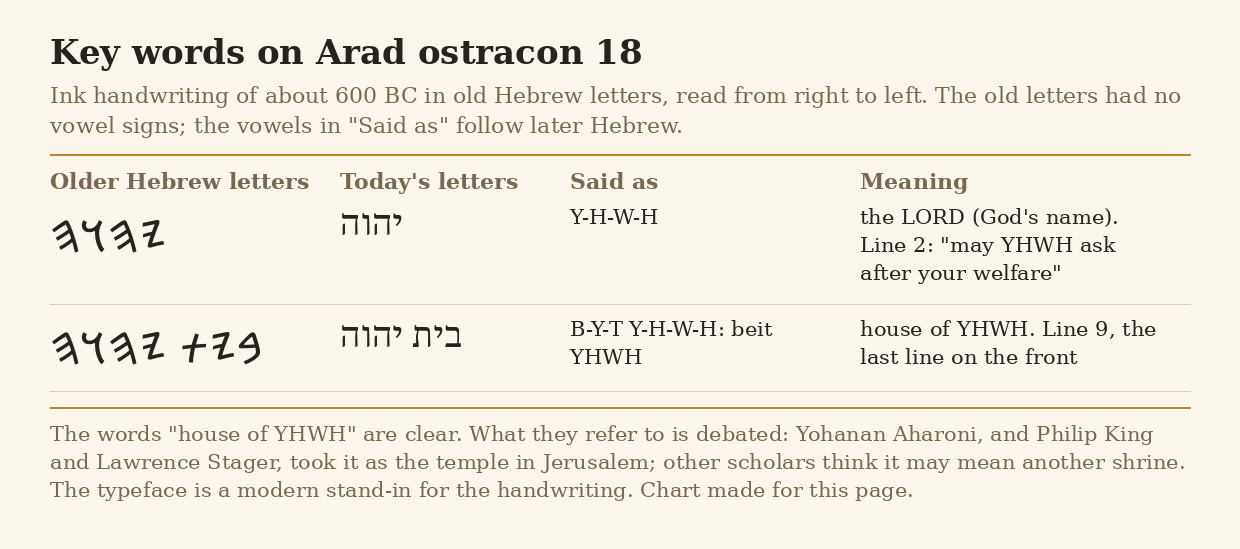
Tel Arad is a mound in the Negev desert in the south of Judah, with the ruins of a Judean fort. In the 1960s Yohanan Aharoni's dig found more than 100 Hebrew ostraca there (pieces of pottery with writing in ink), many of them from about 600 BC. Many are letters to a man named Eliashib, who seems to have been in charge of supplies at the fort. They order wine, flour and oil for soldiers, including the "Kittim" (probably Greek hired soldiers), and one (number 24) warns of an attack "lest Edom should come there". Ostracon 18 ends with a line about the "house of YHWH", which is the Hebrew phrase the Bible uses for the temple ("the house of the LORD"). The picture below shows God's name written in ink on the ostracon, and the chart shows the words "house of YHWH".
Photo of the original Arad ostracon 18 (a piece of pottery with ink writing), the top part of the front. The yellow box marks God's name, YHWH, in line 2, in the words "may YHWH ask after your welfare". The ink is faint: the He, Waw and He are clear, but the first letter, Yod, at the right end of the box, is very faint. The words "house of YHWH" are in line 9, at the bottom of the front (not shown in this close-up); there the ink is too faint in this photo to mark each letter with confidence. The box was added for this page. פעמי-עליון, via Wikimedia Commons, CC BY-SA 4.0.Chart of the key words on Arad ostracon 18, YHWH and "house of YHWH": the older Hebrew letters (shown in a modern typeface), the same words in today's Hebrew letters, how they sound and what they mean. The footer notes the debate over which house is meant. Chart made for this page, free to reuse.
Where it is today
Israel Museum, Jerusalem. The fort itself is in Tel Arad National Park, near the modern town of Arad in southern Israel.
Date
About 600 BC, in the last years of the kingdom of Judah. The letters were found under a burnt layer linked with the end of the fort.
Why this label: The letters come from a recorded dig and are genuine Judean army letters from the last years of the kingdom. They show the world the Bible describes, such as the threat from Edom, but they do not name a Bible person or event, and what the "house of YHWH" in ostracon 18 refers to is debated.
Good to know
What it says: Ostracon 18 asks Eliashib to give supplies to a man named Shemariah and to "the Kerosite". It then says the matter he asked about is fine, and ends, in Aharoni's 1966 translation, "He dwells in the House of Yahweh." The letter does not say who "he" is or why he is there.
Which house: Aharoni, and later Philip King and Lawrence Stager, held that this means the temple in Jerusalem, because the small shrine at Arad was no longer in use by then. Other scholars doubt this and think it could mean another shrine. One summary even reads the line as a report that the temple was still standing safely. The words themselves are clear; their meaning is not.
Kerosite: "The Kerosite" may belong to the family of Keros. Ezra 2:43-44 lists "the children of Keros" among the temple servants (the Nethinims) who came back from exile. This link is possible but not certain.
Arad shrine: The small temple found at Arad is covered on the Leviticus page.
Edom: Arad 24 fits the Bible's picture of Edom as an enemy of Judah at its fall (Psalm 137:7; Obadiah 1:10-14).
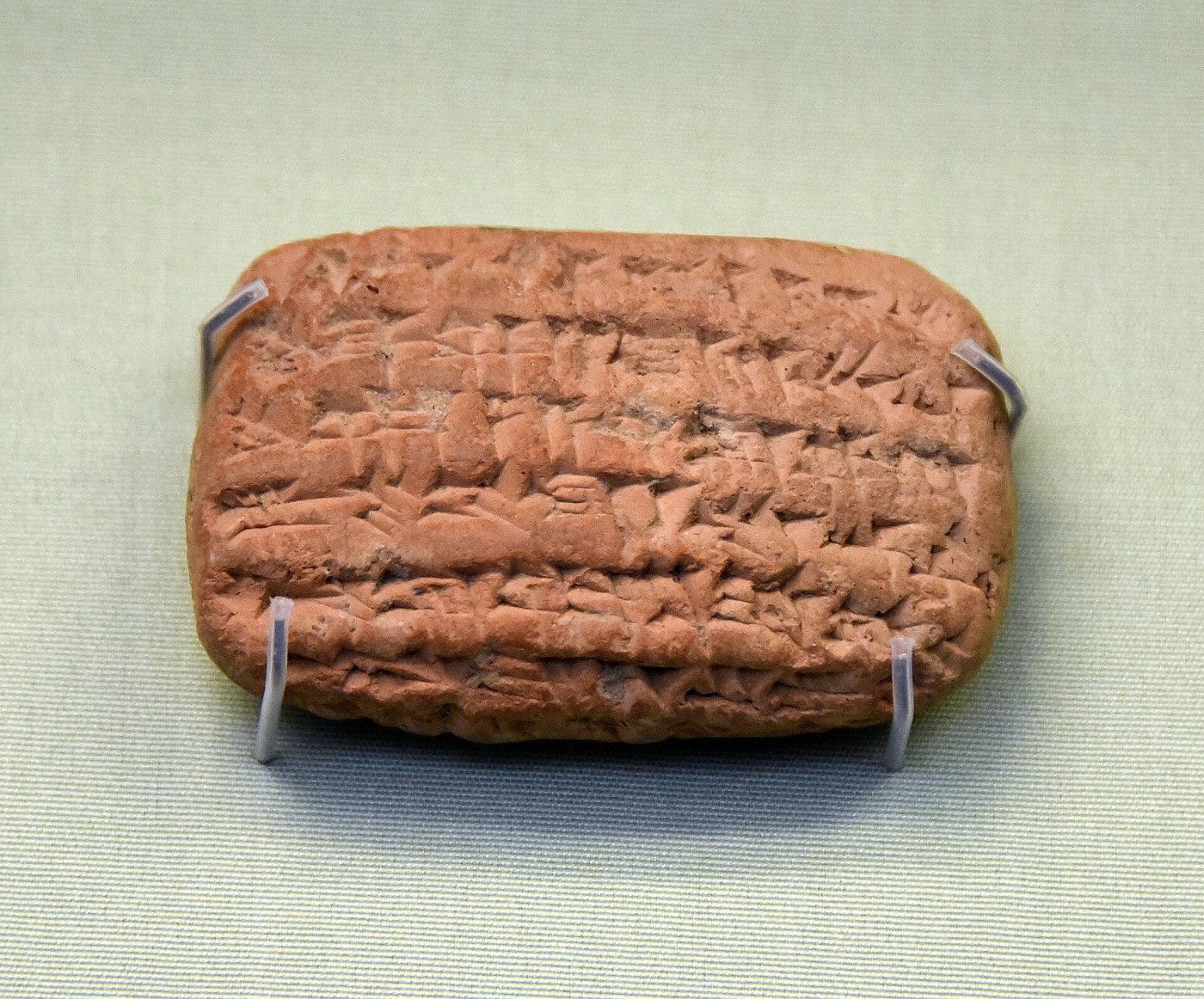
ConfirmedThe Nebo-Sarsekim tablet (BM 114789) in the British Museum. Osama Shukir Muhammed Amin, via Wikimedia Commons, CC BY-SA 4.0.
And all the princes of the king of Babylon came in, and sat in the middle gate, even Nergalsharezer, Samgarnebo, Sarsechim, Rabsaris, Nergalsharezer, Rabmag, with all the residue of the princes of the king of Babylon.
Jeremiah 39:3, KJV
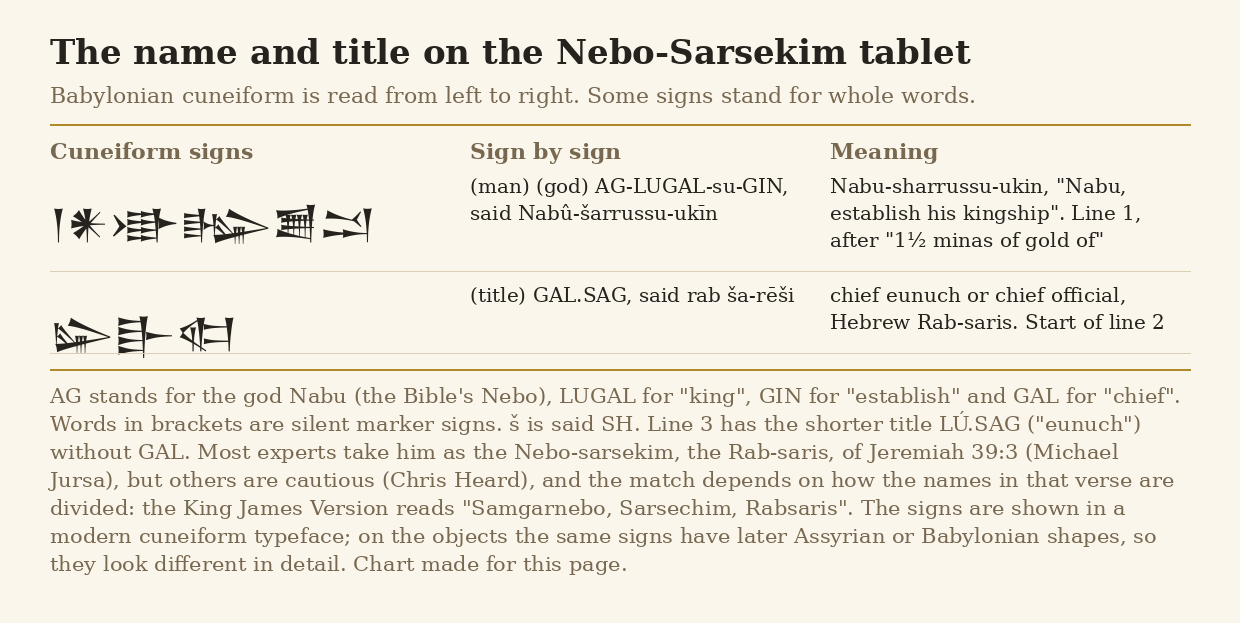
This is a small clay tablet, about 5.5 cm wide, written in cuneiform, the wedge-shaped Babylonian writing. It is a receipt. In the translation based on Michael Jursa (2008) and Henry Stadhouders (2009), it records "1.5 minas of gold of Nabu-sharrussu-ukin, the chief eunuch" (a mina was a weight of about half a kilogram), sent to the great temple Esagila in Babylon, dated "Month 11, day 18, year 10 [of] Nebuchadnezzar, king of Babylon". In 2007 Jursa, of the University of Vienna, pointed out that this name and title match the officer called "Rab-saris" in Jeremiah 39:3, one of the Babylonian officials who sat in the middle gate of Jerusalem when the city fell. "Rab-saris" is the Hebrew form of the Babylonian title rab sha-reshi, "chief eunuch" or "chief official". The chart below shows the official's name and title as the scribe wrote them.
Chart of the name Nabu-sharrussu-ukin and the title "chief eunuch" on the Nebo-Sarsekim tablet: the cuneiform signs (in a modern typeface), how they are read, what they mean and where they are. The footer notes the debate over whether he is the man in Jeremiah 39:3. Chart made for this page, free to reuse.
Where it is today
British Museum, London, museum number BM 114789 (registration number 1920,1213.81). It comes from the temple archive of Sippar, south of modern Baghdad in Iraq.
Date
The 10th year of Nebuchadnezzar the Second, about 595 or 594 BC. That is about 8 or 9 years before the fall of Jerusalem described in Jeremiah 39.
Why this label: The tablet is genuine and names a chief official of Nebuchadnezzar with the same name and title as the man in Jeremiah 39:3, only about 8 or 9 years earlier. Most experts accept that he is the same man, but this cannot be proven, and it depends on how the run of Babylonian names in Jeremiah 39:3 is divided.
Good to know
Word division: The Hebrew of Jeremiah 39:3 is a string of Babylonian names and titles, and translators divide it in different ways. The King James Version reads "Samgarnebo, Sarsechim, Rabsaris", taking Sarsechim as a separate name. Many modern versions read the words as "Nergal-sar-ezer of Samgar, Nebu-sar-sekim the Rab-saris" (English Standard Version), giving one man the name Nebo-sarsekim. The New American Standard Bible reads "Samgar-nebu, Sar-sekim the Rab-saris", which also makes Rab-saris the title of the man named Sarsekim. The tablet supports reading Rab-saris as his title, and fits the English Standard Version's division of the names best.
Same man: Jursa argued that the rare name, the high rank and the short gap in time make it almost certain that this is the same person, and the researcher Lawrence Mykytiuk agrees. Others, such as the Bible scholar Chris Heard, warned that more than one official might have had this name. Jeremiah 39:13, describing events a little later, gives the title Rabsaris to a man named Nebushasban, so the title alone does not identify a man.
What it shows: The tablet shows that a high Babylonian official of this name and title was real and serving Nebuchadnezzar. It says nothing about Jerusalem or Jeremiah.
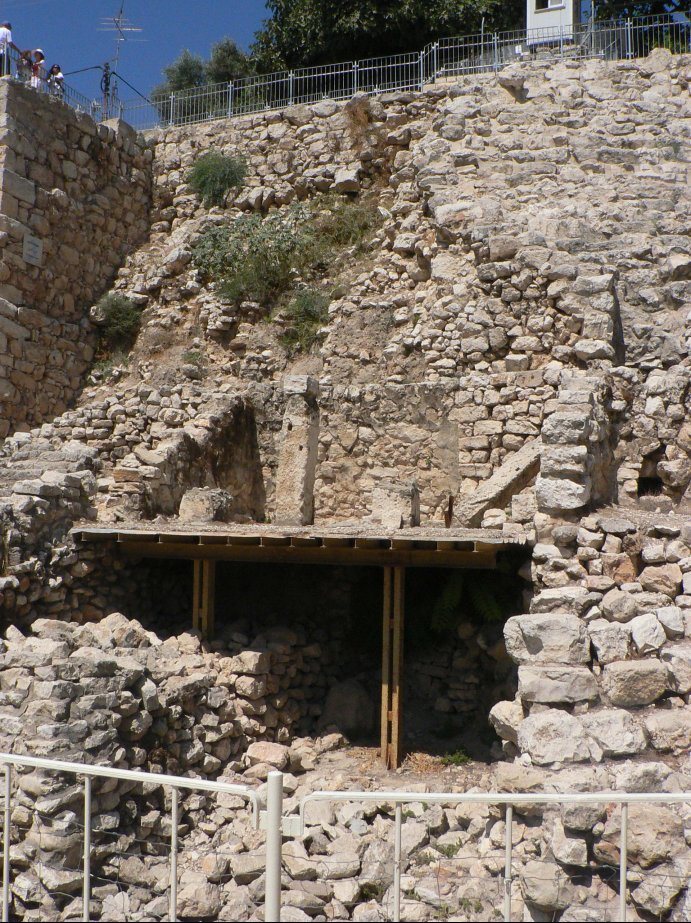
ConfirmedThe stepped stone structure in the City of David, with the House of Ahiel built on top of it. MathKnight at Hebrew Wikipedia, via Wikimedia Commons, CC BY-SA 2.5.
And he burnt the house of the LORD, and the king's house, and all the houses of Jerusalem, and every great man's house burnt he with fire.
2 Kings 25:9, KJV
The Bible says that Nebuzaradan, the Babylonian captain of the guard, burned the temple, the king's house and "every great man's house" in Jerusalem, and broke down its walls. Digs in several parts of the ancient city have found a thick burnt layer from the very end of the kingdom of Judah. In the City of David (the oldest part of Jerusalem), Yigal Shiloh's dig in the 1970s and 1980s found the "Burnt Room", named for the thick layer of charred debris on its floor, and the "House of Ahiel", a typical Judean house named after a name written on a piece of pottery found in it. Nearby, the floor of the "Bullae House" was covered by a thick burnt layer holding pottery, arrowheads and about 50 clay seal impressions, which the fire had baked hard. Newer digs on Mount Zion (2019) and in the Givati Parking Lot (reported in 2019 and 2020) found more of the same burnt layer.
Where it is today
Jerusalem. The House of Ahiel and other remains on the eastern slope can be seen at the City of David site, just south of the Old City walls. The Givati Parking Lot dig is on the western slope of the City of David. The Mount Zion dig is just outside the southern wall of the Old City. Access to dig areas changes, so check before planning a visit.
Date
586 BC (some scholars prefer 587 BC). The Bible dates it to the fifth month of Nebuchadnezzar's 19th year: 2 Kings 25:8 gives the seventh day of the month, and Jeremiah 52:12 the tenth day.
Why this label: Burnt layers with pottery from the last years of the kingdom of Judah have been found across ancient Jerusalem, and no other major destruction is known there for centuries before or after. No inscription found on site says who burned the city, but scholars broadly agree that these layers come from the Babylonian conquest that the Bible describes.
Good to know
Mount Zion: In 2019 a University of North Carolina at Charlotte team led by Shimon Gibson, Rafi Lewis and James Tabor reported a layer of ash with arrowheads of the "Scythian" type used in that period, broken pottery, lamps, and a gold and silver earring or tassel. Gibson said that ash alone can mean many things, but "Nobody abandons golden jewelry and nobody has arrowheads in their domestic refuse." He linked the find to the Babylonian conquest because it is "the only major destruction we have in Jerusalem for this period".
Givati Parking Lot: Yuval Gadot of Tel Aviv University and Yiftah Shalev of the Israel Antiquities Authority found a large stone public or elite building with burnt wooden beams and charred pottery. A 2020 study in the journal PLOS ONE measured the magnetism recorded in the burnt pieces of its fallen upper floor. It showed that the floor cooled after it had fallen, which ties the collapse to the fire. The pottery in the building matches the 586 BC destruction layers found elsewhere.
Date debate: The exact year comes from the Bible's dates, matched with the Babylonian chronicle for 597 BC. No Babylonian record of the second siege has been found. The burnt layer shows a violent end to the city at about this time. The stepped stone structure under the House of Ahiel is covered on the 1 and 2 Samuel page.
Then Shephatiah the son of Mattan, and Gedaliah the son of Pashur, and Jucal the son of Shelemiah, and Pashur the son of Malchiah, heard the words that Jeremiah had spoken unto all the people, saying,
Jeremiah 38:1, KJV
A bulla (plural bullae) is a small lump of clay pressed with a seal to close a rolled-up document. Three bullae found in recorded digs in the City of David in Jerusalem carry names known from the Book of Jeremiah. In 1982 Yigal Shiloh's dig found one reading "Belonging to Gemaryahu son of Shaphan" in the burnt "Bullae House", with about 50 others; Jeremiah 36:10 names "Gemariah the son of Shaphan the scribe". In 2005 Eilat Mazar's dig found one with the name "Yehukal son of Shelemyahu son of Shovi" (the last name is also read Shebi). A few metres away her team found a second one, announced in 2008, with the name "Gedalyahu son of Pashhur". Jeremiah 38:1 names "Gedaliah the son of Pashur, and Jucal the son of Shelemiah" side by side.
Where it is today
Israel Antiquities Authority collections, Jerusalem. They were found in the City of David, just south of the Old City walls.
Date
Late 600s to early 500s BC, before the Babylonian destruction of 586 BC, judged by the shape of the letters and by the layers where they were found.
Why this label: The seal impressions are genuine finds from recorded digs, with clearly readable Hebrew names. The names and the fathers' names match men in Jeremiah, at the right time and place, and many experts accept that they are the same men. But the impressions carry no titles, so this is not certain.
Good to know
Same men: Lawrence Mykytiuk, who studies how to identify Bible people in inscriptions, counts Gemariah, Jehucal and Gedaliah, and their fathers Shaphan, Shelemiah and Pashhur, as reliable identifications. Yair Shoham, who published the City of David bullae, warned that "the names found on the bullae were popular in ancient times and it is equally possible that there is no connection" with the men in the Bible.
Spelling: The seals use the Hebrew forms Gemaryahu, Yehukal and Gedalyahu, with the fathers Shaphan, Shelemyahu and Pashhur. The King James Version uses the English forms Gemariah, Jehucal or Jucal, Gedaliah, Shelemiah and Pashur. The shorter ending "-iah" for "-yahu" is normal in the Bible.
Not market bullae: These three come from controlled digs. They should not be confused with the well-known bullae of Baruch son of Neriah and of Jerahmeel, which were bought on the antiquities market with no known findspot and whose authenticity has been questioned.
Building debate: Mazar believed the building where the Jehucal bulla lay was King David's palace. That is debated, but the debate is about the date of the building, not about the bullae, which belong to the last years of the kingdom.
 LearnAboutHim