 LearnAboutHim

The reading: Genesis 1:1 to 10
The King James Version text of the verses read from orbit around the Moon on 24 December 1968. The notes below the verses say where the spoken words differ.
Read by Bill Anders (verses 1 to 4)
1 In the beginning God created the heaven and the earth.
2 And the earth was without form, and void; and darkness was upon the face of the deep. And the Spirit of God moved upon the face of the waters.
3 And God said, Let there be light: and there was light.
4 And God saw the light, that it was good: and God divided the light from the darkness.
Read by Jim Lovell (verses 5 to 8)
5 And God called the light Day, and the darkness he called Night. And the evening and the morning were the first day.
6 And God said, Let there be a firmament in the midst of the waters, and let it divide the waters from the waters.
7 And God made the firmament, and divided the waters which were under the firmament from the waters which were above the firmament: and it was so.
8 And God called the firmament Heaven. And the evening and the morning were the second day.
Read by Frank Borman (verses 9 and 10)
9 And God said, Let the waters under the heaven be gathered together unto one place, and let the dry land appear: and it was so.
10 And God called the dry land Earth; and the gathering together of the waters called he Seas: and God saw that it was good.
Borman seems to have said "heavens" where the King James Version has "heaven". Both transcripts we checked have "heavens". The Flight Journal has "Let the waters under the Heavens be gathered together into one place." NASA's Space Science Data Coordinated Archive page has "Let the waters under the heavens be gathered together unto one place." So the two transcripts do not agree on one word: the first has "into" and the second has "unto", which is the King James word. "Into" and "unto" sound almost the same on an old, noisy recording, so that one word is not certain.
Apart from verse 9, the words in the Flight Journal transcript match the King James Version word for word. The transcript's capital letters, commas and quotation marks, such as "In the beginning, God created the Heaven and the Earth.", were chosen by the people who typed it up. They are not differences in what was read.
Hear it said
NASA's recording of the reading from the broadcast (about 2 minutes). Recording: NASA. Public domain. Source.
Watch the video
Watch the whole broadcast (about 26 minutes)Watch the reading only (about 2 to 3 minutes)
Both videos are NASA's own footage and open on other websites. The whole broadcast is kept by the Apollo 8 Flight Journal, where the page for the 9th orbit also has the full written transcript. The short videos of the reading are on NASA's Apollo 8 Christmas Eve page.
Source for the King James text
The first trip around the Moon
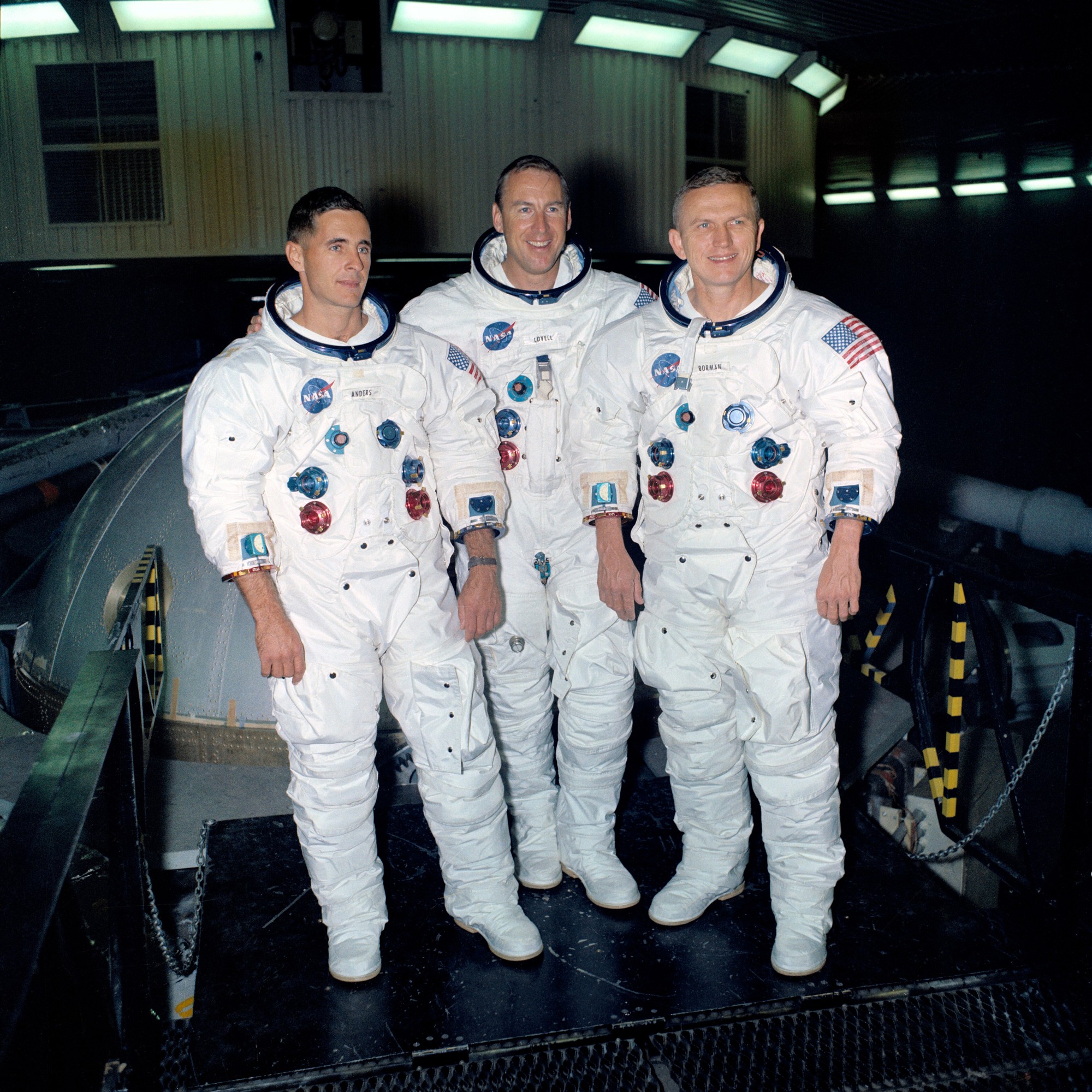
Apollo 8 was launched from Florida on 21 December 1968. It carried three American astronauts: Frank Borman, the commander, Jim Lovell and Bill Anders. It was the first time people rode NASA's new giant Moon rocket, and the first crewed flight around the Moon.
The spacecraft went into orbit around the Moon on 24 December. It circled the Moon 10 times in about 20 hours. On Christmas Day the crew fired the engine to head home, and they splashed down in the Pacific Ocean on 27 December 1968.
Apollo 8 did not land. It carried no landing craft. The first landing on the Moon came 7 months later, with Apollo 11 in July 1969.
The Christmas Eve broadcast
On the evening of 24 December 1968, North American time, the crew went on live television as they came around from the far side of the Moon to begin their 9th orbit. It was the 4th television broadcast of the flight. The times in the transcript show that it lasted about 25 minutes. After a first look at the Earth, the crew turned their camera to the grey surface of the Moon passing below them and described what they saw. Borman called the Moon "a vast, lonely, forbidding-type existence, or expanse of nothing".
Nobody could count how many people watched or listened. Historian Teasel Muir-Harmony, in her 2020 book Operation Moonglow (part of it was printed in Smithsonian magazine), estimates that about 1 in 4 people on Earth, roughly a billion people in 64 countries, listened to the reading, and that recordings reached 30 more countries within 24 hours. This is an estimate, not a count. A newly launched communications satellite let people in North America, South America and Europe follow the broadcast live.
Borman later recalled that the crew had been told to expect "the largest audience that had ever listened to a human voice".
Sources
- Apollo 8 Flight Journal: Day 4, Lunar Orbit 9 (corrected NASA transcript with notes; the whole broadcast as audio and video)
- Smithsonian magazine: How Apollo 8 Delivered Christmas Eve Peace and Understanding to the World (Teasel Muir-Harmony)
- NASA: Apollo 8: Christmas at the Moon
- National Air and Space Museum: Broadcasting Apollo 8 Live From Space (calls it "the most watched television broadcast at the time")
How Genesis was chosen
NASA did not write the words. Borman recalled in 2008: "the only instructions that we got from NASA was to do something appropriate."
Borman asked his friend Simon Bourgin for advice. Bourgin worked for the United States Information Agency and had travelled with the astronauts on overseas tours. According to Muir-Harmony, Bourgin called his friend Joe Laitin, an assistant to the director of the Bureau of the Budget, and it was Laitin's wife, Christine, who came up with the idea. "Why don't you begin at the beginning?" she asked. Bourgin agreed that the opening verses of Genesis would have "universal appeal and a sense of reverence that is called for." The passage was typed on fireproof paper and put into the Apollo 8 flight plan.
The Smithsonian's National Air and Space Museum keeps Bourgin's letters to Borman about what to say, and its short archive note credits the suggestion to Bourgin. Muir-Harmony's fuller account says the idea first came from Christine Laitin and reached Borman through Bourgin. Lovell later explained the choice this way: "The first ten verses of Genesis is the foundation of many of the world's religions, not just the Christian religion."
Who read which verses
As the spacecraft neared the line between day and night on the Moon, Anders said: "We are now approaching lunar sunrise, and for all the people back on Earth, the crew of Apollo 8 has a message that we would like to send to you." Anders then read Genesis 1:1 to 4. Lovell read verses 5 to 8. Borman read verses 9 and 10. They read from the King James Version.
Borman closed the broadcast with these words, as given in the Apollo Flight Journal: "And from the crew of Apollo 8, we close with good night, good luck, a Merry Christmas and God bless all of you - all of you on the good Earth."
The Genesis reading was not the only religious reading from lunar orbit that day. Earlier, on the 3rd orbit, Borman recorded a short prayer for his own church, St. Christopher's Episcopal Church near Seabrook, Texas. He had wanted to read at its Christmas Eve service, but the flight kept him away, so the recording was to be played there instead. It began: "Give us, O God, the vision which can see thy love in the world in spite of human failure."
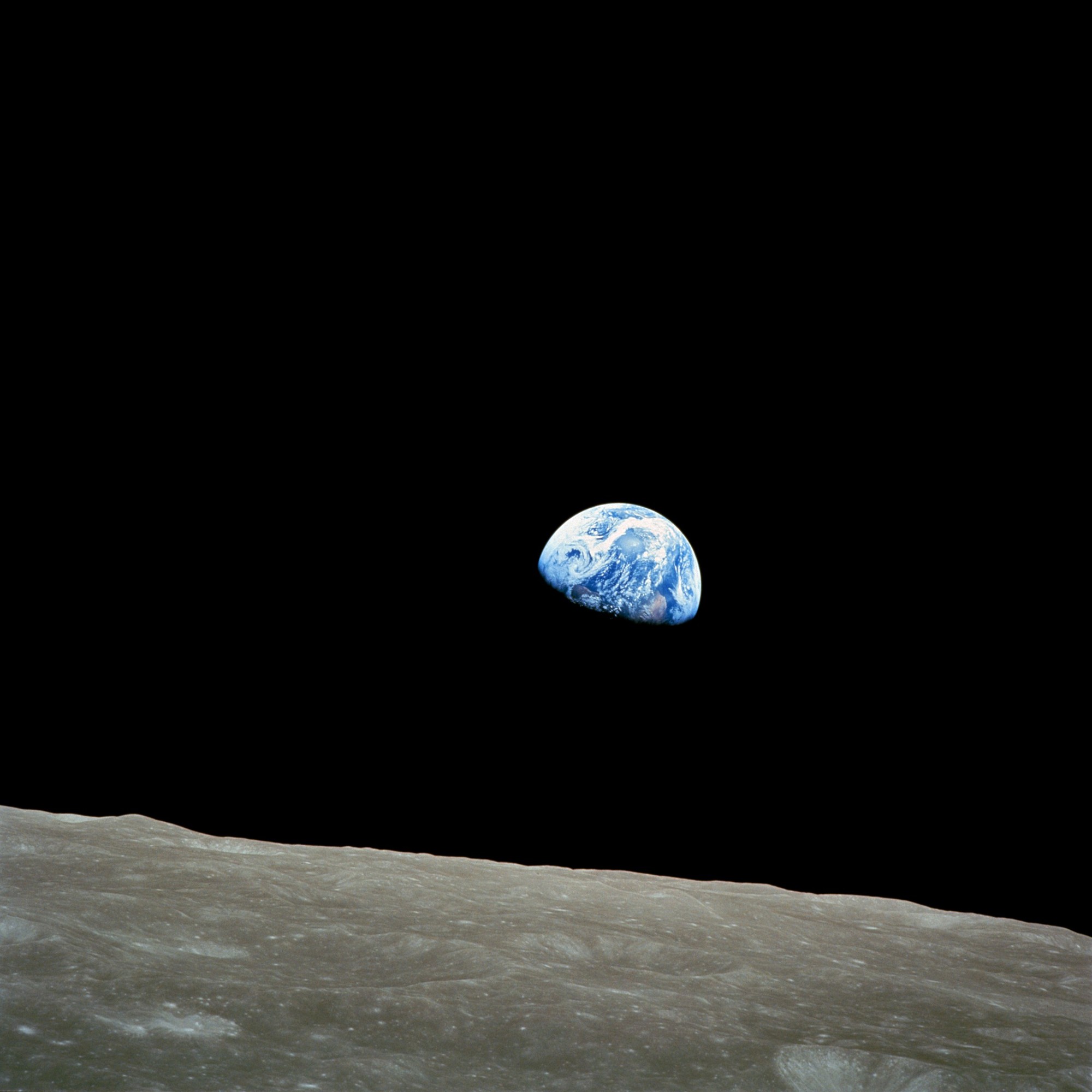
The three men did not all share the same beliefs. Bill Anders, who read the first four verses, also took the Earthrise photo shown on this page. A 2018 article in The Guardian about that photo said it changed his life in a personal way. Anders told the paper: "It really undercut my religious beliefs."
The reading was the crew's chosen message to the world on Christmas Eve, not a statement of what each man personally believed. Whatever each astronaut believed, the words that went out to the world that night were God's own words from Genesis, read almost exactly as the King James Version has them. That is why this page simply sets out the facts and the words that were read.
Sources
- Apollo 8 Flight Journal: Day 4, Lunar Orbit 9 (corrected NASA transcript)
- NASA Space Science Data Coordinated Archive: The Apollo 8 Christmas Eve Broadcast
- Apollo 8 Flight Journal: Day 4, Lunar Orbit 3 (Borman's prayer)
- Ian Sample, "Earthrise: how the iconic image changed the world", The Guardian, 24 December 2018 (copy on inkl)
The Earthrise photograph
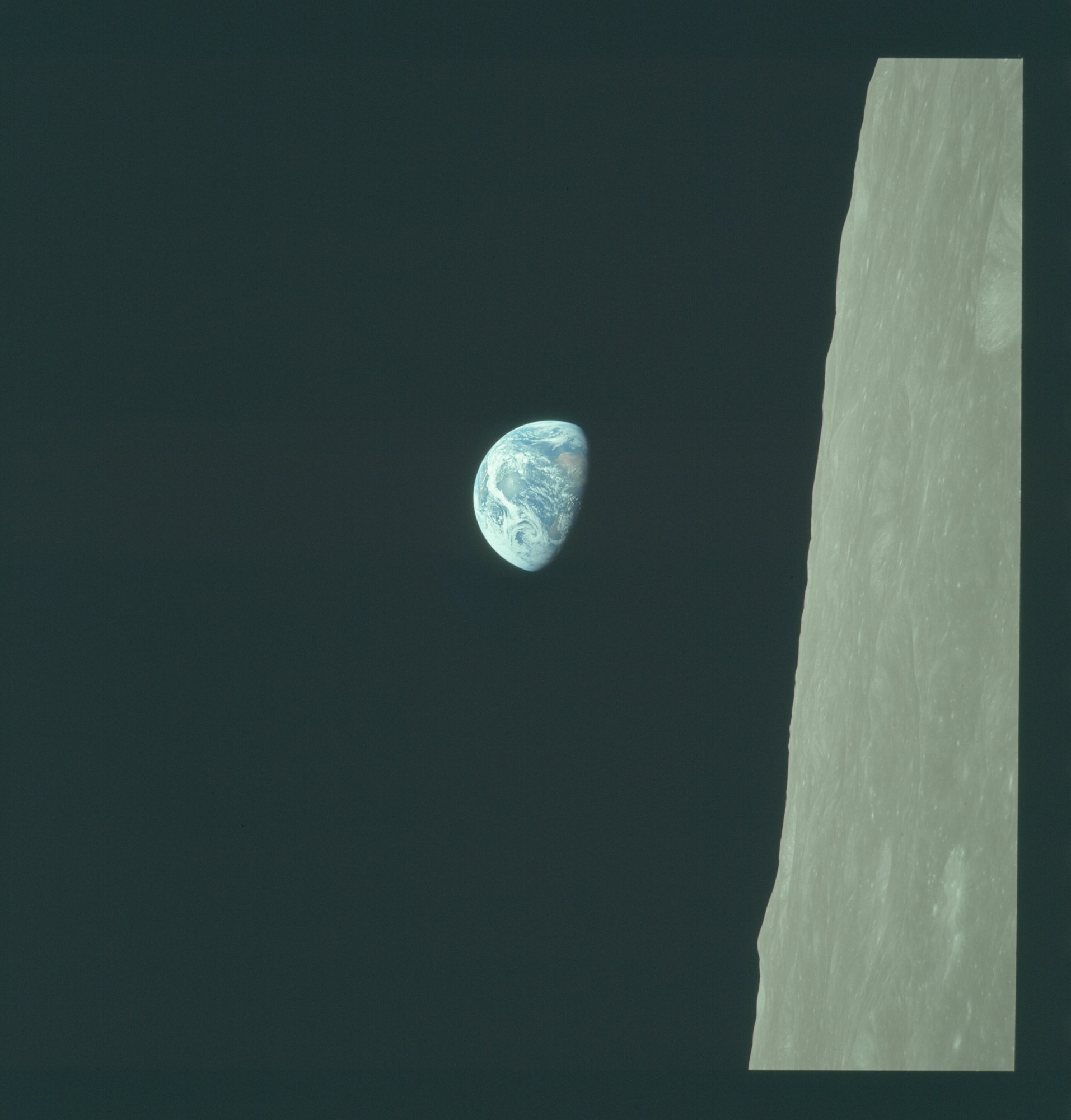
Earlier on 24 December, on the 4th orbit, the crew saw the Earth come up over the edge of the Moon. No person had seen this before. Bill Anders took a black-and-white picture, called for colour film, and then took two colour pictures. The first colour picture, NASA number AS08-14-2383, became known as Earthrise.
It shows the Earth, blue and white and partly in sunlight, above the grey, cratered edge of the Moon. For years Borman said that he took the famous picture. In 2013 NASA's Scientific Visualization Studio studied the moment again. It used the flight's photos, the crew's voices recorded inside the spacecraft, and new maps of the Moon. The study showed that Anders took all three pictures. Borman later said in public that he had been wrong.
As the crew saw it, the edge of the Moon ran up and down beside the Earth. The picture is usually printed turned on its side, so that the Moon lies along the bottom and the Earth seems to rise above it.
Sources
- Apollo 8 Flight Journal: Day 4, Lunar Orbit 4 (Earthrise)
- NASA Scientific Visualization Studio: Earthrise: The 45th Anniversary (2013 study)
- NASA Scientific Visualization Studio: Earthrise 2.0 (shows the horizon as the crew saw it)
- Smithsonian magazine: Who Took the Legendary Earthrise Photo From Apollo 8? (Andrew Chaikin)
Afterward: a lawsuit and a stamp
In 1969 Madalyn Murray O'Hair, founder of American Atheists, sued NASA and its head, Thomas Paine. She said the reading, and other religious acts by astronauts in space, broke the First Amendment of the United States Constitution, the part that deals with religion and government.
On 1 December 1969 Judge Jack Roberts, a federal judge in Texas, dismissed the case. He found that the people suing had not been forced to do anything or stopped from doing anything. He also wrote: "The First Amendment does not require the State to be hostile to religion, but only neutral."
In April 1970 the Supreme Court dismissed her first appeal in a one-line order. It said only that the court did not have jurisdiction, which means the legal power to hear that appeal. An appeals court then agreed with the judge's decision, and in 1971 the Supreme Court refused to hear the case. Some retellings say a court ruled that it had no power over outer space. The Supreme Court's one-line order does not say that.
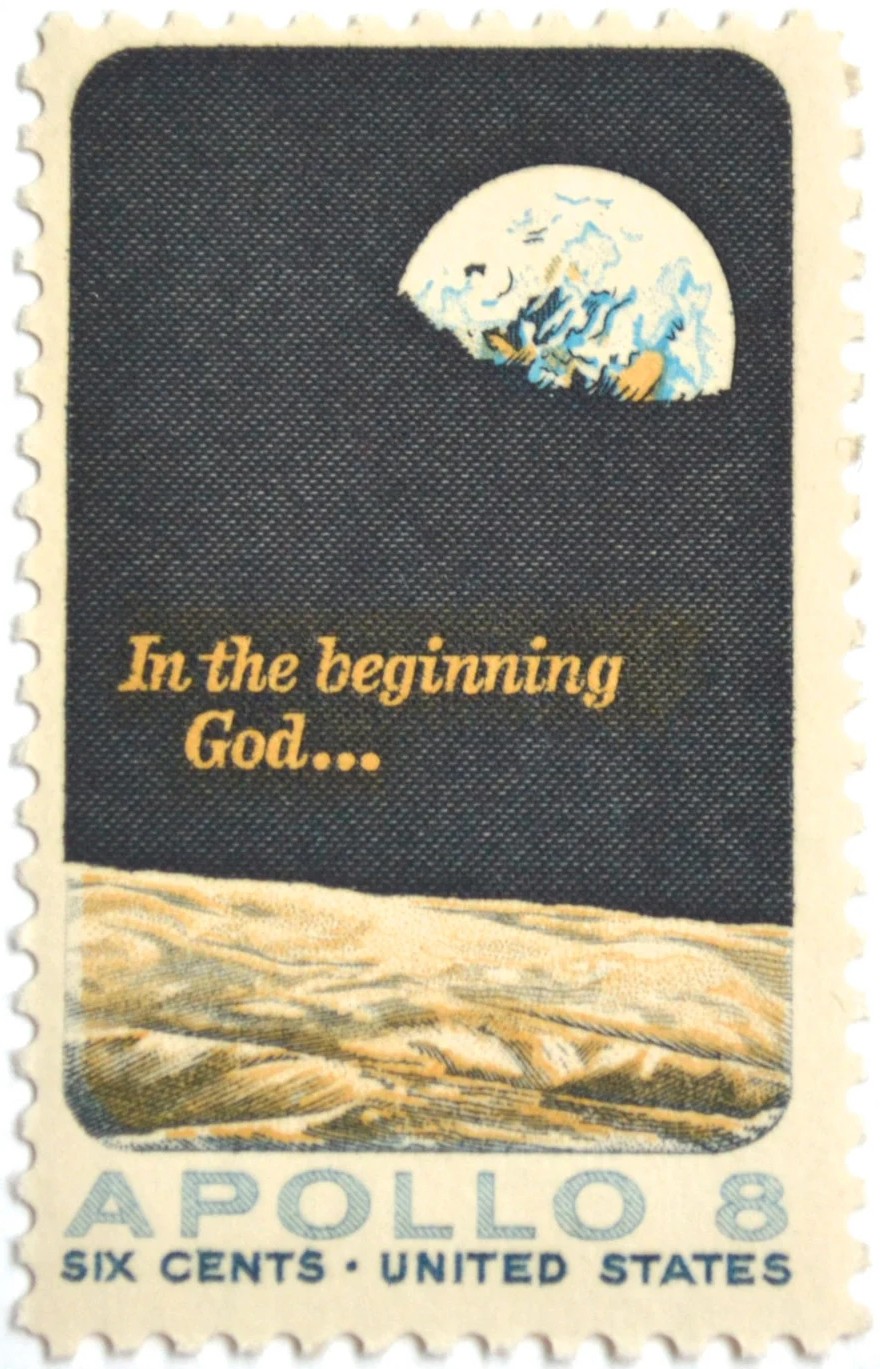
On 5 May 1969, in Houston, Texas, the United States Post Office Department issued a 6 cent stamp to honour the flight. It shows a picture based on the Earthrise photo, with the words "In the beginning God...".
Sources
- National Archives (DocsTeach): Memorandum Opinion in O'Hair v. Paine, 1 December 1969
- Justia: O'Hair v. Paine, 312 F. Supp. 434 (W.D. Tex. 1969), full text of the opinion
- Justia: O'Hair v. Paine, 397 U.S. 531 (1970), Supreme Court order
- Wikipedia: Apollo 8 Genesis reading (lawsuit appeals and the stamp, with court citations)
- Museum of Florida History: Apollo 8 Mission first day cover
In the beginning God created the heaven and the earth.
Genesis 1:1 (KJV)