Real places you can visit and real objects you can see in museums, connected to the Acts of the Apostles: the first church in Jerusalem, the rulers and officials Luke names, and Paul's journeys from Antioch to Rome. Each one is marked honestly, so you can tell solid evidence from tradition and from claims that are still argued over.
ConfirmedThe place or object is real and is clearly the one the Bible names. For a written object, such as an inscription or a scroll, it means the object is genuine and its words are read with confidence, not that every event it mentions is proven.15
Traditional siteA real place that long tradition links to the Bible, but the exact spot cannot be proven.3
DisputedInformed people disagree, or the claim rests on weak evidence.3
BackgroundShows the world the Bible describes, but does not name a Bible person or event.0
From Jerusalem to Antioch
1
Herod Agrippa the First and his sudden death at Caesarea
Acts 12:1-3 · Acts 12:20-23
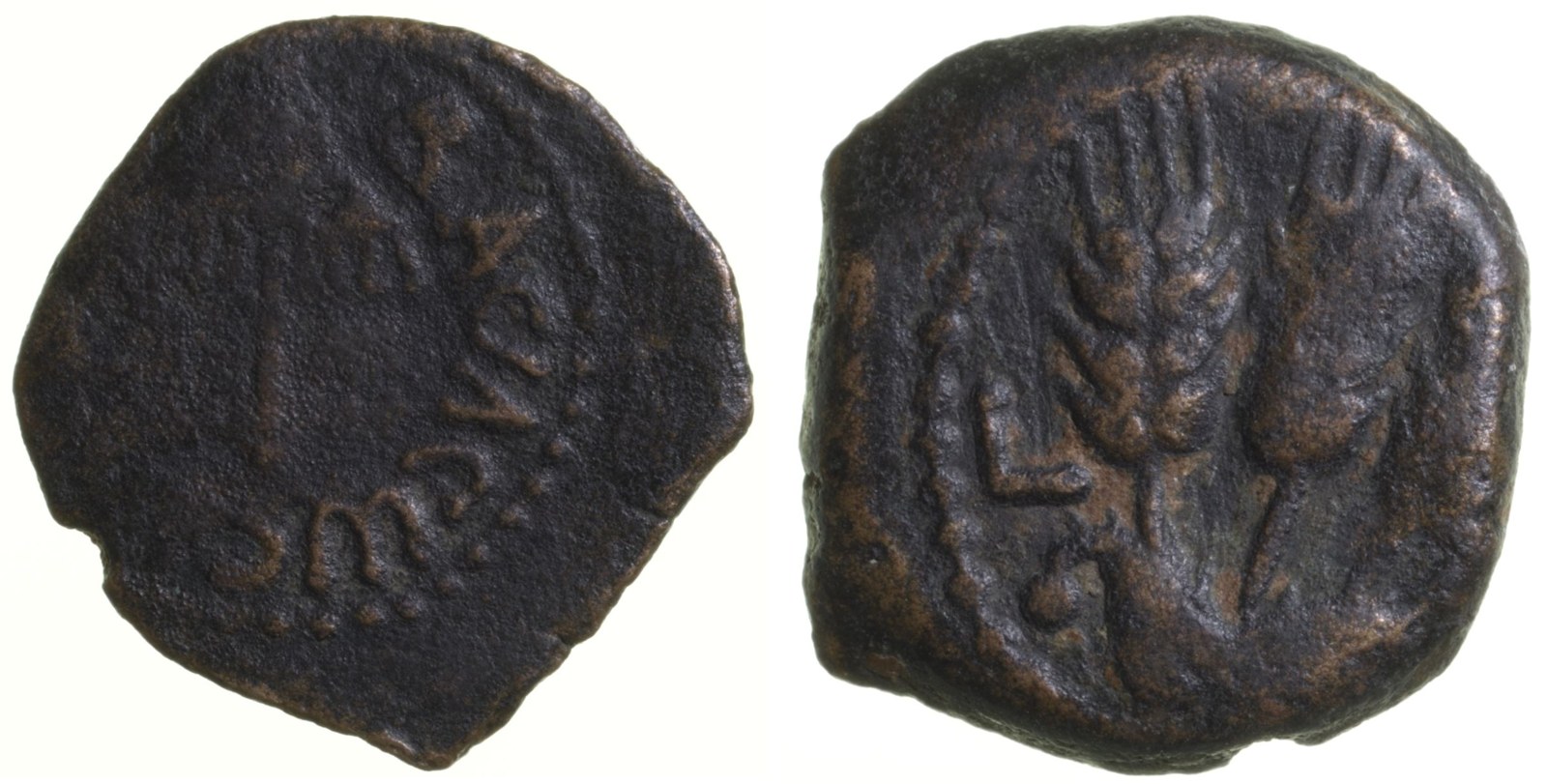
ConfirmedBoth sides of a bronze prutah of Herod Agrippa the First: the royal canopy with the Greek word for king (left), and ears of barley with the sign L for "year" (right). Leipzig University Library coin collection, via KENOM, CC0 1.0 (public domain).
And immediately the angel of the Lord smote him, because he gave not God the glory: and he was eaten of worms, and gave up the ghost.
Acts 12:23, KJV
The King Herod of Acts 12, who killed James and put Peter in prison, is Herod Agrippa the First, a grandson of Herod the Great. He ruled all of Judea from AD 41 until he died at Caesarea in AD 44. Acts says that at Caesarea he wore royal clothing and gave a speech, the people shouted that he was a god, and he was struck down and died. The Jewish historian Josephus, writing about AD 93 and not a Christian, describes the same death in his own words (Antiquities, book 19, sections 343 to 350). The photo and charts below show the Greek word for "king" and the sign for "year" as they appear on one of his coins.
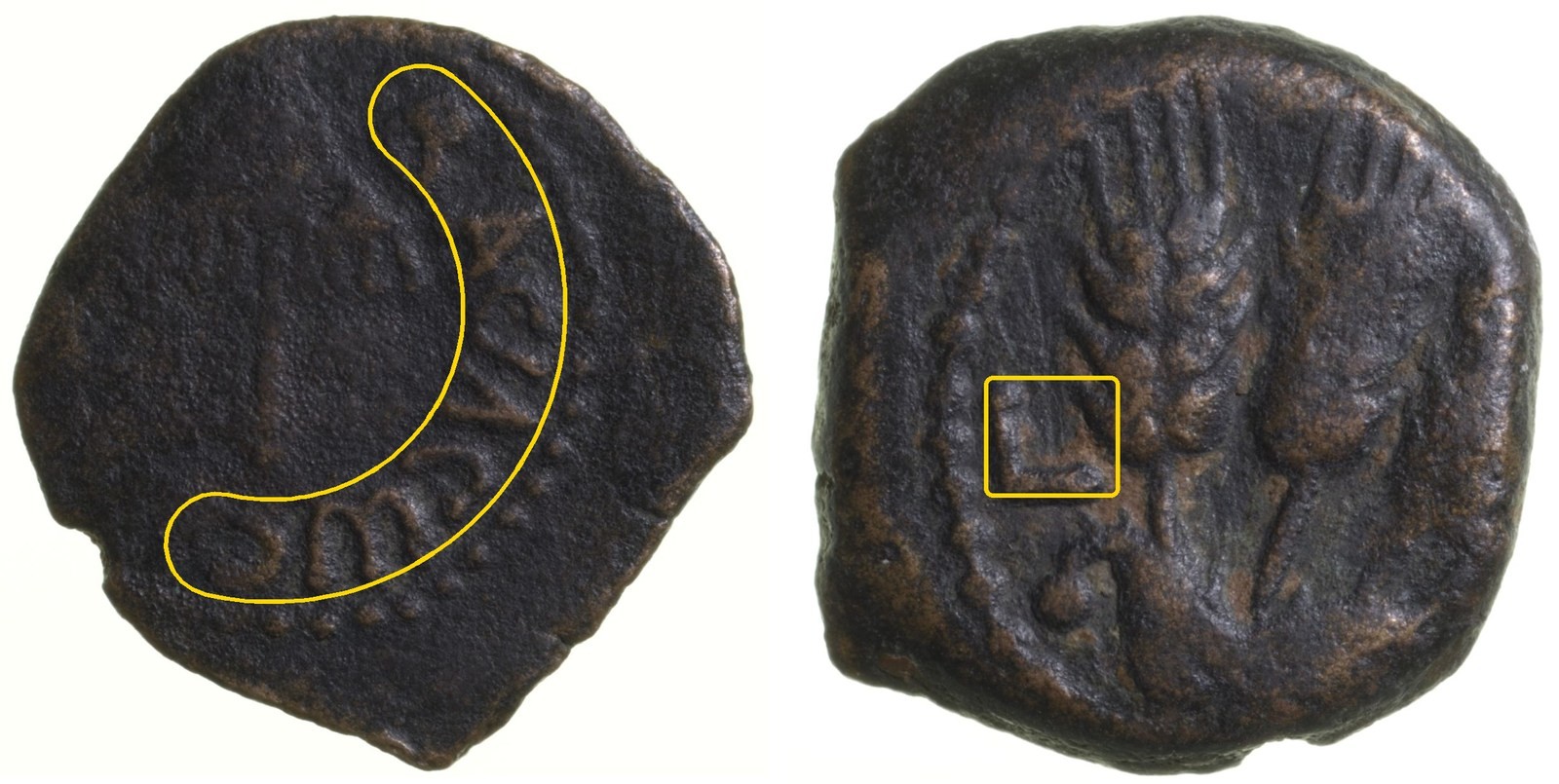
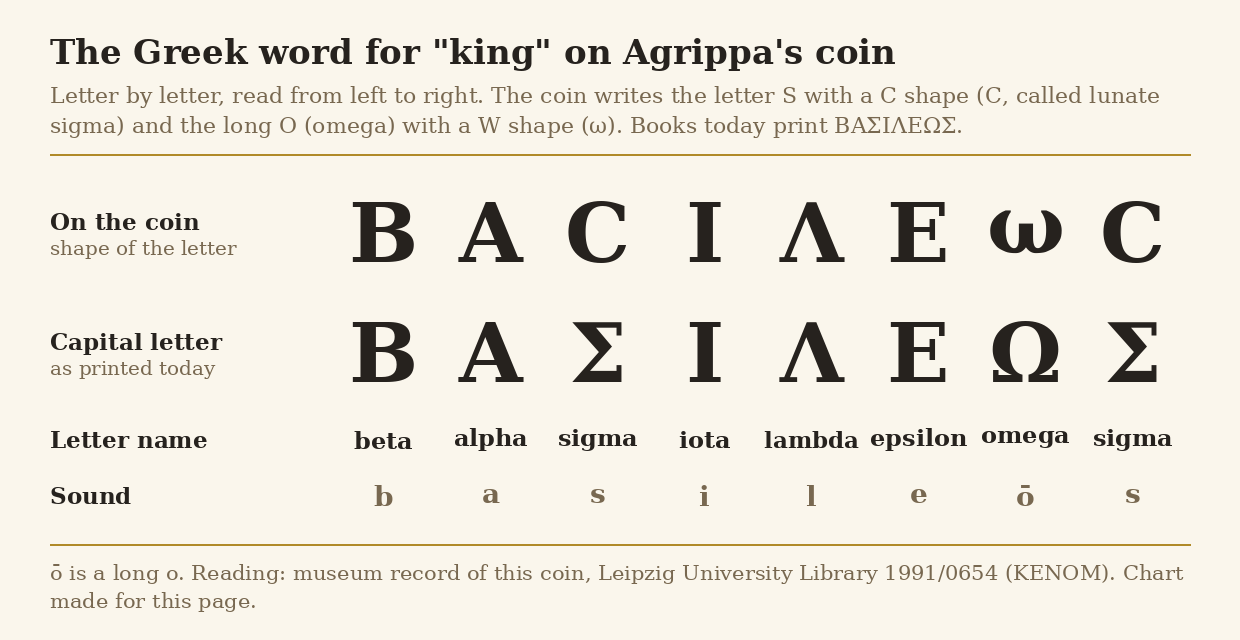
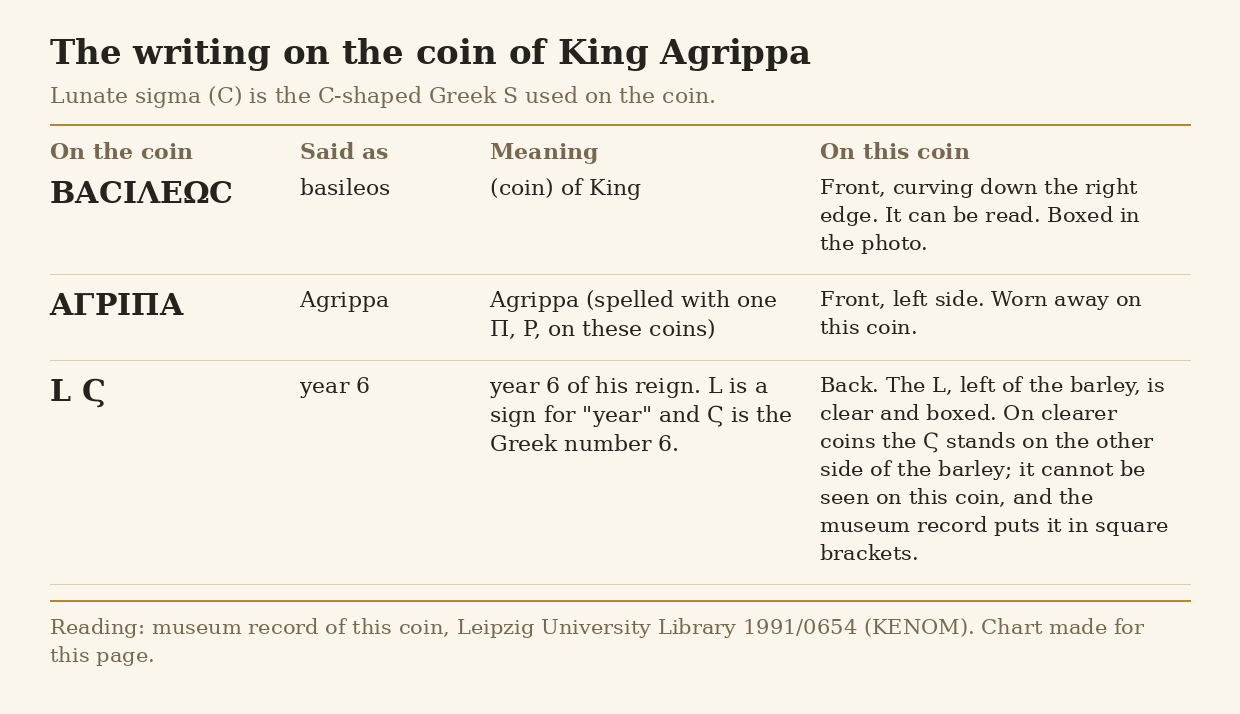
Photo of both sides of a real bronze coin of King Agrippa the First, in Leipzig University Library. The yellow boxes were added for this page. Left, the front: the curved box follows the Greek word ΒΑϹΙΛΕΩϹ (said basileos), "of King". It runs down the right-hand edge from about 1 o'clock to about 7 o'clock, so the letters lie sideways and then upside down. His name, ΑΓΡΙΠΑ, was on the left side, which is worn away on this coin. Right, the back: the box marks L, a sign for "year". The number after it, Ϛ (6), stands on the other side of the barley on clearer coins of this kind; it cannot be made out on this coin, so it is not boxed. The museum record puts the Ϛ in square brackets for this reason; the date, year 6 of his reign, is known from better examples of the same coin. Leipzig University Library coin collection, via KENOM, CC0 1.0 (public domain).The Greek word for "king" on the coin, letter by letter, with each letter's name and sound. The coin writes S with a C shape (Ϲ, lunate sigma) and the long O (omega) with a W shape. Chart made for this page, free to reuse.All the writing on this kind of coin, with how it sounds, what it means, and how much of it can be seen on the coin in the photo. Chart made for this page, free to reuse.
Where it is today
The events took place at Caesarea, on the coast of Israel, where the theatre built by Herod the Great, very likely the one Josephus means, has been dug up (see the Caesarea entry). The coin in the photo is in the coin collection of Leipzig University Library, Germany, inventory number 1991/0654.
Date
Agrippa was made king of lands north-east of the Sea of Galilee in AD 37, was given Judea in AD 41, and died in AD 44. Coins of this kind are dated year 6 of his reign, counted from AD 37, which is about AD 41 to 42.
Why this label: Agrippa is named on his own coins, and Josephus, who was not a Christian, also records his sudden death at Caesarea. History can confirm the king, the place and the sudden fatal illness, but it cannot test the cause Acts gives, the angel of the Lord.
Good to know
Where they agree: Both accounts place the scene at Caesarea at a public gathering. In both, the king wears splendid royal clothing, the crowd calls him a god, he does not refuse the praise, and he is struck at once with a deadly illness.
Where they differ: Acts tells of peace talks with Tyre and Sidon and says he was eaten of worms. Josephus tells of games held for the emperor, a robe made of silver that shone in the morning sun, an owl he took as a bad sign, and five days of severe stomach pain before he died. The details differ enough that neither writer seems to have copied the other.
Copying caution: Eusebius, a church historian of the early 300s, quoted this passage of Josephus, but his copy has an angel where the manuscripts of Josephus have an owl. Use Josephus himself, not that quotation.
His coins: The common coin of Agrippa is a small bronze coin called a prutah. It shows a royal canopy (a kind of umbrella) with the Greek words for "of King Agrippa", and on the back three ears of barley with the date. Like most earlier Jewish coins it shows no person or animal, but his rarer coins show the emperor or Agrippa himself. Acts calls him only Herod, while Josephus and the coins call him Agrippa.
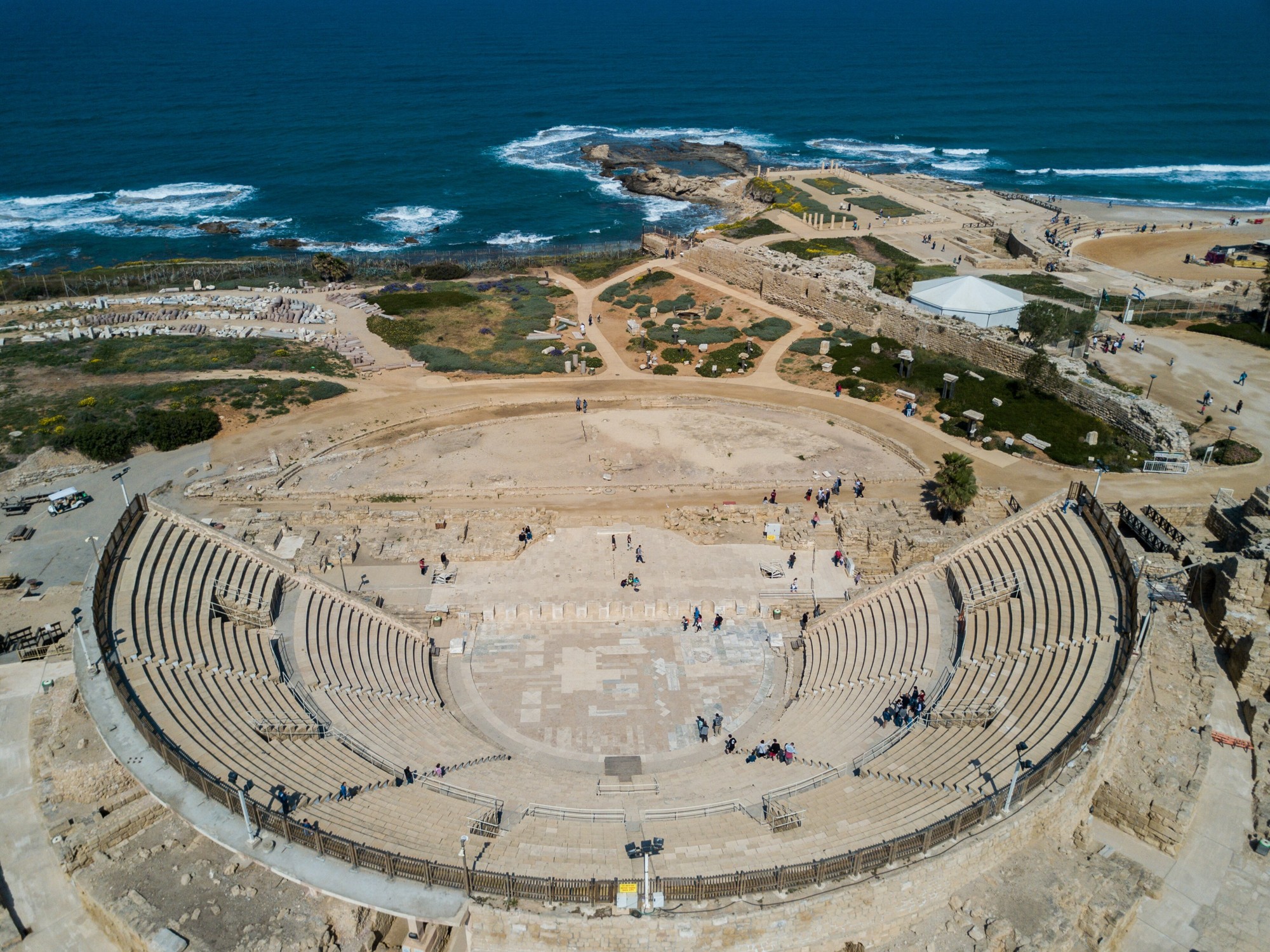
ConfirmedThe theatre at Caesarea seen from the air, with the remains of Herod's palace on the rocky point beyond it. Gilad Topaz, via Wikimedia Commons, CC BY-SA 4.0.
There was a certain man in Caesarea called Cornelius, a centurion of the band called the Italian band,
Acts 10:1, KJV
Herod the Great built Caesarea on the coast between about 22 and 10 BC and named it after the emperor Caesar Augustus. It became the home of the Roman governors of Judea. In Acts, Peter brings the gospel to the Roman officer Cornelius and his household here (Acts 10), Philip the evangelist lives here (Acts 21:8), and Paul is held here for two years under the governors Felix and Festus before he is sent to Rome (Acts 23 to 26). Visitors today can see the theatre, the remains of Herod's palace on a rocky point in the sea, and the sunken sea walls of his harbour.
Where it is today
Caesarea National Park, on the Mediterranean coast of Israel, about 45 kilometres north of Tel Aviv.
Date
Built about 22 to 10 BC. Paul's two years in custody here are usually placed in the late AD 50s (see Good to know). The city lasted until its walls were torn down in AD 1265; later only a small village stood there.
Why this label: The city's name, place and ruins have never been in doubt, and Josephus describes Herod building it. What is less certain is which excavated building was the judgment hall where Paul was kept.
Good to know
The harbour: Herod's harbour, called Sebastos, was built out into open sea with concrete that hardened under water, made with volcanic ash shipped from Italy. Its breakwaters (the long sea walls that sheltered the ships) later sank. The outer parts now lie about 5 metres under the sea.
The palace: Herod built a palace on a rocky point that sticks out into the sea, with a large pool cut into the rock. Many archaeologists think it is "Herod's judgment hall" (Acts 23:35), where Paul was kept. The Greek word Acts uses is praitorion (praetorium in Latin), the Roman name for a governor's headquarters. No inscription names the building, so this is a likely match, not a proven one.
The theatre: The theatre next to the palace has been dug up and partly restored. Josephus says Herod Agrippa the First was struck with his fatal illness in the theatre here (see the Agrippa entry).
Dating Paul: Festus took over from Felix after Paul's two years (Acts 24:27), but the year is debated. Most scholars place it between AD 58 and 60. A change in the local coins in the emperor Nero's fifth year leads many to choose AD 59, while a few argue for as early as AD 55 or as late as AD 61.
Also found here: The stone with the name of Pontius Pilate was found at Caesarea; it is covered on the Gospels page.
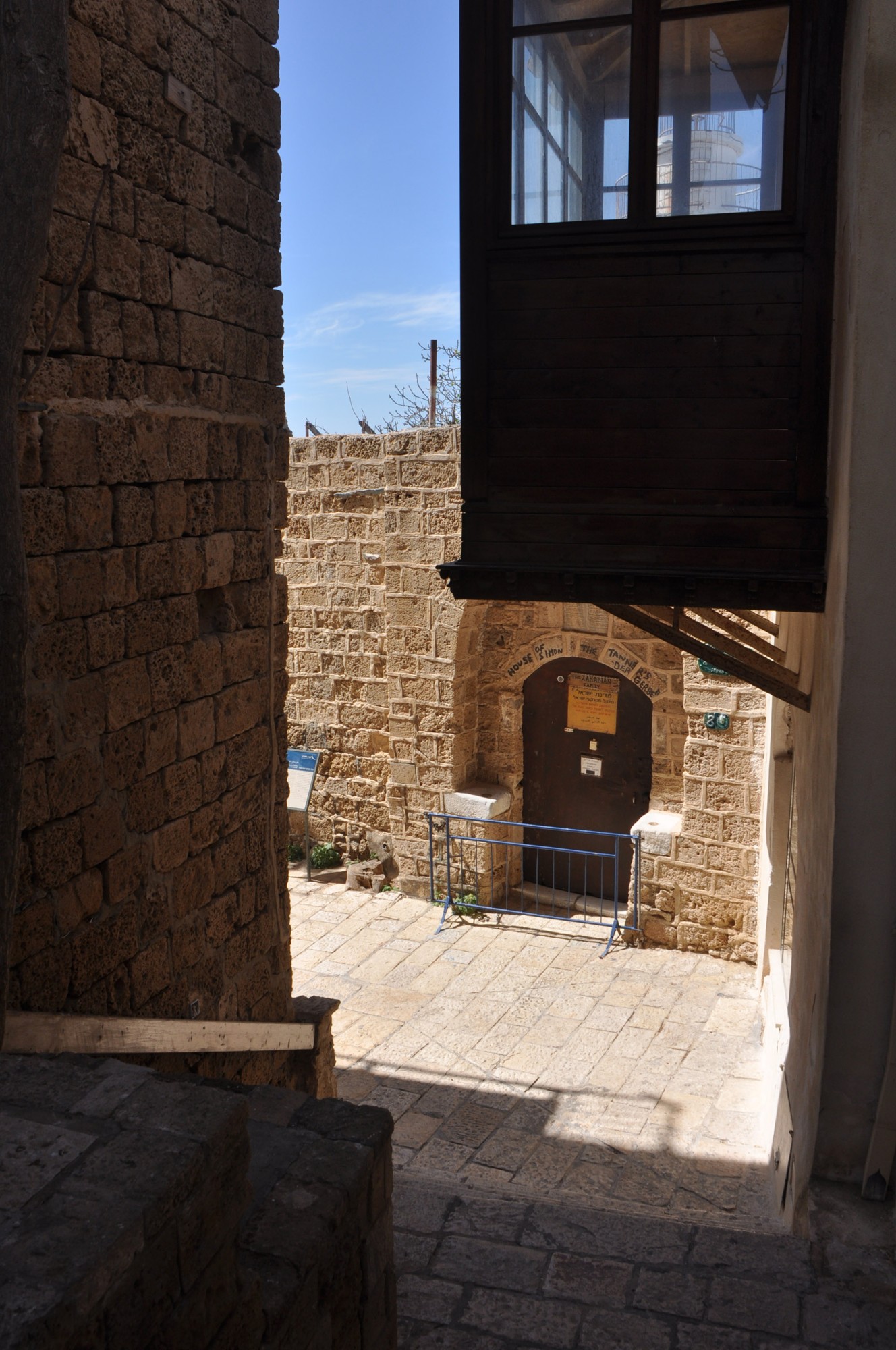
Traditional siteEntrance to the traditional house of Simon the tanner in Old Jaffa, with "House of Simon the Tanner" painted over the door. Yoshi Canopus, via Wikimedia Commons, CC BY-SA 4.0.
He lodgeth with one Simon a tanner, whose house is by the sea side: he shall tell thee what thou oughtest to do.
Acts 10:6, KJV
Joppa, today called Jaffa, is an old port town on the coast of Israel, now part of the city of Tel Aviv-Yafo. Peter stayed there "many days" with Simon, a tanner (a man who made leather from animal skins), whose house was "by the sea side" (Acts 9:43, 10:6). On the roof of that house Peter saw the vision of the sheet full of animals, and from there he went to Cornelius at Caesarea (Acts 10). Joppa is also the port where Jonah found a ship (Jonah 1:3) and where wood from Lebanon was brought by sea for the temple (2 Chronicles 2:16).
Where it is today
Old Jaffa, Tel Aviv-Yafo, Israel. The traditional house is in a narrow lane near the old lighthouse, above the ancient port. It belongs to an Armenian family. Visitors can see the entrance; check before planning a visit, since the inside may not be open. The Franciscan Church of St Peter nearby marks a different tradition.
Date
Peter's stay was in the AD 30s or early 40s, before the death of Herod Agrippa in AD 44. The building shown today is much later; a small mosque on the site is dated 1730.
Why this label: Joppa itself is certain, and the house shown is by the sea as Acts says. But no digging at the house has been reported, nothing found there links it to Simon, and in the sources checked the tradition about this house goes back only to the 1700s.
Good to know
Age of tradition: The sources checked do not record this exact house before the 1700s. Richard Pococke, an English traveller who published his account in 1745, said the Catholic convent was then shown as Simon's house, but he thought a spot by the sea with tanning pits was more likely. A small mosque on the present site is dated 1730. An Armenian family has cared for the site for about 200 years, and the writer Mark Twain was taken to "Simon the Tanner's house" in 1867.
What archaeology found: No digging at the house has been reported, and the building is much later than Peter's time. The only digging reported nearby, around the Franciscan church, found cannon shells from the Turkish period.
A rival tradition: The Franciscan friars, who first settled in Jaffa in 1252, remember Peter's stay at their Church of St Peter nearby. Their own report says the church was not built on Simon's house.
A smelly trade: The Mishnah, a book of Jewish law written down about AD 200, says a tannery had to be kept 50 cubits (about 25 metres) away from a town, most likely because of the smell. This helps explain the trade, but it does not tell us where Simon's house stood.
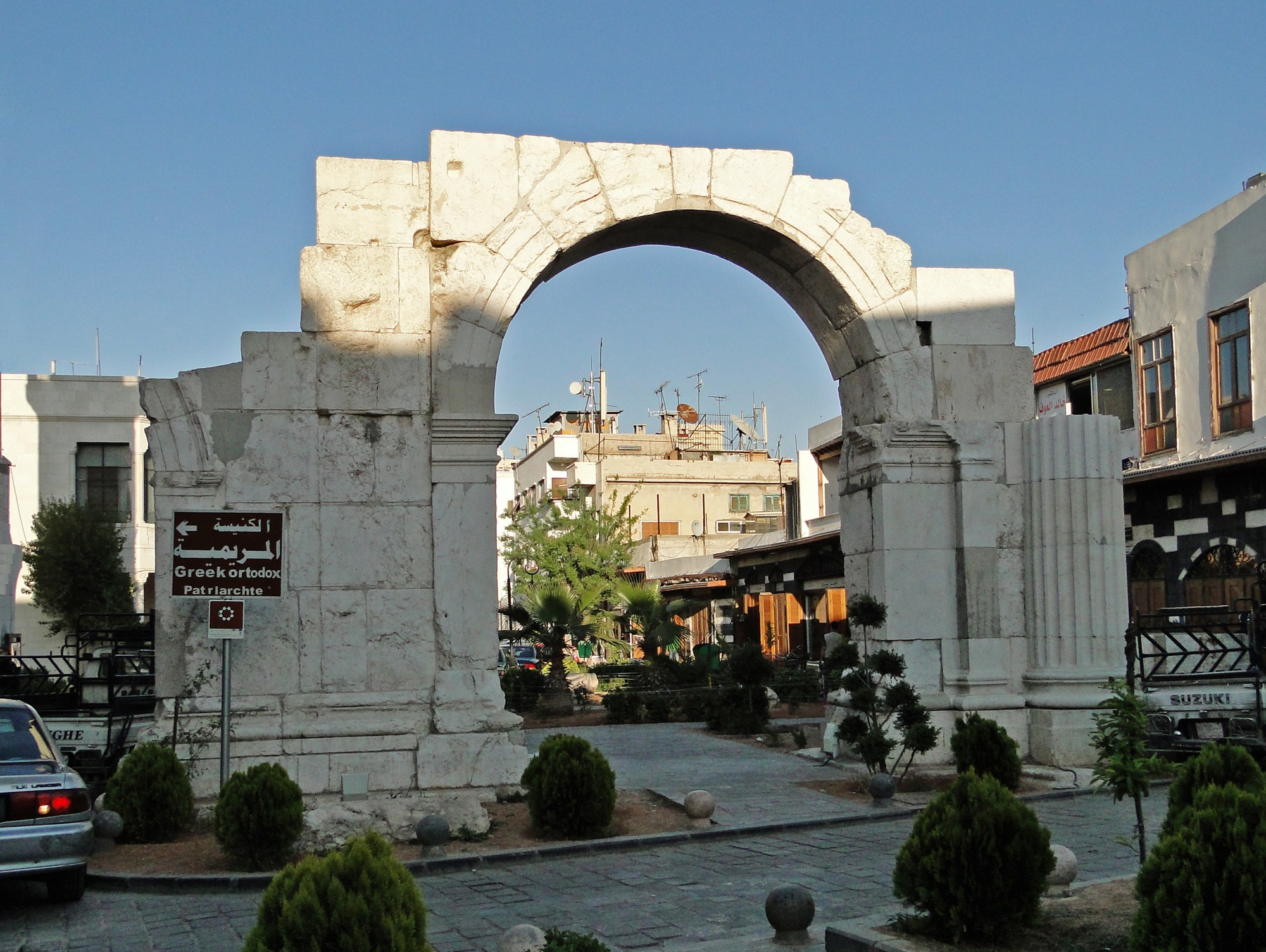
ConfirmedThe Roman arch on Straight Street in the old city of Damascus, dug out and set up again in 1947. Bernard Gagnon, via Wikimedia Commons, CC BY-SA 3.0.
And the Lord said unto him, Arise, and go into the street which is called Straight, and enquire in the house of Judas for one called Saul, of Tarsus: for, behold, he prayeth,
Acts 9:11, KJV
After Saul (Paul) was blinded on the road, the Lord sent Ananias to "the street which is called Straight" to find him in the house of Judas (Acts 9:11). Damascus still has a long, straight main street that runs east to west across the old city. It follows the line of the main street of the Greek and Roman city, which in Latin is called the Via Recta, meaning "straight street". Damascus itself is covered on the Genesis page.
Where it is today
Old City of Damascus, Syria. The street runs about 1.5 kilometres from the Roman east gate (Bab Sharqi) to near the west gate (Bab al-Jabiya). The traditional House of Ananias is an underground chapel near the east end. Access may be limited, so check before planning a visit.
Date
The street plan goes back to the Greek period, before the Romans took Syria in 64 BC; the Romans later widened the street and lined it with columns. Paul's conversion is usually dated about AD 31 to 36. The oldest remains reported under the House of Ananias are from a church of the AD 400s or 500s.
Why this label: Damascus is certain, and its long straight main street follows the line of the ancient one, just as Acts names it. The exact houses of Judas and of Ananias are not known; the places shown for them rest on tradition.
Good to know
Then and now: The Roman street lies about 4 metres below today's street, so visitors walk above the level of Paul's day. In Roman times the street was about 26 metres wide with covered walkways and shops; today it is narrower. A Roman arch about 700 metres west of the east gate was dug out and set up again in 1947. It is not known which parts of the grand Roman street were already built when Paul was there.
House of Ananias: Acts does not say where Ananias lived. The chapel shown as his house is reached by steps below street level. Digging there in 1921 is reported to have found remains of a church from the AD 400s or 500s. That shows the spot was honoured early, but it does not prove it was Ananias's house. Some tour websites call it a church from the first century, but the oldest remains reported are much later.
House of Judas: Local Christian tradition places the house of Judas at a small mosque (the Jakmak or Sheikh Nabhan mosque) in the western part of the street, about 450 metres from its west end. This cannot be tested.
Dating Paul: Most scholars date Paul's conversion to about AD 31 to 36, working back from the time spans Paul gives in Galatians 1:18 and 2:1. Paul also says he escaped from Damascus while King Aretas the Fourth held power (2 Corinthians 11:32 to 33), which fits that period.
Antioch, where the disciples were first called Christians
Acts 11:19-26 · Acts 13:1-3 · Galatians 2:11
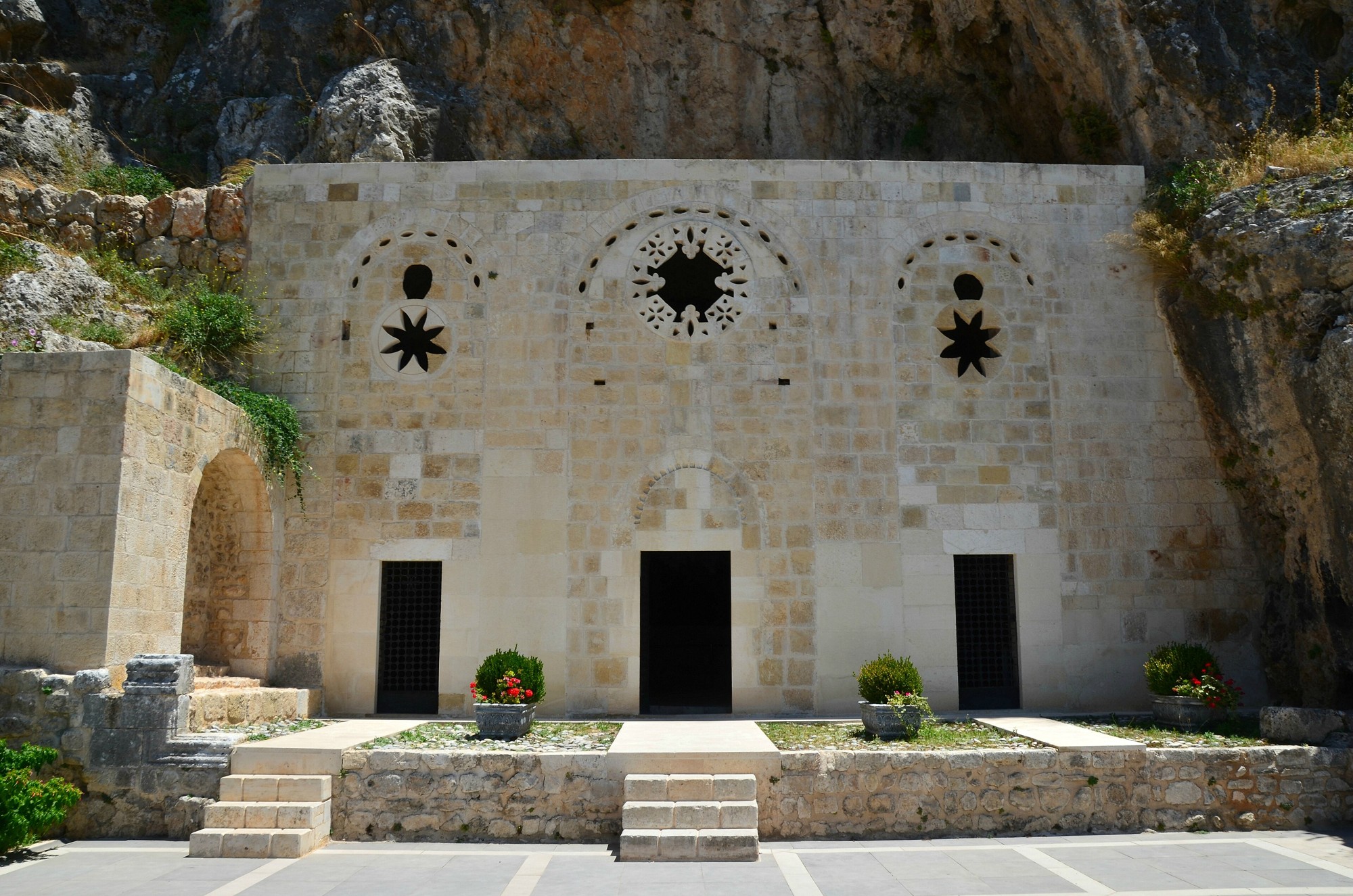
ConfirmedThe front of the Cave Church of St Peter, cut into the hillside at Antakya (ancient Antioch). Carole Raddato, via Wikimedia Commons, CC BY-SA 2.0.
And when he had found him, he brought him unto Antioch. And it came to pass, that a whole year they assembled themselves with the church, and taught much people. And the disciples were called Christians first in Antioch.
Acts 11:26, KJV
Antioch on the Orontes River was a large Greek city in Syria, founded about 300 BC by Seleucus the First, and later the capital of the Roman province of Syria. Believers who fled Jerusalem after Stephen's death preached there, and Barnabas brought Paul from Tarsus to teach the church for a whole year. Acts says that here "the disciples were called Christians first" (Acts 11:26). The church at Antioch then sent Paul and Barnabas out on their journeys (Acts 13:1 to 3).
Where it is today
Antakya, in Hatay Province, southern Turkey. Most of the ancient city lies buried under the modern town. The Cave Church of St Peter is on a hillside at the edge of the city, and many of the Antioch mosaics are in the Hatay Archaeology Museum in Antakya, with others in museums in Europe and the United States. Strong earthquakes in February 2023 badly damaged Antakya; reports say the cave church had only minor damage and the museum's collection survived mostly intact. Check before planning a visit.
Date
Founded about 300 BC. The year Barnabas and Paul taught there is usually placed in the early AD 40s, since Acts sets it near the famine under the emperor Claudius (Acts 11:28) and the death of Herod Agrippa in AD 44. The oldest parts of the cave church are from about the AD 300s or 400s. Most of the mosaics date from the AD 100s to 500s.
Why this label: Antioch has kept its place and its name (Antakya) without a break, and ancient writers describe it as the great city of Roman Syria. The city is certain; the link between the cave church and Peter is tradition only.
Good to know
From the Bible: Paul writes that Peter came to Antioch (Galatians 2:11), so Peter's visit rests on Scripture and not only on tradition. Church tradition goes further and says Peter founded the church there.
The cave church: No record tells when the cave was first used for worship. The oldest remains inside, bits of floor mosaic and traces of wall painting, are from about the AD 300s or 400s. Crusaders lengthened the church and added a front after they took the city in 1098, and the present front was rebuilt in 1863. A visitor in 1211 said it stood over the house of Luke, not Peter, so the stories told about the cave have varied.
The mosaics: Digs from 1932 to 1939, led by Princeton University with several museums, found nearly 300 floor mosaics from houses, villas and baths in and around Antioch. They show the wealth and daily life of the city, but most date from well after Acts, and they do not show the first Christians.
Antioch Chalice: A silver cup in The Met in New York was once claimed to be the Holy Grail, the cup of the Last Supper. The museum says that claim has not held up, dates the cup to about AD 500 to 550, and thinks it may be a standing lamp. It is not even sure the cup came from Antioch.
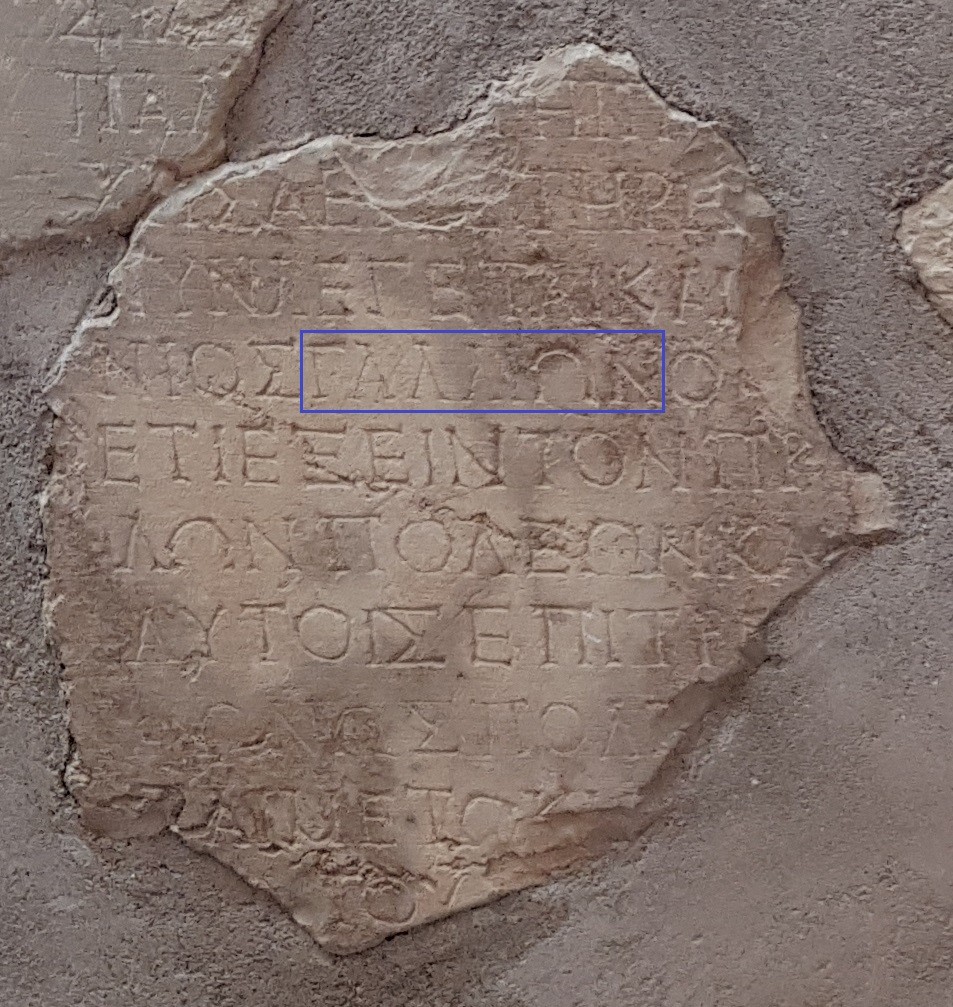
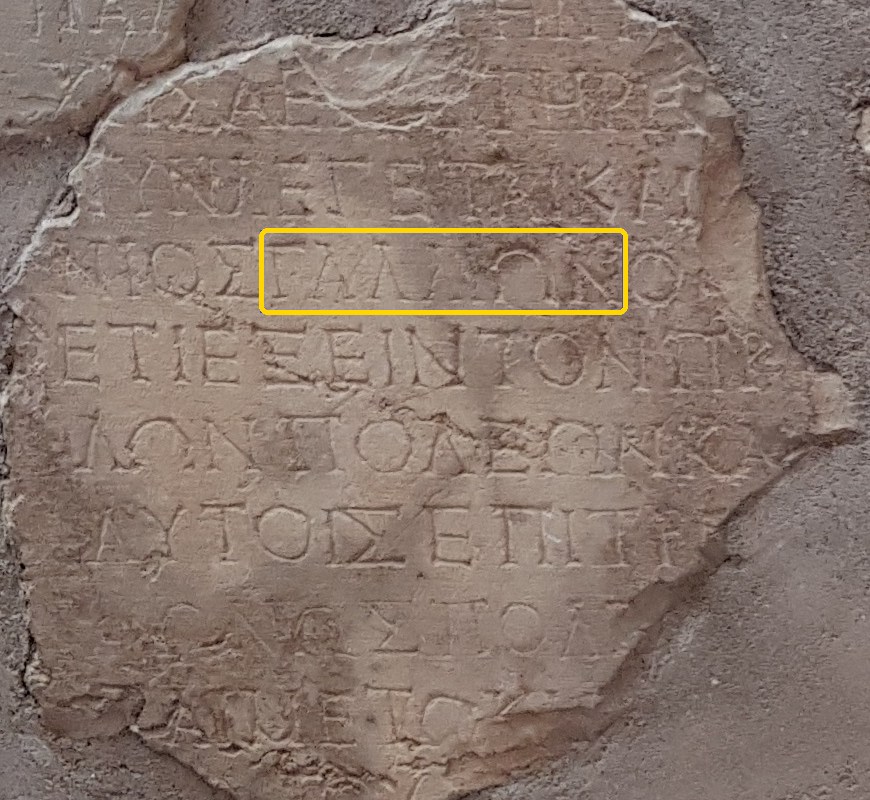
ConfirmedFragment of the Claudius letter in the Delphi Museum bearing the name ΓΑΛΛΙΩΝ (Gallio). The thin blue box around the name was drawn by the photographer, not by this page. Gérard, via Wikimedia Commons, CC BY-SA 4.0.
And when Gallio was the deputy of Achaia, the Jews made insurrection with one accord against Paul, and brought him to the judgment seat,
Acts 18:12, KJV
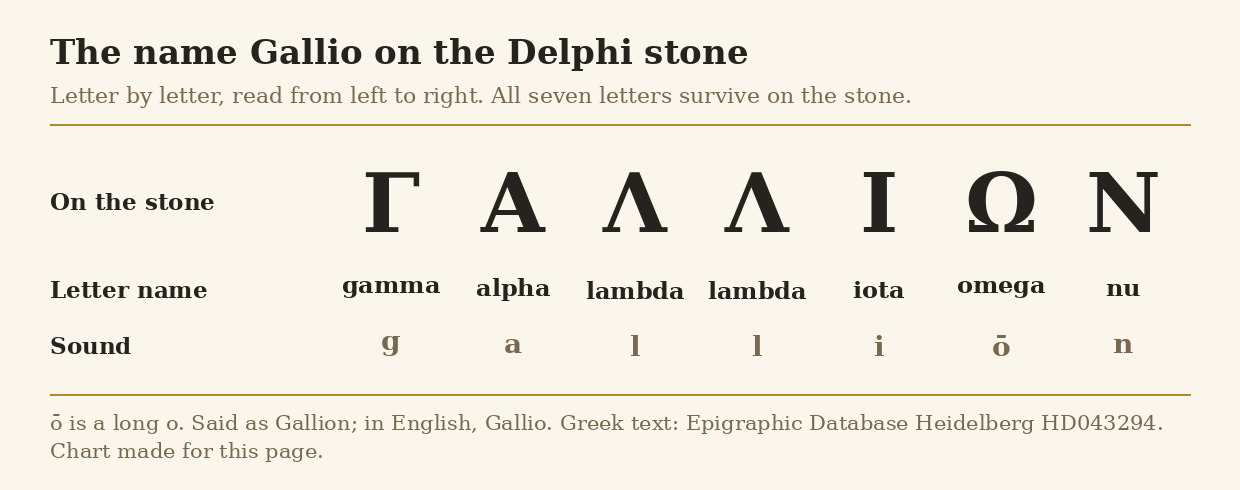
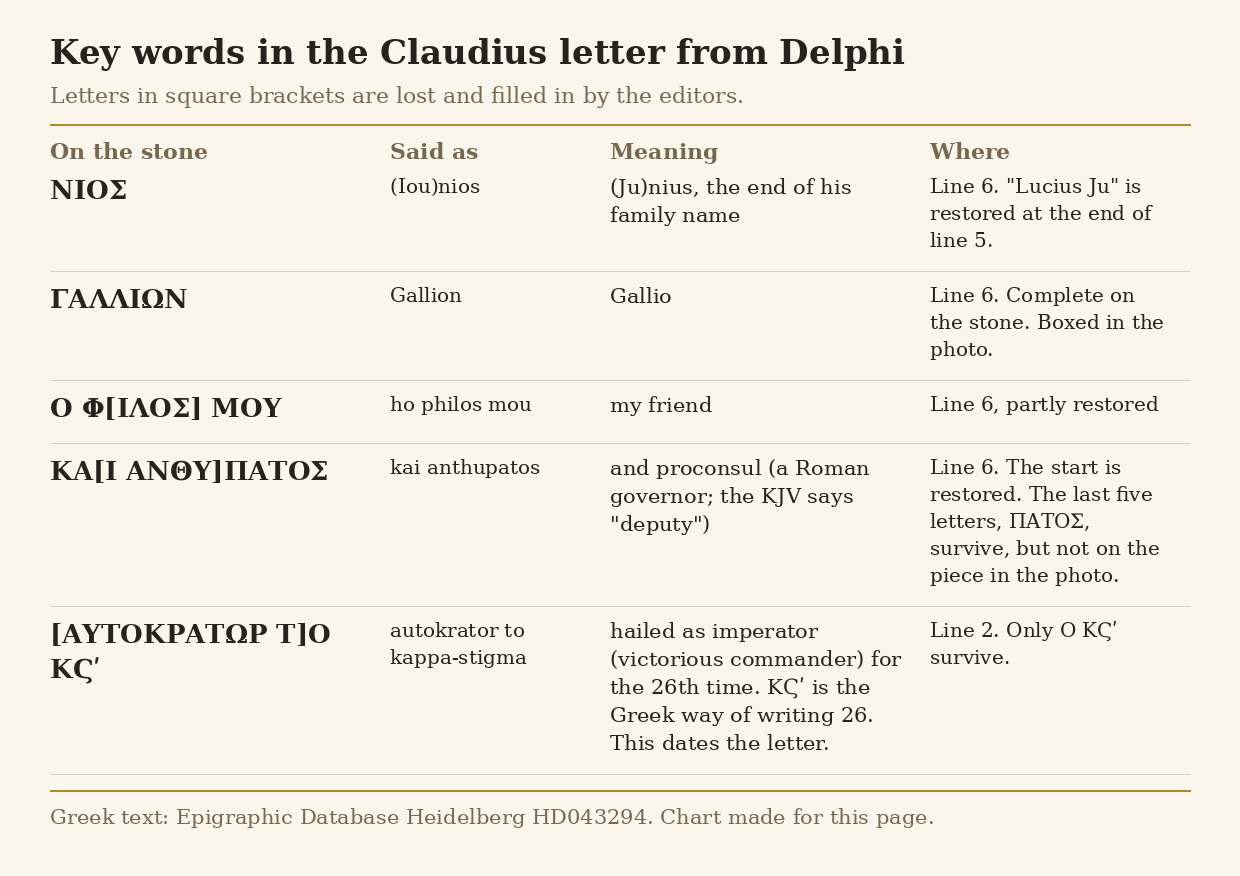
Nine broken pieces of stone found at Delphi in Greece carry a copy of a letter from the Roman emperor Claudius. In it Claudius calls "Lucius Junius Gallio" his "friend and proconsul". Not all of these words survive: the name Gallio is complete, but "Lucius" and most of "Junius" are filled in by the editors, and so are most of the word for friend and the first part of the word for proconsul. A proconsul was the Roman governor of a province, and Delphi was in the province of Achaia, which also included Corinth. Acts 18:12 says Paul was brought before Gallio, "the deputy of Achaia"; "deputy" is the King James word for proconsul. The photo and charts below show the name Gallio as it is carved on the stone.
Photo of one piece of the Claudius letter, set in plaster in the Delphi Museum. The yellow box, added for this page, marks the name ΓΑΛΛΙΩΝ (said Gallion), "Gallio", on line 6 of the letter. The name survives in full. The yellow box sits on top of the thin blue box drawn by the photographer, so the blue barely shows. The word for proconsul and the number 26 on line 2 are on other pieces, not in this photo. Gérard, via Wikimedia Commons, CC BY-SA 4.0.The name Gallio as it is carved on the stone, letter by letter, with each letter's name and sound. Chart made for this page, free to reuse.Key words of the letter: the name Gallio, "my friend and proconsul", and the number that dates the letter, with how much of each survives. Chart made for this page, free to reuse.
Where it is today
Delphi Archaeological Museum, Greece. The pieces were found in the early 1900s at the Temple of Apollo in Delphi. Published as Fouilles de Delphes, volume 3, part 4, no. 286 (A. Plassart, 1970).
Date
About AD 52. The letter is dated by Claudius's titles, especially that he had been "hailed as imperator for the 26th time" (imperator here means a victorious commander; soldiers hailed the emperor this way after each victory won under him). Most scholars place this in the first half of AD 52; some allow a slightly earlier date.
Why this label: The stone names Gallio and calls him proconsul in a letter sent to Delphi, a city in Achaia, in about AD 52. This matches Acts 18:12; the stone does not mention Paul or the hearing in Corinth.
Good to know
What survives: The name Gallio survives in full. Of his other names only the last letters of Junius survive. The first part of the word for proconsul is broken away; only its last five letters, ΠΑΤΟΣ, survive, and the editors fill in the rest. The name Achaia does not appear on the surviving pieces; it is clear from the fact that Delphi was in Achaia.
Main view: Roman governors of provinces like Achaia usually served for one year, arriving in late spring or early summer. So most scholars place Gallio in office from about mid AD 51 to mid AD 52, and Paul's hearing in AD 51 or early AD 52. Since Paul stayed in Corinth a year and six months (Acts 18:11) and then "a good while" more (Acts 18:18), this puts his stay at about AD 50 to 52.
Other views: Some scholars prefer AD 52 to 53 for Gallio's year. Jerome Murphy-O'Connor argued that Gallio left early because of illness (his brother Seneca says Gallio caught a fever in Achaia and took a ship at once), which would put the hearing in the summer or early autumn of AD 51. Others, such as Dixon Slingerland, say that argument goes beyond the evidence, since neither Seneca nor any other writer says Gallio left his post early, and they allow a wider range of dates. Even with these differences, Gallio's time in office is the firmest date scholars have for Paul's life.
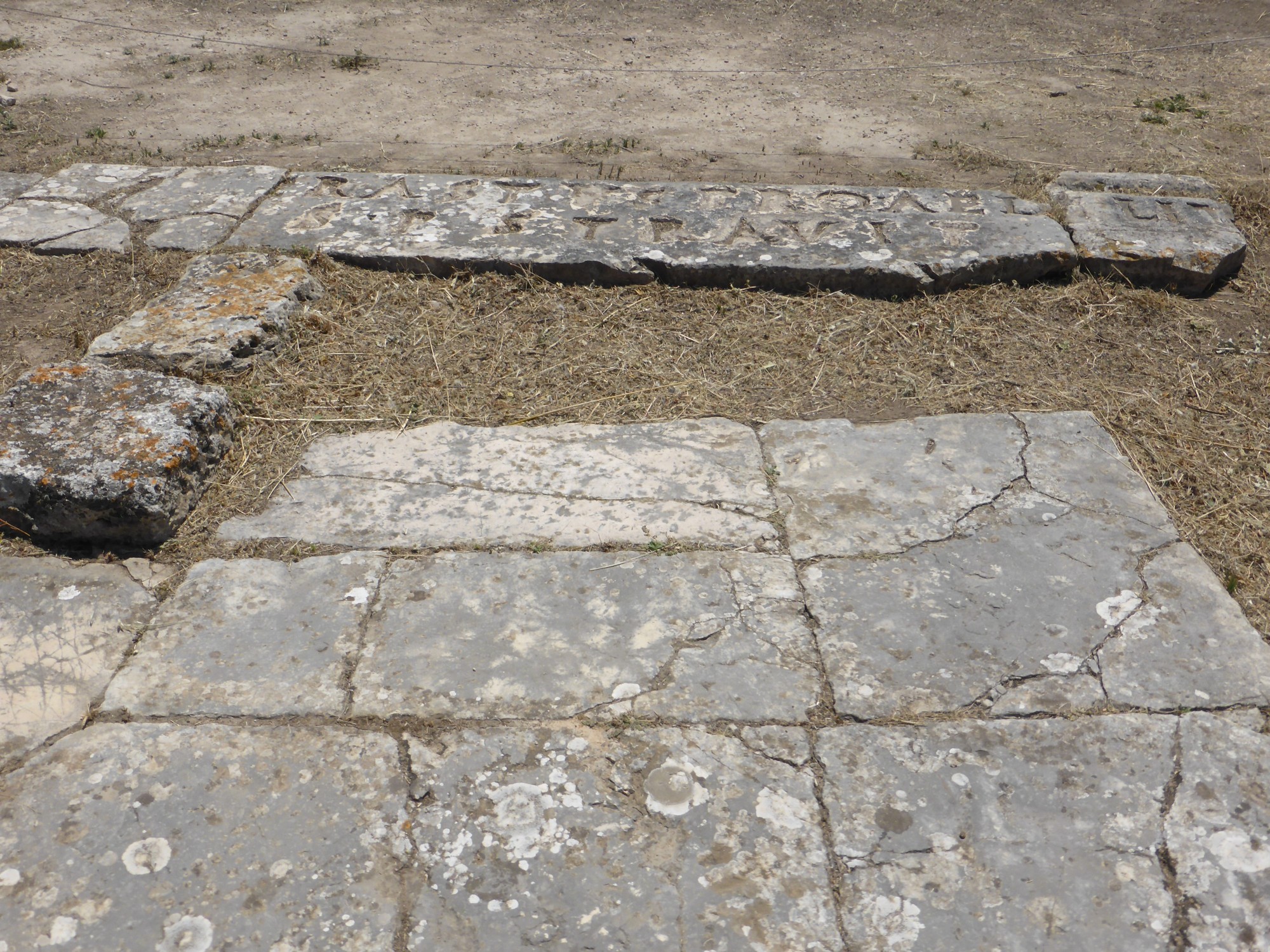
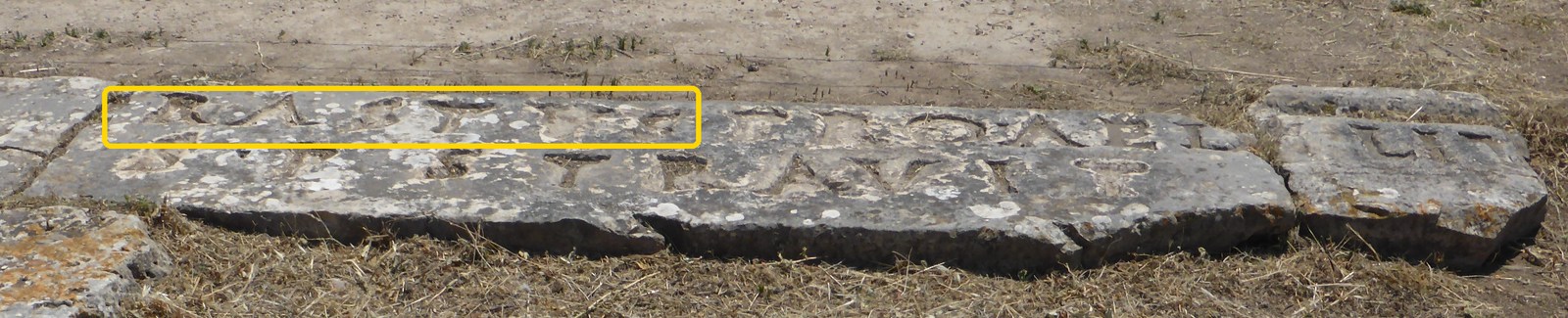
DisputedThe Erastus slab set in the pavement at ancient Corinth (top of the photo, with plain paving stones in front). Only the cut channels for the lost bronze letters remain. Ktiv, via Wikimedia Commons, CC BY-SA 4.0.
Gaius mine host, and of the whole church, saluteth you. Erastus the chamberlain of the city saluteth you, and Quartus a brother.
Romans 16:23, KJV
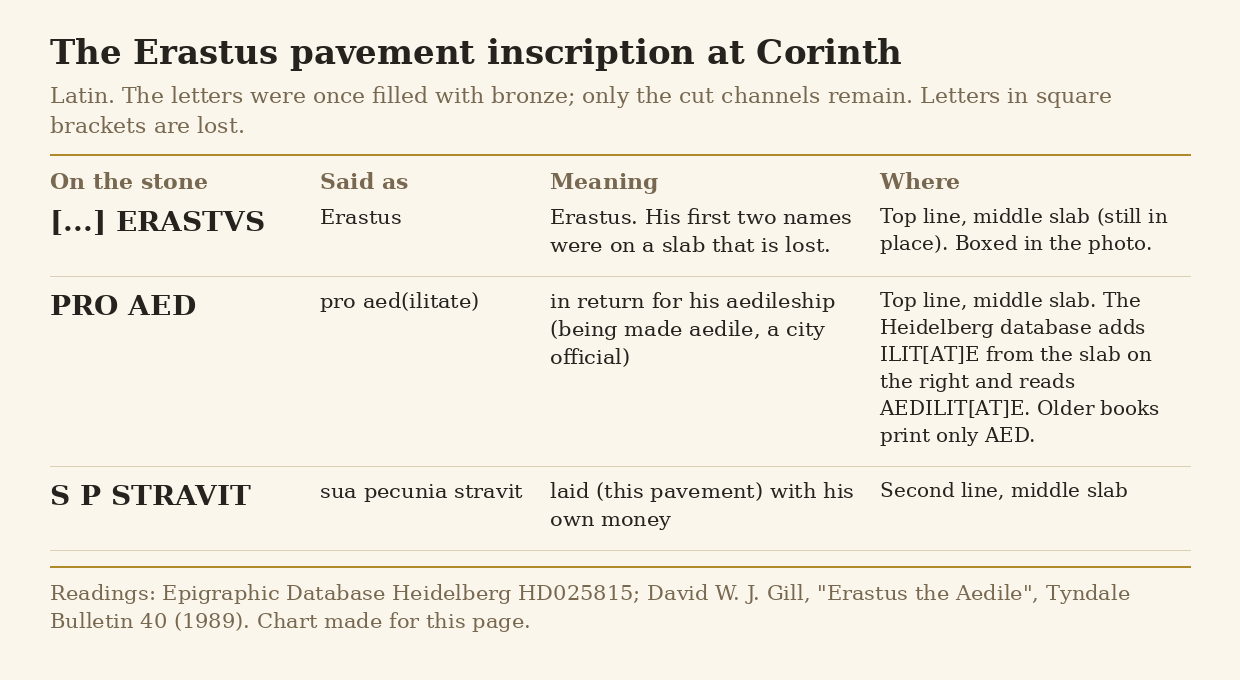
A Latin inscription set into a stone pavement at Corinth says that a man named Erastus laid the pavement at his own expense in return for being made aedile. An aedile was one of two city officials, elected each year, who looked after streets, public buildings and markets. In Romans 16:23, a letter almost certainly written from Corinth, Paul sends greetings from "Erastus the chamberlain of the city", that is, a city official in charge of money or property. A man named Erastus also travels with Paul in Acts 19:22 and stays at Corinth in 2 Timothy 4:20. The photo and chart below show the name ERASTVS where it is cut into the pavement.
Photo of the Erastus inscription in the pavement at ancient Corinth, taken at a low angle from in front of the slab. The yellow box, added for this page, marks the first word of the top line on the middle slab, ERASTVS, "Erastus". The bronze letters are gone and only the cut channels remain. They are worn and spotted with lichen, so the letters are hard to make out at this angle, and the first letter, E, at the worn left end of the slab, is very faint. The rest of the top line reads PRO AED, and the line below reads S P STRAVIT. Ktiv, via Wikimedia Commons, CC BY-SA 4.0.The words of the Erastus inscription in Latin, with how they sound and what they mean. The slab still in place ends the top line with AED. Books written before the last piece was found in 1947 print only that; the Heidelberg database joins the pieces of the slab on the right and reads AEDILIT[AT]E. Chart made for this page, free to reuse.
Where it is today
Ancient Corinth, Greece. The paving had three inscribed slabs side by side. The middle slab, which holds most of the surviving letters, still lies where it was found in 1929, in the paved square east of the theatre. The slab to its right was found in two pieces, one in 1928 in the east side entrance of the theatre and the rest in 1947 in a later building south-west of the theatre. The slab on the left, which held his first names, is lost. Published as J. H. Kent, Corinth volume 8, part 3, no. 232.
Date
Debated. Kent, who published it, dated it to about the middle of the first century AD (the Heidelberg database gives AD 31 to 70). Steven Friesen has argued for the second century AD.
Why this label: The inscription is real and names an Erastus who held office at Corinth. Whether he is the Erastus of Romans 16:23 is debated, because both the date of the pavement and the meaning of Paul's title for him are argued.
Good to know
For the link: Kent, who published the stone, held that it dates from about the middle of the first century, that the name Erastus was not common at Corinth, and that the Greek word Paul uses could describe a Corinthian aedile. Timothy Brookins later collected the known examples of the name and showed that it was in fact rare.
Against the link: Henry Cadbury, and later Steven Friesen, argued that Paul's Erastus held a lower post, perhaps even as a slave owned by the city. Friesen also pointed out that the first editors dated the stone to the first century partly because they linked it with Paul, so the argument took for granted the very link it was meant to support. He argues the pavement was laid in the second century. Brookins, reviewing Friesen's study, agreed with that point but noted that the later date rests mainly on the unpublished views of one archaeologist, so it is not yet shown.
A middle view: Gerd Theissen took Paul's title to mean a lower city post, the city treasurer (in Latin, quaestor), and Victor Furnish suggested that Erastus held that post first and became aedile later. On that view both could be the same man.
Where it stands: David Gill concluded that the evidence allows neither a certain identification nor a certain rejection.
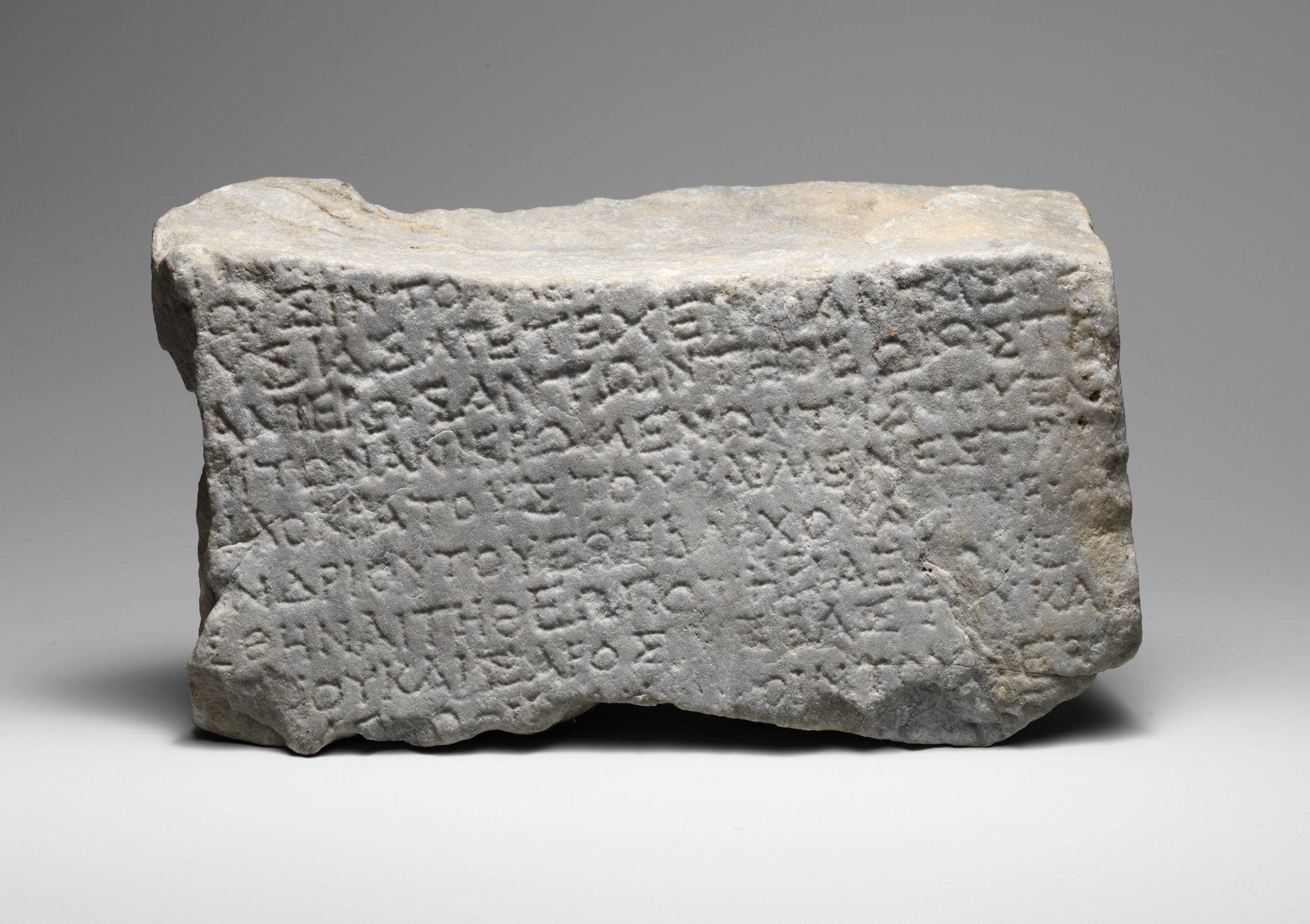
DisputedMarble fragment from Cyprus with a Greek decree about temple offerings, first half of the first century AD. The Met says it contains the Roman name Quintus Sergius, which some scholars link to the governor in Acts (The Met 74.51.2425). The Metropolitan Museum of Art, The Cesnola Collection, Purchased by subscription, 1874-76, Public Domain (The Met Open Access, CC0).
Which was with the deputy of the country, Sergius Paulus, a prudent man; who called for Barnabas and Saul, and desired to hear the word of God.
Acts 13:7, KJV
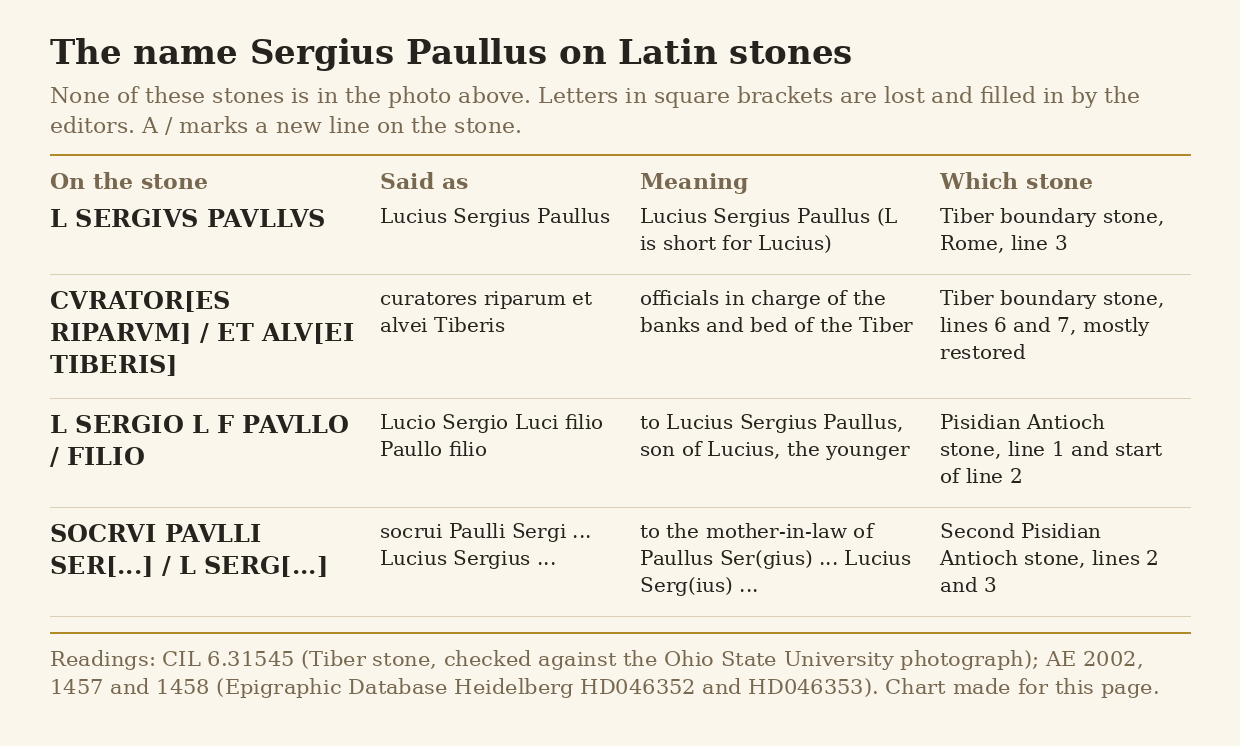
Acts 13 says that at Paphos on Cyprus, Paul and Barnabas met the island's Roman governor ("deputy" in the King James Version), Sergius Paulus, who believed after the sorcerer Elymas was struck blind. Several inscriptions name men of a Sergius Paullus family (Paullus is the Latin spelling of Paulus), and some have been linked to this governor. None of them names a Sergius Paulus as governor of Cyprus, so each link is a matter of judgment. The chart below gives the Latin words of the stones that name men of the Sergius Paullus family.
Latin readings of the stones that name a Lucius Sergius Paullus: the Tiber boundary stone in Rome and two stones from Pisidian Antioch. None of these stones is in the photo. Chart made for this page, free to reuse.
Where it is today
Rome: the Tiber boundary stone is in the National Roman Museum (Baths of Diocletian), published as CIL 6.31545. Pisidian Antioch: stones found near Yalvaç, Turkey (one is in the Yalvaç museum). Cyprus: the Soloi stone is reported to be in the Cyprus Museum, Nicosia; a fragment from Cyprus naming a Quintus Sergius is in The Metropolitan Museum of Art, New York (74.51.2425).
Date
The Tiber stone dates from the reign of Claudius (AD 41 to 54). It does not give Claudius the title censor, which he took in AD 47, so the historian Edmund Groag dated it to AD 41 to 47. An older museum label gives AD 47, and Bryan Windle places it in the middle 40s. Paul's visit to Cyprus is usually placed between about AD 45 and 48.
Why this label: Real inscriptions show an important Sergius Paullus family in the first century, including a Lucius Sergius Paullus in office in Rome under Claudius. No stone calls a Sergius Paulus governor of Cyprus, so tying any of them to the man in Acts is a reasonable suggestion, not a proven fact.
Good to know
Rome: The strongest candidate is a boundary stone found in 1887 on the bank of the Tiber. It lists Lucius Sergius Paullus as one of five officials in charge of the river's banks and bed under Claudius. Ben Witherington and Bryan Windle think the same man could have governed Cyprus before or after this post, but the stone does not mention Cyprus, and the scholar T. B. Mitford called the match "at best a conjecture", that is, a guess. Mitford also noted that it is not certain the governor in Acts was named Lucius at all.
Pisidian Antioch: Two stones near Yalvaç in Turkey name the family. One honours Lucius Sergius Paullus the younger, son of Lucius. The other is broken; it mentions the mother-in-law of a Paullus Sergius, and a Lucius Sergius. They show the family had ties to Pisidian Antioch, the next city Paul visited (Acts 13:14). The idea that the governor sent Paul there is a guess; Acts does not say so.
Cyprus: A Greek stone from Soloi mentions a proconsul named Paulus, with no other name; Mitford thought it was probably considerably later than Paul's visit. A fragment from Cyprus in The Met names a Quintus Sergius, but his last name and the date are lost.
The politarchs, the "rulers of the city" at Thessalonica
Acts 17:6 · Acts 17:8
ConfirmedOld photograph of the politarch inscription in place on the Vardar Gate (also called the Golden Gate), Thessalonica, before 1874. Photo by Richard Wilkison, published by E. D. Burton in 1898, via Wikimedia Commons, Public domain.
And when they found them not, they drew Jason and certain brethren unto the rulers of the city, crying, These that have turned the world upside down are come hither also;
Acts 17:6, KJV
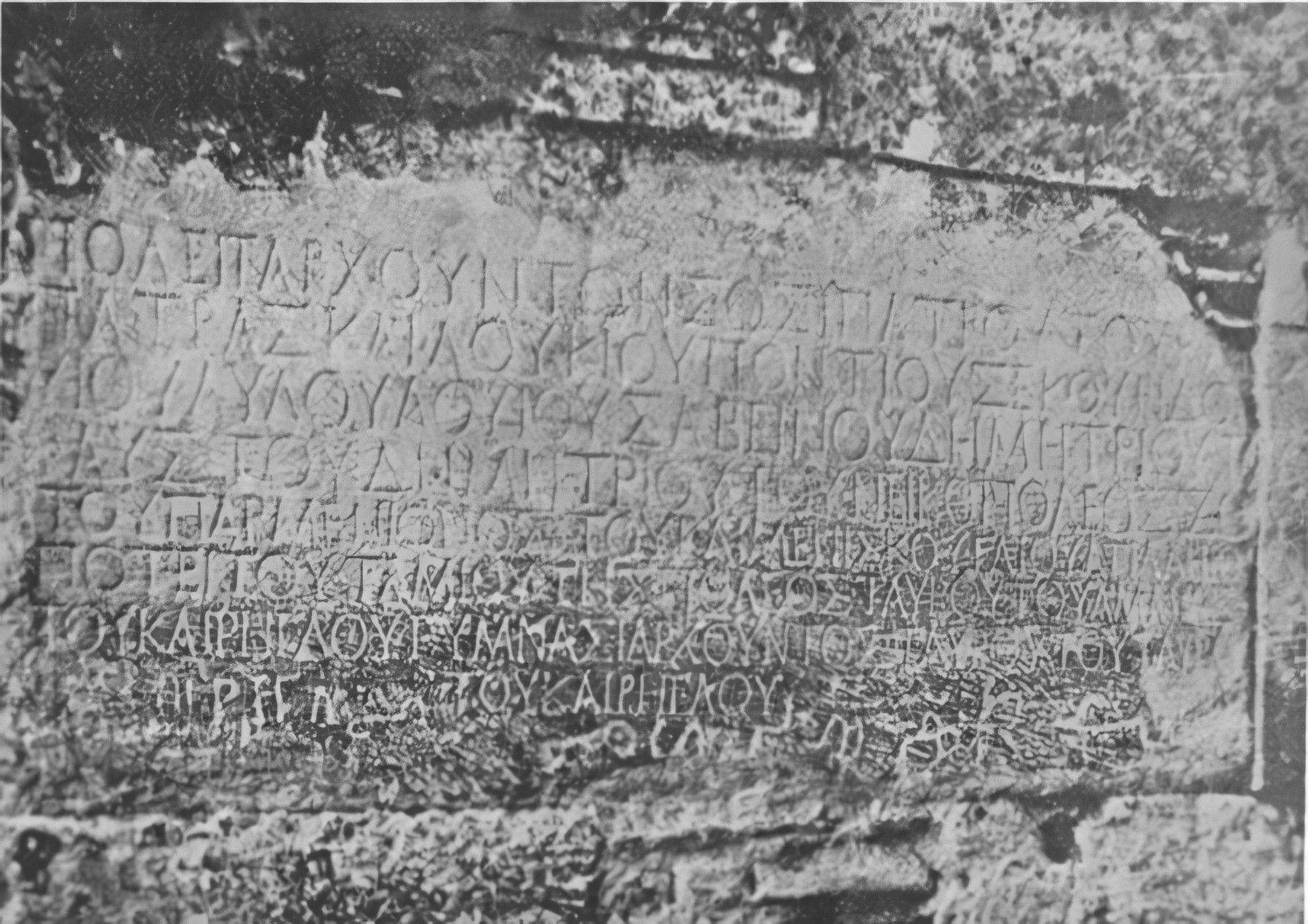
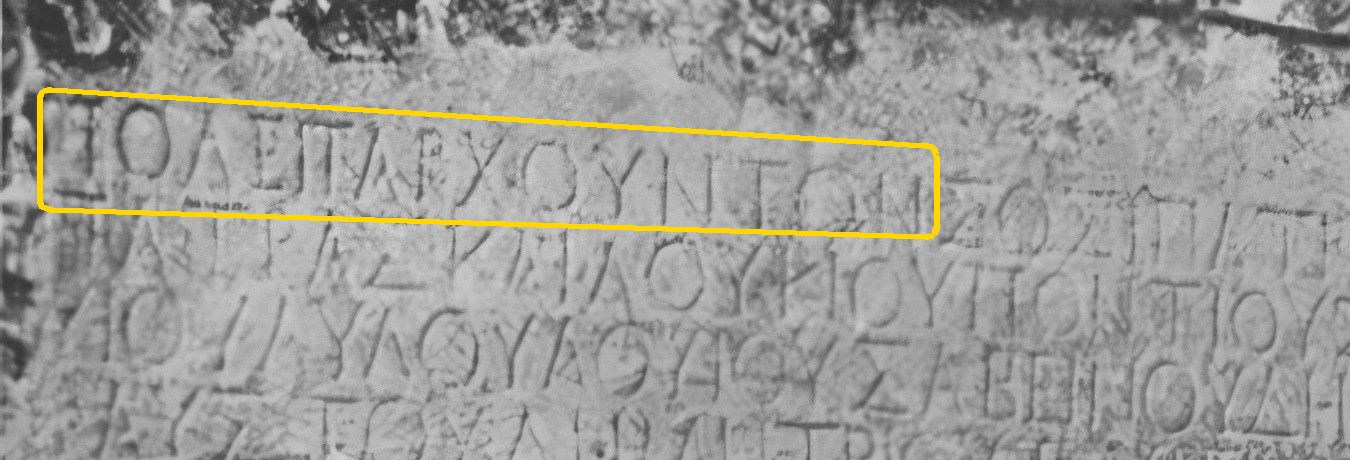
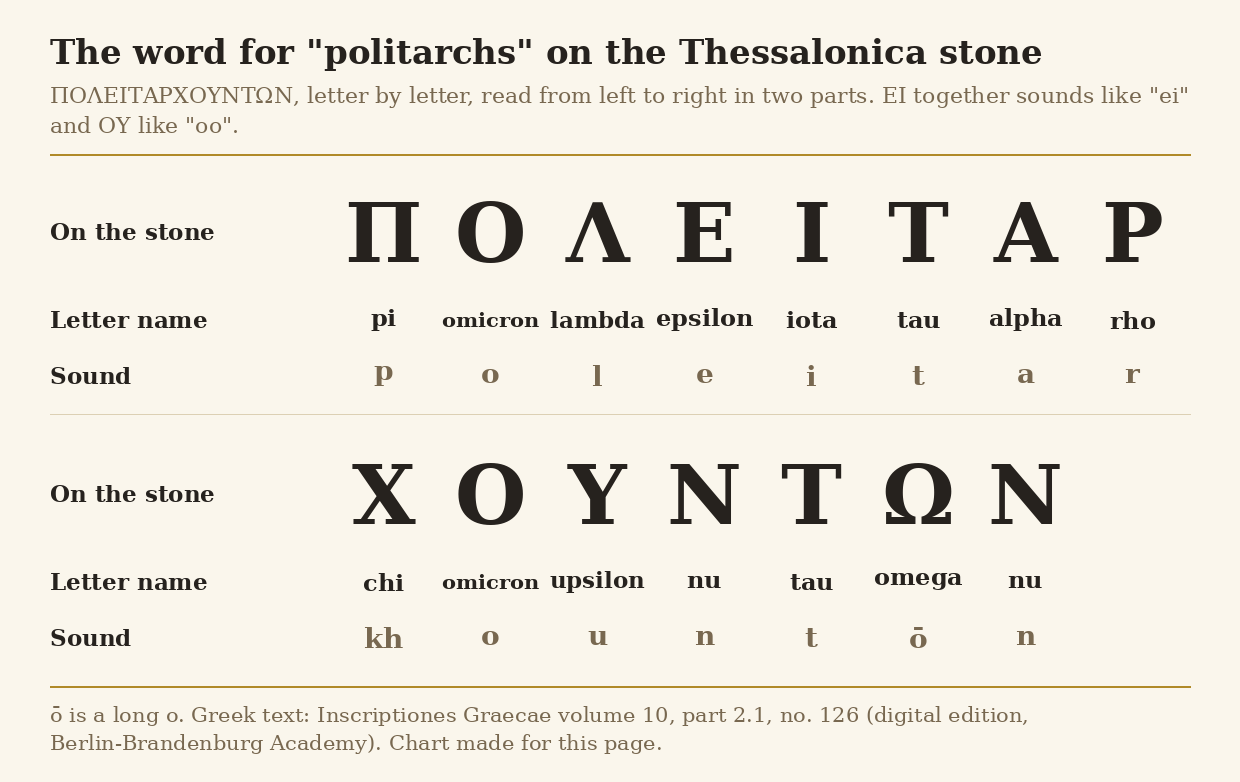
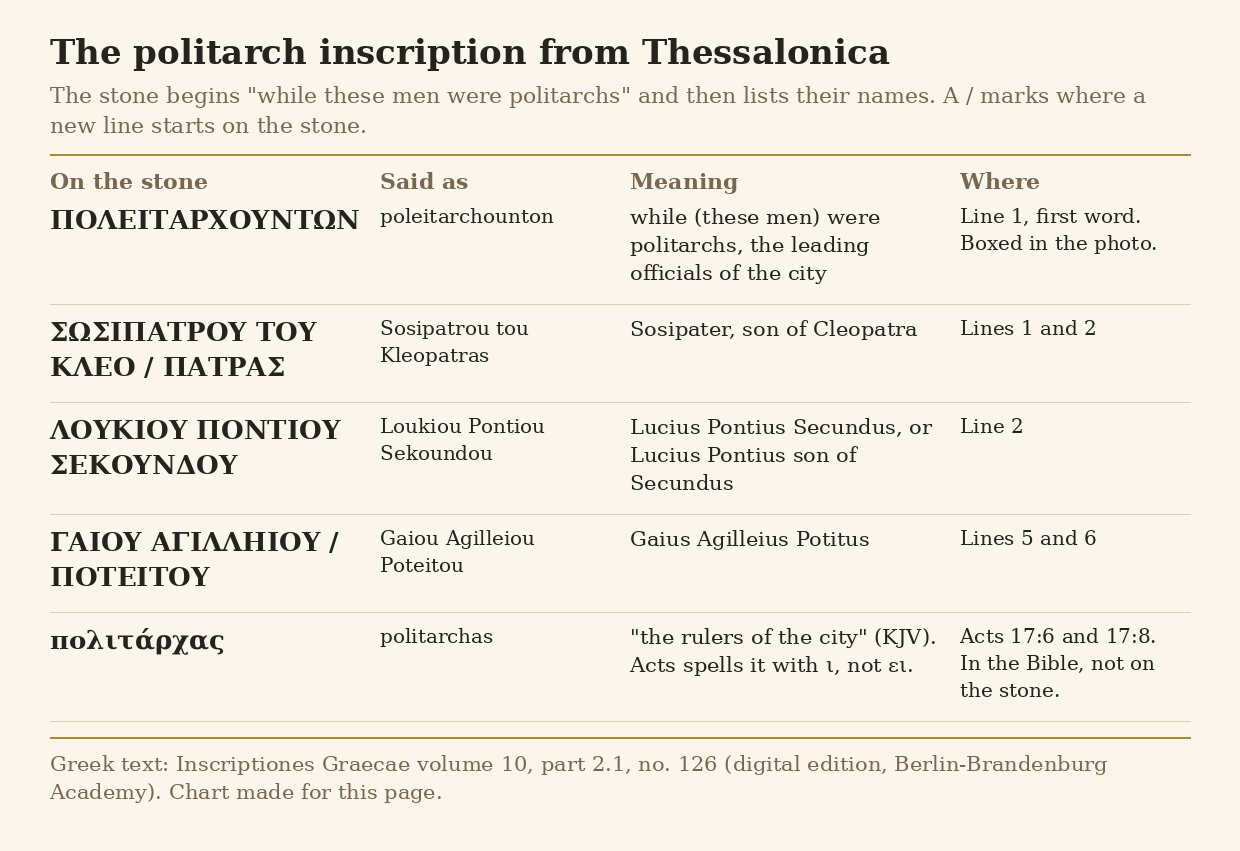
In Acts 17 a crowd in Thessalonica drags Jason and other believers before "the rulers of the city". Luke's Greek word is politarchas, "politarchs", a title for the leading officials of a city. A marble block that was built into the Vardar Gate of Thessalonica begins with the words "while ... were politarchs" and then lists their names. It is now in the British Museum, and many other inscriptions from Macedonia, a good number of them from Thessalonica, use the same title. The photo and charts below show the word for "politarchs" as it is carved at the start of the stone.
Old photograph, taken before 1874, of the politarch inscription when it was still set in the Vardar Gate at Thessalonica; the stone is now in the British Museum. The yellow box, added for this page, marks the first word of line 1, ΠΟΛΕΙΤΑΡΧΟΥΝΤΩΝ (said poleitarchounton), "while (these men) were politarchs". The line slopes down a little to the right, so the box does too. The names of the politarchs follow it. Richard Wilkison, published by E. D. Burton in 1898, via Wikimedia Commons, Public domain.The word ΠΟΛΕΙΤΑΡΧΟΥΝΤΩΝ as it is carved on the stone, letter by letter, with each letter's name and sound. Chart made for this page, free to reuse.The first words of the inscription and the names of the politarchs, with how they sound and what they mean, compared with the word Luke uses in Acts 17. Chart made for this page, free to reuse.
Where it is today
British Museum, London. The block was built into the Vardar Gate on the west side of Thessalonica (Thessaloniki, Greece) until the gate was pulled down in the 1870s; it was removed in 1877 and taken to the British Museum. It is not always on display, so check before planning a visit.
Date
First half of the first century AD, according to the standard edition (Inscriptiones Graecae, volume 10, part 2.1, no. 126). Some older works say the second century AD.
Why this label: Inscriptions from Thessalonica itself show that its leading officials were called politarchs, just as Luke says. The stone confirms the title; it does not mention the riot or anyone named in Acts 17.
Good to know
The old claim: Older Bible reference books say Luke's title was once dismissed as a mistake because no other example was then known. Whatever was said in the past, the title is now well proven on stone; the earliest known example comes from Amphipolis in the time of King Perseus of Macedon, in the second century BC.
Same names: The stone includes the names Sosipater, Secundus and Gaius, names also found among Paul's helpers (Romans 16:21; Acts 20:4; Acts 19:29). These were common names, and there is no reason to think they are the same people.
How many: The British Museum notes that modern editions count the politarchs on this stone in different ways.
Claudius expels the Jews from Rome, and Suetonius's "Chrestus"
Acts 18:2 · Acts 18:18
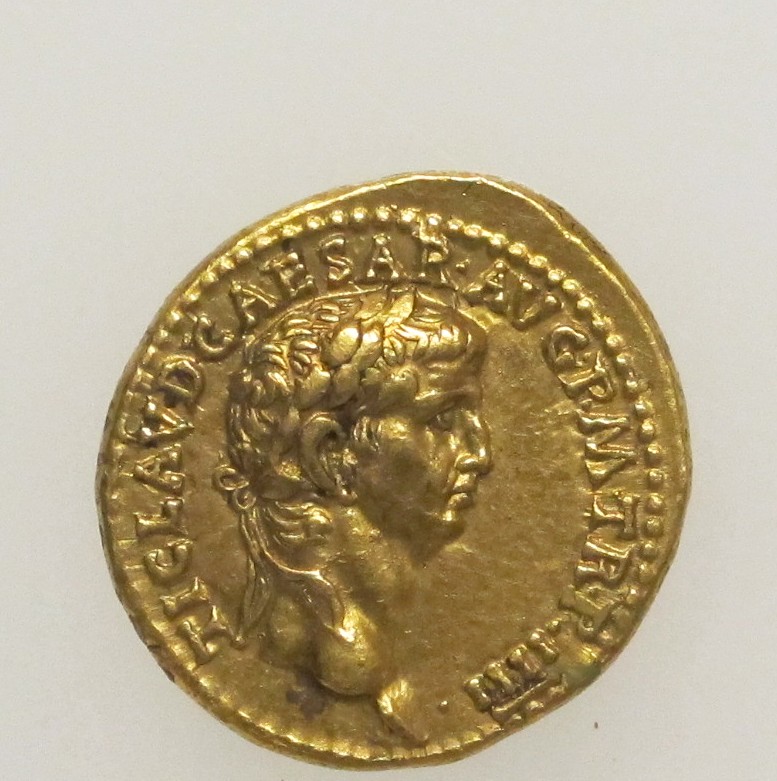
ConfirmedGold coin (aureus) of Claudius showing his head, in The Met (99.35.138). The Latin around the head ends with the number "IIII" (4), which points to AD 44; The Met's record dates the coin to AD 41 to 42. The Metropolitan Museum of Art, Gift of Joseph H. Durkee, 1899, Public Domain (The Met Open Access, CC0).
And found a certain Jew named Aquila, born in Pontus, lately come from Italy, with his wife Priscilla; (because that Claudius had commanded all Jews to depart from Rome:) and came unto them.
Acts 18:2, KJV
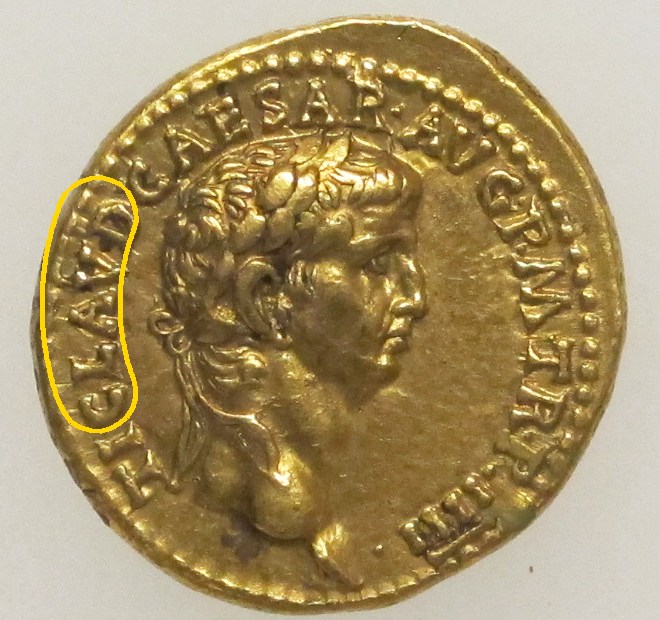
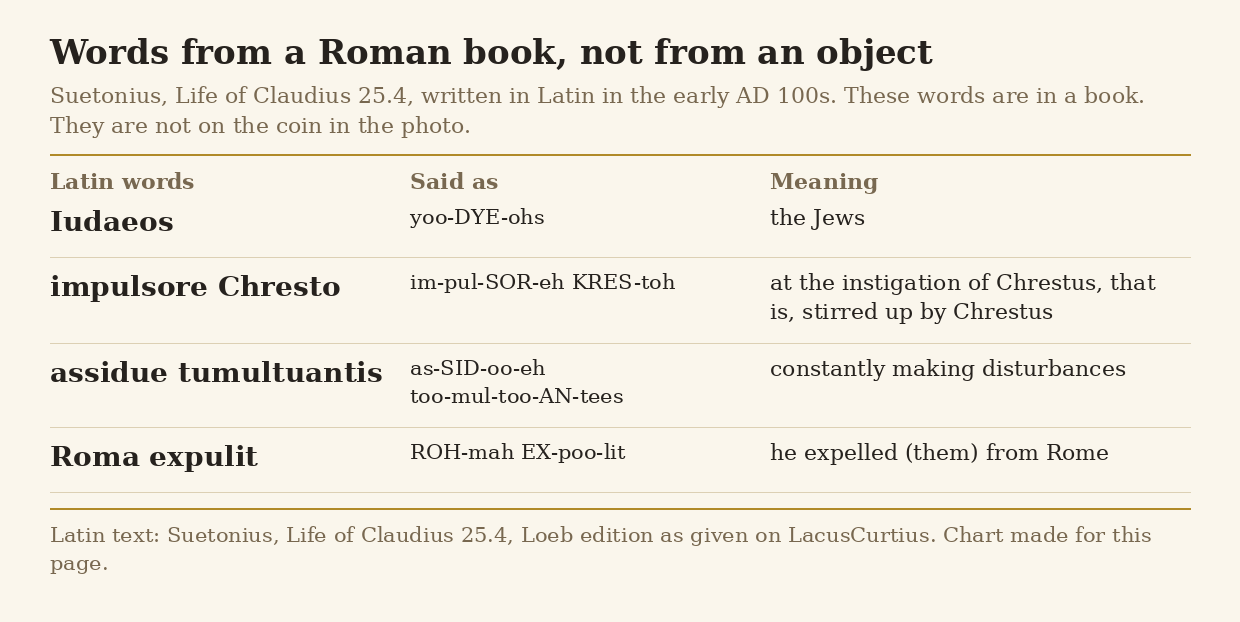
Acts 18:2 says Paul met Aquila and Priscilla in Corinth because the emperor Claudius had ordered all Jews to leave Rome. The Roman writer Suetonius, writing in the early second century AD, says the same emperor "expelled them from Rome" because "the Jews constantly made disturbances at the instigation of Chrestus", that is, stirred up by Chrestus. Many scholars think "Chrestus" is a mistaken form of "Christ", and that the quarrels were between Jews who did and did not accept Jesus as the Messiah. Others disagree. The photo below marks the emperor's name on one of his coins, and the chart gives the key Latin words of Suetonius.
Photo of a gold coin (aureus) of the emperor Claudius in The Metropolitan Museum of Art. The yellow box, added for this page, marks CLAVD, short for Claudius, in the Latin around his head. The whole legend reads TI CLAVD CAESAR AVG P M TR P "IIII" (4). In plain words: Tiberius Claudius Caesar Augustus, chief priest, holding the powers of a tribune for the 4th time. Those powers were renewed each January, and his 4th term ran from January AD 44 to January AD 45. The coin catalogue Roman Imperial Coinage (online as OCRE) lists gold coins with this legend under AD 44. The Met's own record dates this coin to AD 41 to 42, which does not fit the number on it. The words of Suetonius about the Jews are in a book, not on this coin. The Metropolitan Museum of Art, Gift of Joseph H. Durkee, 1899, Public Domain (The Met Open Access, CC0).The key Latin words of Suetonius about Claudius sending the Jews out of Rome. These words come from a Roman book, not from an object. Chart made for this page, free to reuse.
Where it is today
This is a written record, not an object: Suetonius, Life of Claudius, chapter 25, section 4, copied in medieval manuscripts. The photo shows a gold coin of Claudius in The Metropolitan Museum of Art, New York (99.35.138).
Date
Sometime in the reign of Claudius (AD 41 to 54). Many scholars date it to AD 49, following the later Christian writer Orosius; others link it to AD 41.
Why this label: A Roman historian who was not a Christian reports, on his own, that Claudius expelled Jews from Rome, which is what Acts 18:2 says. The year, how many people had to leave, and who "Chrestus" was are still debated.
Good to know
The later date: Orosius, a Christian writer of the early fifth century, says Josephus placed the expulsion in Claudius's ninth year, which is AD 49. No such passage is found in our copies of Josephus, so some scholars, such as Dixon Slingerland and Louis Feldman, distrust the date, while others, such as Mary Smallwood and Rainer Riesner, think Orosius may have drawn on a real record. AD 49 fits well with the Gallio date for Paul in Corinth.
The earlier date: The historian Cassius Dio says that early in his reign, about AD 41, Claudius did not drive the Jews out but banned their meetings. Some think this was a first, smaller step; others think Suetonius and Dio describe the same event.
Who was Chrestus: Chrestus was a common name at the time, especially for slaves, so some scholars think he was an unknown troublemaker in Rome.
How many left: Acts says "all Jews"; some historians, such as Donna Hurley, think the order affected only part of the Jewish community, since neither Tacitus nor Cassius Dio reports a large expulsion in AD 49 or 50.
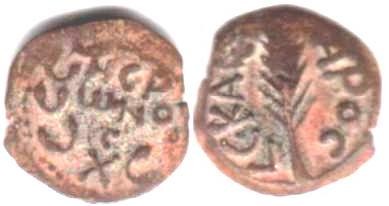
ConfirmedBronze prutah dated year 5 of Nero (AD 58 to 59), usually called a coin of Porcius Festus. Itamar (photographer), via Wikimedia Commons, Public domain.
But after two years Porcius Festus came into Felix' room: and Felix, willing to shew the Jews a pleasure, left Paul bound.
Acts 24:27, KJV
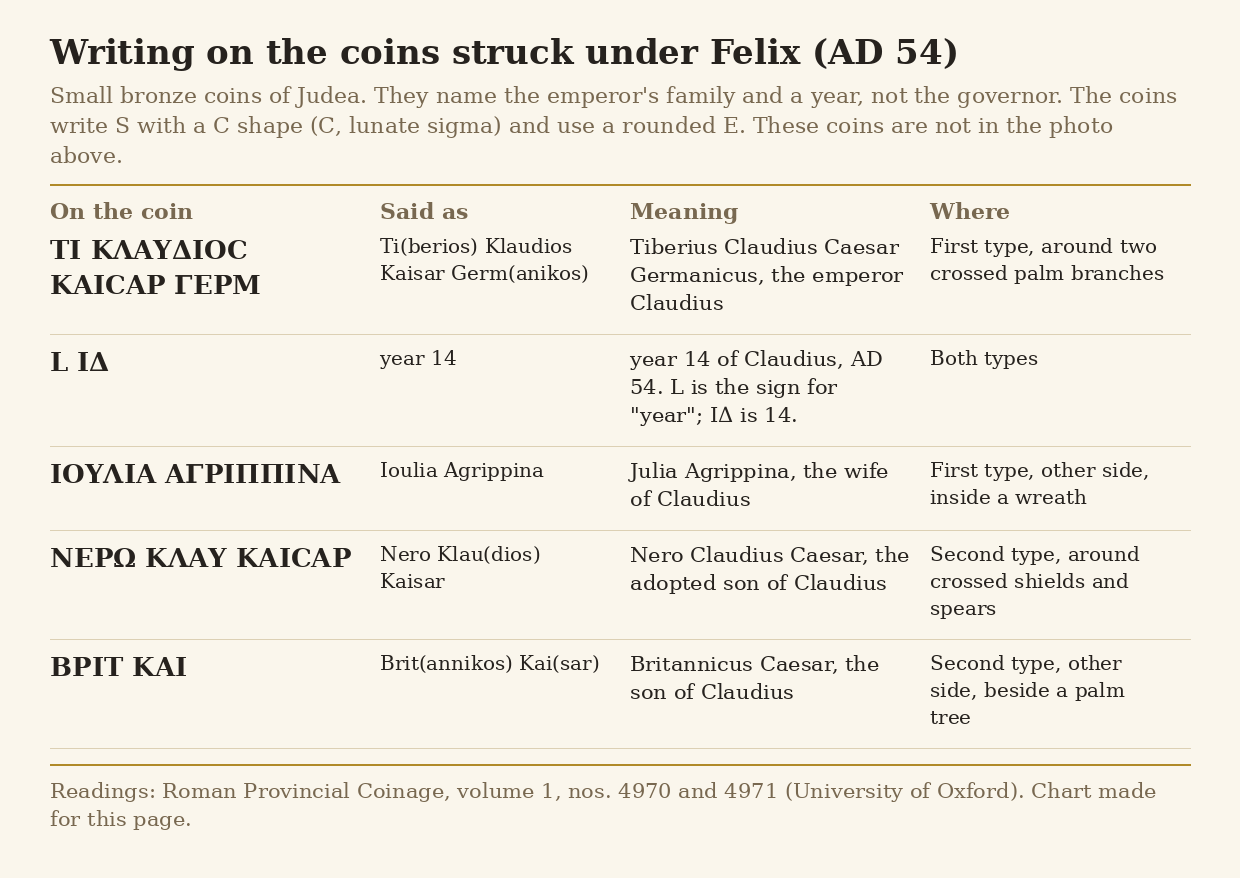
Acts 23 to 26 tells how Paul was held at Caesarea for two years under the Roman governor Felix, and then heard by his successor Porcius Festus, before whom Paul appealed to Caesar. Both men are well known from the Jewish historian Josephus. Small bronze coins called prutot were struck in Judea while each was in office. Like all coins of the Roman governors of Judea, they carry the emperor's name and a year, not the governor's name. The charts below give the Greek writing on these coins, letter for letter, with what it means.
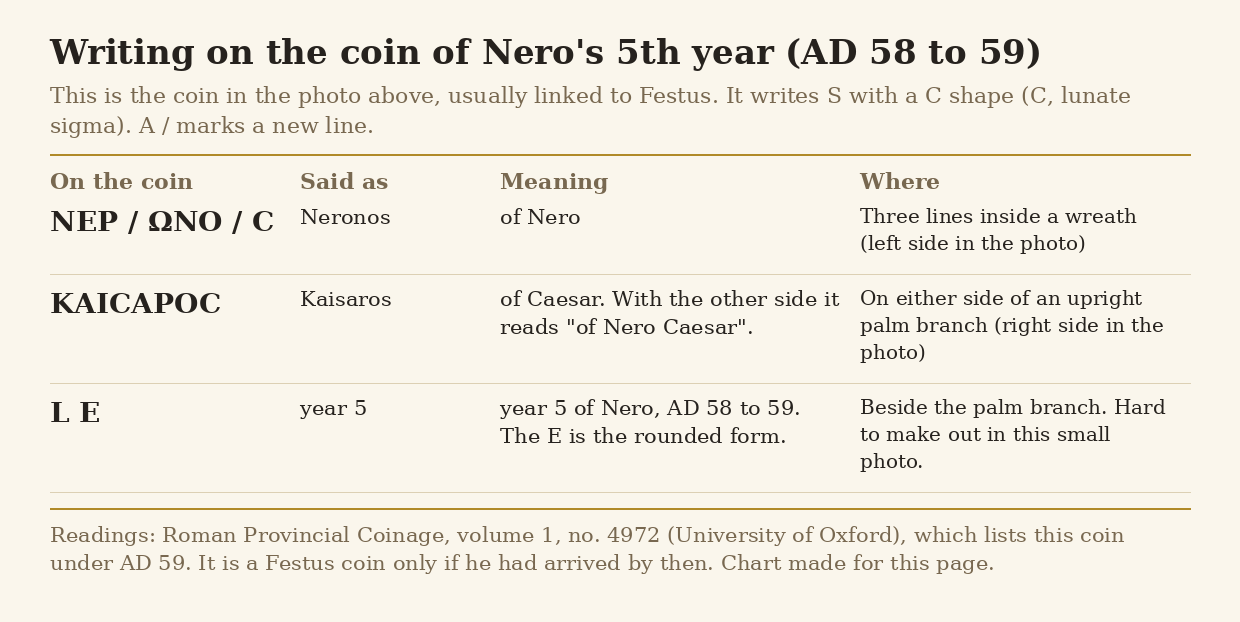
The writing on the coin in the photo above, from Nero's 5th year (AD 58 to 59): "of Nero Caesar" and the year. It is usually called a Festus coin; it was struck under Festus only if he had arrived by then. Chart made for this page, free to reuse.The writing on the two kinds of coin struck under Felix in AD 54, which name Claudius, his wife Agrippina and his sons Nero and Britannicus. These coins are not in the photo. Chart made for this page, free to reuse.
Where it is today
Many examples survive in museums and private collections. Standard catalogue numbers: Felix, Roman Provincial Coinage volume 1, nos. 4970 and 4971; Festus, no. 4972 (Meshorer 345).
Date
Felix's coins are dated year 14 of Claudius (AD 54); Felix governed from about AD 52 until Festus replaced him. The Festus coin is dated year 5 of Nero (AD 58 to 59); Festus took over at some time between about AD 58 and 60 (see Good to know) and died in office about AD 62.
Why this label: Josephus names both Felix and Festus as governors of Judea in this order, and the Roman historian Tacitus also writes about Felix, which matches Acts. The coins do not carry the governors' names. The Felix coins are dated within his term; the coin usually called a Festus coin belongs to Festus only if he had arrived by AD 59.
Good to know
What Josephus says: Claudius sent Felix, the brother of Pallas, to govern Judea. Felix persuaded Drusilla, a daughter of King Agrippa the First, to leave her husband and marry him (compare Acts 24:24). He arranged the murder of the high priest Jonathan, who kept criticizing him, and after his term he escaped punishment in Rome only because his brother Pallas pleaded for him. Nero then sent Festus, who fought armed bands and the sicarii (rebels who carried short curved daggers), and who died in office, after which Nero sent Albinus.
The dating debate: Proposed dates for Festus taking over run from AD 55 to 61, but most scholars choose AD 58 to 60. F. F. Bruce took the new coin of Nero's fifth year (AD 58 to 59) as a sign that the change came in AD 59. Scholars who date the change to AD 60 must give that coin to Felix instead.
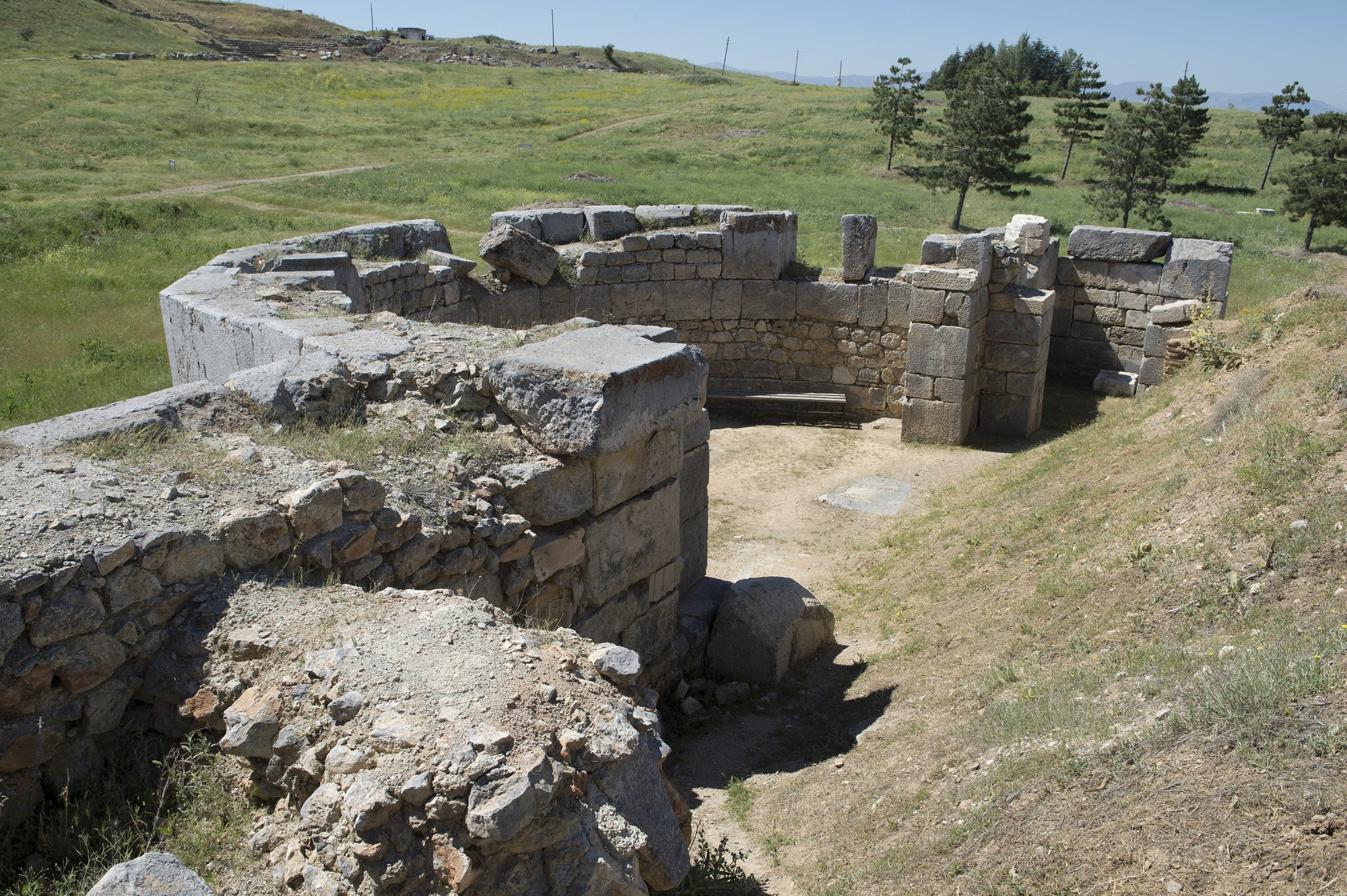
ConfirmedThe ruined east end of the Church of St Paul at Antioch in Pisidia: the curved wall of the apse (the rounded end of the church), with a modern wooden bench for visitors inside. Dosseman, via Wikimedia Commons, CC BY-SA 4.0.
But when they departed from Perga, they came to Antioch in Pisidia, and went into the synagogue on the sabbath day, and sat down.
Acts 13:14, KJV
Antioch in Pisidia was a Roman colony in the hills of central Turkey, in the Roman province of Galatia, near the border of Pisidia and Phrygia. Acts 13 says Paul spoke in its synagogue on the Sabbath, that on the next Sabbath almost the whole city came together to hear, and that the city's leading men then drove Paul and Barnabas out. The ruins lie about 1 km north-east of the modern town of Yalvaç. Visitors can see the city gate, the main streets, the temple of Augustus, the theatre and a large early church called the Church of St Paul. Pieces of a Latin copy of the Res Gestae, the list of his own deeds that Augustus left behind, were found near the gateway to the temple square of Augustus. (The Res Gestae is covered on an earlier page.)
Where it is today
Turkey, Isparta Province: the archaeological site about 1 km north-east of Yalvaç. Many finds from the area are shown in the Yalvaç Museum in the town.
Date
Founded in the 200s BC by a Greek king of the Seleucid family (Antiochus the First or the Second). Made a Roman colony for veteran soldiers by Augustus in 25 BC. Paul's first visit was on his first journey, which scholars usually date between about AD 46 and 49; he came back in Acts 14:21, and he probably passed through the region again in Acts 16:6 and 18:23. The Church of St Paul was first built in the 300s AD and later rebuilt.
Why this label: Scholars agree that these ruins near Yalvaç are the Roman colony of Antioch that Acts names. No inscription marks the synagogue, so the exact place where Paul spoke is not known.
Good to know
The synagogue question: The Church of St Paul is the traditional place of Paul's sermon. The local excavator has argued that walls under or beside the church belong to an earlier synagogue, and some guides now state this as fact. The sources checked for this page do not report an inscription or Jewish symbol that settles it, so treat it as a possibility only.
The digs: W. M. Ramsay first dug here from 1912 to 1914. A larger dig with the University of Michigan worked in 1924, and work ended by 1927. For about sixty years after that, local people took stone from the site for building. Digging started again in 1991 under the director of the Yalvaç Museum.
Lystra and Derbe (the inscriptions that fixed where they were)
Acts 14:6-21 · Acts 16:1-2 · 2 Timothy 3:11
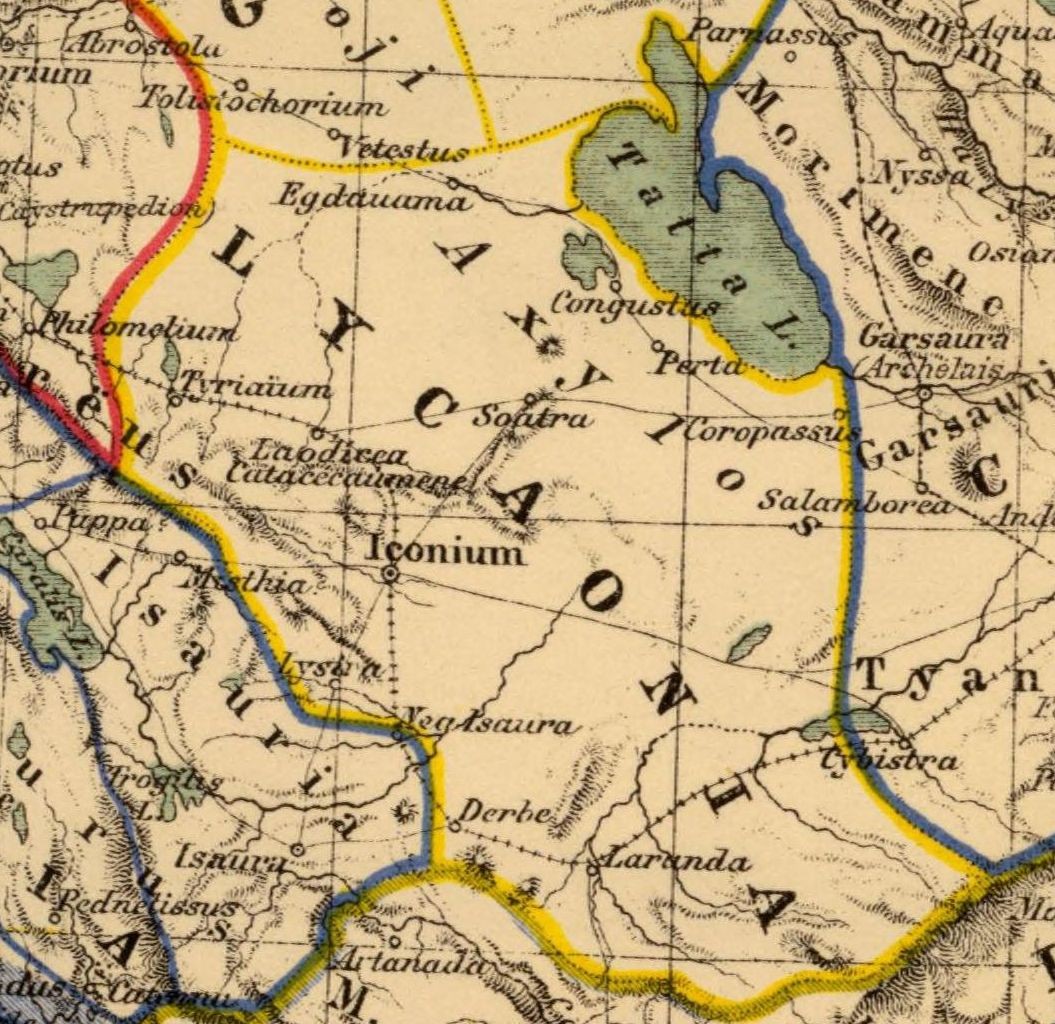
ConfirmedPart of Heinrich Kiepert's map of Lycaonia (dated 1903 on Commons). It marks Lystra south of Iconium, and Derbe further south-east, west of Laranda (modern Karaman). Heinrich Kiepert, 1903, via Wikimedia Commons, Public domain.
And they called Barnabas, Jupiter; and Paul, Mercurius, because he was the chief speaker.
Acts 14:12, KJV
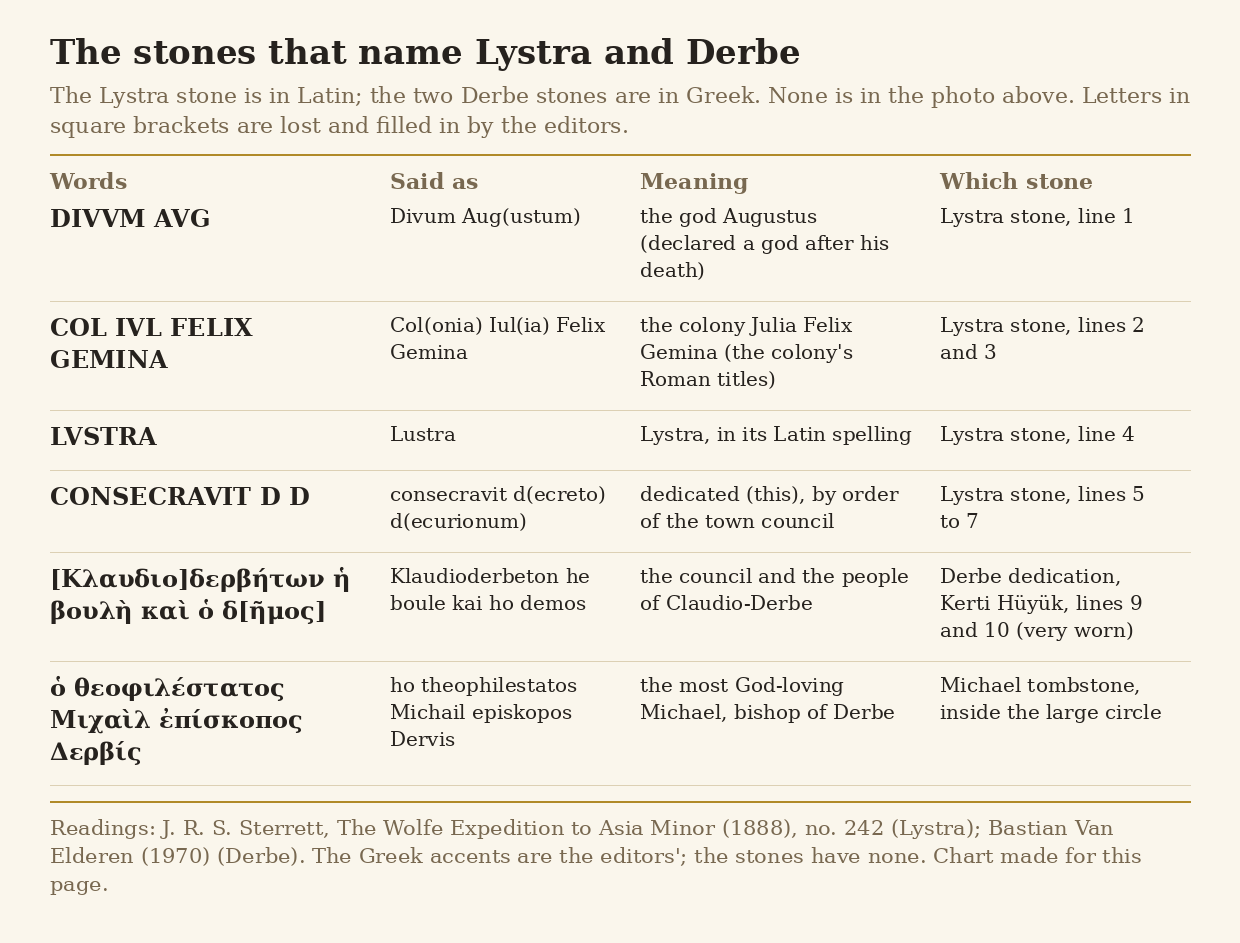
Lystra and Derbe were small towns of Lycaonia in central Turkey. At Lystra, Acts 14 says, Paul healed a lame man, was taken for a god, and was later stoned. In 1885 the American scholar J. R. S. Sterrett found a large stone base on a mound called Zoldera, just north of the village of Hatunsaray. It is carved in Latin with a dedication to the god Augustus by the Roman colony of Lustra (the Latin spelling of Lystra). Derbe was placed by two Greek inscriptions that name it. One is a dedication by the council and people of Claudio-Derbe, found in 1956 at the mound of Kerti Hüyük. The other is a tombstone of Michael, bishop of Derbe; the scholar M. H. Ballance reported that it came from Devri Şehri, about 4 km away, though local villagers said it came from Kerti Hüyük itself. In Acts 14:11-13 the crowd calls Barnabas and Paul by the names of Zeus and Hermes (the KJV uses the Latin names Jupiter and Mercurius), and inscriptions from this region show that Zeus and Hermes were worshipped together here. The chart below gives the words on the stones that name Lystra and Derbe.
The key words of the Latin stone that names Lystra and of the two Greek stones that name Derbe, with how they sound and what they mean. The Lystra words follow J. R. S. Sterrett (1888) and the Derbe words follow Bastian Van Elderen (1970). None of these stones is in the photo, which is an old map. Chart made for this page, free to reuse.
Where it is today
Lystra: the mound at Zoldera, about 1 km north of Hatunsaray, south-west of Konya, Turkey; it has never been fully excavated. Derbe: Kerti Hüyük, about 24 km north-north-east of Karaman, with Devri Şehri about 4 km to its south-south-east. The Lystra stone and the Derbe dedication are on display together, with an inscription from Iconium, at the Konya Archaeological Museum. The Michael tombstone was last reported in a storeroom in Karaman in 1968.
Date
Lystra stone: after AD 14, because it calls Augustus a god, which Rome did only after his death; usually called first century AD. Derbe dedication: AD 157 (some give AD 156 to 157), in the reign of Antoninus Pius. Michael tombstone: about the late 300s to 400s AD, judged by its letter shapes. Paul's visits: first journey about AD 46 to 49 (Acts 14), again in Acts 16:1, and probably in Acts 18:23.
Why this label: Lystra is fixed by a Latin inscription found on the mound itself that names the colony. Derbe's area is fixed by two inscriptions that name it, but scholars still debate whether the town stood on Kerti Hüyük itself or at Devri Şehri nearby.
Good to know
Older maps: Before 1956 most Bible maps put Derbe at Gudelisin, about 50 km farther west. That choice rested on surface ruins, with no inscription naming the town, so older maps put Derbe in the wrong area.
Zeus and Hermes: Inscriptions found in this region in 1909 name priests of Zeus and a statue of Hermes Most Great set up with a sundial for Zeus the sun god. A 2024 study notes that altars to Zeus and Hermes are found mostly around Lystra, and the Roman poet Ovid told a story of the two gods visiting an old couple in nearby Phrygia. This shows that the crowd's reaction in Acts 14 fits the local religion; it does not prove the healing.
Still to dig: Lystra has never been fully excavated, and the scholar W. M. Ramsay was already calling for a dig in 1907.
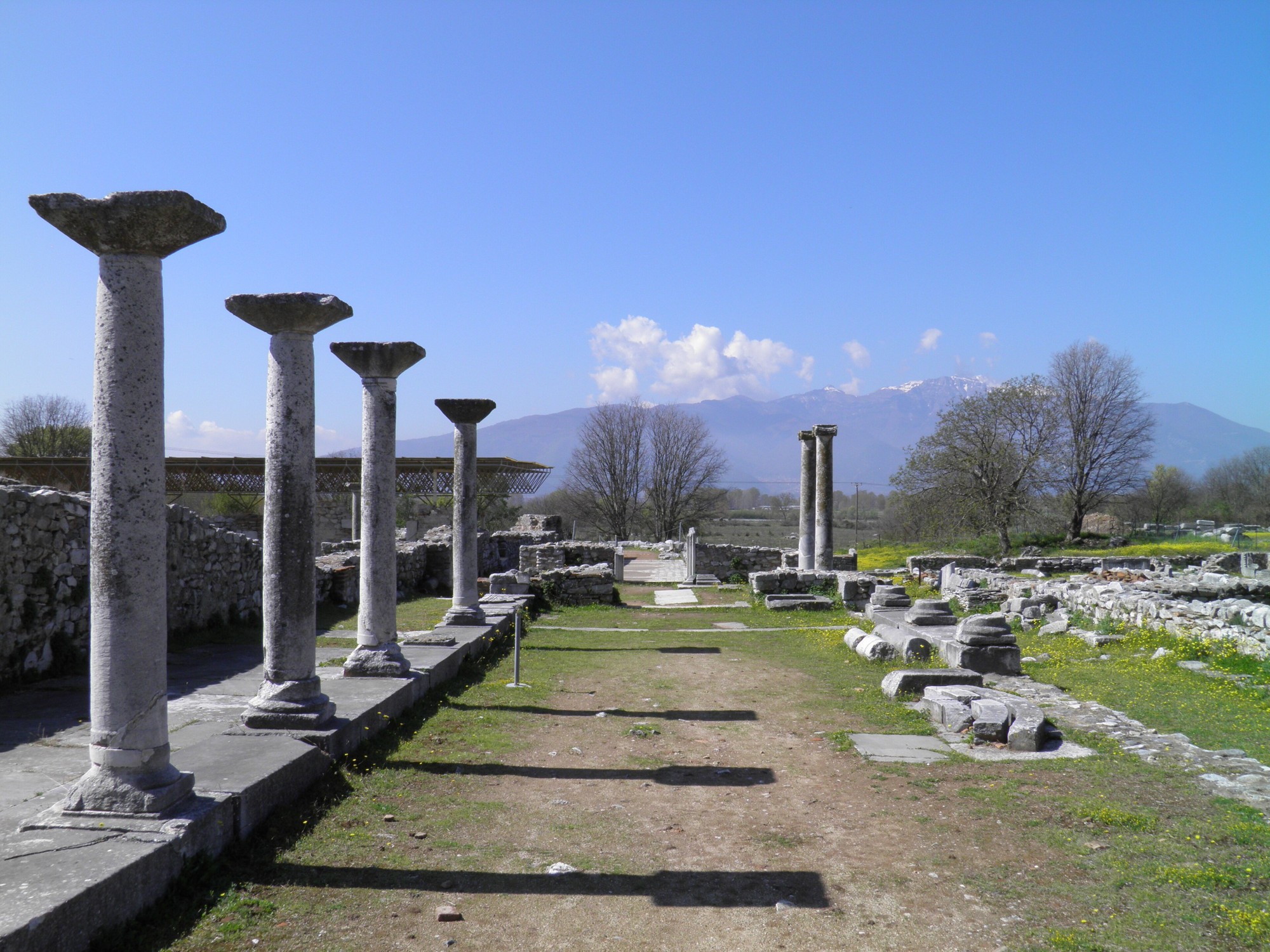
ConfirmedColumns and paving in the Roman forum of Philippi, with mountains behind. Carole Raddato from FRANKFURT, Germany, via Wikimedia Commons, CC BY-SA 2.0.
And from thence to Philippi, which is the chief city of that part of Macedonia, and a colony: and we were in that city abiding certain days.
Acts 16:12, KJV
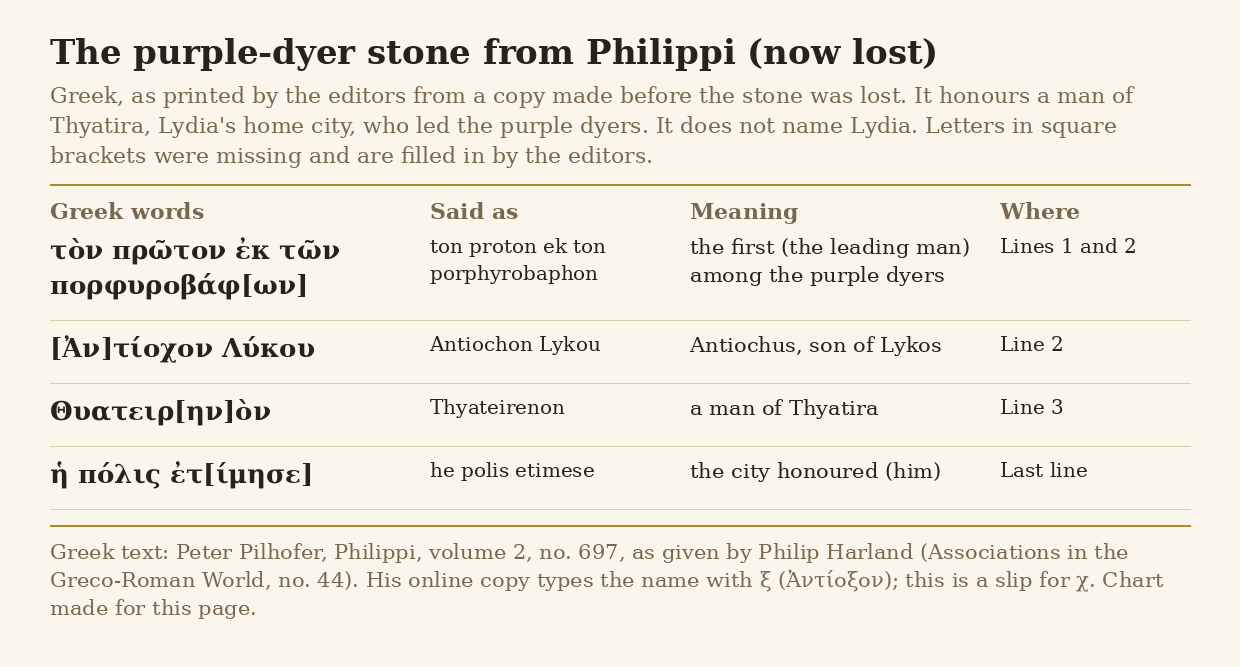
Philippi was a city in north-eastern Greece that Rome refounded as a colony for veteran soldiers after the Battle of Philippi in 42 BC; it was later named Colonia Augusta Iulia Philippensis. Acts 16:12 rightly calls it a colony, and its officials and Roman ways fit the story of Paul and Silas being beaten and jailed. The great Roman road across northern Greece, the Via Egnatia, ran through the city beside the forum, and both can still be walked today. Acts 16:13-15 says Paul met Lydia, a seller of purple from Thyatira, at a place of prayer by a river outside the city. A stone once seen at Philippi, now lost, honoured a man from Thyatira, Lydia's home city, who led the purple dyers; its words are in the chart below, and it is described under Good to know.
The key Greek words of a lost stone from Philippi that honoured Antiochus son of Lykos, a man of Thyatira and the leader of the purple dyers. Lydia also came from Thyatira and sold purple, but the stone does not name her. Because the stone is lost, the words follow the printed edition of Peter Pilhofer (Philippi, volume 2, no. 697), as given online by Philip Harland. Chart made for this page, free to reuse.
Where it is today
Greece, Eastern Macedonia: the Archaeological Site of Philippi beside the village of Krinides, inland from Kavala (ancient Neapolis, the port of Acts 16:11). It is a UNESCO World Heritage Site.
Date
Settled from Thasos as Krenides and refounded by Philip the Second of Macedon about 356 BC; Roman colony from 42 BC; Paul's first visit about AD 49 to 50. The forum seen today was built in stages from the reign of Claudius (AD 41 to 54) to that of Antoninus Pius (AD 138 to 161). Basilica A, near the prison cistern, dates to the late 400s AD.
Why this label: The city's name, its place on the Via Egnatia and its rank as a Roman colony all match Acts, and the site has never been in doubt. The prison and the spot where Lydia was baptized are traditions only.
Good to know
Confirmed parts: The city, the colony, the Via Egnatia and the forum area are certain, though most of the forum we see was rebuilt after Paul's day.
The prison: The small cell shown to visitors as Paul's prison was first a Roman water cistern. Early Christians later turned it into a small shrine with paintings of Paul's arrest, his release and the baptism of the jailer's family. Nothing shows that Paul was held there.
The river: Acts does not name the river. A modern open-air place for baptism and a modern church of Lydia stand by the Zygaktis stream, a short way west of the ancient city, at the place tradition chose.
Purple dyers: A Greek inscription seen at Philippi in the late 1800s, and now lost, honours Antiochus son of Lykos, a man of Thyatira and the leading man among the purple dyers. Some scholars doubt it, because only one person saw it before it was lost and it matches Lydia so closely; others accept it. It shows that purple dyers from Thyatira worked in Macedonia, as Acts says of Lydia; it does not name her. A gravestone from Thessalonica, now in the Istanbul museum, set up by a guild of purple dyers for Menippus of Thyatira, shows the same link.
The Areopagus (Mars' hill) in Athens and the altars to unknown gods
Acts 17:19-34 · Acts 17:22-23
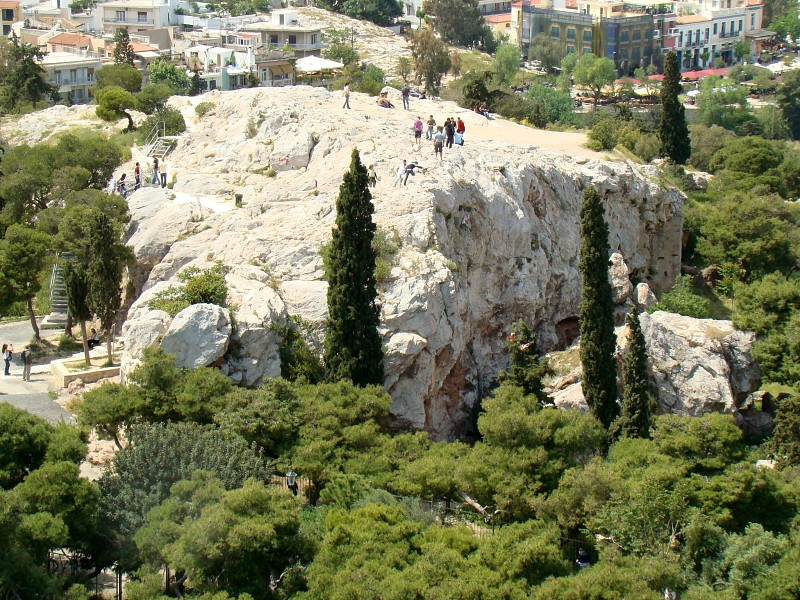
ConfirmedThe bare rock of the Areopagus (Hill of Ares) in Athens, seen from above, with visitors standing on top. O.Mustafin, via Wikimedia Commons, CC0 1.0.
For as I passed by, and beheld your devotions, I found an altar with this inscription, TO THE UNKNOWN GOD. Whom therefore ye ignorantly worship, him declare I unto you.
Acts 17:23, KJV
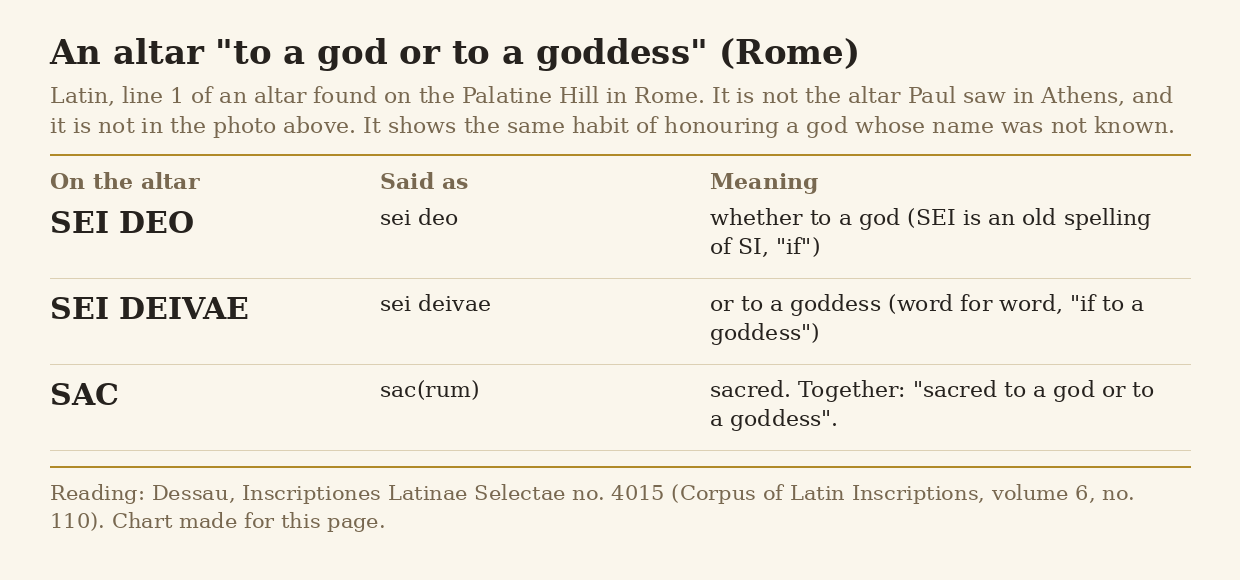
The Areopagus, the Hill of Ares (Mars' hill in the KJV, Acts 17:22), is a bare rock just north-west of the Acropolis in Athens, and it also gave its name to the old council of Athens. Acts 17 says Paul was brought to the Areopagus and spoke about an altar he had seen with the words TO THE UNKNOWN GOD. Ancient writers confirm that Athens had such altars: the travel writer Pausanias, in the AD 100s, saw altars of the gods named Unknown near the harbour of Phalerum, and Diogenes Laertius, in the AD 200s, says altars with no name on them still stood around Attica. He links them to a plague. The Cretan prophet Epimenides is said to have ended it by letting sheep loose from the Areopagus and making a sacrifice wherever each one lay down. No altar with the exact words of Acts 17:23, to the unknown god in the singular, has been found. The chart below shows the words of a different altar, from Rome, set up to a god whose name was not known; it is described under Good to know.
The Latin words on an altar from the Palatine Hill in Rome, "sacred to a god or to a goddess". It is not the altar Paul saw in Athens, which has never been found. It is shown because it was made out to a god whose name was not known, as the Athens altar was. Reading from Hermann Dessau, Inscriptiones Latinae Selectae no. 4015. Chart made for this page, free to reuse.
Where it is today
Greece, Athens: the Areopagus rock below the west end of the Acropolis, open to visitors. A modern bronze plaque on the rock carries the Greek text of Paul's speech.
Date
Homicide trials seem to have been held on the hill from at least the 600s BC. Paul's visit about AD 50, on his second journey, shortly before he reached Corinth. Pausanias wrote in the AD 100s and Diogenes Laertius in the AD 200s.
Why this label: The hill has kept its name since ancient times and is clearly the Areopagus of Acts. The altar Paul quoted has not been found, and scholars debate whether he spoke on the hill itself or before the council meeting somewhere else.
Good to know
No altar found: No altar with the words of Acts 17:23 has been found. The ancient writers speak of altars to unknown gods in the plural, or of altars with no name at all. Jerome, writing in the late AD 300s, said the Athens altar really read to the unknown and foreign gods, in the plural, and that Paul made it singular for his speech. The classical scholar Albert Henrichs also judged that the singular wording does not match any known altar. Others reply that Athens had thousands of altars and inscriptions, most now lost, so one altar with the singular wording could easily have disappeared.
A similar altar: An altar found on the Palatine Hill in Rome in the 1800s is dedicated to a god or a goddess without a name. It shows the same habit of honouring a god whose name was not known.
Hill or council: By Paul's time the council of the Areopagus probably met in the marketplace or in the Royal Stoa there, not on the rock, so Acts may mean that Paul was brought before the council rather than taken up the hill. Others take Acts 17:19 and 17:22 to mean the hill itself; the Greek can be read either way.
Corinth: the bema, the synagogue lintel and the meat market
Acts 18:1-17 · 1 Corinthians 10:25
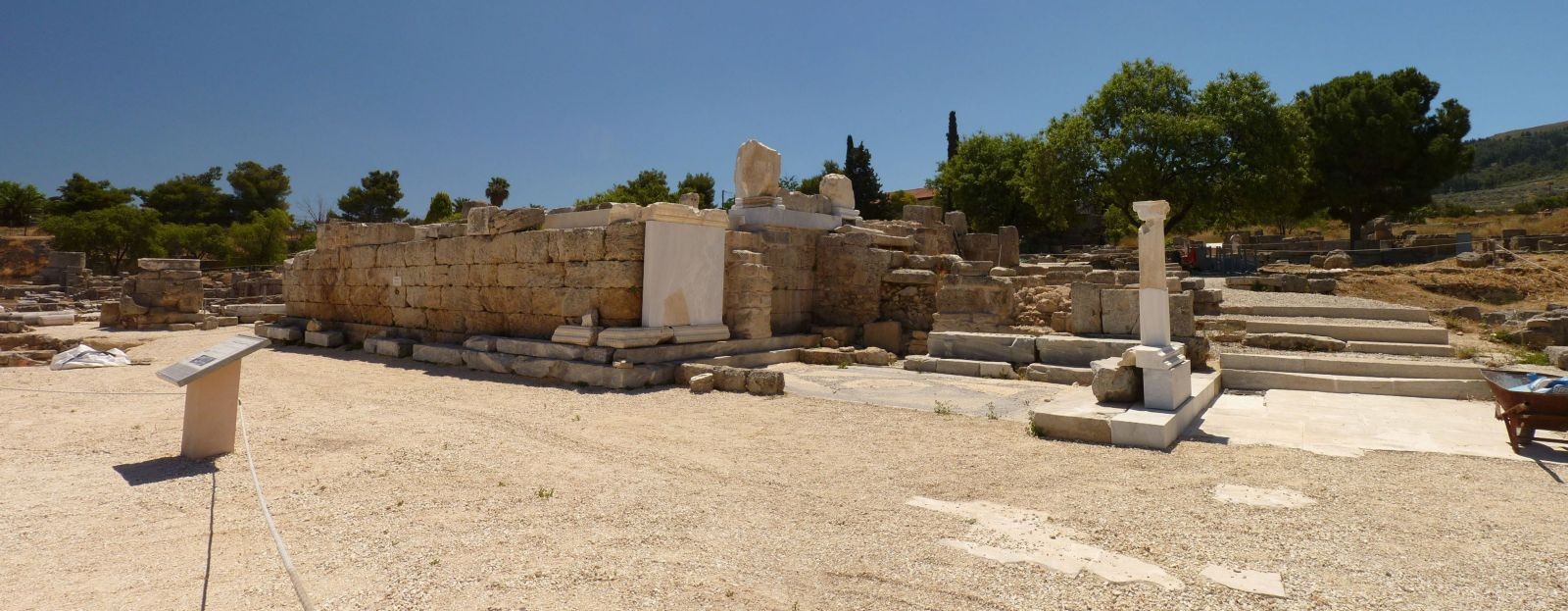
Traditional siteThe bema, the raised stone speaking platform in the forum of Ancient Corinth, with steps on the right. Ploync, via Wikimedia Commons, CC BY 3.0.
And when Gallio was the deputy of Achaia, the Jews made insurrection with one accord against Paul, and brought him to the judgment seat,
Acts 18:12, KJV
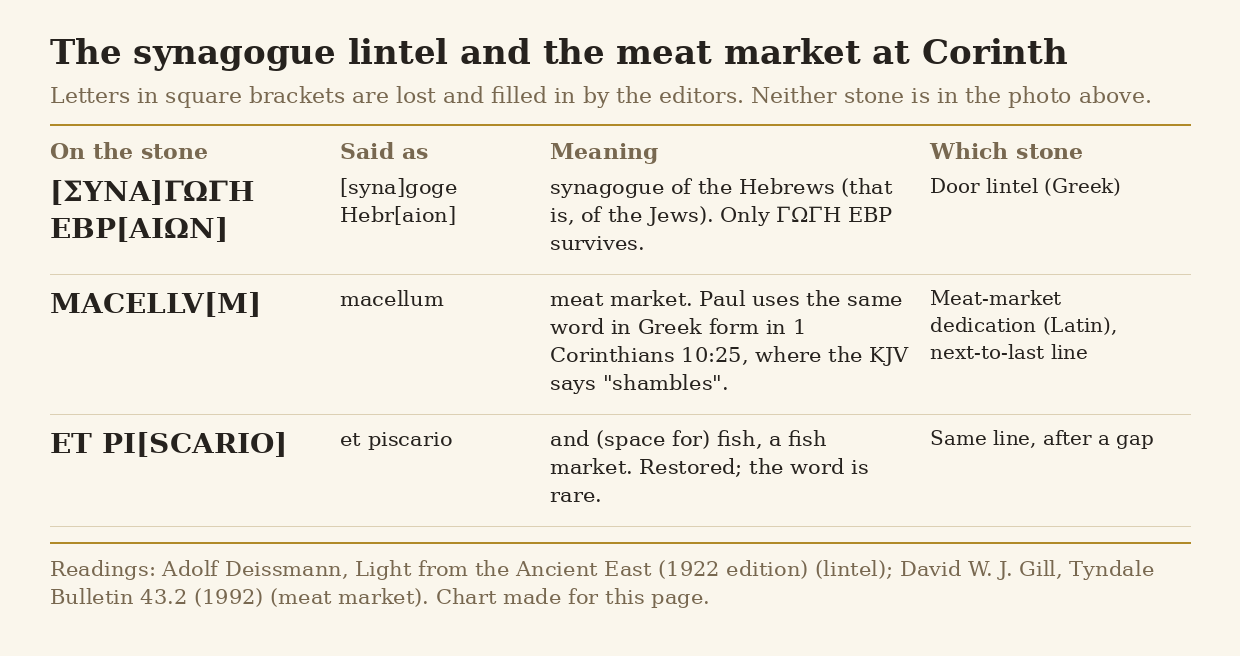
In the middle of the Roman forum at Corinth stands a raised stone speaking platform, about 2.3 to 3 m high, which the excavators named the bema from a nearby Latin inscription about the rostra (the Latin word for such a platform). Acts 18:12-17 says the Jews brought Paul before the governor Gallio at the judgment seat, which is bema in Greek, and many think this platform is the place. A broken door lintel (the stone beam over a door) from near the Lechaion Road carries the words synagogue of the Hebrews, partly broken off, and two Latin inscriptions record the gift of a macellum, or meat market, the very word that Paul uses in Greek form in 1 Corinthians 10:25, where the KJV says shambles. The Gallio letter from Delphi, which dates Paul's stay, and the Erastus inscription are covered in other entries on this page. The chart below gives the words of the synagogue lintel and the meat-market inscription.
The key words of the Greek synagogue lintel and the Latin meat-market inscription at Corinth. The lintel reading follows Adolf Deissmann (1922) and the meat-market reading follows David Gill (1992). Neither stone is in the photo. Chart made for this page, free to reuse.
Where it is today
Greece, Ancient Corinth (Archaia Korinthos): the bema stands in place in the forum. The synagogue lintel is in the Archaeological Museum of Ancient Corinth. The macellum inscription pieces were found at Corinth from 1898 on; where they are shown today was not confirmed.
Date
Bema: built in the first half or the middle of the first century AD, so it was probably standing when Paul was in Corinth; a church was later built on top of it. Gallio's year as governor of Achaia is usually dated AD 51 to 52. Macellum inscription: probably from the time of Augustus (27 BC to AD 14). Synagogue lintel: debated. An early expert opinion allowed anywhere from 100 BC to AD 200; many scholars now place it in the AD 300s or later, but rough letters like these are hard to date. Church on the bema: Byzantine period; its later building phase dates to the AD 1000s or 1100s.
Why this label: Corinth, its forum and this platform are real, and the platform was probably standing in Paul's day. But nothing on it names Gallio or Paul, and the governor may have heard the case somewhere else, such as a law-court building on the forum.
Good to know
The tradition: The American excavators, in the first half of the 1900s, named the platform the bema from pieces of a nearby Latin inscription about the rostra. In the Byzantine period a church was built on top of it, now called the Church of St Paul. It was built in at least two stages, and the later church, with three aisles, dates to the AD 1000s or 1100s, about a thousand years after Paul. This may show that Christians by then linked the platform with Paul's hearing, but no ancient writer names the place where Gallio heard the case.
Bema or basilica: A recent study of the Julian Basilica, at the east end of the forum, argues that the governor's formal hearings may have been held inside it. Acts 18 describes a short public scene that Gallio threw out, which fits an open-air platform, but the exact spot cannot be proven.
The lintel: In the early 1900s Adolf Deissmann thought the rough letters might come from the very synagogue where Paul preached. Many scholars now date the stone to the AD 300s or later, after Paul's time, though the rough letters are hard to date. If it is early, it could come from the synagogue of Acts 18; if it is late, it shows that Jews were still meeting in Corinth centuries after Paul. No synagogue building has been found.
The meat market: The market building has not been securely found. A scratched Greek note once read as Loukios the butcher was later reread by its own finder as a man's name, Lucius Canius, so it should not be used as evidence for the market.
Ephesus: the great theatre, the temple of Artemis and the Salutaris inscription
Acts 19:24-29 · Acts 19:34-35 · Acts 19:39-41
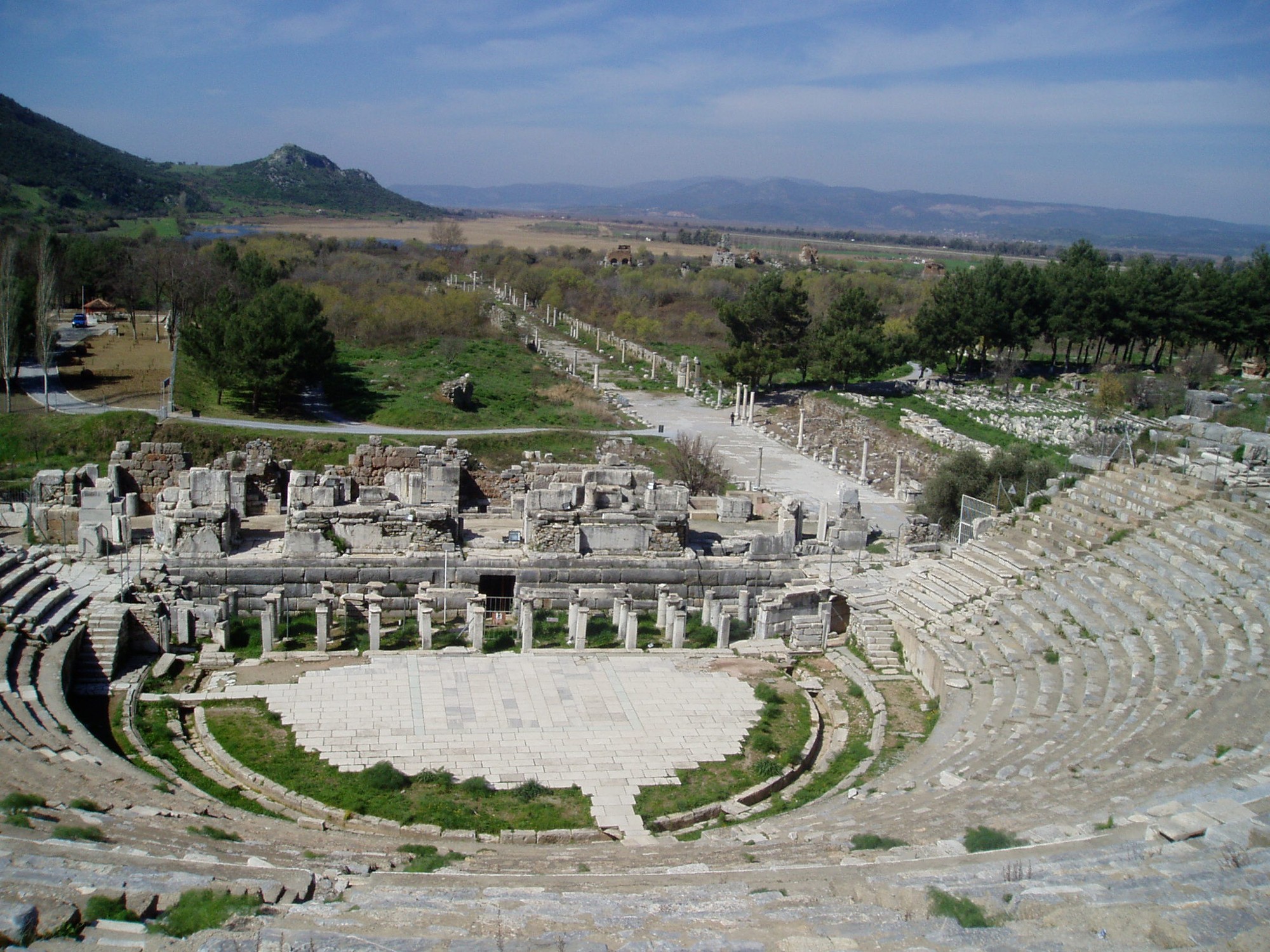
ConfirmedThe great theatre of Ephesus, with Harbour Street running toward the old, silted-up harbour. Jordan Klein from San Francisco, United States, via Wikimedia Commons, CC BY 2.0.
And when the townclerk had appeased the people, he said, Ye men of Ephesus, what man is there that knoweth not how that the city of the Ephesians is a worshipper of the great goddess Diana, and of the image which fell down from Jupiter?
Acts 19:35, KJV
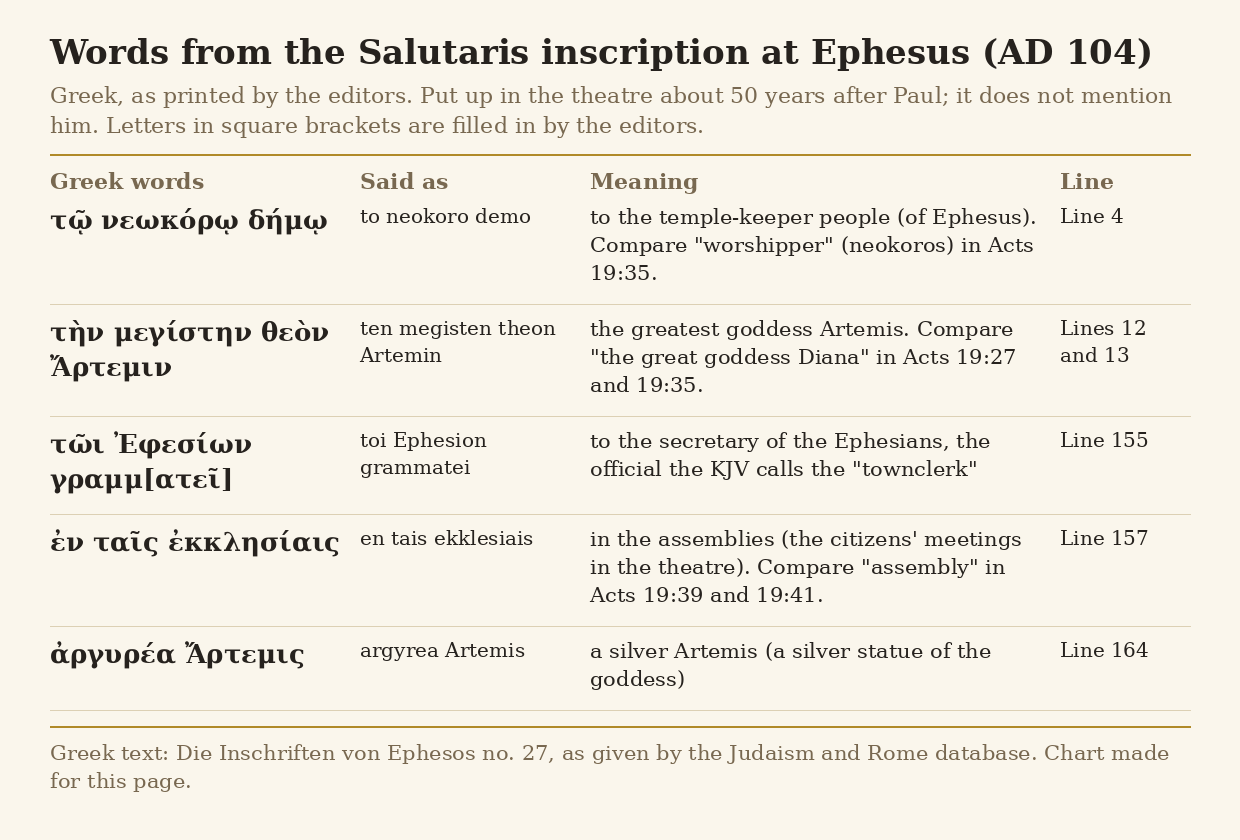
Ephesus was the leading city of the Roman province of Asia, in what is now western Turkey. Acts 19 says a silversmith named Demetrius, who made silver shrines for the goddess Diana (her Greek name is Artemis), stirred up a crowd that rushed into the theatre and shouted "Great is Diana of the Ephesians" for about two hours, until the town clerk calmed them. The theatre still stands, and the site of the goddess's great temple, one of the Seven Wonders of the ancient world, lies about 2 km away. A long Greek inscription put up in the theatre in AD 104 by a rich citizen named Gaius Vibius Salutaris uses several of the same words and titles that Acts uses. The chart below gives some of the inscription's Greek words that Acts also uses.
Key Greek words of the Salutaris inscription put up in the theatre at Ephesus in AD 104, about 50 years after Paul, compared with the words Acts 19 uses. The inscription does not mention Paul. The Greek follows Die Inschriften von Ephesos no. 27. It is not readable in the photo. Chart made for this page, free to reuse.
Where it is today
Ephesus ruins near Selçuk in western Turkey. The theatre stands at the end of Harbour Street. The Salutaris inscription is still on the theatre's south wall, and a few pieces are in the British Museum, London (1868,0620.56 and 2013,5017.29). The temple site, just outside Selçuk, is marked by one column put back together from broken pieces; carved parts of the temple are in the British Museum.
Date
Theatre first built about 200 BC and enlarged in stages from the 1st century AD into the early 2nd century AD. The temple that stood in Paul's day was rebuilt after a fire in 356 BC. Paul's stay of about three years in Ephesus is usually placed in the early to mid 50s AD. Salutaris inscription: AD 104.
Why this label: The city, its theatre and the site of its famous temple are known for certain, and inscriptions name the city, its goddess and its officials. This confirms the setting of Acts 19; no find names Paul, Demetrius or the riot itself.
Good to know
The inscription: The Salutaris inscription calls the people of Ephesus the goddess's neokoros, meaning temple keeper, the same Greek word Acts 19:35 uses where the KJV says "worshipper". It names the city's secretary (grammateus), the office the KJV calls the "townclerk". It also gives silver and gold statues of Artemis to be set up in the theatre during the citizens' meetings, which it calls ekklesiai. Acts 19:32, 19:39 and 19:41 use the same word, where the KJV says "assembly".
Its limits: The inscription was written about 50 years after Paul and does not mention him or the riot. No silver shrine of the kind Demetrius made has been found; the Salutaris gifts were statues, not small temples. The sources checked for this page give no other ancient writer who says the Ephesus image fell from the sky, though Greeks told the same kind of story about some other old statues.
Size of the crowd: The theatre is often said to have held 24,000 or 25,000 people. Estimates run from about 17,000 to 25,000, and one careful study puts it at about 21,500. Parts of it were built after Paul's time.
Miletus: Paul's farewell and the theatre seats for "Jews who are also God-fearers"
Acts 20:15-17 · Acts 20:36-38 · 2 Timothy 4:20
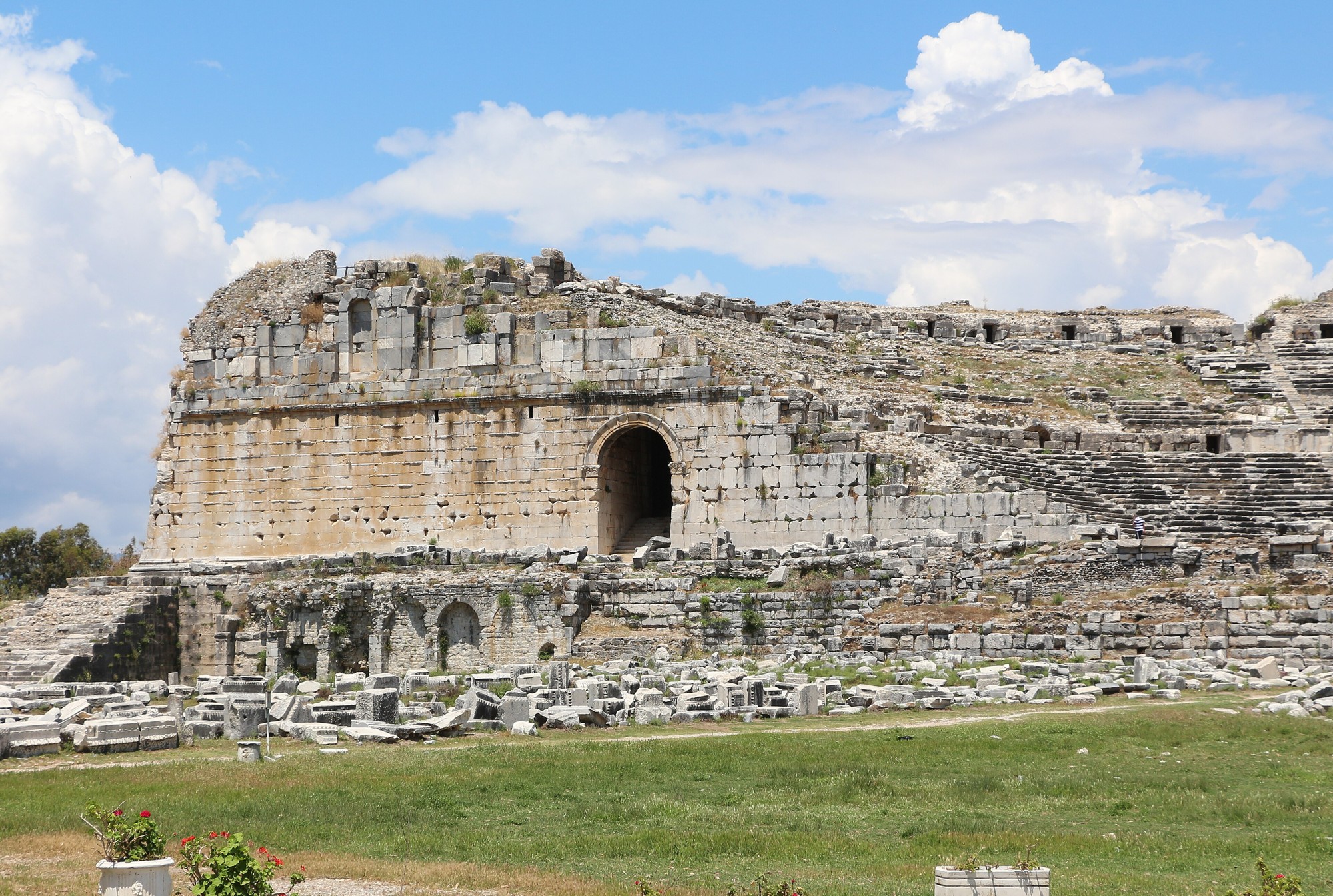
ConfirmedThe great theatre at Miletus seen from outside; the seat label for the Jews is inside, on a lower row of seats, and cannot be seen here. Bernard Gagnon, via Wikimedia Commons, CC BY-SA 3.0.
And from Miletus he sent to Ephesus, and called the elders of the church.
Acts 20:17, KJV
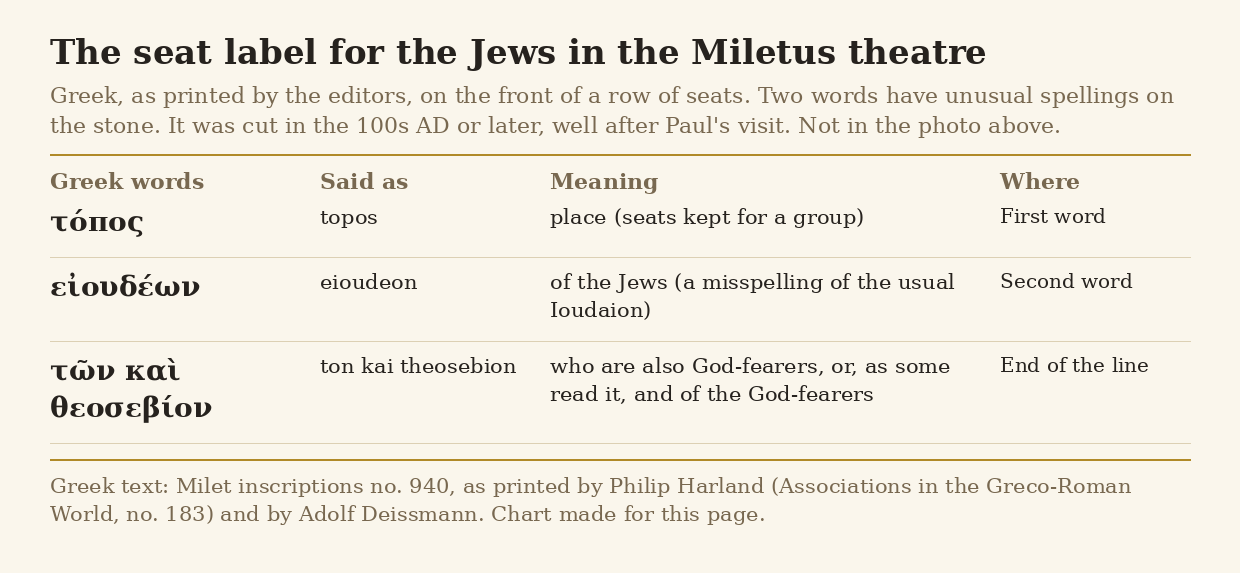
Miletus was a large Greek port city south of Ephesus, near the mouth of the Maeander River in western Turkey. Acts 20 says Paul's ship stopped there on his way to Jerusalem, and he sent for the elders of the church at Ephesus, spoke to them, prayed with them and said goodbye at the ship. 2 Timothy 4:20 later says Paul left his helper Trophimus sick at "Miletum", the same city. In the city's large theatre, one row of seats carries a Greek label reserving it for Jews, which shows that a Jewish community lived in Miletus in Roman times. The chart below gives the Greek words of the seat label.
The Greek seat label for the Jews in the theatre at Miletus, word by word, with both ways of reading the last words. The Greek follows the Milet edition (no. 940), as printed by Philip Harland and by Adolf Deissmann. The label is not in the photo. Chart made for this page, free to reuse.
Where it is today
Ruins of Miletus near the village of Balat, Aydın Province, Turkey. The label is still cut into the front of a seat row in the lower part of the theatre (the 5th row from the bottom, in the 2nd section from the west, as Deissmann recorded it in 1906). The line is about 1.2 metres long. The harbours have filled with river mud, and the ruins now lie about 8 to 10 km from the sea.
Date
Paul's visit: usually dated about AD 57. Seat label: usually dated to the 2nd or 3rd century AD; one edition dates the whole group of seat labels in this theatre to between the 2nd and 5th centuries AD.
Why this label: Miletus is a well-known ancient city whose name and location are certain, so the place in Acts 20 is confirmed. The seat label is later than Paul and only gives background: it shows that Jews lived there and went to the theatre.
Good to know
Two readings: The German scholar Adolf Deissmann, who studied the stone, read it as "Place of the Jews who are also called God-fearing", with "God-fearing" describing the Jews themselves. Louis Feldman read it the same way and said it shows the word was not used only for non-Jews. Others read it as two groups, "Jews and God-fearers", meaning Jews and the non-Jews who worshipped Israel's God alongside them; Deissmann admitted he had expected the stone to say that. The Greek is awkward and two words have unusual spellings, so no reading is certain.
Why it matters: Acts often speaks of non-Jews who honoured Israel's God and met with Jews, as when Paul says "ye that fear God" (Acts 13:16), though Acts uses other Greek words for them. This seat label uses the related word theosebes.
Date caution: The label was cut in the 100s AD or later, well after Paul's visit, so it describes the city's later Jewish community, not the people Paul met.
Malta: Paul's shipwreck and Publius, "the chief man of the island"
Acts 27:39-44 · Acts 28:1-2 · Acts 28:7-10
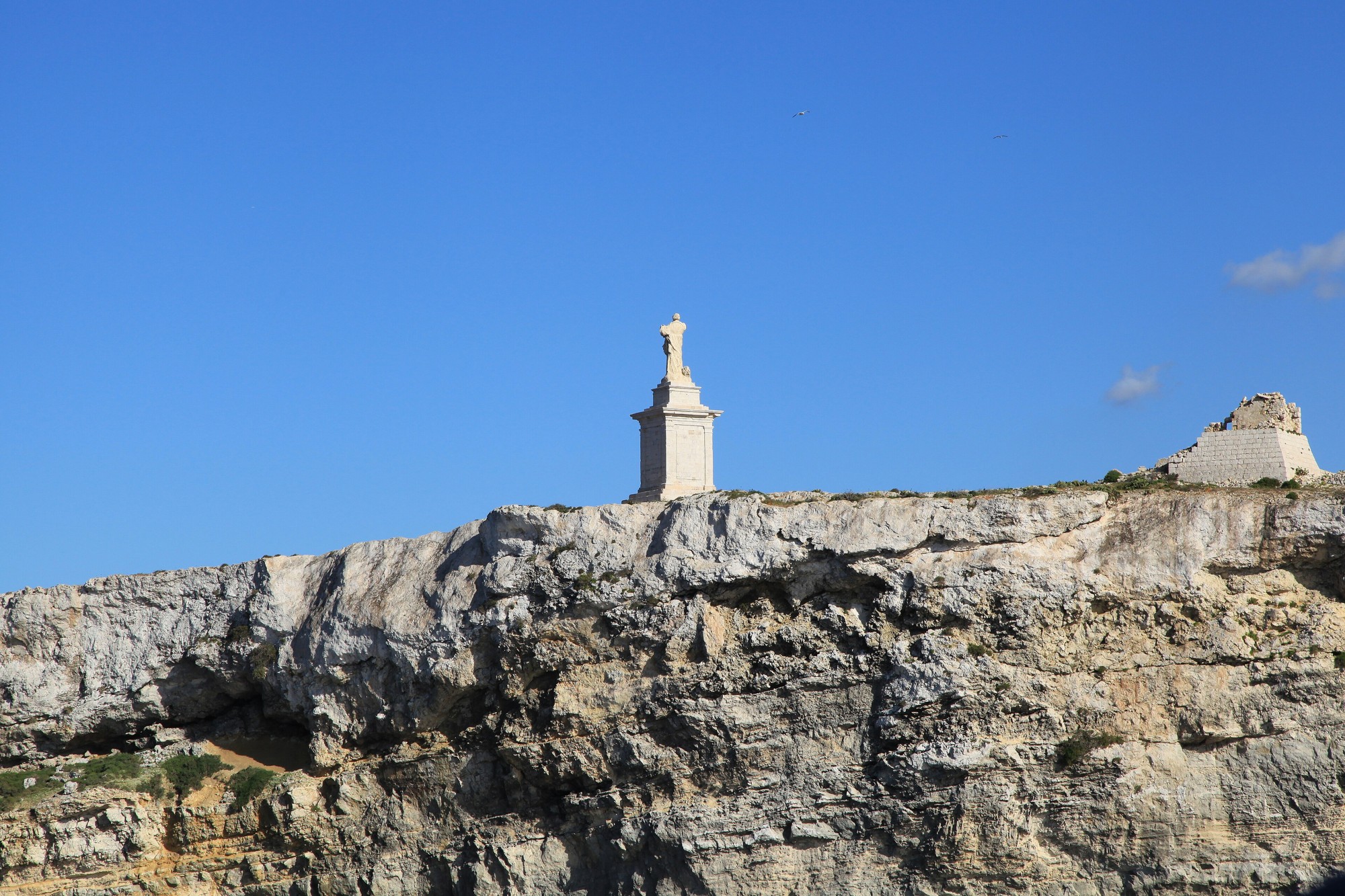
DisputedThe 1845 statue of Paul and a ruined tower on St Paul's Islands, the traditional site of the shipwreck. Frank Vincentz, via Wikimedia Commons, CC BY-SA 3.0.
In the same quarters were possessions of the chief man of the island, whose name was Publius; who received us, and lodged us three days courteously.
Acts 28:7, KJV
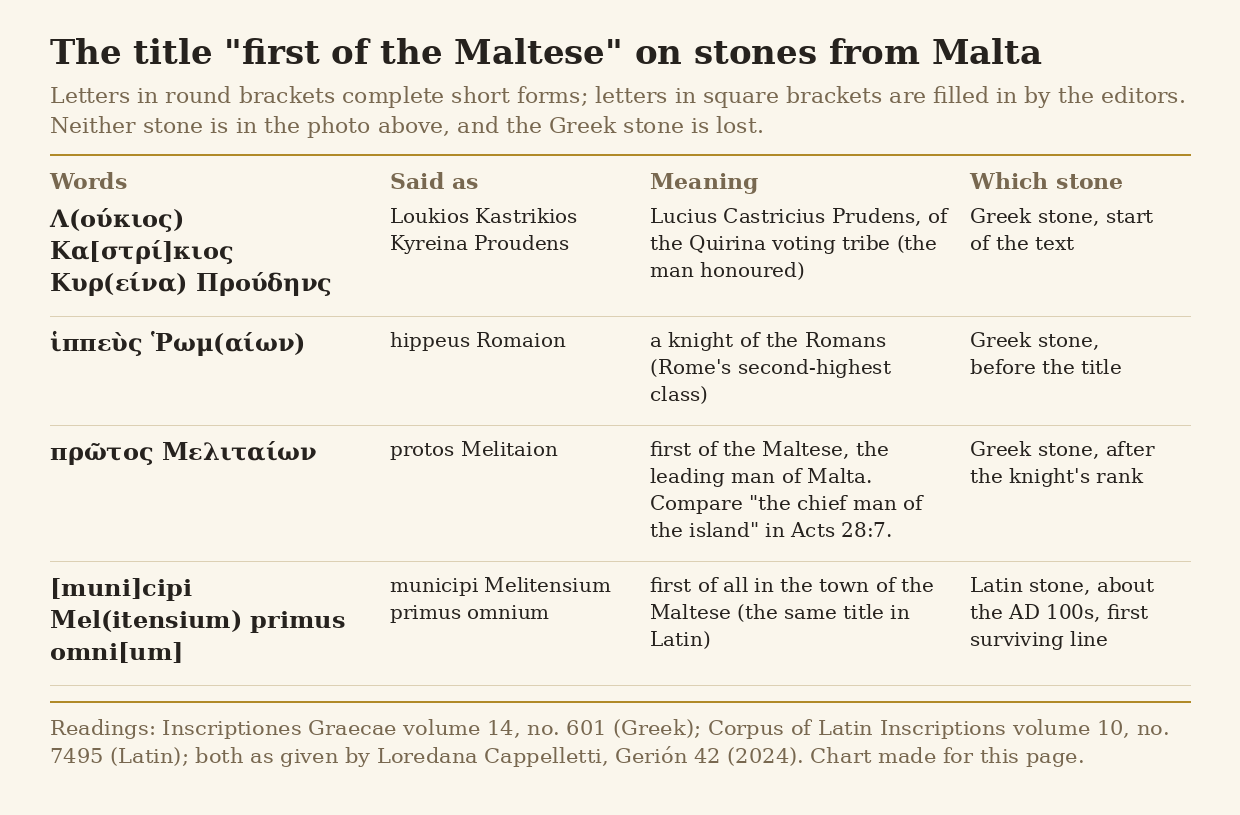
Acts 27 tells how the ship taking Paul to Rome was driven by a storm for 14 days and ran aground at "a place where two seas met", and Acts 28:1 names the island as Melita, which most scholars take to be Malta. The traditional spot is St Paul's Bay on the north coast of Malta, where a statue of Paul on St Paul's Islands was blessed in 1845. Acts 28:7 calls the island's leading man Publius "the chief man of the island", in Greek protos tes nesou, "the first of the island". A Greek inscription from Malta gives almost the same title, "first of the Maltese", to a Roman knight of the early 1st century AD. The chart below gives the Greek words "first of the Maltese" and the same title in Latin.
The Greek and Latin stones from Malta that give the title "first of the Maltese", like "the chief man of the island" in Acts 28:7. The words follow the printed editions (IG 14, 601 and CIL 10, 7495) as given by Loredana Cappelletti (2024). Neither stone is in the photo, and the Greek stone is lost. Chart made for this page, free to reuse.
Where it is today
St Paul's Bay and St Paul's Islands (also called Selmunett), off Mellieħa in northern Malta. Other proposed spots include nearby Salina Bay and Qawra Point, Mellieħa Bay, and the Munxar Reef at St Thomas Bay on the southeast coast. The title inscription was cut on the marble lid of a sarcophagus (a stone coffin) that had been reused as a fountain basin near the main gate of Mdina; the stone is now lost, and its words survive in older published copies.
Date
Shipwreck: in the stormy season, usually dated AD 59 or 60, depending on the date given for Festus taking over from Felix. Title inscription: early 1st century AD (one study dates it to the reign of Tiberius, AD 14 to 37). Statue on St Paul's Islands: blessed on 21 September 1845.
Why this label: Most scholars accept that Melita is Malta, but no find marks the place of the wreck, and informed researchers argue for several different bays. The Publius title is well supported by inscriptions from Malta; the shipwreck spot is not.
Good to know
Traditional view: St Paul's Bay has long been taken as the place, and the scholar James Smith argued that it matches Luke's sailing details. Devotion to Paul in Malta is old, but written records of the tradition from the Middle Ages are scarce; Maltese historians have pointed to evidence from the 1100s.
Other bays: Maltese researchers, including marine archaeologist Timmy Gambin and diver Mark Gatt, have studied Salina Bay next door, where many Roman finds have come up, including a large lead anchor part stamped with the names of the Egyptian gods Isis and Sarapis; that anchor does not show it came from Paul's ship.
The anchor claim: In his 2003 book, Robert Cornuke argued for the Munxar Reef at St Thomas Bay, based on Roman anchor parts that local divers say they found there in the 1960s and 1970s. None was recorded where it lay, most were melted down, lost, sold or kept privately, and that type of anchor was used for about 500 years. Anthony Bonanno of the University of Malta, whom Cornuke consulted, warned that the anchor alone could not show it belonged to Paul's ship, though he called St Thomas Bay a plausible other site.
Other islands: A few writers place Melita at Mljet in Croatia or on Kefalonia in Greece, but most researchers judge that the winds and route in Acts 27 fit Malta better.
The title: Scholars still debate whether "first of the Maltese" was a real office or an honorary title, but it was clearly used in Malta in the 1st century AD, which fits Acts 28:7.
Paul's road to Rome: Puteoli, the Appian Way, Appii Forum and the Three Taverns
Acts 28:11-14 · Acts 28:15
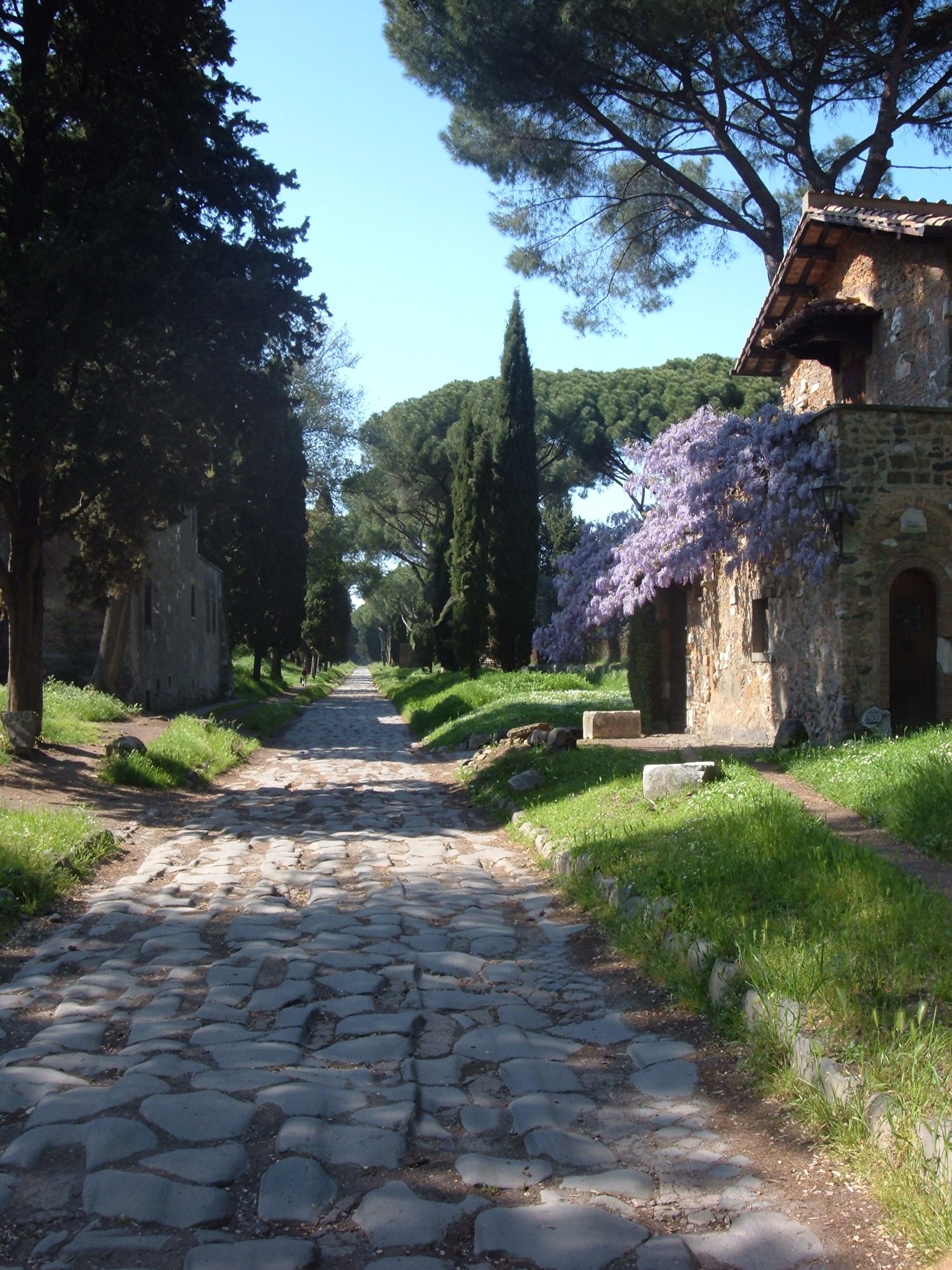
ConfirmedThe old paved Appian Way (Via Appia Antica) just outside Rome, lined with trees and an old stone house. Kleuske at Dutch Wikipedia, via Wikimedia Commons, CC BY-SA 3.0.
And from thence, when the brethren heard of us, they came to meet us as far as Appii forum, and The three taverns: whom when Paul saw, he thanked God, and took courage.
Acts 28:15, KJV
After three months on Malta, Paul sailed on a ship of Alexandria to Puteoli, today Pozzuoli near Naples, which was then the great port for the grain ships coming from Egypt to Rome. Christians there asked him to stay seven days. He then went north toward Rome on the Appian Way, one of Rome's earliest and most important roads. Believers from Rome walked out to meet him at Appii Forum, a road station about 64 km from Rome, and at the Three Taverns, a stopping place about 50 km from Rome.
Where it is today
Pozzuoli, Campania, Italy: remains of the Roman market hall (the Macellum, long misnamed the Temple of Serapis), the Flavian Amphitheatre, and parts of the old harbour now under the sea, because the ground here slowly rises and sinks. The Appian Way: long stretches survive, best seen just outside Rome on the Via Appia Antica. Appii Forum: an archaeological site near Latina, with only a few remains. The Three Taverns: near Cisterna di Latina; the exact spot is debated.
Date
Appian Way: begun in 312 BC by Appius Claudius Caecus. Puteoli: a Greek colony from about 531 BC and a Roman colony from the early 2nd century BC. Paul's arrival in Italy: about AD 60 or 61.
Why this label: Puteoli, the Appian Way, Appii Forum and the Three Taverns are all well known from Roman writers and ancient road lists, and Puteoli and the road can still be visited. The exact ruins of the Three Taverns are not certainly identified, and nothing found on the road records Paul's journey.
Good to know
Roman witnesses: The Roman poet Horace, in the 1st century BC, described Appii Forum as crowded with boatmen and stingy innkeepers, because a canal through the Pontine Marshes started there. The Three Taverns was the first or last stop for travellers changing horses outside Rome, where roads from nearby towns joined the Appian Way.
Puteoli and Acts: Puteoli had a mixed population of traders, including Jews, so it is no surprise that Acts finds Christians there.
On the road: The Appian Way fell out of use after the Western Roman Empire fell and was restored centuries later, so not every stone seen today is one Paul walked on.
Paul in Rome: the rented house under guard, and the Mamertine prison tradition
Acts 28:16 · Acts 28:30-31 · 2 Timothy 1:16-17
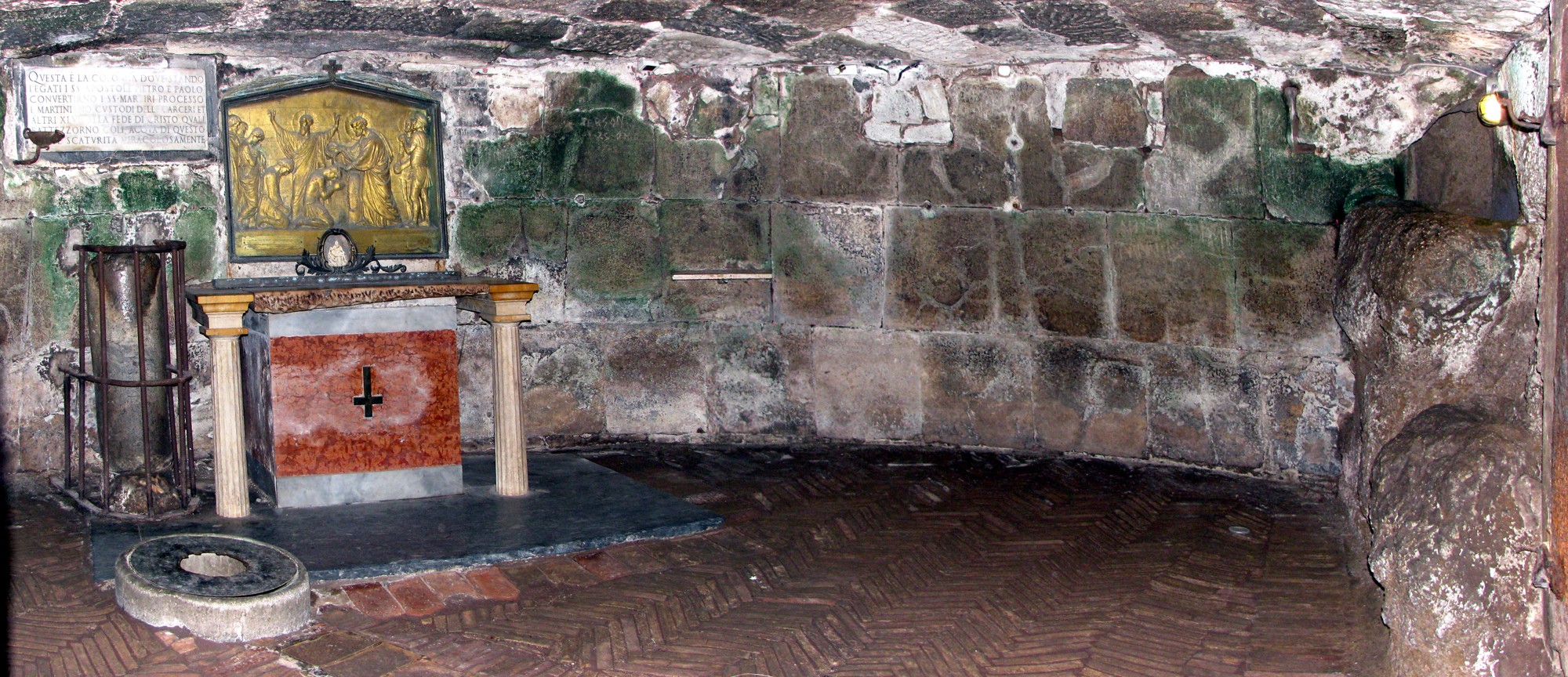
Traditional siteInside the lower room of the Mamertine prison in Rome, with the altar, and the column to which by tradition Peter and Paul were chained. Chris 73, via Wikimedia Commons, CC BY-SA 3.0.
And when we came to Rome, the centurion delivered the prisoners to the captain of the guard: but Paul was suffered to dwell by himself with a soldier that kept him.
Acts 28:16, KJV
Acts ends with Paul in Rome for two whole years, living "in his own hired house" (a rented place) with a soldier guarding him, and freely receiving visitors and teaching. Acts does not say where in the city this was, and no inscription or find marks the place. Two churches claim the spot by later tradition: San Paolo alla Regola, near the Tiber, and Santa Maria in Via Lata, on the Via del Corso. A separate tradition says Paul was held in the Mamertine prison beside the Roman Forum, but that tradition is about his later, final imprisonment (see 2 Timothy 1:16-17), not the house arrest in Acts 28.
Where it is today
Rome, Italy. San Paolo alla Regola: Via di San Paolo alla Regola, with Roman remains under the nearby Palazzo Specchi. Santa Maria in Via Lata: Via del Corso, with Roman rooms under the church. The Mamertine prison (in Roman times the Carcer Tullianum): under the church of San Giuseppe dei Falegnami (St Joseph of the Carpenters) at the edge of the Roman Forum.
Date
Paul's two years under guard: usually dated about AD 60 to 62, or 61 to 63. His final imprisonment and death under Nero: by tradition in the mid to late 60s AD. The prison's lower chamber is centuries older than Paul; the 2010 dig report dates it to the 6th century BC.
Why this label: Acts gives no address, and the churches that claim Paul's lodging rest on later tradition. The Mamertine was a real Roman prison, but no record from the 1st century places Paul or Peter there.
Good to know
Paul under guard: This was a lighter form of custody than a prison cell, but Acts 28:20 shows Paul still wore a chain.
The two churches: The Roman buildings found beside San Paolo alla Regola were built under the emperor Domitian (AD 81 to 96), after Paul's stay. Under Santa Maria in Via Lata are Roman remains from about Paul's time and later, and rooms of a Christian centre from about the 5th or 6th century with paintings of Paul as a prisoner. Acts speaks of one rented house, so at most one of these claims can be right, and neither may be.
The Mamertine: The story of Peter being held there comes from the Acts of Processus and Martinian, a writing from about the 6th century, and the Catholic Encyclopedia (1910) said there is no reliable evidence that Peter was ever held there. Digs that ended in 2010 showed that Christians honoured Peter at the site by the 7th century at the latest. The dig leader said this supports the tradition; the news report added that it is not direct proof that he was held there. Neither Acts nor Paul's letters name this prison.
Later page: The tombs of Peter and Paul in Rome will be covered on the page about the early church and its martyrs.
 LearnAboutHim